How Moradi il Sedicente Keeps Art Alive in Florence 

written by Kaylin Martinez, Elena Beenblossom & Rachel Ward

This blog feature is an exclusive bonus installment to our Fall 2025 issue of Blending Magazine. After you finish reading, be sure to explore the rest of the magazine online—just follow this link to download the full Fall 2025 edition:
https://jschoolfua.com/images/BM/BM_151.pdf

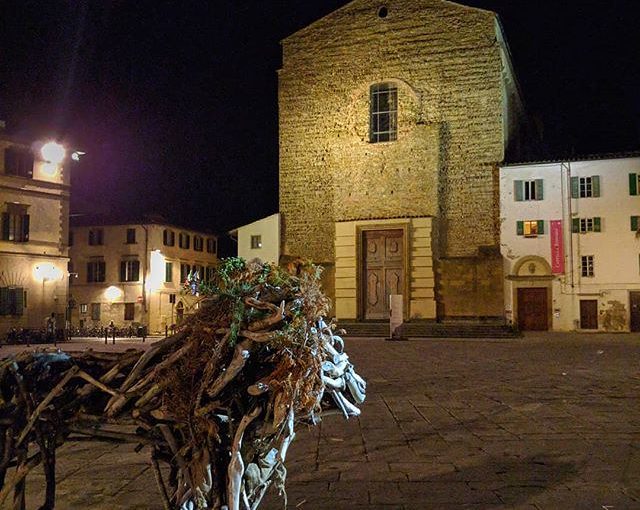
In the heart of Renaissance Florence, history is not just confined to museum walls; instead, it floods the streets, where the art can truly come alive. Florentine street artist, Moradi il Sedicente, creates art through his surrounding resources, intentionally interacting with the environment around him. As an artist, Moradi believes that art “shouldn’t be trapped in galleries — it should grow from the ground, from the city itself.” 

Born in Florence in 1980, Moradi creates art organically, made from branches, leaves, axes, and memory. Looking further into his pieces, it is visible that his works have a deeper meaning; his installations are mostly found in places that he knows well, spaces that he can connect with and understand. Originally having a passion for painting, Moradi found inspiration through nature and what it evokes. He began to adopt the theory behind street art, aiming to connect his art with his viewers. Pieces that have been seen around Florence have revolved mainly around animals made out of wood, but the meaning goes beyond that. Seen through his social media, he further explains the depth behind his pieces. For instance, “I’ve always believed that Nature should take back her space” (27 April 2020). That is supporting the sculpture of a deer standing by the River Arno. 

When walking through Florence, it is not uncommon to come across one of Moradi’s creations emerging from an unexpected corner of the city. A realistic crocodile covered in bark sits on Lungarno Torrigiani, while a statue of a unicorn stands tall in Anoncella Park, serving as a symbol of rebirth after a destructive storm that destroyed the park in 2015.

Each sculpture seamlessly blends into the surroundings of the city due to the natural materials used to build it. Viewers of the artwork are typically drawn in by the details used in creating these pieces, unsure at first whether they are seeing an artwork or something that has simply taken shape on its own. This quiet merging of art and environment captures the essence of Moradi’s work, inviting viewers to rediscover the connection between nature and urban life. 

Moradi’s creations often emerge from what others might overlook, materials such as discarded branches, fragments of wood, and remnants of nature. By reconstructing these materials into expressive, often animalistic forms, he gives new life to the remnants of the natural world. Florence’s environment seems to bring each piece to life with its artistic history, architecture, and heritage. This relationship between Moradi’s work and Florence’s identity is central to his practice. The city of Florence has long been defined by its appreciation for the Renaissance era, and Moradi’s work is an extension of that natural beauty that was once so prevalent. His materials are fragile, temporary, and deeply tied to the cycles of life and death in nature. Instead of striving for timelessness, he allows his works to weather, to rot, to be reclaimed by their environment. Viewers of his work comment, “his pieces don’t stand out at a first glance, and then suddenly it’s there, like the city is breathing.” 

After a quick scroll through Moradi il Sedicente’s Instagram page, his devotion to his art becomes very apparent. As he describes, his work is “a profound journey of listening, creation, and connection, where nature, landscape, and community intertwine in a single, vibrant breath” (23 July 2025). This statement reflects his belief that each piece is more than a sculpture, and is a direct act of participation with Florence’s surroundings and those who inhabit it. Moradi’s art is not meant to be admired as a singular work of art but as part of the street art culture of Florence. His “installations that blend with the territory, inviting passers-by to pause, observe, and feel” (8 August 2025) embody the idea that art should emerge from life itself. In this way, his social media presence extends his practice beyond the physicalities, becoming another form of connection, and sharing the evolving relationship between art and nature. 

Through his blending of tradition and modern technique, Moradi has the means to reshape the understanding of what it is like to be a contemporary Florentine artist today. His sculptures, crafted from reclaimed materials and natural elements, serve as quiet reminders that beauty in Florence is not only in its past but also in a constant transformation. Moradi’s work invites both tourists and locals to reflect on the placement and purpose of the art, suggesting that creativity in Florence is not confined to its museums or monuments. Instead, it lives and evolves within the everyday landscape, continuing the city’s long tradition of reinvention through artistic expression.

Little Things That Last

Florence’s Love for Physical Memories and Moments

This blog feature is an exclusive bonus installment to our Fall 2025 issue of Blending Magazine. After you finish reading, be sure to explore the rest of the magazine online—just follow this link to download the full Fall 2025 edition:
https://jschoolfua.com/images/BM/BM_151.pdf

written by Reegan Parker, Sophie Mosolino & Grace Heffernan

In a world where memories live on screens, Italy still treasures those you can hold in your hands. From collecting an abundance of old receipts from local cafes, to postcards in little shops, to stopping at a vintage photo booth to capture a night with your friends, the charm of Italian travel is not stored in photo albums or Instagram posts. These small physical items we’ve collected throughout several months of living here serve as little stepping stones of a life journey we will never forget. These tangible mementos keep the memories abroad alive. 

Italian Momentos 

Italy is a country that celebrates the art of slowing down a busy life and noticing the small beauties hidden inside little cobblestoned streets, trattorias, and museums. A simple business card of a cafe can take you back to the best croissant you’ve ever had, a postcard from Cinque Terre can bring back the visuals of bright colored buildings and bottles of limoncello. Even an empty wine bottle can shift you back to reminiscing a night filled with laughter and the people you were with. Postcards, a piece of jewelry, or an empty candy wrapper can provide a sense of closeness to the traditions that Florence has to offer. They can even be brought back to America to remember what it felt like to be immersed in this beautiful culture. 

Preserved Memories 

To further our observations, we asked a few of our roommates also studying abroad in Florence what physical objects they hold close to them. Many of them cherish the Fotoautomatica photo booth strips. They shared that the photo strips remind them of spontaneous nights out with their best friends, preserving a happy moment in time with the flash of a camera. The vintage look of 

the photos is unique to any other photo you could take on a cell phone and print out, providing a different and nostalgic sense of emotion that brings back memories every time you look at it. For instance, one of our friends has collected postcards everywhere she has traveled, from Paris to Greece. “I’m keeping these forever,” she says as the postcards are displayed proudly on her bulletin board. These physical mementos will hold a place in most everyone’s heart, and hands, which makes it so special to keep them preserved for a lifetime. 

A Cultural Souvenir 

Furthermore, the attachment to physical objects is deeply rooted in Italian culture, a culture that proudly preserves its history. From making pasta with your hands, to pouring the perfect glass of

Chianti wine with pride, Italy treasures the physical parts of experiences. In America, we’ve experienced the shift of most things being digitalized for ease and efficiency. This goes hand in hand with the dynamic, capitalistic culture of the United States many have grown up with. This is very different from the cultures we have experienced in Italy, where schedules are slower and structured with intentional rest and reset. People in Florence walk slower, enjoy lengthy meals with friends and family, and life is seen to be enjoyed and not occupationally or financially maximized. The objects and mementos have reflected these mannerisms, to savor and remember each moment spent through something physical. As sojourners visiting Italy for a stretch of time, these simple mementos and joys are something we recognize and cherish, and we will proudly bring back these pieces of Italian culture and community with us when we return to America.

Across the River

written by Jack Eckhart

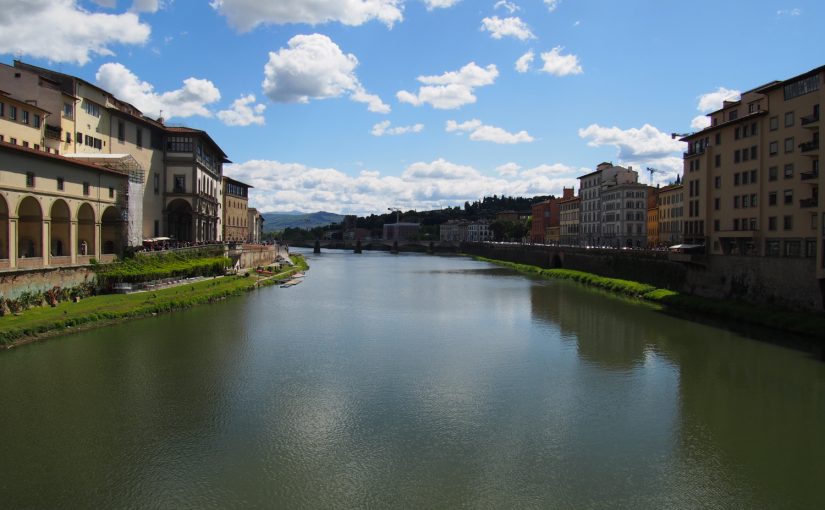
We wade across the crowded Ponte Vecchio, trying to stay out of tourists’ photographs and dodge street vendors hawking odd toys. Finally crossing, the crowd slowly fades as we venture up a steep hill toward Piazzale Michelangelo. Each step we take provides reprieve from the fast-paced Florence I spend most of my days. 

As I continue climbing, nature begins to emerge quietly reasserting its dominance on the land it once controlled. Soggy leaves cover a winding cobblestone road. On each side of the street walls provide homes an additional layer of security from the city. Muffled thumps echo down the road out of my Onitsuka Tigers as I get more lost in the hills. With no end in sight I keep moving forward allowing the road to control my fate. 

Eventually the soft hum of cars slowly became less and less faint, as I’m dumped out of my peaceful sanctuary onto a busy road. Following the cars deeper into the hills, I throw my headphones in, drowning out the noise. 

Looking out I can see fragments of the city around tree branches and in between homes, never seeing the entire city. Each glimpse reminds me of the overwhelming beauty possessed by the city. 

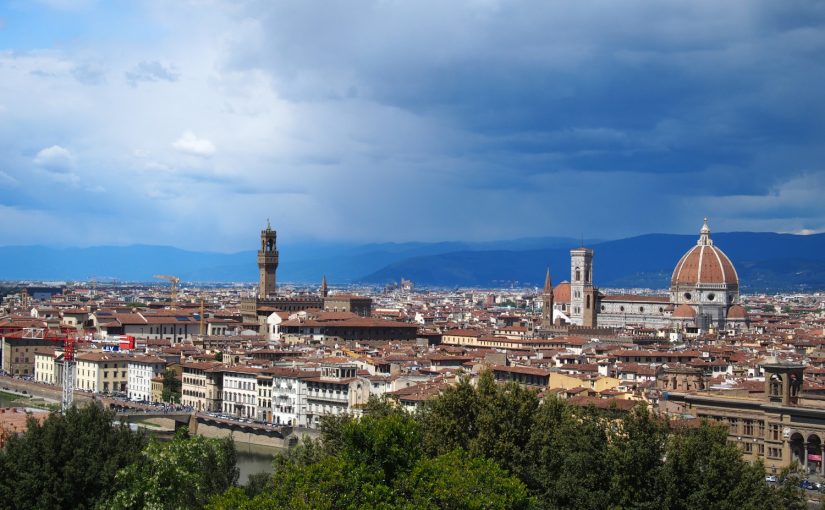
When I finally reach a small overlook with nothing marked, nothing out of the ordinary, I stop. Below me, Florence splinters into terracotta rooftops and thin smoke rises from chimneys, the Arno a silver ribbon threading everything together. It isn’t the grand view tourists climb for, but it feels earned, like a secret the city didn’t mind giving up today.

I stand there longer than I planned, letting the wind tug at my jacket, and the city settle into its tiny compartments below. And as I turn back toward the road, toward the descent I know is coming, I realize this is the part of Florence I’m always searching for: the quiet in-between, the spaces where the city finally lets me breathe.

The Beating Heart Above Florence

A place where sunsets, cameras and people meet to be present

This blog feature is an exclusive bonus installment to our Fall 2025 issue of Blending Magazine. After you finish reading, be sure to explore the rest of the magazine online—just follow this link to download the full Fall 2025 edition:
https://jschoolfua.com/images/BM/BM_151.pdf

written by Maëlys Brunet

As the city slowly changes from season to season, we are constantly reminded of Piazzale Michelangelo as the beating heart of Florence. Especially during the summer months. The Piazzale remains alive through both tourists and locals, particularly at sunset, as wanderers gather on the steps with a simple glass of wine to listen to a band’s music or take pictures as a souvenir of the moment, as time pauses, just for a moment. This Florence phenomenon stirs curiosity about the aura the city holds in people’s hearts, a current that pulses through and unites communities. 

Piazzale Michelangelo seems nowadays as a rite of passage, a go-to place when visiting Florence to admire the city’s iconic skyline. But what about its history? Built in 1869 by Giuseppe Poggi, it was originally meant to just be a terrace, celebrating Michelangelo’s art. A representation of progress, but also modernity and the future, as Florence was the capital of Italy during that time. Nowadays, we see Piazzale Michelangelo as a place to slow down, reconnect to the beauty of the city, with a crowd to accompany us into this poetic journey. 

The typical route to Piazzale Michelangelo is just as memorable as the view itself. Beginning from the tower of San Niccolò, take the ascending stairs and path between the large trees. The climb begins as we slowly rise above the city of Florence, in anticipation of the view that awaits, as if leading towards something sacred. Then, the main terrace appears, the crowd gets denser, and the city spreads below. In the golden hour of the evening, music plays in the background and people dance to its infectious beat. Monuments wear orange and yellow as the sun begins to set, offering the perfect moment for multiple photoshoots to spontaneously appear. Phones and digital cameras alike click with the same rhythm as conversation or laughs. 

Piazzale Michelangelo is the place where multiple generations meet to capture the essence of Florence. As a guitarist tunes his strings, he shares that although the people there always change, the sunset and view remain a constant. There is poetry when we stare at the landscape, thinking it was approximately the same view as the one our ancestors looked out at centuries ago. People at first come for a simple view, then leave with memories, connections and hearts filled with emotion. Here the sunset isn’t edited, it is put on display, shown in its raw form to its audience.

Looking away from the view and back towards the crowd, students share a bottle of wine, while pizzas are eaten by a family visiting from abroad. All the while, social media enthusiasts are trying to capture the perfect shot. A couple stairs down, people listen to music, dance to the rhythm of guitars and saxophones, and cheers can be heard for a couple that just got engaged. This place holds authentic moments of life and connection that will never be forgotten. 

As night approaches, some remain while others venture further, all the way to San Miniato al Monte – a hidden place above Piazzale Michelangelo – to admire the city from a similar perspective. Apart from the overwhelming crowd and movement, you find peace and quietness, almost like coming out of a dream. Two different atmospheres but only a single feeling remains unchanged: reassurance and interaction. 

In those small interactions, it is where Piazzale Michelangelo holds its core, being something rare and precious to keep hold of. A moment apart from digital, inviting those that gather to be there mentally, with your own thoughts, to live in the moment rather than posting it. The space gathers both past and present. Life and art coexist around a skyline view, with a community to share the same moment with, just for a couple of minutes… or even a couple of hours. 

In an age of constant digital scrolling, Piazzale Michelangelo remains a symbol of the contrary. Not every view needs to be shared or posted on social media, as it must be experienced and lived through the senses and presence of people around us. The difference lies in the fact that the beauty of the square can be shared through both photos and memory, however those emotions we feel when in its presence, cannot be replicated on the digital screen.

When we look at Piazzale Michelangelo, we can see its beauty in the different communities it brings together. Some live in the moment, as a break, an aside, a moment apart from the fast pace of life. We take this moment to slow down, take a step back, and enjoy the present moment with friends, family, or alone. Others may take advantage of the moment by capturing a memory, particularly through digital means, engaging in an online community.

Piazzale Michelangelo explores the possibilities and redefines the opportunity to come together as a community, whether in-person or virtually. This place in Florence demonstrates a new perception of what a community can be, beyond what we are used to seeing, while continuing on the same path of harmony and the search for unforgettable moments. 

You Don’t Just Study Abroad…You Study Yourself Too

Discover the three transformative life lessons that I learned during my six-week study abroad experience at Florence University of the Arts that I would not have been able to comprehend if I had stayed home this summer.

When I boarded the plane to Florence, Italy, for a six-week study abroad experience with Florence University of the Arts (FUA), I knew I was going to grow academically and professionally. I enrolled in a three-week course and worked a public relations internship covering diverse community events, conducting research, and collaborating with interns from various departments.

But as much as I learned in classrooms and internship meetings, some of the most valuable lessons came from simply assessing myself and my surroundings while living abroad. Here are are the three main insights I gained in Florence that no textbook could teach:

1. Discomfort is a Great Teacher

Moving across the globe from my familiar Michigan environment was the first jolt of discomfort. I was no longer just a few hours from home like I am for college, instead an entire ocean! That kind of distance forces a newfound level of independence. Whether it becomes overwhelming or empowering is up to you.

There were emotional hurdles, like the occasional hits of homesickness. And then there were the practical challenges, such as navigating a foreign metro system when my international phone plan suddenly stopped working, or trying to communicate professionally at public events where most attendees spoke only Italian. Getting lost, whether physically or in conversations, became something I eventually grew more comfortable with. That said, safety always comes first and keeping your guard up where it’s due is essential. No adventure is worth compromising your instincts or well-being.

Every time I stepped outside of my comfort zone within reason, not once did I regret pushing through the fear. Because if you’re always comfortable, you’re probably not going to grow in the long run.

2. Everyone You Meet Carries a Story Worth Hearing, Including You

During my stay in Florence, I shared a multi-room apartment with eleven roommates from across the U.S. and Australia. We came from all different walks of life…a few older than me, others navigating their very first trip abroad alone. Our most valuable times spent together weren’t always the last-minute weekend trips or shared meals, but the simple conversations where we opened up and shared pieces of our individual stories. There were times when I realized how much of my own life I’ve taken for granted, or received advice from a unique perspective I have not heard previously.

However, one of the most unexpected and memorable interactions happened when I was completely alone.

After finishing a long day working a community event, I treated myself to dinner at Sgrano, a fully gluten-free restaurant in the city. I sat at a table for one and ordered a sandwich followed by a slice of gluten-free chocolate cake. As I was enjoying my dessert, I suddenly heard a voice from the table next to me say, “You know, chocolate cake isn’t really eaten at this hour.”

I looked over and laughed, lightheartedly replying, “Oh well, I guess it’s exposed I’m a tourist.”

To my surprise, my response opened the door to a long, meaningful conversation with the couple seated beside me. What started as small talk of where we’re from turned into an hour-long discussion about life. They shared how they met, talked about their children (who were around my age), their constant travels, hobbies, and asked about my studies and experience abroad. 

Before we left, they unexpectedly paid for my entire meal and said, “Thank you. This felt like we were talking to our kids again.”

While studying abroad, you quickly learn that people will respond to you in all kinds of ways. Some welcome you with open arms, some are simply curious, and others may not understand you right away. Whether it’s a five-minute chat with a roommate in passing or a shared meal with strangers who feel like a touch of family by the end, every interaction holds the potential to teach you something. If you listen more and assume less, you’ll find stories worth hearing; and you’ll begin to recognize that your own story is worth sharing, too.

3. Gratitude Deepens With Distance

Perhaps the most profound lesson of all: travel is a privilege and I do not take that lightly. Not everyone gets the opportunity to live in a foreign country, to immerse themselves in a new culture, or to step outside their familiar world long enough to see it differently. That constant awareness has grounded me throughout the whole experience.

It’s funny how being far away can actually bring you closer to what matters most. With every breathtaking view and every delicious meal, there was also a small part of me that was growing a deeper appreciation for home. The gift of distance doesn’t just create space, it creates clarity too.

This experience also gave me a new appreciation for myself. I’m proud of the courage it took to get on that plane, to navigate unfamiliar places, to build friendships with strangers, and to stay open to every lesson. The version of me who returns home is definitely not the same as the one who left. And that’s something I’ll be forever grateful for.

Recently, I stumbled upon a writing assignment from my senior year of high school, where I had to create a bucket list of dreams to accomplish over the next ten years. On that list were the names of European countries scribbled more as wishes than actual plans. At the time, the thought of visiting these places felt distant, like fantasies reserved for “someday.”

Now, having lived those dreams, It has reminded me that what once felt out of reach can become reality when you stay open, curious, and brave enough to say yes.

So here’s what I’ve learned: always show up. And never forget to look up; whether at the architecture, the people, the unfamiliar streets, and everything in between. Life has an interesting way of leading you exactly where you’re meant to go.

Finding Fashion & Finding Florence

written by Mia Romero

Coming to a new country by yourself can be scary, but learning how to fit into the culture can be even scarier. This is my experience witnessing fashion styles in Florence and learning to adapt to them myself.

Fashion is the style of clothing, hair, makeup, shoes, and so on, used by humans globally to express themselves. Fashion and the idea of fashion goes back centuries, but more specifically, the 19th century. In 1858, Charles Frederick became the first person ever to sew his label into garments he created, thus being the first “fashion designer” as we know it. Since then, fashion and style has elevated, changed, and adapted to different environments and to an array of people.

The biggest elevation of fashion I’ve ever noticed has been coming to Italy from the states. The people in Italy seem well-dressed, put together, and more understanding of expression through fashion. I have not noticed any locals wearing athleisure casually or sleepwear outside of the house, as I would see in America. I believe this is because Europe as a whole houses many of the main fashion capitals of the world. These capitals host weeks out of the year dedicated to showing off creative expression. It is an integral part of their culture and daily lives. It seems to be more respected and understood over here than in America. These events shape the trending styles to come and are watched carefully by locals as well as people all over the world.

I became intrigued with these fashion differences I noticed, so I decided to interview, research, and photograph my surroundings. I have found it extremely fascinating to witness my fellow students from all different parts of the world dressing well to class to fit into Italian style. I would argue none of us would dress as nicely for class at our home colleges.

I had a personal experience of wearing a hoodie and sweatpants around my hotel lobby and getting strange looks from all different types of people, from different areas of the world. It has become a known standard to dress well when out in Italy. After this experience I became much more aware of how I was leaving my apartment as well as how everyone else was.

During this time and the next few days, I was lucky enough to have a conversation with a local about her thoughts on fashion in Florence and Italy as a whole. I met a lady standing in line for a coffee shop who was dressed impeccably. She wore a blazer with dress pants and what looked to be red bottom heels. I could tell this was an expensive and well put together look. I began to tell her about my school journaling assignment and her thoughts on fashion differences worldwide. She explained to me that dressing well had always been the standard for her. She said, “Growing up, my mother and father dressed us in our best and it was expected of us as we grew. This was normal. I never saw my mother without beautiful hair or a nice dress on.” I found it interesting how she explained to me that it was normal to dress nicely and this had been instilled in her since childhood. I believe this to be the disconnect between fashion in Italy from other countries in the world. Parents are less expecting of what their child wears in other countries, thus holding lower standards in my opinion.

Although I discussed this topic with a few other locals, I got very similar responses across the board. The overall consensus being that dressing well had started during childhood and become a social norm. As an American student, I envy the fashion sense these interviewees held. Anyone can buy an expensive outfit, it was the way they styled these outfits that stood out to me. They each had something people around the world try to achieve, which is knowing how to style themselves perfectly. Overall, I grew in my knowledge of stylish appearance and the standards in different parts of the world.

From Coffee to Espresso & a Few Other Changes

written by Charlotte Cicero for SPEL Journalism

Ciao, my name is Charlotte Cicero. I’m a junior at the University of Missouri, and I had the privilege of studying abroad at FUA this past spring semester. For the past 15 weeks, I’ve been writing for the website you’re currently reading, and for Blending Magazine.

When I wrote my first blog post in January, I threw a corny title on what was pretty much a journal entry. For this final piece, without a corny title and with more structure and a little more wisdom, I want to reflect on some parts of that original post. So here we go.

“I’ve lived in Florence for a little over two weeks now. The adjustment has not been easy, and I think I’m still shocked that I’m finally living this dream that has just felt like some faraway plan for many, many years.”

Now I’ve lived in Florence for nearly four months. I’m not ‘shocked’ anymore, but instead in a constant state of wonder, curiosity, and awe of how much beauty I’ve witnessed in such a short time.

“This transition to Florence feels nothing like my transition to college. I’m still trying to decide if that’s a good thing, and I’m hoping it is. This transition feels almost unreal like I am still in the process of, well, processing.”

It turned out to be a great thing – change is supposed to feel like change. I’ve learned that new and different things create new and different comfort zones. At first, I felt behind my friends, like I was late to have the moment of “I’m really doing it! I’m finding myself in my twenties in Europe!” moment. But instead, I got to experience a buildup of little moments that over time made me realize that I was in my twenties, I was in Europe, and I was on the journey of finding myself. 

“I walk the same streets every day. I can get to the store, the city center, and all my classes without Google Maps. I feel lucky that these streets feel so safe and familiar, but sadly, not like home. Not yet, at least.”

I still walk most of the same streets. But now I play around with different routes, knowing that if I make it to the city center, I’ll always find my way back.

The streets feel safe, and familiar, and they finally feel like home. I walk down my street and wave to Matteo and Alessio, who work at the Virgin Rock Pub. I wave at the owners of Cucina di Ghianda, the restaurant next to our apartment. I high-fived Muhammad, who owns the convenience store next door. They all say “Ciao, Charlotte!”. I don’t know them all that well, but seeing them every day reminds me of the quiet power of human connection and community.

“There’s something special about talking to the same employee at the coffee shop on your street every morning, sipping your espresso (that you’re still getting used to) as you muster up the courage to practice the new word you learned on Duolingo the previous night.”

That person became Sergio at Santa Croce Champagneria, right across from FUA. I introduced myself to Sergio before my first day of FUA orientation, poorly attempting to speak Italian and unaware that he’d remember my name. I’d get my homework done there and spend every in-class break grabbing another espresso (which I’m very used to by now). No comment on my Duolingo streak.

“I think what we all need to remember is to stop moving for a second. Breathe. Look at the Duomo and just breathe. Look at the dark green window panes on the top floor of every street and breathe. Before going out with your friends on ‘Space Wednesday,’ breathe. Staying present is the only way to appreciate what a gift this moment is, right? Because we don’t even have any idea just how good this is all going to get.”

Note to January Charlotte: this paragraph needed workshopping, but I’ll forgive it. Deep breaths are in fact important! I paused to breathe in moments I knew were becoming memories. Like the time I was in Orvieto, having a coffee and journaling, and the man I’d shared a train row with walked by. I wrote in my journal: “A sweet elderly man in a yellow raincoat just walked by with his little dog.” I smiled at him, but he didn’t see me. Every time I think of that memory, I tear up. Not because it was emotional, but because it was ordinary. 

“I’ll see you at the end of the semester.”

Well, it’s the end of the semester. I’ve seen so many beautiful places, things, and works of art. I’ve seen life shift and stretch and swell with beauty, and met so many beautiful people. 

I can’t wait to reread this in six months, just like I’m rereading that first blog post now, knowing I had no idea how good it was all going to get.

So, here’s my last reflection: Keep walking new streets, even if you’re scared to get lost. Keep saying “Ciao” to strangers, even if you’re not sure they’ll remember you. Someday, you’ll look back and realize it was never ordinary at all.

I’ll see you. Don’t stop traveling and live your life curiously. And never stop letting the world surprise you.

Tearing Up the Checklist: How Studying Abroad in Florence Redefined My Dreams

A student’s journey from rigid plans to spontaneous gratitude reveals the unexpected beauty of slowing down, connecting deeply, and truly living abroad.

written by Connor McHugh for SPEL Journalism

I left O’Hare Airport in Chicago on a flight to Florence, where I made lists of everything I wanted to see and do while abroad. It included trips, events, restaurants, and everything in between. The longer I was in the air, the higher the anticipation of arriving in Italy grew. For my whole life, I have dreamed of traveling the world and seeing every corner the earth has to offer. Studying abroad was my chance to start those dreams.

I had a very specific idea of the type of experience I thought I would have while abroad. I saw myself being out of Florence 5–6 days a week, traveling to a different country each time with brand-new experiences to show for it. After the first three weeks of the semester and not a single new country visited, I realized I may have been overzealous. However, those first three weeks allowed me to fully immerse myself in the city and community of Florence and begin making connections that would end up lasting.

After that came my first time traveling outside Italy for spring break. From Portugal to France and Switzerland, it was an experience I will never forget. As I traveled from country to country, in awe of the breathtaking landscapes and monuments at each place, I couldn’t help but think about the eight-year-old boy who once dreamed of what I was now doing. At the end of the break, I stood on top of the Swiss Alps with ski poles in hand and thought to myself: How did I ever get so lucky? The air felt like invisible gold on my skin as I relished a moment I had long waited for. It began my mission to make sure I lived every day abroad to the absolute best of my ability. I felt I owed it to everyone in my life who had helped me get to this point. I also owed it to the people who would give anything to be in my position.

Recognizing how fortunate I am to live this way gave me a newfound sense of purpose and direction.

Coming off the best week of my life during spring break came the final 11 weeks of the semester. This is when I began to feel more like an expat living in Florence rather than just a tourist. I became familiar with certain spots in town, getting to know workers and owners of all different kinds. It quickly became apparent that the level of hospitality in Florence is unmatched. Anyone would be glad to strike up a conversation with you and give advice on what it means to live in the city and country.

It was about halfway through the semester when I found myself in an actual routine. I had class and work, different places I would eat on certain days, and I would pick up my bags and travel somewhere for the weekend. That routine became a cornerstone of my time in Florence and made me realize that it’s very easy to make anywhere you live feel like home if you try hard enough. People often talk about being homesick and missing that sense of comfort and belonging. To me, home is a place where I know what I’m doing every day of the week. I find comfort in thinking about the next day and knowing what I’m going to be doing—with new experiences sprinkled in here and there.

Paradoxically, it only feels like home once you start trying new things. That way, you can fully understand what it is you want to continue doing. It’s important to try as many things as you can at least once. Of course, the weekends are when routines should be thrown out the window and used as opportunities to travel and go on new adventures.

As I wrap up my semester abroad, I look back on the things I will remember most about my time and what I’ve learned from it. I learned that the things that will have a lasting impact on me are the moments that made me feel an immense sense of gratitude for the life I’m living. In France, I won’t remember the Eiffel Tower as much as I’ll remember playing soccer with local kids on the street. In Switzerland, I won’t remember any specific tricks I did on my skis, but I’ll remember the feeling of spraying my friend with fresh snow. Across every country and city, the moments that leave a lasting impression are the ones you least expect.

That is the beautiful thing about studying abroad—and life in general. People think that in order to make amazing memories, they have to visit the most luxurious destinations and live lavishly. In reality, the more you connect with the local environment and live in the moment, the more you realize how amazing this experience is.

If I had the chance to meet my former self on that plane five months ago, I would have grabbed that sheet of paper and torn it up in front of him. I would have told him not to be so constrained by expectations and plans—and to live every single moment like it matters.

Being a Tour Guide in a Country Unfamiliar to You

My family’s visit to me in Florence, and some differences they encountered

written by Tyler Kirwan for SPEL Journalism

Recently, my family visited me in Florence for my sister’s spring break. My parents, aunt, and sister landed in Florence on a Thursday afternoon, so I raced to their hotel, which was near the airport. Normally, I would have used the lovely Florence tram system, but the urgency to see my family was real, so I took a taxi instead. Once they had settled into their hotel, it was up to me to make their travels worth it.

A quick Google search revealed a restaurant within walking distance that seemed adequate, and it was an amazing decision on my part. This restaurant was a traditional Italian osteria with a menu featuring appetizer, first plate, second plate, and dessert. The ordering-style was a little unfamiliar to my parents, however. As soon as the waiter approached us they were expecting to just order drinks and appetizers, and then a second round of order-placing for main courses. I am not quite sure if this style of service is an Italian thing, but they like to take the order for all your food at once. We had to ask for a second to decide on what we wanted to eat. When the server delivered a bowl of bread to the table, my dad was a little confused as to why there was no butter. Luckily for him, the staff was very accommodating to our American ways and brought out some butter, just for him. My parents were also a little apprehensive when it came to the lack of ice in our drinks. Coming from a coffee-loving family, they did enjoy the post dinner espresso, but are more used to a big American coffee, rather than a small sip. Once dinner had wrapped up, they were waiting for the bill, then I had to explain to them that Italians sit after dinner and talk for a while, and that we would probably have to get their attention if we would like to pay. 

Besides just the dinner culture being different, the mealtimes and portions themselves have dissimilarities to America. My family is used to a moderate breakfast, a moderate lunch and a large dinner. Italy does not operate in this way.

Italy is geared towards a much smaller breakfast than what we are used to. The next day, about an hour after eating their croissants and drinking their coffees, everyone was already hungry. They had a moderate lunch a little later, but by the time they were ready for dinner at around 5:00 p.m., few restaurants were open. I introduced them to the idea of aperitivo, which I assured would come with some snacks. Some other small things throughout the week I had to help guide them through were; validating their tickets at a train station or understanding that a coffee in a ceramic mug leaning against a counter offers its own experience.

My family and I come from rural America where there is limited public transport. The only trains we take are for when we visit big cities. All these meal related differences and transportation situations were nothing but exciting for me, as I was able to show my family how to experience Italy in the way that I have learned. They enjoyed the beautiful architecture, the parks and greenery, and stared at the sun-kissed walls of the city in the afternoon. I led them to Piazza Della Signoria and as we walked around, I regurgitated all the facts about the Medici family I had learned just weeks prior in a class. My family mentioned a difference in the fashion in Florence and commented on everyone being quite dressed up and appreciated the availability of recycling and waste bins on every corner, recognizing the cleanliness of the city.  Throughout the week there was also an air of hospitality that my family had been receiving during their time, and were taken aback by the friendliness they encountered as tourists. 

I was handed the reins of tour guide, and I was able to share a more intimate experience of Florence with them. We walked through Piazza Massimo D’Azeglio, a park near my apartment and breathed in the fresh air and watched people carrying out their day. Italy offered them a chance to step back, sit around, and enjoy their surroundings. To spend time in such a walkable city has its own pleasure and is something we don’t experience everyday where we are from. One evening, my aunt, sister, and I took a picnic up to Piazzale Michelangelo to watch the sunset. My family in-turn, helped to show me some new experiences of Florence that I wouldn’t have tried myself. We went and tried a gelateria that my aunt had found after doing some research, and found some nice stores in the more tourist-heavy area that I hadn’t spent much time in. These all seem like inconsequential anecdotes, but I never realized how much I had gotten used to in my time being here. 

When you are with people who are not used to your circumstances, you notice certain things that are different from your own culture. The week offered little views into differences between American and Italian/European culture that I had up until this point only subconsciously considered. I was able to step back and not only enjoy their moment with them but realize how lucky I am to be here every day with the people, nature, and culture of this city.

My Italian Roots

written by Guido Togliatti for SPEL: Journalism

My name is Guido Togliatti and I am studying abroad in Florence for the Spring, 2025 semester. Originally, I am from California, but I have Italian ancestry through my Grandfather.

Palmiro Togliatti himself was born in 1893 into a comfortable middle-class household and displayed academic promise from an early age. He earned a law degree at the University of Turin and then served on the front lines during World War I, where he sustained injuries that deepened his commitment to social justice. After the war, he channeled his convictions into journalism—founding the weekly newspaper Il Partito Comunista—and helped organize Italy’s first cohesive communist movement. When Mussolini outlawed the party in 1926, most leaders were arrested, but Togliatti escaped to France and later the Soviet Union, where he navigated the dangerous politics of Stalin’s purges to keep the movement alive.

During the Spanish Civil War, Togliatti helped coordinate aid and volunteers for the Republican side—a chapter of his life that underscored both his political skill and his willingness to risk everything for his beliefs. He returned to Italy in 1944, joining Marshal Badoglio’s transitional government and working to legalize the Communist Party once more. His life nearly ended in 1948, when a young fascist assailant wounded him—an event that triggered mass demonstrations across the country and solidified his status as a symbol of resistance. After his death in 1964, the Soviet city of Stavropol-on-Volga was renamed Tolyatti in his honor, a rare acknowledgment of an Italian figure abroad.

Ultimately, learning this history has deepened my desire to connect with Genoa and to cherish every moment I spend here in Italy. Learning about this made being in Italy even more special for me.