The Beating Heart Above Florence

A place where sunsets, cameras and people meet to be present

This blog feature is an exclusive bonus installment to our Fall 2025 issue of Blending Magazine. After you finish reading, be sure to explore the rest of the magazine online—just follow this link to download the full Fall 2025 edition:
https://jschoolfua.com/images/BM/BM_151.pdf

written by Maëlys Brunet

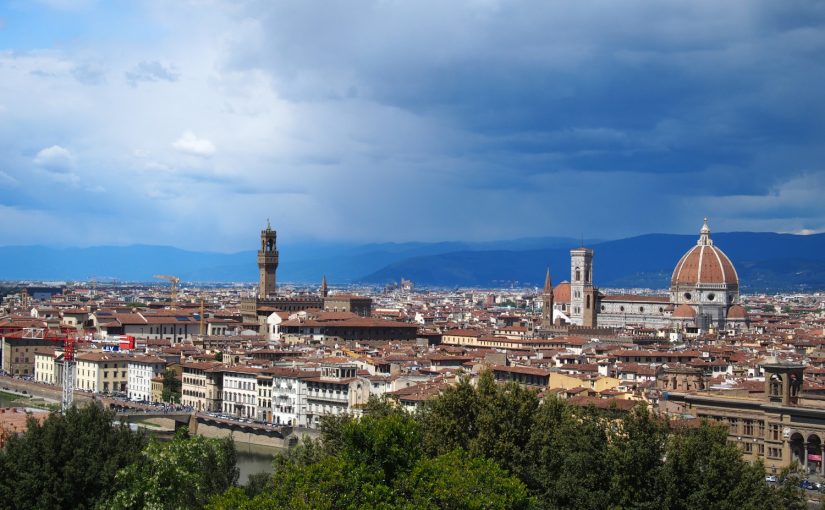
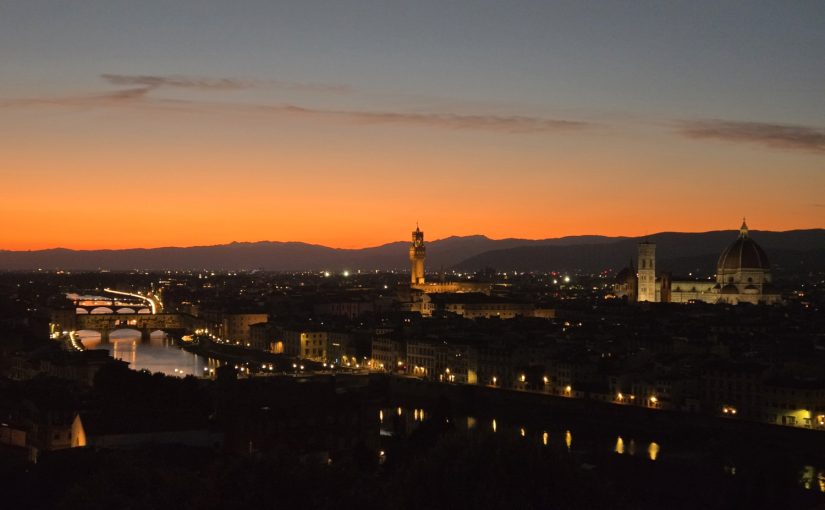
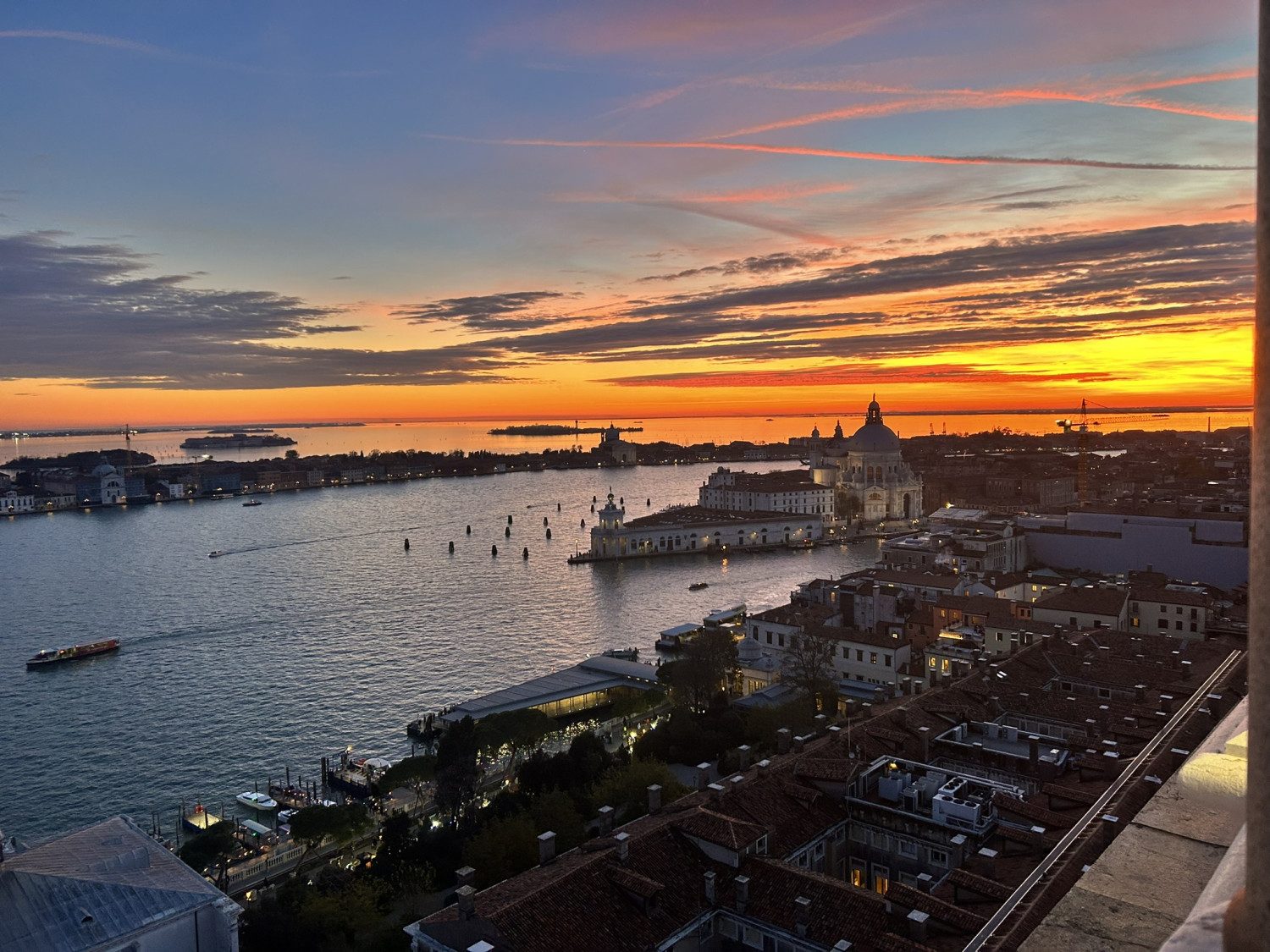
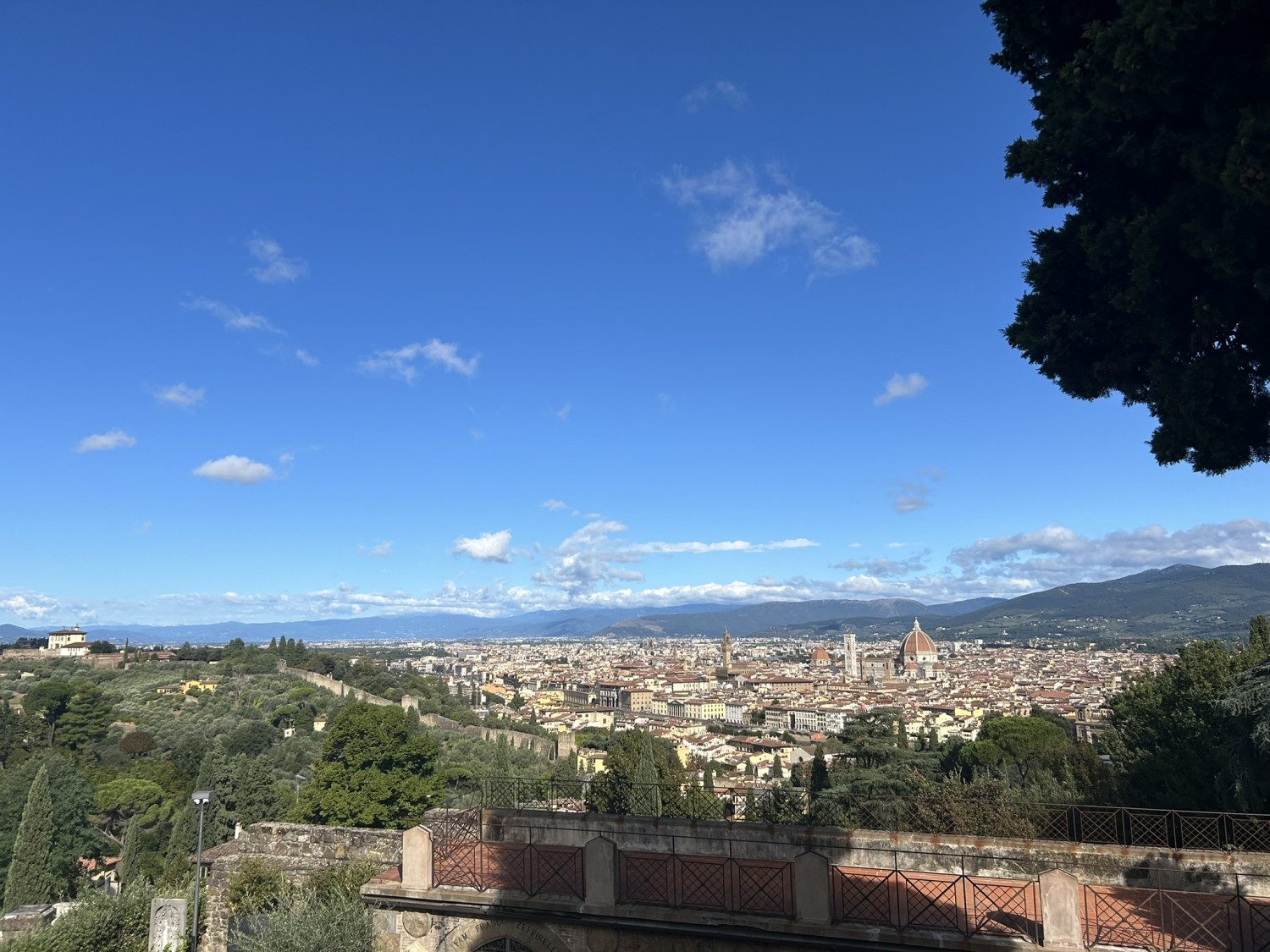
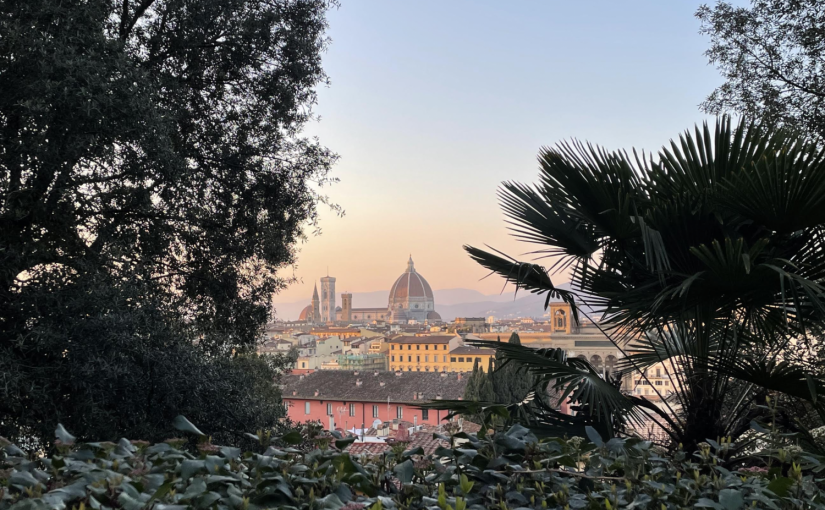
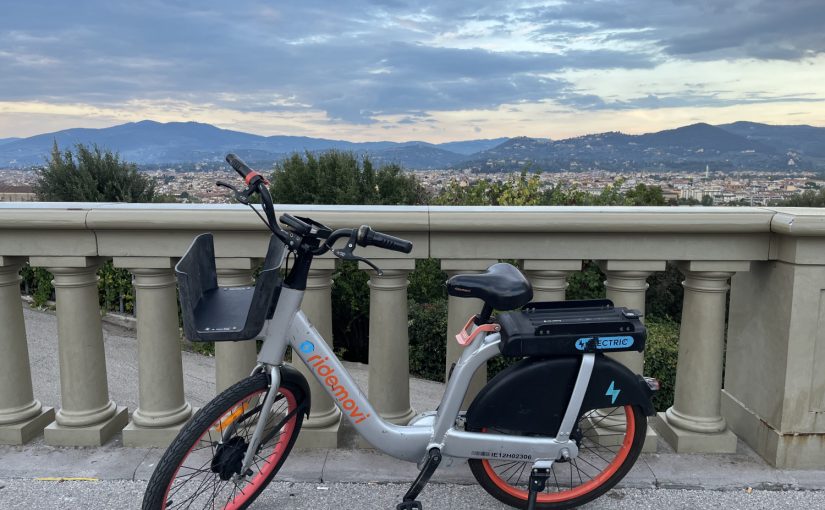
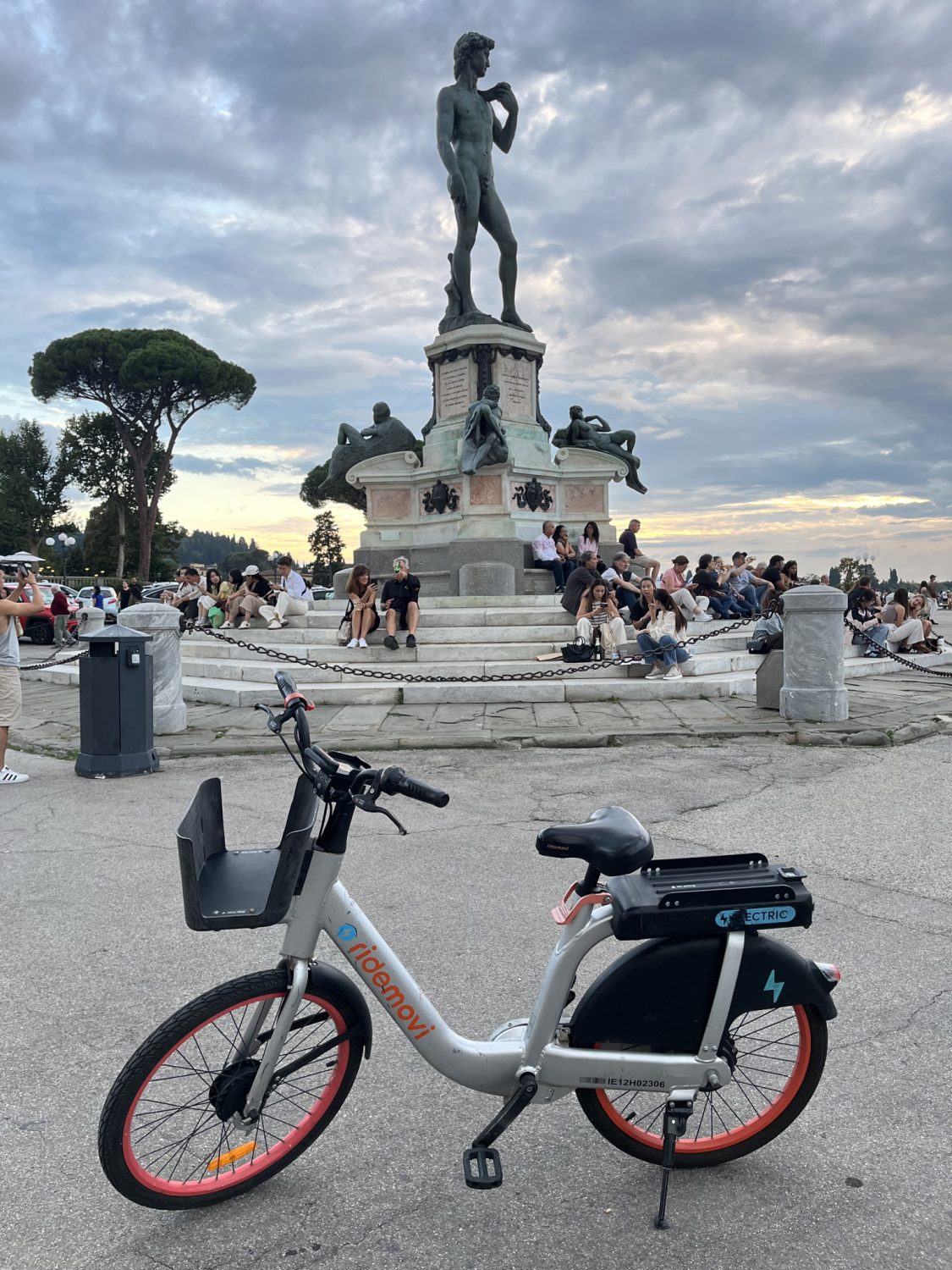
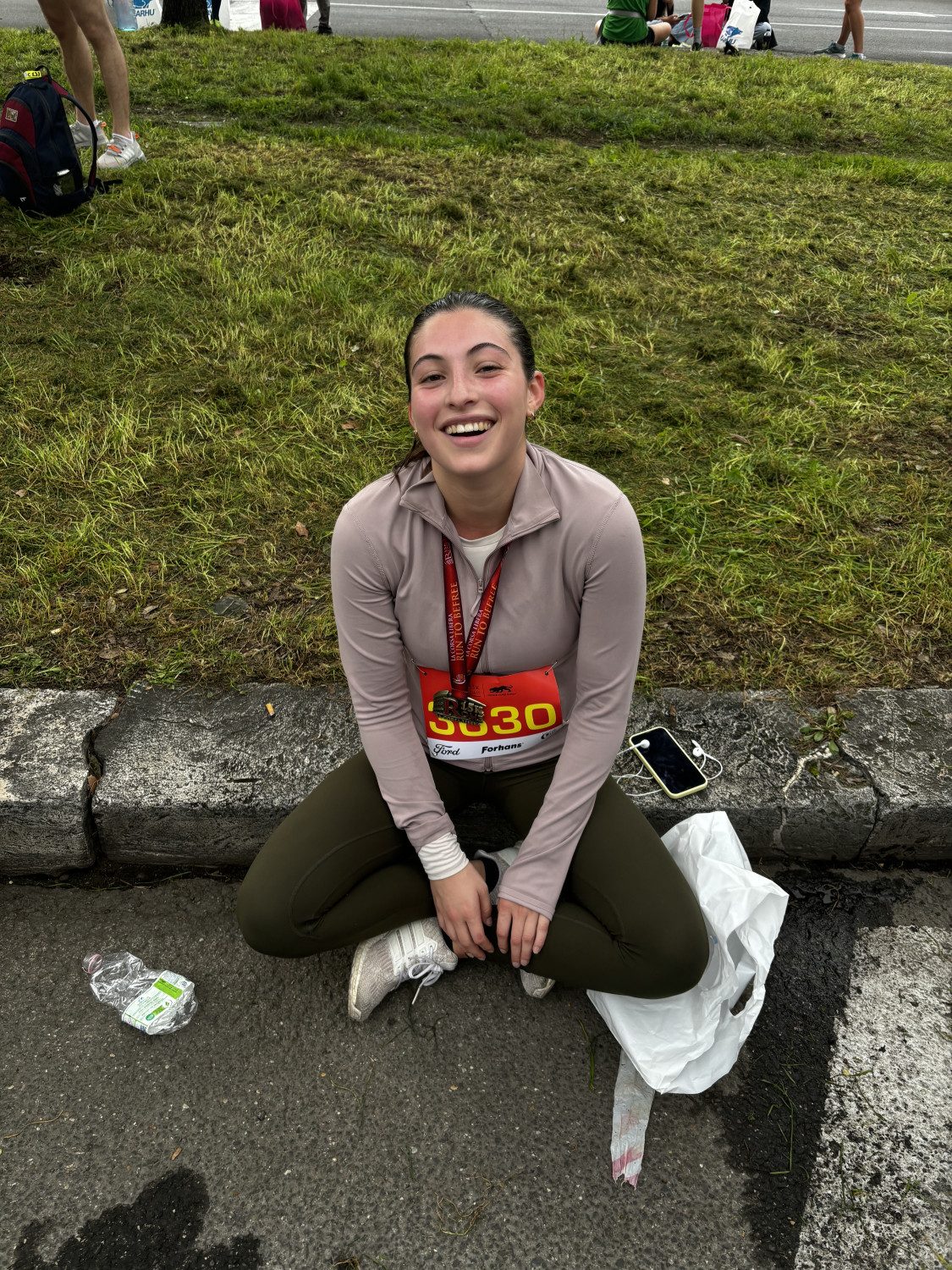
As the city slowly changes from season to season, we are constantly reminded of Piazzale Michelangelo as the beating heart of Florence. Especially during the summer months. The Piazzale remains alive through both tourists and locals, particularly at sunset, as wanderers gather on the steps with a simple glass of wine to listen to a band’s music or take pictures as a souvenir of the moment, as time pauses, just for a moment. This Florence phenomenon stirs curiosity about the aura the city holds in people’s hearts, a current that pulses through and unites communities. 

Piazzale Michelangelo seems nowadays as a rite of passage, a go-to place when visiting Florence to admire the city’s iconic skyline. But what about its history? Built in 1869 by Giuseppe Poggi, it was originally meant to just be a terrace, celebrating Michelangelo’s art. A representation of progress, but also modernity and the future, as Florence was the capital of Italy during that time. Nowadays, we see Piazzale Michelangelo as a place to slow down, reconnect to the beauty of the city, with a crowd to accompany us into this poetic journey. 

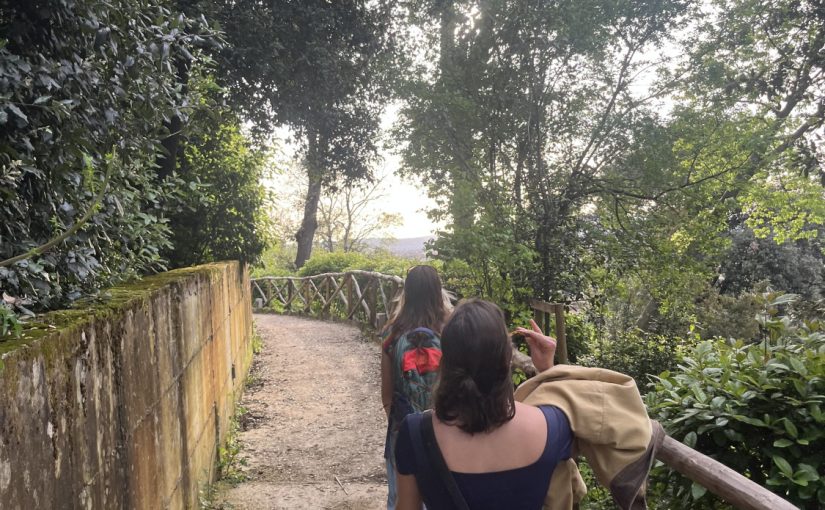
The typical route to Piazzale Michelangelo is just as memorable as the view itself. Beginning from the tower of San Niccolò, take the ascending stairs and path between the large trees. The climb begins as we slowly rise above the city of Florence, in anticipation of the view that awaits, as if leading towards something sacred. Then, the main terrace appears, the crowd gets denser, and the city spreads below. In the golden hour of the evening, music plays in the background and people dance to its infectious beat. Monuments wear orange and yellow as the sun begins to set, offering the perfect moment for multiple photoshoots to spontaneously appear. Phones and digital cameras alike click with the same rhythm as conversation or laughs. 

Piazzale Michelangelo is the place where multiple generations meet to capture the essence of Florence. As a guitarist tunes his strings, he shares that although the people there always change, the sunset and view remain a constant. There is poetry when we stare at the landscape, thinking it was approximately the same view as the one our ancestors looked out at centuries ago. People at first come for a simple view, then leave with memories, connections and hearts filled with emotion. Here the sunset isn’t edited, it is put on display, shown in its raw form to its audience.

Looking away from the view and back towards the crowd, students share a bottle of wine, while pizzas are eaten by a family visiting from abroad. All the while, social media enthusiasts are trying to capture the perfect shot. A couple stairs down, people listen to music, dance to the rhythm of guitars and saxophones, and cheers can be heard for a couple that just got engaged. This place holds authentic moments of life and connection that will never be forgotten. 

As night approaches, some remain while others venture further, all the way to San Miniato al Monte – a hidden place above Piazzale Michelangelo – to admire the city from a similar perspective. Apart from the overwhelming crowd and movement, you find peace and quietness, almost like coming out of a dream. Two different atmospheres but only a single feeling remains unchanged: reassurance and interaction. 

In those small interactions, it is where Piazzale Michelangelo holds its core, being something rare and precious to keep hold of. A moment apart from digital, inviting those that gather to be there mentally, with your own thoughts, to live in the moment rather than posting it. The space gathers both past and present. Life and art coexist around a skyline view, with a community to share the same moment with, just for a couple of minutes… or even a couple of hours. 

In an age of constant digital scrolling, Piazzale Michelangelo remains a symbol of the contrary. Not every view needs to be shared or posted on social media, as it must be experienced and lived through the senses and presence of people around us. The difference lies in the fact that the beauty of the square can be shared through both photos and memory, however those emotions we feel when in its presence, cannot be replicated on the digital screen.

When we look at Piazzale Michelangelo, we can see its beauty in the different communities it brings together. Some live in the moment, as a break, an aside, a moment apart from the fast pace of life. We take this moment to slow down, take a step back, and enjoy the present moment with friends, family, or alone. Others may take advantage of the moment by capturing a memory, particularly through digital means, engaging in an online community.

Piazzale Michelangelo explores the possibilities and redefines the opportunity to come together as a community, whether in-person or virtually. This place in Florence demonstrates a new perception of what a community can be, beyond what we are used to seeing, while continuing on the same path of harmony and the search for unforgettable moments. 

Jazz Revival Amongst the Youth

With the recent closure of Florence’s Jazz Club, allow this to be read as an ode to a staple in past study abroad students’ daily lives, with hopes of bringing back fond memories. In addition, this blog feature is an exclusive bonus installment to our Fall 2025 issue of Blending Magazine. After you finish reading, be sure to explore the rest of the magazine online—just follow this link to download the full Fall 2025 edition:
https://jschoolfua.com/images/BM/BM_151.pdf

written by Clara Koster, Hailey Kookaby, Tess Letendre & Peri Raczynski

“Going to Jazz Club felt like being at home in New York,” said Colleen, a student at Florence University of the Arts (FUA). For many students, the Jazz Club offers a familiar, intimate vibe — a break from the usual bars and techno nights of Florence. The dimly lit venue, tucked into a side street, draws students in with the promise of soulful music and a warm, relaxed atmosphere. 

Despite being an older style of music, jazz is finding new resonance among the city’s youth. A sign of its relevance is when a place appeals to students, who have consistently driven cultural trends. The sound of jazz now drifts through the streets of Florence, played by street performers and live musicians, sparking curiosity and excitement for a nightlife experience that emphasizes listening rather than dancing. 

The Jazz Club opened in 1979 and has consistently offered live performances. While jazz is the primary style, rock, R&B, and blues are also commonly heard. The club is small, and lines begin to form about a half hour before doors open, mostly made up of students eager to see what the venue has to offer. Guests are greeted at the desk, pay cover, and receive a membership card — their first drink included, with future visits covered by the card. 

Reactions to the club vary. “I thought it was kind of boring,” stated Harleigh, another student. “It’s not like the other bars I usually go to.” Devon, a classmate, described her experience as “amazing,” citing her deep love and appreciation for jazz. Maria, another student, elaborated on how she prefers Thursday nights for blues sets, saying, “It’s slower, moodier and fits the atmosphere better than Wednesday nights, which are more crowded.” Despite the differing opinions, one thing is clear: the Jazz Club leaves a lasting impression on those who seek it out. 
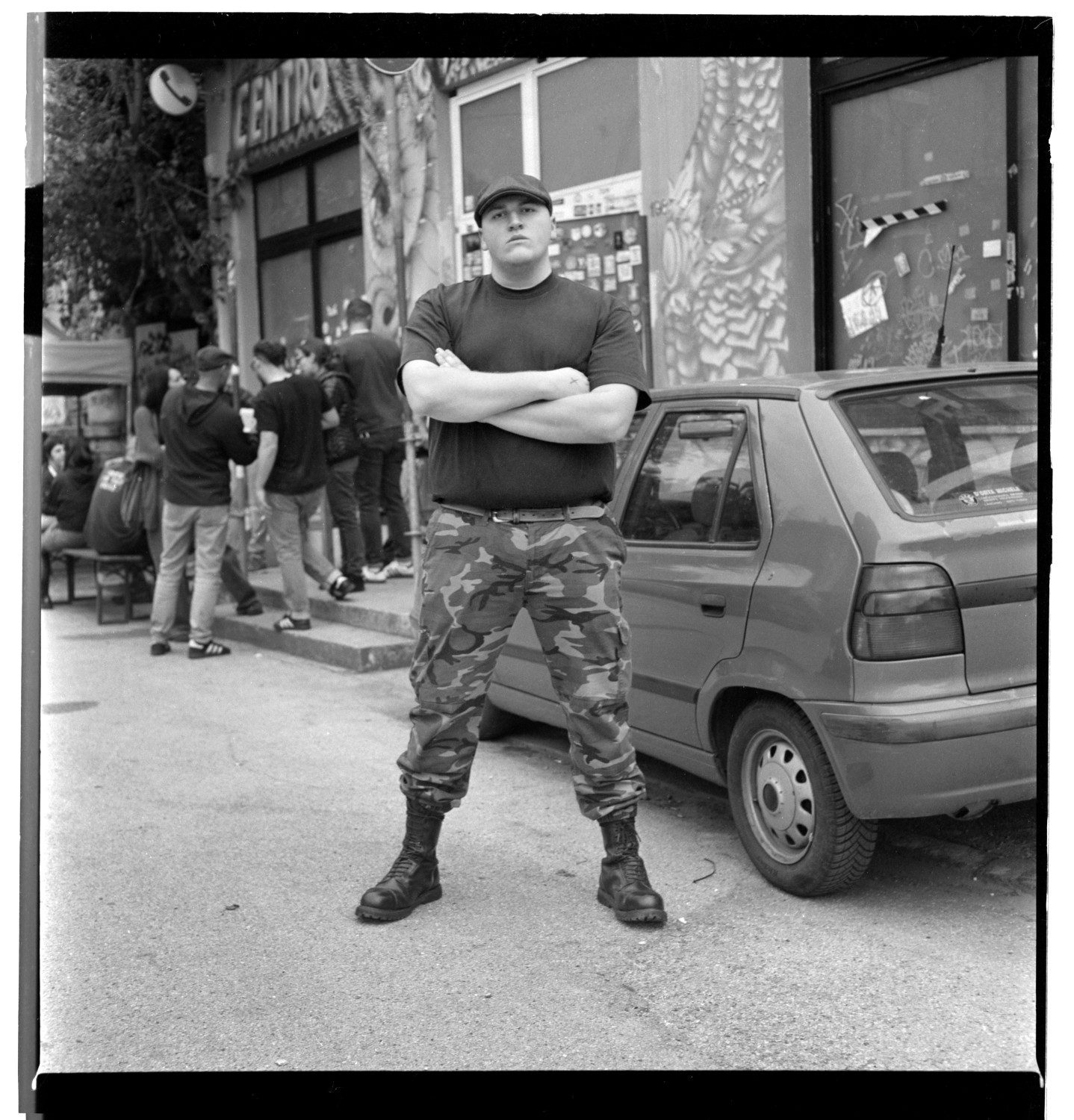
For our own visit, the ambiance was immediately striking. The room was filled with resonant bass tones, the wail of the saxophone, and a sense of focus on the music. Students swayed gently to the rhythm, some closing their eyes to fully immerse themselves, while others held quiet conversations without shouting over the music. The atmosphere was comforting and welcoming, creating a space where anyone interested in music could feel at home. 

The Jazz Club’s blend of historical charm and contemporary appeal illustrates Florence’s ongoing artistic legacy. Students like Tatum Park appreciate the club as a break from conventional “college” music, feeling connected to the city’s long-standing appreciation for music and art. Similarly, Colleen finds nostalgia and familiarity in the experience, while Devon finds inspiration and awe. The club demonstrates that even older musical forms, when presented thoughtfully, can engage and excite a younger generation. 
While most students gravitate toward techno-heavy clubs and crowded bars, the Jazz Club offers something different: a revival of old-fashioned musical reception. It’s a space where students can experience live jazz, blues, and other genres in a way that emphasizes presence and connection. In Florence, a city steeped in artistic and musical heritage, the Jazz Club has become a bridge between past and present, giving students a new way to engage with the timeless power of music.

The Rebirthed Art of “La Vita Lenta”

Journaling: The Personal and Authentic Form of Memory

This blog feature is an exclusive bonus installment to our Fall 2025 issue of Blending Magazine. After you finish reading, be sure to explore the rest of the magazine online—just follow this link to download the full Fall 2025 edition:
https://jschoolfua.com/images/BM/BM_151.pdf

written by Liana Torres, Heather Collins & Lydia Turner

In an age where our thumbs type faster than our thoughts, the digital world feels impossible to escape. Our devices allow us to easily type reminders, organize assignments, jot down school notes, or record fleeting thoughts within seconds. Walking into a library, classroom, or café in Florence, you will often see people with iPhones in their hands, computers on their laps, and the rhythmic tapping of keyboards as they urgently take notes and revise them in record time. It’s a convenience that may seem luxurious, but people are craving originality due to the loss of creative media. It’s efficient, but detached. 

A new wave of creatives, travelers, and locals in Florence is embracing a slower, more tactile ritual: taking pen to paper. Here in Italy, where beauty can be found in imperfection and time is slowed down, journaling has taken on a deeper meaning. Writing by hand anchors you in the moment, making it a physical craft that demands presence and meaningful thought. 

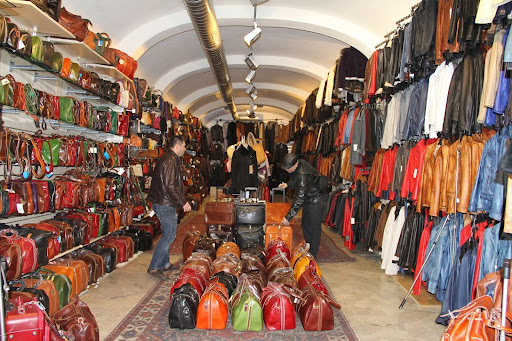
Journaling is an extremely personal experience; a leather-bound notebook isn’t just stationery it’s an accessory, an extension of personal style. The marbled paper, the smooth pen, the color of ink chosen, every detail becomes a reflection of self. In a city renowned for its craftsmanship, from leather bags to jewelry, the journal joins the wardrobe of self-expression. To open it is to reveal not curated perfection, but raw honest thought. The choice of the journal’s cover is unique and tailored to the user’s taste, often serving as a fashion accessory. Residents and visitors alike are slowing down, mirroring the ancient streets and buildings around them, translating their experiences through ink rather than a screen. 

Florence itself feels designed for reflection. The view from the rose garden at sunset, views of the Duomo, the echo of footsteps on cobblestones, and the scent of paper and ink from small workshops all invite slowness. To sit with a notebook in a Florentine café isn’t merely to write, it’s to participate in a centuries-old dialogue between beauty, and thought. The act of journaling becomes a quiet rebellion against the speed of modern life, reconnection with presence. 

Psychological studies have shown that handwriting engages more areas of the brain than typing does. When the hand forms letters on paper, neural pathways responsible for memory, comprehension, and creativity become activated. Writing slows down the mind and creates deeper reflection, forming strong connections between thought, language, and page. One must think before they write, as each sentence becomes more meaningful when it cannot be easily erased. There’s something deeply human about seeing one’s thoughts take shape, imperfect and unfiltered. Typing on a computer removes the permanence, thoughtfulness, and focus that handwriting naturally gives. It is nostalgic, but also a neurological discipline. Our engagement with what we are learning, feeling, and experiencing is deepened.

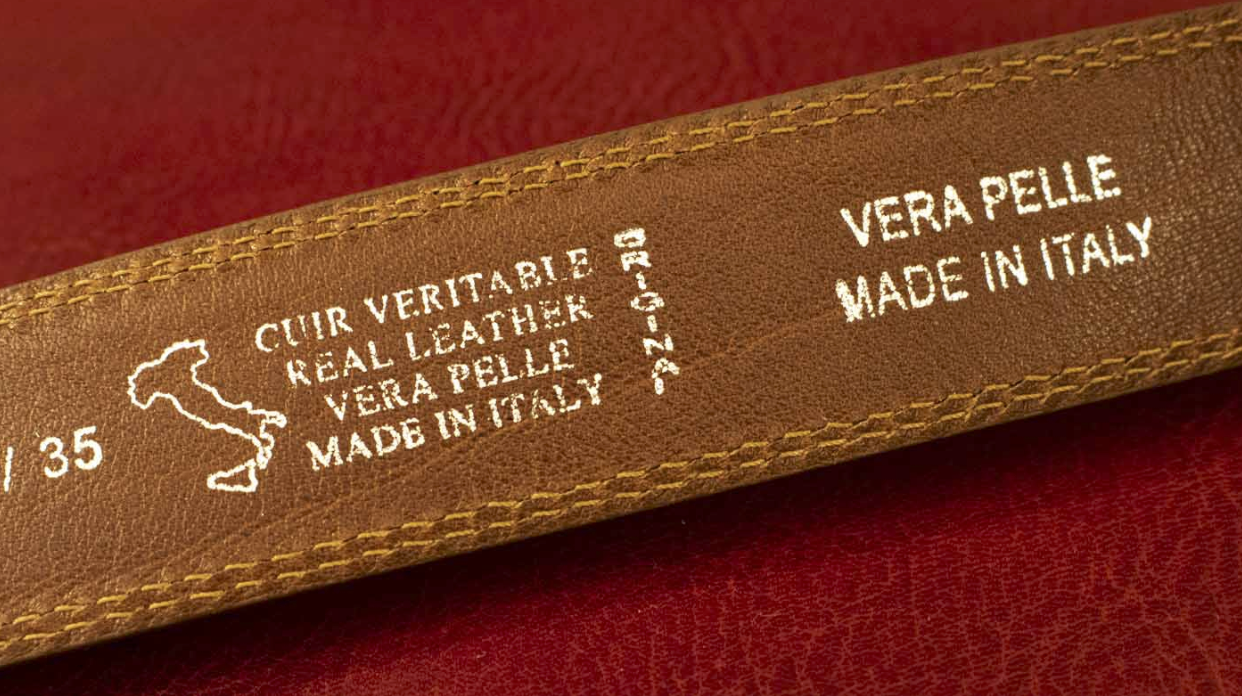
Journaling is an art form in Florence. In local markets and small boutiques, hand-stitched leather notebooks and marbled papers are commonly found authentic, high-quality stationery. They signify Italy’s value for craftsmanship, and in Florence, the art of leatherwork. These boutiques also draw consumers into the old, analog world by offering products such as wax seals, personalized notecards, and fountain pens. Each item tells a story, not only of Italian craftsmanship, but of the person who chooses it. 

Tourists, visitors, and students of Italy often feel compelled to document their experiences here in an honest and authentic way. Instead of simply snapping photos on their phones, many sketch their surroundings or write about their emotions in the moment, carrying their journals as if they were passports. 

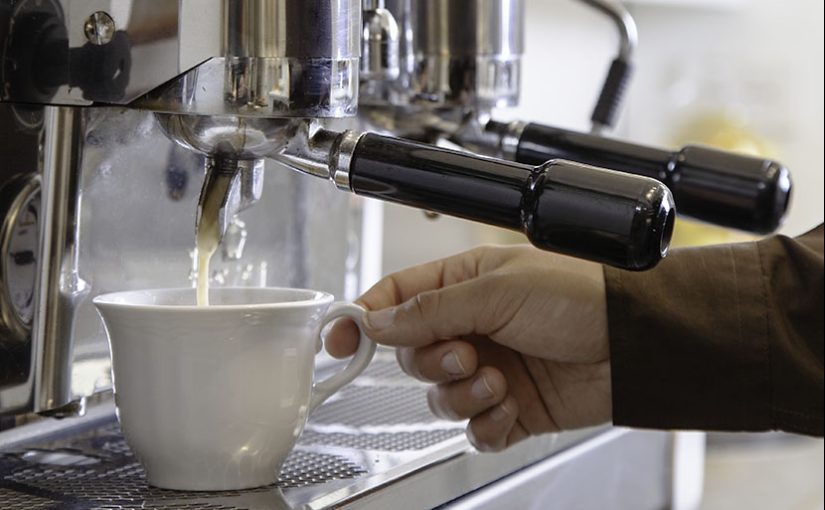
The Italian way of life, la vita lenta, is a philosophy of taking it easy and living in the moment. It embraces the rhythm of slowness and authenticity, valuing conversation, artistry, and the transformation of life’s seemingly mundane moments into something meaningful: a shot of espresso made by a local barista, a handwritten letter or postcard, or a leather journal carefully crafted by an Italian artisan. People can truly reflect rather than quickly react on their phones. 

Journaling allows for the documentation of lived experiences; it’s a way to highlight valuable memories and live through physical paper instead of a screen. Imperfection is welcomed, and the texture of the paper carries the rawness and realness of each written experience. It is more sacred. In Florence, handwriting isn’t about rejecting technology, it’s about reclaiming something real. Paper invites you to be unfiltered, unedited, and utterly yourself.

Florence Was My True Laboratory

written by Kathleen Morris

This blog feature is an exclusive bonus installment to our Spring issue of Blending Magazine, honoring the never-ending legacy of Giancarlo Cauteruccio. After you finish reading, be sure to explore the rest of the magazine online—just follow this link to download the full Spring 2025 edition:
https://jschoolfua.com/images/BM/BM_151.pdf

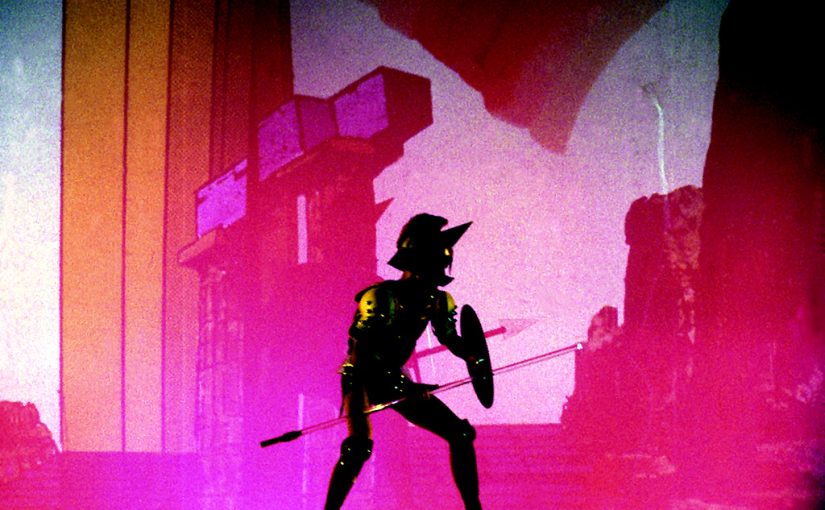
A video of a massive explosion serves as the opening backdrop for the latest production directed by Giancarlo Cauteruccio, capturing the audience’s attention as vibrant flames engulf a building.

The projector screen transitions to display a montage of troops entering battle, introducing visual motifs that reappear throughout “Il ritorno del soldato,” “The Return of the Soldier.”

The application of technology is a trademark of Cauteruccio’s theatrical style, harkening back to his roots as the founder and artistic director of Teatro Studio Krypton, located in Florence, Italy. The essence of Cauterrucio’s work can be summarized in a single word: innovation.

His show, which debuted this February at Teatro Aurora, located in Scandicci – a suburb of Florence, relies heavily on technical elements to underscore war’s toll on soldiers’ families. In his introductory speech, Cauteruccio warns audiences that it is “not going to be a fun night.” Still, he emphasizes the necessity of telling a story shrouded by darkness.

The tragedy portrayed within the script is echoed by the tragic origins of the playwright himself, Saverio Strati.

Strati, a writer from the Calabria Region, lived a life of poverty and did not receive recognition for the thousands of manuscripts he had written until after his death. To revive his legacy, the show was commissioned to celebrate the centenary of the writer’s birth.

Cauteruccio acknowledged his connection to Strati, explaining, “We found ourselves in the same peripheral city of Florence, a suburb without any identity. Today it has changed, thanks to the work done by artists who experienced it.”

Upon entering Teatro Aurora, Cauteruccio’s impact on the community is evident.

The lobby overflows with fans prepared to support his latest project. Following the show, a line forms once more. This time, patrons swarm Cauteruccio to personally offer praise for “Il ritorno del soldato.”

The love that Cauteruccio holds for the region, as evidenced by his willingness to recover Strati’s lost work, is matched by the enthusiasm of his audience in Scandicci.

For decades, Cauteruccio has demonstrated a fierce commitment to Florence’s art scene. He has distinguished himself as a changemaker, tirelessly pushing boundaries and actively defying artistic precedent to modernize the industry. 

“At the end of the ‘70s, I began to understand that technological evolution would lead to a transformation,” he adds.

Since the ‘80s, he has played an influential role in redefining art practices in Florence. The establishment of Teatro Studio Krypton, founded by Cauterruccio and Pina Izzi in 1982, aligned with the awakening of the city’s avant-garde movement.

“We found ourselves amid the phenomenon of postmodernity,” Cauteruccio observes.

In collaboration with other artists, he created a new language built on the notion that the theatre is “a place of synthesis” where all art forms intersect. 

“I set up a job there which looked predominantly at contemporaneity,” he shares. “It was a theater of research, experimentation, and innovation… that featured poets, musicians, philosophers and architects.”

As Florence’s underground scene blossomed in the 20th century, Cauteruccio’s embrace of radical creativity fueled a movement that created instrumental progress within and beyond the theatrical realm. Undeterred by the unknown, Cauteruccio launched a revolution driven by postmodernity and new spectacularity. 

“I was led to strategic approaches in a contemporary way and an aesthetic that allowed the new generations to come into contact with a language that was previously taken for granted,” he describes. 

Cauteruccio refined this approach at Krypton, replacing classical music with electronic sounds and introducing the laser beam to Europe’s theatrical sphere. By rejecting tradition while honoring the elegance of past practices, his work has garnered an “explosion of interest” for half a century.

His career transcends the stage, as he has authored several books and taught at universities across Italy and the United States. In every setting, Cauteruccio considers the influence of his emergence in “The Cradle of Renaissance.” 

With a hint of reverence, he declared, “Florence was my true laboratory.”

Cauteruccio concludes with a thought about the synergistic relationship between artists and their audience – one is not complete without the other. Likewise, Florence’s underground art scene would not be complete without him. As a figurehead of progress and ingenuity, Cauteruccio’s efforts will endure and ignite a spark within the next generation of trailblazers.

The Sound of Florence

written by Alena Pietrini, Clare Kearney & Autumn Verna

This blog feature is an exclusive bonus installment to our Spring issue of Blending Magazine. After you finish reading, be sure to explore the rest of the magazine online—just follow this link to download the full Spring 2025 edition:
https://jschoolfua.com/images/BM/BM_151.pdf

Pinocchio Jazz Club, located in the heart of Florence, serves as a hub for local jazz culture, offering an intimate location for both musicians and audiences. Founded by Costanza Nocentini and Daniele Sordi, the club promotes high-quality jazz music in order to create growth of both classic and emerging talent. Each Saturday, a range of performances play at the club and perform their own original compositions and jazz classics. The famous Pinocchio logo is inspired by pop culture stemming from Florence, creating a sense of community at a very intimate club. Beyond its musical contributions, Pinocchio Jazz Club plays a vital role in preserving Florence’s locality despite the increasing tourist surroundings. The club stands as a testament to Florence’s roots by offering a space for cultural exchange and a deeper connection to music. The Pinocchio Jazz Club stands tall as an important institution for both locals and visitors to celebrate Florence’s dedication to the genre.

Pinocchio Jazz Club is a well known organization located in the heart of Florence. Locals and tourists enjoy this important location for the Florence community. Costanza Nocentini and Daniele Sordi oversee the association and ensure it continues to spread jazz to as many people as possible. Nocentini revealed that the organization was founded with the goal of encouraging the growth of the local jazz community and promoting quality music that stands apart from commercial sounds. That goal has clearly been exceeded, as many jazz stars began their careers at Pinocchio Jazz Club. 

Each Saturday, the club hosts a new musician who brings their own spin on jazz. Some rework classics while others perform original compositions, all contributing to the evolving nature of jazz. Pinocchio Jazz Club isn’t just a venue where people passively watch a performance, it’s a zestful space that comes alive with the effervescence of the music. The club itself sits tucked into a residential part of Florence. The surrounding area has wide streets, more greenery, and a noticeable lack of tourists. It feels like a place where people actually live, not just visit. 

Inside, the setting feels intimate while also being full of enthusiasm. The lighting is vibrant and changes with the vibe of each performance, adding another dimension to them. One of the more iconic details is the famous Pinocchio riding the whale logo, which stands out in the background and reminds you of the novelty and roots of the club. The club is medium-sized, with space for people to sit at tables, making it feel inclusive no matter where you are. The performances range from full-on jam sessions with multiple musicians, to solo acts. 

One of the most striking things about the shows is how often the performers will involve the audience. Since the seating is so close to the performers, it’s impossible for the audience not to get swept up in the passion of the performance. The musicians feed off the audience’s reactions, and the crowd responds in turn, creating a dynamic environment that makes each show feel different and alive. There’s a genuine sense of play between the crowd and the musicians that makes the space feel fun, warm, and communal. It’s a casual crowd as people of all ages come through, some dressed up for a night out, others just stopping by. 

There’s a bar tucked into the back, and the whole place has an effortless local charm. What’s especially cool is that a lot of the musicians don’t seem to be playing off sheet music or pre-planned sets, but are simply riffing and letting the music take shape in real time. This aspect of the club just adds to its electrifying energy. 

 The impact of Pinocchio Jazz Club goes beyond music. It plays a critical role in preserving Florence’s local identity. Many of Florence’s visitors come just to check off the big sights and leave without ever experiencing the soul of the city. The historic center is starting to reflect that, with fast food chains and souvenir shops replacing once locally-run stores. In a city that was once defined by the Renaissance, by pushing boundaries and creating something new, it’s almost upsetting to see it slowly turn into a checklist for tourists. 

Places like Pinocchio Jazz Club push back against that. They give locals and those looking to connect with the city on a deeper level a chance to do so. Pinocchio Jazz Club reminds us of the roots of Florence. Whether you come for the music, vibe, or a break from the city center, there’s something about the club that stays with attendants. Florence will always have to navigate the balance between the old and new, locals and tourists, but places like Pinocchio Jazz Club make that dynamic feel more manageable. 

In the end, what makes Pinocchio Jazz Club so memorable isn’t just the music or the setting, but the sense of being part of something genuine. It’s rare to find places that blend tradition and originality so well, and even rarer to find ones that stay connected to the local community. Whether you’re a long-time jazz fan or just discovering the club, you leave knowing you’ve experienced something special.

Casini Firenze: The Art of Timeless Leather Craftsmanship

written by JJ Anderson, Madeline Hines, Mia Besl & Carys Abbott

This blog feature is an exclusive bonus installment to our Spring issue of Blending Magazine. After you finish reading, be sure to explore the rest of the magazine online—just follow this link to download the full Spring 2025 edition:
https://jschoolfua.com/images/BM/BM_151.pdf

Rooted in Florence’s rich tradition, this brand creates bespoke leather pieces that embody authenticity and artisanal skill, standing apart from fast fashion.

When most people think of Italy’s vibrant fashion industry, names like Prada, Gucci, and Valentino often come to mind. However, for those who truly appreciate the essence of local craftsmanship, there’s a lesser-known, yet highly revered brand, Casini Firenze. Nestled in the heart of Florence, the store is a standout in a city already known for its centuries-old leather craftsmanship.

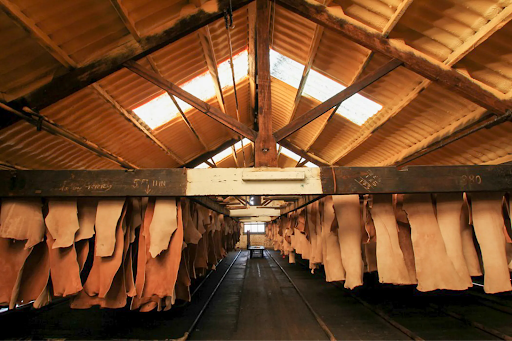
The city’s longstanding practice of leather craftsmanship dates back to the Middle Ages. Florence was found to be an ideal environment for leather production because the Arno River provided access to water needed for time-consuming, labor-intensive techniques like leather tanning. By the 13th century, the city was renowned for producing high-quality leather goods, particularly for the nobility and elite classes across Europe. Over the centuries, Florentine artisans have continuously developed their methods, perfecting the art of tanning and dyeing leather.

In the aftermath of World War II, passionate leather craftsman. Giorgio Tattanelli, opened his family-run business which he named Casini Firenze. Casini specializes in crafting handmade leather totes, wallets, purses and more using authentic Tuscan leather and centuries-old craftsmanship. They pride themselves in being a limited edition brand, upholding timeless Italian values while creating special pieces for each client.

Amid a global fashion economy dominated by the constant manufacturing of mass-produced garments, the brand stands today as a reserved, yet powerful force in Florence’s underground fashion scene.

The store is located in Piazza Pitti, directly across from the Pitti Palace, making it a convenient stop. Upon entering, you’re welcomed by a glass window display showcasing Jennifer Tantinelli’s latest collection. Almost immediately, a sales attendant greets you, ready to elevate your shopping experience. The staff are experts on Casini products and provide a top-tier luxury service to ensure you leave completely satisfied.

After speaking with a few sales representatives it became clear to us that the brand is far different from the fast fashion stores we walk past daily. Casini Firenze‘s unwavering commitment to quality and authenticity proved a stark contrast to the disposable, fleeting nature of mass-produced clothing. Each piece tells a story of dedication, skill, and a deep respect for traditional Florentine artistry that cannot be replicated by factories or synthetic processes.

Specializing in custom made collections, the brand offers clients the opportunity to personalize a piece’s color and style to suit their individual taste. In addition, it provides bespoke services, allowing customers to design a truly one-of-a-kind bag that reflects their personal style and preferences. Among their most iconic creations is the Infinity Leather Basket Bag, a signature piece in the brand’s collection. This bag is made from leather pieces being meticulously weaved in an infinity pattern around a wooden box, giving the piece its signature basket-like look. This bag is available in seven distinct colors, and the customer even has the luxury of adding customizable elements to the bag.

Obviously, these unique pieces would not be created without the brainpower of new designers of the years. In 2002, Jennifer Tantinelli, granddaughter of the brand’s creator and New York native, took the reins of the family business. A lover of classic fashion, Jennifer was inspired by Audrey Hepburn’s timeless style-a vision that aligned perfectly with Casini’s commitment to tradition and elegance. Jennifer followed her family’s roots back to Italy and under her leadership, Casini Firenze transitioned into a modern-day luxury brand while still honoring its artisanal roots.

Despite facing numerous challenges, most notably the global disruption caused by the COVID-19 pandemic, Jennifer’s vision has allowed the brand to thrive. While the flagship store in Florence closed for nearly two years during the height of the pandemic, Jennifer was able to sustain her business through its location in Palm Beach, Florida.

One of the defining features of Casini Firenze is its commitment to maintaining full control over the production process. Unlike many luxury brands that outsource production, Casini prides itself on being self-reliant. The Tantinelli family makes all the leather products in-house, working with local artisans to ensure each piece reflects the highest standards of craftsmanship. This hands-on approach has allowed the brand to retain its authenticity and the hallmark spirit of Florence’s leather legacy.

A “Carless” Chronicle: What I Learned Trading My Keys For a Passport

written by Logan Grigsby

At first, I was nervous about trading my sedentary, car-dependent life for the walkable streets of Florence. I was nervous about getting lost, accidentally walking into the “bad side of town,” or simply not being able to physically walk that far. However, walking in Florence led me on a journey of self-discovery, connection, and helped transform me physically, spiritually, and emotionally.

In my hometown of Kansas City, going just about anywhere meant getting in the car; heck, I couldn’t even take my own dog on a walk without driving somewhere! My lifestyle was very sedentary most days; I would only walk a couple of thousand steps. I felt unhealthy, and walking more than a few blocks felt foreign to me. However, I knew even before I arrived in Florence that I wanted to trade my car keys for a passport and a nice pair of shoes. I knew I wanted to explore the city, and I knew I wanted to be healthier and happier. I never could have imagined the transformation that was in store for me, physically, emotionally, and even spiritually, and the love I would gain for Florence. This is my journey on how simply walking has changed my perspective and my life.

As I mentioned before, I was in pretty rough shape. I didn’t exercise, I didn’t go to the gym, and I was considered by most to be a “couch potato” stuck in a constant loop of getting out of school, plopping on the couch, and doom scrolling TikTok or Instagram for hours, never seeing the beauty in front of me.

My journey started small. Let me tell you, the first week was a challenge. We had a heat wave, and my body was just not used to walking around. At first, my body screamed when I had to walk across town for class, and don’t even get me started on the hills… Although, as time went on, I started shedding off fat, and the steps got easier as every day went by. At first, I struggled to hit seven thousand steps. I soon found I was disappointed in myself if I got anything less than fifteen thousand.

I remember my first week here attempting to make the trek up to Piazzale Michelangelo; A wonderful square with a beautiful look over the city. It was not the easiest hike. I remember having to stop and take breaks constantly. I drank nearly a gallon of water and I genuinely thought my body would give up on me. I decided to retake that journey during my final week in Florence, and not only did I not need any breaks, but I also found I was genuinely enjoying my journey up the hill!

A healthier lifestyle isn’t all that I found; the true magic of a walkable city isn’t the exercise, but it’s the hidden treasures you find along the way. Things you wouldn’t bat an eye at if you were driving in a car. Wandering aimlessly through the city quickly became a favorite pastime of mine. I didn’t know where I was going, but every day I would pick a new direction and set off. This led to some genuinely life-changing experiences.

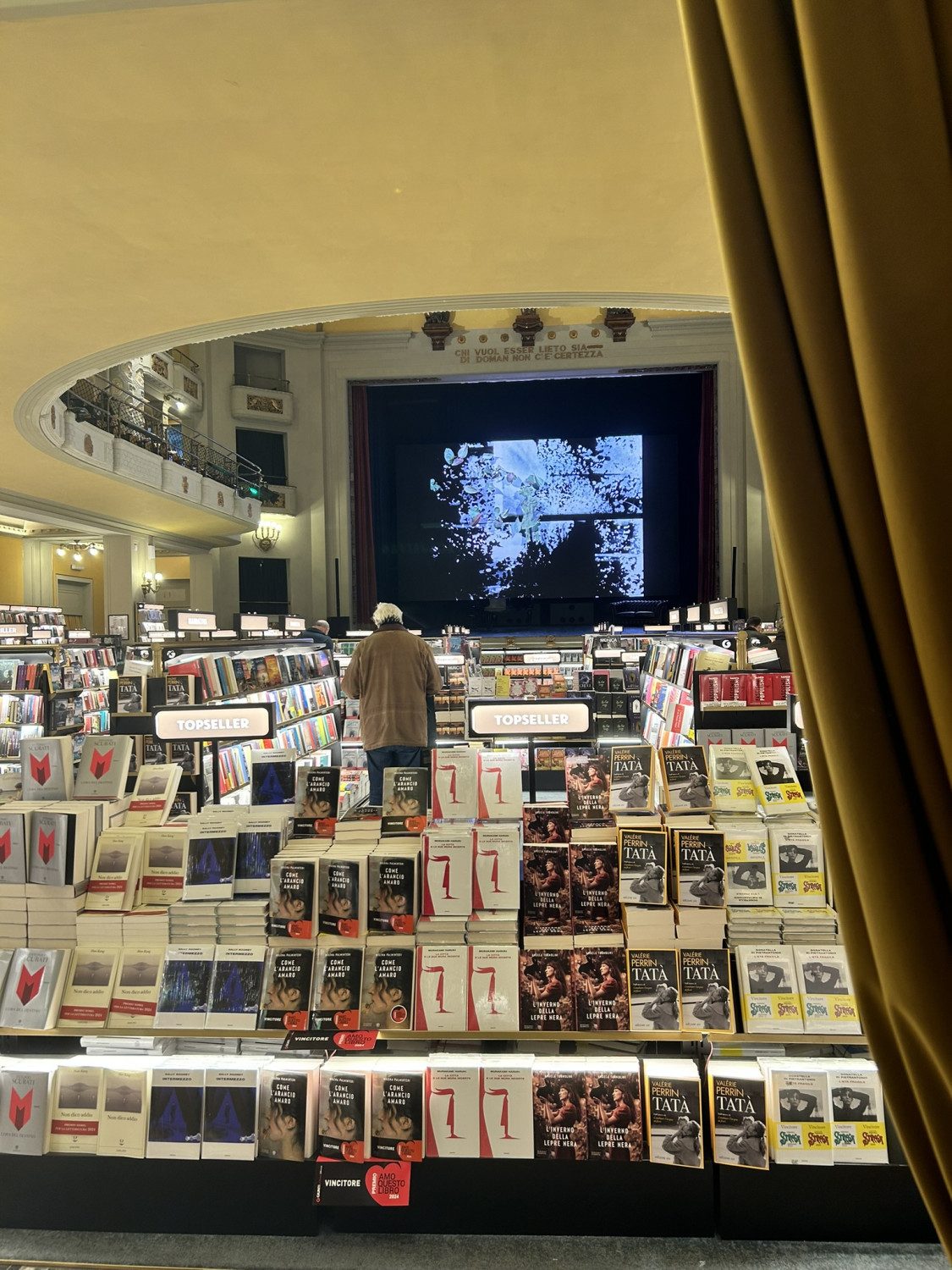
During my first week, I found what I assumed was a small, unassuming bookstore. I honestly went in for the air conditioning; however, it turned out to be the legendary “Giunti Odeon,” a library and cinema, and what many locals have told me is one of their favorite places in the city. This quickly became one of my favorite spots to study, hang out, or just relax and watch a movie.

Then, one day while walking along the river, I stumbled upon “The Ultravox,” a truly unique outdoor event space that regularly hosts free concerts and offers a vast array of food options. I must admit, I fell in love.

One of my more memorable experiences was discovering “The Havana Club,” a small area on the river that the Cuban embassy officially recognizes for showcasing their culture in Florence. This is a place where I truly connected with the area and grew culturally. I remember walking up to the sand volleyball court quite nervous and sheepishly asking if I could join in, and before long, I had made a group of friends with local Florentines! They would eventually convince me to take to the dance floor, something I never considered, as I always thought that I had “two left feet.” I was so anxious, I thought I was going to throw up, but surrounded by people with positive attitudes and energy, I quickly found myself learning to Salsa dance. Who would have thought that I would learn to Salsa in Florence, of all places.

Of all the things I have done, if I hadn’t decided to just go on a walk, I would have never had these amazing experiences.

My walks have allowed me to truly appreciate the art and history of the city, which permeates it. My first time walking into Piazza della Signoria, I honestly was at a loss for words. Surrounded by breathtaking architecture, beyond lifelike statues, I have never experienced anything like that, and it will forever be a memory in my mind. Back home, I felt like I never took the time to “stop and smell the roses,” and appreciate the beauty surrounding me; however, in Florence, it is unavoidable.

My appreciation for Florence extends beyond the architecture, though. What truly makes Florence so special is the people who make up the city. Every day I see something new and special, from seeing artists freehand the Mona Lisa on the street with chalk, to guitars and accordions filling the streets with sound, to my first experience with Opera music on the front steps of the Duomo, the melodies of this city have filled my heart and soul.

My most spiritual moment came from walking down the street and discovering a small church on the street corner where I saw locals walking in and out of. I don’t usually consider myself a religious person, but something drew me to it, and I decided I needed to walk in and see the building for myself. It was quiet, it felt holy, but it also felt warm and welcoming. Before coming to Florence, I attended the funeral of a friend near and dear to me and was still struggling a bit with the loss, so I decided to do something I haven’t done in a very long time: I sat and I prayed. I talked to my friend who left too early, I spoke to my family who left this earth too early, and I sat and I prayed. This was a tremendously difficult moment for me, but I honestly felt a weight off my shoulders, and I felt a connection I hadn’t felt in a long time. I honestly felt like a changed person.

My time in Florence has taught me so much. At first, I thought getting more steps in would at best help me lose some weight and breathe a little deeper, but that couldn’t be further from the truth. It builds a sense of community and connection. I love running into my flatmates or classroom friends that I have made here, who may also just be aimlessly walking around, an experience that never happens back home. Trading my keys for a passport was a nerve-wrecking experience at first, but I now know it’s one of the most rewarding experiences of my life. It forced me to slow down, to pay attention, and engage in my new home. I’m not just living in Florence, I am discovering it one step at a time. This experience has changed my body, my heart, my mind, and my soul in the best way possible. I will forever be grateful for my experience here.

A Guided Journey Through the City’s Creative Underground

written by Alison Sweeney

This blog feature is an exclusive bonus installment to our Spring issue of Blending Magazine. After you finish reading, be sure to explore the rest of the magazine online—just follow this link to download the full Spring 2025 edition:
https://jschoolfua.com/images/BM/BM_151.pdf

From literary cafes to rebellious music movements, uncover the lesser-known artistic history behind some of Florence’s modern-day cultural hot spots.

Florence’s Underground Artistic and Creative Scene

Though Florence is known for its Renaissance art, grand architecture, and famous landmarks, the city has a hidden artistic scene that offers a different kind of cultural perspective and experience. While many of the venues that once hosted this creative underground scene have become more commercial over time, their roots tell hidden stories of rebellion, reinvention, and the key to discovering true Italian culture. This travel guide invites you to step into Florence’s underground, not just physically but historically, creatively, and culturally.

Caffé Giubbe Rosse: A Literary Revolution is Brewed 

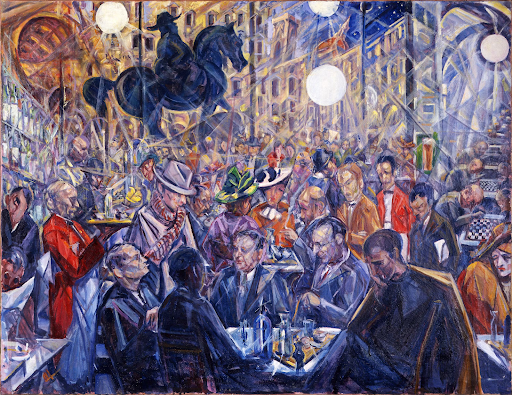
Start your journey at one of the most famous historic literary cafes in Florence, Caffé Giubbe Rosse, where famous poets and writers sat to scribe and exchange radical ideas. According to the article, “Grand Re-opening of Caffé Giubbe Rosse” by Accord Italy Smart Tours, Caffé Giubbe Rosse is located in the Piazza della Republica and was established in 1896 by two German brothers. The cafe earned its current name, meaning Red Jackets, because it was inspired by the red uniform worn by the waiters. 

Caffé Guibbe Rosse grew to become a hub for intellectuals, artists, and writers. The cafe played a pivotal role in the Futurist movement and served as a gathering place for avant-garde thinkers like Baccio Maria Bacci, who looked to challenge traditional artistic roles. 

Today, visitors can still visit the cafe and bar to experience the Italian cultural experience and legacy, where you can find some original Futurist writings still on display! 

Teatro Verdi: Reinventing the Stage

Next, step into the dimly lit Teatro Verdi of the 1980s, where the stage is filled with redefined Italian performance and shortly became a prestigious turnpoint in the uprise of the futurist avant-garde movement. Teatro Verdi transformed into a space for the most sophisticated pop and rock music and for unconventional drama. 

According to the Teatro Verdi website, the theater was inaugurated in 1854 and is the largest “Italian-style” theatre in Tuscany. Located in the historic Santa Croce district, it was built on the remnants of the 14th-century Carcere delle Stinche. In the early 20th century, the theater embraced the futurist avant-garde movement, which challenged traditional theatrical norms. These weren’t just performances but protests, celebrations of youth, and identity in a space of avant-garde reinvention.

Today, Teatro Verdi remains a diverse cultural venue, offering classical music, contemporary performances, and pop and rock concerts, reflecting the artistic landscape Florence has to offer.

Tenax: A Hub for Florence’s New Wave Movement

Last but not least, explore one of the music venues that fueled the cities’ New Wave movement in the 1980s, Tenax. Tenax quickly emerged as a hub for new artists and musicians by influential New Wave and post-punk bands and today remains a symbol of Florence’s alternative music history. Picture this: it’s September 1981, and amid Florence’s enthusiasm for new wave, dark, and punk sounds from the UK, Tenax emerges as a pioneering nightclub. According to the Tenax website, the club was founded by a group of young entrepreneurs and quickly became an innovative and alternative hub for emerging artists, fashion designers, and musicians. Tenax’s stage has hosted an impressive number of acts, including Spandau Ballet, Bauhaus, and New Order, becoming a cornerstone of Italy’s music scene. Bands like Litfibia and Neon, formed in Florence in 1979, found a platform at Tenax for their innovative sounds. 

As the music landscape evolved, Tenax adapted and began to embrace other genres like house music. The club’s ability to reinvent itself while maintaining its core identity has ensured a lasting influence on Florence’s cultural aspect. 

All of these examples of Florence’s underground cultural scene offer a rich and nuanced perspective of the city’s artistic evolution. These places, now more visible, carry with them the same legacy of those underground revolutions. So, next time you find yourself in this beautiful and magnificent city, look closer. Look beyond the espresso machines, beneath the stage lights, and in the echoes and flashing lights, and maybe you’ll find the story of a city whose past reflects a magnificent creative rebellion. 

You Don’t Just Study Abroad…You Study Yourself Too

Discover the three transformative life lessons that I learned during my six-week study abroad experience at Florence University of the Arts that I would not have been able to comprehend if I had stayed home this summer.

When I boarded the plane to Florence, Italy, for a six-week study abroad experience with Florence University of the Arts (FUA), I knew I was going to grow academically and professionally. I enrolled in a three-week course and worked a public relations internship covering diverse community events, conducting research, and collaborating with interns from various departments.

But as much as I learned in classrooms and internship meetings, some of the most valuable lessons came from simply assessing myself and my surroundings while living abroad. Here are are the three main insights I gained in Florence that no textbook could teach:

1. Discomfort is a Great Teacher

Moving across the globe from my familiar Michigan environment was the first jolt of discomfort. I was no longer just a few hours from home like I am for college, instead an entire ocean! That kind of distance forces a newfound level of independence. Whether it becomes overwhelming or empowering is up to you.

There were emotional hurdles, like the occasional hits of homesickness. And then there were the practical challenges, such as navigating a foreign metro system when my international phone plan suddenly stopped working, or trying to communicate professionally at public events where most attendees spoke only Italian. Getting lost, whether physically or in conversations, became something I eventually grew more comfortable with. That said, safety always comes first and keeping your guard up where it’s due is essential. No adventure is worth compromising your instincts or well-being.

Every time I stepped outside of my comfort zone within reason, not once did I regret pushing through the fear. Because if you’re always comfortable, you’re probably not going to grow in the long run.

2. Everyone You Meet Carries a Story Worth Hearing, Including You

During my stay in Florence, I shared a multi-room apartment with eleven roommates from across the U.S. and Australia. We came from all different walks of life…a few older than me, others navigating their very first trip abroad alone. Our most valuable times spent together weren’t always the last-minute weekend trips or shared meals, but the simple conversations where we opened up and shared pieces of our individual stories. There were times when I realized how much of my own life I’ve taken for granted, or received advice from a unique perspective I have not heard previously.

However, one of the most unexpected and memorable interactions happened when I was completely alone.

After finishing a long day working a community event, I treated myself to dinner at Sgrano, a fully gluten-free restaurant in the city. I sat at a table for one and ordered a sandwich followed by a slice of gluten-free chocolate cake. As I was enjoying my dessert, I suddenly heard a voice from the table next to me say, “You know, chocolate cake isn’t really eaten at this hour.”

I looked over and laughed, lightheartedly replying, “Oh well, I guess it’s exposed I’m a tourist.”

To my surprise, my response opened the door to a long, meaningful conversation with the couple seated beside me. What started as small talk of where we’re from turned into an hour-long discussion about life. They shared how they met, talked about their children (who were around my age), their constant travels, hobbies, and asked about my studies and experience abroad. 

Before we left, they unexpectedly paid for my entire meal and said, “Thank you. This felt like we were talking to our kids again.”

While studying abroad, you quickly learn that people will respond to you in all kinds of ways. Some welcome you with open arms, some are simply curious, and others may not understand you right away. Whether it’s a five-minute chat with a roommate in passing or a shared meal with strangers who feel like a touch of family by the end, every interaction holds the potential to teach you something. If you listen more and assume less, you’ll find stories worth hearing; and you’ll begin to recognize that your own story is worth sharing, too.

3. Gratitude Deepens With Distance

Perhaps the most profound lesson of all: travel is a privilege and I do not take that lightly. Not everyone gets the opportunity to live in a foreign country, to immerse themselves in a new culture, or to step outside their familiar world long enough to see it differently. That constant awareness has grounded me throughout the whole experience.

It’s funny how being far away can actually bring you closer to what matters most. With every breathtaking view and every delicious meal, there was also a small part of me that was growing a deeper appreciation for home. The gift of distance doesn’t just create space, it creates clarity too.

This experience also gave me a new appreciation for myself. I’m proud of the courage it took to get on that plane, to navigate unfamiliar places, to build friendships with strangers, and to stay open to every lesson. The version of me who returns home is definitely not the same as the one who left. And that’s something I’ll be forever grateful for.

Recently, I stumbled upon a writing assignment from my senior year of high school, where I had to create a bucket list of dreams to accomplish over the next ten years. On that list were the names of European countries scribbled more as wishes than actual plans. At the time, the thought of visiting these places felt distant, like fantasies reserved for “someday.”

Now, having lived those dreams, It has reminded me that what once felt out of reach can become reality when you stay open, curious, and brave enough to say yes.

So here’s what I’ve learned: always show up. And never forget to look up; whether at the architecture, the people, the unfamiliar streets, and everything in between. Life has an interesting way of leading you exactly where you’re meant to go.

The Upkeep of a Cemetery Honoring Fallen American Soldiers

written by Ansley Peterson

This blog feature is an exclusive bonus installment to our Spring issue of Blending Magazine. After you finish reading, be sure to explore the rest of the magazine online—just follow this link to download the full Spring 2025 edition:
https://jschoolfua.com/images/BM/BM_151.pdf

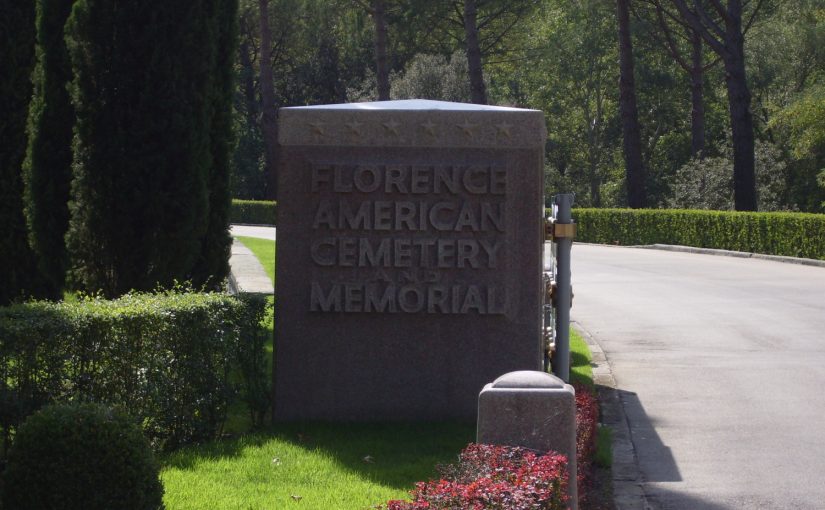
A determined young man in a black puffer jacket nervously clutches a map, tapping his fingers on its cover. An American teenager crouches by a headstone and slowly traces his fingers over the letters of its inscription as his dad watches from afar. An elderly couple stands at the entrance, shoulder to shoulder in awed silence as they look upon rows and rows of graves. They walk slowly, hand in hand, steeling themselves for the journey up the sloping path ahead of them. No matter the reason, it’s 10 a.m. on a Thursday in March and the lives of these strangers all intersect here at the Florence American Cemetery. 

Situated on the Greve River just outside of Florence’s city center, Americans and locals alike make the trip to the cemetery to gain familial closure and to learn more about the historical ties between Italy and the United States. The location of Florence was chosen for a multitude of reasons, starting with its ease of accessibility because of the nearby Santa Maria Novella train station and the bus routes that run with stops at the cemetery throughout the day. Since this is a World War II cemetery, there is a higher likelihood of visitors being descendants of those who have fallen and having memories to share and preserve about those buried here. 

Florence American Cemetery is managed by the American Battle Commission, whose overall mission is to ensure that “time will not dim the glory of their deeds.” Current superintendent Eryth Zecher has been working at the Commission for five years and has been maintaining the Florence American Cemetery for the past year and a half. She explains that the process for choosing the location dates to just after World War II when temporary cemeteries were set up in areas where major battles had just occurred. It was a time of transition when some of the fallen service members were being shipped back to America to their families and the temporary cemeteries were being compared to see which would be best fit for building a permanent cemetery. The Florence location allows a good proximity for visitors, and its rolling Tuscan hills made it a beautiful environment that was deemed fit for the sacrifices of the men killed while liberating nearby cities in the Northern Italian Campaign.

It seems surreal that their bodies eternally rest below the freshly manicured grass, with nothing but a shiny marble cross to signify their life’s worth. Lead gardener, Leonardo has been working with the nature of the cemetery for the past 10 years to keep it as close to the condition as the year that it was founded, in 1960. He polishes the headstones with a sponge and blows off all leaves and debris from each plot. He is passionate about his work and pays close attention to detail because of the gratitude he has for its historical significance. 

“My grandparents were freed by the American soldiers in 1944,” explains Leonardo, “For me, it’s an honor to work here.” 

Small, perfectly shaped Tuscan Cypress trees line the perimeter of the grounds, standing like soldiers at attention over the headstones. Leonardo shares that adult trees don’t grow very well in the cemetery’s environment, so he and his team raise the trees from saplings and keep them looking uniform. They don’t use chemicals on the trees, and everything is done by hand, including removing all weeds from the property. On this blustery, Thursday morning, I watch as two men take turns anchoring down wooden support stakes for smaller trees and chopping off uneven branches. 

The maintenance team and superintendent Zecher work diligently to make sure all the upkeep efforts reflect the promise to the fallen soldier’s families that their loved one’s resting place would be taken care of. The groundskeepers clean the memorial and headstones on a set schedule and work meticulously to keep them in perfect condition. 

“It’s just the ultimate mission to be able to commemorate and honor these service members every day and also work in such a beautiful place,” says Zecher, “I couldn’t find a better way to spend my life than doing this mission.” 

Florence Korea Film Festival 2025: Cross-Cultural Shock

written by Megan Cuviello & Ashlyn Loper

This blog feature is an exclusive bonus installment to our Spring issue of Blending Magazine. After you finish reading, be sure to explore the rest of the magazine online—just follow this link to download the full Spring 2025 edition:
https://jschoolfua.com/images/BM/BM_151.pdf

Since the 1980s, Florence has been an epicenter for art and has cultivated a space for individuals to express themselves. With the rebellious spirit of the city, fostering spaces for punk, street and alternative artwork and design, it’s no secret that the city has allowed for the culture within the city walls to flourish. This includes one notable place in Florence, Cinema La Compagnia. Cinema La Compagnia is a cultural venue located in the heart of Florence. The cinema opened in 1921 and was originally called Cinema Modernissimo. Then, between the years 1984 and 1987, it was transformed into the Teatro della Compagnia and eventually came to be what it is today. Cinema La Compagnia is a place where many film festivals and cultural festivals are held, making it the epicenter to showcase the art and talent of different cultures within the city of Florence.

The Florence Korea Film Festival 2025 was held at Cinema La Compagnia in Spring, 2025. It was a ten-day affair to showcase the different types of South Korean films, such as historical films, documentaries, short films, and many more of the South Korean culture. It showcased many independent films and filmmakers and allowed time for audience interaction with the filmmakers. This film festival has been held in Florence over the past two decades, and people from all over Europe, the United States and all over the world come to see the culture displayed at the Cinema La Compagnia through the Florence Korea Film Festival. 

Throughout the ten-day festival, we were able to attend multiple times to engage with individuals from all walks of life. On our first trip to the festival, we were introduced to the Florence Korean Film Festival Management Coordinator, Caterina Migliarini. We got to visit with Migliarini as she gave us an in-depth look into the festival while also introducing us to some of the history of Cinema La Compagnia. Migliarini stated, “People from all over come to the Cinema to see the Florence Korean Film Festival. People from Estonia, the Czech Republic and even India,” showing the cultural diversity that is welcomed into spaces of this nature. Migliarini also stated, “The beauty of the cinema is not just for the younger generation – it is for the elders and older generations.” This sparked conversation within our group as we reflected on the generations that had walked through Cinema La Compagnia at different times in history. Migliarini shared that it is one of her favorite places, if not her favorite place, in all of Florence, as she lives just down the street. Migliarini continued to share about how “the Cinema brings in Korean culture to other places” and the connections Cinema La Compagnia has with various universities, such as the European University Institute and also our very own FUA & AUF campus.

On our next trip to the Cinema La Compagnia and the Florence Korean Film Festival, we were able to attend a masterclass led by famous director Na Hong-jin. This South Korean film director was debuting his new film “The Wailing”. During this masterclass, we were able to learn more about his film detailing a Japanese man’s arrival in a small community. Through the masterclass, Hong-Jin’s passion for his work truly shone and allowed everyone in the room to grasp his concept. This also shed light on the true meaning of the independent film and allowed for a deeper understanding and appreciation that goes into all of the films shown in the festival.

Overall, the Florence Korea Film Festival at Cinema La Compagnia has opened its doors to a wide array of individuals and the artistry behind the independent films shown. While this film festival is just one effort in the continuance of the rich cultural heritage behind Cinema La Compagnia, it is also one of the many pieces to Florence’s cultural preservation and cross-cultural engagement. Everyone should take the opportunity to continue to support local and independent filmmakers, along with exploring the Florence Korea Film Festival for the 24th annual exhibition in 2026.

Finding Fashion & Finding Florence

written by Mia Romero

Coming to a new country by yourself can be scary, but learning how to fit into the culture can be even scarier. This is my experience witnessing fashion styles in Florence and learning to adapt to them myself.

Fashion is the style of clothing, hair, makeup, shoes, and so on, used by humans globally to express themselves. Fashion and the idea of fashion goes back centuries, but more specifically, the 19th century. In 1858, Charles Frederick became the first person ever to sew his label into garments he created, thus being the first “fashion designer” as we know it. Since then, fashion and style has elevated, changed, and adapted to different environments and to an array of people.

The biggest elevation of fashion I’ve ever noticed has been coming to Italy from the states. The people in Italy seem well-dressed, put together, and more understanding of expression through fashion. I have not noticed any locals wearing athleisure casually or sleepwear outside of the house, as I would see in America. I believe this is because Europe as a whole houses many of the main fashion capitals of the world. These capitals host weeks out of the year dedicated to showing off creative expression. It is an integral part of their culture and daily lives. It seems to be more respected and understood over here than in America. These events shape the trending styles to come and are watched carefully by locals as well as people all over the world.

I became intrigued with these fashion differences I noticed, so I decided to interview, research, and photograph my surroundings. I have found it extremely fascinating to witness my fellow students from all different parts of the world dressing well to class to fit into Italian style. I would argue none of us would dress as nicely for class at our home colleges.

I had a personal experience of wearing a hoodie and sweatpants around my hotel lobby and getting strange looks from all different types of people, from different areas of the world. It has become a known standard to dress well when out in Italy. After this experience I became much more aware of how I was leaving my apartment as well as how everyone else was.

During this time and the next few days, I was lucky enough to have a conversation with a local about her thoughts on fashion in Florence and Italy as a whole. I met a lady standing in line for a coffee shop who was dressed impeccably. She wore a blazer with dress pants and what looked to be red bottom heels. I could tell this was an expensive and well put together look. I began to tell her about my school journaling assignment and her thoughts on fashion differences worldwide. She explained to me that dressing well had always been the standard for her. She said, “Growing up, my mother and father dressed us in our best and it was expected of us as we grew. This was normal. I never saw my mother without beautiful hair or a nice dress on.” I found it interesting how she explained to me that it was normal to dress nicely and this had been instilled in her since childhood. I believe this to be the disconnect between fashion in Italy from other countries in the world. Parents are less expecting of what their child wears in other countries, thus holding lower standards in my opinion.

Although I discussed this topic with a few other locals, I got very similar responses across the board. The overall consensus being that dressing well had started during childhood and become a social norm. As an American student, I envy the fashion sense these interviewees held. Anyone can buy an expensive outfit, it was the way they styled these outfits that stood out to me. They each had something people around the world try to achieve, which is knowing how to style themselves perfectly. Overall, I grew in my knowledge of stylish appearance and the standards in different parts of the world.

Art as Protest

The Political Undercurrents of Florence’s Futurism Movement and Its Impact in the Modern World

written by Susana Colunga

This blog feature is an exclusive bonus installment to our Spring issue of Blending Magazine. After you finish reading, be sure to explore the rest of the magazine online—just follow this link to download the full Spring 2025 edition:
https://jschoolfua.com/images/BM/BM_151.pdf

Florence has long been known as the cradle of the Renaissance, a symbol of classical beauty and deep cultural tradition. But by the 20th century, the city; like much of Italy, was ready for a leap into modernity. This transformation came with the rise of Futurism, one of the most radical and revolutionary artistic movements of the time.

Founded by Filippo Tommaso Marinetti on February 20, 1909, Futurism challenged Italy’s cultural conservatism and aligned itself with bold political change. The movement rejected traditional ideologies like conservatism, liberalism, and socialism, instead celebrating a new vision that emphasized speed, innovation, violence, and the power of the individual.

Futurism aimed to destroy the past in order to build a new, dynamic future.

The movement began with Marinetti’s Manifesto of Futurism, a provocative call to artists around the world to embrace modernity and abandon outdated ways of thinking. It inspired creatives and politicians alike, offering a blueprint for revolution and renewal. For Futurists, artists were not just visionaries they were leaders, responsible for reshaping the political and cultural landscape.

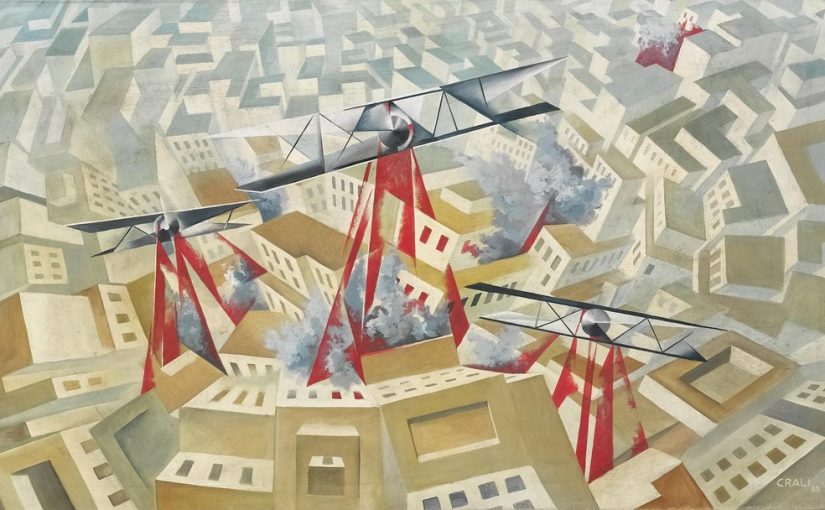
In Florence, Futurism quickly aligned with the rise of Fascism and the political career of Benito Mussolini. As Marinetti publicly supported Mussolini, many Futurist artists followed, embracing violence and destruction as necessary tools for building a new world. Their art reflected this ideology through militaristic and nationalistic themes, visible in poetry, posters, and especially painting. In his manifesto, Marinetti famously called war “the world’s only hygiene.”

The relationship between Futurism and Fascism intensified during World War I. Marinetti and his followers supported Italy’s entry into the war, and some even volunteered to fight.

However, rather than ushering in the radical transformation they envisioned, the war left Italy politically and economically devastated. This collapse only deepened the Futurists’ desire to rebuild a powerful, modern nation.

In 1919, Futurists carried out one of their most notorious acts: the burning of the socialist newspaper Avanti! in Milan. Led by Marinetti, the group set fire to the newspaper’s offices, seeing it as a symbolic act of defiance and alignment with Fascist ideals. Their commitment to political violence only grew, and by the March on Rome in 1922, which brought Mussolini to power, many Futurists believed they had finally achieved the society they had long imagined. But over time, Fascism became more institutionalized and authoritarian, drifting away from the chaotic, revolutionary energy of Futurism. Eventually, the two movements diverged, with Fascism absorbing some Futurist aesthetics but abandoning its more radical artistic ideals.

Still, Futurism’s legacy didn’t disappear. In the 1970s and 1980s, its influence reappeared in various political and artistic movements, particularly through its aesthetic and ideological emphasis on dynamism and transformation. One example is the Italian Autonomia
Movement of the 1970s, a radical leftist collective of students and workers who rejected both capitalism and communism. Their use of bold typography, manifestos, and dynamic visual styles clearly echoed Futurist strategies. Elements of Futurist design found their way into underground magazines, protest posters, and political demonstrations.

Similarly, radical architecture groups such as Superstudio and Archizoom (active from the 1960s to 1980s in Florence) embraced Futurist ideals of destruction and renewal. Their futuristic designs, filled with utopian and dystopian visions, critiqued capitalist consumer culture and proposed bold alternatives to conventional architecture. These movements emerged from Florence’s long-standing tradition of underground intellectual exchange, dating back to the literary cafes of the 19th century, where artists challenged the dominant norms of their time.

Futurism was more than an art movement, it was a cultural and political force that left a lasting imprint on Florence, Italy, and beyond. From its revolutionary beginnings to its entanglement with Fascism, and later its echoes in radical protests and design, Futurism showed how deeply political ideology can shape artistic expression. Even today, we can trace the movement’s legacy in the ways artists challenge norms and imagine new futures, often in the same underground spaces where past movements once thrived.

Finding A Home In Florence

written by Brooke Beste for SPEL: Public Relations

Living abroad isn’t always picture-perfect. Through culture shock, homesickness, and self-discovery, I’ve learned that finding “home” in Florence takes time, patience, and an open heart. This is my journey.

I have currently been away from home for 13 weeks… not that I’m counting. While being away and immersing myself in a new culture, I’ve discovered that I value energy and the overall ambiance of my environment. I love to observe and analyze culture, food, individual attitudes, and especially fashion. Over time, I’ve found my favorite places—and a few dislikes—within Florence. I’ve explored other countries and experienced different ways of life, but I’ve come to a solid conclusion: the way Italians live is unlike anywhere else I’ve visited. 

While Florence is often portrayed through the lens of grand cathedrals and iconic artwork, I’ve learned that the real soul of the city is found in its quiet corners, local rituals, and everyday encounters. As a student living and studying here, I’ve discovered that capturing these moments through photography offers a more intimate and authentic narrative of Florence—one that goes far beyond the postcard image. 

At first, the locals gave me a hard time. From graffiti that read “Yankee Go Home” to the frustration of not understanding the Italian language, I genuinely felt like an outsider during those first few weeks. However, that all began to change once I started school. I suddenly had a

community of individuals around me who wanted to grow and learn just as much as I did. I began to understand the way of life in Italy. 

I started feeling comfortable ordering at restaurants and learning the etiquette of being in Italian society. By week eight, I finally felt like I had a grip on the reality of Florence. I realized the importance of leaving the house looking presentable and enjoying my food inside the restaurant instead of ordering it to go. These small changes made me feel more connected, intentional, and at ease in my new environment. 

Still, being homesick has been a complicated emotion to process. Sometimes it makes me feel guilty. I’m the baby of my family and incredibly close to them—they truly are my best friends. I’ve never been away from them for this long. I miss the simple things: my favorite dark blue suede couch in the living room and Chipotle just down the street. 

But when I sit with these thoughts, I can’t help but smile. How lucky am I to live in the heart of Florence, surrounded by my friends? Within just a few miles, I can be at the train station with endless possibilities. This once-in-a-lifetime opportunity has taught me so much about gratitude—how to thoroughly soak up the Italian sun and appreciate the unique beauty of my life this semester. 

Florence doesn’t offer the same activities my home city of St. Louis once did, and that’s okay. I now walk everywhere, eat pasta shamelessly every day, and leave the house feeling confident in my ability to handle whatever problems the day brings. Florence has shown me how to slow down my overthinking mind. It’s helped me discover where I find happiness and what interests me. It’s allowed me to feel more mature and make decisions supporting my well-being. 

As I approach the end of this study abroad journey, I feel deep appreciation. The excellent professors and advisors I’ve met have shown me how much kindness and intellectual curiosity matter in helping students succeed and stay on the right path. The learning experience of being a twenty-something in Florence has shown me that finding a “home” is more than a physical place to sleep and eat—it’s about the culture, the time, and the personal growth you experience along the way.

Florence has become a part of me. And in its own way, it has become home.

Mystery Meets Mixology

The Evolution of Florence’s Hidden Bars and the Art of Underground Mixology

written by Trinity Conner, Molly FitzGerald, Olivia Adams, Lila Williams & Marisa Jones

This blog feature is an exclusive bonus installment to our Spring issue of Blending Magazine. After you finish reading, be sure to explore the rest of the magazine online—just follow this link to download the full Spring 2025 edition:
https://jschoolfua.com/images/BM/BM_151.pdf

Florence’s artistic spirit isn’t confined to its galleries and historic cafés; it also spills into the city’s underground secret bars—modern-day echoes of Prohibition speakeasies—where secrecy, craftsmanship, and storytelling converge into a singular drinking culture. The hidden bars, like the literary cafés of the past, create an underground atmosphere of exclusivity and creativity, elevating mixology to an art form.

The evolution of Florence’s modern hidden bar scene highlights how these establishments mirror the city’s avant-garde movements by reinventing tradition. Behind unmarked doors and secret entrances, guests enter spaces that showcase both history and innovation.

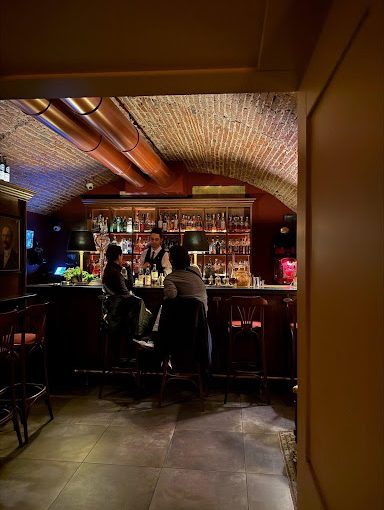
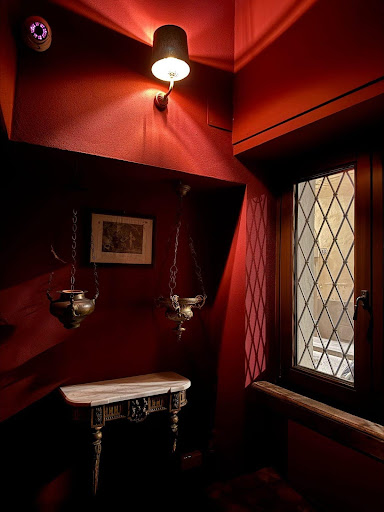
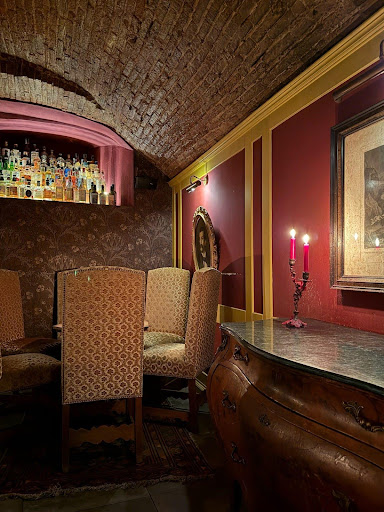
The underground nightlife of the 1980s has evolved into today’s hidden bar scene, shaped by the rise of cocktail culture and modern mixology. One key example of this evolution is Rasputin, Florence’s first hidden bar, discreetly tucked away in Santo Spirito. This underground cellar, with its candlelit tables, antique furnishings, and a rules page on the menu, transports visitors to a vintage atmosphere where handcrafted cocktails strike a balance between tradition and innovation.

Taking a visit to Rasputin feels like traveling back in time, allowing individuals to feel immersed in rich history. Maintaining a strict no-phone policy, discouraging excessive phone usage, and flash photography to keep the experience authentic. These policies enforce full presence, something that is rare in today’s digital world. The hushed conversations, the clinking of glasses, and the soft jazz music in the background make it feel like stepping into another era.

Marco Vinci and Ghermai Zerazion, the co-founders of this hidden gem, came up with the idea to bring a seamless combination of America’s past and present to Florence, Italy. During Prohibition in the United States, the production, sale, and transportation of alcoholic beverages were outlawed. As a result, clandestine bars, now known as speakeasies, sprang up across the country. Therefore, these tucked-away spots were places where people could socialize, dance, and drink bootleg whiskey and gin, despite the looming threat of raids, arrests, and jail time. The consequences were harsh, but the desire was irresistible. Rasputin allows individuals from all over the world an immersive experience of life during this time.

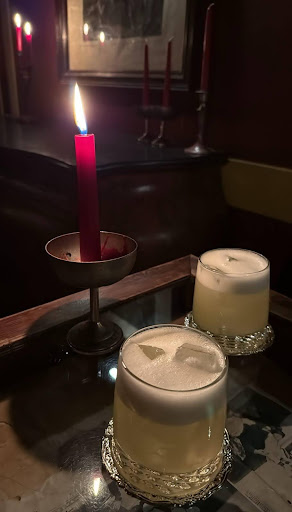
The cocktail menu is as thoughtfully crafted as the space itself, offering a mix of classic recipes with modern twists. The standout for us is “Our Bee’s Knees,” a drink that combines honey, lemon, and lavender into a refreshing and balanced flavor. The foam on top added a nice touch, making it feel both indulgent and relaxing.

The bar also has an impressive selection of over 300 labels, including a wide range of whiskeys, which made the menu feel like more than just a list of drinks—it is an opportunity to learn and explore. Overall, it is a place where the drinks and the atmosphere come together in a way that feels both approachable and special.

Rasputin isn’t just a speakeasy; it’s a hidden world that combines history, mystery, and artistry. If you are looking for a night that blends sophistication with a touch of secrecy, this is a must-visit while in Florence.

Beyond Rasputin, other hidden gems like Vanilla Club Speakeasy capture the charm of the Prohibition era with its password-protected entrance, dark wood interiors, and soft jazz music. The bar’s strict no-phone policy encourages people to experience expertly crafted, Italian-inspired cocktails in an intimate setting.

Beneath Grand Hotel Cavour, The Secret Bar offers an underground lounge experience framed by exposed brick arches and antique chandeliers. Florence’s culture inspires The Secret Bar’s menu, so they transform cocktails into stories that reflect the city’s artistic evolution.

Florence’s hidden bars are more than just places to sip cocktails, they are doorways to another time, where history lines the dimly lit walls and mixology becomes an artful performance. Like the literary cafés of the past, these speakeasies craft narratives with every pour, which blends tradition with innovation in a way that holds Florence’s charm.

Whether you find yourself behind the unmarked doors of Rasputin, sharing secret passwords at Vanilla Club, or uncovering the meaning of The Secret Bar, each visit is an invitation to step beyond the normal. In a city known for preserving its artistic heritage, Florence’s underground bars prove that history isn’t just something to admire; it’s something to taste and experience, one cocktail at a time.

The Art of Getting Lost in Florence

written by Talia Velazquez for SPEL: Public Relations

A reflection on how exploring Florence encourages spontaneity and discovery, highlighting the city’s charm in its unpredictability and the value of wandering off the beaten path to uncover hidden gems and unique experiences.

They say, “You don’t know what you’ve got until it’s gone.” I would say they are right about everything… except Florence. I’ve known all along. 

Every weekend that I pack a bag and leave for some new, exciting city, I feel a little sad–not because I don’t want to explore, but because I already miss home. Not my home-home. My Florence home. My creaky-ceilinged apartment with the mural above my bed. The little store I pass every morning on my way to class, where the dogs are always lounging by the window like they’re in on some secret. And let’s not forget the cobblestone streets that have tested my ankles more times than I can count but somehow still feel charming. There’s something about the worn-out texture of this city that makes it feel alive in a way my clean, polished hometown never could. It’s these small, oddly specific details that have worked their way into my daily rhythm–and now, I can’t imagine my life here without them. 

At first glance, Florence was a maze. I had no idea how to get anywhere without my GPS, and honestly, I treated that little blue dot like my personal life raft. My classes were a 20-30 minute walk from my apartment, and I’d just stare at my phone, hoping it would lead me safely to my destination. One day, my phone died mid-walk; I had no choice but to try to figure out my way back without it. And, in those 30 minutes of trying to “not panic,” I found three new cafes, a few tiny shops, and a quiet little park I had no clue was just around the corner from where I lived. 

It was an accident–but one of the best accidents of my life. 

Since then, I made a habit of getting lost on purpose. I made it a rule: no GPS. I embraced getting lost. Florence rewards you for it, like it’s daring you to wander. Around every corner, there’s something new–an old man selling fresh strawberries, a second hand bookstore with handwritten notes tucked inside the margins, a view from a bridge I’ve never crossed before that feels like a scene out of a movie. These little treasures wouldn’t exist if I stayed on the beaten path, glued to my phone or my to-do list. These are things I’d never find back home. Things I might never find again, even here.

Every single day since I arrived in Florence, I’ve stumbled upon something new. It’s become my daily ritual–taking a different route, looking up instead of at my feet, discovering the city for the first time all over again. My roommates and I even started this funny little game: “What place did you find today?” We know the answer will always be something we’ll all end up visiting together at some point. Florence is like a love letter to curiosity–always waiting to reveal something amazing if you’re just open enough to look. 

When I’m away on weekends, I miss that. I miss the random joy of wandering with no plan, of not knowing where I’m going, but finding something unexpected around every turn. I miss my roommates, too. Staying up late with people from all over the world, talking about nothing but everything at the same time. Swapping stories, comparing cultures, laughing about weird language slip-ups or marveling at the strange, wonderful ways we have all changed since we got here. I miss that feeling. The feeling that even when I have no clue where I’m headed, I know exactly where I belong. 

Florence has made me softer and more spontaneous. Less scared of being unprepared. I’ve stopped trying to plan for everything. I’ve started letting the city guide me, saying “yes” to more things than I ever would have back home: spontaneous dinners with new friends, tagging along with people who seem to have an endless supply of places to explore, or even just stepping out of my comfort zone and taking a walk down a street I’ve never been down before. I’ve learned that you don’t need to have every moment mapped out to make it count. Florence has shown me more than I ever could have scheduled into an itinerary. 

And here’s the thing: I thought I’d get tired of it. I thought the charm would fade, the magic would wear off. I mean, how many breathtaking sunsets over the Arno can one person handle, right? But now here’s the truth: Florence hasn’t gotten old. It’s only gotten more real. It’s not perfect–far from it. The roads are bumpy, the traffic is chaotic, and sometimes it feels like I’m living in a postcard that’s a little too messy to be real. But that’s the beauty of it. It’s raw. It’s alive. It’s a city that doesn’t apologize for being exactly what it is. And because of that, I’ve learned to stop trying to have everything perfectly planned out. Because life isn’t about following a schedule–it’s about the moments in between. The unexpected discoveries. The conversations that stretch until 2 a.m. The way the city feels like it’s breathing with you, not just around you. 

I look back and realize: I’ll never be 19 in Florence again. I’ll never walk these streets in the same way, with the same people, in this same moment. And honestly? I wouldn’t want to. Florence has given me a version of myself that I never expected to find–a version that can be spontaneous, that can wander without a destination, and that can embrace the unknown. That’s what Florence has taught me: to say yes to the journey, to find beauty in the detours, and to never be afraid of getting lost. Because sometimes, getting lost can lead you to exactly where you need to be.

Florentine Streets, Clet’s Canvas

written & photographed by Kathleen Morris

This blog feature is an exclusive bonus installment to our Spring issue of Blending Magazine. After you finish reading, be sure to explore the rest of the magazine online—just follow this link to download the full Spring 2025 edition:
https://jschoolfua.com/images/BM/BM_151.pdf

How many stories can a single office avocado tell?

As I set my laptop onto Clet Abraham’s cluttered desk, I took inventory of its miscellaneous contents: an avocado, a glass with a solitary drop of red wine left behind and an array of art supplies – pencils, cutting tools and scattered pages filled with cartoonish sketches.

I set my cellphone atop a strip of stickers depicting bright pink sausages, thumb hovering over the record button – ready to capture every bit of wisdom from the infamous street artist who I was face-to-face with at last.

The conversation was highly anticipated. Earlier that morning, after exchanging a flurry of WhatsApp messages with an employee at his Florence studio—including a pointed warning not to address him by his full name, Jean-Marie Clet Abraham—I stepped into the cluttered space – I made the trek across Ponte alle Grazie to his studio on a sun-soaked Monday afternoon.

Tiptoeing down the sidewalk, I realized I didn’t need to consult Google Maps to know I had arrived. I followed a wall plastered in a chaotic assortment of stickers – a street artist’s rendition of the yellow brick road.

My instincts were confirmed by the street sign placed just above the door, reimagined to depict a tiny figure flying through the air, its grip tight on the tip of the white arrow.

photo by Kathleen Morris

The use of street signs has become a trademark of Clet’s art.

Originally from France, Clet has now claimed Florence itself as his canvas.

I first encountered his work by the Medici Palace. With crooked eyes and a corkscrew neck, a portrait of childhood whimsy is plastered onto a traffic sign, its head formed by diverging arrows. In the following days, I began to train my vision to spot Clet’s characters tucked into every corner of this historic city.

My article joins countless attempts to profile the elusive artist, who has earned celebrity status (and over 160k Instagram followers) in a destination that echoes with the voices of the Renaissance.

I sought to understand the path of the man who sat across from me, salt-and-pepper hair draped across his forehead and backdropped by a wall of unfinished masterpieces.

The son of creative parents, he recalled his earliest inclination to art.

“When I was young, I used art to be free,” Clet said. “I don’t care about art. I care about freedom.”

Today, his urban installations serve as an outlet for self-expression and a medium for political commentary. With a rebellious flair, he inspires dialogue about pressing social issues and individual rights. Behind his desk, a sign was spray-painted with the colors of the Palestinian flag. The artwork, created in collaboration with the Art for Gaza Collective, exemplifies Clet’s efforts to garner a reaction from and activate the public.

“I don’t think I am the owner of my ideas,” he mused, reflecting on the essence of collaboration he shares with those who engage with his work. “The ideas pass through me,” he said, describing his ability to sculpt messages and inspire his community to think outside the box.

photo by Kathleen Morris

Clet refuses to be confined by artistic boundaries, finding fulfillment in working beyond the walls of traditional museums.

“I don’t work with galleries,” he underscored. “The best place is always the street.”

Clet navigates the gray area between creating impactful art and defacing public spaces. The allure of street art lies in the ambiguity of this ruleless game – a game that Clet has mastered on a global scale, often operating under the cover of night.

“In the United States, I always [install art] at night because I don’t want the police to stop me,” he revealed. “I don’t want to have a big problem and lose my plane ticket to go back home.”

In a perfect world, city authorities would recognize the positive aspects of his work. He imagines that increased acceptance would act like a “business card,” allowing him to explore cities that are “more difficult, where there is less democracy.”

Until then, Clet can be found cloaked in darkness or in the safety of his studio at Via dell’Olmo, 8r in Florence.

Before I exited his sticker-clad oasis, I gathered two pieces of advice from Clet for aspiring artists: embrace your originality, and when working on the streets, it’s best to be a little drunk.

photo by Kathleen Morris

For more information, visit Clet’s website or follow Clet on Instagram (@cletabraham).

Transportation in Florence: Trading Cars for Cobblestones

written by Ashlyn Roselle

Florence, Italy, widely regarded as the heart of the Renaissance, is a city where the past is not only preserved, but woven into everyday life. The tightly packed cobblestone streets, and historic buildings are unlike the sprawling cities many American students are used to. For those studying abroad, Florence allows cultural immersion, but not without some practical adjustments, especially when it comes to transportation.

Most American cities were designed around the car, Florence however was built centuries ago for pedestrian traffic, carts, and horses. Today, the city’s historic layout remains largely intact, protected by strict preservation laws. The timeless charm that remains in Florence today is beautiful, but creates an unexpected challenge for students abroad. There is a large question mark in everyday life: how do I move through a city that was designed for another era?

Florence’s current layout is rooted in its medieval and Renaissance past. The narrow, winding streets and densely packed buildings are from a city that was never intended for modern day cars. Due to this, much of central Florence is a limited traffic zone (ZTL), where only residents and permitted vehicles are permitted to drive. Public transportation consists of buses and trams, where they travel mostly the outer zones of the city. The inner city is primarily navigated on foot or by bicycle.

For students from the US, where cars are a central part of everyday life, this can be a major shift.

Maddie Oberly, a current FUA student from Connecticut says, “In Connecticut we rely greatly on cars to get us from place to place. However here it was solely on walking and the public transportation systems like the bus.”

The transition can be jarring, but it’s also one of the most rewarding aspects of studying abroad in Florence. Students are able to truly immerse themselves in the city and soak up their surroundings of Renaissance facades and hidden piazzas while strolling to class. The lack of reliance on cars encourages deeper exploration and a more intimate connection to a place.

Another current FUA student, Trace McCament reveals his experience with transportation in Florence thus far. “The amount of walking definitely surprised me, but it’s been super nice to walk around and explore. Before dinner, it’s easy to just stroll around, read menus, and people watch, which is fun.”

Students, like Trace, soon discover that Florence’s compact design works in their favor. Most major landmarks, cafes, apartments, and restaurants are within walkable distance. What initially seems like an inconvenience becomes an unexpected part of the adventure.

Bikes and scooters are immensely popular amongst residents of Florence. There are designated parking zones for both and they are always packed. There are also rentable electric scooters and bikes for tourists, providing modern solutions for longer distances.

The pedestrian-friendly architecture of Florence doesn’t just change how students move, but changes how they live. Walking everywhere promotes physical activity, lowers stress, and encourages spontaneous interactions within the city. The benefits of walking 10,000+ steps per day are incredible, which most individuals struggle to do while in the US if they are not creating intentional time for activity. Many students report feeling healthier, more independent, and more connected to their environment after just a few weeks.

The environmental impact is real. With limited access to cars and a focus on sustainable transport, Florence experiences less traffic, lower air pollution, and an overall more pleasant atmosphere. These conditions create a safer, more accessible environment for students to thrive while abroad.

Studying abroad in Florence offers more than academic credit, it offers a new perspective on urban living. Students gain firsthand insight into how city design influences lifestyle and community. Compared to the wide streets, long commutes, and car dependency of many American cities, Florence demonstrates an older, but highly effective model of urban planning.

That contrast often sparks reflection.

Maddie Oberly admits, “I have honestly loved the exercise aspect of walking and it has been weird to get used to the bus system… but with patience it’s really easy to figure out and utilize in ways that can benefit us as students.”

Adapting to Florence’s pedestrian-focused lifestyle is easier with a few tips:

  1. Plan Ahead – Walking and biking takes time, so build buffer time into your schedule.
  2. Comfort Matters – Invest in a good pair of walking shoes, those 20,000+ step days will sneak up on you!
  3. Learn the Local Routes – Familiarize yourself with your walk to class and apartment for easy navigation.
  4. Embrace the Pace – Allow yourself to slow down and experience the city instead of rushing through it.
  5. Try the Rental Bikes – It’s okay to have a little adventure every now and then, just don’t hit anyone!

Florence’s architecture has preserved history and now shapes modern life. For students abroad, that means adapting to a new way of getting around. It requires you to learn how design and environment influence everything, from mobility to mindset.

By stepping into Florence’s streets, students also step into a bigger conversation about sustainability, community, and how cities can be built around people instead of machines. This is a lesson that reaches far beyond the classroom and one they’ll carry with them long after the semester ends.

Are you guys Nazi’s?

written by Lilly Vergnes

This blog feature is an exclusive bonus installment to our Spring issue of Blending Magazine. After you finish reading, be sure to explore the rest of the magazine online—just follow this link to download the full Spring 2025 edition:
https://jschoolfua.com/images/BM/BM_151.pdf

Lorenzo Carollo grew up in the northern part of Italy, in a small town near Verona. He followed the typical life path of an Italian teen, adding some illegal graffiti work in the mix. After high school, he went on to study History in Padova. You might wonder what kind of hobbies and activities one gets up to in rural northern Italy. For Carollo, he did not have to look far. He works in a mechanical factory, takes an interest in medieval history, plays the bagpipe, and in recent years has become a Skinhead. He has his hair cut short, wears boots and bomber jackets and goes to as many concerts as he can. This is also where I met him, at a concert at the Centro Popolare Autogestito (CPA) in Florence. I personally go to the CPA for its cheap beer and good music. Little did I know, that night’s concert was being played and attended by Skinheads. My first thought and question when I heard ‘Skinhead’ was, Are you guys Nazi’s? They all laughed, and Carollo started to explain the Skinhead movement to me over the loud music. 

Skinheads originated in Britain in the ‘60s. They were primarily influenced by Mod and the Jamaican Rudeboy subcultures, with a working-class pride and rejection of conservatism at the time. The original Skins had a lot of influences from Jamaican music and culture, such as Ska and Reggae. Later, in the ‘80s, a Punk aspect was introduced to the movement, with the working class Punk Rock Oi!. This was then mixed with the Jamaican genres from the previous generation, which was referred to as 2Tone. If these are the origins of the movement, then why do we only now associate Skinheads with white supremacists? 

During that same time in the ‘80s, the movement split up into two very distinct directions: far-right and left/apolitical. Britain’s political climate was precarious, and far-right supporters saw the Skinhead subculture as an opportunity to express their ideology. This spread fast, and by the ‘90s, neo-Nazi and fascist groups existed all over Europe and North America. 

photo by Lilly Vergnes

This is the image we still associate Skinheads with today in the mainstream mindset. However, a reaction to these right-winged groups quickly started. The movement known as Skinheads Against Racial Prejudice (SHARP) was created as an anti-fascist and anti-racist group. Today, they are considered an extension of the original Skinhead culture, the ‘real’ Skins. Skinheads completely deny the fascist groups as part of the movement, even refusing to call them ‘skinheads’ but ‘boneheads’ instead. The Skinheads main ideals are inherently left-wing, although some of them identify as apolitical.

Carollo first became familiar with Skinheads through some people he knew from high school. As a teen, he was interested in forming his own opinions on political matters. He was approached by some guys from a far-right Skinhead group in Vicenza, who wanted him to potentially join their group. After listening to some of the things they had to say, Carollo decided that their opinions did not align with his morals at all. He had a good friend who was black, whom he knew to be a good person, so he thought: how could it be true that all black people were bad? He made up his mind and began associating himself with people from the anti-fascist side of the movement: Skins from a smaller group called the Reggae Lads. Their ideas and morals lined up much more with his own, as he explained, “I could never understand why you would decide to hate. If you see a black man walking on the street who is smiling, you can’t be happy for him just because of the color of his skin? This is so stupid to me.” 

As for myself, I never realized that Skinheads are not what we see in the mainstream media. In reality, it seems like a subculture like many others, with their music, fashion and ideals, even ideals that most people could get behind. They are just as much, if not more, against neo-Nazi’s and facism as anyone else. In some way, they are the ones that are trying to make a positive change in the world.

Preparing for Florence: A Student’s Guide to Study Abroad at FUA

written by Savannah Carley for SPEL: Public Relations

A student-written guide to studying abroad in Florence, offering practical tips on packing, planning, and adjusting to life at FUA through personal experience.

Before I left for my study abroad program, my search history was filled with “What to pack for Florence, Italy” and “Best tips for studying abroad.” Every video and article gave the same advice: bring a portable charger, pack basics, and buy toiletries once you arrive. While these tips were helpful, I still felt uncertain. How many clothes should I really bring for six weeks? What would it feel like to land in a brand-new country? 

I remember wishing I had someone who had just done this to walk me through every step. While a lot of studying abroad depends on personal preferences and unexpected moments, I hope this guide offers advice that goes beyond the usual checklist you’ll find on social media. 

Here are some of the most helpful things I learned while preparing for my own study abroad experience. 

Plan Ahead Early 

My biggest piece of advice may sound simple, but it’s essential: do not wait until the last minute. This includes everything from sorting out academics and booking flights to making sure you have the right chargers and adapters. 

Start with your academics. Make sure your courses align with your goals and will transfer properly. Research programs thoroughly and don’t hesitate to ask questions. There are so many unique and specialized opportunities out there. Sometimes, just talking to someone can lead you to a class that’s a perfect fit that you might have otherwise overlooked. 

Stay in close contact with your home university to confirm credit transfers and requirements. Once academics are settled, take care of travel documents. Make sure your passport is valid and check whether you’ll need a visa based on your program’s length. 

After that, book your flights. Having your plans finalized will make everything else smoother. One tip: research your connection airports. I didn’t and ended up with an impossible layover in Paris. Knowing what to expect can ease a lot of stress, especially if it’s your first time abroad. 

Research Florence and Italian Life

Before you start packing, take time to learn about Florence. This can include anything about the culture, neighborhoods, public transit, tipping, or even how grocery stores work. The more familiar you are with daily life, the easier the transition will be. It’ll also help you pack smarter and with more intention. 

Packing 

Packing can be stressful, especially for a country you’ve never visited. For clothes, think layers and neutrals you can mix and match. Italy in early summer starts off cool but heats up fast. I relied on linen pants, airy skirts, and flowy dresses. Here’s what worked for me for six weeks in the summer, though I tend to overpack: 

● 10 Tops: Tanks, basics, flowy shirts 

● 3 Shorts: Linen, denim, patterned 

● 4 Pants: Jeans, linen, lightweight trousers 

● 5 Skirts: 3 long, 2 short 

● 3 Outerwear pieces: Jean jacket, sweater, linen cover-up 

● 4 Dresses: 2 long, 2 short 

● Comfy wear: Leggings, sweatshirt, pajamas 

● Shoes: 1 pair of tennis shoes, 1 pair of sandals 

Beyond clothes, don’t forget the essentials. You’ll use your phone constantly for maps, photos, and travel info, so bring a portable charger. Also bring multiple European plug adapters and extra cords in case one breaks. A small first aid kit with basics like Advil, cold medicine, band-aids, and any personal prescriptions is also a lifesaver. If you plan to buy toiletries in Florence, pack enough to get you through the first few days. You’ll be adjusting and might not get to the store right away. 

I also recommend bringing something to document your experience. For me, that was my camera. For you, it might be a journal, a sketchbook, or even voice notes on your phone. Having a way to capture your thoughts and small moments will help you slow down and appreciate your time abroad even more. A little intention in your packing can go a long way. Focus on comfort, versatility, and what makes you feel at home abroad. 

Final Prep 

Before you travel, make copies of your important documents, like your passport. I also created a printed list of important contacts, both for my program and back home, as well as key addresses. I kept it in my carry-on in case my phone died while traveling. Having a physical backup gave me peace of mind and ensured I wouldn’t be completely lost without my phone.

As your departure approaches, take time to prepare your mindset. The first few days may feel overwhelming. That’s normal. You will adjust. Learning a few basic Italian phrases can boost your confidence and show respect. I also recommend making a short bucket list of what you want to accomplish while abroad. It helps you stay excited and intentional. But, also stay open to spontaneous experiences. Those are often the most memorable. Most importantly, stay present. This is a once-in-a-lifetime opportunity! 

Final Thoughts 

Studying abroad in Florence has been one of the best decisions I’ve ever made. It can feel overwhelming at first, but every step you take to prepare will make your time abroad smoother. No guide can prepare you for everything, but I hope this one helps you feel more grounded and excited. Be curious, stay open, and give yourself grace. You’re about to begin something unforgettable!

Hidden but Not a Secret: The Underground World of Mercato delle Cascine

A historic open-air market where Florentines gather to sell and find clothes, food, household items, and anything else you could possibly imagine. There is a vintage presence along with a modernized vision occurring here.

written by Meredith Simpson, Amelia Mora, Alaura Cross, Sabrina Harris & Katie Brooks

This blog feature is an exclusive bonus installment to our Spring issue of Blending Magazine. After you finish reading, be sure to explore the rest of the magazine online—just follow this link to download the full Spring 2025 edition:
https://jschoolfua.com/images/BM/BM_151.pdf

As you enter the 1.5-kilometer-long market, the hum of bargaining surrounds you–an elderly woman haggles over schiacciata bread while a mother negotiates the price of pecorino cheese. The freshly roasted porchetta drifts through the air, mixing with the scent of sun-warmed leather from handcrafted belts displayed on a nearby stall. The sight of endless crowds moving between stalls, clutching canvas bags brimming with colorful produce, is overwhelming. A sense of curiosity stirs inside from the “offerta €1.50” signs. You wonder: Is this an authentic Italian bargain or just a tourist trap?

Il Mercato delle Cascine is the largest and cheapest open-air market in Florence, with its origins traced back to the 19th century. The market started as a place for Florentines to gather weekly to buy necessities at a bargain price. It is located in the biggest park in Florence, Parco delle Cascine, along the Arno River, and remains in the same location. During the ‘80s, the market stood as a place for authentic Italian vendors to come and sell their products to locals. The market’s products reflected Italian craftsmanship, and vendors were often Florentine families who had been selling for generations. Vendors and customers knew each other, and shopping here felt like an extension of local culture rather than a transaction. The market fulfilled every need, from groceries to clothing and household items. You could find a cobbler selling hand-stitched leather shoes beside a seamstress repurposing vintage silk scarves into elegant blouses. It was an integral part of the Florentine community to go and find truly vintage items.

Since the ’80s, the market has grown beyond its original Italian roots, reflecting a wave of globalization. As Florence became a prime tourist destination, its markets shifted to cater to new demands. In the past, every item was locally sourced—whether it was a handmade ceramic bowl or a handwoven scarf. Now, the merchandise tells a different story. There is a new wave of vendors who sell low-grade clothing products for 3-5 euros. These products have been unethically produced, which contradicts the original purpose of the market. A stall once known for vintage linen shirts now sells polyester blouses with “Made in China” labels. Where artisans once handcrafted belts from Tuscan leather, now imitation leather accessories line the tables. They are often indistinguishable from real craftsmanship until you touch the synthetic material.

The arrival of new vendors has shifted products from locally sourced Italian goods to imported fast fashion. These goods have been replacing Italian leather with synthetic fabrics, yet are sold at the same price. One of the many clothing stalls sells dupe designer shoe brands like Alexander McQueen for 10 euros. This “sale” can give the market a less authentic atmosphere and offer these already inexpensive products at a price that feels like a bargain. It’s clear that these items are not vintage, nor are they part of Florence’s rich fashion history. But for many shoppers, price wins over authenticity.

One local who has visited the Cascine market for decades expressed how the impact of new merchandise has changed the market’s motive from what it was supposed to be. It was originally meant to be a place where locals would come to find second-hand items and give them a new life. Under some vendors’ tents, that’s still the case. You can find well-known re-purposed brands like Levi’s and Diesel for an amazing low price. The market is still successful in its own way, but the new generation of vendors has taken advantage of the authenticity as a way to make a profit on mass-produced fashion.

Some may see this shift as an evolution that keeps the market relevant, while others feel it dilutes Florence’s fashion heritage. The market is held only on Tuesdays from 7 a.m. to 2 p.m. and still flourishes today. The food still smells delicious, and the prices are still low. But is a bargain worth the shift in focus?

Travel Fatigue: The Day Trip For When You Need A Break From Day Trips

written by Hannah Johndrow for SPEL Public Relations

Because my study abroad term was only six weeks long, I packed in a lot of travel into such a short period of time. I didn’t know anybody else going abroad with me, so I didn’t plan any trips in advance as some other students do. I was initially worried that I wouldn’t be able to travel much on the weekends, or that I wouldn’t have anybody to go with. 

I got along very well with my roommates, so we established a sort of unspoken travel group among the three of us. We were bad at planning ahead, so almost every trip we took was booked at the very last second. While I’m not here to recommend following our lead in that respect, I did take the time to compile an itinerary for one of my favorite day trips that I took during my time here in Florence. The constant travel on the weekends most definitely catches up to you, so this is the perfect day trip for when you just need a break from traveling, but still want to explore Italy! 

Travel Tip 

First of all, a quick disclaimer before we get into the full story. I’d like to share some advice for traveling in Italy! When traveling by bus or train, it is really important to understand their ticket validation system. This was a major culture shock for me. In the U.S., I’ve always bought my bus and train tickets on my phone, then was good to go. In Italy, however, many tickets require validation. There is often a machine outside of the bus/train station, or it may be on the actual bus/train. 

It is extremely important that you validate your tickets, because they are not viewed as being valid tickets until they are officially validated (typically the machine will leave a stamp on your ticket with the time and date of validation). I learned this the hard way when I purchased a bus ticket but didn’t understand that I had to validate it. Within thirty seconds of getting on the bus, a ticket officer came up to me and asked to see the ticket, which he refused to accept as valid because I had not validated it. I was fined forty euro! So, beware of this important cultural difference. 

The Elsa River Park 

My favorite day trip was to the Elsa river, which is only an hour drive from Florence. The entrance to the river is called “Parco fluviale dell’Elsa o Sentier Elsa” on Apple Maps (which translates to “Elsa River Park”). While my friends and I drove there, there is a bus that takes you directly from Florence to the entrance of the park! I would suggest Google or Apple Maps to determine the quickest bus route. 

What to pack: 

● Swimsuit 

● Towel (to dry off, and to sit on) 

● Snacks 

● Water bottle 

● A camera (you’ll want to take pictures of the gorgeous turquoise water!) 

I’d recommend leaving earlier in the morning so that you can have the whole day ahead of you (this goes for any day trip). It’s nice to get there before the crowds too. Once you get to the entrance of the park, there is a trail alongside the river. It was crowded the day I went because it was so hot, but we walked down the trail until we found an open spot to sit! Just walk the trail until you find a good spot. It’s nice to get there around lunchtime so you can sit down, eat, and then relax by the water for the rest of the day. I spent the whole day here when I went. I’d just gotten back from a day trip the day before and felt like I needed a more relaxing day, but I didn’t want to sit around either. This trip was perfect because I was able to explore a new place, and relax. 

So, if you’re currently studying abroad at FUA, I hope you decide to explore this hidden gem! It’s the perfect escape from the Summer heat, and is off the beaten path of touristy spots.

From Coffee to Espresso & a Few Other Changes

written by Charlotte Cicero for SPEL Journalism

Ciao, my name is Charlotte Cicero. I’m a junior at the University of Missouri, and I had the privilege of studying abroad at FUA this past spring semester. For the past 15 weeks, I’ve been writing for the website you’re currently reading, and for Blending Magazine.

When I wrote my first blog post in January, I threw a corny title on what was pretty much a journal entry. For this final piece, without a corny title and with more structure and a little more wisdom, I want to reflect on some parts of that original post. So here we go.

“I’ve lived in Florence for a little over two weeks now. The adjustment has not been easy, and I think I’m still shocked that I’m finally living this dream that has just felt like some faraway plan for many, many years.”

Now I’ve lived in Florence for nearly four months. I’m not ‘shocked’ anymore, but instead in a constant state of wonder, curiosity, and awe of how much beauty I’ve witnessed in such a short time.

“This transition to Florence feels nothing like my transition to college. I’m still trying to decide if that’s a good thing, and I’m hoping it is. This transition feels almost unreal like I am still in the process of, well, processing.”

It turned out to be a great thing – change is supposed to feel like change. I’ve learned that new and different things create new and different comfort zones. At first, I felt behind my friends, like I was late to have the moment of “I’m really doing it! I’m finding myself in my twenties in Europe!” moment. But instead, I got to experience a buildup of little moments that over time made me realize that I was in my twenties, I was in Europe, and I was on the journey of finding myself. 

“I walk the same streets every day. I can get to the store, the city center, and all my classes without Google Maps. I feel lucky that these streets feel so safe and familiar, but sadly, not like home. Not yet, at least.”

I still walk most of the same streets. But now I play around with different routes, knowing that if I make it to the city center, I’ll always find my way back.

The streets feel safe, and familiar, and they finally feel like home. I walk down my street and wave to Matteo and Alessio, who work at the Virgin Rock Pub. I wave at the owners of Cucina di Ghianda, the restaurant next to our apartment. I high-fived Muhammad, who owns the convenience store next door. They all say “Ciao, Charlotte!”. I don’t know them all that well, but seeing them every day reminds me of the quiet power of human connection and community.

“There’s something special about talking to the same employee at the coffee shop on your street every morning, sipping your espresso (that you’re still getting used to) as you muster up the courage to practice the new word you learned on Duolingo the previous night.”

That person became Sergio at Santa Croce Champagneria, right across from FUA. I introduced myself to Sergio before my first day of FUA orientation, poorly attempting to speak Italian and unaware that he’d remember my name. I’d get my homework done there and spend every in-class break grabbing another espresso (which I’m very used to by now). No comment on my Duolingo streak.

“I think what we all need to remember is to stop moving for a second. Breathe. Look at the Duomo and just breathe. Look at the dark green window panes on the top floor of every street and breathe. Before going out with your friends on ‘Space Wednesday,’ breathe. Staying present is the only way to appreciate what a gift this moment is, right? Because we don’t even have any idea just how good this is all going to get.”

Note to January Charlotte: this paragraph needed workshopping, but I’ll forgive it. Deep breaths are in fact important! I paused to breathe in moments I knew were becoming memories. Like the time I was in Orvieto, having a coffee and journaling, and the man I’d shared a train row with walked by. I wrote in my journal: “A sweet elderly man in a yellow raincoat just walked by with his little dog.” I smiled at him, but he didn’t see me. Every time I think of that memory, I tear up. Not because it was emotional, but because it was ordinary. 

“I’ll see you at the end of the semester.”

Well, it’s the end of the semester. I’ve seen so many beautiful places, things, and works of art. I’ve seen life shift and stretch and swell with beauty, and met so many beautiful people. 

I can’t wait to reread this in six months, just like I’m rereading that first blog post now, knowing I had no idea how good it was all going to get.

So, here’s my last reflection: Keep walking new streets, even if you’re scared to get lost. Keep saying “Ciao” to strangers, even if you’re not sure they’ll remember you. Someday, you’ll look back and realize it was never ordinary at all.

I’ll see you. Don’t stop traveling and live your life curiously. And never stop letting the world surprise you.

The Monster of Florence

“He came up with a perfect plan.”

written by Charlotte Cicero & Guido Togliatti

This blog feature is an exclusive bonus installment to our Spring issue of Blending Magazine. After you finish reading, be sure to explore the rest of the magazine online—just follow this link to download the full Spring 2025 edition:
https://jschoolfua.com/images/BM/BM_151.pdf

Beneath the romantic cobblestones and rolling hills of Florence, Italy, lies one of the most disturbing true crime stories in European history. Between 1968 and 1985, a series of gruesome double homicides occurred in the Tuscan countryside. Il Mostro di Firenze—The Monster of Florence—created a legacy of terror, controversy, and conspiracy, and a decades-long series of unanswered questions.

A Pattern of Death

The first known crime occurred in 1968, though it wasn’t immediately linked to the rest. It wasn’t until a similar attack in 1974 that authorities began to suspect a serial killer might be at large. For 17 years, the murders continued. As media speculation and fear grew, so did the number of victims. 

Il Mostro di Firenze sought out young couples seeking privacy in rural areas and often attacked while the couples were in their cars. Throughout the serial murders, the weapon used was consistently the same—a .22 caliber Beretta pistol. The ritualistic elements in these murders pointed toward a deranged but highly meticulous criminal at work.

Insights from Florence

To better understand the grip this case holds on Florence, we spoke with Fabio Binarelli, a native of Tuscany and professor at The American University of Florence, who offered personal insight into the murders and their legacy. 

Binarelli noted that the killings followed a consistent pattern: the male victim was shot first, followed by the female, who was also often physically mutilated—most often targeting the breast or pelvic region. “That’s what made it feel truly serial,” Binarelli explained. 

The investigation was very complicated. Binarelli explained, “Today everything is on your laptop—but back then, to connect several files of investigation, you had to have one clever investigator who connected places and years with the details.”

Eventually, suspicion fell on Pietro Pacciani, a violent Tuscan farmer with a disturbing history. “The investigation narrowed down to one person specifically and his close circle of friends,”  Binarelli told us. Pacciani had once killed another man out of jealousy and had been known for abusing his wife and daughters. While Pacciani was convicted in 1994, his sentence was overturned in 1996 due to insufficient evidence. 

Adding to the surreal nature of the case, Pacciani created works of art that disturbed the people around him. “Despite being almost illiterate, he had an interesting collection of drawings, and if you see them, they give you chills…” He also wrote poems and read one about brotherhood and love to the court during his trial. “Imagine that,” Binarelli said. “You’re in front of the Supreme Court, answering for eight double murders, and you’re reciting poetry. Something … it’s off.”

Fear, Conspiracy, and Cultural Reflection

The atmosphere in Florence during the years of the murders was palpable. Locals avoided the countryside, and couples were terrified to go out at night. Conspiracy theories flourished—some claiming that Pacciani was merely a pawn for a secret society involved in ritual killings.

Binarelli elaborated, “It was a great opportunity for fictional writers and journalists – they have many conspiracy theories now.” 

American crime writer Douglas Preston famously got caught up in the case while researching in Florence. His book, The Monster of Florence, helped revive international interest, including a speculative link to the Zodiac Killer. Though no solid evidence ever backed this connection, the eerie similarities between the two killers only fueled the fire.

A Lasting Legacy

Beyond the crimes, the case peeled back layers of Tuscany’s cultural identity. “You have the judges: educated Florentines on one side, and on the other, Pietro and his friends, uneducated, rude, and when they were interrogated, they exposed the truths of their places.”

He continued, “Florence is sort of the light in the dark for human civilization. It’s interesting to see this inner struggle in the person of Piaccani, he was a brutal, violent person, a beast, but a beast with creative thoughts. That made him the perfect serial killer.”

Today, the Monster of Florence case remains officially unsolved. An upcoming Netflix docuseries has reignited interest and is set to be available this coming Fall. However, Binarelli says he’s weary about its historical accuracy: “If it’s only four episodes, that’s a lot to cram. I appreciate the artistic reenactment of things, but sometimes they are inaccurate or culturally distant.” 

Most of the tourists who come to Florence for its beauty, art, and history will never know the story that took place in the rolling hills above town. The legacy of Il Mostro di Firenze is a chilling reminder that even the most beautiful places can be harbors of darkness.

My Favorite Outdoor Florentine Spaces

A personal guide on where to be productive in Florence

written by Tyler Kirwan for SPEL Journalism

As of writing this I have less than 12 days left in Florence. While my dwindling time is upsetting, I have been lucky enough to discover some of the beautiful places the city has to offer. When I am not in class, or working for my internship, I enjoy reading, journaling, or just people watching outdoors in the sun-soaked city I have been able to call home for the past few months. I am someone who loses focus quite easily, and it is important for me to be able to be out of my home when I want to be productive. In the states, I spend most of my time when not in class, sitting in coffee shops. Italian culture is a little different when it comes to working in public, particularly coffee shops, and it is less common here to sit inside for a long while and work. The first few weeks I spent here I was overwhelmed with choices on where to spend my leisure time. Now that I have explored more of Florence, I have my version of a comprehensive list of my favorite places. Hopefully anyone reading this can take my advice and give these places a try, especially if they live in the same corner of Florence as I do.

While this list is in no particular order, I am currently writing this from the ‘Piazza Delle Murate,’ so I shall highlight it first. This Piazza contains a coffee shop/restaurant, and the entrance to the Murate Art District – a museum I would highly recommend. I discovered this space after being assigned to write about an exhibit opening at the museum. The coffee shop has Wi-Fi that extends out to the Piazza and I love getting a coffee and sitting outside and reading or writing. There are a lot of tables to sit at, and bringing a friend and having a conversation in the sun is wonderful.

Another one of my favorite locations is ‘Piazza Sant’Ambrogio.’ This Piazza is fun during the day but especially lively during the night. On any given day of the week all types of people are standing around with a drink and their friends chatting it up. This little area is a great place to meet new people, and I enjoy sitting on the church steps with my roommates. We live very close to this square and most nights, at some point we are spending time there. During the day the Piazza is nice as well and features a coffee shop on the corner that is a great place to study, with multiple restaurants very close.

Down the street is another great place called ‘Piazza dei Ciompi.’ The Piazza is surrounded by restaurants, places to drink and has free Wi-Fi. The centerpiece of the Piazza is a set of steps with columns and a roof. I sit on these steps all the time to read or eat a snack I bought nearby. There is a park behind the columns that also features a vintage market surrounding it on some occasions. My roommates have been able to find some nice stuff at the market, so for that reason alone this Piazza is definitely a great place to check out.

Switching from Piazzas, the next place on my list is my favorite park in Florence. ‘Parco Giochi,’ has beautiful trees surrounding it, and plenty of benches to soak up the sun and read a good book. The park also has a playground and a basketball court if either of those things suit your mood. There is even a merry go round in the center which I find quite sweet. If the benches are ever full there is some grass where I personally have napped during a warm day.

The ‘Giardino Lungarno del Tempio’ is a small park located on the riverbank of the Arno. This park is a great place to hang out with a book or with some friends, and at sunset the view of the Ponte Vecchio is phenomenal. One side note is that there is no Wi-Fi. So no laptop work, but definitely a great place to read a book and look at Florence from a unique viewpoint by the water.

The final location on my list of favorite places is actually on the opposite side of Florence than all the previous mentioned. ‘Orti del Parnaso,’ is a city park that looks over all of Florence. This park is easy to get to, as you can either walk there, or take the tram to the ‘Liberta-Parterre’ stop. This is my preferred method as I live a distance from the park, but the view is always worth the trek. Besides the view, the park itself is nice, and has some sculptures and plenty of benches to relax at.

Hopefully my recommendations are helpful to anyone reading and they can enjoy some of what makes these places so special to me. All I have left to say is, go outside, enjoy the beautiful city, and soak up some sun.

Florence’s Urban Art Display: Street Levels Gallery

written by Sarah Minemier

Funky, colorful graffiti art fills the streets of Florence. As you weave through historical buildings, you may notice cartoon elves, strangely proportioned animals, or just typical graffiti tags. Even if you’re not an artist, you’ll soon recognize that Florence’s graffiti art is part of the city’s beauty, and a popular way its residents artistically express themselves. Yet, in Italy, graffiti remains illegal, and is still ultimately seen as vandalism of public spaces.

The Street Levels Gallery provides a safe space for urban artists to come together, share their artwork, and send important messages without any fear of legal repercussions. The name and backstory are straightforward – Street Levels Gallery remains on the street level, hence the name, accessible to all, and intended to create an environment most similar to that of genuine street art. “You can’t take art off the street,” said Sophia Bonacchi, co-founder of the gallery. “If you take it off the street, it’s something else. It’s not urban art anymore.” Bonacchi mentioned other art galleries in Florence feature public urban art, but some are underground, or feature a more enclosed layout.

Inside the gallery, like any other gallery, artists form exhibitions. 

“We have three to four proper exhibitions per year, but in-between, we do our own setups with artworks from our deposit,” noted Bonacchi. Luckily, for current Florence residents and non-residents alike, there is an exhibition on display right now.

“Di Mondi Lontanissimi” is a collection by Italian street art group Guerrilla Spam, featuring mostly paintings inspired by the bold colors and expressive style of Renaissance artist Pontormo. These factors are evident in Guerrilla Spam’s work. Upon entering Street Levels Gallery, you’ll be greeted with colorful pastel paintings, an iron installation, and shiny plexiglass creations, each of which contains culturally significant symbolism and geometric designs.

The Street Levels Gallery draws its artists from an established pool of mostly Italian urban artists. Solo art exhibitions aren’t necessarily the norm; another recent exhibition featured the contributions of nineteen artists total. Bonacchi tells us that artists within the realm of urban art are well-connected, and finding artists to display is rarely an issue. “The urban art movement is very limited to a few kinds of artists, because you have to have certain features. We know the artists of these movements, and select artists we have known for a long time,” explained Bonacchi. To scout out potential new artists, members of the Street Levels Gallery also regularly attend urban art fairs, and read graffiti art magazines.

Even if you are not a habitual gallery enjoyer, I urge you to visit if you get the chance. As someone who is not particularly artistically inclined, I was immediately drawn in simply by the aesthetically pleasing use of color. Exhibitions typically last three weeks, yet the current exhibition has been extended past its initial end date, and is now scheduled to end on June 22nd. If you’re in or planning to be in Florence this weekend, I highly recommend stopping by the gallery located at Via Palazzuolo, 74AR, 50123 Firenze FI.

Piazza D’Azeglio: The Heartbeat of Florence’s Underground Past

written by Emily Gibson

This blog feature is an exclusive bonus installment to our Spring issue of Blending Magazine. After you finish reading, be sure to explore the rest of the magazine online—just follow this link to download the full Spring 2025 edition:
https://jschoolfua.com/images/BM/BM_151.pdf

An Unexpected Encounter 

How did I end up here, and what do I do now that I am? Surely, this is not that enchanted city where nearly 11 million visit annually, I reasoned. Where are the crowds or the music often needed to drown out the noise of the through traffic? “Michelangelo!” called a woman’s voice. I turned to see what art she could be referring to and was met by a young child with blonde hair and blue eyes running joyfully toward a playset. In a place where tourists spend an average of three billion dollars every year, an experience here, inconspicuous within the Florentine jungle, cost me only time. 

“It’s hallowed ground,” said former Stanford professor and self-made historian Albert Gidari. “You may not know the history in detail or who died and what they did, but you just know, and that feeling conveys the place, so if you want someplace to just reflect for a few minutes on what life was like and why it was important, that’s what spirit is within that park.” 

A Quiet Corner of Buried Defiance 

Piazza Massimo D’Azeglio is a quaint 165-year-old square nestled in the corner of Florence’s city center between Campo Di Marte station and Sant’Ambrogio and, at first glance, a seemingly unusual site for a place where mass tourism has taken a toll. The neighborhood is still inhabited by residents where children play, dogs run, friends converse, and the elderly rest, but when I looked around at the beautiful, historical buildings, some embodying the prestigious liberty style, it was hard for me to imagine war was once present for which cause many lives ended there. 

I shifted my gaze to the heart of the square where water spurted from the beak of a bronze crane — a symbol of good luck — and I wondered whether luck was enough for those brave men and women who once held anti-fascist meetings right here under the nose of the proponents themselves. I tried to imagine myself where I was, only at a time when deafening uncertainty filled the air. 

“Anyone hiding material of any kind useful to the German Armed Forces or the German Nation is liable to be sentenced to death,” stated the Commander General (qtd. in Supporting Radio CORA: ‘resistant’ Arcetri in the memoirs of Michele Della Corte, 17).  

Echoes of Joy Amid Whispers of Loss – WW2 

Initially, I did not perceive the tangible references to a WW2 history still pulsing beneath the surface, but when I saw the children chasing one another up and down the paved piazza, I could not help but reflect on the childish games I once played, such as hide and seek, wherein I knew too well the feeling of rushed adrenaline coupled with fear when my hiding places were eventually found out. In the end, though, it was just a game, and my enemies were still my friends.

Hence, I struggled to picture the square before the 1940s, when there were large iron gates filling the space where the sidewalks now reside, making the park an impossible hideout for 80 years. When the square finally experienced newfound freedom, it came at the expense of Florence’s citizens. The gates were donated and melted to make the weapons forging the real gates around the freedoms of the people as uniformed soldiers of the Nazi Regime filled the city, stripping away what I have often taken for granted: safety, basic rights, and life itself. Many, I learned, would surrender to their cause, but others would stand in opposition, risking it all for hope. 

A Final Transmission of Hope 

A wise man once proved there is no greater love than for a man to lay down his life for a friend. Thus, what Resistance leaders Enrico Bocci, Italo Piccagli, and Luigi Morandi, among others, did on behalf of their friends and beloved city was nothing short of great love. On the fateful day of June 7, 1944, Nazi soldiers raided the top floor of Piazza D’Azeglio 12 — the final hiding place of Radio CORA. Therein, resistance men and women endangered their lives to transmit secret messages and hope to the Italian population. The three partisans were captured, tortured, and killed. 

I walked to the northeastern side of Piazza D’Azeglio to see for myself what remained of those heroes, and I was met by their bronze memorial. I paused for a moment of silence and reflection. 

An Invitation 

My money is useless in D’Azeglio because the peace, joy, and freedom the square offers came at an invaluable investment I may never fully understand. Its rich history whispers through the grounds and nearby corners, where the Jewish synagogue still miraculously illuminates the skyline. Nonetheless, individuals visit D’Azeglio for various reasons, such as convenience and fond pastimes like Florentines Tobias Zerella, Anne Whittaker, and Tommaso Tempesti. Others like Gidari, who dedicated years to uncovering the stories of the resistance movement, visit because the historical site still speaks to them today. In any case, D’Azeglio serves as an invitation to enjoy the present and an opportunity to reflect on the past. Amid all Florence has to offer, I have discovered that if one has the time, Piazza D’Azeglio, the heartbeat of Florence’s underground past, offers an experience that mere money cannot afford. 

“If you’re there for a week or more and want to breathe in Florence, it’s just such a pleasure to go and sit on a bench for an hour or two with a coffee… and watch the real people that live there enjoying their city, and just imagine what the city was like,” said Gidari.

Tearing Up the Checklist: How Studying Abroad in Florence Redefined My Dreams

A student’s journey from rigid plans to spontaneous gratitude reveals the unexpected beauty of slowing down, connecting deeply, and truly living abroad.

written by Connor McHugh for SPEL Journalism

I left O’Hare Airport in Chicago on a flight to Florence, where I made lists of everything I wanted to see and do while abroad. It included trips, events, restaurants, and everything in between. The longer I was in the air, the higher the anticipation of arriving in Italy grew. For my whole life, I have dreamed of traveling the world and seeing every corner the earth has to offer. Studying abroad was my chance to start those dreams.

I had a very specific idea of the type of experience I thought I would have while abroad. I saw myself being out of Florence 5–6 days a week, traveling to a different country each time with brand-new experiences to show for it. After the first three weeks of the semester and not a single new country visited, I realized I may have been overzealous. However, those first three weeks allowed me to fully immerse myself in the city and community of Florence and begin making connections that would end up lasting.

After that came my first time traveling outside Italy for spring break. From Portugal to France and Switzerland, it was an experience I will never forget. As I traveled from country to country, in awe of the breathtaking landscapes and monuments at each place, I couldn’t help but think about the eight-year-old boy who once dreamed of what I was now doing. At the end of the break, I stood on top of the Swiss Alps with ski poles in hand and thought to myself: How did I ever get so lucky? The air felt like invisible gold on my skin as I relished a moment I had long waited for. It began my mission to make sure I lived every day abroad to the absolute best of my ability. I felt I owed it to everyone in my life who had helped me get to this point. I also owed it to the people who would give anything to be in my position.

Recognizing how fortunate I am to live this way gave me a newfound sense of purpose and direction.

Coming off the best week of my life during spring break came the final 11 weeks of the semester. This is when I began to feel more like an expat living in Florence rather than just a tourist. I became familiar with certain spots in town, getting to know workers and owners of all different kinds. It quickly became apparent that the level of hospitality in Florence is unmatched. Anyone would be glad to strike up a conversation with you and give advice on what it means to live in the city and country.

It was about halfway through the semester when I found myself in an actual routine. I had class and work, different places I would eat on certain days, and I would pick up my bags and travel somewhere for the weekend. That routine became a cornerstone of my time in Florence and made me realize that it’s very easy to make anywhere you live feel like home if you try hard enough. People often talk about being homesick and missing that sense of comfort and belonging. To me, home is a place where I know what I’m doing every day of the week. I find comfort in thinking about the next day and knowing what I’m going to be doing—with new experiences sprinkled in here and there.

Paradoxically, it only feels like home once you start trying new things. That way, you can fully understand what it is you want to continue doing. It’s important to try as many things as you can at least once. Of course, the weekends are when routines should be thrown out the window and used as opportunities to travel and go on new adventures.

As I wrap up my semester abroad, I look back on the things I will remember most about my time and what I’ve learned from it. I learned that the things that will have a lasting impact on me are the moments that made me feel an immense sense of gratitude for the life I’m living. In France, I won’t remember the Eiffel Tower as much as I’ll remember playing soccer with local kids on the street. In Switzerland, I won’t remember any specific tricks I did on my skis, but I’ll remember the feeling of spraying my friend with fresh snow. Across every country and city, the moments that leave a lasting impression are the ones you least expect.

That is the beautiful thing about studying abroad—and life in general. People think that in order to make amazing memories, they have to visit the most luxurious destinations and live lavishly. In reality, the more you connect with the local environment and live in the moment, the more you realize how amazing this experience is.

If I had the chance to meet my former self on that plane five months ago, I would have grabbed that sheet of paper and torn it up in front of him. I would have told him not to be so constrained by expectations and plans—and to live every single moment like it matters.

The CPA’s Role in Florence Subculture

written by Katherine Seiler and Isabella McCarthy

This CPA deep dive is an exclusive bonus installment in our Spring issue of Blending Magazine. After you finish reading, be sure to explore the rest of the magazine online—just follow this link to download the full Spring 2025 edition:
https://jschoolfua.com/images/BM/BM_151.pdf

Origins

The Centro Popolare Autogestito (CPA) is a self-managed, community-driven space that offers a platform for political activism, art, and social movement, contrasting the city’s historical and tourist-centric culture. Founded in the 1980s, it began as an escape from heroin, social isolation, and marginalizations that were often present during these times. The group initially occupied a nursery school in early 1989 and transformed it into a community space where people could gather to address social and political issues. They had to move to a mechanical workshop later in the year, and finally moved into their current building in 2001 after the old school was closed down years prior. Nicolo, a member of the CPA, described the space as “squatters that take over abandoned places”, but this practice can be regarded as a way of the CPA reclaiming unused properties and transforming them into usable, community-driven spaces. 

Hub of Creativity and Activity

Over the years, the CPA has evolved, but its core ideals in anti-fascism, community, and artistic expression remain intact and are present throughout its facility. Today, the CPA is a vibrant cultural hub hosting a variety of facilities, including a gym, library, art studio, cinema, and computer spaces. Classes in karate, ceramics, art, and more give people a chance to develop both personally and creatively. These spaces provide members the opportunity to connect, create, and grow. 

Through a visit to the ceramics studio, managed by Roberto, we learned that the studio was established six years ago, and it has become a place of creativity and connection for many. The process is simple: pay a small fee, make two pieces to learn the basics, and then create whatever you want. There are no formal teachers; everyone helps one another, and the focus is on learning together. Through regulars like Ciara, Irene, and Vitoria, it became clear how much they valued the sense of community the studio provides. They worked together on each other’s pieces, sharing tips and experiences, fostering a sense of belonging.

Current Day

Visits to the CPA reveal the diversity of its community. Nicolo noted how younger generations would turn to the CPA to utilize study spaces and as an opportunity to socialize. It was mentioned that some children would skip school, hop the fence, and hang out at the CPA instead of being at school. This seems to be a tradition that has continued over time, as many members laughed and remarked, “just like we used to do!”. Though one member said, “The Italian population is not young, so there are a lot fewer young people here,” when talking about the age of people involved with the CPA. 

The CPA’s finance model is that almost all activities are free of charge, except for concerts and the initial ceramics fee. The money needed to cover rent and utilities comes from the concert revenue. The CPA ensures that anyone, regardless of financial situation, can access the resources available. 

The CPA is also focused on helping the community, as they were instrumental in organizing large-scale food and resource drives during the pandemic. Despite their history of tensions with law enforcement, members of the CPA shared that during the pandemic, the police would give out the CPA’s number to individuals who needed food but could not afford it. At this time, law enforcement recognized the value and importance of some of the work that the CPA does. 

Expanding on the relationship with law enforcement, the center has a longstanding reputation for being anti-authoritarian and believing that the police represent an oppressive force. The CPA does not tolerate drugs and believes in alcohol moderation. People do smoke weed within the CPA, and though it is not legal, the cops do not bother people who smoke it on the CPA property.

For many, the CPA provides a space where people can escape, create, and express themselves freely. Despite facing numerous challenges, the CPA continues to thrive, staying true to its core values. It’s a place for the marginalized, the artists, and the activists and a space that has evolved but remains firmly rooted in its commitment to community. 

The “Made in Italy” Tag: A Legacy of Quality and The Loss of its Reputation

written by Alison Abbruzzese, Tyler Kirwan, Carla Lewinsky, Kendall Kreidel, Madeline Jacaruso, Justin Turner & Sophia Fitzpatrick

This “Made in Italy” deep dive is an exclusive bonus installment in our Spring issue of Blending Magazine. After you finish reading, be sure to explore the rest of the magazine online—just follow this link to download the full Spring 2025 edition:
https://jschoolfua.com/images/BM/BM_151.pdf

The ‘Made in Italy’ label has long been synonymous with elegance, craftsmanship, and luxury. Originating in the mid-20th century, this designation became a hallmark of superior quality and refined style, positioning Italy as a global leader in fashion. However, while the label continues to hold significant prestige, it faces new challenges in an era dominated by globalization and fast fashion. Today, this well-known label can often be misleading and not representative of authentic Italian products. Misleadingly claiming ‘Made in Italy’ does not just deceive consumers but creates a false narrative of Italian culture, heritage, and values. As a country known for being a leader in fashion and skilled craftsmanship, this deceptive tactic utilized by global mass producers can be incredibly harmful to local artisans and Italian small businesses.

The Birth of ‘Made in Italy’

The ‘Made in Italy’ tag emerged in the 1950s, coinciding with several important reforms in Italian history. In the aftermath of World War II, Italy sought to reform its economy and national identity. Fashion played a crucial role in this transformation as Italian designers began showcasing their collections on international runways. These fashion shows, which gained traction in cities like Florence and Milan, introduced the world to Italian tailoring, detailed fabrics, and exceptional craftsmanship.

During this period, designers such as Emilio Pucci, Salvatore Feragamo, and Giorgio Armani began to shape Italy’s reputation as a hub for high fashion, with its strong attention to detail and innovative designs. By the late 1950s and early 1960s, ‘Made in Italy’ had become a mark of prominence, attracting consumers who sought a premium quality and exclusivity in their clothing.

The ‘Made in Italy’ Campaign of the 1980s

Building on its growing fashion reputation, Italy launched the ‘Made in Italy’ campaign in the 1980s. This initiative was designed to capitalize on the country’s flourishing luxury industry and further establish Italian products as the pinnacle of style and refinement. The campaign was highly successful, positioning Italian brands like Gucci, Prada, Versace, and Dolce & Gabbana as leaders in the global fashion scene. At the heart of the campaign was the idea of selling not just clothing but a sophisticated and exclusive lifestyle. Consumers embraced this concept, driving an increased demand for Italian-made goods and reinforcing the country’s dominance in high fashion. The ‘Made in Italy’ label became a coveted symbol.

The Modern Perception of ‘Made in Italy’

The perception of ‘Made in Italy’ remains highly esteemed, with many consumers willing to pay a premium for products bearing the label. This reputation is built on a legacy of high-quality craftsmanship, exceptional tailoring, and timeless style—qualities that continue to be powerful selling points for Italian brands. Beyond its cultural significance, the label also plays a vital role in Italy’s economy. According to the Clean Clothes Campaign, “In 2021, the textile-clothing-footwear sector contributed approximately €24 billion to Italy’s trade balance, accounting for around 11% of the country’s total export earnings.”

However, the integrity of the ‘Made in Italy’ label has come under increasing scrutiny due to shifts in the global fashion industry. One of the most pressing concerns is the rise of fast fashion, which has fundamentally altered both consumer behavior and industry dynamics. As demand for affordable, trend-driven clothing reaches new heights, many brands have been forced to adapt—sometimes at the expense of quality. In an effort to remain competitive, some companies have begun mass-producing garments with lower-quality materials while still capitalizing on the status associated with the ‘Made in Italy’ name. This growing tension raises important questions about authenticity, sustainability, and the future of Italy’s fashion identity.

Challenges Facing ‘Made in Italy’ Today

While the ‘Made in Italy’ label continues to carry weight, several factors have led to its dilution. Some brands exploit legal loopholes to use the ‘Made in Italy’ tag without following traditional standards. In some cases, only the final touches of a product are completed in Italy, allowing companies to label them as Italian-made despite most of the production occurring elsewhere. With these issues occurring, the fashion industry began a significant shift from custom tailoring to ready-to-wear clothing. While Italy once dominated the luxury tailoring market, the increasing preference for off-the-rack fashion has reduced the exclusivity of Italian craftsmanship.

Preserving the Prestige of ‘Made in Italy’

To maintain the integrity of the ‘Made in Italy’ label, industry leaders and policymakers must take steps to protect its authenticity. Stricter regulations on the use of the label could help prevent its exploitation and ensure that only genuinely Italian-made products have the mark.

Additionally, supporting traditional craftsmanship through government incentives and industry collaboration can help keep Italy’s reputation for excellence in fashion. Moreover, embracing sustainable and ethical production practices could bring back the appeal of ‘Made in Italy’ in today’s fashion landscape. As consumers become more conscious of quality and sustainability, Italian brands that emphasize authentic craftsmanship and responsible sourcing may regain their competitive edge.

The ‘Made in Italy’ tag represents a legacy of fashion excellence. While it continues to carry prominence, it faces significant challenges in a rapidly evolving fashion industry. Mass production and fast fashion may dilute its authenticity and undermine its value; however, with the right measures, Italy can safeguard and even bolster the prestige of its most celebrated label.

The Only Guide You’ll Ever Need to Study Spots in Florence

written by Charlotte Cicero for SPEL: Journalism

Whether you’re studying, reading, or grabbing a quick pick me up, this guide will cover everything from ambiance to music, to table sizes, food options, opening and closing hours, book selections, places to meet people, and of course, an honest personal opinion. 

Rivarno – Meals, bright, happy, peaceful 

If you’re looking for a spot off the river to do some homework while enjoying some delicious sandwiches and tarts, Rivarno is your spot. Get there early as this place gets crowded and bring your noise cancelling headphones. 

Fedora – Lively, indoor/outdoor, pastries and sandwiches

Of course, I’m partially biased being a student of FUA, but Fedora is one of my favorite spots on this list. Located on Via Ricasoli just 5 minutes from the Duomo, Fedora offers pastries made by students, for students. Locals will also come to dine for dinner and lunch. When the weather’s nice, you can take a seat outside on comfortable couches or desks. Coffee is delicious and pastries are consistently fresh and yummy.

Bar Grano – Indoor, bar/coffee/pastries/meals, lively 

If you’re looking for a spot to grab a glass of wine and people watch, with some great music, Bar Grano is your place. I sat by the window on a small desk and enjoyed a glass of Pinot while studying, it’s not too loud but enough ambiance to where you can focus. Would recommend to anyone looking for a place to focus while enjoying yourself. 

La Menagere – Brunch, fun, decorative 

Although expensive, Menagere has many cute spots to sit in, with every room representing different colors and flowers. Well-lit and lively with great service. I’ve heard that the dinner here is sub-par, but the pastries are lovely and the coffee is great. I recommend an early morning breakfast or mid-day aperitivo. 

Cat Cafe – Activity-based, coffee/pastries/sandwiches

As long as you’re not allergic to cats, Cat Cafe is a great option to study and read, while snuggling with some cute cats. I did get scratched within my first few moments there but had a great time. The cats are friendly and will crawl onto your laptops (or into your bag), I had a delicious Cafe Orzo and Americano.

Move On – Bar/restaurant, nighttime 

Opening later in the day, Move On is the kind of place that knows exactly what it wants to be, and clearly had a very specific vision. A record store, restaurant, and bar, Move On has a usual quiet ambiance (when there isn’t a football game on) with different rooms upstairs and downstairs. You can enjoy a glass of wine, dinner, or snacks while overlooking the Duomo and listening to some great music.

Todo Modo – Bookstore, coffee/bar/restaurant

Not far off the Ponte Vecchio, this is the hidden ‘coffee shop’ gem of Florence. Todo Modo has the most interesting and cool design, with an ascending staircase full of books that harbors study seats with hanging tables amidst hundreds of books in English and Italian. When you first walk in it’ll look just like a bookstore, but the further you walk, it becomes a restaurant and study spot. If you want to stay for lunch, make a reservation. Get there earlier, preferably on weekdays, as this place is completely packed on Sunday afternoons.

La Cite – Bookstore, live music, pastries/food/coffee, indoor/outdoor

Another hidden gem across the bridge from the Duomo, my friends and I stumbled across La Cite on our way to dinner. Inside we found 3 upstairs and downstairs study areas, a group of friends playing piano, and everyone enjoying food, wine, and coffee. There are couches, desks, board games, books in Italian, and sometimes live musicians. I recommend the Cafe Orzo or any of the creative cakes they have on display.

25Hours Hotel – Restaurant/bar, coffee/pastries, bright 

Less than 10 minutes from the train station, 25Hours is an eclectically decorated hotel with a coffee shop and restaurant. The clear ceiling provides beautiful natural light to anyone trying to relax, and the decor of the hotel lobby provides a great ambiance for meetings – perfect place to meet up with a friend for aperitivo. I enjoy their selection of hot teas, Italian cookies, and of course, Cafe Orzo. 

Being a Tour Guide in a Country Unfamiliar to You

My family’s visit to me in Florence, and some differences they encountered

written by Tyler Kirwan for SPEL Journalism

Recently, my family visited me in Florence for my sister’s spring break. My parents, aunt, and sister landed in Florence on a Thursday afternoon, so I raced to their hotel, which was near the airport. Normally, I would have used the lovely Florence tram system, but the urgency to see my family was real, so I took a taxi instead. Once they had settled into their hotel, it was up to me to make their travels worth it.

A quick Google search revealed a restaurant within walking distance that seemed adequate, and it was an amazing decision on my part. This restaurant was a traditional Italian osteria with a menu featuring appetizer, first plate, second plate, and dessert. The ordering-style was a little unfamiliar to my parents, however. As soon as the waiter approached us they were expecting to just order drinks and appetizers, and then a second round of order-placing for main courses. I am not quite sure if this style of service is an Italian thing, but they like to take the order for all your food at once. We had to ask for a second to decide on what we wanted to eat. When the server delivered a bowl of bread to the table, my dad was a little confused as to why there was no butter. Luckily for him, the staff was very accommodating to our American ways and brought out some butter, just for him. My parents were also a little apprehensive when it came to the lack of ice in our drinks. Coming from a coffee-loving family, they did enjoy the post dinner espresso, but are more used to a big American coffee, rather than a small sip. Once dinner had wrapped up, they were waiting for the bill, then I had to explain to them that Italians sit after dinner and talk for a while, and that we would probably have to get their attention if we would like to pay. 

Besides just the dinner culture being different, the mealtimes and portions themselves have dissimilarities to America. My family is used to a moderate breakfast, a moderate lunch and a large dinner. Italy does not operate in this way.

Italy is geared towards a much smaller breakfast than what we are used to. The next day, about an hour after eating their croissants and drinking their coffees, everyone was already hungry. They had a moderate lunch a little later, but by the time they were ready for dinner at around 5:00 p.m., few restaurants were open. I introduced them to the idea of aperitivo, which I assured would come with some snacks. Some other small things throughout the week I had to help guide them through were; validating their tickets at a train station or understanding that a coffee in a ceramic mug leaning against a counter offers its own experience.

My family and I come from rural America where there is limited public transport. The only trains we take are for when we visit big cities. All these meal related differences and transportation situations were nothing but exciting for me, as I was able to show my family how to experience Italy in the way that I have learned. They enjoyed the beautiful architecture, the parks and greenery, and stared at the sun-kissed walls of the city in the afternoon. I led them to Piazza Della Signoria and as we walked around, I regurgitated all the facts about the Medici family I had learned just weeks prior in a class. My family mentioned a difference in the fashion in Florence and commented on everyone being quite dressed up and appreciated the availability of recycling and waste bins on every corner, recognizing the cleanliness of the city.  Throughout the week there was also an air of hospitality that my family had been receiving during their time, and were taken aback by the friendliness they encountered as tourists. 

I was handed the reins of tour guide, and I was able to share a more intimate experience of Florence with them. We walked through Piazza Massimo D’Azeglio, a park near my apartment and breathed in the fresh air and watched people carrying out their day. Italy offered them a chance to step back, sit around, and enjoy their surroundings. To spend time in such a walkable city has its own pleasure and is something we don’t experience everyday where we are from. One evening, my aunt, sister, and I took a picnic up to Piazzale Michelangelo to watch the sunset. My family in-turn, helped to show me some new experiences of Florence that I wouldn’t have tried myself. We went and tried a gelateria that my aunt had found after doing some research, and found some nice stores in the more tourist-heavy area that I hadn’t spent much time in. These all seem like inconsequential anecdotes, but I never realized how much I had gotten used to in my time being here. 

When you are with people who are not used to your circumstances, you notice certain things that are different from your own culture. The week offered little views into differences between American and Italian/European culture that I had up until this point only subconsciously considered. I was able to step back and not only enjoy their moment with them but realize how lucky I am to be here every day with the people, nature, and culture of this city.

My Italian Roots

written by Guido Togliatti for SPEL: Journalism

My name is Guido Togliatti and I am studying abroad in Florence for the Spring, 2025 semester. Originally, I am from California, but I have Italian ancestry through my Grandfather.

Palmiro Togliatti himself was born in 1893 into a comfortable middle-class household and displayed academic promise from an early age. He earned a law degree at the University of Turin and then served on the front lines during World War I, where he sustained injuries that deepened his commitment to social justice. After the war, he channeled his convictions into journalism—founding the weekly newspaper Il Partito Comunista—and helped organize Italy’s first cohesive communist movement. When Mussolini outlawed the party in 1926, most leaders were arrested, but Togliatti escaped to France and later the Soviet Union, where he navigated the dangerous politics of Stalin’s purges to keep the movement alive.

During the Spanish Civil War, Togliatti helped coordinate aid and volunteers for the Republican side—a chapter of his life that underscored both his political skill and his willingness to risk everything for his beliefs. He returned to Italy in 1944, joining Marshal Badoglio’s transitional government and working to legalize the Communist Party once more. His life nearly ended in 1948, when a young fascist assailant wounded him—an event that triggered mass demonstrations across the country and solidified his status as a symbol of resistance. After his death in 1964, the Soviet city of Stavropol-on-Volga was renamed Tolyatti in his honor, a rare acknowledgment of an Italian figure abroad.

Ultimately, learning this history has deepened my desire to connect with Genoa and to cherish every moment I spend here in Italy. Learning about this made being in Italy even more special for me.

Dario Cecchini: The Butcher Who Honors the Beast

Inside the Tuscan Butcher Shop Where Tradition, Ethics, and Culinary Art Collide

written by Connor McHugh for SPEL Journalism

In the heart of Tuscany lies the small town of Panzano, where there is a butcher shop with a man dubbed “The Greatest Butcher Who Ever Lived.” Dario Cecchini has taken the occupation of being a butcher and turned it into an art form. Armed with a brass instrument that signals the opening of the shop each morning, Cecchini has become an icon in the world of food and animal rights.

While born into an eighth-generation family, Cecchini was originally never interested in the life of a butcher. He grew so attached to the cattle they raised that he moved to Pisa to become a veterinarian. After the early death of his father, Cecchini was forced to return to Panzano to take over the family business. Cecchini saw this as an opportunity to change the butcher world and its treatment of animals. He instituted non-negotiable rules for every cow that he used. These included the cattle living a full and happy life, only using free-range cattle, and requiring the use of every part of the animal. This ensured the best possible life for every animal used and that no death was in vain.

This unique and innovative approach to his craft has led him to collaborate with the likes of Anthony Bourdain, Jamie Oliver, and Gordon Ramsay. He has appeared on shows such as Chef’s Table on Netflix, where he uses his platform to advocate for the lives of animals that are used in cooking. Cecchini gained international attention when, in 2001, he held a televised mock funeral for cows after the EU banned the sale of beef on the bone, which caused meat producers to waste large amounts of beef. The funeral made waves around the culinary world and caused many butchers to follow in his footsteps by using the “head to tail” approach. The “head to tail” approach is a method that uses every single part of the cow, all they way from the head to the tail. 

I had the opportunity to visit Antica Macelleria Cecchini during a wine tour to see for myself the amazing food that the best butcher alive can make. When I first arrived, the shop was surrounded by people waiting for the store to open. A few minutes later, Cecchini came out with his signature small trumpet and played a tune along with his famous “Carne Diem” chants to welcome the guests and signal the official opening of the macelleria.

As guests ushered into the macelleria, they were greeted with bread topped with solidified beef tallow, which comes from the fat of the cow. From the moment you walk in, Cecchini stays true to his goal of using every part of an animal to honor it. As most producers would throw away this part of the animal completely, Cecchini turns it into a savory starter that leaves the customer wanting more.

Heading down to the reserved table for our tour group, the table was set for a family-style dinner with a pre-made menu. The restaurant employs mainly special needs workers, as Cecchini wants to provide opportunities for work to a highly marginalized community in Italy. A message on the placemat informs guests that this is a special type of butcher shop, so you won’t find only traditional cuts of meat but rather any part of the cow that you could want. The restaurant also intentionally seats you at the same table with people not from your party to create a community around the food. My table had people from Texas, Minnesota, England, and Hong Kong. It was a new experience but one that truly did elevate the meal because of the chance to eat with people from all over the world.

Next came the meat. A lot of meat. The meat was flying around the table so fast it was hard to keep up. They brought out multiple dishes, family style, for people to take a little from each plate and pass it around. The objective was to taste the dish and try to guess what part of the cow it came from. Typically, the most common cuts of meat are taken from the loin and the rib. All of the beef that we were served was taken from the typically unused parts in traditional restaurants. There were parts from the neck, round, shank, and brain. These parts usually are not as fatty and more muscular, so they don’t inherently contain as much flavor.

I had high expectations because of the reputation the place… and Cecchini delivered. My expectations were shattered. If you told me that I was eating a $300 steak, I would have believed you. The craftsmanship required to turn “useless” parts of a cow into a high-end delicacy cannot go understated. It is a testament to decades of learning and loving an animal so much that you want to honor it, even in death.

As I left Antica Macelleria Cecchini, I couldn’t help but reflect on the experience—not just the meal, but the philosophy behind it. Dario Cecchini is more than a butcher; he is a storyteller, a craftsman, and a guardian of tradition. His passion for honoring animals, his commitment to ethical butchery, and his ability to turn forgotten cuts into culinary masterpieces make him a true icon in the food world. In a time when mass production often overshadows quality and care, Cecchini’s work is a reminder that food should be respected, shared, and, above all, celebrated.

Where Past Meets Present: A Morning at Piazza Santissima Annunziata

Observations on Culture, Tourism, and Community Dynamics in Florence

written by Emerson Farrow

While visiting Piazza Santissima Annunziata, I went early on a Monday around eight in the morning and sat outside on the steps of Museo Archeologico Nazional di Firenzi. Within the square there are three statues in an open concrete “field” with no natural aspects within proximity. The plaza is surrounded by buildings, two sides being a museum and one side a church. The other side contains two apartment houses with streets in between them. The placements of the church felt out of place to me because of the tourist attractions swallowing its presence and taking away the importance of the value of a church, especially in Italy.

Within about 20 minutes of my observation I saw a group of people come into the middle of the plaza, with the center of the circle being a tour guide standing in the middle and talking about the history of the plaza. The tourists listened and looked around the center admiring the buildings and the streets. I noticed all of them taking pictures of this certain street, so immediately I was curious; what was so special about that street? I noticed outside of that group, there were other people walking around the group that were minding their own business trying to get to their destination. These people, I assume, were locals or people that have been in Florence for a while since they are so used to the appeal of the plaza that they don’t take the time anymore to stop and look around. When the tour left, I decided to get up and look at the street, revealing that it faced directly at the Duomo di Firenze. It was an alluring sight, with the sun reflecting off the Duomo and shining down the street off the buildings. It was perfectly in view of the plaza. I now knew why everyone was looking down that street, and of course I had to take out my phone and take a picture. This made me realize that this street itself is a big tourist attraction because of the beauty looking into the direction of the Duomo. This was the first observation I made on how people use the plaza; tours and taking pictures, while other people use the plaza simply as a shortcut towards their destination. 

After I sat back down and over time, I noticed people going into the church that is located in the plaza; Church Alexander ET Robertvs Pvcii Fratres Dei Genitrici. Having a church there seems to bring the beauty of a community whether it’s with locals or tourists who want to visit the church to see the beauty or practice their religion. When some people were going into the church, they were holding hands, showing religion bringing people together no matter what their ethnicity is. Along with the attendees of the church, a group of kids that looked almost like a school trip went inside the building with an adult which I would assume was their teacher. The church brought both locals and tourists together within a building. This sense of community felt the square to be welcoming especially since there was a mix of locals and tourists. There is also a bus stop that is in front of the church dropping off people that attend the church, so it is also accessible for people that live far away. 

At one point while I was there, there was a group of students hanging out on the other end of the stairs who were sitting down and talking amongst each other. They were all speaking Italian so I assumed they were students waiting for class to start and they were meeting up before so they could talk. As a person who isn’t fluent in Italian, sometimes I will feel isolated within a local spot. However, there was a mix of English speakers and Italian speakers so I didn’t feel left out, and because of all the communication happening around me, it didn’t make me feel isolated within the square which was an enjoyable feeling. Everyone felt included in the square because there were a lot of tours happening and then friends were with each other. Since there was a mix of English speakers and locals, it didn’t feel marginalized or that there was an exclusion of certain groups. 

With the time I was sitting there, two tours happened in total. This made me wonder if the tours ever get annoying for the people who live in the apartments or even the people in the church. One of the tours went inside the church, and it made me think if the tourists were interfering with locals inside the church trying to worship and practice, especially since the locals had cameras out. I didn’t notice any locals using the church as an exhibit, which felt better because it is a church which can sometimes be seen as disrespectful, especially seen from a local’s point of view. Since living here in Florence, I’ve noticed the importance of religion here, and how it’s such a sacred part of Italy’s culture that is proudly incorporated into daily life. I wouldn’t assume the locals were going into the church to use it as an “exhibit” or even a “museum” because of this. 

Other cultures aren’t surrounded by religion so they might not think much of looking inside the church. Religion is such a big practice in Italy that it gives disrespect to the locals that tours were disrupting a religious place of worship. The different interactions with the church shows the indecency of tours interacting differently between the locals and themselves.

I believe the biggest thing that attracted the tourists to Piazza Santissma Annuziata was the street that looked directly at the Duomo and the museum that I was sitting in front of. I later learned that the exact street is famous for the view and of course, the Duomo being a big tourist attraction being a historical beautiful church, it lured many people in to take photos. There were no businesses around besides the museum but I noticed no one went into the museum, I do think the only reason for this however was because it was closed for the day. The museum is a perfect example of gentrification because it’s asking money to enter, and with museums, the biggest community is attracting tourists. 

The biggest gentrification example however, were the apartments surrounding the plaza. The apartments were located on the street that people were taking pictures of and the apartments itself overlooked the Duomo. Those apartments would be a prime location for Airbnbs because of the location and view; it checks all the points tourists want to see when they stay here so it would attract them. The owner of the apartment room would buy the apartments just to rent it out so they can obtain money from tourists who seek a perfect view of the Duomo for the time they were staying in Florence. Having the owners of the apartment within the building just to rent it out for tourists disrupts housing for actual locals searching for housing, decreasing the housing availability in Florence. Locals can actually make use of the apartments and use them year-round and not just for money use. Situations like this lead to housing problems for locals. It can increase the rent money and then the locals within that building can be kicked out of that building because of money problems and the rise of rent. Airbnbs take up opportunities for people looking for housing which can cause a rise of homelessness. Over time, the more the Airbnbs, the more the population decreases and the city turns into only a tourist attraction.

This is what I took out from sitting on the steps observing the environment. There was a great mixture of use of the plaza for locals and tourists. Tourists being so popular just in that spot may become a nuisance for the people that live around there because of the noise they make or the constant photos around their apartment, making it feel like they are never alone or in peace. The Airbnb opportunities around are the biggest example of gentrification I noticed. Not many people think of the long term effects of tourism but it’s a constant problem especially in Italy, causing disputation across the country. Overall, the plaza was a beautiful place that invited everyone and a place everyone can use but there was a big notice of tourist interactions.

Florentine Fashion: Americans vs. Italians

written by Kenna Hughes

Before I left to come abroad, my Google searches consisted of one thing and one thing only: What to pack for a semester abroad in Italy. Now, I knew all about taking adapters, portable chargers, medicine, and things of that nature. But what I really wanted to know was what clothes to wear in order to blend in with local Italians. 

After my research, I concluded that I needed to bring jeans, basic tees, black boots, a trench coat, and all-black skirts and tops for going out. Looking back, I wish I would have done things a little differently. After landing in Italy and observing the fashion here, I can tell an American from an Italian almost instantly. 

Although the clothes I was told to bring from strangers online were perfect staples, I felt as if something was missing. It wasn’t until my fashion walking class at FUA that I realized what it was. Authenticity. 

My three-week course, “Style and the City: Florentine Fashion Walks” taught me how to express myself through fashion. We observed people on the streets, went to authentic markets with vintage clothing, and visited Pitti Palace to see the exhibit on Italian fashion. On day one, I knew this class would inspire me to be more unique, and buy clothes that I like instead of following the seemingly endless cycle of fashion trends. 

Even walking the streets of Florence, you cannot pinpoint any particular trends–especially among local Florentines. No two people are wearing the same item of clothing, or anything remotely close to it. This does not happen with Americans. For example, a friend and I went shopping at Zara about a month ago in Florence. She bought a beautiful brown leather jacket–only to realize every other abroad student was wearing it on the streets, too. It’s interesting how Americans gravitate towards certain items of clothing at these stores–I’ve seen countless American students wearing the same sweaters and jackets from Zara, but no Italians.

Then, a few weeks ago, at the Santo Spirito Market, my friends and I were on the hunt for leather jackets. During our shopping, we passed an American who was wearing one. I made a comment saying, “That style is perfect, I wonder where she got that from.” Without any hesitation, both of my friends remarked that her jacket was actually from a popular shopping website called Princess Polly. Even funnier–both friends that I was with owned the jacket too.

Don’t get it twisted–this is not to say that I don’t indulge in some of the trends myself, or that they are basic or bad in any way. However, if you want to dress more like a true Italian, simply wander around the markets, or visit department stores that are not in the US. Italians also love to accessorize, and dress up an outfit with a neck scarf, sunglasses, fancy belt, or a unique purse.

Another thing I like to do in order to gain some inspiration is to look at the mannequins in the stores. They are always dressed so intricately, showcasing many different items of clothing and ways to style it.

Here are a few of my favorites from my time here so far:

All in all, I’m glad I took with me the clothes I did. But I also know now that “blending in” with Italians basically means wearing whatever you feel most confident in. It’s ironic–the way to blend in here is to actually stand out. Every person I see on the streets is wearing something that suits them—and them only. Whether that be a pair of sparkly chunky boots, a purple fur coat, or a statement necklace, each individual person exudes their own aura.

A great example is this woman in the photo below. This is one of my favorite outfits I have seen in Italy. Now you see what I mean about authenticity and having your own style. I just had to snap a picture!

So, the next time you are out on the streets or sitting at a coffee shop, take a look around at everyone who passes by. And when you are at a store contemplating buying something you like because you fear judgement from peers, I urge you to buy it. Be different, be authentic, and enjoy the confidence that fashion gives you.

Spilling the Beans: Comparing Café Culture Between Italy and America

Reflecting on the differences between the rushed attitude of coffee drinkers in America, to the relaxed nature of café culture in Italy.

written by Tyler Kirwan for SPEL: Journalism

Cafés in America are quite different to those in Italy on multiple different fronts. The reason why seems to stem from the difference in attitudes on leisure between the two countries.

In July 2023 I visited Italy for the first time. My trip was two weeks long and included four other countries in Europe. So many countries in such a short time that I normally forget to mention some when telling people of the trip. Still, it was amazing, and we spent the bulk of the trip traveling around Italy. We made Rome our home base while in the country, and traveled to Florence and Naples while we were here. Of the three cities, I would with 80% certainty say that Florence was my favorite of the places I visited. Luckily for me, I attended my school’s study abroad fair on a whim one day while walking through our Journalism building, and discovered they offered a semester in Florence with an Internship! How exciting I thought, and spoke with my advisor about the opportunity. Six months later I was applying for the abroad program, and four months after that I was packing my bags. 

Working in coffee for over seven years, I would consider myself a pretty O.K. source of all things encompassing. When you take into account the fact that I am only twenty years old, I feel as though I am allowed even more merit points. I have worked in the coffee scene since I was thirteen. I’ll avoid the long explanation, but basically when I was in eighth grade, I opened up a coffee shop at my local mall and have been pretty interested in coffee and its culture ever since. Following my coffee shop, I was hired as a barista in a small café in my hometown. Six years later and I am still working there, so I feel I know the demographics of ours and other American shops. The types of people who spend time inside sitting down are students, remote workers, families, and friends / dates. (I can never really tell which group people fall into.)

My coffee shop also definitely affiliates itself with the younger audience; a place for self-described indie and emo kids.

The coffee scene in Italy though, now that is an entirely different scene. A ‘Brave New World’, if you will. On my first trip to Italy, it was what obsessed me the most. I remember walking through the train station in Rome after leaving the airport, and an Illy Cafè caught my eye. I was previously familiar with Illy having worked in coffee, but this was an entire shop dedicated to it, and even weirder, everyone was huddled around the counter. I walked over with my bags to see what all the commotion could possibly be over this seemingly-ordinary coffee shop, and was physically taken aback by what has to be the biggest differences between coffee in the States and coffee in Italy. Everyone was standing at a flat bar a little lower than the register and drinking ceramic cups of espresso. Ceramic cups at a train station. This was mind boggling. Why are they all standing around when they could just take it away in a paper cup I wondered. Aren’t they in a hurry?

I have come to learn during my time here that Italians have a different relationship with coffee. All this is gathered simply by being an observer, however I believe the following to be true. Italians use a café as a place that is not work, nor home, but its own third thing. When I say cafes, I actually mean bars, as that’s where you can find an elegantly crafted Italian espresso machine sitting alongside a liquor cabinet. They also tend to have pastries and snacks at bars. Tabacchi shops also tend to have espresso machines. The word cafe for me has become an all-encompassing term for coffee shop, bar, tobacco shop – all places in Italy with an espresso machine. The point of all this is to say that Italians treat these third places as hangout spots. These are places to escape work and school, talk to their friends or family, or chat with someone they haven’t seen in a while. They grab a little glass mug of espresso and stand at the counter and catch up. If they know no one there, they lean against the counter and drink their espresso, macchiato, cappuccino, or whatever their preference. It’s not about getting a caffeine boost in a plastic cup, and running as fast as you can to work. The culture is about getting a morning coffee to enjoy and wake up with. A daily ritual, even if short, that can be savored, not rushed.

Now we get back to my previously mentioned demographics. From what I’ve noticed there isn’t much need for cafes with affiliations. Most places offer similar vibes, with the outliers being specialty shops such as bookstores or record store cafes. For my coffee shop at home, to be successful we need an affiliation, a reason for people to specifically come to us. A marketability. Cafes here don’t have much of that. They offer relatively the same menu at the same prices for anyone to come in and enjoy. There are some specific coffee shops whose goal seems to fit a certain market, and one of those Ditta. Ditta Artiginale allows people to sit at tables or bars with laptops or books, and a lot of their customers take that opportunity. To me, they are a very American-oriented shop, and a lot less like a traditional Italian café. Ditta isn’t the only shop like this, there are other places with an American audience, such as Melaleuca, which is an Australian-American brunch café. On Melaleuca’s website, they even ask people to respect their laptop-free days of Friday-Sunday. 

I hope that during the rest of my stay in Florence I can come to learn more of the cafe culture here and maybe a lot of my hypothesis will be disproven by nuances I have yet to uncover. I really do appreciate the way Italians separate life and work, and would love some of that relaxing energy when it comes to my morning coffee in the States.

A Culinary Tour of Florence: Beyond Traditional Italian Cuisine

Exploring the Diverse Food Scene of Florence, from Bistecca to Bao

written by Connor McHugh for SPEL: Journalism

Everyone knows that cultures are defined and characterized greatly by their food. When you think of any given country, your mind almost certainly first goes to the local cuisine of that region. Italy specifically is often considered to have some of the best cuisine on the planet.  However, it is important to understand that even in a country like Italy, the local food is incredibly diverse. We are going to take a look at the many different sides of Florence food and where its place in the overall society sits.

First, it would be blasphemous to not start this with Bistecca alla Fiorentina. The absolute staple and most popular dish of Florence is a sirloin cut of meat that is taken from a young steer or heifer. It is always served rare, as is the tradition and truly the only way to experience it. This steak was one of the best I have ever had, served with grilled potatoes and a salad. By keeping the beef rare, you are able to maintain all of the natural juices and flavors mixed with the loads of salt and seasoning on top. Due to its technical grilling requirements and need to be aged for over two weeks, patrons have to order at least 2 kilos of the meat. So next time you and your gym partner are looking for a good post workout meal, Bistecca alla Fiorentina is the best option.

If you walk around Florence’s city centers, you will be met with endless pizzerias and trattorias which of course serve traditional Italian food. Venture a little farther out from the tourist areas, and you can be met with an entirely different world of amazing food options. For example, the thriving traditional Chinese cuisine of Florence. I was pleasantly surprised about the quality of the Chinese food and its authenticity. After a few orders of boazi and dumplings, I was extremely impressed. The outside was the perfect amount of savory and the texture was soft. The pork filling topped it off with its freshness and seasoning. What really sold the deal, however, was the duck rice. It is not often to see duck rice done correctly as many places don’t put much effort into their fried rice varieties. The rice was most definitely 24 hours old (the correct way to make fried rice) and the duck was cooked perfectly. It’s safe to say that I have eaten Chinese food in Florence more than pizza.

Of course, no European country would be complete without its local kebab spots. The kebab is a dish that can be seen all over the world but is uniquely different at each place. With roots originally in Turkey, the kebab is a simple dish that has an infinite amount of combinations. My kebab was a relatively traditional one, containing shawarma from a doner, and various fresh vegetables and sauces. The two new things that I especially enjoyed about this particular kebab were the jalapeños and fries in the wrap. Of all the different places I have gotten kebabs I have never seen jalapeños as an option. I always make sure to get every topping wherever I go to ensure that I am eating the food as it was truly intended. The jalapeños were a great touch as they added a certain level of acidity to the dish that sometimes kebabs are lacking. I was also surprised to take a bite and find that there were fries inside the wrap. It was an interesting yet welcome addition to the traditional kebab. Sometimes kebabs can be soggy and floppy due to the excess amount of sauce and wet ingredients, but the fries soaked a lot of that up making for an extremely firm and crisp kebab.

An underrated and often overlooked cuisine in European countries is Mexican. In The United States, you can’t go two blocks without seeing a hole in the wall family-owned Mexican restaurant (or at least a Chipotle). Mexican food in Florence needs to be sought out directly. So that’s what I did, because I cannot survive more than a week without a good burrito. I found a burrito stand and had to see what it was all about. I was both surprised and unsurprised. My hopes were not extremely high, but I was not very impressed with the finished product. My spicy chicken burrito was not spicy at all, which surprised me. Also, I am not sure if this is what I should expect in all tortilla wrapped dishes but there were also fries in my burrito. While I am all for innovation, fries in my Mexican burrito is not something I need. The rice was underwhelming and slightly overcooked. The beans and the chicken were both cooked nicely and tasted pleasant enough. Most likely not something that I would order again unfortunately.

As my first three weeks in Florence conclude, I am proud to have tried a multitude of different cuisines and food options. I know that with the eleven weeks I have remaining, I will find the best of each food that Florence has to offer. All of these different cultures are able to spread and be appreciated through their food, and I feel it is a civic duty to be as diverse in my food choices as possible. My taste buds are especially glad about my goal of being a world citizen.

In a Galaxy Far, Far Away: My First Two Weeks Abroad

written by Charlotte Cicero for SPEL: Journalism

Ciao a tutti, my name is Charlotte Cicero. I’m a junior at the University of Missouri in Columbia, Missouri, and am studying abroad at Florence University of the Arts (FUA) this semester. I’m a Broadcast Journalism major with a minor in Hospitality Management, and this semester, I’ll be writing for this website you’re currently reading, as well as the Blending Magazine. 

I’ve lived in Florence for a little over two weeks now. The adjustment has not been easy, and I think I’m still shocked that I’m finally living this dream that has just felt like some faraway plan for many, many years. 

When I was only 16 years old, I set a plan in motion to study abroad during the spring semester of my junior year. I was sitting in 10th grade English class with my friend Zoe, who said she wanted to go to Spain. We’re 21 now, and I’m going to visit her in Spain in a few weeks. I said I wasn’t sure where I wanted to go yet. After all, I had 4 years… 4 years that flew by incredibly fast.

When I was applying to colleges, I wanted an experience that was going to feel brand new. Living in California my whole life, Missouri was nothing short of new. I didn’t totally notice it at first, but people live differently in Missouri than in California. Life moves at a different pace, driven by different forces and values.

This transition to Florence, however, feels nothing like my transition to college. I’m still trying to decide if that’s a good thing, and I’m hoping it is. I feel these changes in a much different way from how everything felt when I got to Missouri. This transition feels almost unreal, like I am still in the process of, well, processing. 

I walk the same streets every day. I can get to the store, the city center, and all my classes without Google Maps. I feel lucky that these streets feel so safe and familiar, but sadly, not like home. Not yet, at least. 

I get this sense that many people see studying abroad as this competition – to see as many places as possible, take as many weekend trips as you can, and always be going somewhere other than your host city. Yes, realistically speaking, you are spending the majority of your time in your host city during the week, so it makes sense to book that weekend getaway. How can you say no when RyanAir is going viral on TikTok and SMARTTRIP EUROPE has a 10% off code for every trip they offer? 

For me, I want to get to know Florence. Of course, I want to see as much of Europe as my schedule (and wallet) will allow. But there’s something special about talking to the same employee at the coffee shop on your street every morning, sipping your espresso (that you’re still getting used to) as you muster up the courage to practice the new word you learned on Duolingo the previous night. Going to see all the museums that Florence has to offer. Spend as many days as you can in the Boboli Gardens and watch all the sunsets you can watch from Piazzalle Michelangelo. Watching old couples walk down the streets of Florence together, hand-in-hand. Telling random people not to buy from the heaping mounds of gelato because it’s a tourist trap. Helping a family take their Christmas card photo in front of the Duomo. Sitting in a crowded coffee shop full of study-abroad kids who are trying to navigate this crazy adventure. Study abroad kids are going through all the same emotions as you, who need a hug from their mom, who are trying to juggle finding normalcy, independence, and friendship in a place they’ve probably never been. 

I think what we all need to remember is to stop moving for a second. Breathe. Look at the Duomo and just breathe. Look at the dark green window panes on the top floor of every street and breathe. Before going out with your friends on ‘Space Wednesday,’ breathe. Staying present is the only way to appreciate what a gift this moment is, right? Because we don’t even have any idea just how good this is all going to get. 

I’ll see you at the end of the semester.

Street Art in the Capital of Artists

written by Makayla Sims

There’s a new renaissance brewing in Florence. 

Let me explain. The city of Florence is known for its Renaissance art, right? Sculptures, paintings, architecture – regardless of where you step in this city, you are acutely aware of the reason for its namesake, the Capital of Artists. But when you take a look past the surface level, deep into the hidden parts of Florence, you’ll see that these artists people talk about are not just from the Renaissance. Down almost every street, you will see street art, graffiti tags, paper mache, statues, and paint. Artists like Clet, Blub, Lediesis, Exit/Enter, and so many others I can’t even begin to name them all, are the makers of this modern renaissance. Like those that came before, these artists have creativity to indulge and messages to spread. But unlike the renaissance of old, the substance of these messages will, and have, resonate with the masses. 

Before I delve into some artists and their themes, I want to contemporarily define art. It is important to note that art, specifically street art, has always been used as a way to stick it to the man and rage against the machine. It is the language of the people, of those who have no other means but to create. Art always has been, and always will be, emotionally, socially, and politically relevant.

Clet is a prime example of an artist who falls under this category. One of his most prevalent statues, the Common Man, lends itself to this image. 

Clet’s Common Man

However, this art piece has more of a complicated history. This piece was originally created and published in 2014, but was later taken down by authorities and given back to him (as it was not “legal”). However, after recieving a fine, Clet decided to reinstate this statue, regardless of the repercussions. After receiving another fine and citation, Clet decided to challenge this decision in the courts, ultimately winning and allowing this monument to remain standing in 2021. This story is ultimately one of resistance and protest. In the true fashion of an artist, Clet went against the grain to ensure that his message was heard.

What is that message? Well, this piece is used to highlight the neglect that the common man receives, and thus the challenges he faces day to day. Clet’s Common Man provides us with an image of this man stepping off into the river, ready to face the end. When this sculpture was put up once more, this piece took on a hopeful, inspiring outlook. Like many pieces of street work, the art itself takes on a life of its own once it was thrust out of the artist’s hands and into those of the public. 

Other artists like Exit/Enter and Blub also reflect a social message within their work. Exit/Enter uses depictions of little stick figures and red ink to, once again, tell the struggle of the common man. In Exit/Enter’s pieces, we consistently see this figure drawn in a relatively juvenile manner – and from the crayon drawings (listed above) or the handwriting used – we can see that he does this on purpose. But what is he trying to say? Exit/Enter’s message is one of hope and love. His work says to the people, the only way we can get through it all, is to have a little positivity. Using the non-detailed drawings and handwriting (like those reminiscent of a young child), we can infer that he uses that to play off of the perceived naivety  that often comes with that line of thinking.

Blub’s message is a similar one. His works can be found all around Florence, with prevalent renaissance figures painted in blue and donning scuba/diving gear. His theme is that even though we are underwater- financially, socially, emotionally, politically- we will meet whatever may come. His work instills on the viewers that the unknown of the future can only truly be met with love. 

An Accelerated Introduction to Europe: Thanksgiving Edition

Over the course of this semester, I’ve learned how to navigate Italy on my own. But over the course of a week in November, my family, friends, and I learned how to do the same as a lively group of six.

written by Savvy Sleevar for SPEL: Journalism

Everyone, Meet Europe

When your mom, grandfather, and three best friends visit you in Florence at the tail end of your semester abroad, your resumè expands in an instant. You become a tour guide, a concierge, an amateur Italian historian, a (mediocre) translator, and a transportation liaison all at once.

Navigating Italy for the first time as an American college student is pretty daunting, but when I hosted six guests in my new home away from home for American Thanksgiving, I knew I had to bring my A-game — whatever that looked like.

Over the course of a week, we checked off the boxes on one of the most extensive travel itineraries that I’ve ever seen. I’m talking Rome, Florence, Pisa, Venice, and Athens, all in a matter of days. (Sleep-deprived is an understatement.)

Jam-packed with chaos, mistakes, unforgettable views, and incredible company, I can’t say we enjoyed every second of it, but I know we wouldn’t trade our European adventure for anything. 

A few highlights:

1. Tried Florentine steak with Chianti Classico at dinner with my family. Fell in love. My grandpa was particularly amused by the wine’s signature rooster label, pointing it out on future bottles of the stuff. 

2. Spent Thanksgiving in Athens with my friends. Got lost downtown. Saw the sea. Made a valiant attempt at using the tram. 10/10 experience.

3. Went to see the Sistine Chapel in Vatican City. All that neck craning was so worth it.

4. Woke up at 3:30 a.m. to fly from Venice to Athens. If I ever book myself a flight like that again, someone, anyone, please stop me. 

5. Received a detailed review of the Italian McDonald’s menu from my friends on their first night in Florence, complete with ratings. Glad their experience was just as eye-opening as my first taste of European Mickey D’s a few months prior. 

6. Led a (marginally) successful pro-walking campaign, encouraging everyone to ditch the expensive American instinct to call a city cab, and instead, stroll down Italy’s cobblestone streets whenever we could. I felt like a tyrant, but our daily step counts were incredible. 

Fresh Eyes

Even if you’ve passed by a piazza, a bridge, or a historic building countless times before, showing visitors these pieces of Italy feels like you’re seeing them again for the first time.

As I took my guests to get a glimpse of Piazza della Signoria, the Arno River, the Duomo, and the Galleria dell’Accademia, I was wide-eyed right along with them. My urge to take pictures in these now-familiar locations was renewed, and soon, my camera roll was full of group selfies — a visual collision of my American life and my Italian one.

Despite my best efforts to make sure things went off without a hitch, my family and friends’ visit to Europe definitely exposed how green I still am when it comes to some aspects of living abroad. There were times when I couldn’t fully answer all my mom’s queries about the city, and it seems my fluency in navigating the high-speed train system doesn’t translate very well when I need to answer my friends’ specific ticket questions via Snapchat.

Even so, this visit also showed me how much I do know about life here, which felt incredible to share with the people closest to me.

For instance, when my friends first arrived in Florence, I knew treating them to aperitivo at my favorite Oltrarno literary café would be the perfect introduction to Italy. Three months ago, I didn’t know what “aperitivo” or “Oltrarno” even meant. But there we were, sipping and crunching and talking in a space I’d fallen in love with over the course of three months.

Similarly, I was able to make restaurant recommendations with ease as we took a gastronomic tour of Florence, and despite my shaky language skills, I found myself having much fuller conversations with locals in Italian that I didn’t know I had in me.

If we had the opportunity to do everything over again, I can probably think of at least half a dozen things we’d change. But I’ve taken enough European side trips to know that imperfection is an integral part of the experience.

Today’s mistakes will become tomorrow’s funny stories, and even with such a wild travel schedule, I know this trip will become a cherished memory for all of us — and a motivator to, one day, do it all again.

15 Weeks in Italy: A Photojournal

written by Jack Wardynski for SPEL: Journalism

To commemorate my study abroad journey, I decided to use this final blog as a photo journal of some of my favorite spots and sights that I encountered during my 15 weeks here. Some are well-known, others are niche and minor, but they all left an impact on me and helped paint the picture of the country in my head that I will carry with me back to the States.

Fedora Pastry Shop (located at FUA & AUF’s Palazzi Community Center)

One of AUF & FUA’s own locations, Fedora Pastry Shop, located on Via Ricasoli, 21 became the staging ground of a daily ritual for me. The café was just a ten minute walk from my apartment, and most days I would make the short trek to grab myself a light breakfast. I tried to embrace the coffee culture while I was in Italy, and I came to enjoy starting my day with a pastry and a cappuccino. Also, it being a school meant that I would often see familiar faces from classes and events, solidifying itself as one of my most appreciated spots in the city.

Piazza San Marco, Venice

Piazza San Marco in Venice is one of the more popular attractions in the floating city, and it was a common meeting place for my family while we were exploring. This shot is from the top of the Campanile di San Marco is one of the most beautiful I captured during my semester. The crisp autumn air blew into the top of the tower as we looked out across the city beneath us, and we spent time identifying landmarks on the skyline that stood out to us. Much of the joy of Venice is exploring the undercurrent of canals that snake through the city, but getting this bird’s eye view was incredible as well.

Siena, Italy

Siena was one of the most memorable places that I visited during this trip, and Orto dei Pecci was the piece of it that has stuck with me the most. This community garden near the outskirts of town featured an eclectic assortment of landmarks, from a herd of free-range goats wandering the treeline to this odd sculpture that was placed in the middle of an open field. Something about exiting the hustle and bustle of the town and entering into this strange green haven offered a welcome respite to a long day of traveling.

The Giunti Odeon Cinema, located in Florence, Italy

The Giunti Odeon Cinema became an unexpected, but welcome frequent hangout spot for me. After first hearing about it online, I checked it out during my first week in Florence and was drawn in by the unique atmosphere. By day, the place is a bookstore and study center that plays muted films in the background, and at night the store is closed so a movie can be screened like in a proper theater. Getting work done here was a common occurrence for me, and while it was often crowded, the free Wifi and general relaxed vibe made it one of my favorite destinations in the city.

Viareggio, Italy

This shot of the seaside town, Viareggio is a particularly stunning one to my eye. This was another place that I visited when my family came to see me, and I initially wasn’t sure what the town had to offer. We ended up renting some bikes from a very kind old woman in the park and rode down the coastline, eventually arriving at the end of a pier. From there, you could see the whole town laid out in front of you, and the view with the cloudline and the mountains in the background was incredible. I will never forget this moment, and I am grateful I got to share it with my family who were experiencing Italy for the first time.

Gatto

This cat was one of my favorite Italian denizens that I encountered during my stay. I ran into him on the streets of Lucca, the fascinating walled city just to the west of Florence. Lucca was the first place that I visited after arriving in Florence, and spending the day exploring really gave me the opportunity to slow down and relax for the first time since leaving the US. The journey over and the days leading up to it were so hectic, I often neglected the opportunity to take in the excitement of what I was doing. This cat, who seemed so comfortable in his environment, resting on pillows that lined the street like he owned the place, was a role model for me: take a second, chill out, and breathe.

Riomaggiore, Cinque Terre, Italy

It goes without saying that Riomaggiore, and Cinque Terre as a whole, is one of the most distinctive places in the country. The vibrant, multi-colored houses were totally new to me, and the only other place that mimicked this style that I saw was the island of Burano in Venice. I had some delicious seafood in Riomaggiore, and then spent the rest of the afternoon exploring all of its little nooks and crannies. More than anything, I wanted to witness things while studying abroad that I may never see again, and that was certainly the case here, as no town back home can really mimic this.

Trastevere, Italy

The days I spent in Rome were fascinating to me. It had such a different feel to it than anywhere else I went in Italy, and the mixture of ancient architecture with modern infrastructure and culture made for an irreplicable blend. For me, however, I was most pulled in by Trastevere, a generally low-energy neighborhood just outside the city center on the west side of the Tiber River. This was where I found the best restaurants in the city, and in general the more relaxed mood offered a soothing refresher from the hectic sights and sounds of the Eternal City. It lacked the iconic landmarks one typically associates with Rome, but I would recommend anyone traveling to the city to check it out.

Basilica di San Miniato

For my money, the best view of Florence can be found here at the Basilica di San Miniato. I discovered this spot during a walking class conducted by an FUA professor, and it instantly clicked in my mind as a place that I will remember for the rest of my life. Located just a short hike from the crowded Piazzale Michelangelo, the Basilica gives you such an incredible perspective on the city, and for me, going up there during my first month here was so valuable. When I think back on my time spent in Italy, the sights from outside this tranquil abbey will be one of the first things I picture in my mind’s eye.

Uniendo Culturas

The Beauty of Finding Home in Another Country

written by Paula Simon Borja for SPEL: Journalism

Han pasado cuatro meses desde que llegué a Florencia, una ciudad que parece suspendida entre el arte de su pasado y el desorden vibrante de su presente. Vivir aquí era un sueño que me había acompañado desde hace años, un anhelo casi romántico que por fin se hizo realidad. Nunca antes había vivido fuera de México, y mi llegada estuvo llena de asombro y pequeños descubrimientos: las cúpulas imponentes que recortan el cielo, los aromas embriagadores de la comida que escapan de las trattorias y la música de la calle que parece marcar el pulso de la ciudad. Desde el primer momento, algo en Florencia resonó en mi interior. La calidez de la gente, el ritmo intenso de las conversaciones y la devoción por la comida me resultan extrañamente familiares, como si en este rincón de Italia estuviera redescubriendo pedazos de mi propio país.

It has been four months since I arrived in Florence, a city that seems suspended between the grandeur of its artistic past and the vibrant chaos of its present. Living here was a dream that had accompanied me for years, an almost romantic longing that finally came true. I had never lived outside of Mexico before, and my arrival was filled with wonder and small discoveries: the imposing domes cutting across the sky, the intoxicating aromas wafting from trattorias, and the street music that seems to set the city’s rhythm. From the very first moment, something about Florence resonated within me. The warmth of its people, the lively cadence of conversations, and the devotion to food felt strangely familiar, as if in this corner of Italy, I were rediscovering pieces of my own country.

Entre todas las similitudes, la conexión con la comida es quizá la más entrañable. En Florencia, cada comida es un ritual, un acto que trasciende lo cotidiano para convertirse en una celebración. Recuerdo una tarde en el mercado central, donde los colores y aromas de los ingredientes frescos parecían cobrar vida: quesos curados, panes recién horneados, frutas maduras y embutidos artesanales. Me transportó a los mercados en México, donde los puestos de chiles secos, especias y tortillas recién hechas vibran con la misma energía. Mientras saboreaba un panino relleno de porchetta, pensé en los vendedores y cocineras que, tanto en México como aquí, son los custodios de un saber ancestral, portadores de tradiciones que se comparten a través de sabores y texturas. Visitar el mercado, aquí y allá, es un acto casi mágico que conecta a las personas con sus raíces y da forma a la memoria colectiva.

Among all the similarities, the connection to food is perhaps the most heartwarming. In Florence, every meal is a ritual, an act that transcends the ordinary to become a celebration. I remember an afternoon at the central market, where the colors and aromas of fresh ingredients seemed to come alive: aged cheeses, freshly baked bread, ripe fruit, and artisanal cured meats. It transported me to the markets in Mexico, where stalls of dried chiles, spices, and freshly made tortillas hum with the same energy. As I savored a Schiacciata, I thought of the vendors and cooks who, both in Mexico and here, are the custodians of ancestral knowledge, carriers of traditions shared through flavors and textures. Visiting the market, here and there, is a near-magical act that connects people to their roots and shapes the collective memory.

Pero no todo son coincidencias agradables. En una de mis primeras semanas, fui a registrar mi residencia temporal. Llegué temprano, con todos mis documentos en orden, solo para descubrir que las filas eran interminables y los procesos, laberínticos. Fue una experiencia que me llevó de vuelta a las oficinas gubernamentales de Ciudad de México, donde la paciencia es indispensable para navegar la burocracia. En ambas culturas, la burocracia tiene ese peculiar talento para recordarte que, aunque todo avance, hay cosas que parecen resistirse al cambio.

But not everything is a pleasant coincidence. During my first few weeks, I went to register for my temporary residency. I arrived early, with all my documents in order, only to find endless lines and labyrinthine processes. It was an experience that took me back to government offices in Mexico City, where patience is neccesary for navigating bureaucracy. In both cultures, bureaucracy has that peculiar talent for reminding you that, while everything else moves forward, some things seem stubbornly resistant to change.

El caos también se manifiesta en las calles. Las motos y camionetas manejan con una audacia que raya en lo temerario, los peatones desafían las leyes del tráfico con una despreocupación admirable, y los autos parecen fluir más por instinto que por reglas. Este desorden me resulta, curiosamente, reconfortante. Me recuerda al bullicio de las calles mexicanas, al ir y venir caótico pero lleno de vida que define nuestras ciudades. Incluso la suciedad en las esquinas, los restos de una noche animada, tienen ese aire familiar que habla de la humanidad que late en cada rincón.

Chaos also manifests in the streets. Bikes and vans drive with an audacity that borders on recklessness, pedestrians defy traffic laws with admirable nonchalance, and cars seem to flow more by instinct than by rules. This disorder feels, oddly enough, comforting. It reminds me of the bustle of Mexican streets, the chaotic yet vibrant movement that defines our cities. Even the litter in the corners, remnants of a lively night, has that familiar air that speaks of humanity pulsing through every corner.

Hay, sin embargo, aspectos más oscuros que conectan a Italia y México. Al poco tiempo de estar aquí, comencé a notar cómo ciertas dinámicas de poder impregnan la vida cotidiana de manera sutil pero innegable, como un murmullo constante que todos escuchan pero pocos mencionan abiertamente. Pensé inevitablemente en las redes de crimen organizado en México, en cómo sus historias se entrelazan con la realidad diaria, moldeando una parte del carácter colectivo. En ambos países, estas sombras son reconocidas pero no permitidas a definir la identidad por completo. Hay una resistencia a ceder el alma de la cultura a estas fuerzas, un esfuerzo por preservar lo mejor de cada lugar.

There are, however, darker aspects that connect Italy and Mexico. Soon after arriving, I began to notice how certain power dynamics subtly but undeniably permeate daily life, like a constant murmur everyone hears but few openly acknowledge. I inevitably thought about Mexico’s organized crime and how their stories intertwine with daily reality, shaping part of the collective character. In both countries, these shadows are acknowledged but never allowed to fully define identity. There is a resistance to surrender the soul of the culture to these forces, a determination to preserve the best of each place.

El machismo es otro terreno común, aunque aquí se manifiesta de formas distintas. Las historias de las mujeres italianas que luchan por sus derechos me recordaron las marchas multitudinarias de México, los cantos y los gritos de justicia que llenan las calles cada 8 de marzo. En ambas culturas, la lucha por la igualdad y la dignidad es un movimiento imparable, un eco que atraviesa fronteras y conecta a quienes se niegan a aceptar la desigualdad como destino.

Patriarchy is another shared terrain, though it manifests differently here. The stories of Italian women fighting for their rights reminded me of the massive protests in Mexico, the chants and cries for justice that fill the streets every March 8. In both cultures, the fight for equality and dignity is an unstoppable movement, an echo that crosses borders and connects those who refuse to accept inequality as destiny.

Y luego está el nacionalismo, ese orgullo ferviente que tanto italianos como mexicanos llevan en la sangre. Aquí, como en México, hay una devoción por proteger la lengua, las tradiciones, la historia. Pero también hay una solidaridad implícita, una lealtad silenciosa que parece decir: “En las buenas y en las malas, los tuyos siempre serán los tuyos.” Es algo que siento en los pequeños gestos, en la manera en que se cuidan entre sí, en cómo defienden lo suyo con pasión y amor.

And then there is the undeniable nationalism, that fervent pride that both Italians and Mexicans carry in their veins. Here, as in Mexico, there is a devotion to protecting language, traditions, and history. But there is also an implicit solidarity, a quiet loyalty that seems to say: “Through thick and thin, your people will always be your people.” It’s something I sense in the small gestures, in the way they care for one another, in how they defend what is theirs with passion and love.

Ahora, mientras miro por la ventana de mi pequeño departamento florentino, las campanas de una iglesia cercana resuenan con una melodía que ya me resulta familiar. El aroma de una trattoria invade el aire, mezclados con el eco de pasos sobre los adoquines. Pienso en los sonidos vibrantes de México, en el calor del sol que abraza incluso en invierno, en los volcanes que custodian el horizonte de mi país. Las diferencias entre estas dos culturas son apenas un matiz. En el amor por la vida, la comida, la familia y la resistencia ante la adversidad, somos, al final, mucho más parecidos de lo que jamás imaginé.

Now, as I look out the window of my small Florentine apartment, the bells of a nearby church ring with a melody that has already become familiar. The aroma of a trattoria fills the air, mingling with the echo of footsteps on cobblestones. I think of the vibrant sounds of Mexico, the warmth of the sun that embraces even in winter, the volcanoes that guard the horizon of my homeland. The differences between these two cultures are few. In their love of life, food, family, and resilience in the face of adversity, we are, in the end, far more alike than I ever imagined.

Want to Make the Most of your Time in Florence? 5 Tips to Avoid FOMO!

written by Jaye Conn for SPEL: Public Relations

Curious about how to make the most out of your time during a study abroad experience? Here are five suggestions to help with time management

The moment I landed in Florence, my gut sank as I felt a countdown start in my head. I had only eleven weeks for this once-in-a-lifetime semester abroad. How could I have a fulfilling and satisfying experience in such a short time span, when my friends, who spent nearly five months abroad, said even that wasn’t enough?

I had spent the last few months anxiously anticipating the trip. The Florence Bucket List I had written in my notes app was full of foods to try, cities to visit, and attractions to see. But the ticking clock weighed on me. I had ten weeks, really, as I had to travel home for a week to take the Law School Admissions Test. Nine weeks, if I considered the time commitment of studying for the test and working through the law school application process. On top of that, I would have to balance my academic workload with my free time. I couldn’t imagine that this was enough time to do the things I wanted or settle in, let alone feel like a local.

Although nervous at first, I learned to balance my time and how to make the most of every precious moment. While there are some items on my bucket list that I will have to save for another time, I have had a much more rewarding experience than I ever imagined I could have had.

If you are considering a semester in Florence and are worried about squeezing it all in, here are five tips to help you avoid FOMO and make the most of your time abroad.

1) Don’t Make Escapism a Habit

It’s tempting to retreat into the comfort of TikTok or Netflix, especially when you are adjusting to your new city or just feeling tired. But you didn’t come to Florence to sit on the couch. Push yourself to get up and go to check out that cool market you heard about, even when it’s easier to stay inside.

2) Set (Reasonable) Goals for Your Days

It’s overwhelming to balance academics, social life, and exploring Florence. Set easy goals that will enrich your days without adding too much stress to your life. Go write your essay at a new cafe or go on a walk in a new part of town while you call your friends back home! It is easier than you may think to incorporate new experiences into your daily life.

3) Make Local Spots Feel Like Home

Create routines that will connect you to the city. Find your favorite cafe, make friends with the barista, or frequent a local butcher for your meat. These habits will help you feel integrated into your community, and even start to feel like a local.

4) Be Selectively Spontaneous

Have fun! Say yes to a last minute day trip or a post-dinner gelato run. But also learn when to say no. You can always have a late night at the club with your friends back at home, but you can’t always visit the Leaning Tower of Pisa. Learn how to have fun without jeopardizing the experiences unique to your time in Florence.

5) Actively Reflect on your Experiences

Okay, I know it sounds cheesy, but taking time to reflect on each day will help you feel more accomplished! Whether it’s through journaling, calling home, or looking back through your pictures of the day, take the time to cherish the memories you have made each day.

A Love Letter to Piazza della Passera

Thousands of miles from the comfort of my American neighborhood, this small Oltrarno piazza reminds me of home.

written by Savvy Sleevar for SPEL: Journalism

First Flower

Every summer back home, my dad transforms our backyard into a jungle of flowers. Fueled by a stash of seeds that’s been growing in size and variety for years now, zinnias of every color emerge from the ground and run wild along our fenceline. The colorful horde of blooms dominates the yard for months, and bunches of them often make their way to vases on our kitchen windowsill. No matter where I find one, a zinnia always takes me back home.

The first zinnia I encountered in Italy was in a planter box, right in the middle of Florence’s Piazza della Passera. Raspberry pink and thick with itty-bitty petals, it would be a star in my Illinois garden. I texted a photo of it to my dad, and it received its due enthusiasm.

Turns out, I’d become well-acquainted with Piazza della Passera, botanicals and all. This little square, full of fantastic places to eat, grab a drink, and hang out, is just a minute away from my apartment. I walk through it at least twice a day, and through my conversations with Florence residents (plus a helpful glance at The Florentine), I’ve started to piece together the piazza’s history.

Blossoming

Back in the day, I’ve been told, the piazza used to be home to a brothel. Not only does this explain the name “passera,” which has a pretty risqué slang meaning, it also makes the mildly suggestive names of the sandwiches at the nearby Schiaccia Passera even funnier. “Only The Top” is a prime, albeit awkwardly translated example, not to mention my favorite item on the menu.

There is another origin story for how Piazza della Passera got its name, though. It involves a sparrow (“sparrow” is the more direct, PG-rated translation of “passera”) dying in the middle of the piazza hundreds of years ago, instigating the Black Death in Florence — though I personally prefer the raunchier tale.

But no matter how the piazza got its name, its prominence in my neighborhood is undeniable. On weekends, the square is full of Florentines young and old, sampling artisan gelato from Gelateria della Passera, eating a plate of pasta at one of Trattoria 4 Leoni’s outdoor tables, or simply enjoying the night air on the rainbow-colored benches. 

Even beyond the piazza, the eclectic vibe of the main square bleeds into the surrounding streets. Graffiti illustrations decorate almost every building, almost like a trail of breadcrumbs that leads back to my place. Even street signs are canvases for street art, often plastered with layers of stickers and cartoons. And if there’s ever any music in the piazza, the sound of it follows me down the cobblestone street all the way to my apartment.

Still In Bloom

It probably sounds sappy and sentimental, but out of all the sights I’ve seen, and out of all the kind people I’ve met in Italy, the places and faces of the tiny piazza by my apartment have been some of my all-time favorites. The square isn’t grand like Piazza della Signoria, and it may not have the constant stream of foot traffic and street performers that Piazza della Repubblica does, but what it does have is a quintessential Florentine charm that’s hard to put into words.

Through culture shock, travel mishaps, and long days of classes, Piazza della Passera is always there to greet me at the end of my journey home. It’s a familiar landmark that gives me the solace I’m missing. Alternatively, on my particularly good days, when I’ve found a cool new study spot, initiated a successful conversation in Italian, or had an especially fun day in the city, the piazza senses my joy. No matter how I’m feeling, the sight of the square right before I arrive at my front door is something I can rely on.

As for the pink zinnia sprouting in the piazza’s planter box, I was surprised to see the flower remain in its place well into the fall. Thanks to the relatively kind Mediterranean climate, deadheads didn’t appear on the plant until it was almost time for me to start thinking about my upcoming flight home.

When I leave Florence in December after my semester abroad, I have no idea when I’ll be able to return. Until I find the time and funds to travel across the Atlantic again, I’ll only have this image of the city I’ve created for myself, composed of the photos in my camera roll and all the details my faulty memory can hold. I get the feeling, though, that when I see the new batch of zinnias growing in my backyard next summer, I won’t just think of my permanent address, I’ll also think of Piazza della Passera and the home I made for myself in Florence.

A Foreigner’s Unqualified Guide to Gelato

written by Jack Wardynski for SPEL: Journalism

Gelato. I love it, you love it. If you don’t, yes you do. Despite early onset lactose intolerance, I will continue to eat gelato until I can no longer. The dairy-based treat is so good, it seems almost bestowed upon humanity by some higher power, like God extending his outstretched hand to Adam. If you ask me, though, gelato slots above Michelangelo’s Sistine Chapel frescoes on the ranking of greatest human achievements – it probably lands somewhere between the printing press and the motorized carriage.

Who invented this frozen delicacy? Some say the ancient Chinese, some say the Persians, I say some very enlightened individuals. As far as Italy is concerned, it is believed that Florentine architect Bernardo Buontalenti may have invented a version of modern ice cream in the 16th century. We know that the Sicilians got their hands on some sorbet around the 17th century, and from there it spread to the rest of the mainland peninsula.

Like many modern creations, gelato has a vague and fragmented history that will probably never be neatly defined and sorted out. All that matters for us here in the 21st century is that it was made by someone, somewhere, at some point. But what are the best gelato flavors? What are the best flavor combinations? Should it be consumed in a cone, or in a cup? Where should one go to consume such a dessert? After two months of living in Florence, I can confidently say there is no one more qualified to answer these questions than me, a man with zero culinary experience whatsoever.

First off, it should be common knowledge at this point to avoid the gelato piled high in the storefront displays, usually with some bits and bobs of fruit or baked goods added for good measure. The best gelato I have found is the kind that you can’t see, hidden underneath the lids of steel containers. While not as visually exciting as the mountains of frozen, multi-colored dessert, the concealed nature of this more authentic gelato makes it perhaps more enticing. The reveal of your treat only upon its placement into your container of choice builds anticipation within your very being for the next ten minutes you will spend consuming it.

The cone vs. cup debate is one stretching back generations, and I am here to settle it once and for all. For clarity’s sake, I come from the U.S., and in the States, when you get an ice cream cone, you are rarely, if ever, provided with a spoon; licking up the ice cream is your only option. As one can imagine, in the summertime, this results in frequent, tragic messes. The ice cream spilled in the car strikes fear in the hearts of all American parents, and the weak, thin napkins ice cream shops provide are of no help. So my mind was blown the first time I ordered a cone of gelato and was given a complementary spoon. Needless to say, this changes the game completely, as you combine the convenience of the cup with the playfulness of the cone. It’s for that reason that the cone is definitely superior; the toastiness of the cone combines exquisitely with the sweetness of your gelato. Plus, you can break off a piece of your cone and offer it to a nearby bird, and now you have a companion with your gelato as well.

The phrase “less is more” does not apply to American ice cream; for us, more is more. Here, I will invoke my beloved Portillo’s, a chain restaurant native to the Chicagoland area that has been providing my people with beef, hot dogs, and french fries for generations. The beautiful folks at Portillo’s serve an item called the chocolate cake shake, which, of course, is a chocolate ice cream shake with an entire slice of cake mixed in. My personal preference is actually the strawberry lemon cake shake, which is the same thing but with strawberry ice cream and lemon cake. The Midwestern specialty is “food that will put you into a coma.” Suffice it to say, the no-frills, toppings-less style of ice cream here in Italy was a distinct change of pace in my frozen dessert palette. I haven’t seen a single sprinkle since I left home!

If you’re talking gelato flavors, I find that contrast is really the way to go when looking for the perfect combination. Personally, I am a dark chocolate champion. The bitterness of dark chocolate mixes best with the bright, sweet flavors found in most other gelato. Dark chocolate plus a fruit flavor is the strongest base for your gelato. I fear I may never again have quite as transcendent an experience as the first bite of dark chocolate and raspberry gelato. Strawberry would be a close runner-up with the raspberry, but you could of course sub in mango, orange, lemon, passionfruit, pomegranate, or even pear, which I did find at one spot. For sour and sweet, lemon and raspberry is the clear combination to go with. 

There are a number of quality gelato spots across Florence, many with their own unique flavors and styles. Unfortunately, in just 10 weeks of being here, I have not had the opportunity to sample all of them, but here are some of the best that I have found. La Strega Nocciola, just south of Ponte Vecchio, has a white chocolate and cinnamon flavor that so closely imitates the taste of Cinnamon Toast Crunch it is eerie. I am not even sure if they have Cinnamon Toast Crunch available in Italy, but it is one of the premiere cereals, so having it codified into gelato form is truly a marvel of modern technology. In Piazza Della Passera, you can find the aptly named Gelateria Della Passera. They have a number of unique flavors, including the aforementioned pear, but the Monna Lisa, which somehow works in apple sauce, walnuts, and fleur d’oranger, is the clear standout. Grom’s Crema di Grom is a great toasty flavor that almost tastes like a s’more (do they make s’mores in Italy?).

Some other standout locations: there are two places named Cantina di Gelato, one south of the river on Via dei Bardi and one on Borgo la Croce. North of the Duomo are two spots, another La Strega Nocciola and Carabè on via Ricasoli. There are two shops adjacent to each other in Piazza di San Pier Maggiore, David La Gelateria and Rivareno. La Sorbettiera next to Piazza Torquato Tasso for people further away from the city center. As bonus shoutouts, outside of Florence, I loved the Gelati e Granit in Lucca and La Sorbetteria Castiglione in Bologna.

That’s everything I have absorbed about the intricate world of gelato in just over two months in Florence. I have certainly gained a newfound respect and admiration for the Italian renditions on the dairy treat, though I had no doubt that I would when I arrived here. Though, I cannot say that I fully have converted to the Italian mindset; I still find myself craving a chocolate cake shake from time to time.

A Magical Holiday Season at the Santa Croce Market

written by Makayla Sims

Just in time for winter, Florence’s holiday markets have been set up across the city. Here, residents and tourists alike can see the accumulation of different cultures, foods, crafts, and cheers within these stalls. The Santa Croce market takes place in the square of the Basilica di Santa Croce, with German-style stalls selling all different types of things.

The first place I make a quick pit stop at is this stall shown in the image below, where they sell little ceramic pieces. Here I take a look at the small houses and mushrooms that people often put in their garden, however, that’s not what I’m most excited about. Rather, I take a look at the bells that they are selling. Each one is engraved and painted with different patterns. I don’t know if they’re meant to be, but I know that my mom would love one of these to put on her Christmas tree. We have a long-standing tradition of collecting ornaments from every place we travel to, and since this is my first time away from home for the holidays, I want her to know that I am thinking of her. 

After I pay the vendor and leave the stall, a drink hub with three steaming pots catches my eye. I walked over there expecting hot chocolate but was instead introduced to an Italian holiday staple, mulled wine. I decided to buy a cup. One, because it’s freezing, and two, because it smells really good. This is my first time buying this drink, and when I take a sip I can understand its popularity. It is mildly fruity and mildly sweet, but the taste of the wine is still there. By the time I finish my cup, I’m warmed, the sweetness of the wine and temperature working in tandem.

Afterward, I make my rounds through the remaining stalls. There is this stall that sells the most beautiful paper lanterns, but they only take cash and I don’t have any on me. After some looking, I decided to head home for the day and revisit this market later in the day. 

As I’m leaving though I’m stopped by the muffled sound of a beautiful strong voice filling the air.  I removed the headphones I had been wearing, which had Christmas music blasting, and was greeted by an opera singer.  She isn’t wearing anything fancy,  just a winter coat and curly hair,  but she sings like no other person I’ve heard before. It’s gorgeous. 

Later, I came back with my friend and we decided to window shop some more. She ends up getting a bratwurst and I go with the trusted potato spiral that I often get at my hometown’s local fair. They aren’t the same thing, that’s for sure. But, the taste of fried potatoes on a stick reminds me of home and how I’m leaving soon. I also end up getting a cream puff; one about the size of my fist and it is absolutely delectable. When we sit down to eat our food on the wooden benches they have supplied, she and I are separated by an accordion and trumpet player, who goes up to some customers asking for spare change. As I near the end of my residency here in Florence, I think I’m starting to realize that that’s what I’m going to miss most about Florence. The music.

Roma 15k

Una guía para principiantes 

written by Paula Simon Borja for SPEL: Journalism

Ser un corredor requiere destreza mental. Los profesionales no me dejarán mentir: es un ejercicio que demanda rigor físico, disciplina y un enorme control sobre la cabeza. Al correr, la capacidad de mantener la concentración y gestionar el dolor es lo que marca la diferencia entre el éxito y el fracaso. Es cierto que para todos los deportes de alto rendimiento es importante entender el poder que tiene la mente sobre el cuerpo, pero, ¿qué es lo que tiene este de particular? Debo decir que no soy experta en el tema: Roma fue el primer acercamiento al mundo de las carreras. 

Running requires mental skill. The pros won’t let me lie; it’s an exercise that demands physical toughness, discipline, and a ton of mental control. When you run, the ability to stay focused and manage the pain is what really separates success from failure. It’s true that in any high-performance sport, understanding the power of the mind over the body is crucial, but what makes running stand out? I’ll be honest—I’m no expert on this: Rome was my first real introduction to the world of running.

En agosto conocí a una mexicana en el centro de Florencia. Durante la conversación me platicó que recién había empezado a correr y que había iniciado un club para todos los interesados en el deporte. Dos días más tarde pagué la carrera de 15 kilómetros en Roma que se llevaría a cabo el domingo 10 de noviembre, lo cual me dejaba con menos de tres meses para entrenar. Septiembre fue de viajes y fiestas, y luego llegó octubre con algo peor: la postergación. Me amarraba a la cama en las mañanas, y en las noches cualquier excusa era lo suficientemente buena. Al parecer, correr era algo fuera de mi liga aún siendo una persona inclinada al deporte. Que curioso, ¿no? Parecería que podríamos colocar “correr” en una categoría separada de las demás, como si las demandas fueran sólo para unos cuantos valientes. 

In August, I met a Mexican woman in downtown Florence. During our conversation, she told me she had just started running and had even started a running club for anyone interested in the sport. Two days later, I signed up for a 15-kilometer race in Rome that was set for Sunday, November 10, leaving me with less than three months to train. September was all about travel and partying, and then came October, bringing something worse: procrastination. I’d get stuck in bed in the mornings, and at night, any excuse seemed good enough. It felt like running was just out of my league, even though I’m someone who usually loves sports. Funny, right? It’s like we could put “running” in a category of its own, as if the demands were only for a select few brave souls.

Algunos dirán que lo más difícil son los entrenamientos, y no se equivocan. Cada kilómetro es una experiencia nueva: los primeros tres son fáciles, engaña la falsa sensación de que la energía durará para siempre; poco a poco las piernas se debilitan, el cuerpo se vuelve más pesado. Llegar al kilómetro cinco es un reto y después al seis, al siete, ocho… y así sucesivamente. Aunque es cierto que el cuerpo se acostumbra, la cabeza nunca para de gritar. El secreto es tener a alguien cerca, un compañero a quien seguir, alguien que empuje y motive, el vivo recordatorio de la importancia de seguir adelante cuando el cuerpo comienza a ceder a la presión de la cabeza. Establecer los días y el horario de entrenamiento ayudará con esa tan necesitada preparación mental. También el desayuno, por ejemplo, puede marcar la diferencia: uno lleno de azúcar y carbohidratos será el combustible perfecto. 

Some people will say that the hardest part is the training, and they’re not wrong. Every mile is a whole new experience: the first three are easy, tricking you into thinking the energy will last forever. But little by little, your legs start to weaken, your body gets heavier. Reaching mile four is a challenge, and then comes six, eight, ten… and it just keeps going. While it’s true that the body adapts, the mind never stops screaming. The trick is having someone by your side, a buddy to follow, someone who pushes and motivates you—living proof of how important it is to keep going when your body starts to give in to the pressure from your head. Setting specific training days and times helps with the mental preparation you’ll need. Even breakfast, for example, can make a huge difference: one packed with sugar and carbs will give you the perfect fuel.

Cuando entrenas es imposible no conocer la marca por kilómetro, mucho menos si el camino es uno conocido, pero en un escenario nuevo las cosas son distintas: te abres a la posibilidad de ignorar la distancia. Aquí entra en juego el tiempo. Aquel que pasa siempre a la misma velocidad, ya sea que permitamos hundirnos en las afectaciones que provoca o no. Para un corredor, el tiempo es imposible de ignorar: conoce perfectamente cuántos minutos le toma recorrer cierta distancia. La marca del kilómetro ya no será medida por el recurrente camino sino por lo que tarda usualmente en completarlo. Dependerá de la particularidad dentro de cada corredor tomar esto como un regalo o como una tortura. Para mí, fue un regalo inesperado. La novedad de los paisajes me forzó a contar con el tiempo para medir la distancia, y cuando uno piensa en una hora y media la vida pasa más rápido que cuando piensa en 15 kilómetros. 

When you train, it’s impossible not to keep track of your pace per mile, especially if the route is familiar. But in a new setting, things change: you open yourself up to the possibility of ignoring the distance. That’s where time comes into play. Time always moves at the same pace, whether we let ourselves get lost in the impact it has on us or not. For a runner, time is impossible to ignore: you know exactly how many minutes it takes to cover a certain distance. The mile marker is no longer measured by the same old route, but by how long it usually takes you to complete it. Whether you see this as a gift or a torture depends on the runner’s mindset. For me, it was an unexpected gift. The novelty of the scenery forced me to rely on time to measure the distance, and when you focus on an hour and a half, life passes by faster than when you’re thinking about 10 miles.

Nunca corras la misma cantidad de kilómetros que los que te tocarán en la carrera. Otra conocidísima instrucción de los profesionales. Yo la seguí a ciegas. No por ser fiel a las creencias restrictivas del deporte o por ser una persona compulsiva al seguir las reglas, sino porque el cuerpo lo pedía a gritos. La cabeza también, y con un poco más de intensidad. En una gran cantidad de entrenamientos me pidió parar y yo cedí sin cuestionarlo, como si de no hacerlo estuviera engañándome a mí misma. Como si una parte de mí se separará en dos, desatando una gran pelea entre el cuerpo y la mente, y que horrible traición darle la espalda a tu fiel compañera. Tu cabeza se deslinda de las acciones del cuerpo, hasta que en algún punto se convierten en algo tan ajeno que roza lo involuntario, lo automático. Si logras pasar el umbral de los gritos, las acciones involuntarias del cuerpo son otro gran regalo. 

Never run the same number of miles in training as you’ll do in the race. Another piece of advice from the pros. I followed it blindly. Not because I was strictly adhering to the sport’s rules or because I’m compulsive about following instructions, but because my body was screaming for it. So was my mind, and with even more intensity. During many of my training sessions, my mind begged me to stop, and I gave in without questioning it—like I’d be fooling myself if I didn’t. It felt like a part of me was splitting in two, unleashing a huge battle between body and mind. And what a horrible betrayal it is to turn your back on your loyal companion. Your mind detaches from your body’s actions, until at some point, they become so foreign that it feels almost involuntary, automatic. If you manage to push past the threshold of the screaming, the body’s involuntary actions become another great gift.

La semana antes de la carrera es la más importante. Aquí deberás cuidar con más atención las comidas, las horas de sueño y el rigor de los entrenamientos: ¿cómo se siente el estómago por la mañana después de comer ciertos alimentos? ¿Ese gel energético es el correcto, lo necesito realmente? ¿Cuáles son los calentamientos que a mí me funcionan? ¿Cómo me siento corriendo junto a una compañera? ¿La música es lo suficientemente motivante o podré soportar el unísono de la respiración? Tomaré este momento para dar un consejo de principiante: la música es el mejor amigo de un corredor. La razón, supongo, recae en lo tedioso y repetitivo que son los movimientos. Correr es un deporte, me atreveré a decir, monótono. La música, con su ritmo y energía, no solo distrae, sino que también puede ayudar a mantener un paso constante y a darle a cada zancada un propósito, transformando el esfuerzo en algo más llevadero y, a veces, si realmente te lo propones, disfrutable. 

The week before the race is the most important. This is when you need to pay extra attention to your meals, sleep schedule, and the intensity of your training: How does your stomach feel in the morning after eating certain foods? Is that energy gel the right one, and do I really need it? What warm-ups work best for me? How do I feel running alongside a training partner? Is the music motivating enough, or will I be able to handle the sound of my own breathing? Here’s a piece of advice from a beginner: music is a runner’s best friend. The reason, I suppose, lies in how tedious and repetitive the movements can be. Running, I dare say, is a monotonous sport. Music, with its rhythm and energy, doesn’t just distract you; it can also help you maintain a steady pace and give each stride a sense of purpose, making the effort more bearable and, sometimes, if you really commit to it, even enjoyable.

Llega el día y los nervios son incontrolables, o quizás, para algunos suertudos, ese sentimiento predominante es la emoción. De cualquier manera, será un impulso que deberás usar a tu favor. Llega prevenido ante cualquier circunstancia: la ropa cómoda y un clima favorable son algunos de los pequeños placeres que la vida te regala y uno solo aprecia cuando faltan. La repetitiva pero contundente recomendación es una buena lista de canciones. Aquellas te llevarán por el camino, pues tienen la capacidad de hacerte sentir invencible. En mi caso, cada canción fue meticulosamente seleccionada y acomodada en un orden que reconoceré como obsesivo: ¿cómo quiero empezar? ¿Qué emoción será la predominante en el minuto 30 y cuál será la canción correcta para representarla? ¿Cuál es la indicada para cerrar y cuál es la parte específica que deberá estar sonando mientras cruzo la meta? 

The day arrives, and the nerves are out of control, or maybe, for some lucky ones, that dominant feeling is excitement. Either way, it’s an energy you’ll need to channel to your advantage. Be prepared for any circumstance: comfortable clothing and favorable weather are some of life’s small pleasures that you only truly appreciate when they’re missing. One piece of advice you’ll hear over and over is to have a solid playlist. Those songs will carry you through, because they have the power to make you feel invincible. For me, each song was carefully selected and arranged in an order I’ll admit was a bit obsessive: How do I want to start? What emotion will dominate at the 30-minute mark, and what’s the right song to match it? Which track should close out the race, and what specific part of the song should be playing when I cross the finish line?

No importa cuanto intentes controlar el momento, las cosas saldrán diferentes a lo que imaginas. La mente tiene el poder inmensurable de dar lugar, sobre cualquier otra cosa, a emociones completamente abrumadoras. En mi caso, los sentimientos no esperan a nadie y no frenan por nada. Sale una canción que recuerda a una persona o a un momento en específico, y la mente se inunda de memorias incómodas, alegres, dolorosas, o incluso de una tremenda nostalgia, entonces pega el momento incontrolablemente correcto y se clava un nudo en la garganta, el dolor de las piernas es diminuto junto a la nube de emociones que se acomodan en el pecho, todo se siente infinito y el lugar te recuerda al enorme privilegio de estar, de vivir, de escuchar y de sentir, de la incomparable capacidad del cuerpo para mantener un movimiento demandante por tanto tiempo y lo amable que es la cabeza cuando uno más la necesita. Llegar a la meta te recubre en un sentimiento de satisfacción que hace que todo el recorrido haya valido la pena. Prometo que lo volverás a hacer. Volverás a sufrir, pero también volverás a sentir. 

No matter how much you try to control the moment, things will always turn out differently than you imagine. The mind has this immeasurable power to give way, above all else, to emotions that can completely overwhelm you. In my case, feelings don’t wait for anyone and they don’t hold back for anything. A song comes on that reminds you of a person or a specific moment, and your mind floods with memories—awkward, joyful, painful, or even filled with a deep sense of nostalgia. Then, the perfect, uncontrollable moment hits, and a lump forms in your throat. The pain in your legs feels insignificant next to the storm of emotions settling in your chest. Everything feels infinite, and your surroundings remind you of the immense privilege of being alive, of living, of hearing, of feeling, and of the body’s incomparable ability to keep moving for so long. The mind, in those moments, is gentle with you when you need it most. Crossing the finish line wraps you in a feeling of satisfaction that makes the entire journey worth it. I promise, you’ll do it again. You’ll suffer again, but you’ll also feel it all again.


A Traveler’s Guide to Enjoying (and Escaping) Bologna

What do you get when you mix a dead phone, a missed train, and a first-time solo traveler stuck in Bologna? A recipe for disaster — and resilience.

written by Savvy Sleevar for SPEL: Journalism

Flying Solo

Before I embarked on my semester-long journey to study abroad in Florence, I had never stepped foot outside the United States. Earlier this year, I had no passport, no overnight flights to speak of, and almost no solo travel experience. Before Italy, my most notable independent excursion was a quick trip to Chicago, which definitely involved a frantic sprint to my platform to catch the Amtrak train home. So, when I finally had a free day to travel during fall break, I figured I should start small.

Bologna, Italy was my natural first choice. It’s just over 100 kilometers from Florence, and a round-trip Regionale train ticket only put me back about 20 euros. Not only was Bologna a safe bet for Baby’s First Italian Day Trip, the city itself is stunning. After I spent the afternoon perusing the local markets, wandering through the miles of colonnades in the city center, and standing awestruck inside Basilica di San Petronio, I wanted to get a glimpse of Bologna from above. But with the famous Asinelli Tower closed for maintenance, Torre dell’Orologio was the only way to get the bird’s-eye view of the city that I was after.

To get to the top of Torre dell’Orologio, the historic clock tower in Bologna’s main square, you need to sign a waiver. The staircase that takes you to the rooftop looks ancient, and it’s steeper than a heavy-duty step ladder. Put simply, you can’t afford to fall. So very, very carefully, I climbed up the steps, putting all my faith in the wooden railing and any remaining traction on my threadbare, 4-year-old HOKAs.

Once I reached the top, though, my precarious journey up the stairs was quickly forgotten. Immediately, I was enraptured by the view.

New Heights

Hey, I say to a low-resolution image of Mom on my phone screen.

Hi, Savvy, she replies. How’s Bologna?

I flip my camera around, replacing the image of my face with the view in front of me.

Oh, WOW! she says.

I spin my phone around to show her the city from every angle, and nearly 8,000 kilometers apart, Mom and I take in the scenery together. We look out at the tiled rooftops on Bologna’s countless amber buildings, the distant green hills speckled with homes and churches, and the statuesque towers and domes beyond the main square. I could have stayed up there all evening, taking endless pictures of the panoramic view, but I knew I had more to see at ground level. After hanging up with Mom and taking one last look at the breathtaking Bolognese skyline, I made my descent.

For the rest of the day, I soaked up as much of the city as I could. I people-watched in the square, craned my neck to see the frescoed ceilings in the extensive municipal art gallery, sipped a spritz at Serre dei Giardini Margherita, and savored incredible food. Earlier in the day, I ate lunch at Ahimè, sampling duck and porcini mushroom filled ravioli  — and a single oyster just for fun. For dinner, I treated myself to Trattoria Da Me; I tried a regional specialty, tortellini in brodo, and I absolutely devoured a plate of lamb chops, beetroot, and chicory.

My adventures in the world of Bolognese cuisine were exceptionally rewarding. However, they were also doing quite a number on my bank account, so I begrudgingly declined dessert after dinner. Besides, I didn’t have much time left now that night had fallen, knowing I had a train to catch, and soon.

So, with a full belly and the haze of sleepiness starting to creep in, I hopped on a bike and set off for the station, determined to get there on time. My train was the last one bound for Florence’s Santa Maria Novella station that night, so when I reached Platform 1 with some time to spare, I felt a wave of relief.

The feeling wouldn’t last.

A Daring Escape

During one of my three-week intensive courses at Florence University of the Arts – The American University of Florence, we briefly went over the Italian words for cardinal directions. Nord is north, sud is south, est is east, and ovest is west. Pretty straightforward. Unfortunately for me, though, I didn’t recall this key Italian vocab until after my train disappeared from the Departures screen.

What was going on? I’m at Platform 1, but a train still hasn’t come and gone. Am I where I’m supposed to be right now?

Spoiler alert: I wasn’t. Like, not even close.

Turns out, my train had arrived at Platform 1 Est, leaving without me as I waited with false confidence on the opposite end of the station. Once I realized I definitely wasn’t in the right place, I finally saw the sign behind me on a pillar near my platform. Ovest, it read. Ovest? Oh NO.

Thus began my scramble to find any other conceivable way back home. As much as I enjoyed my day there, I was not sleeping in Bologna — but my phone sure wanted to. During my feverish stress walk around the station, my phone decided that this was the perfect time to die. I had already maxed out the juice on my portable charger, and I didn’t think it would be necessary to bring a charging brick. Surely I’d be on my train home by the time my phone is in danger of dying anyway, I thought. No need to bring it.

Yeah, right.

I probably looked like a lost puppy, wandering around outside the station, seeing if any of the employees at nearby hotels would lend me a charger, even if I couldn’t produce a room key. I quickly realized this was a waste of time and decided to shift gears after choking up in front of a concierge. Even though I knew full well that there weren’t any more trains bound for Florence until the next morning, I tried the station’s customer service desk. They didn’t have a charger to spare, but the men behind the desk did give me a little bit of hope. There was a bus station nearby, and from what they recalled, there should be some late-night trips to Florence. Thank goodness.

The trouble was, the directions to the station that they gave me were either too vague or simply didn’t process through my frantic brain correctly. Regardless, my search for a bus home wasn’t going well at all. And this time, I couldn’t quite choke back the tears as I paced down the street. I flagged down a police officer, hoping he could give me a sense of where on Earth I should be going before the waterworks really started. Luckily, his directions were much clearer, and I headed in the direction of the station as fast as my feet could carry me.

A quick note: The folks who work security at the Bologna Central Bus Station are not in charge of the bus schedule or ticket management; anything outside of protecting the area isn’t really part of their job description. However, they’ll evidently help you if you’re scared, alone, and in desperate need of a charger. Thanks to them, I was able to breathe just enough life back into my phone to book a FlixBus ticket to Florence. And because everything about me screamed American, I wound up in a very impassioned conversation about U.S. politics with Fabio, a security guy who made me feel way less alone in the midst of my chaotic night.

After what felt like forever, my bus arrived. I was on my way back to my host city at last, slated to arrive at Piazzale Montelungo. I felt the tension in my body slowly beginning to fade, and I fell asleep almost as soon as we reached the highway.

Crash Landing

When I woke up to the shuffling feet of disembarking passengers around 1 a.m., we were most certainly not at Piazzale Montelungo. Instead, the bus took us to Villa Costanza and made a quick getaway.

Villa Costanza, which felt just as desolate as a middle-of-nowhere rest stop in the Midwest, was a two-hour walk from my apartment. It was too late to catch a tram, there wasn’t a rentable bike in sight, and the nighttime chill was just intense enough to make me shiver in my short sleeves as I tried to troubleshoot. Oh, and did I mention my phone blew through its meager charge and died again? Fantastic.

With no other transportation options at my disposal, my next task was to procure an obscenely expensive late-night cab. Running on fumes, I awkwardly approached the other stragglers at the station one by one, squeaking out “inglese?” in the hope that I could explain my plight and ask to borrow someone’s phone. After a couple awkward attempts, I finally found someone who patiently watched me fumble around with their cell as I secured my ride.

The cab was there within minutes, and I could finally see the light at the end of the tunnel. As we sped down the nearly empty streets, I looked out the tinted windows, wondering how I would’ve ever managed to make this trip on foot, especially in the dead of night. Before I knew it, we arrived at the piazza by my apartment, but I couldn’t tell if I was more exhausted or elated. I used my final ounce of energy to walk to my building and trudge up the four flights of stairs, reaching my door at a cool 2 a.m. Needless to say, I was wiped, sleeping well into the afternoon the next day.

The way I see it, though, I can look at my trip to Bologna in one of two ways. On the one hand, I had to shell out a bunch of extra money to get back to Florence, I had my first real cry of the semester in Piazza delle Medaglie D’Oro, and I made more than enough travel mistakes to make myself question whether I’m even cut out for solo travel to begin with.

But on the other hand, the trip itself was fabulous, and it doesn’t deserve to be spoiled by a rocky trip home. And even though I was the one who got myself into this whole mess in the first place, I also proved that I was capable of getting myself out of it. I was overwhelmed and felt a little clueless, sure, but I promised myself that when I fell asleep that night, it would be back in Florence — and I kept that promise. I navigated the curveballs, I wasn’t too proud to ask for help, and someway, somehow, I managed to make it home.

It’s a little counterintuitive, but there’s something good about doing things wrong. It teaches you how to do things right, even if you have to learn the hard way. In that spirit, I’m confident my next trip to Bologna will be super smooth, especially after working through what felt like every possible worst case scenario the first time around. But even if things do go south in Bologna (or anywhere I visit, really) I know now that I have what it takes to persevere and get home in one piece, even if it means taking a route I didn’t expect. After all, where’s the fun in traveling if you don’t bring back a good story?

Football in Football Country

written by Jack Wardynski for SPEL: Journalism

While I may be spending four months abroad to immerse myself in new, foreign cultures, I find it difficult to keep myself from indulging in my home country’s most popular pastime. American football is an exciting, dramatic, slightly barbaric–definitely dangerous–sport, but it’s ours, darn it. My hometown Chicago Bears are 4-2 this season, a feat that on the surface may not seem wildly impressive, but for the Bears it feels like a small miracle. Lucky for me, their Week 6 game in London was just a short plane ride away.

As most fans back in the States were still fast asleep, I was riding the London Tube to Tottenham Hotspur Stadium. This arena is typically used for the classic English sport, but today it would house a bunch of Americans tossing the pigskin around. A funny thing about the NFL in London is how many expats attend who are not actually fans of either team playing. I made it my mission to find a jersey for each of the 32 teams before I entered the stadium. Bears jerseys were rampant across the city the whole weekend, and I noted Eagles, 49ers, Jets, and Seahawks before I stepped off the train.

There is a certain maximalist quality to American football that permeates into all aspects of the sport. Teams employ a roster of 53 players each, and those players are divided into three different teams within. Unlike most sports, where points are scored one at a time, football awards points in chunks of two, three, six, seven, or eight. Players wear bulky pads and helmets that make them appear more like post-apocalyptic gladiators than athletes. Every Sunday, fans in the stands don ridiculous costumes while cheering the entire game, many of them legends in their respective fanbase, then return to their normal lives the next day as if nothing happened.

Shad Khan’s superyacht, Kismet, parked in the River Thames struck me as an extension of the sport’s megalomaniacal streak. If you were the owner of the Jacksonville Jaguars and worth somewhere in the tens of billions, wouldn’t you also take your 400-foot pleasure barge across an entire ocean and park it in the heart of a metropolis to watch your 1-5 football team play?

Of course, English football (soccer as we “Yanks” would call it) has its own mania around it which surpasses that of its western counterpart. The Tottenham residents were largely unfazed as the seemingly endless procession of fans traveled north on High Road to the arena. For them, this must have been no different than any other Spurs game day, just with different jerseys. For me, the 30 minute walk was a brand new experience. I’m used to being stuck in cars, jamming up the highway into the city, then spending the better part of an hour hunting for a parking spot that won’t cost an arm and a leg. The chance to walk about and explore the area offered exciting new opportunities. I bought an overpriced sandwich from a street vendor, an even more overpriced commemorative Chicago Bears beanie, and listened to the tranquil tones of religious extremists on every corner warning about the rapture that would surely come if we don’t repent soon (this had something to do with football I suppose).

I joined in with a group of older English fellows who, like me, had taken on the challenge of spotting merchandise for each franchise. I soon narrowed it down to just two teams that I had yet to see: the Tennessee Titans and the Houston Texans. A #8 Will Levis jersey spotted off in the distance made Houston the big losers of my exercise. The Texans are only as old as I am, so I can’t blame them for having subpar international appeal.

At 12:30, the gates opened and the fans started pouring inside. I found my seat behind the south end zone and took in the sights. Despite the Jaguars having games in London every season, Bears fans handily outnumbered them, with the stands blanketed in navy and orange. Playing on the screens in the arena was a PSA-style video explaining the rules of football, and I chuckled to myself realizing how silly the particulars of the game really are when summarized in this manner. After settling in, I watched the players warm up and waited for the opening kickoff.

After a slow start, the Bears found their stride and bested Jacksonville 35-16. After a full week of anticipation, seeing your team score five touchdowns in person makes you believe you are untouchable, unassailable. I felt like I could walk right up to Buckingham Palace and claim it as my own. Luckily, I instead settled for a corner table at a pub down the road and a chicken sandwich. I struck up a conversation with an Englishman, his wife, and a couple of American tourists. The Englishman was recounting his origins with the team, how the famous Super Bowl-winning 1985 Bears captured his imagination as a kid and converted him into a diehard fan, despite never stepping foot in Chicago. I heard stories of other local fans who, pre-Internet, would make international calls to Chicago numbers on game days to ask what the score was.

There are many aspects of football that can do nothing but draw an individual’s ire. The sport itself is violent, with the potential to cause serious physical and mental harm. The draft system is fairly archaic and arguably exploitative of young players entering the league. The whole endeavour, ultimately, is a thinly-veiled cash grab, with major American universities functioning more like professional football franchises with education as a side gig. But on a baseline level, it is truly remarkable how much football, and sporting as a whole, can bring disparate individuals together. There are consistent trends across the world of crime rates dropping in cities when the local sports team is performing well. For me, I doubt I would have found my way to London were it not for my team coming to town. I certainly wouldn’t have ended up in a dingy bar at the end of the night, surrounded by locals from a country brand new to me. At that time, sitting next to a sleeping cat on a stack of speakers, and watching a broadcast of teams playing halfway across the world, I felt the most at-home as I’ve been during my study abroad journey.

In Florenzia: A Day In The Life

written by Makayla Sims

When I wake, the black-out curtains of my apartment that are cracked only let in a sliver of light to let me know a new day has come. I’ll lay in bed for a couple (see: 30) more minutes and then decide it’s time to go face what has come to greet me. Today is Tuesday, so it’s my slow morning. Normally, I will make myself breakfast, but Conad was busy last night with locals, tourists, and students alike shopping, so I figured I’ll go out for breakfast before my anatomy class later in the evening. 

I make my way to Le Vespe Cafe, a little American breakfast spot off of Via Ghibellina and where I find myself if I ever miss a taste of home. Currently, I’m studying abroad until mid-December, and I’ve been here since mid-September. Slight homesickness is a part of the gig, I fear. When I step outside of my apartment, I catch a glimpse of the Duomo, not even five minutes away from my front door. Despite my sentimentality, I will miss it greatly when I am gone. My ten minute walk to Le Vespe is accompanied by October rain, and the pumpkin latte I end up getting reminds me of how beautiful it is to have rain during the fall.

I still have a couple of hours before my next class, and there are a couple of things I want to do today before my three and a half hour lecture. 

The first place I want to go to is the Boboli Gardens. For my 8 am class, Grow, Cook, Heal, Therapy for Wellbeing, that I have on Wednesdays, we have an assignment where my group must tour four different gardens from different neighborhoods. Then, we must take and upload photos as well as a brief history and description of the grounds (as you can see, nothing too bad).

My twenty minute walk to the gardens features a major staple in Florence, as we (me and my friends) cross the Golden Bridge. It’s hectic and loud and crowded, and by far has one of the most beautiful views of the Arno River I have seen. Still, hold onto your phone and your friends- with these conditions losing one of these is not unlikely.

Boboli Gardens comes attached with a ten dollar entrance fee for the day. We enter through the Pitti Palace, but skip that tour because that isn’t what I’m here for. Instead, we climb the slanted, small, long stairs to the beginning of the garden’s grounds. It’s beautiful here, undeniably so, with a beautiful clearing for the main statues and ponds. To the left and right, the grounds spread out behind a wall of shrubs, with a maze to get into and out of those sections of the garden. If you continue straight all the way to the top, however, you see one of the best views in Florence (apart from the top of the Duomo). 

This picture does not do this view justice.

For a moment, I forget about the assignment and just stare. I’m in Italy, I’m in Florence. And the bustling cityscape, the rolling countryside behind it, that’s been my home. For the rest of my life I can know for myself that I, at one point in the distant past, lived there. The beauty of the art, the people (most of them), the food, my friends. It’s just-

Beautiful. 

I finish up taking notes of the different architecture and landscapes, then I make my way to my second destination before my anatomy class.

There’s this little record store called Contempo Records that I pass everyday on my way to FUA’s lecture halls. Everyday I pass it, I want to go inside. I don’t have a record player, but my sister does. I know she will appreciate a little memento. I walk inside and am greeted with spiraling ceilings and records stacked to the nines. I don’t end up getting anything, but it makes me feel at home.

After enduring my three hour lecture, I know that it’s time for me to get some homework done. FUA has a library in the same building, but it closes at 6pm and my class is done at 6:55. So I go to, quite genuinely, my favorite place in the city. 

The Giunti Odeon Libreria e Cinema is a bookstore/movie theater. Up in the rafters, there are old theater seats for visitors to read or work on homework while a movie plays in the background. Almost always it’s really, really warm inside and almost never can you hear the movie. I love it.

I sit there and work till about 8:30 pm, which is when I make my way back to my apartment. My friends and I have decided to cook ourselves dinner, with some gnocchi pasta, green beans, and focaccia. Before I head inside, I take one last look at the Duomo. How can anyone not be romantic about Florenzia? I wonder.

La última parada

Florence & the moment that changed everything

written by Paula Simon Borja for SPEL: Journalism

En el verano de 2022, tuve el privilegio de viajar 45 días por Europa. Comencé en Madrid, luego recorrí Barcelona, Viena, Budapest, Praga, Berlín, Ámsterdam, París, Roma, Venecia y, finalmente, Florencia. Aunque en ese momento no era plenamente consciente de ello, esa última parada marcaría el cierre perfecto para un viaje que terminó superando todas mis expectativas. Al final de aquel mes, me encontraba exhausta: había subido y bajado de cientos de trenes, me había alojado en hoteles baratos, arrastrado maletas de 20 kilos y me había alimentado principalmente de comida rápida de puestos callejeros. Ya no sentía el impulso de seguir explorando, aunque era absurdo quejarse. Durante esas semanas, tuve la fortuna de admirar algunos de los lugares más hermosos del mundo, de escuchar las canciones más alegres, de reír hasta sentir dolor de estómago y, a su vez, sentir una necesidad profunda de llorar. Florencia, de todos los lugares que visité, fue el que más me conmovió.

In the summer of 2022, I had the privilege of spending 45 days traveling around Europe. I landed in Madrid, then made my way to Barcelona, Vienna, Budapest, Prague, Berlin, Amsterdam, Paris, Rome, Venice, and finally, Florence. What I didn’t know at the time was that I would end the trip with a truly unforgettable experience. By the end of that month, I was utterly exhausted: hopping on and off trains, staying in budget hotels, hauling 44-pound suitcases, and surviving mostly on street food. Honestly, I was running out of steam. It felt almost ridiculous to complain, given how fortunate I was. I had seen some of the world’s most beautiful places, heard the happiest music, laughed until my stomach hurt, and, at times, cried from overwhelming emotions. It was Florence that moved me the most.

Llegué a Florencia sin demasiadas expectativas. Después de haber estado en lugares como París o Roma, pensaba que la ciudad no podía competir con la magnitud histórica y cultural de esos destinos. Mi hermano, un apasionado de la historia, siempre me había hablado de Italia con una devoción casi reverencial. Su fascinación por el Imperio Romano, por los mapas antiguos y por las ciudades históricas es casi obsesiva. Vivió un año en Turín, y su lugar favorito en el mundo es la Plaza de San Marcos, en Venecia. Ese verano, tuve el privilegio de recorrer Italia a través de su ojos, de sus relatos, de sus sentimientos.

I arrived in Florence with little to no expectation. After seeing amazing places like Paris and Rome, I thought, perhaps wrongly, that Florence couldn’t compare in terms of history, culture, or beauty. My brother, however, has an almost obsessive passion for history. He spends hours watching documentaries, drawing ancient cities from old photos, and knows everything there is to know about the Roman Empire. He is utterly obsessed with old maps, especially of ancient cities. He lived in Turin for a year, and his favorite place in the world is Piazza San Marco in Venice. That summer, I had the privilege of seeing Italy through his eyes.

Fuimos al Coliseo en dos ocasiones, exploramos el Vaticano, pasamos casi tres horas bajo el sol abrasante del Foro Romano y contemplamos el atardecer desde el Castillo Sant’Angelo. Fueron experiencias inolvidables. Al día siguiente, llegamos a Florencia. Visitamos el Duomo, recorrimos el museo Uffizi, comimos pizzas y focaccias, nos impresionamos ante el David y volvimos a caminar bajo el sol abrasante ahora en Santo Spirito. En nuestro último día de recorrido, y de viaje en general, mi hermano nos llevó a la Plaza Michelangelo.

We visited the Colosseum twice, explored the Vatican, spent nearly three hours under the scorching sun at the Roman Forum, and watched the sunset from Castel Sant’Angelo. Those were unforgettable experiences. The next day, we arrived in Florence. We toured the Duomo, walked through the Uffizi Gallery, ate pizza and focaccia, were awestruck by the statue of David, and then walked under the hot sun again, this time in Santo Spirito. On our last day in the city, and the last day of the trip, my brother took us to Piazzale Michelangelo.

La subida no fue fácil, pero cada paso valió la pena. Opté por lo que hoy sé que es “el lado correcto”: el que ofrece una vista completa de la ciudad, mientras que el otro, más corto, evita el espectáculo que se despliega frente a ti. Ese día, me encontré en primera fila. La plaza no estaba no estaba demasiado, estaba en su punto justo: un ambiente vibrante, festivo, pero con espacio para sentarse en las famosas escaleras y dejarse envolver por la magia del lugar. En la cima, una banda comenzó a tocar música, canciones populares, algunas de ellas de épocas pasadas. Una de esas canciones, en particular, me dejó sin aliento. No era de mi gusto ni pertenecía a mi estilo musical habitual, pero en ese instante, en ese preciso contexto, la sentí profundamente, hasta lo más íntimo. No pude evitarlo: lloré con una intensidad inesperada, como si ese momento estuviera sanando algo dentro de mí, como si fuera la pieza que me faltaba para sentirme completamente realizada y feliz.

The climb wasn’t easy, but every step was worth it. I took what I now know is “the right path”, the one that offers a full view of the city, while the other, shorter route, turns its back on the spectacle ahead. That day, I was front and center. The square wasn’t too crowded; it was just the right amount of people: lively, festive, but still with space to sit on the famous stairs and let yourself be wrapped up in the magic of the place. At the top, a band started playing music—popular songs, some from past eras. One of those songs, in particular, took my breath away. It wasn’t my usual taste, nor the kind of music I’d typically choose, but in that moment, in that exact place, it moved me deeply. I couldn’t help it: I cried, unexpectedly and intensely, as if that moment was healing something inside me, like it was the missing piece I needed to feel completely whole and happy.

Estaba acompañada de mis hermanos y dos mujeres rumanas que habíamos conocido unos destinos atrás y que decidieron acompañarnos en la última parte del viaje. Compartí esa experiencia con personas que, aunque tal vez por razones distintas, estaban viviendo algo igualmente significativo. En ese momento, todos compartimos una misma emoción, un mismo sentimiento. Es una acción tan común entre los seres humanos que parece casi involuntaria, pero es un privilegio sentir. Es un privilegio llorar, reír, admirar, asombrarse. 

I was with my siblings and two Romanian women we had met a few stops earlier, who decided to join us for the last part of the trip. I shared that experience with people who, although for different reasons, were feeling something just as meaningful. In that moment, we all shared the same emotion, the same feeling. It’s such a common thing among humans that it almost feels automatic, but it’s a privilege to feel. It’s a privilege to cry, to laugh, to appreciate, to be amazed.

Esa escena, esa canción, ese atardecer en la Plaza Michelangelo, fue el cierre perfecto para un viaje que ya había sido extraordinario. Ese momento encapsuló todo lo que había vivido en los 45 días anteriores: los lugares, las personas, los sentimientos, los recuerdos. Fue como si la vida hubiese tomado todo eso y lo hubiera condensado en ese instante, en ese lugar, con esas personas. Ese día comprendí, de manera profunda, que Florencia poseía una magia única. Fue entonces cuando supe que debía regresar, que había vivido algo irrepetible. En diciembre de 2024, cuando decidí buscar la oportunidad de hacer un intercambio académico, no hubo duda de que Florencia sería mi destino. Ahora, todos los días, voy a esa plaza a ver el atardecer, a escuchar música y a compartir un sentimiento de libertad. Abrazo con fuerza el privilegio de revivirlo a diario.

That moment, that song, that sunset in Piazzale Michelangelo, was the perfect ending to a trip that had already been extraordinary. It captured everything I had experienced in the past 45 days: the places, the people, the emotions, the memories. It felt like life had taken all of that and condensed it into one instant, in one place, with those specific people. That day, I deeply understood that Florence had a unique magic. It was then that I knew I had to return, that I had experienced something unforgettable. In December 2024, when I decided to look for a chance to study abroad, there was no question: Florence would be my destination. Now, every day, I go to that place to watch the sunset, listen to music, and share a sense of freedom. It’s a gift I cherish, being able to relive it each day.

Tuscan Leather

written by Pedro Calderon for SPEL: Public Relations

If you take just a 10-minute walk through the center of Florence, you will immediately notice a wide variety of storefronts: trattorias, gelaterias, and souvenir shops. Among these, leather goods shops are particularly prominent, and for good reason. Many of these shops offer a range of products such as leather jackets, accessories, bags, wallets, shoes, belts, and countless other items in practically every color you can imagine. Italy, especially the region of Tuscany, is known for its high-quality leather and craftsmanship, thanks to a long tradition of being a central market for trade.

One of the best places to find leather goods is the Mercato di San Lorenzo, located next to the Mercato Centrale, just a 7-minute walk from the Piazza del Duomo. Inside the Mercato Centrale, you will find vendors selling fresh produce and meat, as well as restaurants upstairs offering delicious local cuisine and an excellent selection of wines. Outside, the Mercato di San Lorenzo is lined with vendors selling souvenirs like key chains, miniature statues, postcards, shirts, sweaters, scarves, and an impressive selection of leather goods. While these shops are plentiful with colors and designs, real leather lovers may want to wander outside of the Mercato Centrale area to find family-run boutiques. Some of the highest rated, and local favorites include Casini (Piazza de Pitti, 30, Firenze), Bemporad (Via Calzaiuoli 11/15/17/B Firenze), Giorgio 1966 Leather Store (Via del Canto dei Nelli 34, Florence), Pierotucci (via Lungo L’Ema 17, Ponte a Ema, Florence), and Benheart. 

Tuscan leather is sourced from local cattle, and the region’s pastures are ideal for raising them. The same cattle that contribute to Florence’s famous Bistecca alla Fiorentina also provide the high-quality hides used in artisanal leather products. This connection between the livestock and leather industries reinforces a sustainable tradition where nothing goes to waste, blending the region’s culinary and artisanal excellence into one cultural experience.

The area’s tradition of leather working dates back to the 13th century. Leather working was already popular in the 1200s in the Republic of Pisa, and after Florence conquered Pisa in the 1400s, many wealthy business owners decided to establish leather production operations in and around Florence; this practice has remained stable despite economic cycles. Professional leather workers can have successful careers as pattern makers, prototype makers, product developers, accessories designers, and fashion entrepreneurs. Modern luxury brands based in Florence, such as Gucci, Ferragamo, Pucci and Cavalli, specialize in high-quality leather goods. Today, local artisans are often hired to collaborate with high-end fashion houses on specialty accessory designs.

The leather making process begins in a tannery, where the hide is processed using vegetable tannins to get its color. The tanning agent, called liquor, is made from a mixture of ground tree bark, twigs, leaves, and water, and other ingredients to form the desired color. But before this step, the raw hides must be prepared by tanning or drying them with salt to preserve their properties. The hides are then rehydrated to make it easier to remove the hair on the surface, exposing the leather’s natural grain, texture, and softness. They are then pre-tanned with natural tannins and then fully vegetable-tanned using the liquor. Finally, the hides are dried and classified based on their appearance and quality, determining how and for what they will be used. The entire process can take 20 to 40 days to complete. Although centuries old, the process has been made more efficient by technological advancements. In the Arno Valley near Pisa alone, there are hundreds of leather factories and workshops.

Leather is prized for its many qualities, including flexibility, strength, elasticity, malleability, and breathability. There are generally four types of leather that consumers encounter. The highest quality is full-grain leather, which is the top layer of leather and shows off the natural properties of the leather, sometimes even imperfections. Top-grain leather, which is smoother and cheaper than full-grain leather, is still considered high quality. Genuine leather, the most common and affordable type, is what is usually found in everyday designs and souvenirs, although it is considered the lowest quality. Finally, suede is a soft, velvety type of leather often used for footwear and upholstery.

I always recommend purchasing leather products with the “Made in Italy” label to support local artisans and the economy. Although cash is often preferred, most vendors accept cards. Leather is a perfect and useful souvenir or gift for anyone visiting Florence and wanting to take home a piece of Tuscany. It is a product that lasts almost a lifetime.

Florence on Two Wheels: The Subtle Joys of Cycling in Italy

Throughout the United States, car-based infrastructure reigns supreme. But here in Florence, all I need for a quick commute, a trip to the market, or just a leisurely day exploring the city, is a bicycle.

written by Savvy Sleevar for SPEL: Journalism

Shifting Gears

Back home in Illinois, it takes me 30 minutes to get from my house to work on a bike. 25 if I’m really booking it. That’s 5 miles, 4 busy, multi-lane streets, 3 bridges, 2 zip codes, and 1 water bottle’s worth of riding. The trail system in my town provides me with a safe path for most of my trip, and the canopy of trees overhead grants me a much-needed respite from the boiling Midwestern sun as I ride. But even the most bike-friendly route to work includes a sprawl of asphalt parking lots and the off chance of being hit by a car on College Avenue or Jumer Drive. Without the security of the trail (unless you’re a professional, Tour de France-level cyclist), it’s eat or be eaten out on the road. 

An ocean away from my hometown, in Florence it takes me less than 15 minutes to get almost anywhere I need to go. Granted, that’s partially because I’m in a city. It’s also because skinny, one-way streets dominate the urban landscape here. If a car finds itself behind me on the street and doesn’t have the room to pass me for a few blocks, there are no funny looks from the drivers. I’m rarely honked at and never relegated to the sidewalks — I can’t be, they’re microscopic anyhow. I have the right of way. I can ride in the street without fear of a car hitting me, and I can park in more places than a car ever could. When you’re on a bike in Italy, how can it feel like it’s eat or be eaten when you’re at the top of the food chain? 

In Florence, riding a bike isn’t just a way to get exercise, it’s a key to the city. For a cash-poor college student whose time management is a little worse for wear and whose legs are still getting used to the sheer amount of walking that’s almost synonymous with European living, a bicycle for me might as well be a shiny new Vespa, ready to ferry me to new places, new people, and new experiences that I’d never encounter back home. 

No More Training Wheels

The first time I tried to rent a bike in Florence, I was in rough shape. I didn’t know my class would be taking a 30-plus-minute walk at the end of the lecture that day, and while my grandma’s vintage brown sandals looked super cute with my outfit, they were threatening to cover the soles of my feet with blisters. Long story short, I adopted something of a nonchalant hobble by the time class was dismissed. I was way out of my way, it was blazing hot, and there was absolutely no way I was walking home, not like this.

When I saw the orange and silver frame of a rentable bike, casually parked on the curb, I made a beeline for it. I hadn’t spent the summer riding around on my swanky blue Huffy for nothing. I intended to do some cycling in Italy, and there was no better time to start. 

Well, my time to start ended up feeling more like a time to start, then stop, then start, then stop again. 

What I didn’t realize when I unlocked the bike was that a.) it would talk to me and b.) it was electric. While manual bikes are no problem for me, I had never used an electric one before. So as I’m trying to mount this talking Italian bicycle, I get spooked by the momentum boost it gives me as soon as my feet hit the pedals. I quickly lose my balance, making an ungraceful dismount. All of a sudden, I’m a 5-year-old girl again, learning to ride without training wheels in my driveway. But this time, Mom and Dad aren’t here with me to give me a push. Just the occasional passersby on the sidewalk, all of whom minded their own business, but definitely watched me try and fail to get myself situated on the bike seat an embarrassing number of times. 

After a few more attempts, I finally get on the bike and stay there, gingerly pedaling as it propels me down the cobbled street. Thousands of miles from home and 16 years after my training wheels first came off, I was learning to ride a bike again.

Picking Up Speed

Soon, I began riding everywhere. I’ll fill the front basket with groceries, my purse, or a tote bag, and then I’ll set off for class, a quick lunch, a leisurely dinner, an outing to the market — any reason to get on a bike is reason enough for me. 

By no means am I the perfect European cyclist. So far, I have accidentally hit one tourist in a crowded piazza, lost my balance and hopped off the bike mid-ride at least twice, and I just recently figured out how to ring my bell. Even so, riding a bike here has felt miraculous. My first week or so in Florence was dominated by the unforgiving September heat, culture shock, and the overall sense that I was stuck in survival mode until further notice. But that very first time I cycled here, I decided to take a long route home. The road I was on spit me out onto a paved street by the river; I felt my first cool breeze in days rushing through my hair, and as I whizzed down the street, I saw the Duomo peek out from behind the buildings on the north side of the Arno. 

For the first time, I didn’t feel like I was in survival mode. I wasn’t just visiting Florence, I was living here. I was riding down the street in my host city, soaking up the view, the sunshine, the essence of this new home away from home.

Mysteries Beyond the Tourist Trail: Ghosts, Legends, and Timeless Traditions of Florence

written by Sydney Kerrihard for SPEL: Public Relations

With only a few months to explore Florence, study abroad students are often swept up in the surface-level customs of the city – refraining from cappuccinos after 11 am or adjusting to the quiet afternoons of the Italian riposo. But beneath these everyday habits lies a city full of rich folklore and deep-rooted traditions, passed down from generation to generation. From haunting ghost stories whispered among children to age-old rituals, Florence’s cultural heritage is far too complex to fully unravel in just a few short months. Yet, it’s these lesser-known stories, tales, and traditions that truly capture the heart of this historic city.

The Ghost of Palazzo Vecchio

Figure 1. 
Palazzo Vecchio late at night.

While the exact number of people who were killed at Palazzo Vecchio remains unknown, one story specifically stands out. Baldaccio d’ Anghairari, a military leader notorious for his violent nature, earned his grim nickname “Baldaccio” because of his aggression.

On September 6, 1441, Baldaccio was summoned to the Palazzo Vecchio where he was ambushed – shot from behind, thrown from a window, and dragged into the Piazza della Signoria where he was beheaded. Wrongfully accused of treason, his death shocked the city of Florence, and even the Pope expressed remorse for the horrible crime committed against him.

Since that day, legend has it that Baldaccio’s ghost haunts the halls of Palazzo Vecchio, returning every September 6th.  Some believe that every 50 years, Baldaccio would return on the night of his death, holding its head under its arm. In 2001, a couple claimed to have encountered Baldaccio while on a romantic stroll at Piazzale Michelangelo. Having taken some photos of the evening, they later discovered a face staring back at them in one of the pictures. When paranormal investigators confirmed the photo was unaltered, they concluded the face belonged to the restless ghost of Baldaccio, still unable to find peace.

The Legend of “Rifrullo del Diavolo” (“The Devil’s Recoil”)

Figure 2. 
A visual representation of the “Rifrullo del Diavolo”.

Near Via Della Studio, just over the bridge, you will feel a slight breeze that in the winter turns into a powerful whirlwind. The wind is known as the “Rifrullo del Diavolo” or “The Devil’s Recoil”, a strange natural phenomenon rooted in an ancient legend.

The legend begins long ago when the devil was said to be pursuing a priest through the streets of Florence, determined to claim his soul. Once they arrived at the Cathedral of Santa Maria del Fiore, the priest pleaded with the devil, asking to pray one more time before suffering eternal damnation. The devil agreed, confident in his victory, and waited outside while the priest entered the church.

As the devil stood by the front doors, he dozed off, and his snores stirred up a gentle breeze. But when he awoke, he realized the priest had outwitted him, escaping through a back door. Furious at this deception, the devil’s anger turned his snores into a whirlwind of rage.

Since that day, the “Rifrullo of the Devil” has never stopped blowing, waiting in anger for the priest to emerge from the church.

The Rificolona Festival

Figure 3. 
Lanterns from the Rificolona Festival lining the streets.

The Rificolona Festival is an ancient tradition that gained popularity in the mid-17th century. Held on September 7th, the night before the celebration of the Virgin Mary’s birth on September 8th, it marks a unique moment in Florence’s history.

On the evening of September 7th, farmers and merchants from the surrounding countryside would make their way into Florence, bringing goods to sell the next morning. They set out early to secure prime spots in the marketplace, lighting their way with lanterns hanging from sticks, canes, or poles, creating a beautiful collection of light through the dark streets.

Today, this tradition lives on through the children of Florence, who will craft or buy colorful lanterns to parade throughout the city. As they traverse the streets, they chant traditional songs such as the famous folk tune, “Ona, ona, ona che bella Rificolona! La mia l’è co’ fiocchi e la tua l’è co’ i pidocchi” (“Oh, oh, oh, what a beautiful lantern! Mine has ribbons, yours has lice”). The parade begins at the Basilica di Impruneta at 4 pm and concludes at Piazza Santissima Annunziata at 9:30. Sometimes, children will even throw clay balls at the lanterns to try and break them, adding an element of competition to the evening.

The following day on September 8, the terrace of Santa Maria del Fiore opens to visitors, offering a view of the lanterns from the previous night.

A City Full of History & Chaos

written by Isabella Tecchio for SPELL: Journalism

I know very well how to work an espresso machine. Better than a lot of people; at least I think. I know exactly how each pasta dish served to me here was made, what is inside of it, each and every kind of pasta there is, and how long each ragù took to cook. I grew up around Italians, an Italian family that came from Veneto. 

I felt that I knew a tremendous amount about the culture, and a tremendous amount about the people. I do believe I still do, but because of the large difference Italians and Americans have culturally, it is impossible to not be overwhelmed. I had an idea that I would not need as much cultural integration because I am already so aware of the culture, but it is simply not true. I am an American, born and raised in upstate New York. Although raised around the culture it does not separate the fact that I am not from Italy. 

Arrival in Florence

Florence is stunning. Stunning, and completely shocking for an American from a small town. How can so much history be packed into one city? Into one country? It is something I cannot grasp. With this incredible art and history come tourists. Many including me look in awe at everything around them. How can the outside and inside of the Duomo be so incredible? Genuinely, I wish I could express my amazement. Each minor detail was carved so long ago, each detail painted and worked on from centuries ago. I can go on and on, and for this reason I will always look like an American tourist. First of all because I am, and because of the utter astonishment I am in every time I walk by this masterpiece. 

The amount of people that pack into the city center freaks me out. More than freaks me out, it scares me. Never in my life have I been around so many people, or lived somewhere so close to the center of something so important. I can continue to use the word overwhelming but unfortunately this word does not cover it. Walking outside and making one left turn I see the Duomo, and every designer store you can imagine. I believe this is the most tourism-filled part of the city. Understandably, since this is also the home of the Uffizi Gallery, something I cannot wait to see. 

Lifestyle Changes & Differences

Living in a space where I am able to see the Duomo from outside my window is incredible. The way of living is extremely different. Americans love to waste energy. We keep our air conditioning on for hours at a time, leave the water running in the shower, and keep the lights on. At least these are things that I do…

If my roommates and I use too many outlets at one time, the circuit blows. By too many, I mean charging three computers at once, or someone wants to blow dry their hair. Conserving energy is taken more seriously, as well as the environment. Partly because I don’t think the same choice is given to waste energy, but also because it is of an almost cultural importance. I was always told to shut off the lights, turn off the fan, to not leave things running all day, and it puts things into perspective as I learn more about Italy, and how connected my family remains. 

Environmentally, Italy is very in tune. They separate glass, paper, and organics, usually maintaining five different bins for what Americans would just call trash. I don’t want to group all of us into one realm of not recycling, but at least in my home, even when we do recycle, the garbage truck puts everything into one bin. I have seen it happen every single time. Unfortunately even if we want to be as environmentally friendly, I don’t know that we care enough. There is a care for their country that I do believe we lack. Americans I know in Florence I have seen not separate their trash and recycling, which is very sad. If we don’t have respect for other countries, how can we have respect for our own?

I do believe that we can turn this ideal around, but witnessing it in front of me has brought me not just a cultural shock, but also sadness. I would like to point out how exciting this is for many Americans as well, to see another country caring so much about the environment to separate everything, and following it. 

In the end

I love Florence, and I love the country. I love being here, although overwhelming and the fact that it has taken me a bit to adjust; I don’t know that I ever will be fully adjusted. There is a comfort and a calmness here that the U.S. lacks, at least for me. Life here is based on taking care of yourself, feeding yourself, doing your work, being social and seeing friends.

The social aspect here is something we simply do not have in the U.S. as well. Walking culture and a thousand other things that make for a healthier life. Health is valued and cared about, activities and speaking to people is valued. I miss home, but for now home is here, and I am excited about it.

The Art of Busking: Florence’s Relationship with Street Performers

written by Ava Lees for SPEL: Public Relations

When walking around Florence, it’s difficult to miss the wide array of street performers who make their living displaying their talents in front of famous landmarks like the Duomo and Ponte Vecchio. All different types of performances from singing to puppeteering can be seen across the city, adding to the rich culture of art here. Florence’s streets often echo with the vibrant sound of guitars, violins, and even the occasional accordion, as artists fill the air with melodies that seamlessly compliment the city’s centuries-old architecture.

Street performing, or busking, has been around for centuries and has been present in Florence since the Renaissance era. During the Renaissance, Florence was not only the center of intellectual and artistic innovation but also a city where art and life intertwined in the most public ways. The streets were alive with performers entertaining and inspiring everyday citizens. These street artists brought art to the masses, making it accessible to people from all walks of life, and fostering a unique communal experience in public squares. This has carried into the culture of the city today, although there are a few more regulations around it. 

In my short time in Florence, I’ve seen dozens of different performances by buskers. I remember the first time I came across this was during sunset as I was taking a walk over Ponte Santa Trinita. Before I could see anyone, I could hear the music floating through the air and adding to the atmosphere of the gorgeous scenery of Florence. A crowd had gathered around a woman as she sat on the bridge playing the violin for a mix of both tourists and locals who were on the bridge to watch the sunset. It felt like a scene straight out of a movie and since that moment I have found the street performances in this city captivating. 

After witnessing dozens of talented buskers around the city, I started to wonder how these artists make their money. In recent years, Florence has implemented fairly strict laws when it comes to allowing people to busk, so it isn’t as simple as setting up and playing music. They’ve implemented a licensing system that performers can use so they can all display their talents without stepping on each other’s toes and causing chaos in the city. 

The license requires planning about a month in advance and costs fifty dollars a week for performers to be given a designated space for up to seven days in a row. Once performers do have a license, they are given guidelines to follow, such as having a two-meter square to perform in and reserving spaces at least ten days in advance. The regulations are so strict that even using a chair while performing incurs an additional 50-cent charge a day. 

Despite the regulations and logistical challenges, the spirit of busking in Florence continues to thrive, bringing life, music, and creativity to the city’s streets. These performers are not just providing entertainment, they are keeping alive a centuries-old tradition that has shaped the cultural fabric of Florence. The city’s unique blend of history, art, and strict modern regulations ensures that while Florence evolves, it remains a haven for street performers who enrich the daily lives of both locals and visitors.

Transportation Follies

written by Jack Wardynski for SPEL: Journalism

After a busy first full week of classes and internship work, I thought a weekend trip to the nearby town of Lucca would suit me well. I had heard from both my professor and a previous study abroad student how unique the famous walled city is, and I was eager to get a look at it for myself. A €25 round trip by train, plus the cost of a few meals, should make for an easy, cost-effective day.

“Should” was the critical word of that sentence. As my train pulled into the station in Pescia, just a few stops before Lucca, an announcement came over the speakers, and everyone started to pour off the train. Since my Italian is così così at best, I wasn’t sure what was going on, but I figured I should follow the pack. It became clear to me, based on people’s perturbed expressions and some highly agitated phone calls, that the train was not going to Lucca as originally planned. Instead, buses would be coming to take us the rest of the way. The issue: there were easily over a hundred of us waiting outside the station, much more than could fit on one or two buses. I settled in next to a friendly-looking group conversing in Italian and prepared for a long day.

Goodbye, Home

This latest public transportation folly sparked flashbacks to my initial journey from the U.S. to Florence just a few weeks prior. My flight out of O’Hare International Airport in Chicago was scheduled for 7 p.m. local time on August 27. Nature had other plans, however, as a massive storm with sideways rain and petulant lightning cut through the darkness outside. The plane took off two hours later than expected, which, considering my layover in Iceland was only meant to be one hour, presented an issue.

Five hours later (ten with the time zone change), we landed outside Reykjavik and I received the bad news: there were no more flights into Rome for the day, so I would have to stay the night in Iceland and depart the following morning. Thankfully, the good folks at Icelandair were kind enough to give me and the rest of the wayward travelers on Flight 852 free lodging and meals at a nearby hotel. After getting bused to our home for the night and receiving my room key, I promptly crawled into bed and crashed. I have never been able to sleep on planes, so I had been awake for around thirty hours straight at that point.

Icelandic Wake-Up Call

I awoke in the evening and decided to explore this new, exotic land. When one pictures themself visiting a foreign country for the first time, I don’t think many envision it being Keflavik, Iceland, but the universe works in mysterious ways. With all due respect to the people of Iceland, there wasn’t an extraordinary amount of things going on during a random Wednesday in late summer, though there were some beautiful sights. I ordered dinner at a small local joint called Kentucky Fried Chicken and returned to the hotel, only to learn that the bus to the airport would leave at 4 in the morning. Thankfully, my circadian rhythm was so out of sorts that getting up at 3 a.m. was no problem for me. For those keeping score, it is now the 29th. Upon returning to the airport, however, my problems only deepened.

Apparently, the airline had not booked me for a flight directly into Rome like I assumed, but instead a flight to Germany with a five hour layover before a connector into Rome. Panic started to settle in around now, as this meant I would miss the check-in time at FUA. Thankfully, one of my friends would grab my apartment keys for me, so that at least was taken care of. With no alternatives, I resigned myself to my imminent stay in Germany’s Frankfurt Airport. Fun fact: Iceland’s airport has no jet bridges, so you have to take a bus to and from the plane.

My brief excursion to Germany was largely uneventful; I ate an overpriced cheeseburger (Germans, why do you put cucumbers on burgers?), failed to locate a water fountain, and watched some anime. I did have a brief scare before boarding the flight that my luggage had been lost, but luckily this was sorted out eventually. If you thought this particular leg of the journey would go smoothly, I would question how closely you were paying attention to the rest of this blog. No, the flight was delayed an extra 90 minutes, because of course it was, and my eventual arrival in Florence was looking more and more dubious.

All Roads Lead to Rome, But Only Some to Florence

We touched down at Fiumicino Airport around 10:30 p.m. Finally, Italia! After a quick train ride to Roma Termini, all I needed to do was hop on a late train to Florence and… there were no more for the night. There were outgoing trains to seemingly every town in the entire country, but no Florence. It was around this point when my grip on reality started slipping. The prospect of roughing it in the station until the first train left at 6 a.m. began to break me. The idea of calling it quits and returning to the States a defeated man seemed almost more appealing. A phone call with my mother refocused me, however, and I settled for an overnight bus to Florence departing at 1:45 a.m. My Uber ride to the bus station with my trusted driver, Adam mimicked the great Roman emperors as they would parade through the city’s streets in their grand chariots pulled by mighty steeds.

After an hour waiting at the bus stop, the journey continued. Again, I have been cursed with an inability to doze off on moving vehicles, so I settled in for four hours of staring at the seat in front of me. It was on this bus that I realized that the date was August 30, which meant I was now 22 years old. I have never been one to enjoy the pageantry of a birthday celebration, but this particular milestone felt especially irreverent. As the sun rose on the Tuscan countryside and another year of my life, we pulled into Villa Costanza, a final destination further from the city center than I had anticipated. I grit my teeth and ordered a whopping €50 Uber to take me to Corso Tintori, where I would, at long last, acquire the key to my apartment, where sleep awaited me.

A Traveling Companion to Lucca

As I sat at the train station in Pescia, listening to the exasperated chatterings of the people around me in languages I mostly couldn’t understand, I realized the key mistake I made during my previous Sisyphysian travel extravaganza. Though I was going from country to country, city to city, airport to airport, I saw many familiar faces during those days on the move. A number of the people I sat alongside on that first plane out of Chicago were still with me on the final flight to Rome. Even still, I never made connections with them, after due to exhaustion, agitation, or plain indifference.


This time, I did not want to make the same error twice. So, I introduced myself to a man close to my age traveling with his mom. He spoke English and Italian and took the bus with me to Lucca. We talked the whole way about Italy, America, and what we each like (and dislike) about our home countries. Upon arriving in Lucca, we exchanged contact info, and he told me to reach out when I go to his home city of Venice. I had gone from a solo traveler to someone making valuable connections.

Lucca was beautiful, and a more than worthwhile place to spend a day. The walls were exactly as advertised; I walked the entire perimeter and then some. I climbed the Guinigi Tower and got a view of the whole town, then had the most delicious gelato I’ve ever tasted. Thankfully, my return trip to Florence went smoothly; the train actually went as far as it was supposed to this time. These lengthy transportation mishaps, while frustrating in the moment, demonstrated to me the real joy that can come from being a world traveler. Plus, they make for good stories, which is always nice.

Italy From the Lens of Media, and the View From Reality

written by Alex Daggett for SPEL: Journalism

Italy has become one of the most popular and sought after destinations for travelers in the past decade, and this tourism boom has been heavily contributed by depictions of Italy and Italian culture in American media. However, the way that this representation in popular movies, pop culture, and television shows has portrayed the country does not accurately reflect the current landscape and culture of Italy. After living and studying in Florence for the past 10 weeks, I have sought to examine the differences in expectations set by the media, and the reality of the country. 

One of the main reasons that I had such an affinity for Florence and Italy was the rich history, the art, and the culture that I have been studying and reading about for years. However, it is becoming more and more common for people to travel to Italy because of the images and ideas of the country that have been pushed out and popularized by American media. The issue of this is that these depictions are not accurate, and portray a romanticized version of the culture and country. Thus, leading to travelers who seek these unrealistic expectations being left with disappointment, and an unfair resentment for the true Italian culture. Some of the common tropes and ideas that I have seen being pushed come from very popular movies and television shows, such as the romanticized version of Northern Italy in the film, ‘Call Me by Your Name’. 

While many go to Italy expecting to see the same lush landscapes and sprawling villas that are portrayed in the feature film with Timothée Chalamet, they are confronted with the fact that Italy is not the perfect utopia that is depicted in the film, but rather a real living country, with a diverse and intricate community from all walks of life. This is not a bad thing at all, and part of what makes Italy so special to me, but to many who have watched this film, they are expecting reality to align with Hollywood. When they are inevitably confronted with the truth of the situation, they unfairly direct their anger at the country and the people who did nothing but get stereotyped by Hollywood. In my personal experiences, I have found some amazing small towns and beautiful surroundings, that are nothing like what is shown in movies, but are even more amazing than the cliche scenes in movies. Seeing actual vineyards, with real farmers, and to see real homes that you can tell people actually live in rather than just decorated like they are in magazines is so much more personally fulfilling to me, and I wish that was what was shown in these movies, rather than an idealized version of reality.  

The language barrier is also something that many tourists are not prepared for, as in films such as ‘Call Me by Your Name’ or the hit series ‘The Sopranos.’ In these forms of media, characters are portrayed as speaking mostly English with a vague ‘Italian’ accent, and that is the image that is seared into the brains of the viewers, setting them up for disappointment when they realize that most Italians speak their actual native tongue. That is part of the immersive experience, to try and learn someone else’s language, while you are in their country; it is selfish to expect the opposite. ‘The Sopranos’ also paints a scene of Italy where everyone is connected in some form to the Mafia, or organized crime, and this is also simply not the case. 

The problem also lies in expectations set by Italian-American culture, that many have internalized as just purely Italian. The most obvious example of this would be the differences in food, and dining culture. While many Americans think that the dishes of Spaghetti and Meatballs, thick and creamy Fettuccine Alfredo, and Chicken Parm, are dishes that they can find that are native and from Italian culture, they are actually creations from the blending of Italian immigrants and American culture, that only exist in the states, and are not actually from the country of Italy itself. This culture shock is often hard to adjust to for many travelers, and unfortunately many restaurants have started making these Italian-American dishes exclusively for travelers to eat because it is what they expect of Italy, causing many tourists to completely miss out on proper and authentic Italian cuisine. This is defeating the entire point of traveling. The failure to appreciate true Italian culture is heartbreaking to see, as I have found so many amazing dishes that I could never find in the United State. These dishes have actual history and roots from the country of origin, and are not portrayed nearly as often in American media. There is a large disconnect between what is portrayed in the media that is classified as ‘Italian’ and what you actually find in Italy, which is sad to see, because the real Italy is far more interesting than the version that is shown to Americans in the media. In order to appreciate the true beauty, one must set aside past baisers from media, and experience the culture authentically.