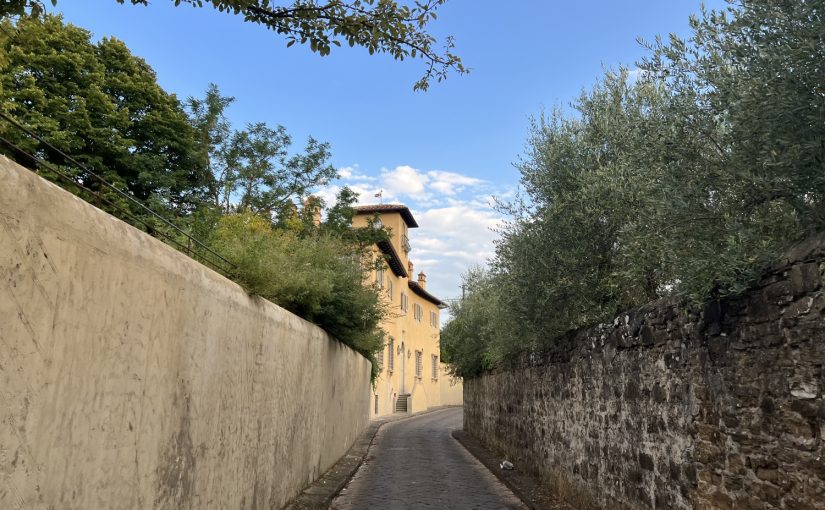
From a Smile to Friendship: Florence’s Small Moments

written by Gia Woodfolk for SPEL: Public Relations

My time in Florence has been full of newness: new people, new streets, new food, and everything in between. However, the element I have most enjoyed is the new smiles. Throughout my time living in the heart of the city center, and taking the daily walks to coffee shops, classes, and my internships, I have realized what I most look forward to is not the incredible grandeur of the city, but rather, a simple interaction. 

Living in a smaller town in Virginia, I have to drive everywhere. I do not have the opportunity to build relationships with shopkeepers and restaurant owners through the act of walking by them as I begin or end my day. However, Florence has provided me with the natural occurrence of relationships fostered through the mere existence of a small, walkable city. 

One of these relationships happens to be with a local leather shopkeeper whose store stands next door to my apartment. Every time I leave my apartment, exiting the sprawling wooden doors, I greet my neighbor.

Since the first “ciao!” was exchanged, there have seldom been days without this meaningful interaction. It became a part of my day I looked forward to. And, eventually, the “ciao!” turned into a “how are you?” As time has passed, on good days and bad days, a consistency I can count on is this exchange of words. I soon began stopping by for conversation for a few moments to learn a bit more about the man downstairs.

I eventually learned he hails from Bangladesh, and, through each interaction, he has told me bits and pieces of his life story. Although I may have expected us to be very different individuals, I came to learn we are more similar than I originally thought. 

Each moment I strolled by his shop, the conversations brightened my day. I cherished each hello and goodbye and felt more integrated with the community through getting to know such a unique Florentine individual. And, most importantly, these interactions helped me understand that what matters is not what is on my phone or computer screen. Rather, it is the people in front of me in this present moment. 

The lack of presence is something that transcends global populations; with the rise of technology and the capitalist drive that permeates our world, billions of humans are preoccupied with the future or materialistic aspirations.

Living in Florence, however, has made me realize that taking a moment to put down your phone, look around you, and say hello to a stranger is incredibly important. Because of a singular moment I was present, a stranger became a friend. And now, every small interaction provides more internal happiness than anything a screen could provide. 

Ultimately, Florence is known for its large attractions, from the Duomo to the Uffizi and Piazzale Michelangelo. But, it is the little moments that make the city so special. Florence is filled with people from diverse places who have many stories to tell; I am eternally grateful to have been able to meet and get to know one of these individuals.

Home Away From Home

written by anonymous

To be an immigrant’s daughter, there is a certain weight that sits with you. From the day you are born, you’re split in two. To be taught two languages, two cultures, two homelands. In the United States, to be an immigrant is to be lower. To be a Mexican immigrant is to be scum. As I grew up, I was taught to hide my identity. I spoke in English in public and Spanish in private, to favor American pop culture over Mexican. My golden skin was something to be ashamed of, to stay inside more. My locks of curls to be burned and tamed into straightened hair. My heart has always been torn into two.

At home, my family was proud of the life they worked so hard to make for my brothers and I. Now, it is our job to show that we are educated, organized, and hard working; that university is the goal to change the narrative for my family. My mom attended high school in the U.S. and graduated, but it wasn’t until 18 years later when she was 32 years old that she got her bachelor’s degree. She was the first in my family to ever receive a degree in higher education. My mom set the example that anything was possible, that my brothers and I had our futures handed to us; we were supposed to be nothing more than exceptional. In my parent’s eyes, that meant to hide our culture that America saw as less-than.

My brothers and I knew how to play the part; after all, we experienced the everlasting backlashes of America. Our whole lives, we have been told we didn’t belong where generations of my family worked for us to be. I was told to go back where I came from, and countless times I was picked on. Kids would throw my pencil case to the floor, leaving my things scattered, and tell me to pick it up “cleaning lady.” My brother was told to “mow the grass gardener” by a player of the opposite team on the soccer field. My little brother is a clean slate, doesn’t know any Spanish, and has yet to come to understand his culture.

The aggressions are something I’ve realized is my price to pay for living in the United States. Something I’m not sure I’m equipped to take anymore. Since going to university, I’ve been faced with micro aggressions, and it’s now supposed to be my job as the minority to educate my classmates. It’s aggravating, and parts of me wished I had never stepped foot in Missouri. Countless phone calls to my mom asking if I am overreacting or if they are being racist. It’s hard to be in a place that I have worked to be, and yet, in many ways said or unsaid, that I shouldn’t be in. Despite this, I continue my academic career in hopes of raising the percentage of 19% of Latino that have a bachelor’s degree, joining my mom and my older brother and showing my dad that his countless days of sacrifice have amounted to something.

Now, I stand here, not in the U.S. or Mexico, but in Italy, a country that my grandparents would have never imagined one of their grandkids would be in. I’m here interning for a food publication, where I had the opportunity to cover an event dedicated to Latino food. For once, I saw my culture being celebrated on a bigger stage instead of being shamed or transformed into something others could easily grasp. For once, speaking Spanish isn’t alien-like, but a bridge for me to communicate with others. Being Mexican doesn’t mean I’m associated with drugs, gangs, or the lower class. I was told by one of the chefs that, “It’s so wonderful that you’re Mexican. Your culture, your people are so bright, giving, and happy. Thank you for everything you have brought here.”

For once, I was seen for who I am, who my family is, and for how my people are. Parts of me never want to leave Italy with my little time spent here. The problem is, if I stay here, what was all that my family struggled for? To be an immigrant’s daughter is to be split in two.

Unpacking Self-Discovery: How Florence Painted My Journey of Growth

written by Kylyn Maxwell for SPEL: Public Relations

Packing is always daunting for me. Whether it is an overnight stay at a friend’s house or a three month endeavor in a foreign country, both scenarios instill the same amount of panic within me. How do I temporarily abandon the things that mean so much to me? I would never wish my most prized possessions to collect a layer of dust, leaving them neglected. 

My bag can only weigh fifty pounds. Even my youngest sister weighs more than that.

I had finally come to terms with entering a new country. I prepared myself to become consumed with a deep feeling of discomfort. I was willing to let things go. After all, how do you grow if nothing is changing? I let my petals flourish and my roots grow deep into unfamiliar soil. 

My suitcase held business casual loafers and slacks instead of my cherished paint brushes and 16×20 canvases. I had been decorating canvases with the thoughts that entered my mind since I was 16. 

I could refrain from zipping my sister up in my suitcase, but I had no choice but to let go of the things that have been grounding me for so many summers. 

The plane engulfed my thoughts. The amount of rows on the aircraft put me in a trance, I had never been overseas. The flight was filled with contemplation. I decided I would welcome the unfamiliar with open arms, in hope that it would do the same to me. 

A different scene appears through the narrow gape of the plane window. Mediterranean cypresses and warm-colored buildings caught my attention. They were quite different from the oak trees and neutral-colored houses I had been surrounded with my whole life. I had no idea what I was doing, and perhaps that was the best remedy for an intense desire for personal growth and expansion. 

I wandered the uneven, cobblestone streets of Florence. Not a single step I took was steady and secure, similar to my placement in the city. I couldn’t find anything reminiscent of the things that typically brought me comfort. 

I had four keys. Two small ones, one medium sized one, and one that looked like it was out of a storybook. I put the key in the lock of the large, decadent door, struggling to enter. 

Noticing my struggle, a man next door asks if I need help. He grasps the key in his hand, easily unlocking the door. I notice his hand is covered in swatches of paint; blues, yellows, and red-orange. I noticed his shop next door, decorated in canvases with thick strokes of paint and thoughtful color choices. I feel a sense of comfort knowing that my apartment is next to someone who shares the same love for painting as me. It was in that moment, that I knew I could make home in a place that was unconnected from the rest of my life. 

As my time in Florence dwindled, the sun gleamed brighter and my connection with the painter grew stronger. I used his acrylic paint and palette knives. I showed him paintings from the previous summers that I had left behind. Our styles of painting were so different, yet we could both appreciate each other’s talent. We made an exchange. I sketched citrus fruits along the canvas he lent me. I had painted oranges, lemons, and grapefruits before, but the painter insisted I try to paint in his style; a style that was reminiscent of Post-Impressionist artworks. 

As time is fleeting, my suitcase reappears in front of me. I stare at the canvas that hangs on the wall of my bedroom that I grew to love. How do I rip my roots from the ground that I had become so familiar with? I place my canvas in my suitcase, remembering how I came here lacking canvases, paints, and brushes.

My suitcase is more full than it was in May, along with my heart and my brain. I had flourished, all because of Florence. 

Connections can be forged no matter the location and there are always exchanges to be made that leave you fulfilled. Sometimes the best fertilizer for growth can be one you’re unfamiliar with.

Bio Fashion Lab: The Thoughtful Retail Experience

written by Lily Carroll for Special Project: Experiential Learning in Journalism

Through experiential learning at FUA-AUF, I’ve gotten the opportunity to interact with Bio Fashion Lab, an independent boutique dedicated to responsible, ethical shopping. The store’s owner, Debora Florio, has spent over nine years in the fashion industry, seven of which were in fast fashion, an industry worth approximately 103 billion U.S. dollars in 2022, projected to reach 291 billion U.S. dollars in 2032, according to PR Newswire. This experience has driven Florio to conduct extensive research, educating herself about consumer behavior, the fashion industry as a whole, and ethical solutions to the extensive problems it creates. With her findings, Florio started Bio Fashion Lab, a space designed to invite others to join in this mission for change. 

Upon receiving a degree in Economics, Florio realized that she wasn’t dissatisfied in this line of work. She says that at the time, unfortunately, shopping for clothes was what brought her the most joy, so she decided to find a job in the fashion industry. Unaware of the many unethical practices implemented in the industry, Florio slowly uncovered the ways we harm people around the world and the environment when we support fast fashion. She learned that these stores use minimal human resources, producing thousands of the same products at low prices, 30% of which wind up in landfills. Just one of the many ways this industry is creating crises everywhere. 

“I realized what was behind the scenes of production in terms of social injustice, and the negative impact that this industry has on the planet, I decided to take action,” Florio said. “I started studying consumer behavior, marketing and whatever lies behind the mechanism that triggers our mind to go and shop for ourselves.”

Florio continued to work in the fashion industry, this time with a seemingly ethical brand. It was there that she met a woman with a crippling shopping addiction, spending thousands of euros a week with no satisfaction, and an insatiable desire that could not be fulfilled. This woman inspired her to create a solution for people to shop responsibly.

So, Bio Fashion Lab was born, to promote emerging, ethical designers using natural materials and equitable production. Offering a healthy way for customers to shop in a manner that does not promote overconsumption, and respects the environment and all who inhabit it.

“Whenever you start to go really deep in the research, you see the truth with your eyes. I’ve never been to Pakistan, Bangladesh, places where these issues are most prevalent, so we do a lot of calls with different unions and government workers on the other side of the world,” Florio proudly states. “We can hear their testimonies and see that it’s quite real. It’s there. When you really understand what’s going on, you can never go back.”

Florio says that the clothes are just a small part of the ways she educates others on the fashion industry, and how we can improve it. Through documentary screenings, workshops, and panels. Bio Fashion Lab strives to educate this generation of consumers to make the right choices. An environment that encourages shoppers to ask themselves, “Do I really need this?” especially when faced with a cheap, overproduced option. Bio Fashion Lab teaches us how to say no, and explore another option.

To learn more about Bio Fashion Lab, visit https://biofashionlab.com/, where you can read about the movement and upcoming events. On Thursday, 13 June, Bio Fashion Lab will host its first fashion show entitled, “Fashion Under Construction,” making light of the construction that currently surrounds the store, highlighting the store’s call for unconventional ways to shop. 

My Family in Florence: Bringing One Home to Another

written by Lily Carroll for Special Project: Experiential Learning in Journalism

When I chose to study abroad in Florence for the entire summer, I took a giant leap out of my comfort zone. Back home in Minnesota, my family is my whole life. As the sixth of seven children, my siblings and parents are my absolute best friends. My few experiences traveling have always been with at least one family member, with the exception of going to and from my campus in Missouri. Being someone who experiences lots of anxiety surrounding separation and travel, I knew that this opportunity would challenge me in the areas that have always restricted me.

Going to school outside of my home state was my initial step toward overcoming my struggles, fostering strength through vulnerability. I grew my independence a tremendous amount and became accustomed to the environment at school. I had gotten so comfortable with my friends, my boyfriend, and my apartment, that the mundane became almost irritating. However, the idea of adventure seemed exhausting. The decision to spend the summer in Italy came with the hopes that some of my loved ones could share in this experience, and I was elated to hear of my family’s plans to visit.

The distance and time change caused me to miss my family very much upon arrival, but in the back of my mind I was already working towards seeing them again, showing them all I’ve learned since being here. Knowing that in a few short weeks I would be able to give my mom a hug and show her my new home would be what I looked forward to most. What I didn’t know was how quickly it would come — in all of the excitement of meeting new people, discovering a whole new culture, and falling in love with my internships and courses, the time flew by. 

Comfort washed over me when I saw my mom’s sweet smile, and I was so relieved to see a familiar face in a place I’m still getting to know. My mom and brother arrived, and I was home again. Together, we ventured to Venice, where we prioritized quality time, relaxation, and taking in the beauty of the water surrounding us. We came back to Florence, and I got to play tour guide for a few days, exploring the things I’ve seen and the things I still had yet to discover. 

We toured the Duomo and Galleria dell’Accademia, bringing life to the landmarks I’ve been passing by for over a month. My family got so excited over things I have gotten so used to. This gave me a newfound appreciation for the city around me and served as a good reminder of how lucky I am to have the opportunity to call this place home for a short period of time. While I am sad to see them go, I feel so lucky to have been able to show them around and combine my two homes for a week of love and appreciation. I will forever cherish our time together, and I can associate this place I love with the people I’ve missed so much.

My Home Away From Home: The Florence Vintage Market

written by Kyla Pehr for Special Project: Experiential Learning in Journalism

As a study abroad student, I am constantly looking for activities that both cater to my interests and will help in immersing me with the Florentine culture. So, when one of my roommates found a vintage market taking place inside a beautiful, historic building while scrolling through TikTok, I was hooked.

The Florence Vintage Market, which took place May 17 to May 19 , was held in the Palazzo Corsini sul Lungarno. The event takes place twice a year — in spring and autumn — and sells vintage women’s and men’s clothing, accessories, and home items to raise money for “seriously ill people and their families,” according to the website.

I nervously entered the building after making my way to the Palazzo Corsini. It was dimly lit, and yet, a feast for the senses. I meandered through sprawling hallways littered with racks and racks of vintage textiles. People bustled in and out of each room, chattering with one another, prizes in hand. Piles of clothes filled crevices where racks could not fit, organized mess juxtaposing with the ornate ceiling, adorned in sculptures and paintings reminiscent of the Florentine Baroque style I have observed in other locations across the city. The smell of the antique items hit me almost immediately; sweet, sour, oily, herbal. I relished in it.

I have long been a fan of buying secondhand, not only for the environmental impact but also for the excitement of making something old new again. I take great joy in the idea that I am giving something that was once loved by another a new life, a new light. Maybe this is my Textile & Apparel Management (fashion, basically) minor speaking, or maybe I am just enthralled by the bridge across time that vintage items provide. Regardless, it is not uncommon for me to attend events much like this one with my loved ones in my home country, where I experience similar sights, sounds, and smells and leave with a barrage of repurposed articles in tow.

The latest edition of the vintage market saw 70.000 euros raised, according to the website. This made me smile to myself; I felt proud that I could be a part of something so important, giving back to the community that has already given me so much in my short time here. I look forward to seeing how much would be raised this time around.

After making my purchase — a black tie-front top with a v-neck and beaded details along the sides — I approached the exit, or at least, what I thought was the exit. A man stood in front of the door, arms crossed. Quickly I was shooed away, left to wander the racks for a while longer, taking in my last moments of the vintage market. I found another door, unguarded, and stepped outside, momentarily blinding myself with the abrupt shift in light.

Ciao, Palazzo Corsini. Until next time.

Lived Moments

written by Valerie Tiscareno for Special Project: Experiential Learning in Journalism

This is a collection of photos showcasing places, things, and experiences that I would have liked to share with my dear friend who passed away in January. He passed away pursuing what he loved: photography. He was 19 years old when the accident happened, 4 months away from his 20th birthday.

We had always talked about the adventures we would go on as photographers. Our aspirations of working for National Geographic, traveling the world and seeing what it had to offer. I had told him my story of giving up my Quinceanera in order to travel in Europe.

I remember one of my last calls with him. I had told him I was finally going to Europe. I remember seeing his smile for one last time. The way his mouth curled up and the indents on his cheeks. That call felt like we were both going towards the path we had both talked about.

Here now, I am filled with memories of him, of things I wished to tell him. This collection of photos are my last adventure with him.

These photos were shot either how I think he would have taken them, or as photos I would have been excited to share with him. These all have been shot on the camera I met him with.

I remember him meeting me and the first thing we bonded about was photography. The next weekend he drove 4 hours to be able to take photos with me. I remember he thought my camera was a film camera and the disappointment on his face when I told him it was a digital camera.

This project is a reflection on the experiences we take for granted as living, but even more so, as lived moments. I challenge viewers not to think about the personal stylization or the absence of people; rather, look closer at how we as people decide to live our lives.

Hidden Gem: Locally Owned Gym in Florence Provides Much Needed Solace

written by Alex Daggett for Special Project: Experiential Learning in Journalism

Tucked away on the quiet street, Via del Leone, with a modest sign and entrance, Gym & Tonic is a true, classic testament to athletic performance and bodybuilding. Built on the first floor of a residential building, the space extends to the back with free weights and old school machines adorning the right side. Under a skylit converted garden is a dance studio and boxing area. Certificates, awards, records, and trophies for mens physique occupy the walls everywhere the eye can see, and a sense of community is felt. 

As soon as I arrived in Florence to study abroad for the Summer, I immediately sought after a gym so I could stick to my workout routine.  After some research, there still weren’t any gyms that stood out to me. By pure chance, I happened to walk by Gym & Tonic while exploring the south side of the city, and decided  to take a look around. Immediately upon entering, I was shocked by how seamlessly the whole space was integrated into the classic architecture, nothing looked out of place. I was so used to the concept and sights of large scale commercial gyms where everything looks the same, and this was far from it. Despite the rustic nature of the machinery, everything was clean, and practical. I have been to a non commercial body building gym only once before, and this evoked very similar emotions and feelings, while offering an Italian twist. 

“I’ve been in charge for 26 years, since I inherited the gym from the man who owned before me,” said owner, Francesco Borghesi.

Despite the establishment being older than himself, Borghesi is synonymous with Gym & Tonic in the current date.

“I’ve been lifting weights since I was 15,” Borghesi said. “It’s what I love.” Borghesi provides not only customer relations, but also teaches various courses.

“I am thankful to have many good teachers in my time,”  Borghesi said. “So I try to provide the same to others.”

When I met Borghesi, he was teaching a patron a boxing lesson. Once he was finished, he told me all about the gym. I then bought a membership and got a workout in that day. Since then, I have gone every day and have yet to find a flaw in the gym. The hours are from 10:00 to 20:00, and every time I’m met with an immersive environment full of lively locals. Working out has always been a great escape and opportunity for self focus and reflection, and this is the perfect place for just that. Every time that I go to a commercial gym, it always just feels so clinical and uninviting, but Gym & Tonic offers such a different environment that is refreshing. I am very glad that I found this spot, as it made this international transition a lot easier. 

While it may not be on any travel destinations, or top ten lists, I think that adds to the charm of such an establishment. A place that is largely untouched by tourists offers a level of immersion and authenticity that is hard to come by. For that reason alone, Gym & Tonic is worth checking out, and they even offer day passes for people looking to get a quick lift in. A true hidden gem of Florence, located at Via del Leone 10.

Special Project: Experiential Learning in Journalism – A Writing Journey Through Study Abroad

written by Sophia Koch for Special Project: Experiential Learning in Journalism

I’ve always harbored a deep desire to explore the world. Contemplating my future as a journalist, I’ve often envisioned myself traversing diverse landscapes and culture. Some of my favorite travel experiences have thus far been confined to the United States, with standout destinations including Carmel, California; Maui, Hawaii and Key West, Florida. These travels sparked a realization within me: a profound yearning to delve into travel writing to some extent.

Studying abroad has unveiled a different facet of journalism, exposing me to the intricacies of writing about entirely new cultures, cities, and people.

Upon learning my home institution at the University of Missouri School of Journalism added the Florence study abroad program, I swiftly recognized it as the ideal opportunity. Uncertainty came over me regarding the experience awaiting me in a foreign country at a different university. I wondered whether the instructors would be stringent, what subjects they would cover, and how my Special Project Experiential Learning (SPEL) internship in Journalism would unfold. The SPEL program, offered through Florence University of the Arts – The American University of Florence, provides 3 credits along with real-world reporting and writing experience. The special project course features experiential learning hours with the Community Engagement Member Institutions (CEMI), which are dynamic learning environments created to foster learning through interaction within the community. 

During my second week in Florence, as my first class commenced and I met with Sofia Galli, my supervisor for the SPEL placement, I realized the breadth of knowledge awaiting me. The professors’ expertise and the assignments the instructor tasked me with promised to enrich my understanding of Florence thus being my first time ever in Europe.

Over the past 15 weeks, Professor Galli has assigned me various articles to be published on the institution’s websites. I’ve had the privilege of attending school-sponsored events, such as a book presentation featuring Italian author Caterina Perrone. Alongside attending, I conducted a thorough interview with the author, delving into her book and gaining insights into Florentine history. Hosted by the school’s advisors and students, the article found its place on their website. Another school-sponsored event I had the opportunity to attend was Laura Fauzzi’s art exhibition. Although I’m not a big art enthusiast, learning about the way she creates art through breathing and listening to waves was incredibly intriguing and something I had never encountered before. This experience once again reminded me why I love journalism so much – because it allows me to learn something new every day.

While some events I cover are not in English, initially posing a challenge, I’ve overcome this hurdle with assistance from my advisors and by conducting interviews in English such as the book presentation with Caterina Perrone. This journey has facilitated my growth as a journalist, reinforcing the notion that in this profession, nothing comes easy—a skill set I owe to FUA-AUF and the SPEL placement.

One of my favorite pieces I worked on was a profile of two bachelor’s degree students attending The American University of Florence. They are siblings from Brazil studying culinary arts and fine arts. I had the opportunity to speak with them about their experience living full-time abroad and learn more about their Brazilian culture. Additionally, I participated as a journalist in the Art and Community: Secret Florence Walks course, observing the dynamic interactions between the professor, students, and the urban landscape. Beyond contributing an article to the website and enhancing my portfolio, this experience exponentially deepened my understanding of Florence.

While my SPEL journalism internship is concluding, the whole experience has been transformative. From the picturesque landscapes of Carmel to the vibrant streets of Florence, each experience has shaped my understanding of journalism and ignited my passion for travel writing. Through the SPEL internship, I’ve not only honed my writing skills but also gained invaluable insights into different cultures and storytelling techniques. 

The Digital Pen: How Digital Platforms Shape Our Words and Ideas

written by Madison Baldwin for the course, Writing for Digital Media

In the age of the internet, the digital pen has emerged as a powerful force, shaping the way we communicate, express ourselves, and share ideas. From the humble beginnings of email and online chat rooms, to the wide reach of social media and blogging, digital platforms have become the canvas upon which our words and ideas are painted. However, as we navigate this new world of online communication, we must stop to consider the impact it has on our everyday communication, our thinking, and our society at large. 

One of the most distinct aspects of the digital pen’s influence is its power to equalize expression. With the click of a button, digital platforms have given voice to millions who may have otherwise not been seen or heard. Anyone with access to the internet can become a published author, sharing their thoughts and experiences with a global audience. This accessibility has sparked a renaissance of creativity, fostering diverse perspectives and narratives. Bloggers, podcasters, and YouTubers have become modern-day storytellers, shaping public discussion and challenging traditional media channels. 

However, this new level of expression comes with its own set of challenges. There have been rising concerns about the quality and authenticity of online content. Since publishing is so easily accessible to everyone, it has led to the spread of misinformation, making it challenging to determine fact from fiction. Misinformation spreads like wildfire, amplified by algorithms that prioritize engagement over accuracy. The digital pen, once proclaimed as a tool for empowerment, can also be wielded as a weapon of manipulation and deceit. 

Moreover, digital platforms have fundamentally altered the way we interact with language, producing new forms of expression and communication. Emojis, abbreviations, and memes have become integral parts of our online communication, allowing us to convey complex emotions and ideas in a matter of characters. While these innovations can enhance communication in the digital realm, they also risk destroying the depth of human expression. The internet is fundamentally changing the way we write and speak, blurring the lines between formal and informal language and challenging traditional notions of grammar and style.

Furthermore, the monetization of online content has introduced commercial interests into the world of creativity. Influencers and content creators navigate a landscape driven by likes, shares, and sponsorships, sometimes prioritizing popularity over authenticity. The pursuit of virality can compromise artistic integrity, as creators tailor their content to fit the algorithms rather than their own creative vision. 

Despite these challenges, the digital pen remains a powerful tool for self-expression and connection. Online communities and social movements have harnessed the power of digital platforms to gain support, raise awareness, and create positive social changes.

As we navigate this evolving landscape, it is imperative that we use the potential of the digital pen to build a more inclusive, equitable, and empathetic world. By discerning credible sources, engaging in meaningful dialogue, and embracing the diversity of voices online, we can use digital platforms to foster genuine connections and collective understanding. In conclusion, the digital pen has revolutionized the way we communicate and create, shaping our words and ideas in ways previously unimaginable.

While it presents opportunities for empowerment and expression, it also poses challenges regarding authenticity, quality, and commercialization. As we continue to navigate this digital frontier, let us approach it with critical thinking, empathy, and responsibility, ensuring that our words and ideas contribute positively to the collective conversation of humanity.