A “Carless” Chronicle: What I Learned Trading My Keys For a Passport

written by Logan Grigsby

At first, I was nervous about trading my sedentary, car-dependent life for the walkable streets of Florence. I was nervous about getting lost, accidentally walking into the “bad side of town,” or simply not being able to physically walk that far. However, walking in Florence led me on a journey of self-discovery, connection, and helped transform me physically, spiritually, and emotionally.

In my hometown of Kansas City, going just about anywhere meant getting in the car; heck, I couldn’t even take my own dog on a walk without driving somewhere! My lifestyle was very sedentary most days; I would only walk a couple of thousand steps. I felt unhealthy, and walking more than a few blocks felt foreign to me. However, I knew even before I arrived in Florence that I wanted to trade my car keys for a passport and a nice pair of shoes. I knew I wanted to explore the city, and I knew I wanted to be healthier and happier. I never could have imagined the transformation that was in store for me, physically, emotionally, and even spiritually, and the love I would gain for Florence. This is my journey on how simply walking has changed my perspective and my life.

As I mentioned before, I was in pretty rough shape. I didn’t exercise, I didn’t go to the gym, and I was considered by most to be a “couch potato” stuck in a constant loop of getting out of school, plopping on the couch, and doom scrolling TikTok or Instagram for hours, never seeing the beauty in front of me.

My journey started small. Let me tell you, the first week was a challenge. We had a heat wave, and my body was just not used to walking around. At first, my body screamed when I had to walk across town for class, and don’t even get me started on the hills… Although, as time went on, I started shedding off fat, and the steps got easier as every day went by. At first, I struggled to hit seven thousand steps. I soon found I was disappointed in myself if I got anything less than fifteen thousand.

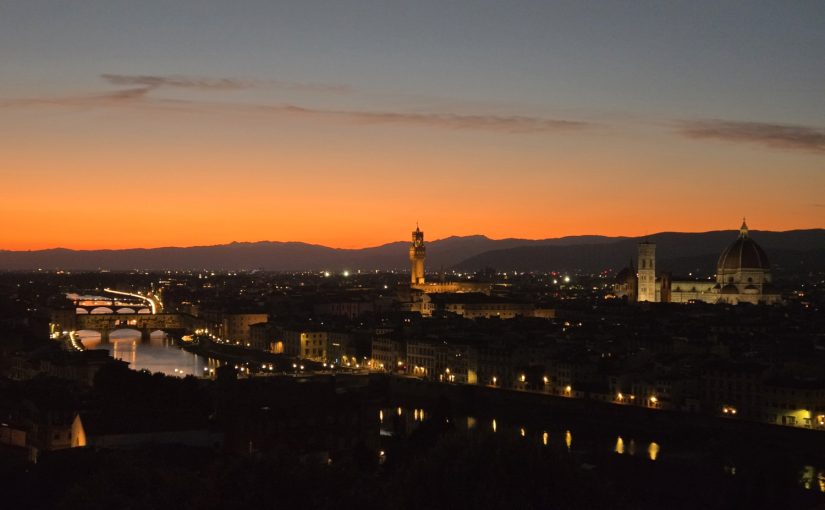
I remember my first week here attempting to make the trek up to Piazzale Michelangelo; A wonderful square with a beautiful look over the city. It was not the easiest hike. I remember having to stop and take breaks constantly. I drank nearly a gallon of water and I genuinely thought my body would give up on me. I decided to retake that journey during my final week in Florence, and not only did I not need any breaks, but I also found I was genuinely enjoying my journey up the hill!

A healthier lifestyle isn’t all that I found; the true magic of a walkable city isn’t the exercise, but it’s the hidden treasures you find along the way. Things you wouldn’t bat an eye at if you were driving in a car. Wandering aimlessly through the city quickly became a favorite pastime of mine. I didn’t know where I was going, but every day I would pick a new direction and set off. This led to some genuinely life-changing experiences.

During my first week, I found what I assumed was a small, unassuming bookstore. I honestly went in for the air conditioning; however, it turned out to be the legendary “Giunti Odeon,” a library and cinema, and what many locals have told me is one of their favorite places in the city. This quickly became one of my favorite spots to study, hang out, or just relax and watch a movie.

Then, one day while walking along the river, I stumbled upon “The Ultravox,” a truly unique outdoor event space that regularly hosts free concerts and offers a vast array of food options. I must admit, I fell in love.

One of my more memorable experiences was discovering “The Havana Club,” a small area on the river that the Cuban embassy officially recognizes for showcasing their culture in Florence. This is a place where I truly connected with the area and grew culturally. I remember walking up to the sand volleyball court quite nervous and sheepishly asking if I could join in, and before long, I had made a group of friends with local Florentines! They would eventually convince me to take to the dance floor, something I never considered, as I always thought that I had “two left feet.” I was so anxious, I thought I was going to throw up, but surrounded by people with positive attitudes and energy, I quickly found myself learning to Salsa dance. Who would have thought that I would learn to Salsa in Florence, of all places.

Of all the things I have done, if I hadn’t decided to just go on a walk, I would have never had these amazing experiences.

My walks have allowed me to truly appreciate the art and history of the city, which permeates it. My first time walking into Piazza della Signoria, I honestly was at a loss for words. Surrounded by breathtaking architecture, beyond lifelike statues, I have never experienced anything like that, and it will forever be a memory in my mind. Back home, I felt like I never took the time to “stop and smell the roses,” and appreciate the beauty surrounding me; however, in Florence, it is unavoidable.

My appreciation for Florence extends beyond the architecture, though. What truly makes Florence so special is the people who make up the city. Every day I see something new and special, from seeing artists freehand the Mona Lisa on the street with chalk, to guitars and accordions filling the streets with sound, to my first experience with Opera music on the front steps of the Duomo, the melodies of this city have filled my heart and soul.

My most spiritual moment came from walking down the street and discovering a small church on the street corner where I saw locals walking in and out of. I don’t usually consider myself a religious person, but something drew me to it, and I decided I needed to walk in and see the building for myself. It was quiet, it felt holy, but it also felt warm and welcoming. Before coming to Florence, I attended the funeral of a friend near and dear to me and was still struggling a bit with the loss, so I decided to do something I haven’t done in a very long time: I sat and I prayed. I talked to my friend who left too early, I spoke to my family who left this earth too early, and I sat and I prayed. This was a tremendously difficult moment for me, but I honestly felt a weight off my shoulders, and I felt a connection I hadn’t felt in a long time. I honestly felt like a changed person.

My time in Florence has taught me so much. At first, I thought getting more steps in would at best help me lose some weight and breathe a little deeper, but that couldn’t be further from the truth. It builds a sense of community and connection. I love running into my flatmates or classroom friends that I have made here, who may also just be aimlessly walking around, an experience that never happens back home. Trading my keys for a passport was a nerve-wrecking experience at first, but I now know it’s one of the most rewarding experiences of my life. It forced me to slow down, to pay attention, and engage in my new home. I’m not just living in Florence, I am discovering it one step at a time. This experience has changed my body, my heart, my mind, and my soul in the best way possible. I will forever be grateful for my experience here.
Florentine Streets, Clet’s Canvas

written & photographed by Kathleen Morris

This blog feature is an exclusive bonus installment to our Spring issue of Blending Magazine. After you finish reading, be sure to explore the rest of the magazine online—just follow this link to download the full Spring 2025 edition:
https://jschoolfua.com/images/BM/BM_151.pdf

How many stories can a single office avocado tell?

As I set my laptop onto Clet Abraham’s cluttered desk, I took inventory of its miscellaneous contents: an avocado, a glass with a solitary drop of red wine left behind and an array of art supplies – pencils, cutting tools and scattered pages filled with cartoonish sketches.

I set my cellphone atop a strip of stickers depicting bright pink sausages, thumb hovering over the record button – ready to capture every bit of wisdom from the infamous street artist who I was face-to-face with at last.

The conversation was highly anticipated. Earlier that morning, after exchanging a flurry of WhatsApp messages with an employee at his Florence studio—including a pointed warning not to address him by his full name, Jean-Marie Clet Abraham—I stepped into the cluttered space – I made the trek across Ponte alle Grazie to his studio on a sun-soaked Monday afternoon.

Tiptoeing down the sidewalk, I realized I didn’t need to consult Google Maps to know I had arrived. I followed a wall plastered in a chaotic assortment of stickers – a street artist’s rendition of the yellow brick road.

My instincts were confirmed by the street sign placed just above the door, reimagined to depict a tiny figure flying through the air, its grip tight on the tip of the white arrow.

photo by Kathleen Morris

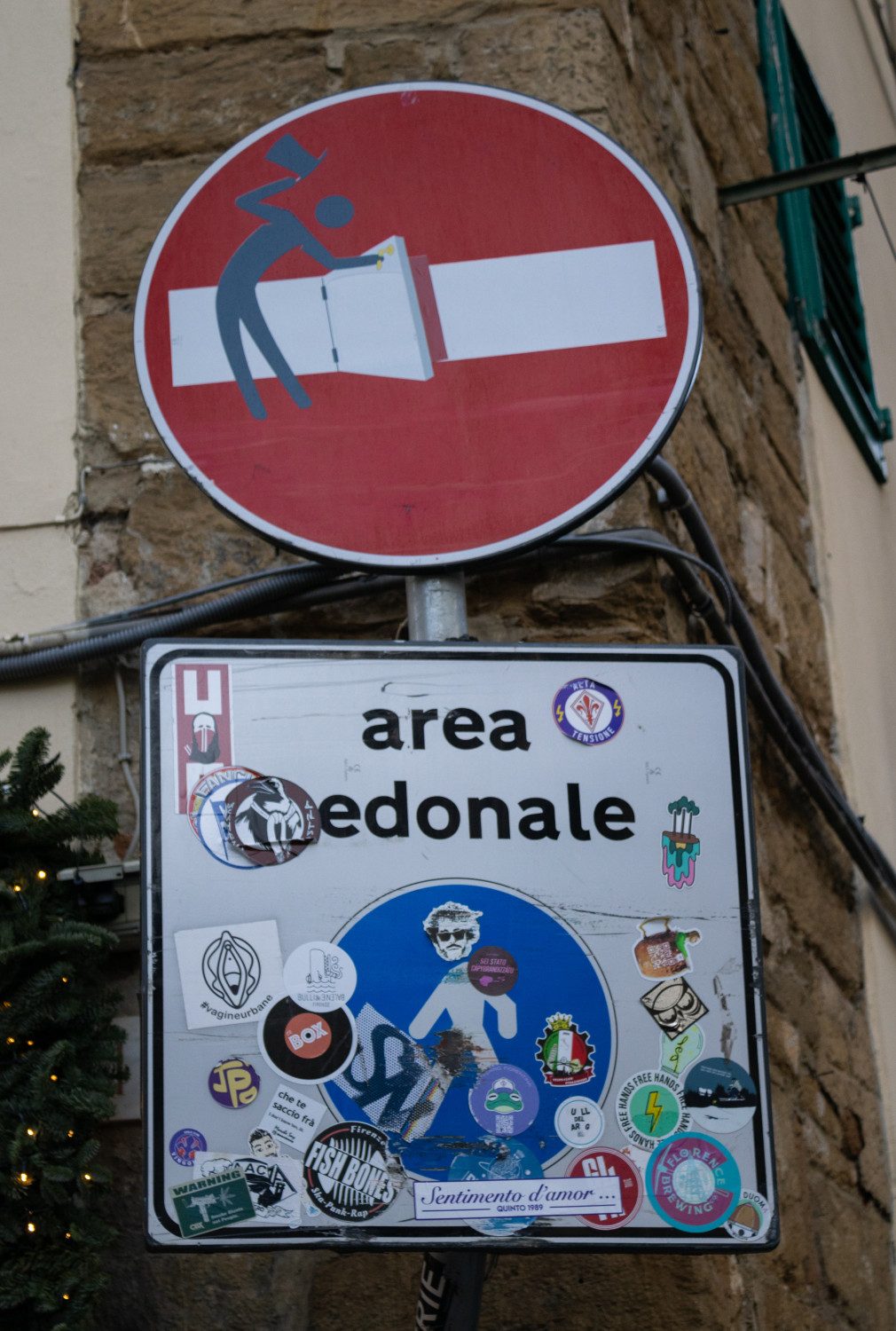
The use of street signs has become a trademark of Clet’s art.

Originally from France, Clet has now claimed Florence itself as his canvas.

I first encountered his work by the Medici Palace. With crooked eyes and a corkscrew neck, a portrait of childhood whimsy is plastered onto a traffic sign, its head formed by diverging arrows. In the following days, I began to train my vision to spot Clet’s characters tucked into every corner of this historic city.

My article joins countless attempts to profile the elusive artist, who has earned celebrity status (and over 160k Instagram followers) in a destination that echoes with the voices of the Renaissance.

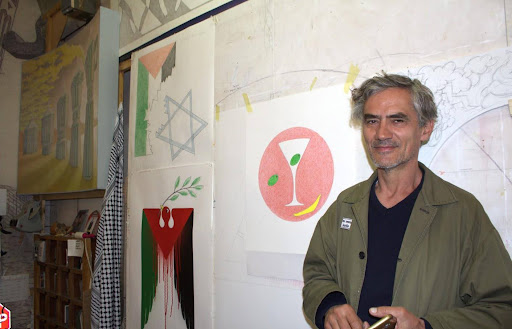
I sought to understand the path of the man who sat across from me, salt-and-pepper hair draped across his forehead and backdropped by a wall of unfinished masterpieces.

The son of creative parents, he recalled his earliest inclination to art.

“When I was young, I used art to be free,” Clet said. “I don’t care about art. I care about freedom.”

Today, his urban installations serve as an outlet for self-expression and a medium for political commentary. With a rebellious flair, he inspires dialogue about pressing social issues and individual rights. Behind his desk, a sign was spray-painted with the colors of the Palestinian flag. The artwork, created in collaboration with the Art for Gaza Collective, exemplifies Clet’s efforts to garner a reaction from and activate the public.

“I don’t think I am the owner of my ideas,” he mused, reflecting on the essence of collaboration he shares with those who engage with his work. “The ideas pass through me,” he said, describing his ability to sculpt messages and inspire his community to think outside the box.

photo by Kathleen Morris

Clet refuses to be confined by artistic boundaries, finding fulfillment in working beyond the walls of traditional museums.

“I don’t work with galleries,” he underscored. “The best place is always the street.”

Clet navigates the gray area between creating impactful art and defacing public spaces. The allure of street art lies in the ambiguity of this ruleless game – a game that Clet has mastered on a global scale, often operating under the cover of night.

“In the United States, I always [install art] at night because I don’t want the police to stop me,” he revealed. “I don’t want to have a big problem and lose my plane ticket to go back home.”

In a perfect world, city authorities would recognize the positive aspects of his work. He imagines that increased acceptance would act like a “business card,” allowing him to explore cities that are “more difficult, where there is less democracy.”

Until then, Clet can be found cloaked in darkness or in the safety of his studio at Via dell’Olmo, 8r in Florence.

Before I exited his sticker-clad oasis, I gathered two pieces of advice from Clet for aspiring artists: embrace your originality, and when working on the streets, it’s best to be a little drunk.

photo by Kathleen Morris

For more information, visit Clet’s website or follow Clet on Instagram (@cletabraham).

Florence’s Urban Art Display: Street Levels Gallery

written by Sarah Minemier

Funky, colorful graffiti art fills the streets of Florence. As you weave through historical buildings, you may notice cartoon elves, strangely proportioned animals, or just typical graffiti tags. Even if you’re not an artist, you’ll soon recognize that Florence’s graffiti art is part of the city’s beauty, and a popular way its residents artistically express themselves. Yet, in Italy, graffiti remains illegal, and is still ultimately seen as vandalism of public spaces.

The Street Levels Gallery provides a safe space for urban artists to come together, share their artwork, and send important messages without any fear of legal repercussions. The name and backstory are straightforward – Street Levels Gallery remains on the street level, hence the name, accessible to all, and intended to create an environment most similar to that of genuine street art. “You can’t take art off the street,” said Sophia Bonacchi, co-founder of the gallery. “If you take it off the street, it’s something else. It’s not urban art anymore.” Bonacchi mentioned other art galleries in Florence feature public urban art, but some are underground, or feature a more enclosed layout.

Inside the gallery, like any other gallery, artists form exhibitions. 

“We have three to four proper exhibitions per year, but in-between, we do our own setups with artworks from our deposit,” noted Bonacchi. Luckily, for current Florence residents and non-residents alike, there is an exhibition on display right now.

“Di Mondi Lontanissimi” is a collection by Italian street art group Guerrilla Spam, featuring mostly paintings inspired by the bold colors and expressive style of Renaissance artist Pontormo. These factors are evident in Guerrilla Spam’s work. Upon entering Street Levels Gallery, you’ll be greeted with colorful pastel paintings, an iron installation, and shiny plexiglass creations, each of which contains culturally significant symbolism and geometric designs.

The Street Levels Gallery draws its artists from an established pool of mostly Italian urban artists. Solo art exhibitions aren’t necessarily the norm; another recent exhibition featured the contributions of nineteen artists total. Bonacchi tells us that artists within the realm of urban art are well-connected, and finding artists to display is rarely an issue. “The urban art movement is very limited to a few kinds of artists, because you have to have certain features. We know the artists of these movements, and select artists we have known for a long time,” explained Bonacchi. To scout out potential new artists, members of the Street Levels Gallery also regularly attend urban art fairs, and read graffiti art magazines.

Even if you are not a habitual gallery enjoyer, I urge you to visit if you get the chance. As someone who is not particularly artistically inclined, I was immediately drawn in simply by the aesthetically pleasing use of color. Exhibitions typically last three weeks, yet the current exhibition has been extended past its initial end date, and is now scheduled to end on June 22nd. If you’re in or planning to be in Florence this weekend, I highly recommend stopping by the gallery located at Via Palazzuolo, 74AR, 50123 Firenze FI.

A Love Letter to Piazza della Passera

Thousands of miles from the comfort of my American neighborhood, this small Oltrarno piazza reminds me of home.

written by Savvy Sleevar for SPEL: Journalism

First Flower

Every summer back home, my dad transforms our backyard into a jungle of flowers. Fueled by a stash of seeds that’s been growing in size and variety for years now, zinnias of every color emerge from the ground and run wild along our fenceline. The colorful horde of blooms dominates the yard for months, and bunches of them often make their way to vases on our kitchen windowsill. No matter where I find one, a zinnia always takes me back home.

The first zinnia I encountered in Italy was in a planter box, right in the middle of Florence’s Piazza della Passera. Raspberry pink and thick with itty-bitty petals, it would be a star in my Illinois garden. I texted a photo of it to my dad, and it received its due enthusiasm.

Turns out, I’d become well-acquainted with Piazza della Passera, botanicals and all. This little square, full of fantastic places to eat, grab a drink, and hang out, is just a minute away from my apartment. I walk through it at least twice a day, and through my conversations with Florence residents (plus a helpful glance at The Florentine), I’ve started to piece together the piazza’s history.

Blossoming

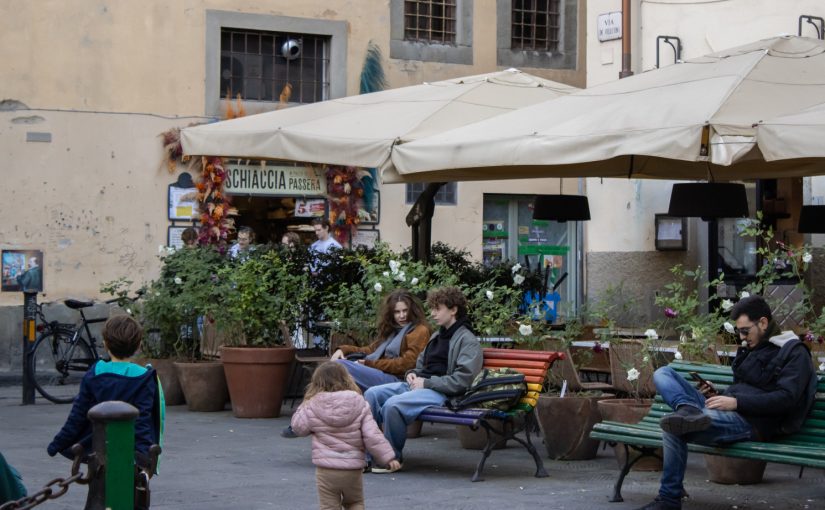
Back in the day, I’ve been told, the piazza used to be home to a brothel. Not only does this explain the name “passera,” which has a pretty risqué slang meaning, it also makes the mildly suggestive names of the sandwiches at the nearby Schiaccia Passera even funnier. “Only The Top” is a prime, albeit awkwardly translated example, not to mention my favorite item on the menu.

There is another origin story for how Piazza della Passera got its name, though. It involves a sparrow (“sparrow” is the more direct, PG-rated translation of “passera”) dying in the middle of the piazza hundreds of years ago, instigating the Black Death in Florence — though I personally prefer the raunchier tale.

But no matter how the piazza got its name, its prominence in my neighborhood is undeniable. On weekends, the square is full of Florentines young and old, sampling artisan gelato from Gelateria della Passera, eating a plate of pasta at one of Trattoria 4 Leoni’s outdoor tables, or simply enjoying the night air on the rainbow-colored benches. 

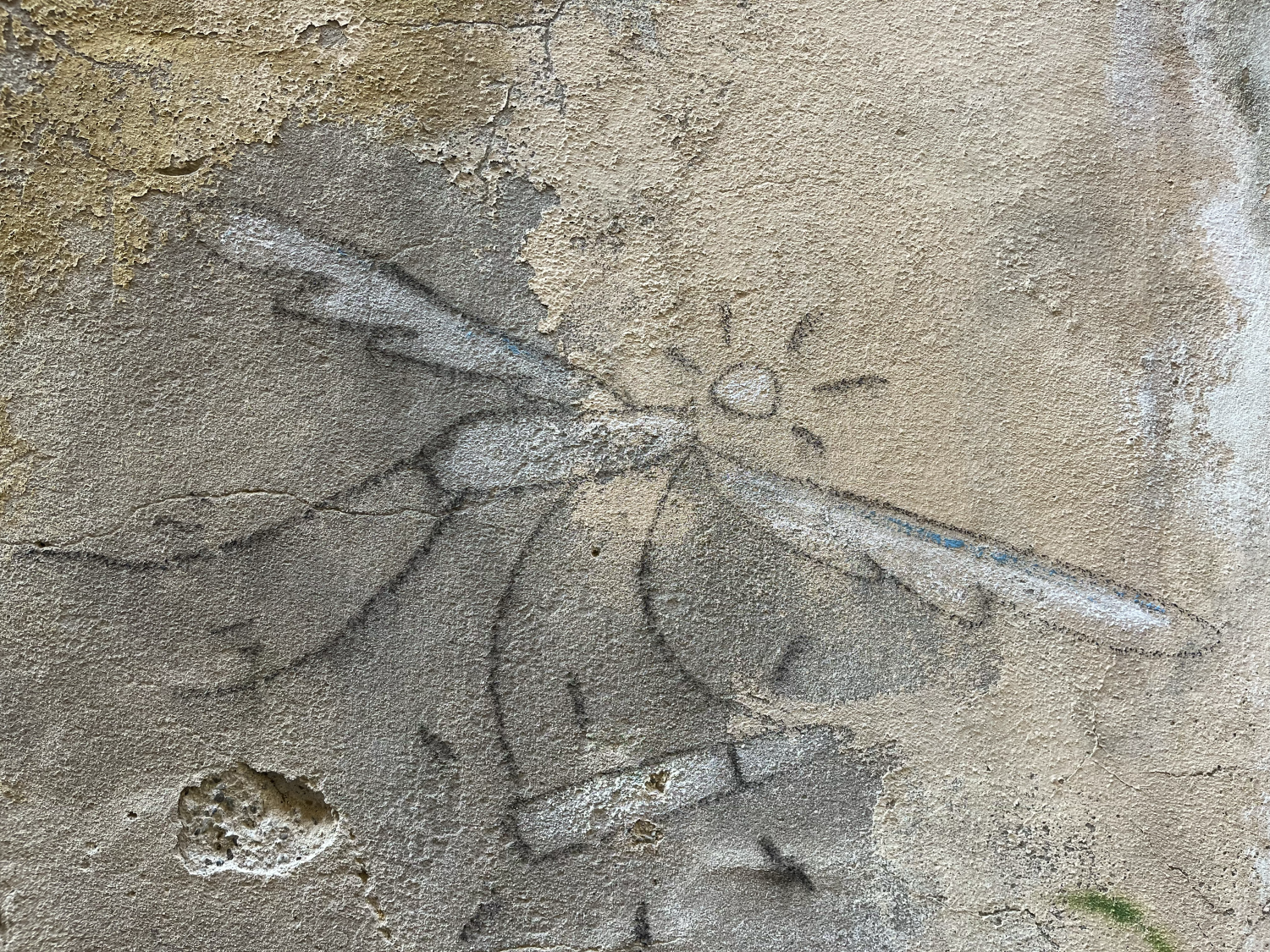
Even beyond the piazza, the eclectic vibe of the main square bleeds into the surrounding streets. Graffiti illustrations decorate almost every building, almost like a trail of breadcrumbs that leads back to my place. Even street signs are canvases for street art, often plastered with layers of stickers and cartoons. And if there’s ever any music in the piazza, the sound of it follows me down the cobblestone street all the way to my apartment.

Still In Bloom

It probably sounds sappy and sentimental, but out of all the sights I’ve seen, and out of all the kind people I’ve met in Italy, the places and faces of the tiny piazza by my apartment have been some of my all-time favorites. The square isn’t grand like Piazza della Signoria, and it may not have the constant stream of foot traffic and street performers that Piazza della Repubblica does, but what it does have is a quintessential Florentine charm that’s hard to put into words.

Through culture shock, travel mishaps, and long days of classes, Piazza della Passera is always there to greet me at the end of my journey home. It’s a familiar landmark that gives me the solace I’m missing. Alternatively, on my particularly good days, when I’ve found a cool new study spot, initiated a successful conversation in Italian, or had an especially fun day in the city, the piazza senses my joy. No matter how I’m feeling, the sight of the square right before I arrive at my front door is something I can rely on.

As for the pink zinnia sprouting in the piazza’s planter box, I was surprised to see the flower remain in its place well into the fall. Thanks to the relatively kind Mediterranean climate, deadheads didn’t appear on the plant until it was almost time for me to start thinking about my upcoming flight home.

When I leave Florence in December after my semester abroad, I have no idea when I’ll be able to return. Until I find the time and funds to travel across the Atlantic again, I’ll only have this image of the city I’ve created for myself, composed of the photos in my camera roll and all the details my faulty memory can hold. I get the feeling, though, that when I see the new batch of zinnias growing in my backyard next summer, I won’t just think of my permanent address, I’ll also think of Piazza della Passera and the home I made for myself in Florence.

Street Art: Letting Go

girl-balloon-finding-florence-blog-fua

By Patricia Hoban

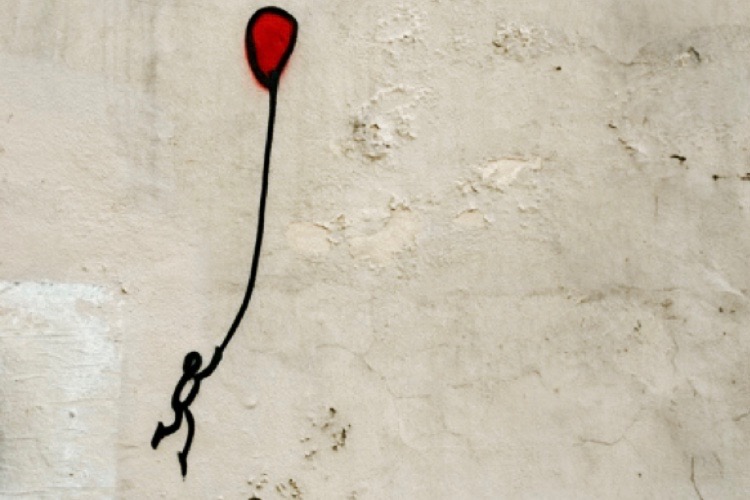
In the Renaissance city of Florence, home to the Uffizi, one of the largest and most famous museums in the world, and pilgrimage site of artists and art lovers alike, I was impressed not only by the greats such as Michelangelo, Masaccio and Masolino, or Giotto, who I was able view just a few minutes from my apartment. I was especially fascinated by street art, and specifically with an example that I attributed as “the girl with the balloon.”

As I walked to class, I often passed by the image of a stick figure with a hand outstretched, grasping at a red balloon. I have studied Banksy at my home university, and know this to be a copy of his work. Banksy, for those of you who are unfamiliar with him, is an anonymous street artist who uses the city as his canvas. The art he creates sends a message to its viewers and brings attention to the problems that are silenced or ignored by society. What does the balloon symbolize, and is the stick figure reaching for it, or letting it go? Each day as I walked by the piece, I juggled with possible meanings.

I, a student who was studying in a foreign country, interpreted the piece to be a girl lost somewhere between holding onto her cultural habits, childhood, and comforts, and letting them go to adopt a new Italian lifestyle. In the beginning of the semester in Florence, I almost always saw the girl reaching for the balloon and holding it tightly. However, as the semester progressed and as I became more confident in providing tourists with directions and grocery shopping at my neighborhood supermarket, what I saw was not a girl reaching for a balloon, but one letting go.

See more of Florence at FUA’s FB, Instagram, and Twitter.