The Beating Heart Above Florence

A place where sunsets, cameras and people meet to be present

This blog feature is an exclusive bonus installment to our Fall 2025 issue of Blending Magazine. After you finish reading, be sure to explore the rest of the magazine online—just follow this link to download the full Fall 2025 edition:
https://jschoolfua.com/images/BM/BM_151.pdf

written by Maëlys Brunet

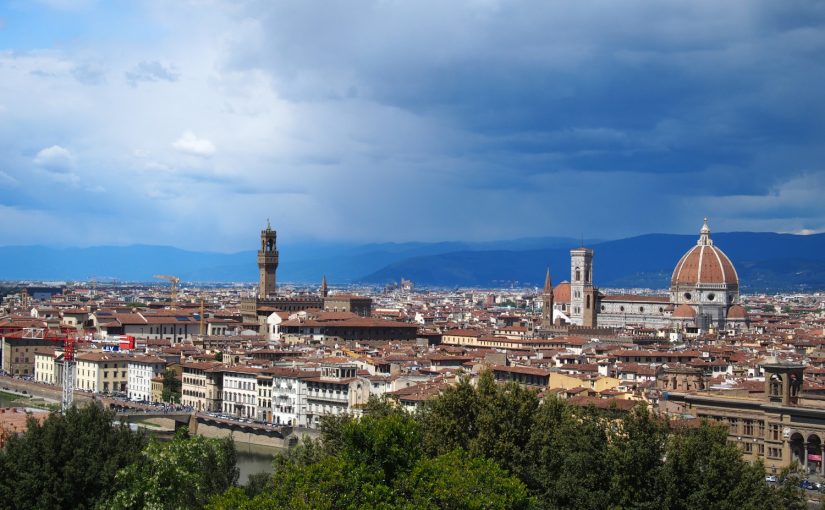
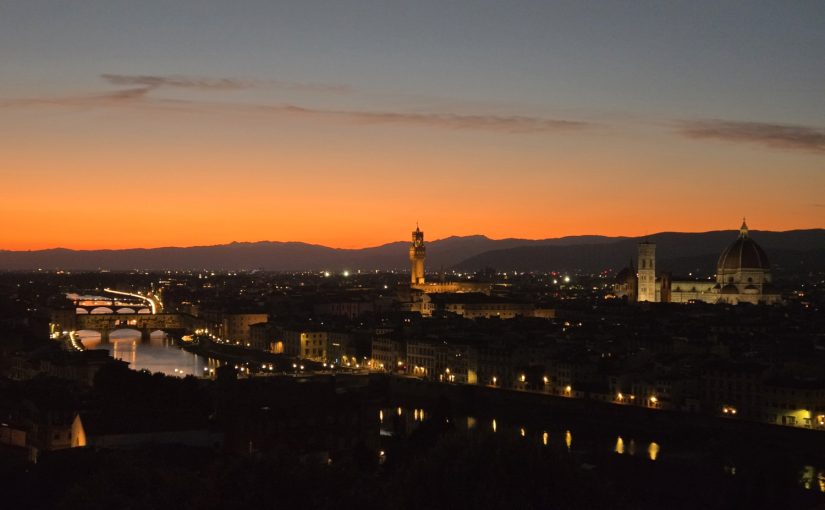
As the city slowly changes from season to season, we are constantly reminded of Piazzale Michelangelo as the beating heart of Florence. Especially during the summer months. The Piazzale remains alive through both tourists and locals, particularly at sunset, as wanderers gather on the steps with a simple glass of wine to listen to a band’s music or take pictures as a souvenir of the moment, as time pauses, just for a moment. This Florence phenomenon stirs curiosity about the aura the city holds in people’s hearts, a current that pulses through and unites communities. 

Piazzale Michelangelo seems nowadays as a rite of passage, a go-to place when visiting Florence to admire the city’s iconic skyline. But what about its history? Built in 1869 by Giuseppe Poggi, it was originally meant to just be a terrace, celebrating Michelangelo’s art. A representation of progress, but also modernity and the future, as Florence was the capital of Italy during that time. Nowadays, we see Piazzale Michelangelo as a place to slow down, reconnect to the beauty of the city, with a crowd to accompany us into this poetic journey. 

The typical route to Piazzale Michelangelo is just as memorable as the view itself. Beginning from the tower of San Niccolò, take the ascending stairs and path between the large trees. The climb begins as we slowly rise above the city of Florence, in anticipation of the view that awaits, as if leading towards something sacred. Then, the main terrace appears, the crowd gets denser, and the city spreads below. In the golden hour of the evening, music plays in the background and people dance to its infectious beat. Monuments wear orange and yellow as the sun begins to set, offering the perfect moment for multiple photoshoots to spontaneously appear. Phones and digital cameras alike click with the same rhythm as conversation or laughs. 

Piazzale Michelangelo is the place where multiple generations meet to capture the essence of Florence. As a guitarist tunes his strings, he shares that although the people there always change, the sunset and view remain a constant. There is poetry when we stare at the landscape, thinking it was approximately the same view as the one our ancestors looked out at centuries ago. People at first come for a simple view, then leave with memories, connections and hearts filled with emotion. Here the sunset isn’t edited, it is put on display, shown in its raw form to its audience.

Looking away from the view and back towards the crowd, students share a bottle of wine, while pizzas are eaten by a family visiting from abroad. All the while, social media enthusiasts are trying to capture the perfect shot. A couple stairs down, people listen to music, dance to the rhythm of guitars and saxophones, and cheers can be heard for a couple that just got engaged. This place holds authentic moments of life and connection that will never be forgotten. 

As night approaches, some remain while others venture further, all the way to San Miniato al Monte – a hidden place above Piazzale Michelangelo – to admire the city from a similar perspective. Apart from the overwhelming crowd and movement, you find peace and quietness, almost like coming out of a dream. Two different atmospheres but only a single feeling remains unchanged: reassurance and interaction. 

In those small interactions, it is where Piazzale Michelangelo holds its core, being something rare and precious to keep hold of. A moment apart from digital, inviting those that gather to be there mentally, with your own thoughts, to live in the moment rather than posting it. The space gathers both past and present. Life and art coexist around a skyline view, with a community to share the same moment with, just for a couple of minutes… or even a couple of hours. 

In an age of constant digital scrolling, Piazzale Michelangelo remains a symbol of the contrary. Not every view needs to be shared or posted on social media, as it must be experienced and lived through the senses and presence of people around us. The difference lies in the fact that the beauty of the square can be shared through both photos and memory, however those emotions we feel when in its presence, cannot be replicated on the digital screen.

When we look at Piazzale Michelangelo, we can see its beauty in the different communities it brings together. Some live in the moment, as a break, an aside, a moment apart from the fast pace of life. We take this moment to slow down, take a step back, and enjoy the present moment with friends, family, or alone. Others may take advantage of the moment by capturing a memory, particularly through digital means, engaging in an online community.

Piazzale Michelangelo explores the possibilities and redefines the opportunity to come together as a community, whether in-person or virtually. This place in Florence demonstrates a new perception of what a community can be, beyond what we are used to seeing, while continuing on the same path of harmony and the search for unforgettable moments. 

The Rebirthed Art of “La Vita Lenta”

Journaling: The Personal and Authentic Form of Memory

This blog feature is an exclusive bonus installment to our Fall 2025 issue of Blending Magazine. After you finish reading, be sure to explore the rest of the magazine online—just follow this link to download the full Fall 2025 edition:
https://jschoolfua.com/images/BM/BM_151.pdf

written by Liana Torres, Heather Collins & Lydia Turner

In an age where our thumbs type faster than our thoughts, the digital world feels impossible to escape. Our devices allow us to easily type reminders, organize assignments, jot down school notes, or record fleeting thoughts within seconds. Walking into a library, classroom, or café in Florence, you will often see people with iPhones in their hands, computers on their laps, and the rhythmic tapping of keyboards as they urgently take notes and revise them in record time. It’s a convenience that may seem luxurious, but people are craving originality due to the loss of creative media. It’s efficient, but detached. 

A new wave of creatives, travelers, and locals in Florence is embracing a slower, more tactile ritual: taking pen to paper. Here in Italy, where beauty can be found in imperfection and time is slowed down, journaling has taken on a deeper meaning. Writing by hand anchors you in the moment, making it a physical craft that demands presence and meaningful thought. 

Journaling is an extremely personal experience; a leather-bound notebook isn’t just stationery it’s an accessory, an extension of personal style. The marbled paper, the smooth pen, the color of ink chosen, every detail becomes a reflection of self. In a city renowned for its craftsmanship, from leather bags to jewelry, the journal joins the wardrobe of self-expression. To open it is to reveal not curated perfection, but raw honest thought. The choice of the journal’s cover is unique and tailored to the user’s taste, often serving as a fashion accessory. Residents and visitors alike are slowing down, mirroring the ancient streets and buildings around them, translating their experiences through ink rather than a screen. 

Florence itself feels designed for reflection. The view from the rose garden at sunset, views of the Duomo, the echo of footsteps on cobblestones, and the scent of paper and ink from small workshops all invite slowness. To sit with a notebook in a Florentine café isn’t merely to write, it’s to participate in a centuries-old dialogue between beauty, and thought. The act of journaling becomes a quiet rebellion against the speed of modern life, reconnection with presence. 

Psychological studies have shown that handwriting engages more areas of the brain than typing does. When the hand forms letters on paper, neural pathways responsible for memory, comprehension, and creativity become activated. Writing slows down the mind and creates deeper reflection, forming strong connections between thought, language, and page. One must think before they write, as each sentence becomes more meaningful when it cannot be easily erased. There’s something deeply human about seeing one’s thoughts take shape, imperfect and unfiltered. Typing on a computer removes the permanence, thoughtfulness, and focus that handwriting naturally gives. It is nostalgic, but also a neurological discipline. Our engagement with what we are learning, feeling, and experiencing is deepened.

Journaling is an art form in Florence. In local markets and small boutiques, hand-stitched leather notebooks and marbled papers are commonly found authentic, high-quality stationery. They signify Italy’s value for craftsmanship, and in Florence, the art of leatherwork. These boutiques also draw consumers into the old, analog world by offering products such as wax seals, personalized notecards, and fountain pens. Each item tells a story, not only of Italian craftsmanship, but of the person who chooses it. 

Tourists, visitors, and students of Italy often feel compelled to document their experiences here in an honest and authentic way. Instead of simply snapping photos on their phones, many sketch their surroundings or write about their emotions in the moment, carrying their journals as if they were passports. 

The Italian way of life, la vita lenta, is a philosophy of taking it easy and living in the moment. It embraces the rhythm of slowness and authenticity, valuing conversation, artistry, and the transformation of life’s seemingly mundane moments into something meaningful: a shot of espresso made by a local barista, a handwritten letter or postcard, or a leather journal carefully crafted by an Italian artisan. People can truly reflect rather than quickly react on their phones. 

Journaling allows for the documentation of lived experiences; it’s a way to highlight valuable memories and live through physical paper instead of a screen. Imperfection is welcomed, and the texture of the paper carries the rawness and realness of each written experience. It is more sacred. In Florence, handwriting isn’t about rejecting technology, it’s about reclaiming something real. Paper invites you to be unfiltered, unedited, and utterly yourself.

A “Carless” Chronicle: What I Learned Trading My Keys For a Passport

written by Logan Grigsby

At first, I was nervous about trading my sedentary, car-dependent life for the walkable streets of Florence. I was nervous about getting lost, accidentally walking into the “bad side of town,” or simply not being able to physically walk that far. However, walking in Florence led me on a journey of self-discovery, connection, and helped transform me physically, spiritually, and emotionally.

In my hometown of Kansas City, going just about anywhere meant getting in the car; heck, I couldn’t even take my own dog on a walk without driving somewhere! My lifestyle was very sedentary most days; I would only walk a couple of thousand steps. I felt unhealthy, and walking more than a few blocks felt foreign to me. However, I knew even before I arrived in Florence that I wanted to trade my car keys for a passport and a nice pair of shoes. I knew I wanted to explore the city, and I knew I wanted to be healthier and happier. I never could have imagined the transformation that was in store for me, physically, emotionally, and even spiritually, and the love I would gain for Florence. This is my journey on how simply walking has changed my perspective and my life.

As I mentioned before, I was in pretty rough shape. I didn’t exercise, I didn’t go to the gym, and I was considered by most to be a “couch potato” stuck in a constant loop of getting out of school, plopping on the couch, and doom scrolling TikTok or Instagram for hours, never seeing the beauty in front of me.

My journey started small. Let me tell you, the first week was a challenge. We had a heat wave, and my body was just not used to walking around. At first, my body screamed when I had to walk across town for class, and don’t even get me started on the hills… Although, as time went on, I started shedding off fat, and the steps got easier as every day went by. At first, I struggled to hit seven thousand steps. I soon found I was disappointed in myself if I got anything less than fifteen thousand.

I remember my first week here attempting to make the trek up to Piazzale Michelangelo; A wonderful square with a beautiful look over the city. It was not the easiest hike. I remember having to stop and take breaks constantly. I drank nearly a gallon of water and I genuinely thought my body would give up on me. I decided to retake that journey during my final week in Florence, and not only did I not need any breaks, but I also found I was genuinely enjoying my journey up the hill!

A healthier lifestyle isn’t all that I found; the true magic of a walkable city isn’t the exercise, but it’s the hidden treasures you find along the way. Things you wouldn’t bat an eye at if you were driving in a car. Wandering aimlessly through the city quickly became a favorite pastime of mine. I didn’t know where I was going, but every day I would pick a new direction and set off. This led to some genuinely life-changing experiences.

During my first week, I found what I assumed was a small, unassuming bookstore. I honestly went in for the air conditioning; however, it turned out to be the legendary “Giunti Odeon,” a library and cinema, and what many locals have told me is one of their favorite places in the city. This quickly became one of my favorite spots to study, hang out, or just relax and watch a movie.

Then, one day while walking along the river, I stumbled upon “The Ultravox,” a truly unique outdoor event space that regularly hosts free concerts and offers a vast array of food options. I must admit, I fell in love.

One of my more memorable experiences was discovering “The Havana Club,” a small area on the river that the Cuban embassy officially recognizes for showcasing their culture in Florence. This is a place where I truly connected with the area and grew culturally. I remember walking up to the sand volleyball court quite nervous and sheepishly asking if I could join in, and before long, I had made a group of friends with local Florentines! They would eventually convince me to take to the dance floor, something I never considered, as I always thought that I had “two left feet.” I was so anxious, I thought I was going to throw up, but surrounded by people with positive attitudes and energy, I quickly found myself learning to Salsa dance. Who would have thought that I would learn to Salsa in Florence, of all places.

Of all the things I have done, if I hadn’t decided to just go on a walk, I would have never had these amazing experiences.

My walks have allowed me to truly appreciate the art and history of the city, which permeates it. My first time walking into Piazza della Signoria, I honestly was at a loss for words. Surrounded by breathtaking architecture, beyond lifelike statues, I have never experienced anything like that, and it will forever be a memory in my mind. Back home, I felt like I never took the time to “stop and smell the roses,” and appreciate the beauty surrounding me; however, in Florence, it is unavoidable.

My appreciation for Florence extends beyond the architecture, though. What truly makes Florence so special is the people who make up the city. Every day I see something new and special, from seeing artists freehand the Mona Lisa on the street with chalk, to guitars and accordions filling the streets with sound, to my first experience with Opera music on the front steps of the Duomo, the melodies of this city have filled my heart and soul.

My most spiritual moment came from walking down the street and discovering a small church on the street corner where I saw locals walking in and out of. I don’t usually consider myself a religious person, but something drew me to it, and I decided I needed to walk in and see the building for myself. It was quiet, it felt holy, but it also felt warm and welcoming. Before coming to Florence, I attended the funeral of a friend near and dear to me and was still struggling a bit with the loss, so I decided to do something I haven’t done in a very long time: I sat and I prayed. I talked to my friend who left too early, I spoke to my family who left this earth too early, and I sat and I prayed. This was a tremendously difficult moment for me, but I honestly felt a weight off my shoulders, and I felt a connection I hadn’t felt in a long time. I honestly felt like a changed person.

My time in Florence has taught me so much. At first, I thought getting more steps in would at best help me lose some weight and breathe a little deeper, but that couldn’t be further from the truth. It builds a sense of community and connection. I love running into my flatmates or classroom friends that I have made here, who may also just be aimlessly walking around, an experience that never happens back home. Trading my keys for a passport was a nerve-wrecking experience at first, but I now know it’s one of the most rewarding experiences of my life. It forced me to slow down, to pay attention, and engage in my new home. I’m not just living in Florence, I am discovering it one step at a time. This experience has changed my body, my heart, my mind, and my soul in the best way possible. I will forever be grateful for my experience here.

A Guided Journey Through the City’s Creative Underground

written by Alison Sweeney

This blog feature is an exclusive bonus installment to our Spring issue of Blending Magazine. After you finish reading, be sure to explore the rest of the magazine online—just follow this link to download the full Spring 2025 edition:
https://jschoolfua.com/images/BM/BM_151.pdf

From literary cafes to rebellious music movements, uncover the lesser-known artistic history behind some of Florence’s modern-day cultural hot spots.

Florence’s Underground Artistic and Creative Scene

Though Florence is known for its Renaissance art, grand architecture, and famous landmarks, the city has a hidden artistic scene that offers a different kind of cultural perspective and experience. While many of the venues that once hosted this creative underground scene have become more commercial over time, their roots tell hidden stories of rebellion, reinvention, and the key to discovering true Italian culture. This travel guide invites you to step into Florence’s underground, not just physically but historically, creatively, and culturally.

Caffé Giubbe Rosse: A Literary Revolution is Brewed 

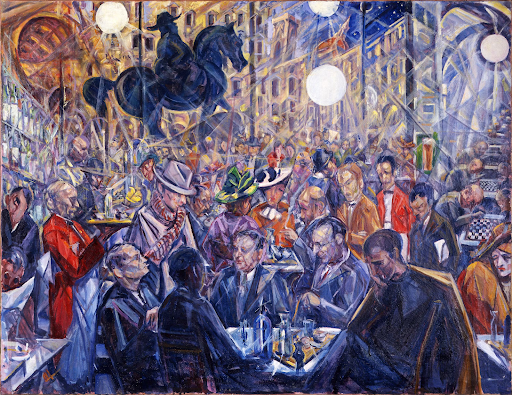
Start your journey at one of the most famous historic literary cafes in Florence, Caffé Giubbe Rosse, where famous poets and writers sat to scribe and exchange radical ideas. According to the article, “Grand Re-opening of Caffé Giubbe Rosse” by Accord Italy Smart Tours, Caffé Giubbe Rosse is located in the Piazza della Republica and was established in 1896 by two German brothers. The cafe earned its current name, meaning Red Jackets, because it was inspired by the red uniform worn by the waiters. 

Caffé Guibbe Rosse grew to become a hub for intellectuals, artists, and writers. The cafe played a pivotal role in the Futurist movement and served as a gathering place for avant-garde thinkers like Baccio Maria Bacci, who looked to challenge traditional artistic roles. 

Today, visitors can still visit the cafe and bar to experience the Italian cultural experience and legacy, where you can find some original Futurist writings still on display! 

Teatro Verdi: Reinventing the Stage

Next, step into the dimly lit Teatro Verdi of the 1980s, where the stage is filled with redefined Italian performance and shortly became a prestigious turnpoint in the uprise of the futurist avant-garde movement. Teatro Verdi transformed into a space for the most sophisticated pop and rock music and for unconventional drama. 

According to the Teatro Verdi website, the theater was inaugurated in 1854 and is the largest “Italian-style” theatre in Tuscany. Located in the historic Santa Croce district, it was built on the remnants of the 14th-century Carcere delle Stinche. In the early 20th century, the theater embraced the futurist avant-garde movement, which challenged traditional theatrical norms. These weren’t just performances but protests, celebrations of youth, and identity in a space of avant-garde reinvention.

Today, Teatro Verdi remains a diverse cultural venue, offering classical music, contemporary performances, and pop and rock concerts, reflecting the artistic landscape Florence has to offer.

Tenax: A Hub for Florence’s New Wave Movement

Last but not least, explore one of the music venues that fueled the cities’ New Wave movement in the 1980s, Tenax. Tenax quickly emerged as a hub for new artists and musicians by influential New Wave and post-punk bands and today remains a symbol of Florence’s alternative music history. Picture this: it’s September 1981, and amid Florence’s enthusiasm for new wave, dark, and punk sounds from the UK, Tenax emerges as a pioneering nightclub. According to the Tenax website, the club was founded by a group of young entrepreneurs and quickly became an innovative and alternative hub for emerging artists, fashion designers, and musicians. Tenax’s stage has hosted an impressive number of acts, including Spandau Ballet, Bauhaus, and New Order, becoming a cornerstone of Italy’s music scene. Bands like Litfibia and Neon, formed in Florence in 1979, found a platform at Tenax for their innovative sounds. 

As the music landscape evolved, Tenax adapted and began to embrace other genres like house music. The club’s ability to reinvent itself while maintaining its core identity has ensured a lasting influence on Florence’s cultural aspect. 

All of these examples of Florence’s underground cultural scene offer a rich and nuanced perspective of the city’s artistic evolution. These places, now more visible, carry with them the same legacy of those underground revolutions. So, next time you find yourself in this beautiful and magnificent city, look closer. Look beyond the espresso machines, beneath the stage lights, and in the echoes and flashing lights, and maybe you’ll find the story of a city whose past reflects a magnificent creative rebellion. 

Florence Korea Film Festival 2025: Cross-Cultural Shock

written by Megan Cuviello & Ashlyn Loper

This blog feature is an exclusive bonus installment to our Spring issue of Blending Magazine. After you finish reading, be sure to explore the rest of the magazine online—just follow this link to download the full Spring 2025 edition:
https://jschoolfua.com/images/BM/BM_151.pdf

Since the 1980s, Florence has been an epicenter for art and has cultivated a space for individuals to express themselves. With the rebellious spirit of the city, fostering spaces for punk, street and alternative artwork and design, it’s no secret that the city has allowed for the culture within the city walls to flourish. This includes one notable place in Florence, Cinema La Compagnia. Cinema La Compagnia is a cultural venue located in the heart of Florence. The cinema opened in 1921 and was originally called Cinema Modernissimo. Then, between the years 1984 and 1987, it was transformed into the Teatro della Compagnia and eventually came to be what it is today. Cinema La Compagnia is a place where many film festivals and cultural festivals are held, making it the epicenter to showcase the art and talent of different cultures within the city of Florence.

The Florence Korea Film Festival 2025 was held at Cinema La Compagnia in Spring, 2025. It was a ten-day affair to showcase the different types of South Korean films, such as historical films, documentaries, short films, and many more of the South Korean culture. It showcased many independent films and filmmakers and allowed time for audience interaction with the filmmakers. This film festival has been held in Florence over the past two decades, and people from all over Europe, the United States and all over the world come to see the culture displayed at the Cinema La Compagnia through the Florence Korea Film Festival. 

Throughout the ten-day festival, we were able to attend multiple times to engage with individuals from all walks of life. On our first trip to the festival, we were introduced to the Florence Korean Film Festival Management Coordinator, Caterina Migliarini. We got to visit with Migliarini as she gave us an in-depth look into the festival while also introducing us to some of the history of Cinema La Compagnia. Migliarini stated, “People from all over come to the Cinema to see the Florence Korean Film Festival. People from Estonia, the Czech Republic and even India,” showing the cultural diversity that is welcomed into spaces of this nature. Migliarini also stated, “The beauty of the cinema is not just for the younger generation – it is for the elders and older generations.” This sparked conversation within our group as we reflected on the generations that had walked through Cinema La Compagnia at different times in history. Migliarini shared that it is one of her favorite places, if not her favorite place, in all of Florence, as she lives just down the street. Migliarini continued to share about how “the Cinema brings in Korean culture to other places” and the connections Cinema La Compagnia has with various universities, such as the European University Institute and also our very own FUA & AUF campus.

On our next trip to the Cinema La Compagnia and the Florence Korean Film Festival, we were able to attend a masterclass led by famous director Na Hong-jin. This South Korean film director was debuting his new film “The Wailing”. During this masterclass, we were able to learn more about his film detailing a Japanese man’s arrival in a small community. Through the masterclass, Hong-Jin’s passion for his work truly shone and allowed everyone in the room to grasp his concept. This also shed light on the true meaning of the independent film and allowed for a deeper understanding and appreciation that goes into all of the films shown in the festival.

Overall, the Florence Korea Film Festival at Cinema La Compagnia has opened its doors to a wide array of individuals and the artistry behind the independent films shown. While this film festival is just one effort in the continuance of the rich cultural heritage behind Cinema La Compagnia, it is also one of the many pieces to Florence’s cultural preservation and cross-cultural engagement. Everyone should take the opportunity to continue to support local and independent filmmakers, along with exploring the Florence Korea Film Festival for the 24th annual exhibition in 2026.

Travel Fatigue: The Day Trip For When You Need A Break From Day Trips

written by Hannah Johndrow for SPEL Public Relations

Because my study abroad term was only six weeks long, I packed in a lot of travel into such a short period of time. I didn’t know anybody else going abroad with me, so I didn’t plan any trips in advance as some other students do. I was initially worried that I wouldn’t be able to travel much on the weekends, or that I wouldn’t have anybody to go with. 

I got along very well with my roommates, so we established a sort of unspoken travel group among the three of us. We were bad at planning ahead, so almost every trip we took was booked at the very last second. While I’m not here to recommend following our lead in that respect, I did take the time to compile an itinerary for one of my favorite day trips that I took during my time here in Florence. The constant travel on the weekends most definitely catches up to you, so this is the perfect day trip for when you just need a break from traveling, but still want to explore Italy! 

Travel Tip 

First of all, a quick disclaimer before we get into the full story. I’d like to share some advice for traveling in Italy! When traveling by bus or train, it is really important to understand their ticket validation system. This was a major culture shock for me. In the U.S., I’ve always bought my bus and train tickets on my phone, then was good to go. In Italy, however, many tickets require validation. There is often a machine outside of the bus/train station, or it may be on the actual bus/train. 

It is extremely important that you validate your tickets, because they are not viewed as being valid tickets until they are officially validated (typically the machine will leave a stamp on your ticket with the time and date of validation). I learned this the hard way when I purchased a bus ticket but didn’t understand that I had to validate it. Within thirty seconds of getting on the bus, a ticket officer came up to me and asked to see the ticket, which he refused to accept as valid because I had not validated it. I was fined forty euro! So, beware of this important cultural difference. 

The Elsa River Park 

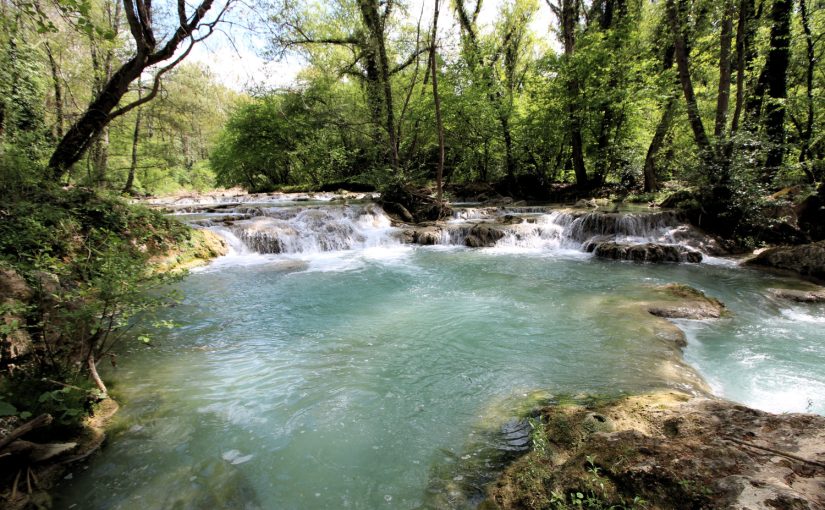
My favorite day trip was to the Elsa river, which is only an hour drive from Florence. The entrance to the river is called “Parco fluviale dell’Elsa o Sentier Elsa” on Apple Maps (which translates to “Elsa River Park”). While my friends and I drove there, there is a bus that takes you directly from Florence to the entrance of the park! I would suggest Google or Apple Maps to determine the quickest bus route. 

What to pack: 

● Swimsuit 

● Towel (to dry off, and to sit on) 

● Snacks 

● Water bottle 

● A camera (you’ll want to take pictures of the gorgeous turquoise water!) 

I’d recommend leaving earlier in the morning so that you can have the whole day ahead of you (this goes for any day trip). It’s nice to get there before the crowds too. Once you get to the entrance of the park, there is a trail alongside the river. It was crowded the day I went because it was so hot, but we walked down the trail until we found an open spot to sit! Just walk the trail until you find a good spot. It’s nice to get there around lunchtime so you can sit down, eat, and then relax by the water for the rest of the day. I spent the whole day here when I went. I’d just gotten back from a day trip the day before and felt like I needed a more relaxing day, but I didn’t want to sit around either. This trip was perfect because I was able to explore a new place, and relax. 

So, if you’re currently studying abroad at FUA, I hope you decide to explore this hidden gem! It’s the perfect escape from the Summer heat, and is off the beaten path of touristy spots.

From Coffee to Espresso & a Few Other Changes

written by Charlotte Cicero for SPEL Journalism

Ciao, my name is Charlotte Cicero. I’m a junior at the University of Missouri, and I had the privilege of studying abroad at FUA this past spring semester. For the past 15 weeks, I’ve been writing for the website you’re currently reading, and for Blending Magazine.

When I wrote my first blog post in January, I threw a corny title on what was pretty much a journal entry. For this final piece, without a corny title and with more structure and a little more wisdom, I want to reflect on some parts of that original post. So here we go.

“I’ve lived in Florence for a little over two weeks now. The adjustment has not been easy, and I think I’m still shocked that I’m finally living this dream that has just felt like some faraway plan for many, many years.”

Now I’ve lived in Florence for nearly four months. I’m not ‘shocked’ anymore, but instead in a constant state of wonder, curiosity, and awe of how much beauty I’ve witnessed in such a short time.

“This transition to Florence feels nothing like my transition to college. I’m still trying to decide if that’s a good thing, and I’m hoping it is. This transition feels almost unreal like I am still in the process of, well, processing.”

It turned out to be a great thing – change is supposed to feel like change. I’ve learned that new and different things create new and different comfort zones. At first, I felt behind my friends, like I was late to have the moment of “I’m really doing it! I’m finding myself in my twenties in Europe!” moment. But instead, I got to experience a buildup of little moments that over time made me realize that I was in my twenties, I was in Europe, and I was on the journey of finding myself. 

“I walk the same streets every day. I can get to the store, the city center, and all my classes without Google Maps. I feel lucky that these streets feel so safe and familiar, but sadly, not like home. Not yet, at least.”

I still walk most of the same streets. But now I play around with different routes, knowing that if I make it to the city center, I’ll always find my way back.

The streets feel safe, and familiar, and they finally feel like home. I walk down my street and wave to Matteo and Alessio, who work at the Virgin Rock Pub. I wave at the owners of Cucina di Ghianda, the restaurant next to our apartment. I high-fived Muhammad, who owns the convenience store next door. They all say “Ciao, Charlotte!”. I don’t know them all that well, but seeing them every day reminds me of the quiet power of human connection and community.

“There’s something special about talking to the same employee at the coffee shop on your street every morning, sipping your espresso (that you’re still getting used to) as you muster up the courage to practice the new word you learned on Duolingo the previous night.”

That person became Sergio at Santa Croce Champagneria, right across from FUA. I introduced myself to Sergio before my first day of FUA orientation, poorly attempting to speak Italian and unaware that he’d remember my name. I’d get my homework done there and spend every in-class break grabbing another espresso (which I’m very used to by now). No comment on my Duolingo streak.

“I think what we all need to remember is to stop moving for a second. Breathe. Look at the Duomo and just breathe. Look at the dark green window panes on the top floor of every street and breathe. Before going out with your friends on ‘Space Wednesday,’ breathe. Staying present is the only way to appreciate what a gift this moment is, right? Because we don’t even have any idea just how good this is all going to get.”

Note to January Charlotte: this paragraph needed workshopping, but I’ll forgive it. Deep breaths are in fact important! I paused to breathe in moments I knew were becoming memories. Like the time I was in Orvieto, having a coffee and journaling, and the man I’d shared a train row with walked by. I wrote in my journal: “A sweet elderly man in a yellow raincoat just walked by with his little dog.” I smiled at him, but he didn’t see me. Every time I think of that memory, I tear up. Not because it was emotional, but because it was ordinary. 

“I’ll see you at the end of the semester.”

Well, it’s the end of the semester. I’ve seen so many beautiful places, things, and works of art. I’ve seen life shift and stretch and swell with beauty, and met so many beautiful people. 

I can’t wait to reread this in six months, just like I’m rereading that first blog post now, knowing I had no idea how good it was all going to get.

So, here’s my last reflection: Keep walking new streets, even if you’re scared to get lost. Keep saying “Ciao” to strangers, even if you’re not sure they’ll remember you. Someday, you’ll look back and realize it was never ordinary at all.

I’ll see you. Don’t stop traveling and live your life curiously. And never stop letting the world surprise you.

My Favorite Outdoor Florentine Spaces

A personal guide on where to be productive in Florence

written by Tyler Kirwan for SPEL Journalism

As of writing this I have less than 12 days left in Florence. While my dwindling time is upsetting, I have been lucky enough to discover some of the beautiful places the city has to offer. When I am not in class, or working for my internship, I enjoy reading, journaling, or just people watching outdoors in the sun-soaked city I have been able to call home for the past few months. I am someone who loses focus quite easily, and it is important for me to be able to be out of my home when I want to be productive. In the states, I spend most of my time when not in class, sitting in coffee shops. Italian culture is a little different when it comes to working in public, particularly coffee shops, and it is less common here to sit inside for a long while and work. The first few weeks I spent here I was overwhelmed with choices on where to spend my leisure time. Now that I have explored more of Florence, I have my version of a comprehensive list of my favorite places. Hopefully anyone reading this can take my advice and give these places a try, especially if they live in the same corner of Florence as I do.

While this list is in no particular order, I am currently writing this from the ‘Piazza Delle Murate,’ so I shall highlight it first. This Piazza contains a coffee shop/restaurant, and the entrance to the Murate Art District – a museum I would highly recommend. I discovered this space after being assigned to write about an exhibit opening at the museum. The coffee shop has Wi-Fi that extends out to the Piazza and I love getting a coffee and sitting outside and reading or writing. There are a lot of tables to sit at, and bringing a friend and having a conversation in the sun is wonderful.

Another one of my favorite locations is ‘Piazza Sant’Ambrogio.’ This Piazza is fun during the day but especially lively during the night. On any given day of the week all types of people are standing around with a drink and their friends chatting it up. This little area is a great place to meet new people, and I enjoy sitting on the church steps with my roommates. We live very close to this square and most nights, at some point we are spending time there. During the day the Piazza is nice as well and features a coffee shop on the corner that is a great place to study, with multiple restaurants very close.

Down the street is another great place called ‘Piazza dei Ciompi.’ The Piazza is surrounded by restaurants, places to drink and has free Wi-Fi. The centerpiece of the Piazza is a set of steps with columns and a roof. I sit on these steps all the time to read or eat a snack I bought nearby. There is a park behind the columns that also features a vintage market surrounding it on some occasions. My roommates have been able to find some nice stuff at the market, so for that reason alone this Piazza is definitely a great place to check out.

Switching from Piazzas, the next place on my list is my favorite park in Florence. ‘Parco Giochi,’ has beautiful trees surrounding it, and plenty of benches to soak up the sun and read a good book. The park also has a playground and a basketball court if either of those things suit your mood. There is even a merry go round in the center which I find quite sweet. If the benches are ever full there is some grass where I personally have napped during a warm day.

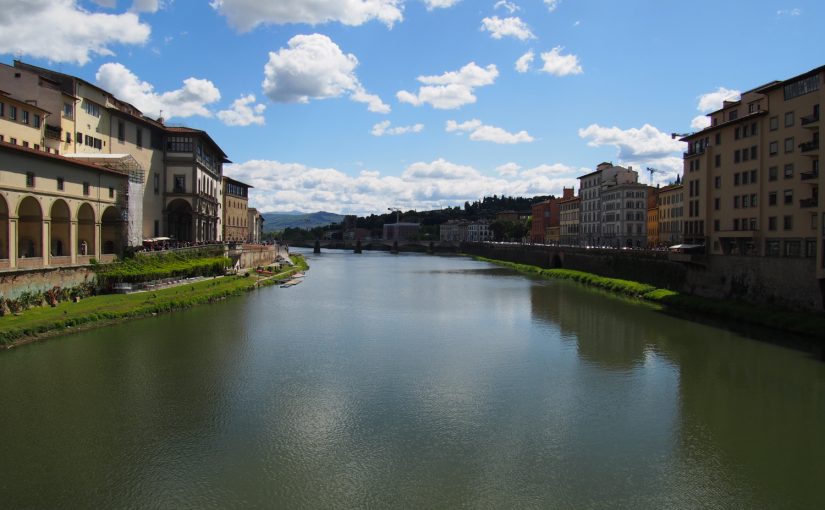
The ‘Giardino Lungarno del Tempio’ is a small park located on the riverbank of the Arno. This park is a great place to hang out with a book or with some friends, and at sunset the view of the Ponte Vecchio is phenomenal. One side note is that there is no Wi-Fi. So no laptop work, but definitely a great place to read a book and look at Florence from a unique viewpoint by the water.

The final location on my list of favorite places is actually on the opposite side of Florence than all the previous mentioned. ‘Orti del Parnaso,’ is a city park that looks over all of Florence. This park is easy to get to, as you can either walk there, or take the tram to the ‘Liberta-Parterre’ stop. This is my preferred method as I live a distance from the park, but the view is always worth the trek. Besides the view, the park itself is nice, and has some sculptures and plenty of benches to relax at.

Hopefully my recommendations are helpful to anyone reading and they can enjoy some of what makes these places so special to me. All I have left to say is, go outside, enjoy the beautiful city, and soak up some sun.

The CPA’s Role in Florence Subculture

written by Katherine Seiler and Isabella McCarthy

This CPA deep dive is an exclusive bonus installment in our Spring issue of Blending Magazine. After you finish reading, be sure to explore the rest of the magazine online—just follow this link to download the full Spring 2025 edition:
https://jschoolfua.com/images/BM/BM_151.pdf

Origins

The Centro Popolare Autogestito (CPA) is a self-managed, community-driven space that offers a platform for political activism, art, and social movement, contrasting the city’s historical and tourist-centric culture. Founded in the 1980s, it began as an escape from heroin, social isolation, and marginalizations that were often present during these times. The group initially occupied a nursery school in early 1989 and transformed it into a community space where people could gather to address social and political issues. They had to move to a mechanical workshop later in the year, and finally moved into their current building in 2001 after the old school was closed down years prior. Nicolo, a member of the CPA, described the space as “squatters that take over abandoned places”, but this practice can be regarded as a way of the CPA reclaiming unused properties and transforming them into usable, community-driven spaces. 

Hub of Creativity and Activity

Over the years, the CPA has evolved, but its core ideals in anti-fascism, community, and artistic expression remain intact and are present throughout its facility. Today, the CPA is a vibrant cultural hub hosting a variety of facilities, including a gym, library, art studio, cinema, and computer spaces. Classes in karate, ceramics, art, and more give people a chance to develop both personally and creatively. These spaces provide members the opportunity to connect, create, and grow. 

Through a visit to the ceramics studio, managed by Roberto, we learned that the studio was established six years ago, and it has become a place of creativity and connection for many. The process is simple: pay a small fee, make two pieces to learn the basics, and then create whatever you want. There are no formal teachers; everyone helps one another, and the focus is on learning together. Through regulars like Ciara, Irene, and Vitoria, it became clear how much they valued the sense of community the studio provides. They worked together on each other’s pieces, sharing tips and experiences, fostering a sense of belonging.

Current Day

Visits to the CPA reveal the diversity of its community. Nicolo noted how younger generations would turn to the CPA to utilize study spaces and as an opportunity to socialize. It was mentioned that some children would skip school, hop the fence, and hang out at the CPA instead of being at school. This seems to be a tradition that has continued over time, as many members laughed and remarked, “just like we used to do!”. Though one member said, “The Italian population is not young, so there are a lot fewer young people here,” when talking about the age of people involved with the CPA. 

The CPA’s finance model is that almost all activities are free of charge, except for concerts and the initial ceramics fee. The money needed to cover rent and utilities comes from the concert revenue. The CPA ensures that anyone, regardless of financial situation, can access the resources available. 

The CPA is also focused on helping the community, as they were instrumental in organizing large-scale food and resource drives during the pandemic. Despite their history of tensions with law enforcement, members of the CPA shared that during the pandemic, the police would give out the CPA’s number to individuals who needed food but could not afford it. At this time, law enforcement recognized the value and importance of some of the work that the CPA does. 

Expanding on the relationship with law enforcement, the center has a longstanding reputation for being anti-authoritarian and believing that the police represent an oppressive force. The CPA does not tolerate drugs and believes in alcohol moderation. People do smoke weed within the CPA, and though it is not legal, the cops do not bother people who smoke it on the CPA property.

For many, the CPA provides a space where people can escape, create, and express themselves freely. Despite facing numerous challenges, the CPA continues to thrive, staying true to its core values. It’s a place for the marginalized, the artists, and the activists and a space that has evolved but remains firmly rooted in its commitment to community. 

The Only Guide You’ll Ever Need to Study Spots in Florence

written by Charlotte Cicero for SPEL: Journalism

Whether you’re studying, reading, or grabbing a quick pick me up, this guide will cover everything from ambiance to music, to table sizes, food options, opening and closing hours, book selections, places to meet people, and of course, an honest personal opinion. 

Rivarno – Meals, bright, happy, peaceful 

If you’re looking for a spot off the river to do some homework while enjoying some delicious sandwiches and tarts, Rivarno is your spot. Get there early as this place gets crowded and bring your noise cancelling headphones. 

Fedora – Lively, indoor/outdoor, pastries and sandwiches

Of course, I’m partially biased being a student of FUA, but Fedora is one of my favorite spots on this list. Located on Via Ricasoli just 5 minutes from the Duomo, Fedora offers pastries made by students, for students. Locals will also come to dine for dinner and lunch. When the weather’s nice, you can take a seat outside on comfortable couches or desks. Coffee is delicious and pastries are consistently fresh and yummy.

Bar Grano – Indoor, bar/coffee/pastries/meals, lively 

If you’re looking for a spot to grab a glass of wine and people watch, with some great music, Bar Grano is your place. I sat by the window on a small desk and enjoyed a glass of Pinot while studying, it’s not too loud but enough ambiance to where you can focus. Would recommend to anyone looking for a place to focus while enjoying yourself. 

La Menagere – Brunch, fun, decorative 

Although expensive, Menagere has many cute spots to sit in, with every room representing different colors and flowers. Well-lit and lively with great service. I’ve heard that the dinner here is sub-par, but the pastries are lovely and the coffee is great. I recommend an early morning breakfast or mid-day aperitivo. 

Cat Cafe – Activity-based, coffee/pastries/sandwiches

As long as you’re not allergic to cats, Cat Cafe is a great option to study and read, while snuggling with some cute cats. I did get scratched within my first few moments there but had a great time. The cats are friendly and will crawl onto your laptops (or into your bag), I had a delicious Cafe Orzo and Americano.

Move On – Bar/restaurant, nighttime 

Opening later in the day, Move On is the kind of place that knows exactly what it wants to be, and clearly had a very specific vision. A record store, restaurant, and bar, Move On has a usual quiet ambiance (when there isn’t a football game on) with different rooms upstairs and downstairs. You can enjoy a glass of wine, dinner, or snacks while overlooking the Duomo and listening to some great music.

Todo Modo – Bookstore, coffee/bar/restaurant

Not far off the Ponte Vecchio, this is the hidden ‘coffee shop’ gem of Florence. Todo Modo has the most interesting and cool design, with an ascending staircase full of books that harbors study seats with hanging tables amidst hundreds of books in English and Italian. When you first walk in it’ll look just like a bookstore, but the further you walk, it becomes a restaurant and study spot. If you want to stay for lunch, make a reservation. Get there earlier, preferably on weekdays, as this place is completely packed on Sunday afternoons.

La Cite – Bookstore, live music, pastries/food/coffee, indoor/outdoor

Another hidden gem across the bridge from the Duomo, my friends and I stumbled across La Cite on our way to dinner. Inside we found 3 upstairs and downstairs study areas, a group of friends playing piano, and everyone enjoying food, wine, and coffee. There are couches, desks, board games, books in Italian, and sometimes live musicians. I recommend the Cafe Orzo or any of the creative cakes they have on display.

25Hours Hotel – Restaurant/bar, coffee/pastries, bright 

Less than 10 minutes from the train station, 25Hours is an eclectically decorated hotel with a coffee shop and restaurant. The clear ceiling provides beautiful natural light to anyone trying to relax, and the decor of the hotel lobby provides a great ambiance for meetings – perfect place to meet up with a friend for aperitivo. I enjoy their selection of hot teas, Italian cookies, and of course, Cafe Orzo.