A “Carless” Chronicle: What I Learned Trading My Keys For a Passport

written by Logan Grigsby

At first, I was nervous about trading my sedentary, car-dependent life for the walkable streets of Florence. I was nervous about getting lost, accidentally walking into the “bad side of town,” or simply not being able to physically walk that far. However, walking in Florence led me on a journey of self-discovery, connection, and helped transform me physically, spiritually, and emotionally.

In my hometown of Kansas City, going just about anywhere meant getting in the car; heck, I couldn’t even take my own dog on a walk without driving somewhere! My lifestyle was very sedentary most days; I would only walk a couple of thousand steps. I felt unhealthy, and walking more than a few blocks felt foreign to me. However, I knew even before I arrived in Florence that I wanted to trade my car keys for a passport and a nice pair of shoes. I knew I wanted to explore the city, and I knew I wanted to be healthier and happier. I never could have imagined the transformation that was in store for me, physically, emotionally, and even spiritually, and the love I would gain for Florence. This is my journey on how simply walking has changed my perspective and my life.

As I mentioned before, I was in pretty rough shape. I didn’t exercise, I didn’t go to the gym, and I was considered by most to be a “couch potato” stuck in a constant loop of getting out of school, plopping on the couch, and doom scrolling TikTok or Instagram for hours, never seeing the beauty in front of me.

My journey started small. Let me tell you, the first week was a challenge. We had a heat wave, and my body was just not used to walking around. At first, my body screamed when I had to walk across town for class, and don’t even get me started on the hills… Although, as time went on, I started shedding off fat, and the steps got easier as every day went by. At first, I struggled to hit seven thousand steps. I soon found I was disappointed in myself if I got anything less than fifteen thousand.

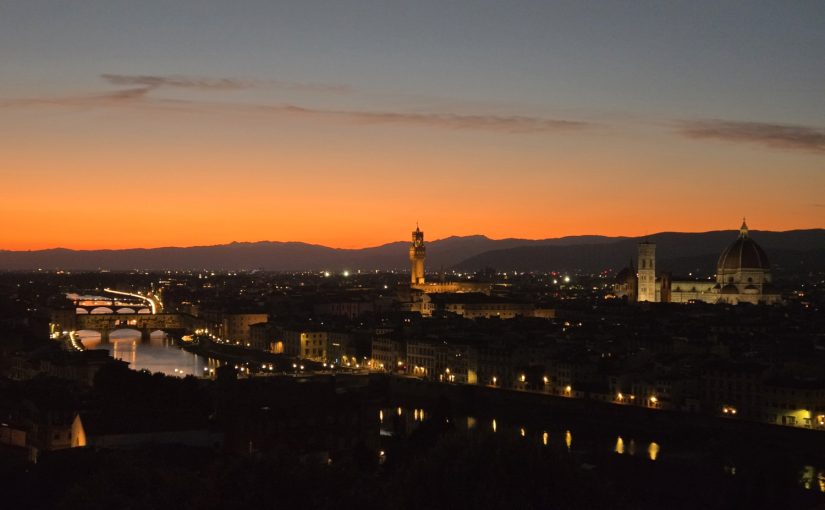
I remember my first week here attempting to make the trek up to Piazzale Michelangelo; A wonderful square with a beautiful look over the city. It was not the easiest hike. I remember having to stop and take breaks constantly. I drank nearly a gallon of water and I genuinely thought my body would give up on me. I decided to retake that journey during my final week in Florence, and not only did I not need any breaks, but I also found I was genuinely enjoying my journey up the hill!

A healthier lifestyle isn’t all that I found; the true magic of a walkable city isn’t the exercise, but it’s the hidden treasures you find along the way. Things you wouldn’t bat an eye at if you were driving in a car. Wandering aimlessly through the city quickly became a favorite pastime of mine. I didn’t know where I was going, but every day I would pick a new direction and set off. This led to some genuinely life-changing experiences.

During my first week, I found what I assumed was a small, unassuming bookstore. I honestly went in for the air conditioning; however, it turned out to be the legendary “Giunti Odeon,” a library and cinema, and what many locals have told me is one of their favorite places in the city. This quickly became one of my favorite spots to study, hang out, or just relax and watch a movie.

Then, one day while walking along the river, I stumbled upon “The Ultravox,” a truly unique outdoor event space that regularly hosts free concerts and offers a vast array of food options. I must admit, I fell in love.

One of my more memorable experiences was discovering “The Havana Club,” a small area on the river that the Cuban embassy officially recognizes for showcasing their culture in Florence. This is a place where I truly connected with the area and grew culturally. I remember walking up to the sand volleyball court quite nervous and sheepishly asking if I could join in, and before long, I had made a group of friends with local Florentines! They would eventually convince me to take to the dance floor, something I never considered, as I always thought that I had “two left feet.” I was so anxious, I thought I was going to throw up, but surrounded by people with positive attitudes and energy, I quickly found myself learning to Salsa dance. Who would have thought that I would learn to Salsa in Florence, of all places.

Of all the things I have done, if I hadn’t decided to just go on a walk, I would have never had these amazing experiences.

My walks have allowed me to truly appreciate the art and history of the city, which permeates it. My first time walking into Piazza della Signoria, I honestly was at a loss for words. Surrounded by breathtaking architecture, beyond lifelike statues, I have never experienced anything like that, and it will forever be a memory in my mind. Back home, I felt like I never took the time to “stop and smell the roses,” and appreciate the beauty surrounding me; however, in Florence, it is unavoidable.

My appreciation for Florence extends beyond the architecture, though. What truly makes Florence so special is the people who make up the city. Every day I see something new and special, from seeing artists freehand the Mona Lisa on the street with chalk, to guitars and accordions filling the streets with sound, to my first experience with Opera music on the front steps of the Duomo, the melodies of this city have filled my heart and soul.

My most spiritual moment came from walking down the street and discovering a small church on the street corner where I saw locals walking in and out of. I don’t usually consider myself a religious person, but something drew me to it, and I decided I needed to walk in and see the building for myself. It was quiet, it felt holy, but it also felt warm and welcoming. Before coming to Florence, I attended the funeral of a friend near and dear to me and was still struggling a bit with the loss, so I decided to do something I haven’t done in a very long time: I sat and I prayed. I talked to my friend who left too early, I spoke to my family who left this earth too early, and I sat and I prayed. This was a tremendously difficult moment for me, but I honestly felt a weight off my shoulders, and I felt a connection I hadn’t felt in a long time. I honestly felt like a changed person.

My time in Florence has taught me so much. At first, I thought getting more steps in would at best help me lose some weight and breathe a little deeper, but that couldn’t be further from the truth. It builds a sense of community and connection. I love running into my flatmates or classroom friends that I have made here, who may also just be aimlessly walking around, an experience that never happens back home. Trading my keys for a passport was a nerve-wrecking experience at first, but I now know it’s one of the most rewarding experiences of my life. It forced me to slow down, to pay attention, and engage in my new home. I’m not just living in Florence, I am discovering it one step at a time. This experience has changed my body, my heart, my mind, and my soul in the best way possible. I will forever be grateful for my experience here.
Spring 2018 ChatPal Update

Photo by Authors

By Virginia Pagan and Jalissa Sanchez

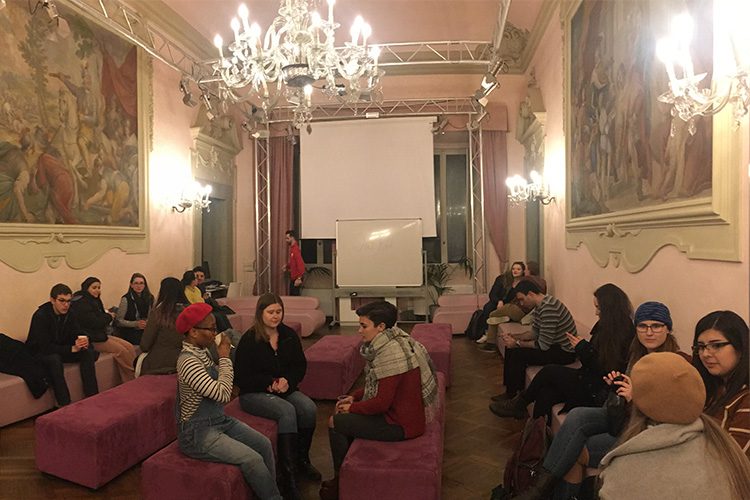
FUA Social Media students Virginia and Jalissa had the opportunity to cover firsthand the first meeting of FUA students and their local Chat Pal partners for the semester-long activity of language and cultural exchange.

The latest ChatPal encounter that pairs students and locals took place on February 26 in Corso Tintori. The purpose of this event was for the FUA students to meet their Italian pal for the first time and have a place to get to know each other and have refreshments. To sweeten the encounter, the FUA hospitality department provided an abundance of snacks such as brownies, cakes, tarts, and savory items as well. Upon arriving everyone took a seat and SLD advisor Mattia Delle Piane announced the partner assignments, and one by one students were united with their local chat pal partner. We then took pictures of each pair in the cardboard cutout of the ChatPal Instagram. This meet & greet was a great introduction for both the students and the Italians involved. Participants will spend the rest of semester sharing and practicing the respective languages of the partners, meeting once a week for a minimum length of an hour to speak 30 minutes in one language and switch to the other for the remaining time. The Italian population this semester features individuals from diverse backgrounds and ages ranging from the 20s to early 40s. We were fortunate enough to meet and interview a local participant, Andrés Rosales, a Spanish transplant in Florence who works as a professional tour guide.

Where are you originally from?
AR: Madrid Spain but I have lived in Florence for 12 years now.

How long have you been a participant in this program?
AR: 3 years

How did u hear about ChatPal?
AR: One of my acquaintances participated the year before I started. He told me about the university, the language exchange program with the students, and I contacted FUA to meet and talk about it.

How many “Pals” do you usually get paired up with?
AR: Sometimes 1 sometimes 2 or 3, depends on the students and how often they can meet up.

Why ChatPal?
AR: To practice and improve my English.

Has your English improved?
AR: Yes, thanks to the practice and the opportunity to chat about different topics.

What do you usually talk about?
AR: General topics such as the city, life in the students’ home countries, and life here in Italy.

See more of Florence and Italy at FUA’s FB, Instagram, and Twitter.

I Wish I’d Been Here When: My Home Was a Nunnery

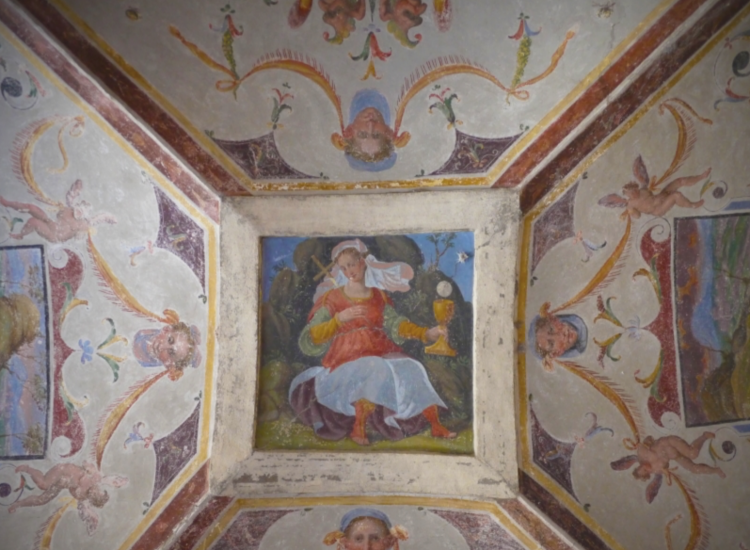
Artwork from my apartment’s walkway depicting angels and other religious imagery. Image courtesy of apartment building.

By Isabel Pellegrino

My apartment used to be a convent dating back to the 15th  century. I can’t help but wonder about the way the nuns lived here. I wish I was able to go back in time to better understand their lives and how they perceived Florence and its future.

I wish I had been in Firenze when nuns gathered in my apartment’s kitchen. In the 15th century, my apartment was a convent. It is hard to picture this space as home to a religious community. While I try to embrace the Italian culture in all of it’s beauty and class, I am not sure the way I live could ever be compared to the grace of a Renaissance nunnery. Yet, here I am. Through an old wooden door, rod iron gates and a few flights of stone stairs, you will find us cooking and practicing our Italian; sometimes we feel like it’s the best we can do to connect with those who occupied this space before us.

During the 15th century, Florentine convents were evolving from small communities to large institutions, according to historian Sharon T. Strocchia in her book “Nuns and Nunneries in Renaissance Florence.” It became common practice for highly- educated unmarried women to congregate in convents. As a result, nunneries became hubs for research, academic dialogue and political influence. As I sit at the kitchen counter of my apartment, I dream of traveling back in time to speak with these women. I can see them now gathering around tables with their noses in books and crosses around their necks. Question after question would flow from me: What is it like to be women leaders of a religion often dominated by men? What do you see your legacy as? What does Firenze mean to you and your faith? How can I honor your lives in my time?

But more than anything else, I wish I had the chance to roam the Florentine streets with them and see the city through their perspective. In the midst of the Renaissance, I wonder how they felt about the art and how it influenced their faith. I wonder if they had any idea of what the convent space would become in the centuries afterwards. While I will never have a time machine during my fleeting few months in Italy, my roommates and I have pledged to take time every day to be grateful for our apartment and our lives in Italy. When we sit around our dinner table and discuss culture, religion, politics and philosophy, it’s almost as if we have been transported back in time by the everlasting art of conversation. I like to imagine the nuns doing exactly this, just centuries ago. Our apartment bridges our times together. So maybe, we aren’t all that disconnected after all.

See more of Florence and Italy at FUA’s FB, Instagram, and Twitter.

Il Palio: More than a Horse Race

Photo by the author
Photo by the author

By Monica Humphries

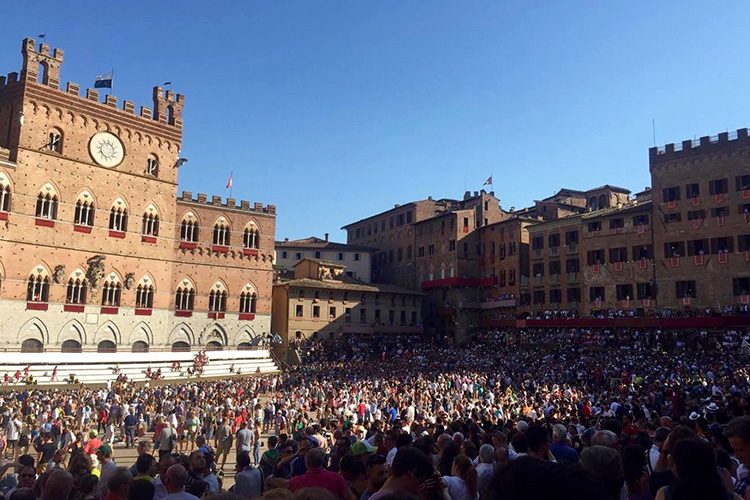
For us, it was a fun race, but for others, it was an event they had waited for all year. From the moment we stepped off the bus in Siena, we learned what the Il Palio means to the city.

Il Palio is horse race held twice a year in the heart of Siena. Piazza del Campo, the city’s main piazza, transforms into a race track. Dirt is packed down on the cobblestone, and fences are built to create the course. The city is divided into 17 districts (contrade) but only ten districts will compete in the race. The jockeys ride bareback and wear their district’s colors. Throughout the day parades and celebrations take place to prepare for the race. The horses are blessed, the bets are made and everyone gathers to the center for the race to start.

The race isn’t about coming in first but about beating your rival. Everywhere you look you see people with colorful flags tied around their necks, cheering for their district. To truly embrace the race, I picked the Tartuca district to cheer for and wore a yellow and blue flag embellished with a turtle, the district’s symbol.

As thousands trickled into the city center, anticipation slowly built up. The race was three simple laps around the track. Months have gone by in anticipation for those three laps.

Above the crowd I could see the brightly colored jockeys ready to race. Decked in black and white, yellow and red, or blue and white with distinguishing patterns, they all sat on their horses pacing for the start. The rules of the Il Palio involve a complicated tradition for starting the race, so it could start at any moment.

Twenty minutes passed, a shotgun was fire and the race had begun. We could feel a gust of air as the horses passed us. We felt the dirt kicked up from the horses’ hooves. We watched as the horses circled the track and competed to finish first.

When the first horse from the Lupa contrada crossed the finish line, the entire town erupted into emotion. The district hadn’t won a Palio since 1989 so emotions ran high. Immediately people were jumping over fences to congratulate the winning jockey and hug their friends and families. Tears of joy ran down some faces, while others cried with disappointment. Tensions broke out, people hugged and the race was over. People paraded down streets in celebration, while our group stood in amazement. The race itself was incredible, but the aftermath left us in shock. This wasn’t a silly race, but a long-lasting tradition built up over centuries. People took pride in their district and celebrated their culture.

The race itself was short but the day was long. Seeing firsthand a tradition that dates back to the 14th century isn’t an opportunity I come across often. On one hand, it was amazing getting to be a part of the tradition. But on the other, I still felt like an outsider. I had no investments in the race, but felt the heart rise as the horses cross the finish line. At the start of the day, the Il Palio felt so foreign to me, but by the end, I had grasped a better understanding of a city and its culture.

See more of Florence and Italy at FUA’s FBInstagram, and Twitter.

From Da Vinci to Mac: Creative Connections

Untitled-2

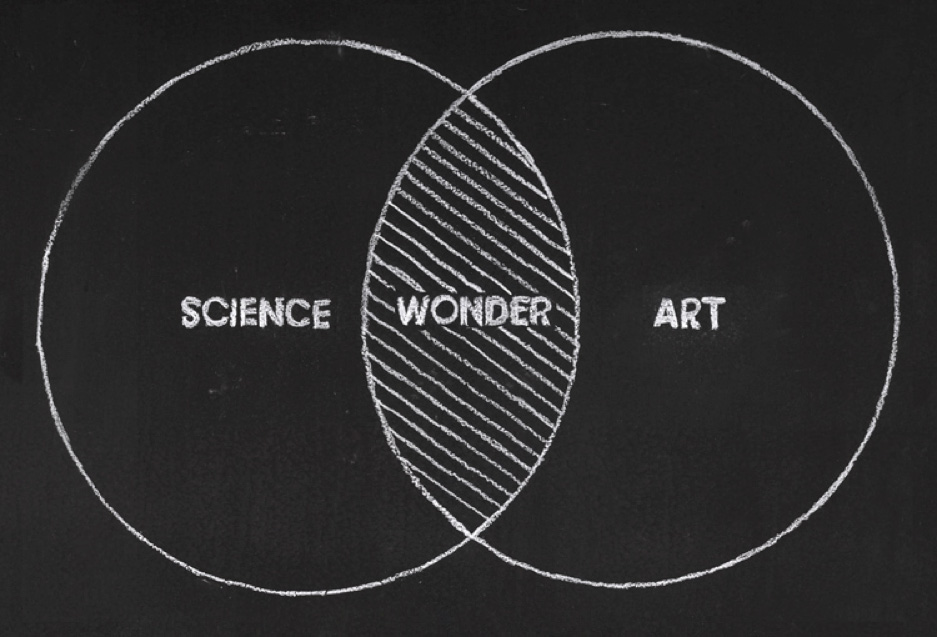
Tuscans like Leonardo da Vinci created a connection between the arts and sciences that continues to inspire global brands like Apple.

Leonardo da Vinci was one Tuscan who blurred the boundaries between the worlds of science and art. Little did he know that the world would be referencing his great work well into the 21st century.

His influence on brands such as Apple began with his use of the “golden ratio,” a ratio that dates back to the 3rd century BC. The “golden ratio” is a concept used to achieve, what is considered, perfect balance and beauty. This concept is still used today in order to create precise and relative designs. Apple is known to have used the ratio in several of its products, such as the iCloud logo. The company logo is also thought to have been designed with the ratio in mind but a Quora  discussion online seems to debunk this theory.

Leonardo Da Vinci, Dante Alighieri, Brunelleschi, Michelangelo, and Galileo, are some Tuscan names that can be identified internationally through their renowned works that have all held an impact within the modern-day use in the arts and sciences. These individuals were able to blur the boundaries of cultures by studying profusely and realizing the subtle connections between the inspiration that had been sought by artists, and the teachings that are required for educating oneself. Their ability to wonder, think, and ponder the scientific ideas they were posed with, broke barriers and created bridges between two very different disciplines.

The culture of art and science that Italy has to offer has made a strong impact for the world and its future. Maybe you too, during your term abroad, can develop such studies that will break boundaries and bridge the two worlds of arts and science. Inspiration is everywhere, even in FUA’s very own DIVA campus where Michelangelo’s Tondo Doni was originally housed before its permanent installation at the Uffizi!

See more of Florence at FUA’s FB, Instagram, and Twitter.

Image credit: Venn diagram image courtesy of the Imaginary Foundation.