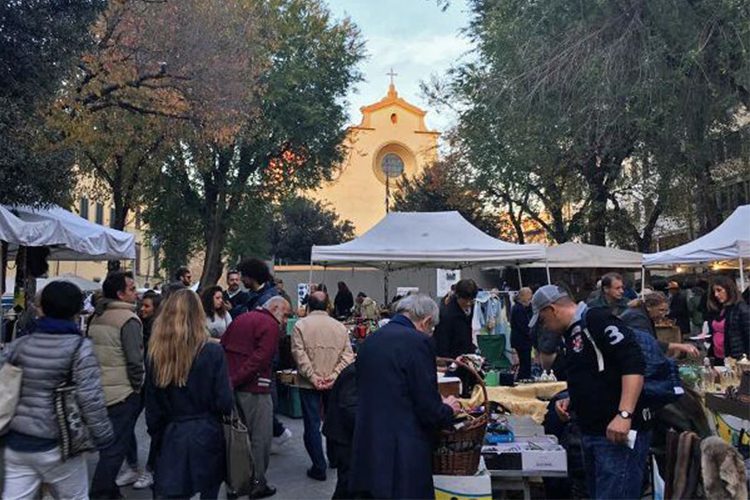
The Santo Spirito Market is an area where tourists and locals combine to experience all that Florence has to offer. It is a time where people can explore anything from food to wine to art to jewelry.
On the second Sunday of February it was time to visit the Santo Spirito Market. This is a perfect activity for a lazy Sunday to go walk around with your friends and browse through all the different fun stands. It’s amazing to be able to walk through and see such a variety of fresh, authentic goods. Whether you want to buy fresh meats and cheeses, homemade jams, or hand-crafted Italian jewelry, this market had it all.
Tourists and locals alike appreciate the San Spirito Market. It exemplifies Italians’ value of fresh produce and delicious-tasting meals. Of course, Italy is known for its exquisite meals using only the best ingredients. The market’s locally-grown vegetables, carefully sliced meats, and handmade pastas demonstrate the Italian value of putting time, effort, and thought into the production of each meal. Italians are committed to fresh, enticing, cuisine.
Observing the shoppers at the market, it was clear that they were carefully considering each purchase. They took their time to examine each product, whether it was the level of intricacy in a piece of jewelry or an orange’s freshness.
One of the best things about this market was that it was full of local Florentines. Santo Spirito is located on the other side of the river from the Duomo. Here you can have a genuine Italian cultural experience. If you start to get tired while shopping, the market is in the middle of the square surrounded by restaurants and a beautiful church. There is something for everyone. The San Spirito Market shows the norm of Italian culture: that people take their time to enjoy the little things in life.
Free Museum Days: 5 tips to make the most out of free entry.
On the first Sunday of every month, as well as other special days throughout the year, Florence’s civic museums allow guests to visit for free! Here are some tips to get the most out of your visit and appreciate the Medici art.
1. Check hours and restrictions
Some museums and churches open earlier than others, while other facilities (such as Museo del Bigallo) may only allow visitors upon reservation. Did you know that the Palazzo Vecchio museum is open from 9 a.m. to 7 p.m. but the museum’s tower is only open from 10 a.m. to 5 p.m.? Do your research ahead of time to avoid frustration later.
2. Map out your day If you are aimlessly walking around the city from one museum to another, you will tire out before even getting to your destination. After picking the places you want to visit and checking their hours, map the museums out and see what route makes the most sense. Your friends (and feet) will thank you later!
3. Dress for success
Check the weather and dress accordingly. If you plan on walking a lot, make sure to wear comfortable shoes. If you plan on visiting a church, make sure your outfit adheres to their dress code (some require shoulders and knees to be covered.)
4. Pack Light
Make sure you are prepared for a long day of adventures. If you are planning on using your phone a lot, bring a portable phone charger or wall unit and adapter. Throw a water bottle into your bag since beverages at a restaurant or café can be pricey. When it comes to traveling, less is more. Keep in mind that anything you pack you will have to carry on your back all day and that can start to weigh on you.
5. Expect crowds You are not the only person who decided to save a few euros and visit museums on a free entrance day! Anticipate long lines and crowded exhibits and remember that you are not the only person who has been walking from one museum to another. Be patient, kind and – most importantly – flexible when things do not go as planned.
With these tips in mind, my friends and I were able to visit Palazzo Vecchio, Museo Novecento, Santa Maria Novella and Cappella Brancacci all in one afternoon. Even with a student discount, we saved over 100 euros between the five of us on one free museum day. Hopefully these tips can help you get the most out of free museum days in Italy, too!
A walk through the city of Florence in search of memory stones which have so much meaning to the past and present of this historical city.
Florence is a thriving city, constantly moving and changing with the times. As a student with a passion for history and art, Florence was an easy choice when it came to picking a destination to study abroad. Defined by the renaissance, history and art is what built Florence and is absolutely inescapable: everywhere you turn is a different palazzo with historical significance, a different statue or fountain that is hundreds of years old, or a museum filled with priceless objects all telling the story of the city. I found this evident more than ever in my walk through the city in search of memory stones.
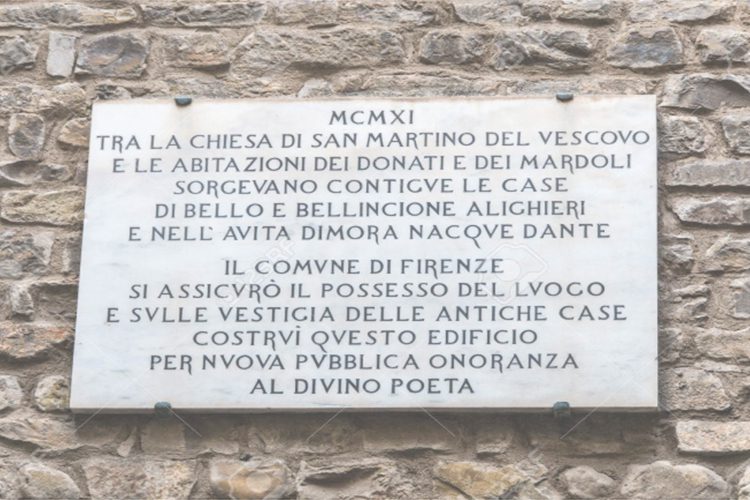
The beauty of these stones isn’t in their appearance, but in their message and purpose. Some stones are set on the outside of buildings where a Florentine of importance was born, passed, or had achieved something within the walls. Others share the history of the city through its culture such as quotes and excerpts by the famous Dante Alighieri.
What I found most interesting during this search was how the stones perfectly married the past with the future, by celebrating the continuous achievements of the city and its inhabitants. When another momentous achievement is made or event has taken place, it is immortalized in stone, and becomes engrained in Florence’s culture and celebration of the past and present.
As students living here, we are the future, and while there is much we can learn from Florence’s past, it is important to see that the city’s commitment to the past and present is what makes it truly unique.
FUA Social Media students Virginia and Jalissa had the opportunity to cover firsthand the first meeting of FUA students and their local Chat Pal partners for the semester-long activity of language and cultural exchange.
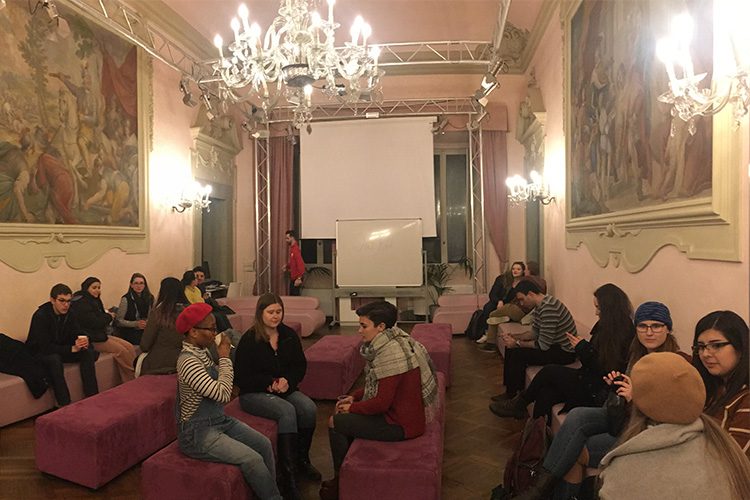
The latest ChatPal encounter that pairs students and locals took place on February 26 in Corso Tintori. The purpose of this event was for the FUA students to meet their Italian pal for the first time and have a place to get to know each other and have refreshments. To sweeten the encounter, the FUA hospitality department provided an abundance of snacks such as brownies, cakes, tarts, and savory items as well. Upon arriving everyone took a seat and SLD advisor Mattia Delle Piane announced the partner assignments, and one by one students were united with their local chat pal partner. We then took pictures of each pair in the cardboard cutout of the ChatPal Instagram. This meet & greet was a great introduction for both the students and the Italians involved. Participants will spend the rest of semester sharing and practicing the respective languages of the partners, meeting once a week for a minimum length of an hour to speak 30 minutes in one language and switch to the other for the remaining time. The Italian population this semester features individuals from diverse backgrounds and ages ranging from the 20s to early 40s. We were fortunate enough to meet and interview a local participant, Andrés Rosales, a Spanish transplant in Florence who works as a professional tour guide.
Where are you originally from?
AR: Madrid Spain but I have lived in Florence for 12 years now.
How long have you been a participant in this program?
AR: 3 years
How did u hear about ChatPal?
AR: One of my acquaintances participated the year before I started. He told me about the university, the language exchange program with the students, and I contacted FUA to meet and talk about it.
How many “Pals” do you usually get paired up with?
AR: Sometimes 1 sometimes 2 or 3, depends on the students and how often they can meet up.
Why ChatPal?
AR: To practice and improve my English.
Has your English improved?
AR: Yes, thanks to the practice and the opportunity to chat about different topics.
What do you usually talk about?
AR: General topics such as the city, life in the students’ home countries, and life here in Italy.
A listicle of some of Florence’s best spots to overcome your writer’s block, and to find your inspiration as a writer.
How to get over writer’s block, writing tips, become a better writer, places in Florence to visit
Even in a city like Florence, a city teeming with inspiration, it can sometimes be difficult to find a spark of creativity as a writer. I realize this must sound like a contradiction, but writer’s block can happen even in Florence. As any writer knows, writer’s block can strike at any time, and to combat this a writer must know what encourages and nurtures his or her own writing process. Over the past few weeks I have found a few locations in Florence which I feel do just that, and have proved very successful in getting me to write. From a secret garden to a pen shop, these Florentine locations will help any writer to feel inspired.
Ditta Artigianale With two locations, (my favorite located on Via dello Sprone) this is a cozy two floor café with lush green plants and graphic eye-catching wallpaper. Sitting down with a coffee and a notebook, this place is the perfect place for a writer’s retreat. There are occasionally live musicians, and plenty of comfortable velvet armchairs to work in. Part of the atmosphere of this café is made up by the lively servers, and also the many students studying throughout. Another perk of Ditta Artigianale is that it stays open very late it is open until 11pm Sun-Thurs, and 12am on Fri-Sat. These hours are perfect for writers who work best at night, or for those who find late night inspiration.
Oblate Café Offering one of the most spectacular views of the Duomo, this rooftop café is a tucked away spot perfect for warm days, reading, and of course writing. As part of a library you can find a book by your favorite author, sit down with a great cup of coffee, and write something at any one of the numerous tables throughout the rooftop. There is also an indoor portion of the café, and so if the weather is not so great, you can still find a nice spot to sit down to get some work done. By seeing such a notable landmark from a different perspective, this café offers you a chance to look at your own writing from a new perspective as well.
News Café Just a short walk from the train station, this café is simple, quiet, and homey. A great blank canvas for writers, this café lends itself to all sorts of creative concepts. The cappuccinos are artfully designed, and the lighting is soothing. A wall of wine bottles acts as a backdrop to this writing spot, and you will find yourself spending hours typing away, or scribbling down notes in your journal in this café. There are also single tables, as well as larger conference type tables here, so whether you are working with a group or by yourself, the News Café has something for everyone.
Todo Modo Perhaps the ultimate inspo-café, this bookstore-café hybrid offers endless opportunities to those who want to write. The entrance is a bookstore, filled with art books, novels, and great literature, but if you travel deeper into the building, you will find so much more. Divided into a library, a café, and a theater, you can eat, read and explore this shop and find something new to do every day. In the back of the shop is a wooden double staircase which offers more seating opportunities, and also acts as a stage for live performers. Described as “a large reading room that becomes a bistro, a place for meetings, performances, projections, concerts, workshops, and seminars” it seems like there is always something new at Todo Modo. Sometimes authors will visit this café, or hold a seminar which can help you to hone your craft, and garner you new skills as a writer as well. There aren’t many places in Florence that offer so much for writers, and the opportunity to improve as a writer makes this place a must-see.
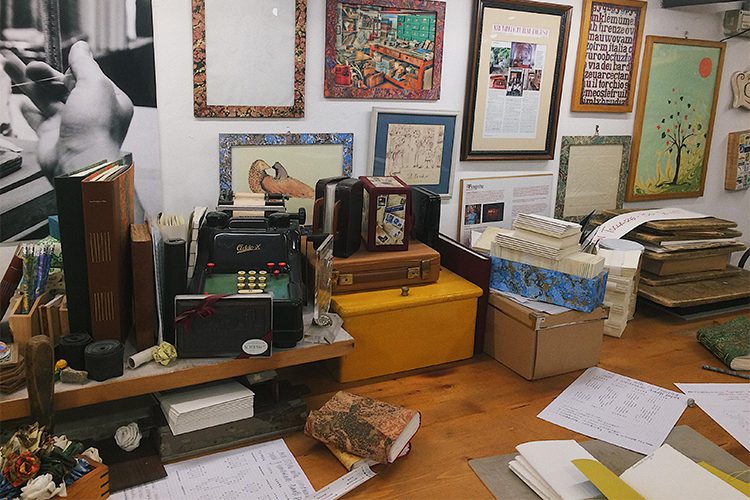
Il Torchio and Casa della Stilografica A writer is only as good as their writing supplies, and I find when I have really good supplies, I end up producing much more content. Try a custom notebook from Il Torchio, these books are all handmade and locally sourced. The paper is made on the Amalfi coast, and the woman who runs the shop can be found binding the books all day long. You can buy a premade book, or get a custom book to fit your needs. If you like this slightly more analog approach to writing, then you may also want to check out the fountain pens from Casa della Stilografica. These pens write like a dream, and you will be hard pressed to find a pen that writes better. The dedication and craftsmanship in good writing supplies can truly inspire any writer, every time I see my notebook or pen, I am immediately inspired to write.
Outdoor Spots My last spots to visit as a writer are all outdoors, and weather permitting, these spots are truly unmatched. They offer intimate and solitary opportunities for a writer to find a slightly more introspective experience. The first spot is part of the rose garden near the Piazzale Michelangelo, if you walk just a bit further into this garden there is a zen garden with some benches that supply a perfect spot to take a break, and write. If you climb to the top of the Piazzale, especially at sunrise, there are few more awe inspiring sights in the city, and so this spot can give a writer many opportunities to find their spark of creativity.
Another slightly less common spot to do some writing, is the area in front of the Palazzo Pitti. It may seem strange to sit here to write, but many people actually picnic in front of the Palazzo, and the community atmosphere has helped me to write many times, something about people watching and the outdoors really helps me to get inspired.
The final spot to do some writing involves a little walking, or maybe even taking the bus, and is on the way to Fiesole. The walk there is so beautiful itself that it would be a challenge to not be inspired. However, if you take Via Giuseppe Mantellini you will find yourself at a small park, with benches, and the most breath-taking view of Florence imaginable. The park is very quiet and on a sunny day you can see the Duomo, the Santa Croce, and so much more. You can find rolling hills, a bright blue sky, the golden Tuscan sun, and hopefully that elusive inspiration to write.
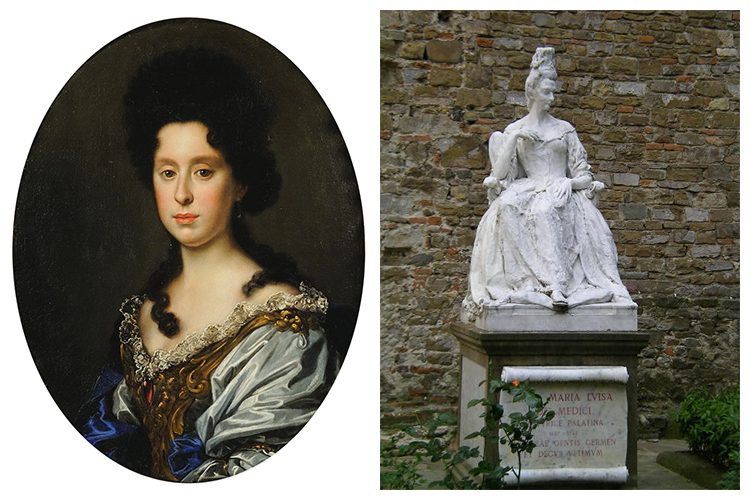
Photograph on right: by Sailko, distributed under a CC BY-SA 3.0 license
By Gregg Casazza
On the first Sunday of each month Florence opens up its museums free of charge, so why then were you able to stumble into the Uffizi on Feb. 18th without paying? You consult with your calendar, count back the weeks of the month, and are utterly stumped. Perhaps there was some mistake at the ticket counter, have you just snuck into one of the most famous museums in Italy? You hurry into the museum hoping no one will notice that you did not pay, completely unaware of this momentous anniversary.
Each year on this historic date, Feb. 18, the city of Florence remembers one of the most instrumental people in its history, Anna Maria Luisa de’Medici, by opening the Medici museums and tombs free for visitors. The last of the Medici’s, Anna Maria Luisa was a woman made of fire, steel, and an intense love for her country.
Sometimes referred to as “Principessa Saggia,” the wise princess, Anna Maria Luisa is the reason all of the art in Florence remains the property of the city. She was so wise that her own father thought that she would have made an excellent eldest son of the family, and tried to make arrangements for the Medici rule to be passed to Anna Maria Luisa in the case of her brother’s death. This was ultimately unsuccessful, and so after both her and her brother failed to produce heirs, and her brother passed away, Anna Maria Luisa was faced with a difficult decision. She realized something had to be done to ensure that the next family in line, the Lorraines, did not sell the many works of art for which Florence was and is famous for. She saw how this happened to another family which fell from power, the Gonzaga family in Mantua, and so she was determined to make sure this did not happen to Florence.
Anna Maria Luisa spearheaded this cause, and eventually created the Family Pact (Patto di Famiglia.) This formal legislature declared that the patrimony of the art must remain “ornaments of the state for the use of the public,” that would “attract the curiosity of foreigners.” This pact made it so that the art of Florence would forever remain in Florence. This single action ensured the longevity of the city, and has made Florence the destination that it is today. Anna Maria Luisa can be thanked for many things: tourism in Florence, the many museums and their works, music and theatre, and of course study-abroad. As a student, Florence is one of the greatest cities to study in, the universities and the culture offer an experience unlike anywhere else in the world, all because of Anna Maria Luisa.
Anna Maria Luisa is a figure unlike any other in history. Her sacrifices and dedication have made Florence what it is today; the birthplace of the Renaissance, as well as a destination for art enthusiasts and students all over the world. The legacy she left behind is the legacy of Florence as a whole, and although she is only remembered on Feb. 18, her impact can be seen every day in each street and each painting.
A study abroad student reflects on overcoming challenges when facing a new culture such as the Italian one and what he has learned so far.
You’ve done it. You said arrivederci to friends and family, left the comforts of your university behind, and have settled into your new life in a different country. Now what? No matter what your expectations of this experience were, you are probably finding yourself a bit overwhelmed with the new sights, sounds, and of course the language of your new Italian environment. I found it a lot to take in myself; I’ve never visited, let alone lived in a place where I didn’t speak the native language, nor have I felt so personally attacked by pigeons or shared an alley with speeding cars and motorcyclists every day. I almost felt reduced to a child again, constantly confused and unsure of what to do and how to do it right. However, over this last week I’ve come to the realization that if this is where I chose to live for the next 3 months of my life, I might as well live it properly. I’ll admit my accent is terrible and I am nowhere near fluent, but it’s important to focus on small steps, i.e. making an effort to learn courtesy phrases like ciao, grazie, prego and buonasera. Thanks to these efforts, I have already felt more at home and comfortable with my surroundings. I’ve explored, purposefully gotten lost, tried new foods, and have fallen more in love with Florence and Italy after every passing day. So, my advice to you in your new home is to take your time, avoid tourist spots in favor of exploring the city for yourself, and most importantly, live how the locals do!
Walls are built to keep people apart, but in the small borgo of San Frediano it seems that this wall actually brings the community together.
Between 1332 and 1334 the Porta San Frediano was constructed. This gate acted as an important route between Pisa and Florence, allowing travellers to access the city through the gate in the sixth city wall, and enter the Oltrarno quarter. Nearly 500 years later, this gate is still a functioning access point to the city, however, unlike many of the standing gates, much of the connected wall remains. More remarkable than this is the veneration the community around the wall has for the historic culture of this gate.
In a city like Florence, the birthplace of the Renaissance, it should come as no surprise that those who walk its cobblestoned streets appreciate and respect the history of the city. Perhaps nowhere in the city is this as true as in the hidden treasure of Florence, the Oltrarno quarter.
The “other side of the river” (the Arno) as it is sometimes called, is home to many artisan shops, and is too often overlooked by the casual tourist. The borgo (borough) of San Frediano is especially connected to its historical roots, and to the roots of the Porta San Frediano. It seems in many ways that the gate which watched over the borgo for centuries now acts like a friend or a family member within the close knit community.
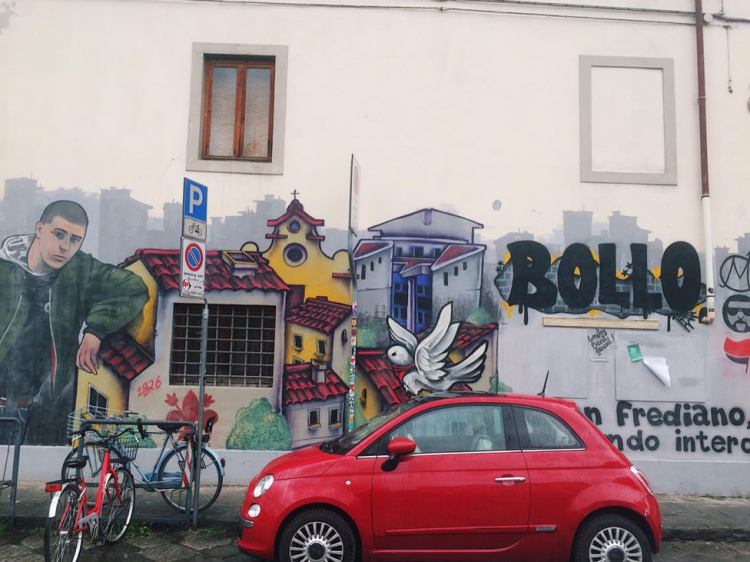
Locals can be seen hanging out by the wall. They leave flowers at its base, and in the alcoves of its stone exterior. Bright orange carnations pepper the ground, and stand out on even the dreariest of February days. A likeness of the gate is painted in stylistic purple on the outside walls of Da Simone la buticche del lampredotto, and a massive multicolored mural depicts the wall, the borgo, and states “San Frediano, il mondo intero” (San Frediano, the whole world) to all who enter the small borgo.
The wall acts as a sort of keystone for the community, holding the community together. Whether you sit in any of the small cafes nearby, or try some traditional cuisine at Trattoria Sabatino, the Porta San Frediano can be seen, watching over and protecting the community all these years later. During Notte Bianca, one of the famous festivals held in June in San Frediano, the community gathers for a long night of fun and music. During which, the focal point for many is the Porta San Frediano, which has lights and designs projected on it while locals partake in festivities from 9pm to 2am.
When something is part of a culture for so long it is easy to forget its importance. This is how history is lost, and how stories are forgotten. Thankfully, the people of San Frediano are keeping this part of their history in the forefronts of their minds, and still see an importance in this ancient wall.
A Roman column stands surrounded by designer brands in the center of Florence.
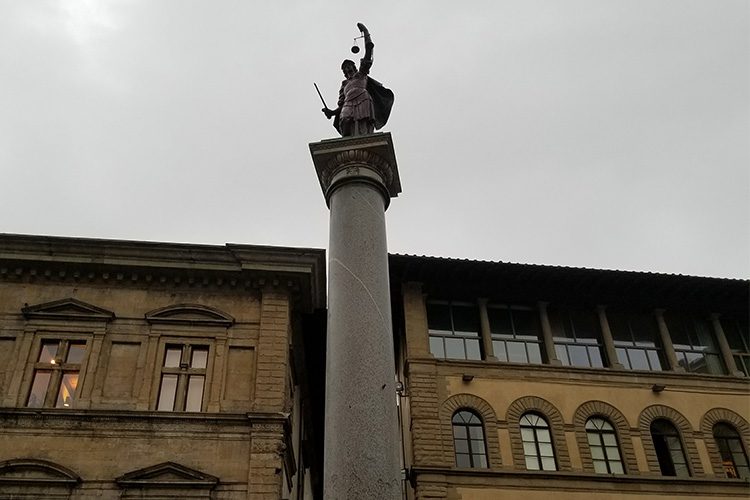
The Column of Justice in piazza Santa Trinita is one of the many great works of art in Florence. Unfortunately, it receives little tourist attention, despite being at end of the famous via Tornabouni. Along this road are a myriad of designer and luxury stores that attract tourists from all over; wealthy or not, everyone can window shop. In piazza Santa Trinita the luxury brand stores with their extravagant displays are contrasted with the Medieval and Renaissance architecture of several palaces from Florence’s history. Overlooking this juxtaposition of contemporary fashion and historical architecture is the statue of Lady Justice, stoically watching as the city evolves around her.
The Column of Justice is the largest Roman column in Florence. Atop it stands a statue of Lady Justice, carved out of porphyry stone. The column has two mates in the city, the Column of Peace in piazza San Marco and the Column of Religion in piazza San Felice; neither of which have statues atop them.
The Column of Justice was originally found in the Baths of Caracalla in Rome, but was moved to Florence in 1563 as a gift from Pope Pius IV to Duke Cosimo I de’ Medici. The journey from Rome to Florence took almost an entire year. It was also attacked several times along the way by Turkish pirates.
The statue atop the column was originally a wooden replica until the current porphyry stone was created. At the time it was carved, porphyry was one of the hardest materials known. It was an incredibly difficult material to work with for this reason and was carved by expert porphyry sculptor Francesco del Tadda and his son Romolo del Tadda. It took them eleven years to carve the statue to completion, and it is carved from six different blocks of porphyry that are held together by copper linchpins.
The Column of Justice was just made viewable again after a period of restoration. Lady Justice had noticeable wear and even some holes in her cape before the restoration. But now she is looking impeccable as ever!
Today Florence is full of creative women, but what about Florence of the past?
For centuries it has been male artists who have attracted the interest of art historians. Great collectors and museums have barely paid attention to the existence of talented female artists from periods such as the Italian Renaissance and Baroque period. Women like Artemisia Gentileschi and Plautilla Nelli are not as widely known as Michelangelo and Leonardo da Vinci. Even by doing a simple Google search, looking for Italian renaissance artists, not one top result is a female artist. This may also be due to the fact that women had to be self-taught. Female artists were not able to study at universities. They were also not allowed to study anatomy and it was illegal for them to sell their artwork. Now, times are starting to change. Over the last decade, more than 40 works of art by female artists have been restored to their original dignity and returned to the museum spotlight. This is because of the AWA: Advancing Women Artists Foundation. Florence is known for its excellence in the arts, and the female artists of the Renaissance paved the way for women in the arts today.