The Birds Are What Make Florence Magical

Photo by Author

By Oceana Minthorne

A unique approach at one student’s thoughts on Florence and a twist on what others typically find as ugly.

Living in Florence has taught me to look up! There is always something going on. Whether it’s a moped about to crash into a pedestrian, a super trendy outfit or a musician creating magic for your ears, you are sure to be delighted wherever you find yourself.

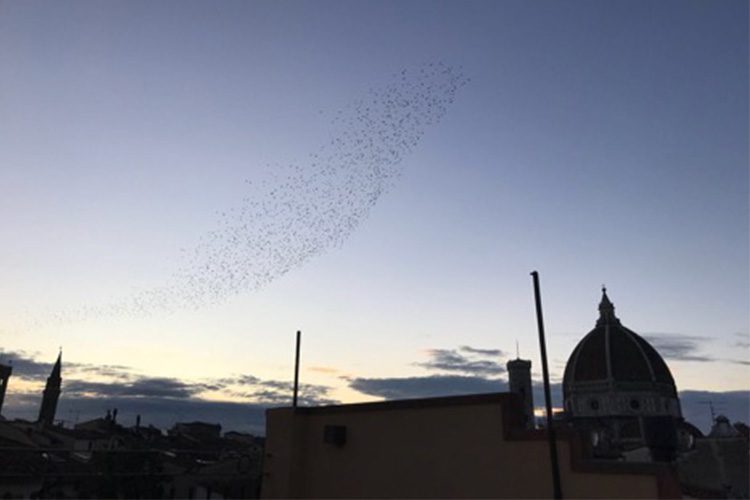
I think my favorite “thing” about Florence is the birds. I find that during sundown they gather together and put on a show. I’ve come up with a theory and it goes like this: the birds spend all day on the ground going unnoticed and despised that they then decide every evening to redeem themselves. They call upon their friends and relatives and have dance offs. They practice different routines when no one is watching and put them to use when on center stage.

The stage they choose is the Duomo at sunset. The cotton candy skies are their backdrop and their helpful prop is the most beautiful thing in all of Florence. They soar, twist, turn, and flip upside down and right side up all over again. They are dancers, fliers, performers.

I was lucky to have been placed in an apartment that boasts a rooftop terrace. As often as I can, I make it up there when the sun is bidding us adieu. I sit down with my neck craned towards the sky and wait for the magic. They flock in hundreds and cloud the sky on route to their stage.

Wave upon wave of birds take hold of all that I can see. Once the progression of performers has slowed down I stop looking up and cast my sights on the show that is just beginning. One group soars in from the left while another group soars in from the right and yet another group comes in from the back. This step is repeated a few times over until a new move is introduced and the algorithm is repeated.

They do this magical dance until there is no daylight to cast rays upon them and make their act visible to all the onlookers. Tomorrow they’ll return to the streets and redeem themselves again in the evening.

See more of Florence and Italy at FUA’s FB, Instagram, and Twitter.
Florence’s Marzocco Lion

Photo by Author

By Kellie Bessette

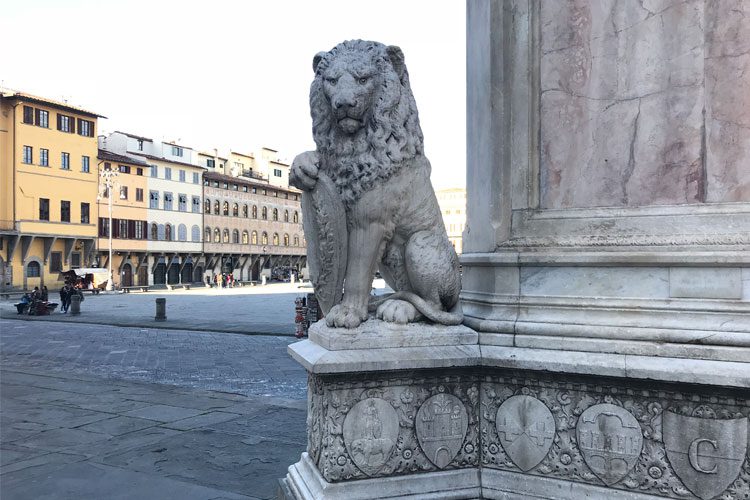
Florence is covered with many versions of the Marzocco lion that date back to the Middle Ages. The Marzocco lion is the animal symbol of the free Republic of Florence.

While there are no real lions hunting the streets of Florence, statues of lions have been seen around the historic city center since the Middle Ages. The Marzocco lion, also known as the heraldic lion, is a symbol representing the free Republic of Florence. The Republic chose a lion not only because lions are a universal symbol for strength, but because they are able to tear apart eagles, which is the symbol of imperial power.

During the Middle Ages, it was not uncommon for nobles to present each other with exotic gifts. By the fifteenth century, as many as 24 lions were kept in cages behind Palazza Vecchio, or what is now Via dei Leoni. According to legend, one of the lions escaped and snatched a child during the reign of the Primo Popolo. The lion gave the child back to it’s mother unharmed and was dubbed a symbol of good luck for the people of Florence.

The most famous Marzocco was sculpted by Donatello in 1418 and was originally installed at Santa Maria Novella for Pope Martin V. The piece was later moved to Piazza Della Signoria in 1812. The lion is seated protecting the red fleur de lis, the coat-of-arms of Florence. The lion’s eyes are wise and the body is lifelike. Within the same piazza, two large lions guard the entrance to the Loggia dei Lanzi.

Another spotting of the Marzocco lion is located at Piazza Santa Croce at the Statue of Dante. The Statue of Dante was created in 1865 to celebrate the poet’s 600th birthday. Four heraldic lions stand at each corner of the pedestal holding shields with the names of Dante’s works. With many more statues of the Marzocco lion, it is clear that this animal has such an important historic connection.

See more of Florence and Italy at FUA’s FB, Instagram, and Twitter.

An Intimate Portrait of Pietra Serena

Photo by the Author

By Oceana Minthorne

Anyone who has visited Tuscany will appreciate pietra serena, a gray stone found in architectural and sculptural details as well as street pavement throughout cities such as Florence, Siena, and Arezzo. It has been used by the ancient Etruscans and cited since Renaissance times by the likes of Vasari. Oceana Minthorne shares an intimate and personified portrait of pietra serena.

I wish I could lay down on the floor and stare for hours.  The stone is so smooth. Opposite from me, I want to be it. Perfect. Elegant. Clean. It envelopes this entire ceiling, cascades onto the walls, and delicately embraces the floors. The stone is cool but inviting, like the girl you envied in high school and wanted to be friends with but didn’t know how to talk to.  Serena.  Calm.  She is just that.

The dome is circular.  It goes round and round and does not stop.  Gets back to its starting position and begins again.  Never tiring.  Effortlessly elegant.

I wish I could lay down on the floor and stare for hours.  Melt into the ground, become the stone.  I would have a view of the dome forever.  I could watch visitors “oooh” and “aaah” over my aesthetic. They could step on me and it wouldn’t hurt. I’d be quarried from Fiesole. The best. They’d talk about how strong and sleek I am. I would inspire Steve Jobs and bits of me would be placed all over the world.

I am the stone.  Perfect. Elegant. Clean.  I fill the room, the ceiling, the walls, the floor. I am cool, inviting, Serena.

See more of Florence and Italy at FUA’s FB, Instagram, and Twitter.
A Glance into Florentine Tabernacles

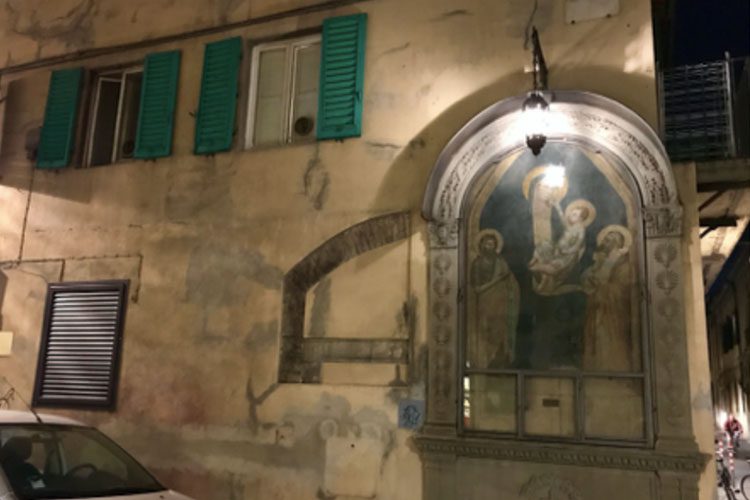
The Florentine Tabernacle Canto di Monteloro on Via degli Alfani.

By Emelia Imperati

Tabernacles cover the streets of Florence, adding further religious, historical and aesthetic appeal and meaning to the city. Canto di Monteloro is one example of these beautiful and purposeful creations, dedicated to their patron saints.

Although it is customary to be swept away by the grandiose markers of Florence, such as the Duomo or the Santa Croce, many tourists overlook the hidden treasures that flood the city. The Florentine tabernacles cover many streets and offer additional historic and artistic significance that is often overlooked by travelers. Depictions of Pagan gods were originally displayed around the city but were later replaced by images of saints after Constantine’s conversion to Christianity. During the 14th century, Italian towns dedicated themselves to patron saints, and Florence reflected their vowed devotion to the Virgin Mary and John the Baptist through the approximate 1,200 tabernacles. These religious testaments were built to offer support for the Christian doctrine during the war against heresy, during which groups challenged Catholicism. They also were used as a source of protection during the plague in 1348, the year of the “Black Death” Residents utilized them through candle lightings, written prayers, and placed offerings to seek out defense from the patron saints against disease and death. They were commonly commissioned by middle class families, as those of greater wealth focused on assisting cathedrals, chapels, sculptures and more elegant decorations and structures.

One of these tabernacles placed on Via degli Alfani, on the corner of Borgo Pinti, was a common site for these behaviors, customs and beliefs of the past. It was named Canto di Monteloro, meaning Corner of Monteloro. It reflects an illustration of the Virgin Mary holding the child, surrounded by Saint John and Saint Peter. It was built by Compagnia della’Assunta, one of the companies of the Festive Powers, an association of regional companies that created exhibits, parties and banquets. They played an essential role in the construction of antiquities of late Renaissance Florence. The Canto di Monteloro was made with a popular and traditional stone of this era known as pietra serena, which was used for many other structural and artistic creations throughout the city. Below the image of the three saints is a portrayal of a cross on a 3-pointed mountain, which became the crest that gave name to the song the tabernacle was named after, and also to the powerful festive power, Montiloro, who gathered at this location. A wide shed resembling a small chapel originally protected the ornament, but was destroyed by traffic in the street. The fresco underwent several reconstructions overtime and was removed in 1953 for an extended period of time by the Superintendent for Artisitic and Historical Property. It was later replaced in this original location in 1991, and still remains as a beautiful additive to the street.

See more of Florence and Italy at FUA’s FB, Instagram, and Twitter.
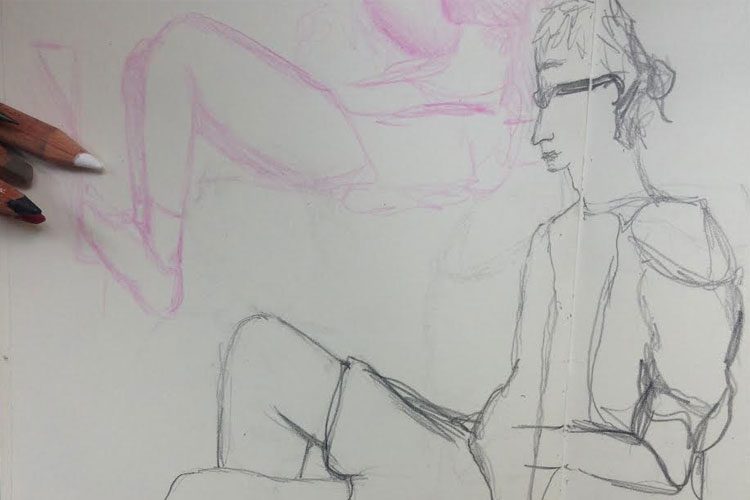
Documenting Strangers

Photo by the Author

By Chrystalla Christodoulou

Have you ever pondered on how you navigate the cities you inhabit or visit? In this piece I discuss a change in mediums I made in order to find my place in Florence’s streets. 

Everything I love about art came from my introduction to photography. It made me appreciate the human body as poetry, with secrets being exchanged between subject and audience. My own camera has helped me turn moments of joy, doubt, and vulnerability into art.

However, when travelling, photography becomes a game for me; it gives me adrenaline and pushes me around. I didn’t want to remember my time in Florence as a rushed hunt.

So I bought a sketchbook.

Drawing pulls me to the ground. It slows me down, and makes me choose one single atom of this vivid city to analyse.

When someone realises I’m drawing them, they are usually amused. Vastly different from the angered looks I get as a photographer; I am seen as harmless when sketching. They sometimes accentuate their pose, or even ask to see themselves.

I sit on the steps of Palazzo Vecchio and observe a couple presumably travelling together. They are discussing the David, as tourists and residents alike rush by them. In that moment, they are still unaware of me so I take my time in documenting her hat and his ponytail.

When I look back at the drawing I remember waiting for my friend, knowing she’ll be mad because of my dead phone. I remember the man trying to make his companion laugh, and her looking away. I know exactly what song I was listening to, playing from a stranger’s phone. A new favourite.

See more of Florence and Italy at FUA’s FB, Instagram, and Twitter.
A Morning Walk in Florence

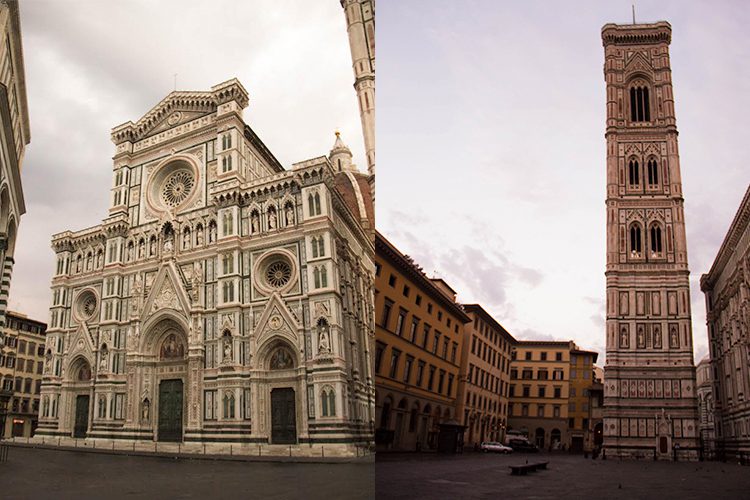
The Duomo and Campanile at 5am.

Texts and Photo Essay By Logan Hillen

One wouldn’t think to get up before the sunrises, but it is an experience that no tour guide can show you in the middle of the day. At 5am the streets are bare and free of any crowds, street vendors, or locals. All there are is you, and the street cleaners. This leaves a person free to enjoy every inch of the sights around them, uninterrupted and worry free. To see the Duomo, usually flocked by hundreds of people, completely empty is an overwhelming image and going at 5am gives you the opportunity to walk around it and take in the sight from bottom to top in its entirety. You can admire it in complete and utter peace.

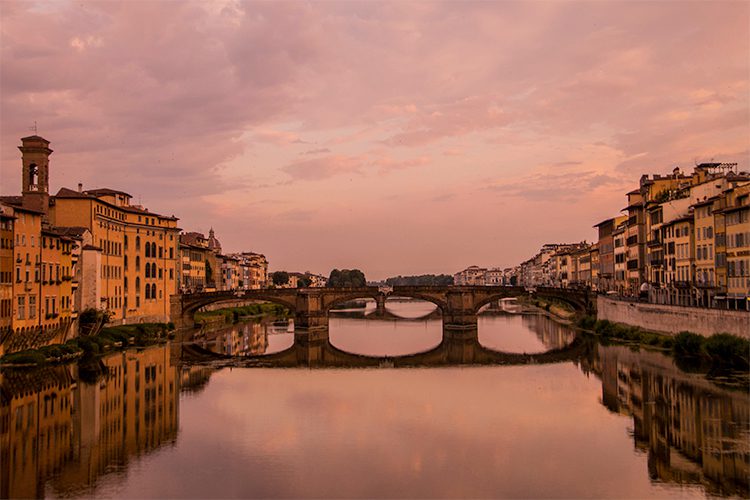
The Arno from Ponte Vecchio at 6am.

Then after you have finally taken in the beautiful sight, you can head to a pedestrian-free Ponte Vecchio. Here, around 6am now, you have an entire bridge to yourself to scan the horizon uninterrupted from both sides of the bridge. If you face East, you can see the sky painted with a rising sun and the beautiful colors that follow. Getting up and taking a walk around the city before it wakes up is one of the best ways to explore Florence.

See more of Florence and Italy at FUA’s FB, Instagram, and Twitter.
Boboli Gardens Photo Essay

By Stanley Chen
Photos by the author

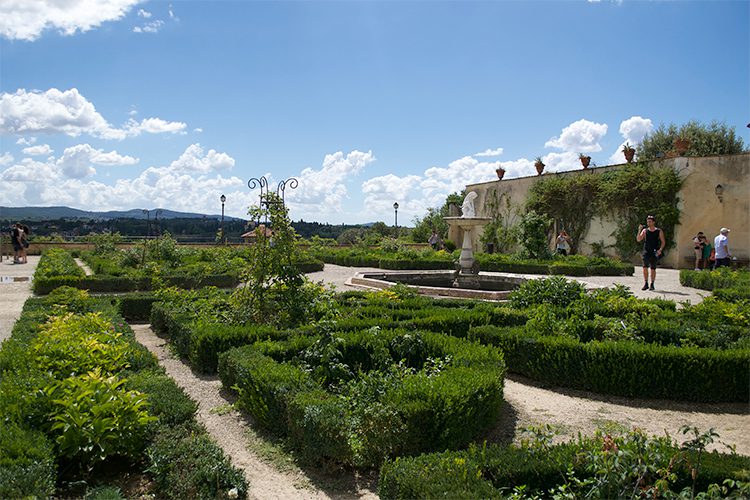
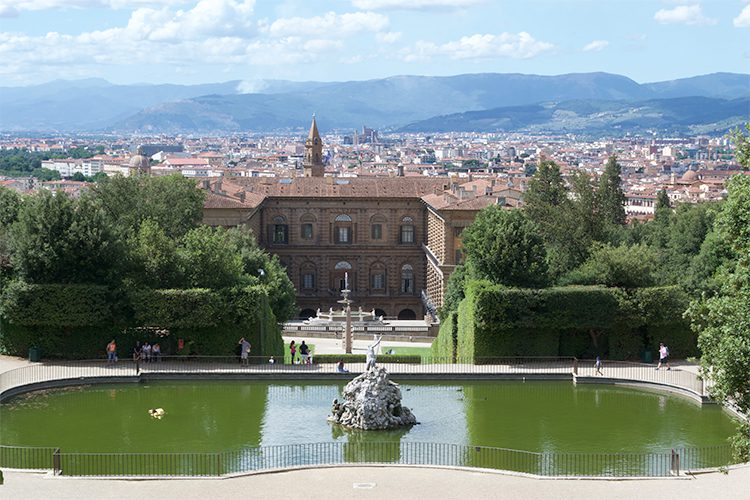
This mini photo essay explores the great and small details of one of Florence’s most magical green spaces, starting from the above panoramic shot that fully captures how the garden and the city are entwined. Created for a Street Photography course by FUA study abroad alum Stanley Chen, these gorgeous shots show a resplendent and luminous Boboli Gardens.

The Boboli gardens, a site that formerly housed the famous Medici family of the Italian Renaissance era, is a large open-air museum that contains many forms of green architecture and represents what many would consider an ideal Italian Renaissance garden.

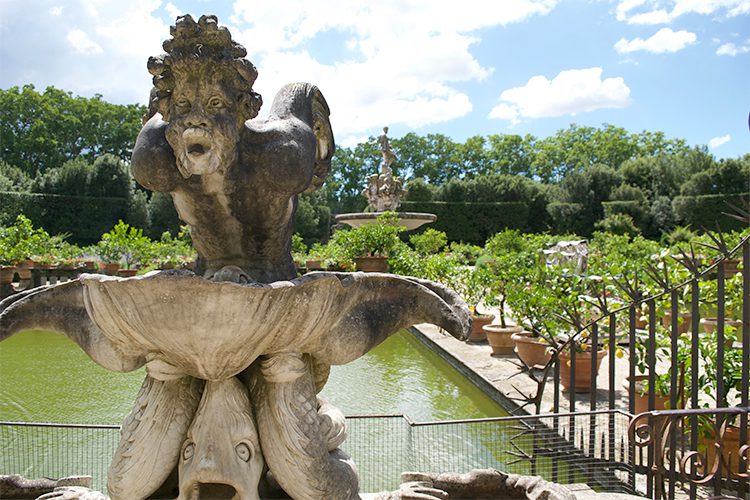
Though Neptune’s fountain, also pictured above, is one of the principal fountains, the garden is abundant with sculptural surprises such as this grotesque male harpy on top of sea creatures in the Isolotto section:

Another site of interest is the Giardino del Cavaliere, which sits atop of a wall built by Michaelangelo. A lovely hedge maze arranges flowers and shrubbery in sprawling yet geometrically harmonious deigns:

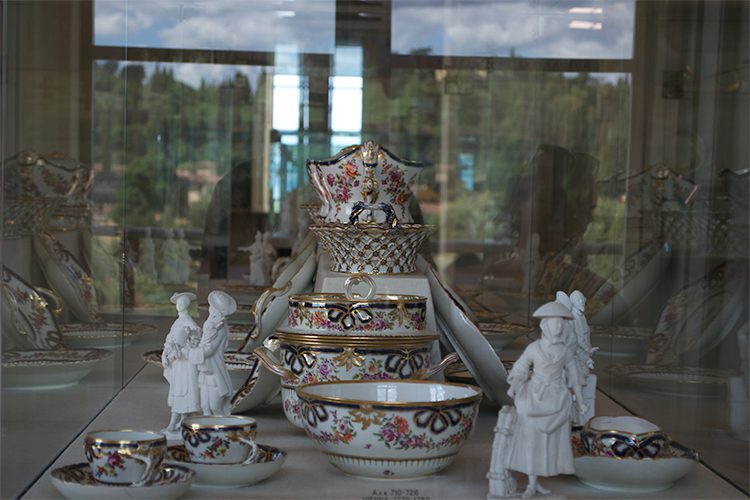
The hedges leads to the entrance of the main building, the Casino del Cavaliere built in 1700 and where the last Grand Duke Gian Gastone de’Medici kept rooms. The building today hosts the Porcelain Museum of the Pitti Palace museum complex, a showcase of porcelain works from many of the former ruling families of Tuscany:

See more of Florence and Italy at FUA’s FB, Instagram, and Twitter.
A Main Monument Secret: Duomo

Photo by the author

By Shelby Olson

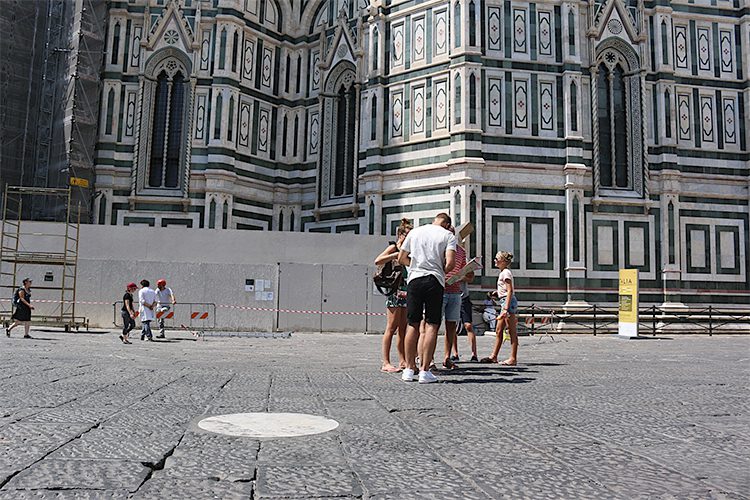
Throughout my time in Florence, I was not only able to discover the nooks and crannies of the city but make new and at times peculiar discoveries about the large, main monuments everybody knows and loves. I entered what I would call the “tourist phase” and saw anything and everything there was to see but reminiscing on my stay in Florence, I really didn’t know a lot about the places I was visiting. For example, did you know a ball-shaped decoration fell off the Duomo and there is now a marble slab to commemorate it? Me neither.

In January of 1601, Florence experienced a thunderstorm and lightning struck the golden sphere on top of the Dome’s lantern, causing it to detach and land right next to the church. To this day, there is a circular marble slab to signify where the ball landed when it fell off. The sphere, commissioned to Verrocchio in 1468, was made of bronze and weighed almost 2000 kilos (approx. 4409 lbs). Andrea del Verrocchio, it should be mentioned, ended up inheriting the Duomo’s architectural project after Brunelleschi’s death in 1446. The weight itself can show the large impact this ball had upon touchdown. Prior to falling off in 1601 and definitely restored in 1602, the ball had proved be unruly on other occasions – electricity-related problems due to thunderstorms had already been documented at least twice in the 1500s.

Turns out I was not the only one who didn’t know about this “fallen ball.” I decided to visit the Duomo to see the marble slab itself and watch if anybody else would notice it. During my hour of sitting there, not a single person stopped to look at it or take a picture. Rather, I was getting weird looks for taking a picture of this random circle on the ground. This taught me that when you are visiting an important monument, there is so much more to see than its beauty and you should learn everything you can beforehand.

Next time you are visiting the Duomo or simply walking past it, make sure to venture to the back side of the Duomo to check out this marble slab. It may just be a circle on the ground but it holds much significance and you may be one of the few that knows about it. If you learned one thing from this, remember to research the places you are visiting beforehand because you may learn something the tour guide doesn’t tell you.

See more of Florence and Italy at FUA’s FB, Instagram, and Twitter.
The Pazzi Chapel: Venturing into Santa Croce

Photo by the author

By Shelby Olson

If you venture further into the Santa Croce complex, you will come across many other monuments that hold much significance to early Florentine history such as the Pazzi Chapel. 

When staying in Florence, Santa Croce is a highly recommend spot to visit because it is beautiful but also has fascinating history behind it such as the tombs of the famous. When you enter Santa Croce, the first thing you see is a large church filled with sculptures, paintings, and stained glass windows that light up the room. When you head out of the church, you are met by a large garden and a series of cloisters. If you walk across the garden, this is where you will find the Pazzi Chapel which is not something to miss out on when visiting Santa Croce.

The Pazzi Chapel was commissioned by Andrea Pazzi and built by Filippo Brunelleschi. It was built to show the legacy of the Pazzi’s power and patronage, as well as to show off their wealth and status to the Medici family. Originally, the chapel was a learning area for the monks but also a burial place for the family.

The chapel is a very important project of Filippo Brunelleschi because it was built according to a specific architectural harmony, and he was able to achieve this after studying and measuring ancient buildings in Rome such as the Pantheon. The chapel was commissioned in 1429 and it was opened in 1443, during this time Brunelleschi had passed away and was not able to finish the chapel on his own. There were also many stops in construction throughout the years due to funding as well as conspiracies the Pazzi family made on the Medici family. In 1478, Giuliano de’Medici was killed and Lorenzo de’Medici wounded while attending mass at the Florence Cathedral. Needless to say, the family’s position swiftly fell after the attempted coup to topple the Medici.

Although Filippo Brunelleschi was not able to finish the chapel, he holds much significance within it because of his perspective and ingenuity. Brunelleschi’s works are not limited to the Pazzi Chapel as he had worked on the Florence Cathedral of Santa Maria del Fiore and its famed Dome, the Basilica di San Lorenzo, the Ospedale degli Innocenti and much more. Filippo Brunelleschi is buried inside the Florence Cathedral and continues to be an important part of the city’s history.

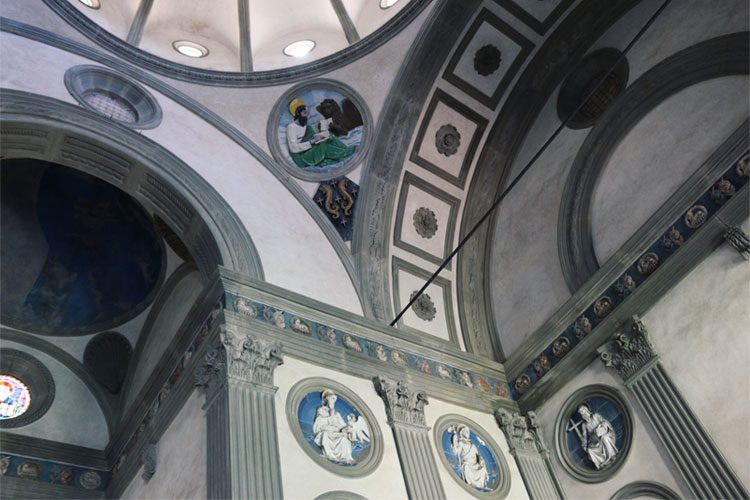
Inside the chapel, there are many beautiful works of art created by different Florentine artists. The relief, a raised sculpture representing Saint Andrew, was created by Luca della Robbia. Della Robbia also created the rounds with the apostles and decorated the central dome with sculptures and two paired dolphins. The stained glass window representing the figure of Saint Andrews was drawn by Alesso Baldovinetti.

The Pazzi Chapel is a simple yet elegant chapel. Although the interior colors are dim, the stained glass windows and colors of the paintings light up the room. Not only is the chapel full of history that dates back centuries, but it is a beautiful work of art and architecture that is worth seeing when visiting Santa Croce.

How to Visit:

Basilica di Santa Croce, Piazza S. Croce, 16, 50122 Firenze
Monday-Saturday 9:30AM to 5PM
Sunday 2PM to 5PM
Tickets: €8

People of Florence

By Chantal Boynes
All photos by the author

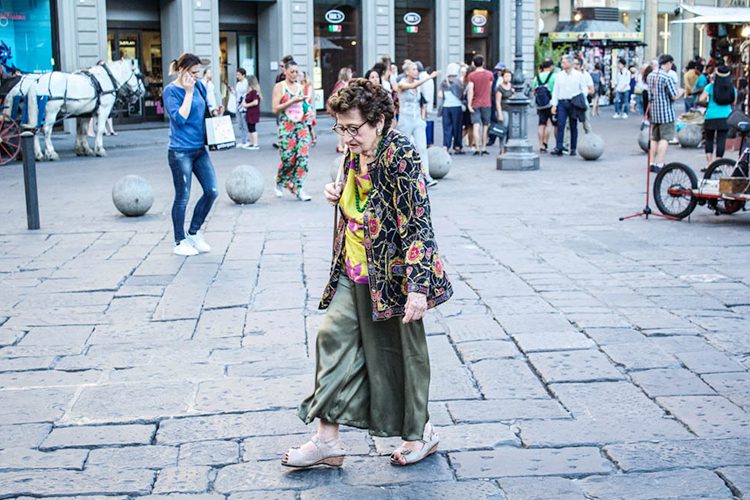
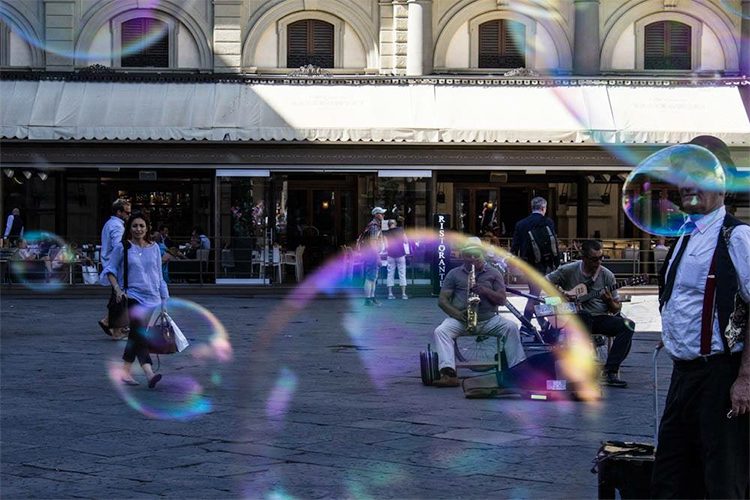
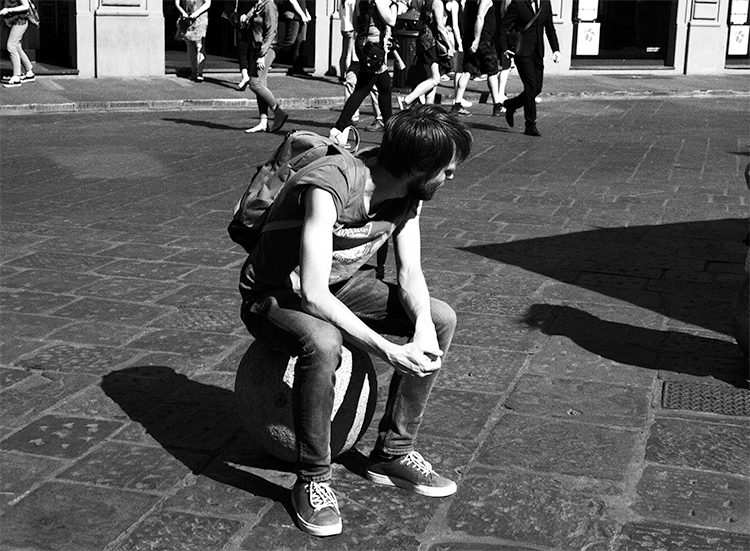
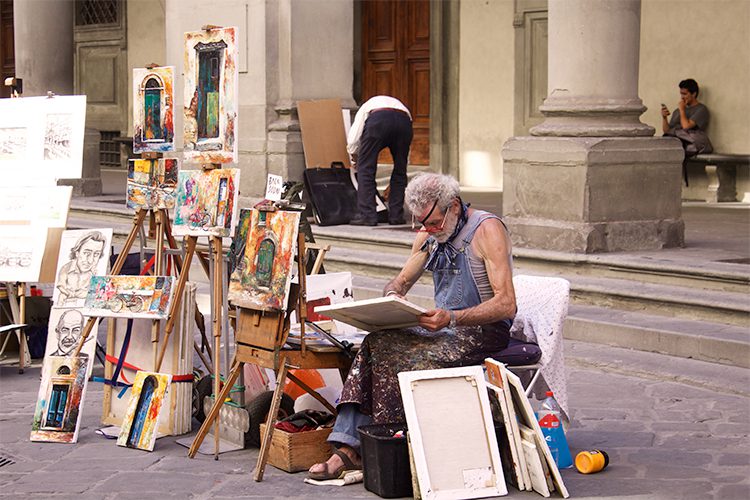
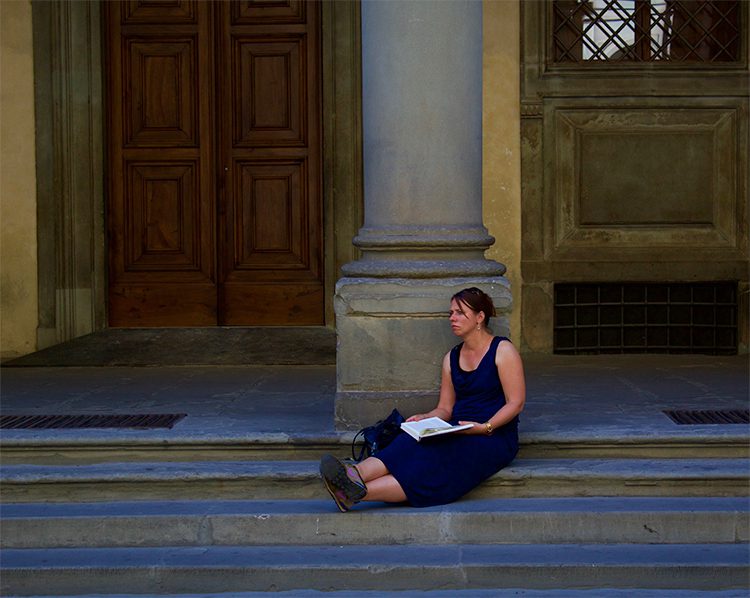
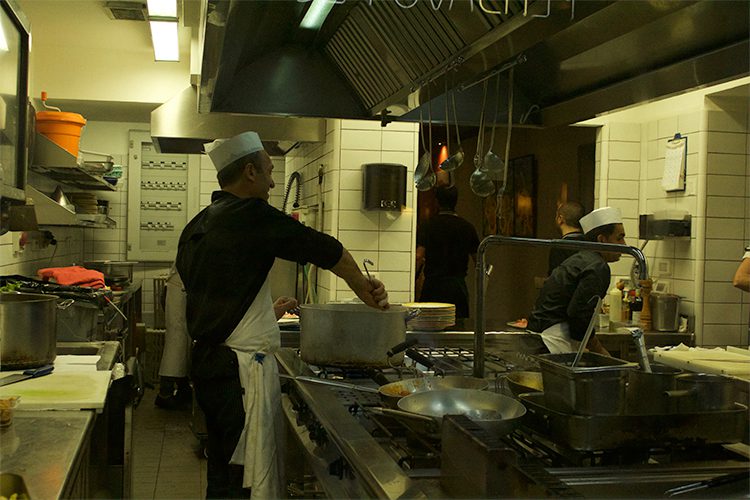
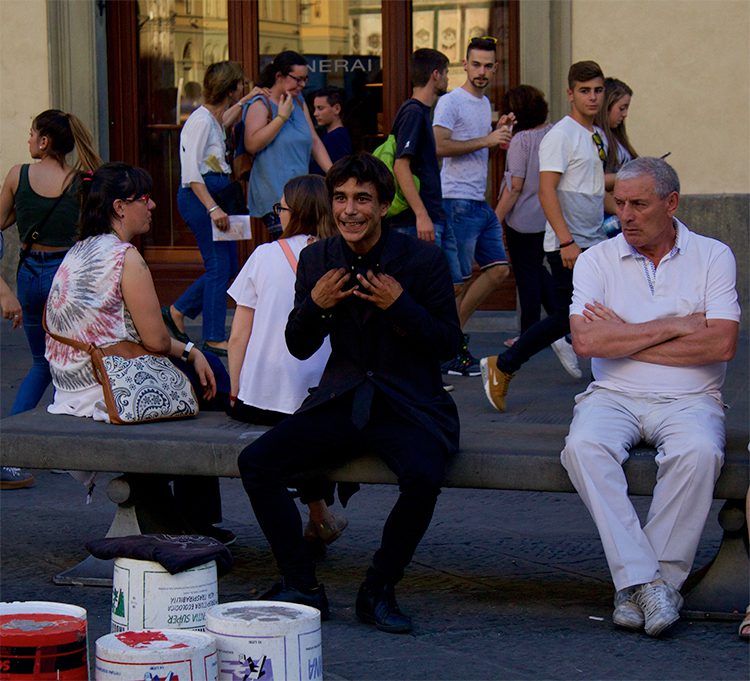
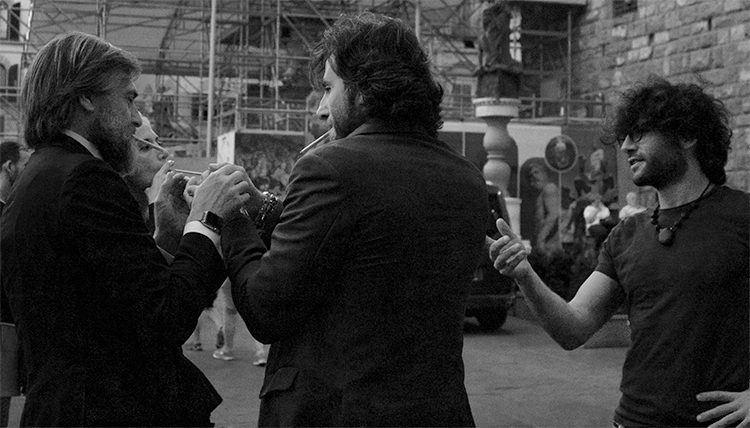
Recent Street Photography student Chantal Boynes captures the people of Florence through this gorgeous photo essay on the diverse individuals that make up our city.

There are hundreds of stories that I could have written for this article about the different people walking the streets of this beautiful old city everyday. Each person is at a different point in their lives, coming from different countries, backgrounds and languages. Each individual has their own story to tell and this photo series captures just 1 second of the 2,228,800,000 seconds in the average person’s life. With this we can catch a brief glimpse into the lives of some of the People of Florence.