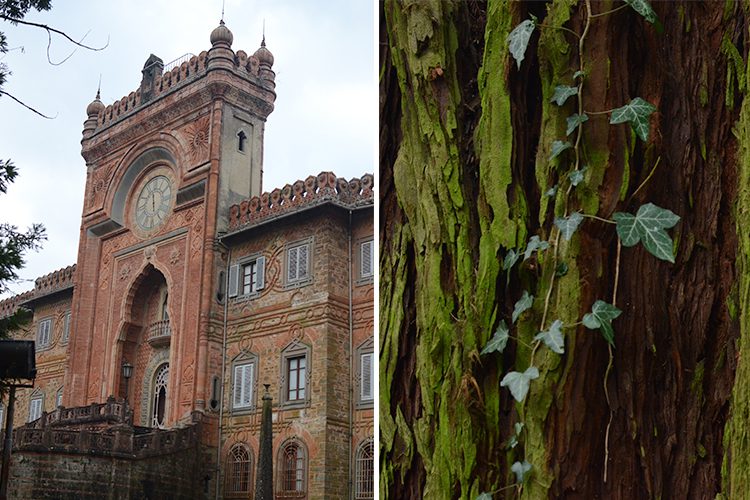
Castello di Sammezzano

Photos courtesy of the author

By Steven Scaglione

Sometimes the well-traveled roads lead to unexpected finds, such as the Sammezzano Castle that is at the center of a movement to save a now-abandoned architectural gem.

After stepping out of a two-story charter bus in little Leccio, Italy, I took a breath and surveyed my surroundings. I was at The Mall, which is not a luxury shopping mall but a luxury shopping “destination,” specializing in high fashion brands like Salvatore Ferragamo, Burberry and – maybe more fittingly named – Billionaire started by Italian entrepreneur Flavio Briatore. Though the stores would not open for another 20 minutes, already a line of eager shoppers had neatly queued in front of the Gucci and Prada outlets, talking among themselves with an electric excitement. Soon they would be pulling green suits and bright dresses from the racks, but I would not be among them. I was headed for a different kind of treasure: Sammezzano Castle, only a short hike away.

The castle lies at the top of Sammezzano Park’s central hill, overlooking the town below like a silent, stoic patriarch. The park is home to many exotic species of plants, including the species of giant sequoias native to California. One of them, known as “Sequoia Gemella,” or the “Twin Sequoia” in English, is more than 8.4 meters (27 feet) in diameter and 50 meters (164 feet) tall.

From the outside, the castle’s Moorish-style architecture is a mix of Spanish, Arabic, and Oriental influences. Inside “La Sala dei Pavoni,” or “The Room of the Peacocks” in English, is arguably its most beautiful feature, with mosaics of every color stretching from floor to ceiling.

Unfortunately, the castle is currently closed to the public, falling victim to littering and vandalism. One organization, Save Sammezzano, has been fighting to preserve and protect the now abandoned castle and surrounding park. A petition by the group ended with over 30,000 signatures, but the castle is now privately owned, making it difficult for the municipal government institutions to safeguard it. The future for any restoration is uncertain, but the cause has found great support on social media. For now, the castle remains as it has been for many years, the hands on its clock stopped at 11:28, waiting for the day they might turn again.
See more of Florence at FUA’s FB, Instagram, and Twitter.

Lose Yourself, Find Your Way

Photo courtesy of FUA

By Abby Moran

Embrace the uncomfortable, enjoy the bewilderment of studying abroad.

Studying abroad may have been the most difficult thing i have ever done. 21 years of figuring life out, myself out and now a new culture is an incredible adventure. To step away from all that is familiar, to acknowledge that you will get lost mentally, emotionally, and physically but all of this will make you grow in ways you could never imagine is daunting. After a couple weeks in Florence, I am less afraid and regaining pieces of myself I thought would be lost back home forever.

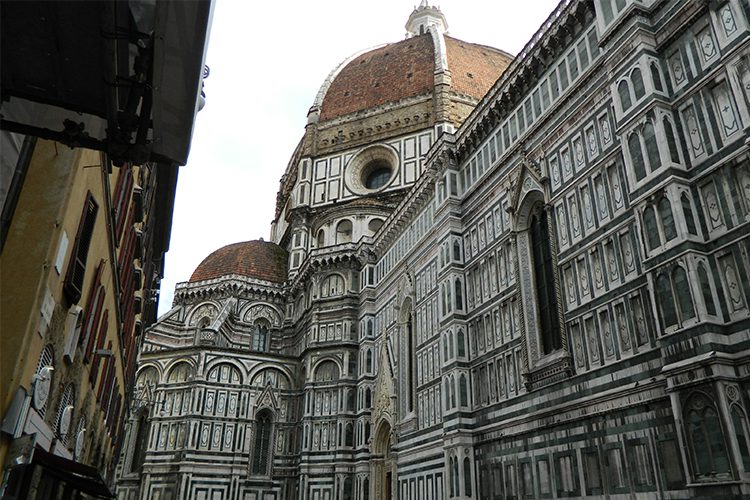
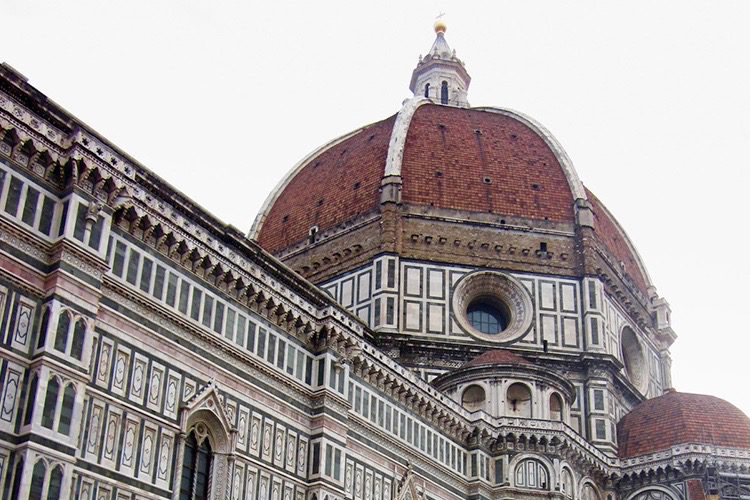
Being in a situation where in order to save time, effort, and my roommate’s energy involves being outgoing, assertive, and confident in new situations has turned out to be the absolute best scenario. I love it. I love walking in the rain here. I love the puzzle of streets that could lead anywhere but often times lead me to the Duomo, that I’ve come to see as a safe haven. I love the different languages filling my ears. The uncertainty of who and what can be encountered around the next corner. Gucci, Prada, Valentino, your shop windows bring a spark of life to my longest walks. Even in the most unfamiliar places we find objects to cling to, people to relate to, and places to become accustomed to.

Home is truly where the heart is and when we open our hearts to the culture and lifestyle of others we are given a priceless gift. Be scared, intimidated, and get completely lost because it is there, in this state of initial uncertainty where we find our strength. Find your home away from home is what study abroad offers, despite the voice in your head that says “but it will be hard.” It’s often said that nothing good comes to those who wait, so let’s proactively reach for that which seems the most intimidating. Find your landmark, in my case the Duomo, and learn something about it instead of just passing through the piazza.

Don’t shoot for the stars, shoot for the Duomo.

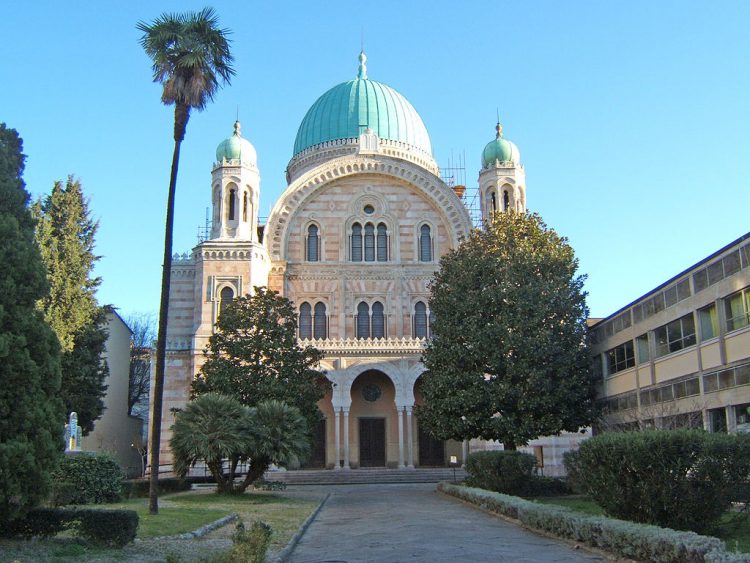
The Great Synagogue of Florence

Image by Wikimedia Commons user Toksave

By Caroline Angelini

Though Italy is a predominantly Catholic country, its religious landscape represents other traditions as well. The relationship between the Jews and the city of Florence dates back hundreds of years, and this community is one of the focal points discussed during the FUA course “Shoah: The Holocaust in History.”

This course, taught in Fall 2016 by Valentina Nocentini, focuses on the history of the Jews, specifically in Italy, and how their treatment eventually led to the the Holocaust. To give her students a better grasp on exactly what happened to the Jews in Italy during the Holocaust, Prof. Nocentini brought her students to the Tempio Maggiore, or the Great Synagogue of Florence. Based on the experience and how it helped to contextualize the treatment of Jews in Italy, students wrote a reflective assignment as an outcome of the visit.

The Synagogue dating to 1882 is truly breathtaking. The intricate detail of the hand-painted walls, and the ornamentation of the women’s balcony were like nothing else that students had witnessed both in Florence and beyond. The mosaics and frescoes are reminiscent of Christian art, but have their own character that makes them unique to the Jewish culture of the Synagogue.

While the artistic ornamentation was magnificent, the mood that most students had while in the Synagogue shifted once they reached the museum. The Synagogue separates a portion of its space dedicated to the Florentine victims of the Holocaust. There are stone slabs with each victim’s name and videos depicting the lives that they carried out while being exploited during the Shoah. “It was something difficult to experience—the contrast from first seeing the beauty and grandeur of the Synagogue to then learning about how the Jews were treated during the Holocaust,” commented student Emma Dunleavy.

The visit to the Synagogue helped the students of the Shoah course gain a deeper understanding of the past lives of Jews in Florence. It also provided insight into how Florentine and Italian citizens in general aided those in need of protection especially during WWII, which gave students food for thought as they themselves experience daily the hospitality of a foreign host city with whom they must forge a new relationship, one day at a time.

To visit:
The synagogue is located in Via Farini 6, near the Sant’Ambrogio church. Details about visiting hours, synagogue history, and much more can be found on the website of the Jewish community of Florence – moked.it/jewishflorence

See more of Florence at FUA’s FB, Instagram, and Twitter.

My Journal: A Priceless Souvenir

Photo courtesy of the author

By Amber Wright

“I’m a fickle girl who falls in love easily. It’s happened about a million times since I started my study abroad journey four months ago. I get off the bus/plane/train and it’s love at first sight. No matter where I am, every street, corner shop, and coffee bar seem as if they’re covered in gold. In Siena, I fell in love faster than the horses ran in the Palio di Siena, and in Cinque Terre I could feel the warmth of the sun all through my body – at least for the ten minutes it was out. I’m in love, and I can’t imagine leaving this feeling behind.” – A reflection from my personal journal.

It wasn’t until a month after arriving in Italy that I realized I hadn’t actually bought any souvenirs. At first, I was a little bummed I didn’t buy a bunch of things from the places that I had been exploring, but as I thought about it more, I was thankful I didn’t. Being abroad did not have to be something I did to acquire things. I didn’t have the budget for that, nor did I want to have to carry pointless souvenirs. Instead, I had accumulated memories, feelings, and stories. I hadn’t wasted any time in souvenir shops, instead I was just present where I was spending money on museums and experiences rather than keychains.

I’m one of those individuals who has always kept a journal in some form or fashion. I also have a problem because when I see a new one that catches my eye, I have to have it – which also means I have about a hundred half-finished notebooks. My travel writing class here at FUA requires you to keep a journal for class, which I’m very thankful for. I get so caught up in the exciting day to day, that I often don’t take a breather or moment to reflect. Being held accountable on a constant basis, to journal makes me sit every so often and really reflect on what I’m seeing, doing, and encountering. I have a running list of “things I’ve learned traveling,” “places I need to go back to,” and “favorite memories.” I also have multiple entries about things I’m missing from home, things encountered that I dislike, and general grievances from that day. It’s me and my thoughts put down onto paper, and nothing could accurately represent my time abroad more than this journal.

My journal has actually become the best souvenir I could have asked for. In it now holds the memory of when I went wine tasting for the first time in beautiful Vinci in Tuscany, and I absolutely did not like the glass I had. In addition to my memories of living and studying in Florence, it contains the story of when I went to Portugal with my best friends and walked home in the rain, lost, but somehow wound  up in front of a beautiful monastery. It holds the account of each outlandish costume I ran into in Barcelona on Halloween. My journal is also full of visuals – i.e. funny photostrips from the photobooth across from a favorite pizza slice stop in Florence – every photo features at least one friend taking an overly ambitious bite.

Other than the photostrips, I would say you can’t buy memories. Your thoughts and memories will last longer than any tee-shirt or key chain would. Invest in a journal and constantly reflect and write down what has been happening during your studies abroad. Keep a list of your favorite spots in Florence and jot down the funny moments you have with your friends on the train. Write down how the interior of Santa Croce made you feel, and what you thought about the view from the Duomo. Instead of just being able to say you’ve been to this place and purchased a trinket, a journal will reveal the true fruits of your experiences. It will safeguard your memories, thoughts, feelings, and lessons all associated with a new place, and it will be completely priceless.

See more of Florence at FUA’s FB, Instagram, and Twitter

ACF Fiorentina: Florence’s Soccer Team

Photo by Beatrice Santini

By Karla Silva

I grew up in a Brazilian family – we live and breathe soccer. It is like a religion. My parents would set their lives around a soccer game, adjusting their work schedules to watch an important match. There was no such thing as DVR to them– the game always had to be experienced in real time. Soccer games were a time of celebration, where family and friends got together. It was one of my favorite things growing up. And to see that embedded in the Italians, especially the Florentines, is a way to reconnect to my family.

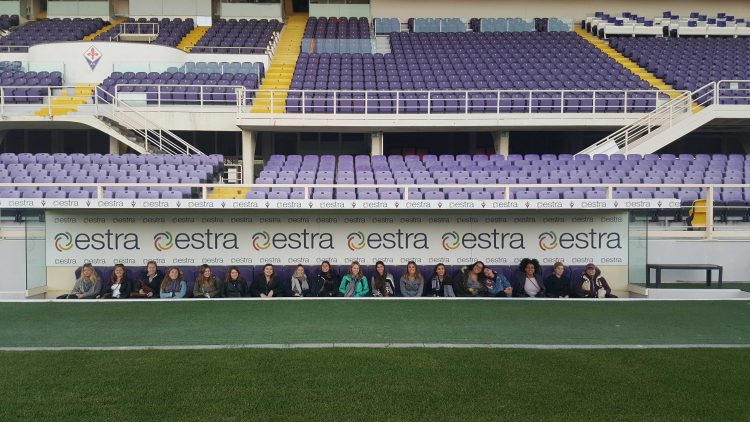
I recently had the honor to go on a special tour of the Stadio Artemi Franchi, home of the ACF Fiorentina soccer team thanks to my Writing for Digital Media course at FUA. You can feel the pride of the stadium’s management team as you walk through the VIP entrance, with its bright white walls and the elegant symbol of the team adorning them: a purple fleur-de-lys inside a gold-lined diamond.

We quickly made our way to the media room, where the press gather together after each match. You can imagine the intensity of representatives of different media outlets fighting to get their questions asked, one jumping over the other to get their burning questions asked for their article.

It takes a lot of work to get a team popular enough for there to be a need for the media room, let alone an audience to watch the game, and we have the team’s Digital Media department to thank for that. To get the word out via countless social media channels and put out content that will appeal to fans of all ages isn’t an easy task. It takes hard work that many do not realize. It made me wonder how much effort truly goes into getting a game to run smoothly, or to construct a large fan base for the team as we make our way out of the media room and into the stadium itself.

I’ve always felt that the locker room is a sacred place for the players. It’s where they get ready, prepare for the upcoming match. They talk strategies, spread words of encouragement. It’s their home. Their private space. And entering that space allowed us to see a personal side that no other fan is able to see. It felt like we were in on a secret that everyone wanted to know.

The Florentines value the sport of soccer, which goes hand in hand with family. It’s impossible to walk down the streets of Florence without seeing a splash of purple here and there. To have the opportunity to walk on the field that the Florentines value so much was an experience I’ll never forget. Though the stadium is on the smaller end, seating around 45,000+ fans, it felt expansive underneath the glowing setting sun. Back home, whenever there was a game, it was always a party. Family and friends, friends of family and even neighbors get together celebrate. The spirits are always high, the energy constantly flowing.

Seeing the stadium empty and quiet, was a new feeling for me. You visualize the loud and high energy of a full stadium in comparison. The lack of cheers and chants made the stadium seem almost peaceful, like the quiet before the storm. We were even given the chance to sit on the players’ bench, which was the perfect end for our visit. Being able to experience the field from the player’s angle was unforgettable, a viewpoint that only a certain select few get to see.

One thing that I noted during our visit was the amount of people it takes to operate the stadium. The fans don’t always know, and neither did I, that the game consists of so much more than just the players. From the coach to the stadium manager, the commentators, the digital media specialist, even the workers who keep the field in top conditions – all of these individuals support the needs of the players and the game itself. The backbone of the stadium is just as important as the team.

I am forever grateful for this opportunity that I have been given. Soccer is a big part of my life and to be able to walk through the inner workings of a stadium and witness how the entire range of stadium workers connect to put on an amazing game for fans was a unique experience that I will cherish.

See more of Florence at FUA’s FB, Instagram, and Twitter

Florence in the Rain

Photo by the author
Photo by the author

By Jess Pitocco

A typical day in Florence looks like this: the Duomo is never shrouded by clouds, the sun always makes the bronze ball on the top of the cupola shine like gold, the streets are filled with bustling people, and in each doorway, a new delicious smell entices you. Florence may seem like just another city of dreams; however, what does it look like when it’s raining?

The contrast can be quite stark, actually. The streets slowly get less crowded as the sky opens up. Ponchos and umbrellas are sold at every corner. The whole city feels like it is in a shadow as people try and find shelter from the storm. And just as the rain pours down and splashes you, the sun peeks through the clouds and you see blue sky. But only for a moment. The rest of the day is cloudy, on and off rain, making the Duomo as gray as the sky.

I find solace on these rare rainy days at small cafes, preferably on a side street. I usually throw on sneakers and try to get through the puddles without making my socks too wet. The rain boots I bought for this occasion have a hole in the sole and are useless when it gets stormy outside. I fast-walk, bringing my backpack and hope that the wifi works today.

Depending on how I feel, I get a cappuccino, coffee, hot chocolate, or tea. It makes my hands sweat and fogs my glasses, but it’s so comforting to me in my soggy clothes that I don’t care. I usually get a snack while I sit and do homework. Sometimes I read, or just relax. At home, where I’m from, rainy days are designated movie/cinema days. Here, I will happily settle for a cute cafe, some sweet treats, and a good book.

Florence, before arriving, had never seemed like a cold season city to me (a fellow FUAer shares how to spend a winter day alone, btw). However, a rainy day can sometimes bring a fall-like atmosphere to the city. People bundle up, briskly walk back and forth to escape the rain; it reminds me of the snowed-in streets of New England where people do the exact same with snowflakes. Either way, some of the gloomiest looking days in Florence make me feel most connected to the city. I found a good reading spot, my favorite coffee, and a comforting ambiance to a city that is most of the time lively and exciting. Rainy days here aren’t sad; they are calm, introspective and more enjoyable than you’d expect. What’s your favorite rainy-day spot?

See more of Florence at FUA’s FB, Instagram, and Twitter


My Love of Slow Tourism

Photo by the author
Photo by the author

By Amber Wright

I’m a slow tourist. You won’t see me power walking from monument to monument or rushing to get through a museum because there are still three other places I need to get to that day. This is the main reason that studying in Italy was right for me. At the start of my program I had four whole months to see Italy for what it really is. I had 106 days to get to know the heartbeat of the city and understand the area.

The art and detail put into everything in Italy is astounding. You can’t capture this with your camera and you won’t be able to see it all with a short walking tour through city center. I walk by the Duomo every day, twice a day, and because of my busy schedule between classes and my experiential learning tasks, I never really stop to admire it. I glance up and think how beautiful it is, but that’s the extent of it. Because I walk by these monuments so often, I tend to take them for granted, and I have to intentionally take time to go experience them and just be engrossed by the beauty. 

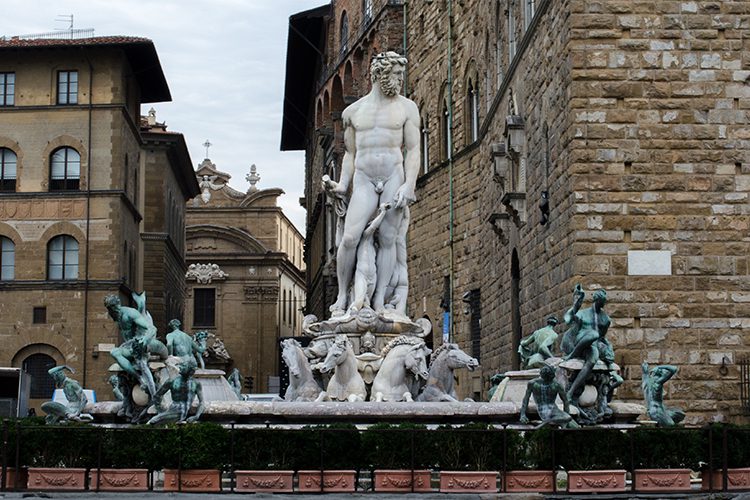
As for my slow tourist style and as weird as it sounds, steps are my favorite thing in Italy. I love sitting on the steps of Santa Croce in the morning, before all the other tourists wake up, and then heading to Piazza Della Signoria for the Fountain of Neptune. The steps of Santo Spirito are the perfect place to enjoy a pizza at sunset and the steps of the Duomo at midnight are worth missing a few hours of sleep for. These steps are where I sit for hours, slow down, and take in every detail of Florence.

As for seeing every detail, Stendhal Syndrome is real. It’s a funny diagnosis of being absolutely overwhelmed by beauty, and it’s hard not to believe its real. However, when it was first diagnosed, it was to tourists who had spent all day in the heat, running from place to place, looking up at the monuments. Its no wonder they felt dizzy. 

Don’t rush to do everything, like the diagnosed tourists, just to say you did it. Take time to experience and be in the moment of the places you go. Slow down and etch the details of Santa Croce, The Fountain of Neptune, and Duomo into your memory – these are the moments you will take home with you and remember forever.

Time may feel like its against you, but Italy isn’t a sprint. As a student here, my time is a marathon that I’m soaking up every moment of.

See more of Florence and Italy at FUA’s FBInstagram, and Twitter.

Filistrucchi: Fake Beauty, Real Tradition

Photo by Megan McCall

By Melissa Maize

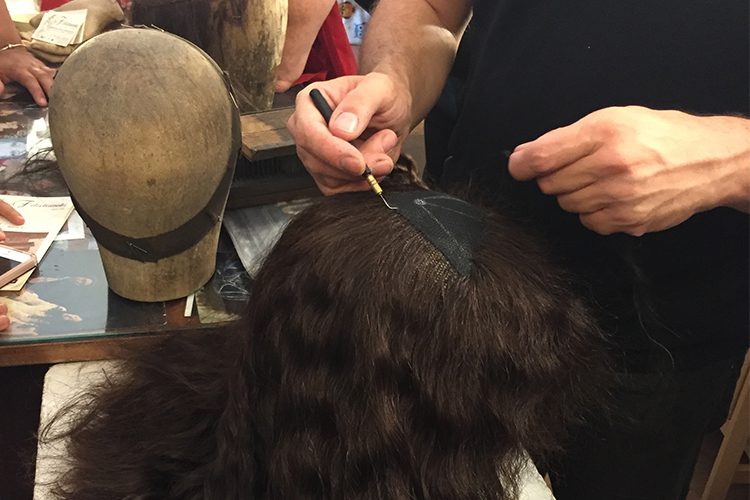
Filistrucchi is a Florentine institution that makes the ordinary, extraordinary. FUA Digital Writing students recently visited the historic theater makeup laboratory and shop. 

If you could be anyone, who would you want to be?

If you could swap faces, swap lives, even for only day, who would you choose? A Duke, a Duchess, Abraham Lincoln? Lady GaGa? At Filistrucchi, you can be anyone.

We all have little things about our appearance we’d like to change- smaller nose, thicker hair, higher cheekbones- and Filistrucchi was built on that need. Established in 1720, it catered to Florentine nobles, providing wigs and make up to suit their stylistic needs. It then developed into one of the leading make-up and hair providers to the Opera and stage, and later cinema. Gaining notoriety as masters of their trade, their clients soon spread as far as New York and Boston.

Perusing photos of their work, the shop owners recount stories of how they transformed men into women, women into men, old into young, the transformations often so complete that the clients’ families didn’t even recognize them.

It’s amazing to think that all that stands between you and complete anonymity is a few layers of make up. It seems to me that Filistrucchi has survived three hundred years and two epic floods not because beauty is timeless, but because the desire to look beautiful is.

See more of Florence and Italy at FUA’s FB, Instagram, andTwitter.

The Love Affair of Dante and Florence

Photo by Amber Wright
Photo by the author

By Amber Wright

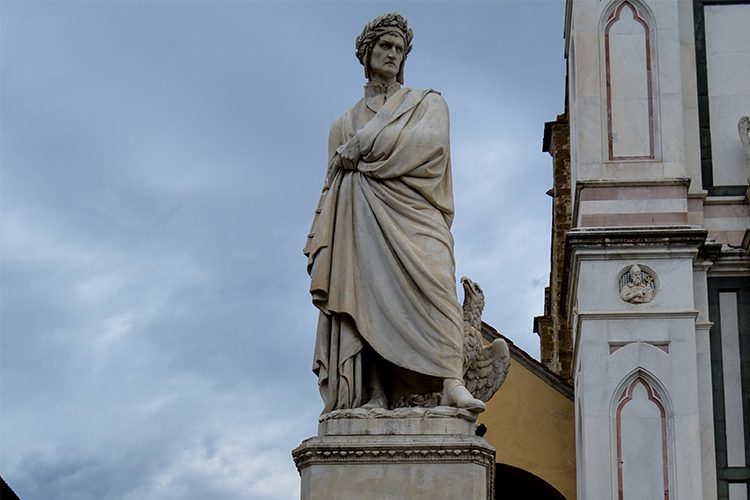
Every time I walk down a corridor of the Uffizi, I look Dante in the eye. I bitterly and sarcastically thank him for making me work so hard in the literature class I took my senior year of high school. Oh, The Divine Comedy. I still have the poem on my shelf back in California with copious amounts of notes in the margins, yet somehow I completely forgot Dante himself was a Florentine. Now living in the city’s center, it seems I cannot walk down the road without metaphorically looking Dante in the eye.

It’s not hard to miss the admiration Florence has for the poet. According to FUA faculty member Marta Russo, there are over 100 references to Dante throughout the city. He had a love affair with Florence as you can see in his poems. However, it was not always like this. In Florence, he was involved in a political struggle between the Guelphs and Ghibellines, and these rival parties disagreed on who should hold power in Italy. The Ghibellines supported the Holy Roman Emperor and the Guelphs were in favor of the Pope. Dante himself was a Guelph and was eventually exiled for it, but you wouldn’t know by Florence’s current celebration of the poet.  

The most obvious places to see Dante in Florence are the Uffizi – in the museum’s outdoor gallery of statues – and in front of the Basilica of Santa Croce. As mentioned previously, Dante was exiled from Florence for his political stance among the Guelphs. He never returned, and was buried in Ravenna – this is something Florence is still trying to cope with. According to Prof. Russo, the cities to this day disagree over where his bones should rest. While he isn’t actually buried there, Santa Croce still houses a tomb in his honor.

This love struggle isn’t one-sided: Dante loved his city back then as much as it loves him now. The father of the Italian language references Florence in many passages in The Divine Comedy. In Canto XXVI, Dante proclaims, “Florence, rejoice, now that you have such fame, and over land and sea you spread your wings! The whole Inferno’s ringing with your name!”

He may have been exiled, but his ties to Florence were undying. In fact, if Dante had not been exiled, he may have not written The Divine Comedy at all, says Prof. Russo. It was his exile that made Dante realize and understand his great love for his city. He was able to step back and fully understand the greatness of where he was from, and essentially intertwine this passion into his poem.

Dante and Beatrice, painting by Henry Holiday

Today, Florence honors Dante with plaques and statues around the city. They are its olive branch to the great poet, and a way to preserve his great history.  I see this preservation not only when I visit the Uffizi, but also when I walk down Via Guelfa. I see his legendary presence on the corner where he first saw his true love Beatrice and am reminded of the ultimate love story that Dante lived, with his native city.

See more of Florence and Italy at FUA’s FB, Instagram, and Twitter.

Cinque Terre-ible Weather

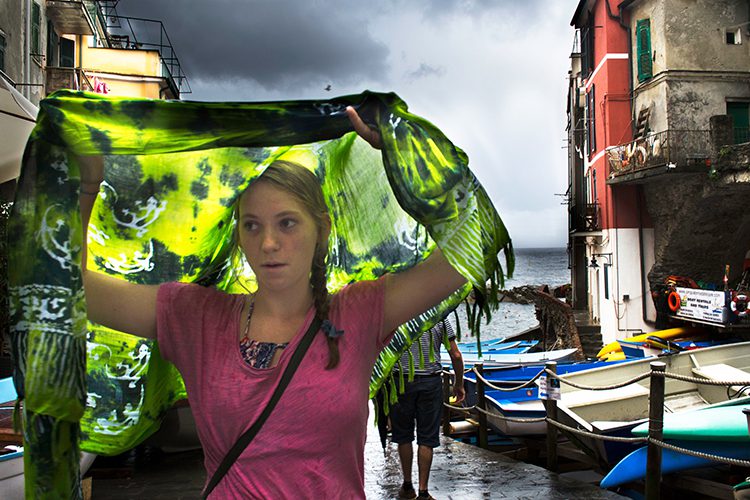
Rain in Cinque Terre, photo by the author.

By Amber Wright

Every photograph, video, and snap chat I have ever seen of Cinque Terre has been stunning. The colors of the buildings, the waves breaking on the rocks, and the sun shining down on the tourists makes it the perfect destination, and I finally had the opportunity to experience it for myself.

However, the sun wasn’t shining, and the water seemed to be more of a sea monster than just the Mediterranean sea. This area is constantly in danger of mudslides and the hiking trails were closed off for the rain that seemed to never stop falling. My weekend that was supposed to be picturesque and dream-like, now had the potential of being ruined by the Cinque Terre-ible weather.

Thankfully, I was sitting at a covered cafe as the rain came down and was able to just take it all in. I surprisingly loved the rain. I felt that the weather was a nice change from the sweltering heat, and my friends and I were not about to let a few raindrops keep us from the sea. It was surreal swimming in the mediterranean for the first time, during a storm no less, and the view of Monterosso from the water was magnificent. I now understood the raving reviews and why this coastal town deserved to be a protected site.

Sanctioned by the United Nations, a World Heritage Site like Cinque Terre is deemed so for its cultural, scientific, or historical significance. Therefore, it’s unsurprising that Italy, being the beautiful and rich country it is, has the largest number of these UNESCO protected sites.

The symbiotic relationship between man and nature is captured in the complex structure and architecture of each village. The steep hills and cliffs are dotted with buildings and agriculture that have been perfectly constructed to withstand the treacherous coastal area.

Monterosso and Vernazza were the first of the five villages built in the eleventh century. The following three villages were soon developed, and later reinforced with barricades and defence towers to combat the attacks from pirates. By the 15th century, Cinque Terre, or “five villages,” was the local term for the villages, and it was known for it’s excellent vino, produced to this day by incredibly determined farmers whose vines seem to grow vertically from the precipitous inclines. Progress halted in the area when mudslides destroyed the local agriculture, but recovered in the mid-18th century. Fast forward to 1997 when it became a protected area and to 1999 when it was officially named a national park. Today, accessibility is limited in Cinque Terre, and other than a train between the five villages, modern infrastructure has had only a hidden presence in this area.

It’s one of the most photographic areas in Italy, but there is so much more to experience than what you’ll see through the lense of your camera or behind your iPhone. Take a look around and understand why this area is deeply cherished. Look up and see the local old ladies people-watching from above, or take the hike to see the sweeping views from above. Take a dip to feel the warmth of the sea and try your hardest not to swallow the brackish water. Climb the stairs to the top of a watch tower and imagine being under attack by pirates.

Lastly, if the weather is bad, embrace it. Not only did the rain not ruin my trip, but it added to the excitement and memories that I’ll have forever. The history and beauty easily shines through, and I cannot wait to go back.

See more of Florence and Italy at FUA’s FBInstagram, and Twitter.