The Beating Heart Above Florence

A place where sunsets, cameras and people meet to be present

This blog feature is an exclusive bonus installment to our Fall 2025 issue of Blending Magazine. After you finish reading, be sure to explore the rest of the magazine online—just follow this link to download the full Fall 2025 edition:
https://jschoolfua.com/images/BM/BM_151.pdf

written by Maëlys Brunet

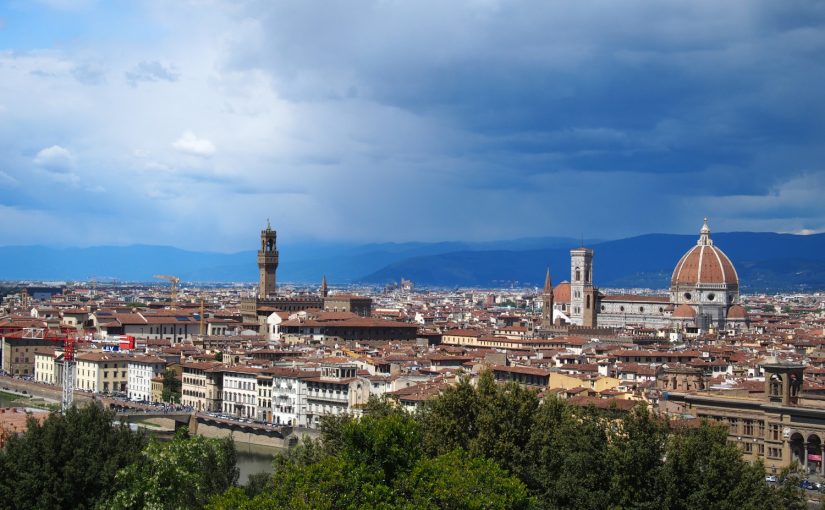
As the city slowly changes from season to season, we are constantly reminded of Piazzale Michelangelo as the beating heart of Florence. Especially during the summer months. The Piazzale remains alive through both tourists and locals, particularly at sunset, as wanderers gather on the steps with a simple glass of wine to listen to a band’s music or take pictures as a souvenir of the moment, as time pauses, just for a moment. This Florence phenomenon stirs curiosity about the aura the city holds in people’s hearts, a current that pulses through and unites communities. 

Piazzale Michelangelo seems nowadays as a rite of passage, a go-to place when visiting Florence to admire the city’s iconic skyline. But what about its history? Built in 1869 by Giuseppe Poggi, it was originally meant to just be a terrace, celebrating Michelangelo’s art. A representation of progress, but also modernity and the future, as Florence was the capital of Italy during that time. Nowadays, we see Piazzale Michelangelo as a place to slow down, reconnect to the beauty of the city, with a crowd to accompany us into this poetic journey. 

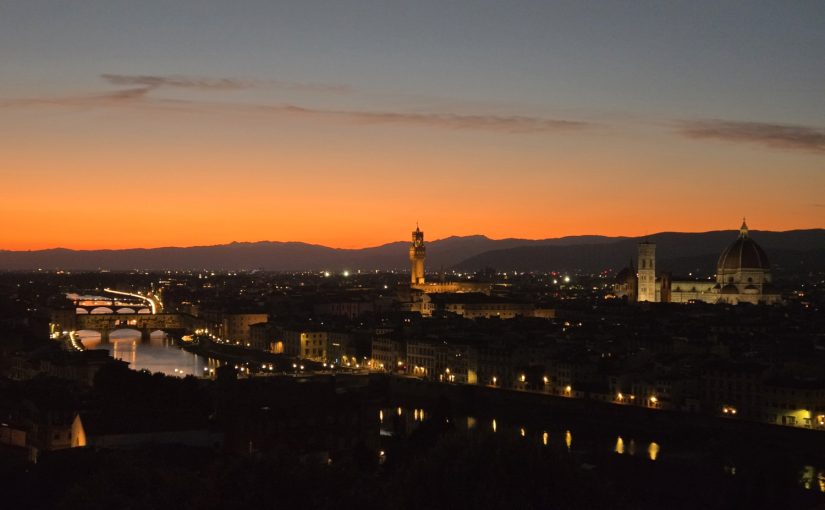
The typical route to Piazzale Michelangelo is just as memorable as the view itself. Beginning from the tower of San Niccolò, take the ascending stairs and path between the large trees. The climb begins as we slowly rise above the city of Florence, in anticipation of the view that awaits, as if leading towards something sacred. Then, the main terrace appears, the crowd gets denser, and the city spreads below. In the golden hour of the evening, music plays in the background and people dance to its infectious beat. Monuments wear orange and yellow as the sun begins to set, offering the perfect moment for multiple photoshoots to spontaneously appear. Phones and digital cameras alike click with the same rhythm as conversation or laughs. 

Piazzale Michelangelo is the place where multiple generations meet to capture the essence of Florence. As a guitarist tunes his strings, he shares that although the people there always change, the sunset and view remain a constant. There is poetry when we stare at the landscape, thinking it was approximately the same view as the one our ancestors looked out at centuries ago. People at first come for a simple view, then leave with memories, connections and hearts filled with emotion. Here the sunset isn’t edited, it is put on display, shown in its raw form to its audience.

Looking away from the view and back towards the crowd, students share a bottle of wine, while pizzas are eaten by a family visiting from abroad. All the while, social media enthusiasts are trying to capture the perfect shot. A couple stairs down, people listen to music, dance to the rhythm of guitars and saxophones, and cheers can be heard for a couple that just got engaged. This place holds authentic moments of life and connection that will never be forgotten. 

As night approaches, some remain while others venture further, all the way to San Miniato al Monte – a hidden place above Piazzale Michelangelo – to admire the city from a similar perspective. Apart from the overwhelming crowd and movement, you find peace and quietness, almost like coming out of a dream. Two different atmospheres but only a single feeling remains unchanged: reassurance and interaction. 

In those small interactions, it is where Piazzale Michelangelo holds its core, being something rare and precious to keep hold of. A moment apart from digital, inviting those that gather to be there mentally, with your own thoughts, to live in the moment rather than posting it. The space gathers both past and present. Life and art coexist around a skyline view, with a community to share the same moment with, just for a couple of minutes… or even a couple of hours. 

In an age of constant digital scrolling, Piazzale Michelangelo remains a symbol of the contrary. Not every view needs to be shared or posted on social media, as it must be experienced and lived through the senses and presence of people around us. The difference lies in the fact that the beauty of the square can be shared through both photos and memory, however those emotions we feel when in its presence, cannot be replicated on the digital screen.

When we look at Piazzale Michelangelo, we can see its beauty in the different communities it brings together. Some live in the moment, as a break, an aside, a moment apart from the fast pace of life. We take this moment to slow down, take a step back, and enjoy the present moment with friends, family, or alone. Others may take advantage of the moment by capturing a memory, particularly through digital means, engaging in an online community.

Piazzale Michelangelo explores the possibilities and redefines the opportunity to come together as a community, whether in-person or virtually. This place in Florence demonstrates a new perception of what a community can be, beyond what we are used to seeing, while continuing on the same path of harmony and the search for unforgettable moments. 

Jazz Revival Amongst the Youth

With the recent closure of Florence’s Jazz Club, allow this to be read as an ode to a staple in past study abroad students’ daily lives, with hopes of bringing back fond memories. In addition, this blog feature is an exclusive bonus installment to our Fall 2025 issue of Blending Magazine. After you finish reading, be sure to explore the rest of the magazine online—just follow this link to download the full Fall 2025 edition:
https://jschoolfua.com/images/BM/BM_151.pdf

written by Clara Koster, Hailey Kookaby, Tess Letendre & Peri Raczynski

“Going to Jazz Club felt like being at home in New York,” said Colleen, a student at Florence University of the Arts (FUA). For many students, the Jazz Club offers a familiar, intimate vibe — a break from the usual bars and techno nights of Florence. The dimly lit venue, tucked into a side street, draws students in with the promise of soulful music and a warm, relaxed atmosphere. 

Despite being an older style of music, jazz is finding new resonance among the city’s youth. A sign of its relevance is when a place appeals to students, who have consistently driven cultural trends. The sound of jazz now drifts through the streets of Florence, played by street performers and live musicians, sparking curiosity and excitement for a nightlife experience that emphasizes listening rather than dancing. 

The Jazz Club opened in 1979 and has consistently offered live performances. While jazz is the primary style, rock, R&B, and blues are also commonly heard. The club is small, and lines begin to form about a half hour before doors open, mostly made up of students eager to see what the venue has to offer. Guests are greeted at the desk, pay cover, and receive a membership card — their first drink included, with future visits covered by the card. 

Reactions to the club vary. “I thought it was kind of boring,” stated Harleigh, another student. “It’s not like the other bars I usually go to.” Devon, a classmate, described her experience as “amazing,” citing her deep love and appreciation for jazz. Maria, another student, elaborated on how she prefers Thursday nights for blues sets, saying, “It’s slower, moodier and fits the atmosphere better than Wednesday nights, which are more crowded.” Despite the differing opinions, one thing is clear: the Jazz Club leaves a lasting impression on those who seek it out. 

For our own visit, the ambiance was immediately striking. The room was filled with resonant bass tones, the wail of the saxophone, and a sense of focus on the music. Students swayed gently to the rhythm, some closing their eyes to fully immerse themselves, while others held quiet conversations without shouting over the music. The atmosphere was comforting and welcoming, creating a space where anyone interested in music could feel at home. 

The Jazz Club’s blend of historical charm and contemporary appeal illustrates Florence’s ongoing artistic legacy. Students like Tatum Park appreciate the club as a break from conventional “college” music, feeling connected to the city’s long-standing appreciation for music and art. Similarly, Colleen finds nostalgia and familiarity in the experience, while Devon finds inspiration and awe. The club demonstrates that even older musical forms, when presented thoughtfully, can engage and excite a younger generation. 

While most students gravitate toward techno-heavy clubs and crowded bars, the Jazz Club offers something different: a revival of old-fashioned musical reception. It’s a space where students can experience live jazz, blues, and other genres in a way that emphasizes presence and connection. In Florence, a city steeped in artistic and musical heritage, the Jazz Club has become a bridge between past and present, giving students a new way to engage with the timeless power of music.

The Rebirthed Art of “La Vita Lenta”

Journaling: The Personal and Authentic Form of Memory

This blog feature is an exclusive bonus installment to our Fall 2025 issue of Blending Magazine. After you finish reading, be sure to explore the rest of the magazine online—just follow this link to download the full Fall 2025 edition:
https://jschoolfua.com/images/BM/BM_151.pdf

written by Liana Torres, Heather Collins & Lydia Turner

In an age where our thumbs type faster than our thoughts, the digital world feels impossible to escape. Our devices allow us to easily type reminders, organize assignments, jot down school notes, or record fleeting thoughts within seconds. Walking into a library, classroom, or café in Florence, you will often see people with iPhones in their hands, computers on their laps, and the rhythmic tapping of keyboards as they urgently take notes and revise them in record time. It’s a convenience that may seem luxurious, but people are craving originality due to the loss of creative media. It’s efficient, but detached. 

A new wave of creatives, travelers, and locals in Florence is embracing a slower, more tactile ritual: taking pen to paper. Here in Italy, where beauty can be found in imperfection and time is slowed down, journaling has taken on a deeper meaning. Writing by hand anchors you in the moment, making it a physical craft that demands presence and meaningful thought. 

Journaling is an extremely personal experience; a leather-bound notebook isn’t just stationery it’s an accessory, an extension of personal style. The marbled paper, the smooth pen, the color of ink chosen, every detail becomes a reflection of self. In a city renowned for its craftsmanship, from leather bags to jewelry, the journal joins the wardrobe of self-expression. To open it is to reveal not curated perfection, but raw honest thought. The choice of the journal’s cover is unique and tailored to the user’s taste, often serving as a fashion accessory. Residents and visitors alike are slowing down, mirroring the ancient streets and buildings around them, translating their experiences through ink rather than a screen. 

Florence itself feels designed for reflection. The view from the rose garden at sunset, views of the Duomo, the echo of footsteps on cobblestones, and the scent of paper and ink from small workshops all invite slowness. To sit with a notebook in a Florentine café isn’t merely to write, it’s to participate in a centuries-old dialogue between beauty, and thought. The act of journaling becomes a quiet rebellion against the speed of modern life, reconnection with presence. 

Psychological studies have shown that handwriting engages more areas of the brain than typing does. When the hand forms letters on paper, neural pathways responsible for memory, comprehension, and creativity become activated. Writing slows down the mind and creates deeper reflection, forming strong connections between thought, language, and page. One must think before they write, as each sentence becomes more meaningful when it cannot be easily erased. There’s something deeply human about seeing one’s thoughts take shape, imperfect and unfiltered. Typing on a computer removes the permanence, thoughtfulness, and focus that handwriting naturally gives. It is nostalgic, but also a neurological discipline. Our engagement with what we are learning, feeling, and experiencing is deepened.

Journaling is an art form in Florence. In local markets and small boutiques, hand-stitched leather notebooks and marbled papers are commonly found authentic, high-quality stationery. They signify Italy’s value for craftsmanship, and in Florence, the art of leatherwork. These boutiques also draw consumers into the old, analog world by offering products such as wax seals, personalized notecards, and fountain pens. Each item tells a story, not only of Italian craftsmanship, but of the person who chooses it. 

Tourists, visitors, and students of Italy often feel compelled to document their experiences here in an honest and authentic way. Instead of simply snapping photos on their phones, many sketch their surroundings or write about their emotions in the moment, carrying their journals as if they were passports. 

The Italian way of life, la vita lenta, is a philosophy of taking it easy and living in the moment. It embraces the rhythm of slowness and authenticity, valuing conversation, artistry, and the transformation of life’s seemingly mundane moments into something meaningful: a shot of espresso made by a local barista, a handwritten letter or postcard, or a leather journal carefully crafted by an Italian artisan. People can truly reflect rather than quickly react on their phones. 

Journaling allows for the documentation of lived experiences; it’s a way to highlight valuable memories and live through physical paper instead of a screen. Imperfection is welcomed, and the texture of the paper carries the rawness and realness of each written experience. It is more sacred. In Florence, handwriting isn’t about rejecting technology, it’s about reclaiming something real. Paper invites you to be unfiltered, unedited, and utterly yourself.

Florence Was My True Laboratory

written by Kathleen Morris

This blog feature is an exclusive bonus installment to our Spring issue of Blending Magazine, honoring the never-ending legacy of Giancarlo Cauteruccio. After you finish reading, be sure to explore the rest of the magazine online—just follow this link to download the full Spring 2025 edition:
https://jschoolfua.com/images/BM/BM_151.pdf

A video of a massive explosion serves as the opening backdrop for the latest production directed by Giancarlo Cauteruccio, capturing the audience’s attention as vibrant flames engulf a building.

The projector screen transitions to display a montage of troops entering battle, introducing visual motifs that reappear throughout “Il ritorno del soldato,” “The Return of the Soldier.”

The application of technology is a trademark of Cauteruccio’s theatrical style, harkening back to his roots as the founder and artistic director of Teatro Studio Krypton, located in Florence, Italy. The essence of Cauterrucio’s work can be summarized in a single word: innovation.

His show, which debuted this February at Teatro Aurora, located in Scandicci – a suburb of Florence, relies heavily on technical elements to underscore war’s toll on soldiers’ families. In his introductory speech, Cauteruccio warns audiences that it is “not going to be a fun night.” Still, he emphasizes the necessity of telling a story shrouded by darkness.

The tragedy portrayed within the script is echoed by the tragic origins of the playwright himself, Saverio Strati.

Strati, a writer from the Calabria Region, lived a life of poverty and did not receive recognition for the thousands of manuscripts he had written until after his death. To revive his legacy, the show was commissioned to celebrate the centenary of the writer’s birth.

Cauteruccio acknowledged his connection to Strati, explaining, “We found ourselves in the same peripheral city of Florence, a suburb without any identity. Today it has changed, thanks to the work done by artists who experienced it.”

Upon entering Teatro Aurora, Cauteruccio’s impact on the community is evident.

The lobby overflows with fans prepared to support his latest project. Following the show, a line forms once more. This time, patrons swarm Cauteruccio to personally offer praise for “Il ritorno del soldato.”

The love that Cauteruccio holds for the region, as evidenced by his willingness to recover Strati’s lost work, is matched by the enthusiasm of his audience in Scandicci.

For decades, Cauteruccio has demonstrated a fierce commitment to Florence’s art scene. He has distinguished himself as a changemaker, tirelessly pushing boundaries and actively defying artistic precedent to modernize the industry. 

“At the end of the ‘70s, I began to understand that technological evolution would lead to a transformation,” he adds.

Since the ‘80s, he has played an influential role in redefining art practices in Florence. The establishment of Teatro Studio Krypton, founded by Cauterruccio and Pina Izzi in 1982, aligned with the awakening of the city’s avant-garde movement.

“We found ourselves amid the phenomenon of postmodernity,” Cauteruccio observes.

In collaboration with other artists, he created a new language built on the notion that the theatre is “a place of synthesis” where all art forms intersect. 

“I set up a job there which looked predominantly at contemporaneity,” he shares. “It was a theater of research, experimentation, and innovation… that featured poets, musicians, philosophers and architects.”

As Florence’s underground scene blossomed in the 20th century, Cauteruccio’s embrace of radical creativity fueled a movement that created instrumental progress within and beyond the theatrical realm. Undeterred by the unknown, Cauteruccio launched a revolution driven by postmodernity and new spectacularity. 

“I was led to strategic approaches in a contemporary way and an aesthetic that allowed the new generations to come into contact with a language that was previously taken for granted,” he describes. 

Cauteruccio refined this approach at Krypton, replacing classical music with electronic sounds and introducing the laser beam to Europe’s theatrical sphere. By rejecting tradition while honoring the elegance of past practices, his work has garnered an “explosion of interest” for half a century.

His career transcends the stage, as he has authored several books and taught at universities across Italy and the United States. In every setting, Cauteruccio considers the influence of his emergence in “The Cradle of Renaissance.” 

With a hint of reverence, he declared, “Florence was my true laboratory.”

Cauteruccio concludes with a thought about the synergistic relationship between artists and their audience – one is not complete without the other. Likewise, Florence’s underground art scene would not be complete without him. As a figurehead of progress and ingenuity, Cauteruccio’s efforts will endure and ignite a spark within the next generation of trailblazers.

The Sound of Florence

written by Alena Pietrini, Clare Kearney & Autumn Verna

This blog feature is an exclusive bonus installment to our Spring issue of Blending Magazine. After you finish reading, be sure to explore the rest of the magazine online—just follow this link to download the full Spring 2025 edition:
https://jschoolfua.com/images/BM/BM_151.pdf

Pinocchio Jazz Club, located in the heart of Florence, serves as a hub for local jazz culture, offering an intimate location for both musicians and audiences. Founded by Costanza Nocentini and Daniele Sordi, the club promotes high-quality jazz music in order to create growth of both classic and emerging talent. Each Saturday, a range of performances play at the club and perform their own original compositions and jazz classics. The famous Pinocchio logo is inspired by pop culture stemming from Florence, creating a sense of community at a very intimate club. Beyond its musical contributions, Pinocchio Jazz Club plays a vital role in preserving Florence’s locality despite the increasing tourist surroundings. The club stands as a testament to Florence’s roots by offering a space for cultural exchange and a deeper connection to music. The Pinocchio Jazz Club stands tall as an important institution for both locals and visitors to celebrate Florence’s dedication to the genre.

Pinocchio Jazz Club is a well known organization located in the heart of Florence. Locals and tourists enjoy this important location for the Florence community. Costanza Nocentini and Daniele Sordi oversee the association and ensure it continues to spread jazz to as many people as possible. Nocentini revealed that the organization was founded with the goal of encouraging the growth of the local jazz community and promoting quality music that stands apart from commercial sounds. That goal has clearly been exceeded, as many jazz stars began their careers at Pinocchio Jazz Club. 

Each Saturday, the club hosts a new musician who brings their own spin on jazz. Some rework classics while others perform original compositions, all contributing to the evolving nature of jazz. Pinocchio Jazz Club isn’t just a venue where people passively watch a performance, it’s a zestful space that comes alive with the effervescence of the music. The club itself sits tucked into a residential part of Florence. The surrounding area has wide streets, more greenery, and a noticeable lack of tourists. It feels like a place where people actually live, not just visit. 

Inside, the setting feels intimate while also being full of enthusiasm. The lighting is vibrant and changes with the vibe of each performance, adding another dimension to them. One of the more iconic details is the famous Pinocchio riding the whale logo, which stands out in the background and reminds you of the novelty and roots of the club. The club is medium-sized, with space for people to sit at tables, making it feel inclusive no matter where you are. The performances range from full-on jam sessions with multiple musicians, to solo acts. 

One of the most striking things about the shows is how often the performers will involve the audience. Since the seating is so close to the performers, it’s impossible for the audience not to get swept up in the passion of the performance. The musicians feed off the audience’s reactions, and the crowd responds in turn, creating a dynamic environment that makes each show feel different and alive. There’s a genuine sense of play between the crowd and the musicians that makes the space feel fun, warm, and communal. It’s a casual crowd as people of all ages come through, some dressed up for a night out, others just stopping by. 

There’s a bar tucked into the back, and the whole place has an effortless local charm. What’s especially cool is that a lot of the musicians don’t seem to be playing off sheet music or pre-planned sets, but are simply riffing and letting the music take shape in real time. This aspect of the club just adds to its electrifying energy. 

 The impact of Pinocchio Jazz Club goes beyond music. It plays a critical role in preserving Florence’s local identity. Many of Florence’s visitors come just to check off the big sights and leave without ever experiencing the soul of the city. The historic center is starting to reflect that, with fast food chains and souvenir shops replacing once locally-run stores. In a city that was once defined by the Renaissance, by pushing boundaries and creating something new, it’s almost upsetting to see it slowly turn into a checklist for tourists. 

Places like Pinocchio Jazz Club push back against that. They give locals and those looking to connect with the city on a deeper level a chance to do so. Pinocchio Jazz Club reminds us of the roots of Florence. Whether you come for the music, vibe, or a break from the city center, there’s something about the club that stays with attendants. Florence will always have to navigate the balance between the old and new, locals and tourists, but places like Pinocchio Jazz Club make that dynamic feel more manageable. 

In the end, what makes Pinocchio Jazz Club so memorable isn’t just the music or the setting, but the sense of being part of something genuine. It’s rare to find places that blend tradition and originality so well, and even rarer to find ones that stay connected to the local community. Whether you’re a long-time jazz fan or just discovering the club, you leave knowing you’ve experienced something special.

Casini Firenze: The Art of Timeless Leather Craftsmanship

written by JJ Anderson, Madeline Hines, Mia Besl & Carys Abbott

This blog feature is an exclusive bonus installment to our Spring issue of Blending Magazine. After you finish reading, be sure to explore the rest of the magazine online—just follow this link to download the full Spring 2025 edition:
https://jschoolfua.com/images/BM/BM_151.pdf

Rooted in Florence’s rich tradition, this brand creates bespoke leather pieces that embody authenticity and artisanal skill, standing apart from fast fashion.

When most people think of Italy’s vibrant fashion industry, names like Prada, Gucci, and Valentino often come to mind. However, for those who truly appreciate the essence of local craftsmanship, there’s a lesser-known, yet highly revered brand, Casini Firenze. Nestled in the heart of Florence, the store is a standout in a city already known for its centuries-old leather craftsmanship.

The city’s longstanding practice of leather craftsmanship dates back to the Middle Ages. Florence was found to be an ideal environment for leather production because the Arno River provided access to water needed for time-consuming, labor-intensive techniques like leather tanning. By the 13th century, the city was renowned for producing high-quality leather goods, particularly for the nobility and elite classes across Europe. Over the centuries, Florentine artisans have continuously developed their methods, perfecting the art of tanning and dyeing leather.

In the aftermath of World War II, passionate leather craftsman. Giorgio Tattanelli, opened his family-run business which he named Casini Firenze. Casini specializes in crafting handmade leather totes, wallets, purses and more using authentic Tuscan leather and centuries-old craftsmanship. They pride themselves in being a limited edition brand, upholding timeless Italian values while creating special pieces for each client.

Amid a global fashion economy dominated by the constant manufacturing of mass-produced garments, the brand stands today as a reserved, yet powerful force in Florence’s underground fashion scene.

The store is located in Piazza Pitti, directly across from the Pitti Palace, making it a convenient stop. Upon entering, you’re welcomed by a glass window display showcasing Jennifer Tantinelli’s latest collection. Almost immediately, a sales attendant greets you, ready to elevate your shopping experience. The staff are experts on Casini products and provide a top-tier luxury service to ensure you leave completely satisfied.

After speaking with a few sales representatives it became clear to us that the brand is far different from the fast fashion stores we walk past daily. Casini Firenze‘s unwavering commitment to quality and authenticity proved a stark contrast to the disposable, fleeting nature of mass-produced clothing. Each piece tells a story of dedication, skill, and a deep respect for traditional Florentine artistry that cannot be replicated by factories or synthetic processes.

Specializing in custom made collections, the brand offers clients the opportunity to personalize a piece’s color and style to suit their individual taste. In addition, it provides bespoke services, allowing customers to design a truly one-of-a-kind bag that reflects their personal style and preferences. Among their most iconic creations is the Infinity Leather Basket Bag, a signature piece in the brand’s collection. This bag is made from leather pieces being meticulously weaved in an infinity pattern around a wooden box, giving the piece its signature basket-like look. This bag is available in seven distinct colors, and the customer even has the luxury of adding customizable elements to the bag.

Obviously, these unique pieces would not be created without the brainpower of new designers of the years. In 2002, Jennifer Tantinelli, granddaughter of the brand’s creator and New York native, took the reins of the family business. A lover of classic fashion, Jennifer was inspired by Audrey Hepburn’s timeless style-a vision that aligned perfectly with Casini’s commitment to tradition and elegance. Jennifer followed her family’s roots back to Italy and under her leadership, Casini Firenze transitioned into a modern-day luxury brand while still honoring its artisanal roots.

Despite facing numerous challenges, most notably the global disruption caused by the COVID-19 pandemic, Jennifer’s vision has allowed the brand to thrive. While the flagship store in Florence closed for nearly two years during the height of the pandemic, Jennifer was able to sustain her business through its location in Palm Beach, Florida.

One of the defining features of Casini Firenze is its commitment to maintaining full control over the production process. Unlike many luxury brands that outsource production, Casini prides itself on being self-reliant. The Tantinelli family makes all the leather products in-house, working with local artisans to ensure each piece reflects the highest standards of craftsmanship. This hands-on approach has allowed the brand to retain its authenticity and the hallmark spirit of Florence’s leather legacy.

A “Carless” Chronicle: What I Learned Trading My Keys For a Passport

written by Logan Grigsby

At first, I was nervous about trading my sedentary, car-dependent life for the walkable streets of Florence. I was nervous about getting lost, accidentally walking into the “bad side of town,” or simply not being able to physically walk that far. However, walking in Florence led me on a journey of self-discovery, connection, and helped transform me physically, spiritually, and emotionally.

In my hometown of Kansas City, going just about anywhere meant getting in the car; heck, I couldn’t even take my own dog on a walk without driving somewhere! My lifestyle was very sedentary most days; I would only walk a couple of thousand steps. I felt unhealthy, and walking more than a few blocks felt foreign to me. However, I knew even before I arrived in Florence that I wanted to trade my car keys for a passport and a nice pair of shoes. I knew I wanted to explore the city, and I knew I wanted to be healthier and happier. I never could have imagined the transformation that was in store for me, physically, emotionally, and even spiritually, and the love I would gain for Florence. This is my journey on how simply walking has changed my perspective and my life.

As I mentioned before, I was in pretty rough shape. I didn’t exercise, I didn’t go to the gym, and I was considered by most to be a “couch potato” stuck in a constant loop of getting out of school, plopping on the couch, and doom scrolling TikTok or Instagram for hours, never seeing the beauty in front of me.

My journey started small. Let me tell you, the first week was a challenge. We had a heat wave, and my body was just not used to walking around. At first, my body screamed when I had to walk across town for class, and don’t even get me started on the hills… Although, as time went on, I started shedding off fat, and the steps got easier as every day went by. At first, I struggled to hit seven thousand steps. I soon found I was disappointed in myself if I got anything less than fifteen thousand.

I remember my first week here attempting to make the trek up to Piazzale Michelangelo; A wonderful square with a beautiful look over the city. It was not the easiest hike. I remember having to stop and take breaks constantly. I drank nearly a gallon of water and I genuinely thought my body would give up on me. I decided to retake that journey during my final week in Florence, and not only did I not need any breaks, but I also found I was genuinely enjoying my journey up the hill!

A healthier lifestyle isn’t all that I found; the true magic of a walkable city isn’t the exercise, but it’s the hidden treasures you find along the way. Things you wouldn’t bat an eye at if you were driving in a car. Wandering aimlessly through the city quickly became a favorite pastime of mine. I didn’t know where I was going, but every day I would pick a new direction and set off. This led to some genuinely life-changing experiences.

During my first week, I found what I assumed was a small, unassuming bookstore. I honestly went in for the air conditioning; however, it turned out to be the legendary “Giunti Odeon,” a library and cinema, and what many locals have told me is one of their favorite places in the city. This quickly became one of my favorite spots to study, hang out, or just relax and watch a movie.

Then, one day while walking along the river, I stumbled upon “The Ultravox,” a truly unique outdoor event space that regularly hosts free concerts and offers a vast array of food options. I must admit, I fell in love.

One of my more memorable experiences was discovering “The Havana Club,” a small area on the river that the Cuban embassy officially recognizes for showcasing their culture in Florence. This is a place where I truly connected with the area and grew culturally. I remember walking up to the sand volleyball court quite nervous and sheepishly asking if I could join in, and before long, I had made a group of friends with local Florentines! They would eventually convince me to take to the dance floor, something I never considered, as I always thought that I had “two left feet.” I was so anxious, I thought I was going to throw up, but surrounded by people with positive attitudes and energy, I quickly found myself learning to Salsa dance. Who would have thought that I would learn to Salsa in Florence, of all places.

Of all the things I have done, if I hadn’t decided to just go on a walk, I would have never had these amazing experiences.

My walks have allowed me to truly appreciate the art and history of the city, which permeates it. My first time walking into Piazza della Signoria, I honestly was at a loss for words. Surrounded by breathtaking architecture, beyond lifelike statues, I have never experienced anything like that, and it will forever be a memory in my mind. Back home, I felt like I never took the time to “stop and smell the roses,” and appreciate the beauty surrounding me; however, in Florence, it is unavoidable.

My appreciation for Florence extends beyond the architecture, though. What truly makes Florence so special is the people who make up the city. Every day I see something new and special, from seeing artists freehand the Mona Lisa on the street with chalk, to guitars and accordions filling the streets with sound, to my first experience with Opera music on the front steps of the Duomo, the melodies of this city have filled my heart and soul.

My most spiritual moment came from walking down the street and discovering a small church on the street corner where I saw locals walking in and out of. I don’t usually consider myself a religious person, but something drew me to it, and I decided I needed to walk in and see the building for myself. It was quiet, it felt holy, but it also felt warm and welcoming. Before coming to Florence, I attended the funeral of a friend near and dear to me and was still struggling a bit with the loss, so I decided to do something I haven’t done in a very long time: I sat and I prayed. I talked to my friend who left too early, I spoke to my family who left this earth too early, and I sat and I prayed. This was a tremendously difficult moment for me, but I honestly felt a weight off my shoulders, and I felt a connection I hadn’t felt in a long time. I honestly felt like a changed person.

My time in Florence has taught me so much. At first, I thought getting more steps in would at best help me lose some weight and breathe a little deeper, but that couldn’t be further from the truth. It builds a sense of community and connection. I love running into my flatmates or classroom friends that I have made here, who may also just be aimlessly walking around, an experience that never happens back home. Trading my keys for a passport was a nerve-wrecking experience at first, but I now know it’s one of the most rewarding experiences of my life. It forced me to slow down, to pay attention, and engage in my new home. I’m not just living in Florence, I am discovering it one step at a time. This experience has changed my body, my heart, my mind, and my soul in the best way possible. I will forever be grateful for my experience here.

A Guided Journey Through the City’s Creative Underground

written by Alison Sweeney

This blog feature is an exclusive bonus installment to our Spring issue of Blending Magazine. After you finish reading, be sure to explore the rest of the magazine online—just follow this link to download the full Spring 2025 edition:
https://jschoolfua.com/images/BM/BM_151.pdf

From literary cafes to rebellious music movements, uncover the lesser-known artistic history behind some of Florence’s modern-day cultural hot spots.

Florence’s Underground Artistic and Creative Scene

Though Florence is known for its Renaissance art, grand architecture, and famous landmarks, the city has a hidden artistic scene that offers a different kind of cultural perspective and experience. While many of the venues that once hosted this creative underground scene have become more commercial over time, their roots tell hidden stories of rebellion, reinvention, and the key to discovering true Italian culture. This travel guide invites you to step into Florence’s underground, not just physically but historically, creatively, and culturally.

Caffé Giubbe Rosse: A Literary Revolution is Brewed 

Start your journey at one of the most famous historic literary cafes in Florence, Caffé Giubbe Rosse, where famous poets and writers sat to scribe and exchange radical ideas. According to the article, “Grand Re-opening of Caffé Giubbe Rosse” by Accord Italy Smart Tours, Caffé Giubbe Rosse is located in the Piazza della Republica and was established in 1896 by two German brothers. The cafe earned its current name, meaning Red Jackets, because it was inspired by the red uniform worn by the waiters. 

Caffé Guibbe Rosse grew to become a hub for intellectuals, artists, and writers. The cafe played a pivotal role in the Futurist movement and served as a gathering place for avant-garde thinkers like Baccio Maria Bacci, who looked to challenge traditional artistic roles. 

Today, visitors can still visit the cafe and bar to experience the Italian cultural experience and legacy, where you can find some original Futurist writings still on display! 

Teatro Verdi: Reinventing the Stage

Next, step into the dimly lit Teatro Verdi of the 1980s, where the stage is filled with redefined Italian performance and shortly became a prestigious turnpoint in the uprise of the futurist avant-garde movement. Teatro Verdi transformed into a space for the most sophisticated pop and rock music and for unconventional drama. 

According to the Teatro Verdi website, the theater was inaugurated in 1854 and is the largest “Italian-style” theatre in Tuscany. Located in the historic Santa Croce district, it was built on the remnants of the 14th-century Carcere delle Stinche. In the early 20th century, the theater embraced the futurist avant-garde movement, which challenged traditional theatrical norms. These weren’t just performances but protests, celebrations of youth, and identity in a space of avant-garde reinvention.

Today, Teatro Verdi remains a diverse cultural venue, offering classical music, contemporary performances, and pop and rock concerts, reflecting the artistic landscape Florence has to offer.

Tenax: A Hub for Florence’s New Wave Movement

Last but not least, explore one of the music venues that fueled the cities’ New Wave movement in the 1980s, Tenax. Tenax quickly emerged as a hub for new artists and musicians by influential New Wave and post-punk bands and today remains a symbol of Florence’s alternative music history. Picture this: it’s September 1981, and amid Florence’s enthusiasm for new wave, dark, and punk sounds from the UK, Tenax emerges as a pioneering nightclub. According to the Tenax website, the club was founded by a group of young entrepreneurs and quickly became an innovative and alternative hub for emerging artists, fashion designers, and musicians. Tenax’s stage has hosted an impressive number of acts, including Spandau Ballet, Bauhaus, and New Order, becoming a cornerstone of Italy’s music scene. Bands like Litfibia and Neon, formed in Florence in 1979, found a platform at Tenax for their innovative sounds. 

As the music landscape evolved, Tenax adapted and began to embrace other genres like house music. The club’s ability to reinvent itself while maintaining its core identity has ensured a lasting influence on Florence’s cultural aspect. 

All of these examples of Florence’s underground cultural scene offer a rich and nuanced perspective of the city’s artistic evolution. These places, now more visible, carry with them the same legacy of those underground revolutions. So, next time you find yourself in this beautiful and magnificent city, look closer. Look beyond the espresso machines, beneath the stage lights, and in the echoes and flashing lights, and maybe you’ll find the story of a city whose past reflects a magnificent creative rebellion. 

You Don’t Just Study Abroad…You Study Yourself Too

Discover the three transformative life lessons that I learned during my six-week study abroad experience at Florence University of the Arts that I would not have been able to comprehend if I had stayed home this summer.

When I boarded the plane to Florence, Italy, for a six-week study abroad experience with Florence University of the Arts (FUA), I knew I was going to grow academically and professionally. I enrolled in a three-week course and worked a public relations internship covering diverse community events, conducting research, and collaborating with interns from various departments.

But as much as I learned in classrooms and internship meetings, some of the most valuable lessons came from simply assessing myself and my surroundings while living abroad. Here are are the three main insights I gained in Florence that no textbook could teach:

1. Discomfort is a Great Teacher

Moving across the globe from my familiar Michigan environment was the first jolt of discomfort. I was no longer just a few hours from home like I am for college, instead an entire ocean! That kind of distance forces a newfound level of independence. Whether it becomes overwhelming or empowering is up to you.

There were emotional hurdles, like the occasional hits of homesickness. And then there were the practical challenges, such as navigating a foreign metro system when my international phone plan suddenly stopped working, or trying to communicate professionally at public events where most attendees spoke only Italian. Getting lost, whether physically or in conversations, became something I eventually grew more comfortable with. That said, safety always comes first and keeping your guard up where it’s due is essential. No adventure is worth compromising your instincts or well-being.

Every time I stepped outside of my comfort zone within reason, not once did I regret pushing through the fear. Because if you’re always comfortable, you’re probably not going to grow in the long run.

2. Everyone You Meet Carries a Story Worth Hearing, Including You

During my stay in Florence, I shared a multi-room apartment with eleven roommates from across the U.S. and Australia. We came from all different walks of life…a few older than me, others navigating their very first trip abroad alone. Our most valuable times spent together weren’t always the last-minute weekend trips or shared meals, but the simple conversations where we opened up and shared pieces of our individual stories. There were times when I realized how much of my own life I’ve taken for granted, or received advice from a unique perspective I have not heard previously.

However, one of the most unexpected and memorable interactions happened when I was completely alone.

After finishing a long day working a community event, I treated myself to dinner at Sgrano, a fully gluten-free restaurant in the city. I sat at a table for one and ordered a sandwich followed by a slice of gluten-free chocolate cake. As I was enjoying my dessert, I suddenly heard a voice from the table next to me say, “You know, chocolate cake isn’t really eaten at this hour.”

I looked over and laughed, lightheartedly replying, “Oh well, I guess it’s exposed I’m a tourist.”

To my surprise, my response opened the door to a long, meaningful conversation with the couple seated beside me. What started as small talk of where we’re from turned into an hour-long discussion about life. They shared how they met, talked about their children (who were around my age), their constant travels, hobbies, and asked about my studies and experience abroad. 

Before we left, they unexpectedly paid for my entire meal and said, “Thank you. This felt like we were talking to our kids again.”

While studying abroad, you quickly learn that people will respond to you in all kinds of ways. Some welcome you with open arms, some are simply curious, and others may not understand you right away. Whether it’s a five-minute chat with a roommate in passing or a shared meal with strangers who feel like a touch of family by the end, every interaction holds the potential to teach you something. If you listen more and assume less, you’ll find stories worth hearing; and you’ll begin to recognize that your own story is worth sharing, too.

3. Gratitude Deepens With Distance

Perhaps the most profound lesson of all: travel is a privilege and I do not take that lightly. Not everyone gets the opportunity to live in a foreign country, to immerse themselves in a new culture, or to step outside their familiar world long enough to see it differently. That constant awareness has grounded me throughout the whole experience.

It’s funny how being far away can actually bring you closer to what matters most. With every breathtaking view and every delicious meal, there was also a small part of me that was growing a deeper appreciation for home. The gift of distance doesn’t just create space, it creates clarity too.

This experience also gave me a new appreciation for myself. I’m proud of the courage it took to get on that plane, to navigate unfamiliar places, to build friendships with strangers, and to stay open to every lesson. The version of me who returns home is definitely not the same as the one who left. And that’s something I’ll be forever grateful for.

Recently, I stumbled upon a writing assignment from my senior year of high school, where I had to create a bucket list of dreams to accomplish over the next ten years. On that list were the names of European countries scribbled more as wishes than actual plans. At the time, the thought of visiting these places felt distant, like fantasies reserved for “someday.”

Now, having lived those dreams, It has reminded me that what once felt out of reach can become reality when you stay open, curious, and brave enough to say yes.

So here’s what I’ve learned: always show up. And never forget to look up; whether at the architecture, the people, the unfamiliar streets, and everything in between. Life has an interesting way of leading you exactly where you’re meant to go.

The Upkeep of a Cemetery Honoring Fallen American Soldiers

written by Ansley Peterson

This blog feature is an exclusive bonus installment to our Spring issue of Blending Magazine. After you finish reading, be sure to explore the rest of the magazine online—just follow this link to download the full Spring 2025 edition:
https://jschoolfua.com/images/BM/BM_151.pdf

A determined young man in a black puffer jacket nervously clutches a map, tapping his fingers on its cover. An American teenager crouches by a headstone and slowly traces his fingers over the letters of its inscription as his dad watches from afar. An elderly couple stands at the entrance, shoulder to shoulder in awed silence as they look upon rows and rows of graves. They walk slowly, hand in hand, steeling themselves for the journey up the sloping path ahead of them. No matter the reason, it’s 10 a.m. on a Thursday in March and the lives of these strangers all intersect here at the Florence American Cemetery. 

Situated on the Greve River just outside of Florence’s city center, Americans and locals alike make the trip to the cemetery to gain familial closure and to learn more about the historical ties between Italy and the United States. The location of Florence was chosen for a multitude of reasons, starting with its ease of accessibility because of the nearby Santa Maria Novella train station and the bus routes that run with stops at the cemetery throughout the day. Since this is a World War II cemetery, there is a higher likelihood of visitors being descendants of those who have fallen and having memories to share and preserve about those buried here. 

Florence American Cemetery is managed by the American Battle Commission, whose overall mission is to ensure that “time will not dim the glory of their deeds.” Current superintendent Eryth Zecher has been working at the Commission for five years and has been maintaining the Florence American Cemetery for the past year and a half. She explains that the process for choosing the location dates to just after World War II when temporary cemeteries were set up in areas where major battles had just occurred. It was a time of transition when some of the fallen service members were being shipped back to America to their families and the temporary cemeteries were being compared to see which would be best fit for building a permanent cemetery. The Florence location allows a good proximity for visitors, and its rolling Tuscan hills made it a beautiful environment that was deemed fit for the sacrifices of the men killed while liberating nearby cities in the Northern Italian Campaign.

It seems surreal that their bodies eternally rest below the freshly manicured grass, with nothing but a shiny marble cross to signify their life’s worth. Lead gardener, Leonardo has been working with the nature of the cemetery for the past 10 years to keep it as close to the condition as the year that it was founded, in 1960. He polishes the headstones with a sponge and blows off all leaves and debris from each plot. He is passionate about his work and pays close attention to detail because of the gratitude he has for its historical significance. 

“My grandparents were freed by the American soldiers in 1944,” explains Leonardo, “For me, it’s an honor to work here.” 

Small, perfectly shaped Tuscan Cypress trees line the perimeter of the grounds, standing like soldiers at attention over the headstones. Leonardo shares that adult trees don’t grow very well in the cemetery’s environment, so he and his team raise the trees from saplings and keep them looking uniform. They don’t use chemicals on the trees, and everything is done by hand, including removing all weeds from the property. On this blustery, Thursday morning, I watch as two men take turns anchoring down wooden support stakes for smaller trees and chopping off uneven branches. 

The maintenance team and superintendent Zecher work diligently to make sure all the upkeep efforts reflect the promise to the fallen soldier’s families that their loved one’s resting place would be taken care of. The groundskeepers clean the memorial and headstones on a set schedule and work meticulously to keep them in perfect condition. 

“It’s just the ultimate mission to be able to commemorate and honor these service members every day and also work in such a beautiful place,” says Zecher, “I couldn’t find a better way to spend my life than doing this mission.”