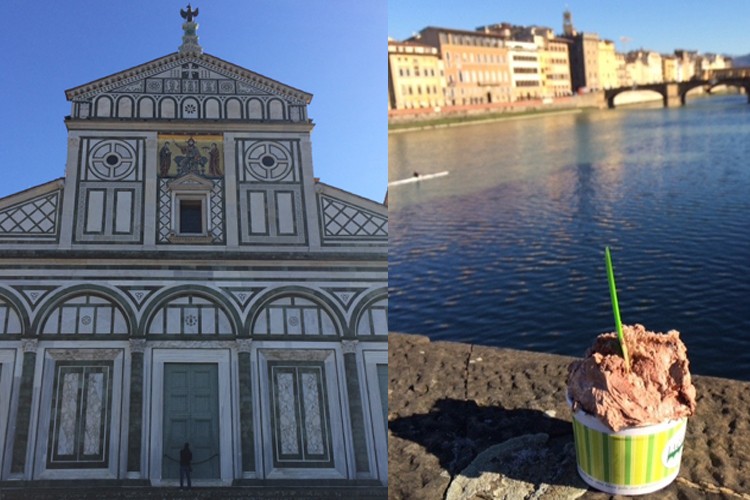
Left, San Miniato al Monte; Right, gelato from La Carraia with a beautiful view. Photos by author.
By Emma Vogel
Contrary to popular belief, not everything worth seeing in Florence is on the north side of the Arno river. Here are some of the hidden gems I’ve discovered living beyond the river, or as the locals call it, the “Oltrarno” or in an even further colloquial way, “Diladdarno.”
I was confused the first day I arrived at my apartment in Florence. Where was the Duomo? The Ponte Vecchio? The statue of David? Okay, I wasn’t quite so naive as to expect all of those Florentine staples right outside of my apartment door, but I knew I was in a different part of Florence than I had seen when searching Google Images. It took me only a few minutes of wandering to realize that I lived on the south side of the Arno river, and it took only a few days after that to fall in love with where I live. Sure, what draws most people to Florence is the bustling Piazza della Repubblica, the magnificent Duomo, and the incredibly famous Palazzo Vecchio, but there’s much more to see than what the tourist guides suggest. There’s a whole hidden part of Florence with charming artisan shops, authentic Italian cuisine, and hip cafés filled with locals that you can find by simply crossing one of the many bridges. Here are the best parts of Oltrarno that I’ve discovered so far.
Food
Oltrarno has some of the best restaurants in all of Florence. With a multitude of choices from family-owned restaurants to trendy eateries, I find a new favorite restaurant every day. So far my top picks include: GustaPizza (not surprising as it is loved by abroad students, tourists, and locals alike), Osteria Santo Spirito (great sit-down spot), Club Paradiso (owned by an Italian couple, the wife cooks the food, the husband is the waiter, and the menu changes everyday!) As for gelato, Gelateria Carraia never disappoints and has been a local favorite for years (a wide variety of flavors and generous portions.)
Pro Tip: You can compare southern Italian pizza styles in the neighborhod. After GustaPizza, check out O’ Munaciello and Da Gherardo (don’t let the plain website fool you, the place is tiny but packs a punch!).
Santo Spirito: A Place to See
Crossing the Ponte Vecchio into Oltrarno brings you to the center of the most authentic artisan shops in Florence. Walking down Via Romana, you pass stores selling handmade leather shoes, fresh pasta and olive oil, and art galleries. Past the artisan shops you can find Santo Spirito, arguably the hippest neighborhood in Florence. Piazza Santo Spirito is filled with cute cafes and trendy restaurants known for apertivo and, of course, the famous Basilica di Santo Spirito. The square has a daily market open until 2 p.m. where you can find fresh produce sold by neighborhood locals. A short hike from there brings you to the breathtaking Piazzale Michelangelo where you have a view of the entire city. A little farther up the hill you can find San Miniato al Monte, one of the most beautiful and unique churches in Florence.
Pro Tip: Santo Spirito is the iconic square of the Oltrarno area. Also try exploring the tiny Piazza della Passera for funky restaurants and great gelato. Piazza del Carmine (also home to the Brancacci Chapel) and Piazza Tasso are also interesting squares with a great local vibe.
Although Florence’s most famous monuments are undeniably amazing, it’s more than worth it to escape the crowds of tourists to explore the hidden beauty and authenticity that is Oltrarno.
Welcome to the beautiful, bustling center of the Italian Renaissance. Upon arrival, your bags will be full, your feet tired, your stomach empty, and your mind racing. To ease the initial shock, here is an essential survival guide to help you through your first few days in this incredible city.
1 – Get to know your apartment
When you first walk into your new apartment, you’ll probably feel a mix of emotions. One of these will be excitement, but another one might hit you: confusion. Apartment living may be a little different than what you’re used to at home. Italians value conserving electricity, water, and heat. Turning on too many electrical appliances at the same time can result in a power surge. Don’t expect to take long showers because the hot water will run out. Remember to space out showers between roommates to conserve the hot water and turn off lights when you leave a room. Be environmentally friendly!
Electrical outlets are also different, and it’s very important to use the correct converter/adapter to avoid damaging your devices. Ladies, don’t use your electrical hair tools unless they’re dual wattage and compatible with Italian outlets.
Appliances like ovens, stovetops, and washing machines work differently than what most study abroad students use at home. Carefully read your apartment manual to figure out how the appliances work in your individual apartment. If you find that they aren’t working, don’t panic! Simply visit your MyFUA account and fill out a Housing Troubleshooting form to have the issue resolved in a timely manner.
Pro Tip: Scope out if your sleeping area is facing an internal or external part of the building. Like in any city in the world, facing street-side can get noisy at times, consider whether you may need earplugs or not.
2 – Get to know your area
At first, living in Florence might seem overwhelming. Don’t worry. It’s normal. You’ll be surprised at how quickly it is to get around the city. Begin to walk around the area near your apartment to familiarize yourself with the markets, cafes, and restaurants. You never know, there may be an awesome panini joint right under your apartment.
Take photos of different landmarks for reference when you need help remembering how to get somewhere. Pay attention to your surroundings! Think: how far away is this place from a main square or easily recognizable landmark? Organize a walking tour with roommates or newfound friends. Find the best routes from your apartment and your classes, and it’s also a great way to get to know the city! Knowing where you can grab a quick bite or grab groceries will help Florence feel like home.
Once you become more acquainted with the city, it’s time to find your favorite study spot in addition to the quiet study areas at the FUA Main Library. Head over to the bookstore La Feltrinelli in Piazza Repubblica. You can grab a quick bite to eat from the cafe to enjoy while completing your weekly assignments. There’s also a large selection of books. It’s open all week 9:30am-11pm. If you need a quieter place to do your work, Oblate Library is located near FUA’s J School. Take a study break and head to the top floor where you can find an aperitivo buffet. Peek out the window, and you’ll see a great view of the Duomo! It’s open Monday 2-10pm and Tuesday through Thursday 9-12am. In addition, make sure to explore Florence’s wide array of coffee shops, book stores, and other nooks to find your perfect study area for the upcoming semester.
Pro Tip: Don’t forget to take a picture or carry around a physical copy of your updated registration to avoid walking into the wrong class.
3 – Get to know FUA’s Facilities
Florence’s bustling, crowded piazzas and countless street corners can make anyone feel bewildered upon stepping on this giant historical landmark. One of the most effective and easiest ways to get to know the city lies alongside many of your classes. The Student Life office in Corso Tintori offers events, tours, trips, and free campus facility services. Attending events like the Welcome Reception, walking tours, weekend trips, or free gym classes, can open up possibilities to meet the faculty and staff as well as some fellow study abroad students. After a long day, grab a pastry or some aperitivos at the campus pastry spot, Fedora, or FUA’s student restaurant, Ganzo.
Pro Tip: Exercising at FUA’s gym will not only give you the most for your money, but it can be a great stress reliever for the hectic first week. Also, attending a free class can be a fun, social way to burn off last night’s third scoop of Gelato.
4 – Get to know Italian dining/social culture
In your first few days in living in Florence, you will probably realize that there are some serious culture differences, especially around food. Italians generally sit down for dinner around 8:30 or 9. If they eat out, it is not generally for convenience, but rather as a treat not to be rushed through. A good Italian waiter will never rush a customer, so it will be your responsibility to ask for the check. Here, dining establishments can generally be categorized by three types: Osteria, Trattoria, and Ristorante. An Osteria is a less formal way of eating out with food served at shared tables. A Trattoria serves as the second “level” of Italian dining. These serve inexpensive, regional home cooking. A Ristorante tends to be a little more formal and expensive of the three. But always do a double check if possible, as the names and price ranges nowadays are interchangeable.
Other types of establishments include the Pizzeria, Bar, and places for Aperitivo. We can conclude that pizzerias serve pizza, and they might serve other food as well. The best usually have an actual wood burning oven. Pizzas in Italy are generally individual dishes rather than family style. A Bar in Italy is a cafe, a place for people to grab a quick espresso and a small sandwich or pastry. Aperitivo is usually a pre-meal beverage served with snacks and appetizers, and the popular buffet-style has become a quick, informal way to enjoy dinner and wine with friends. Keep in mind that wine with a meal is an Italian social activity, but excessive drinking is not.
One last note is that tipping in Italy is not a common practice. Waiters and retail employees earn a regular salary as opposed to working for tips, so a required service charge and possibly rounding up a euro or two will more than suffice. This being said, if your service is exceptional; for example if they make you laugh, cry of happiness, or if they pull out their best magic tricks/acrobatic techniques, then by all means tip as you see fit.
Pro Tip: If you want to find a local Italian restaurant, stray away from the main squares and keep your ears open; if the customers speak Italian, it’s a good sign that the experience will be more authentic.
5 – Get to know some Italian
Learning some Italian phrases will not only help you communicate with the locals, but it will also help you better assimilate into the Italian culture. Don’t be afraid of pronouncing things wrong. The locals will appreciate your effort! Practicing each day will improve your skills.
Hello Ciao/Salve (formal)
Good morning Buongiorno
Good afternoon Buonasera
Good night Buonanotte
Good bye Ciao/Arrivederci (formal)
Please Per favore
You’re welcome Prego
How are you? Come stai/Come sta? (formal)
I’m fine Sto bene
Excuse me Mi Scusi
I’m sorry Mi dispiace
I don’t understand Non capisco
How much is it? Quanto costa?
Pro Tip: Check out your Student Manual for other helpful phrases. Download a translation App to your phone when you need help reading a menu or communicating with someone. Or, keep a small notebook to jot down other commonly used words.
Soak up the rich history, enjoy authentic cuisine, and admire the amazing views. Living in a new place might feel scary at first, but Florence will start to feel like home sooner than you expect.
Studying abroad in a whole different country is one of the most exciting experiences you will ever have. For those still in college, we are on pretty tight budgets and money can fly out of our pockets if we’re not careful. Specifically in Florence, there are so many new things to discover such as the extraordinary cuisine, beautiful architecture, the multitude of museums, world-famous and niche fashion brands, and many more. So how can you fully enjoy the experience without breaking the bank?
Here are some helpful tips that I have made and followed throughout my semester abroad:
1. Understand the currency exchange rates. It is helpful to know how much your country’s currency is worth compared to the European Euro. Exchange rates can always be changing so it’s important to keep a look out.
2. Talk to your bank. Don’t forget to let your bank know that you are studying abroad. Most banks will shut down your debit/credit card if they notice that you are spending money in a different country. Also, speak to them about international fees when withdrawing money and if they recommend certain ATMs that correspond to yours at home.
3. Create a general budget. Take a look at your bank account and decide how much money you are willing to spend total during your term(s) abroad. This number can range from high to low, it all depends on how comfortable you feel about spending while abroad.
4. Segment your budget into categories. Once you’ve calculated your general budget, decide how you want to spend your money in regards to eating, activities, shopping/gifts, travel, etc. The allotted figures will vary depending on your personal interests and how they evolve during your time abroad. I personally decided to spend more money on food and activities rather than souvenirs. It’s up to you but it’s important to take the time to reflect prior!
5. Stick to your budget. Don’t just buy something because it’s there. Spend your money on the most important items/activities you want. It may seem challenging, but it will be worth it in the end so you don’t break your bank!