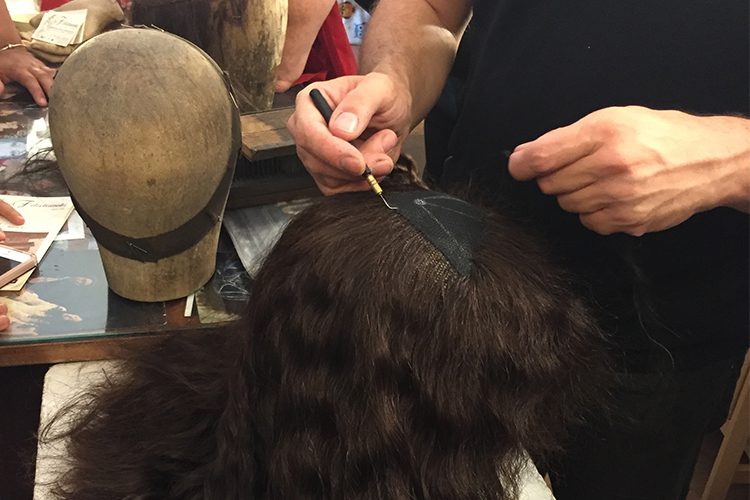
Filistrucchi is a Florentine institution that makes the ordinary, extraordinary. FUA Digital Writing students recently visited the historic theater makeup laboratory and shop.
If you could be anyone, who would you want to be?
If you could swap faces, swap lives, even for only day, who would you choose? A Duke, a Duchess, Abraham Lincoln? Lady GaGa? At Filistrucchi, you can be anyone.
We all have little things about our appearance we’d like to change- smaller nose, thicker hair, higher cheekbones- and Filistrucchi was built on that need. Established in 1720, it catered to Florentine nobles, providing wigs and make up to suit their stylistic needs. It then developed into one of the leading make-up and hair providers to the Opera and stage, and later cinema. Gaining notoriety as masters of their trade, their clients soon spread as far as New York and Boston.
Perusing photos of their work, the shop owners recount stories of how they transformed men into women, women into men, old into young, the transformations often so complete that the clients’ families didn’t even recognize them.
It’s amazing to think that all that stands between you and complete anonymity is a few layers of make up. It seems to me that Filistrucchi has survived three hundred years and two epic floods not because beauty is timeless, but because the desire to look beautiful is.
Alicia Deakin from London discusses how being in Florence has had a first hand impression on her perspective on Art History.
After the first half of the semester here at Florence University of the Arts, the students seem to be settling in nicely to the bustling lifestyle of classes during the week and exploring on the weekends. Sitting down with 21-year-old Alicia Deakin from Suffolk, England we discussed how she has had to adapt to this cultural change and new lifestyle.
With classes taking place Monday through Friday, Deakin said that her art history class is held twice a week.
“I’m happy that the class meets twice a week. Originally I found myself comparing my schedule to other semester students taking once a week classes, but I quickly realized just how much I enjoyed the class,” said Deakin. “I was feeling super lucky to be able explore the city of Florence and take part in the included field learning city activities offered through the class.”
Taking an art history course through FUA, Deakin said how amazing it was to experience this much raw culture within a class. When asked why this class was her favorite, she said how inspiring it was to be amongst some of the most amazing artwork she’d ever seen.
“Offering me new skills that I have not used in sometime, because I had taken a few years off from University, this class provides me an opportunity to study a new topic that both interests me and excites me,” said Deakin.
Noting the high quality education being provided to her through FUA, Deakin said, “the difference in my classes here from in London are so drastic, it is important to see how much the professors want to engage with you as students, while also wanting you to have the best possible experience in Florence.”
Since Deakin has never studied art history prior to coming to Florence, she said her favorite part is the novelty of the class, learning new topics, while also being placed within the Florentine environment. Knowing she is able to see the art firsthand, Deakin is thankful for the opportunity that FUA has provided her, and being here has allowed her to open her cultural perspective.
Offering students an opportunity to receive a strong education, while also an experience of a lifetime, including travel, cultural exchanges, and new opportunities, attending FUA, Deakin says, “is a once in a lifetime experience!”
There is a pressure all study abroad students feel to travel, and travel often. In the months leading up to your departure, you get seemingly hundreds of Facebook invites and messages from travel companies urging you to book trips. Your friends tell you they are jealous of all the countries you will visit, and your older sister will say that traveling during study abroad was the best experience of her entire life.
How do you compete with that? How can you balance classes, getting to know your home city and still travel every weekend? Can you afford the big price tag of traveling from country-to-country seeing the sights?
Studying abroad isn’t about getting the perfect Snapchat story, Instagram post, or foreign fashion. It’s not about impressing your friends back home with how sophisticated and worldly you have become in such a short period of time. It’s about giving yourself the opportunity to explore the world, find yourself, and have a little fun while doing it. The pressure, anxiety, and apprehensiveness that goes along with that are normal. That’s what everyone experiences every day back home. What you have to remember is that this is your experience and your four months to get outside your comfort zone and really enjoy your time here.
So stay home one weekend and try that restaurant you always pass by and smell the goodies in the air. Try that cooking class instead of Skyping home and relaying every moment of your day, instead of actually living in that moment. Give yourself a weekend to be a tourist in your own city, and try to find a favorite spot to write in your journal. And if you do want to travel, do so not because everyone else is doing it. Do it for you.
Personally, I plan on taking advantage of FUA’s optional excursions because of their convenience and quality guides. I will be going on, but not limited to, at least two different trips within Italy: Venice & its Islands, Napoli, Capri and Pompeii, and more. However, I’ve had a lot of fun staying here in Florence for some weekends as well. I love visiting the museums on the first Sunday of every month because all admission is free! I also enjoy bringing a picnic to the Piazzale Michaelangelo to enjoy with the view. Figure out your favorite spot in Florence, and tag #MyFUA to let us know how much you love just being here in the city!
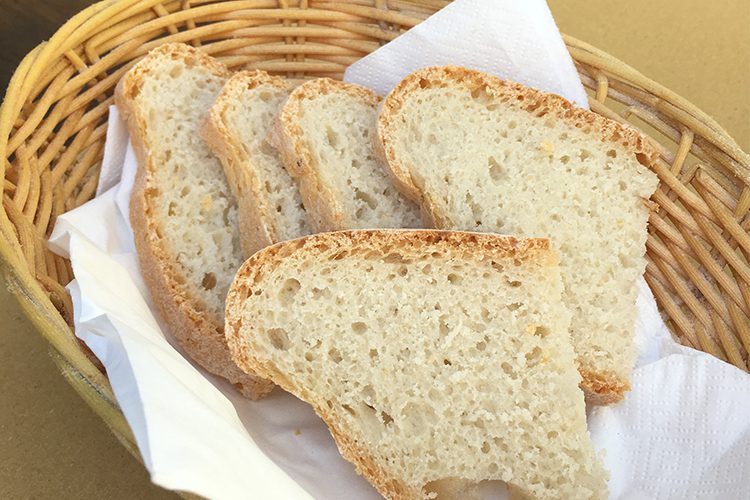
On my first day in Florence, I sat down at a restaurant in the shadow of the Duomo hungry from my flight. I had unpacked and was looking forward to food like a dog looks forward to playing fetch. So when I was brought the bread basket, I devoured each piece and noticed something strange. It was hearty but extremely bland and tasteless. I realized there was no salt! Salt, a seemingly essential ingredient, wasn’t in my first taste of Italian food whatsoever. I didn’t know at the time you should wait to mop up your meal with the bread, an Italian custom I had forgotten in my desperation to get food in my belly. So, after realizing this, I had to find out why the bread was saltless and sciapo (Italian for “bland”).
Chef Pietro Di Marco says the legends of saltless bread vary, and that if asked, every Florentine will give you a different story as to how it happened. A chef his whole life, teaching at Apicius since January, I trust his version of the salt-legend:
Throughout the centuries, the legends have been told. Nothing is on paper, but we all know about the bad blood between (the city of) Pisa and Florence. Pisa, long ago, was the only Tuscan city with access to the sea. Therefore, they were responsible for the distribution, packaging, and taxation of salt for Florence. Florence didn’t want to pay to bake their bread, plus the rivalry and battles between them didn’t help the situation. From there, the evolution of Florentine cuisine began.
The most common dishes involving Tuscan bread (pane toscano), and the most important dishes according to Chef Di Marco, are pappa al pomodoro and ribollita. Pappa al pomodoro is a bread-based tomato soup with herbs and spices, a rich and filling dish invented by Florentine farmers. Ribollita translated means “twice boiled,” and it is another soup reboiled with vegetables (like local white and black cabbage) and poured over bread. Chef Di Marco says it is easy to tell when dishes are made with old-school recipes or new-school recipes: the thickness of the soup, and the ingredients like olive oil, give it away. He says that every chef in Florence knows how to make these dishes, and that without them Florentine cuisine wouldn’t be Florentine cuisine.
Pane toscano can be made in about three hours time and takes a while to rise. This ensures its freshness for days, lasting longer than most bread you get at the supermarket. Its origin is from the province of Lucca, in the town of Altopascio, which still claims its fame to the crunchiest crust and the softest insides of all bread in Italy.
To learn about Tuscan bread, stop by Apicius, the hospitality department at FUA, and get a taste of it where it’s served daily at Ganzo, the Apicius restaurant. And while having a breakfast pastry or dessert at Fedora, the Apicius pastry shop, ask the baking experts there for tips and tidbits about it!
Italy isn’t all about the carbs; fruits and vegetables play a huge role in Italian cuisine. Here’s everything you need to know this fall about the best fruits and veggies in Florence. Check out the best markets, what produce is in-season, and vegetarian-friendly restaurants and recipes!
The high-carbohydrate diet many associate with Italian cuisine is a falsehood: Italians may eat carbs, but their lifestyle, portions, and eating habits are much healthier. That’s why when the New York Times reports on Italian eating habits, the focus is not on how to eat a low-carb diet while traveling, but rather why Italians are some of the healthiest people in the world. Fruits and vegetables, though filled with those ‘nasty’ carbs, are absolutely essential not only to a healthy diet, but also to Italian cuisine. That’s why including some apples, asparagus or zucchini in your basket while on your daily market trip is important to the Italian experience.
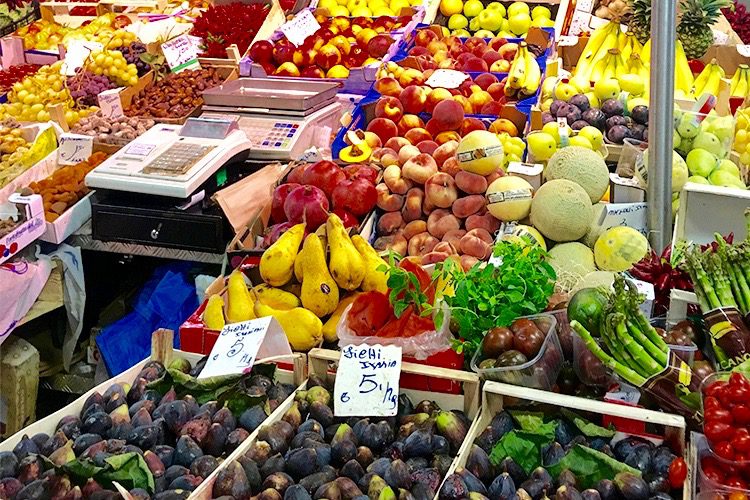
If you haven’t been to an Italian local market yet, give yourself an afternoon to go and explore one of the best parts of living in Florence. There are more than four big Florentine markets, not including the San Lorenzo Market, that you should visit to get the best, and freshest, produce (and even some clothing, music, plants and pastry too!)
However, before going to the market, know what fruits and vegetables are in season. Check out this chart to see that apples, blueberries, grapes, tomatoes, green beans, and cucumbers are just some of the fruits and vegetables that are at their best in September.
Want to visit some renowned vegetarian restaurants in Florence? Try Le Fate on Via S. Zanobi, for it’s fully vegan and vegetarian menu inspired by the signs of the zodiac and recommended by Travel + Leisure Magazine. Dolce Vegan and Il Vegetariano both have extensive vegetarian and vegan options as well, both a less than 10 minute walk from one another in the center of Florence. Still want more options? Silvana Vegan is an additional option, on Via dei Neri near the Galileo Museum.
If you don’t want to eat out, FUA Professor Cecilia Ricci, who often teaches food and culture courses, swears by this traditional Italian recipe for fruits and vegetables:
Cold Barley Salad, with Shrimp, Anchovy Fillets, and Cherry Tomatoes
Ingredients:
300 g Pearl barley
200 g Shelled shrimp
15 g Extra-Virgin olive oil
150 g Cherry tomatoes
3-4 leaves of basil, cut in julienne
Black pepper
Salt
8 Anchovies fillets, preserved under oil
Directions:
Boil the barley in a pot with 1.5lt of water with salt. Once the barley is cooked, strain it and place it to cool down in a bowl. In the meantime, wash and dice the cherry tomatoes. In a casserole pan add the extra-virgin olive oil, heat it at medium temperature, and let the anchovies fillet to melt. Once the anchovies are ready add the shrimp and sauté them in the oil for 2-3 minutes. Add the barley in the casserole, stir and mix all the ingredients together for 5 more minutes. Then, remove all the ingredients from the pan and place them in a bowl, add the diced cherry tomatoes, basil, pepper, salt, and mix. Refrigerate for at least 30-45 minutes before to serve. And enjoy!
After buying your fruits and vegetables, make sure you pay attention to how long they keep. Basically, how long the fruits veggies last is based on where they are from. If they are fresh from the market, your fruits and vegetables can last 3-4 days without rotting or refrigeration. If they are from the supermarket, the produce can go bad within a day or two because it has been refrigerated and prevented from becoming ripe. That way, as soon as they leave the supermarket your fruits and veggies can become ripe faster and ultimately rot faster. Buying fresh produce from the local market is a better way to ensure it will last (and it will taste better too!)
Click here for a guide to eating out in Florence, provided by FUA’s hospitality department.
For us, it was a fun race, but for others, it was an event they had waited for all year. From the moment we stepped off the bus in Siena, we learned what the Il Palio means to the city.
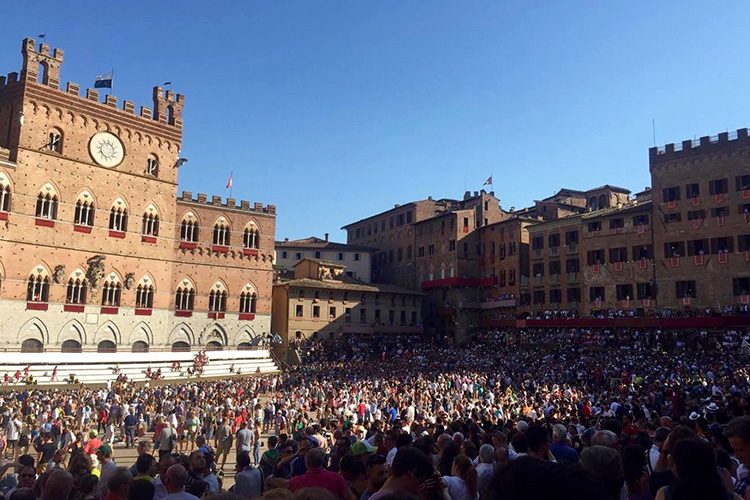
Il Palio is horse race held twice a year in the heart of Siena. Piazza del Campo, the city’s main piazza, transforms into a race track. Dirt is packed down on the cobblestone, and fences are built to create the course. The city is divided into 17 districts (contrade) but only ten districts will compete in the race. The jockeys ride bareback and wear their district’s colors. Throughout the day parades and celebrations take place to prepare for the race. The horses are blessed, the bets are made and everyone gathers to the center for the race to start.
The race isn’t about coming in first but about beating your rival. Everywhere you look you see people with colorful flags tied around their necks, cheering for their district. To truly embrace the race, I picked the Tartuca district to cheer for and wore a yellow and blue flag embellished with a turtle, the district’s symbol.
As thousands trickled into the city center, anticipation slowly built up. The race was three simple laps around the track. Months have gone by in anticipation for those three laps.
Above the crowd I could see the brightly colored jockeys ready to race. Decked in black and white, yellow and red, or blue and white with distinguishing patterns, they all sat on their horses pacing for the start. The rules of the Il Palio involve a complicated tradition for starting the race, so it could start at any moment.
Twenty minutes passed, a shotgun was fire and the race had begun. We could feel a gust of air as the horses passed us. We felt the dirt kicked up from the horses’ hooves. We watched as the horses circled the track and competed to finish first.
When the first horse from the Lupa contrada crossed the finish line, the entire town erupted into emotion. The district hadn’t won a Palio since 1989 so emotions ran high. Immediately people were jumping over fences to congratulate the winning jockey and hug their friends and families. Tears of joy ran down some faces, while others cried with disappointment. Tensions broke out, people hugged and the race was over. People paraded down streets in celebration, while our group stood in amazement. The race itself was incredible, but the aftermath left us in shock. This wasn’t a silly race, but a long-lasting tradition built up over centuries. People took pride in their district and celebrated their culture.
The race itself was short but the day was long. Seeing firsthand a tradition that dates back to the 14th century isn’t an opportunity I come across often. On one hand, it was amazing getting to be a part of the tradition. But on the other, I still felt like an outsider. I had no investments in the race, but felt the heart rise as the horses cross the finish line. At the start of the day, the Il Palio felt so foreign to me, but by the end, I had grasped a better understanding of a city and its culture.
With clamped eyelids and the flicker of a burning candle, I contemplated my wish. As my life’s dream reemerged back into my conscious thought, my eyes flicked open, I peeked at the wax “10” in front of me, and I blew. Underneath, in place of a conventional birthday cake, lay a cannoli; I looked up from the red checkerboard table and saw my cheering family under the light of the Macaroni Grill sign. My wish was to travel; little did I know that I would be enjoying an authentic Italian meal in Florence only 10 years later.
Growing up, I had always loved food. I sat at dinner tables scooping mussels from shells and openly trying international cuisine. To this day, I actively search for new flavor combinations and cooking techniques. Despite my culinary openness, my perception of Italian cooking has changed dramatically since my arrival in Florence. I grew up with the mac and cheese, breadsticks, and spaghetti of Italian restaurant chains back home; and despite trying my hand in Italian home cooking, I really didn’t know what the “real thing” entailed. For me, I was coming to the land of bread, cheese, and pasta; and I was 100% fine with that.
Upon arrival, I aimlessly wandered Florence’s winding streets as I gripped my list of recommended panino and aperitivo places. After tasting some of Italy’s fresh pasta and coming to the harsh realization that meatballs are not an actual thing here, I realized how skewed my perception on this lifestyle was. My day to day life in town surprisingly never included the bread or pasta-induced food comas of the “Italian” food that I was accustomed to, and instead, I felt physically and mentally satisfied with what I was putting into my body. In fact, although the study abroad 15 has proved an irritating reality, I have never felt as good about the food I was consuming.
After a few weeks, once the initial excitement died down, I started to eat in more. Whether at the farmer’s market or grocery store, I slowly began appreciating the seasonality and freshness of what I was consuming. Although eating in does not seem like the optimal way to seize the day while abroad, learning to utilize fresh, regional ingredients in simple recipes gave me a deeper appreciation for the food I was eating and for Italian culture. My roommates and I have made everything from roasted vegetables to pork chops to shrimp with lemon asparagus; and the simple act of learning to work with seasonal, simple ingredients has shown me more about Italian culture than I would have ever expected.
Looking back, my experience with food while abroad and my deeper appreciation for what I eat has mirrored my sense of appreciation for all aspects of culture. Like expanding my knowledge on the slow food movement, biodynamic farming, and the third wave coffee movement through conversations with locals, I have learned to step out of my comfort zone and challenge my perception of Italy, travelling, and on life in general. This experience has opened my eyes to finding value and culture in the tiniest of details; whether it be a tablespoon of olive oil, my daily walk past the Santa Croce, or a genuine conversation with friends from around the world. Above all else, studying abroad has taught me to openly seek out culture in every aspect of living, and it is something I cannot wait to apply beyond the walls of the city I now call my home.
Left, San Miniato al Monte; Right, gelato from La Carraia with a beautiful view. Photos by author.
By Emma Vogel
Contrary to popular belief, not everything worth seeing in Florence is on the north side of the Arno river. Here are some of the hidden gems I’ve discovered living beyond the river, or as the locals call it, the “Oltrarno” or in an even further colloquial way, “Diladdarno.”
I was confused the first day I arrived at my apartment in Florence. Where was the Duomo? The Ponte Vecchio? The statue of David? Okay, I wasn’t quite so naive as to expect all of those Florentine staples right outside of my apartment door, but I knew I was in a different part of Florence than I had seen when searching Google Images. It took me only a few minutes of wandering to realize that I lived on the south side of the Arno river, and it took only a few days after that to fall in love with where I live. Sure, what draws most people to Florence is the bustling Piazza della Repubblica, the magnificent Duomo, and the incredibly famous Palazzo Vecchio, but there’s much more to see than what the tourist guides suggest. There’s a whole hidden part of Florence with charming artisan shops, authentic Italian cuisine, and hip cafés filled with locals that you can find by simply crossing one of the many bridges. Here are the best parts of Oltrarno that I’ve discovered so far.
Food
Oltrarno has some of the best restaurants in all of Florence. With a multitude of choices from family-owned restaurants to trendy eateries, I find a new favorite restaurant every day. So far my top picks include: GustaPizza (not surprising as it is loved by abroad students, tourists, and locals alike), Osteria Santo Spirito (great sit-down spot), Club Paradiso (owned by an Italian couple, the wife cooks the food, the husband is the waiter, and the menu changes everyday!) As for gelato, Gelateria Carraia never disappoints and has been a local favorite for years (a wide variety of flavors and generous portions.)
Pro Tip: You can compare southern Italian pizza styles in the neighborhod. After GustaPizza, check out O’ Munaciello and Da Gherardo (don’t let the plain website fool you, the place is tiny but packs a punch!).
Santo Spirito: A Place to See
Crossing the Ponte Vecchio into Oltrarno brings you to the center of the most authentic artisan shops in Florence. Walking down Via Romana, you pass stores selling handmade leather shoes, fresh pasta and olive oil, and art galleries. Past the artisan shops you can find Santo Spirito, arguably the hippest neighborhood in Florence. Piazza Santo Spirito is filled with cute cafes and trendy restaurants known for apertivo and, of course, the famous Basilica di Santo Spirito. The square has a daily market open until 2 p.m. where you can find fresh produce sold by neighborhood locals. A short hike from there brings you to the breathtaking Piazzale Michelangelo where you have a view of the entire city. A little farther up the hill you can find San Miniato al Monte, one of the most beautiful and unique churches in Florence.
Pro Tip: Santo Spirito is the iconic square of the Oltrarno area. Also try exploring the tiny Piazza della Passera for funky restaurants and great gelato. Piazza del Carmine (also home to the Brancacci Chapel) and Piazza Tasso are also interesting squares with a great local vibe.
Although Florence’s most famous monuments are undeniably amazing, it’s more than worth it to escape the crowds of tourists to explore the hidden beauty and authenticity that is Oltrarno.
Welcome to the beautiful, bustling center of the Italian Renaissance. Upon arrival, your bags will be full, your feet tired, your stomach empty, and your mind racing. To ease the initial shock, here is an essential survival guide to help you through your first few days in this incredible city.
1 – Get to know your apartment
When you first walk into your new apartment, you’ll probably feel a mix of emotions. One of these will be excitement, but another one might hit you: confusion. Apartment living may be a little different than what you’re used to at home. Italians value conserving electricity, water, and heat. Turning on too many electrical appliances at the same time can result in a power surge. Don’t expect to take long showers because the hot water will run out. Remember to space out showers between roommates to conserve the hot water and turn off lights when you leave a room. Be environmentally friendly!
Electrical outlets are also different, and it’s very important to use the correct converter/adapter to avoid damaging your devices. Ladies, don’t use your electrical hair tools unless they’re dual wattage and compatible with Italian outlets.
Appliances like ovens, stovetops, and washing machines work differently than what most study abroad students use at home. Carefully read your apartment manual to figure out how the appliances work in your individual apartment. If you find that they aren’t working, don’t panic! Simply visit your MyFUA account and fill out a Housing Troubleshooting form to have the issue resolved in a timely manner.
Pro Tip: Scope out if your sleeping area is facing an internal or external part of the building. Like in any city in the world, facing street-side can get noisy at times, consider whether you may need earplugs or not.
2 – Get to know your area
At first, living in Florence might seem overwhelming. Don’t worry. It’s normal. You’ll be surprised at how quickly it is to get around the city. Begin to walk around the area near your apartment to familiarize yourself with the markets, cafes, and restaurants. You never know, there may be an awesome panini joint right under your apartment.
Take photos of different landmarks for reference when you need help remembering how to get somewhere. Pay attention to your surroundings! Think: how far away is this place from a main square or easily recognizable landmark? Organize a walking tour with roommates or newfound friends. Find the best routes from your apartment and your classes, and it’s also a great way to get to know the city! Knowing where you can grab a quick bite or grab groceries will help Florence feel like home.
Once you become more acquainted with the city, it’s time to find your favorite study spot in addition to the quiet study areas at the FUA Main Library. Head over to the bookstore La Feltrinelli in Piazza Repubblica. You can grab a quick bite to eat from the cafe to enjoy while completing your weekly assignments. There’s also a large selection of books. It’s open all week 9:30am-11pm. If you need a quieter place to do your work, Oblate Library is located near FUA’s J School. Take a study break and head to the top floor where you can find an aperitivo buffet. Peek out the window, and you’ll see a great view of the Duomo! It’s open Monday 2-10pm and Tuesday through Thursday 9-12am. In addition, make sure to explore Florence’s wide array of coffee shops, book stores, and other nooks to find your perfect study area for the upcoming semester.
Pro Tip: Don’t forget to take a picture or carry around a physical copy of your updated registration to avoid walking into the wrong class.
3 – Get to know FUA’s Facilities
Florence’s bustling, crowded piazzas and countless street corners can make anyone feel bewildered upon stepping on this giant historical landmark. One of the most effective and easiest ways to get to know the city lies alongside many of your classes. The Student Life office in Corso Tintori offers events, tours, trips, and free campus facility services. Attending events like the Welcome Reception, walking tours, weekend trips, or free gym classes, can open up possibilities to meet the faculty and staff as well as some fellow study abroad students. After a long day, grab a pastry or some aperitivos at the campus pastry spot, Fedora, or FUA’s student restaurant, Ganzo.
Pro Tip: Exercising at FUA’s gym will not only give you the most for your money, but it can be a great stress reliever for the hectic first week. Also, attending a free class can be a fun, social way to burn off last night’s third scoop of Gelato.
4 – Get to know Italian dining/social culture
In your first few days in living in Florence, you will probably realize that there are some serious culture differences, especially around food. Italians generally sit down for dinner around 8:30 or 9. If they eat out, it is not generally for convenience, but rather as a treat not to be rushed through. A good Italian waiter will never rush a customer, so it will be your responsibility to ask for the check. Here, dining establishments can generally be categorized by three types: Osteria, Trattoria, and Ristorante. An Osteria is a less formal way of eating out with food served at shared tables. A Trattoria serves as the second “level” of Italian dining. These serve inexpensive, regional home cooking. A Ristorante tends to be a little more formal and expensive of the three. But always do a double check if possible, as the names and price ranges nowadays are interchangeable.
Other types of establishments include the Pizzeria, Bar, and places for Aperitivo. We can conclude that pizzerias serve pizza, and they might serve other food as well. The best usually have an actual wood burning oven. Pizzas in Italy are generally individual dishes rather than family style. A Bar in Italy is a cafe, a place for people to grab a quick espresso and a small sandwich or pastry. Aperitivo is usually a pre-meal beverage served with snacks and appetizers, and the popular buffet-style has become a quick, informal way to enjoy dinner and wine with friends. Keep in mind that wine with a meal is an Italian social activity, but excessive drinking is not.
One last note is that tipping in Italy is not a common practice. Waiters and retail employees earn a regular salary as opposed to working for tips, so a required service charge and possibly rounding up a euro or two will more than suffice. This being said, if your service is exceptional; for example if they make you laugh, cry of happiness, or if they pull out their best magic tricks/acrobatic techniques, then by all means tip as you see fit.
Pro Tip: If you want to find a local Italian restaurant, stray away from the main squares and keep your ears open; if the customers speak Italian, it’s a good sign that the experience will be more authentic.
5 – Get to know some Italian
Learning some Italian phrases will not only help you communicate with the locals, but it will also help you better assimilate into the Italian culture. Don’t be afraid of pronouncing things wrong. The locals will appreciate your effort! Practicing each day will improve your skills.
Hello Ciao/Salve (formal)
Good morning Buongiorno
Good afternoon Buonasera
Good night Buonanotte
Good bye Ciao/Arrivederci (formal)
Please Per favore
You’re welcome Prego
How are you? Come stai/Come sta? (formal)
I’m fine Sto bene
Excuse me Mi Scusi
I’m sorry Mi dispiace
I don’t understand Non capisco
How much is it? Quanto costa?
Pro Tip: Check out your Student Manual for other helpful phrases. Download a translation App to your phone when you need help reading a menu or communicating with someone. Or, keep a small notebook to jot down other commonly used words.
Soak up the rich history, enjoy authentic cuisine, and admire the amazing views. Living in a new place might feel scary at first, but Florence will start to feel like home sooner than you expect.
Studying abroad in a whole different country is one of the most exciting experiences you will ever have. For those still in college, we are on pretty tight budgets and money can fly out of our pockets if we’re not careful. Specifically in Florence, there are so many new things to discover such as the extraordinary cuisine, beautiful architecture, the multitude of museums, world-famous and niche fashion brands, and many more. So how can you fully enjoy the experience without breaking the bank?
Here are some helpful tips that I have made and followed throughout my semester abroad:
1. Understand the currency exchange rates. It is helpful to know how much your country’s currency is worth compared to the European Euro. Exchange rates can always be changing so it’s important to keep a look out.
2. Talk to your bank. Don’t forget to let your bank know that you are studying abroad. Most banks will shut down your debit/credit card if they notice that you are spending money in a different country. Also, speak to them about international fees when withdrawing money and if they recommend certain ATMs that correspond to yours at home.
3. Create a general budget. Take a look at your bank account and decide how much money you are willing to spend total during your term(s) abroad. This number can range from high to low, it all depends on how comfortable you feel about spending while abroad.
4. Segment your budget into categories. Once you’ve calculated your general budget, decide how you want to spend your money in regards to eating, activities, shopping/gifts, travel, etc. The allotted figures will vary depending on your personal interests and how they evolve during your time abroad. I personally decided to spend more money on food and activities rather than souvenirs. It’s up to you but it’s important to take the time to reflect prior!
5. Stick to your budget. Don’t just buy something because it’s there. Spend your money on the most important items/activities you want. It may seem challenging, but it will be worth it in the end so you don’t break your bank!