A Magical Holiday Season at the Santa Croce Market

written by Makayla Sims

Just in time for winter, Florence’s holiday markets have been set up across the city. Here, residents and tourists alike can see the accumulation of different cultures, foods, crafts, and cheers within these stalls. The Santa Croce market takes place in the square of the Basilica di Santa Croce, with German-style stalls selling all different types of things.

The first place I make a quick pit stop at is this stall shown in the image below, where they sell little ceramic pieces. Here I take a look at the small houses and mushrooms that people often put in their garden, however, that’s not what I’m most excited about. Rather, I take a look at the bells that they are selling. Each one is engraved and painted with different patterns. I don’t know if they’re meant to be, but I know that my mom would love one of these to put on her Christmas tree. We have a long-standing tradition of collecting ornaments from every place we travel to, and since this is my first time away from home for the holidays, I want her to know that I am thinking of her. 

After I pay the vendor and leave the stall, a drink hub with three steaming pots catches my eye. I walked over there expecting hot chocolate but was instead introduced to an Italian holiday staple, mulled wine. I decided to buy a cup. One, because it’s freezing, and two, because it smells really good. This is my first time buying this drink, and when I take a sip I can understand its popularity. It is mildly fruity and mildly sweet, but the taste of the wine is still there. By the time I finish my cup, I’m warmed, the sweetness of the wine and temperature working in tandem.

Afterward, I make my rounds through the remaining stalls. There is this stall that sells the most beautiful paper lanterns, but they only take cash and I don’t have any on me. After some looking, I decided to head home for the day and revisit this market later in the day. 

As I’m leaving though I’m stopped by the muffled sound of a beautiful strong voice filling the air.  I removed the headphones I had been wearing, which had Christmas music blasting, and was greeted by an opera singer.  She isn’t wearing anything fancy,  just a winter coat and curly hair,  but she sings like no other person I’ve heard before. It’s gorgeous. 

Later, I came back with my friend and we decided to window shop some more. She ends up getting a bratwurst and I go with the trusted potato spiral that I often get at my hometown’s local fair. They aren’t the same thing, that’s for sure. But, the taste of fried potatoes on a stick reminds me of home and how I’m leaving soon. I also end up getting a cream puff; one about the size of my fist and it is absolutely delectable. When we sit down to eat our food on the wooden benches they have supplied, she and I are separated by an accordion and trumpet player, who goes up to some customers asking for spare change. As I near the end of my residency here in Florence, I think I’m starting to realize that that’s what I’m going to miss most about Florence. The music.
The Magic of the Florentine Neighborhoods

written by Ashley Rodio for SPEL: Journalism

Neighborhoods. Something both Denver, my home city, and Florence are all composed of, yet have such different meanings. In Denver, a neighborhood is just where you live. Maybe you are attached to a certain local food joint or park. But in Florence, a neighborhood is where you live. There is an intense sense of pride that comes with the neighborhood you live in as a Florentine, and it’s apparent in every aspect of life. They have personalities, different charms and offerings to locals and tourists alike. 

Santa Croce 

I live in the Santa Croce neighborhood. It’s my beating heart of Florence, and I can feel the pulse in everything. Below my apartment lays a square of restaurants, vibrant as ever but only at night; it waits to come alive. I hear words in every language, see people of every decent, and smell the vast arrays of cuisine on display. Here lies the Santa Croce Basilica, where I pass on my way to class everyday. I have seen proposals, polo matches, and every celebration under the sun. I sit on the stoop with the painter who lives next door to my apartment. We sip cappuccinos and pet the dogs that trot by, and he tells me about his life in Yugoslavia. 

Santo Spirito 

I could never write enough about the Santo Spirito neighborhood, the area I frequently brave the cross-river trek to enjoy. My favorite tradition, Sundays in front of the Basilica di Santo Spirito, stems from this neighborhood. At the Sunday market I meet the Florentine vendors. I hear the stories of the lavender man, with fields long spanning the Tuscan countryside. He shows me the lavender soap covers his wife spends hours making. She couldn’t make the trip to the city. The Santo Spirito neighborhood holds the esteemed Pitti Palace, the Boboli gardens sprawling along the rear. I leave this place with a sore neck for days, as I can’t tear my gaze away from the intricate ceiling artworks in the Palace. 

Santa Maria Novella 

The neighborhood that first greeted me when I stepped out of the train station: Santa Maria Novella. My first introduction to the city I have been calling my newfound home. It stretches beyond the Arno River’s right bank, fitting, as the neighborhood flows with art and culture. Florence’s main exhibition center lies here, forming the Palazzo dei Congressi, the Palazzo degli Affari and the Fortezza da Basso. In front of the Basilica of Santa Maria Novella, the keeper of medieval renaissance art, I sit on the curb and sipped cappuccinos. I watch locals and tourists alike flit by. A new perfume aroma fills the air, presumably from the perfumery. Here, I feel peace.

San Giovanni 

The San Giovanni neighborhood, the real beating heart of Florence. The neighborhood with, arguably, the most tourists. This isn’t a bad thing. I watch people who have spent their entire lives saving to experience the Cathedral of Santa Maria del Fiore, mouths agape as they take it all in. The marble of the cathedral gleams as I pass by. I can never take enough pictures. I hear children laugh as they go round and round on the carousel in the historic Piazza della Repubblica. At night it comes alive, with music filling my ears and lights lining the streets. 

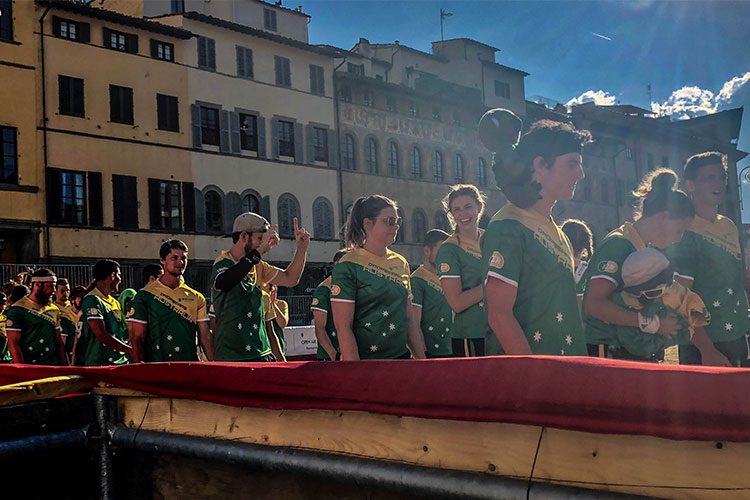
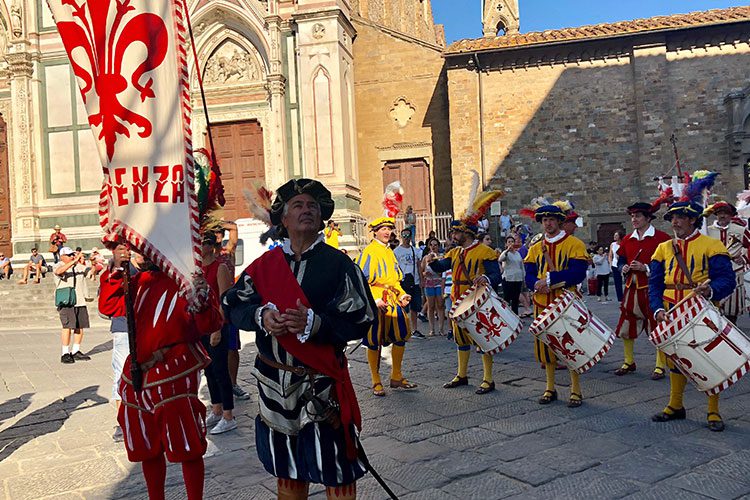
The first time I really understood the neighborhood pride of Florence was during Calcio Storico, the classic Florentine sport. While violent, the game brings local comradery to light, displaying long fostered honor to the tourists. The parade, held before the first Calcio Storico game, marched through the piazza while I was on my way home. I remember being frozen, so intrigued by the chants, the Italians dressed in their neighborhood colors. Reds, blues, purples flash by, people from the streets joining in. Flags waved, and young children ran alongside their parents, gleaming at who they might one day become. It was incredible. Although I am an American, I was so proud of these people and what they were standing for. It was more than just a game, it was family ties. 

I may have only lived in Italy for a couple of months, but the importance of the Florentine neighborhoods has become increasingly prominent to me. This pride, these charms, are irreplaceable, and I’m so lucky to have experienced a piece of each location.

Quidditch in Florence?

By Guneet Singh
All photos by author

Journalism student Guneet Singh explores her childhood in Florence.

When I chose Florence as my study abroad location, I knew it was a city that would give me a lot of experiences. But one experience I didn’t expect was being able to attend the opening ceremony of the Quidditch World Cup.

Yes, you read that right.

Quidditch, the fictional sport J.K. Rowling created in the Harry Potter series, is a real-life sport that was invented in 2005.

A Potterhead through and through, I couldn’t believe my luck when I found out the event was happening here! I’ve read all the Harry Potter books and as a child, Quidditch was the main sport I really understood.

The opening parade itself was a five minute walk from Corso Tintori, one of FUA’s main buildings. I got there early and saw dozens of people in red shirts with the words “International Quidditch Association” sprawled across the back.

This is real.

A couple hundred spectators circled the stadium. I didn’t have a ticket but was standing in the right place at the right time and got in to see the ceremony! I was at the front of a crowd spread out across the sides of the dirt field. Eager fans ranged from toddlers to frantic young adults to those a little older and just curious about what the commotion was about.

Music started and teams entered the stadium slowly. I saw teams from countries all over the world, like New Zealand, Australia and the United States of America. There was a myriad of female players, which only serves as a testament to the diversity and acceptance the Harry Potter series preaches.

It was incredible to see an event like this bring so many people together and it was the best way to kick off my first week in Florence!

The Quidditch World Cup will be happening in Florence until July 2nd.

See more of Florence and Italy at FUA’s FBInstagram, and Twitter.

Via dei Malcontenti

Tabarnacle on Via dei Malcontenti

By Molli A. Browne
All photos by the author

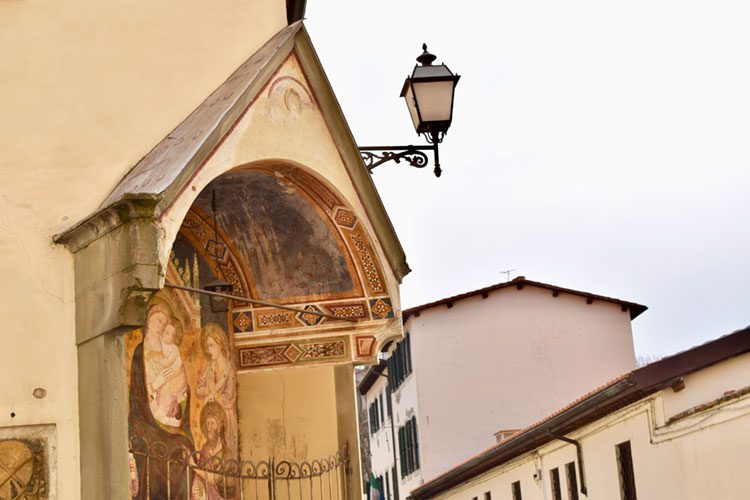
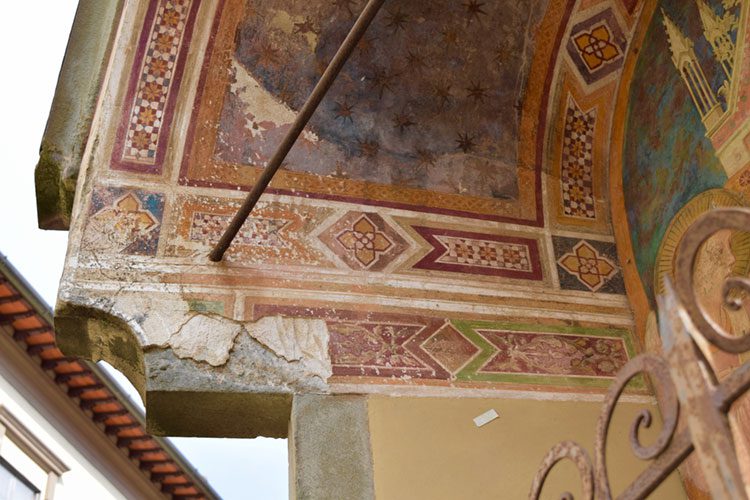
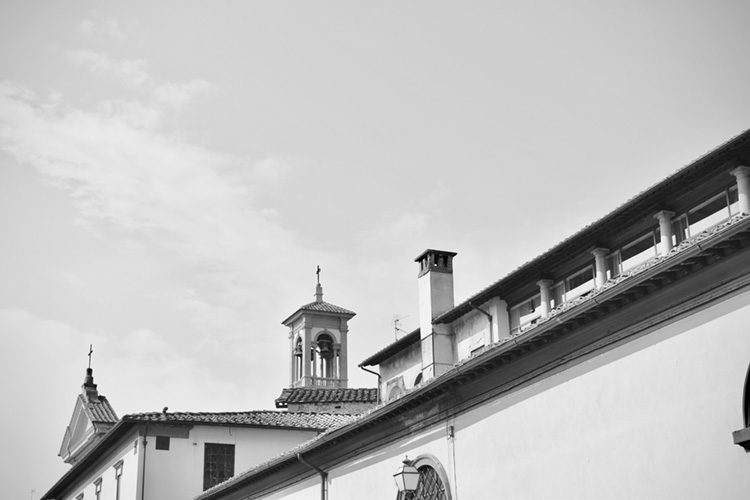
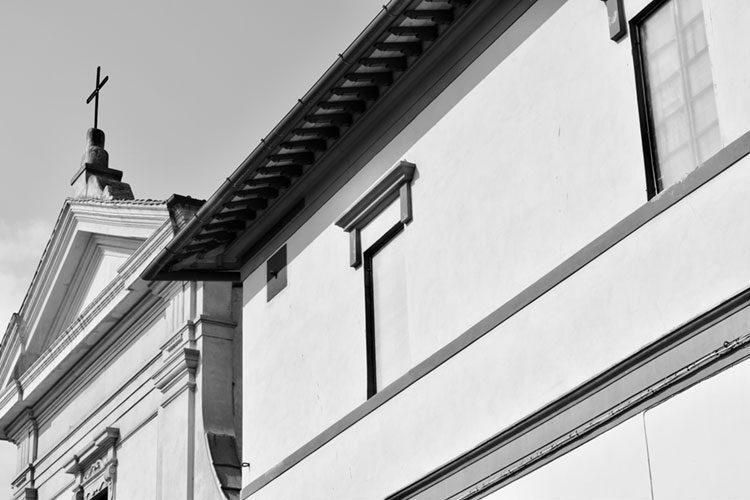
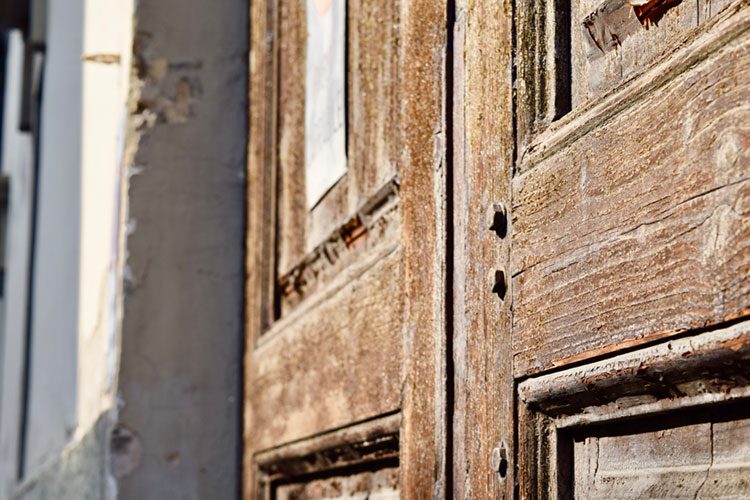
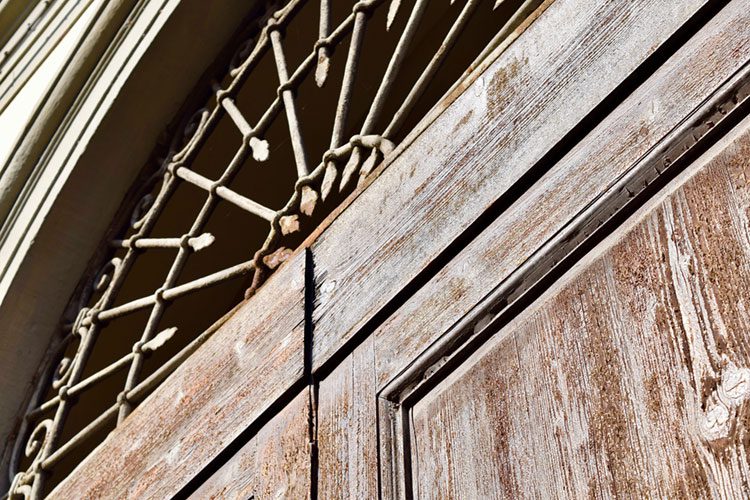
Via dei Malcontenti is the street the Florentine prisoners would walk down before being excecuted. Via dei Malcontenti connects Via delle Casine to Piazza Piave. Today, the street consists of apartments, a church, and a school. During the day, the road is quiet and calming. The following set of images are what a prisoner would have seen walking down Via dei Malcontenti before the execution. 

Photography student Molli A. Browne imagines the final moments of a prisoner walking down Via dei Malcontenti.

My time has come.

My darkest day…

I pray for forgiveness, I pray for my sins.

My last chance.

Gone.

See more of Florence and Italy at FUA’s FB, Instagram, and Twitter.

The Pazzi Chapel: Venturing into Santa Croce

Photo by the author

By Shelby Olson

If you venture further into the Santa Croce complex, you will come across many other monuments that hold much significance to early Florentine history such as the Pazzi Chapel. 

When staying in Florence, Santa Croce is a highly recommend spot to visit because it is beautiful but also has fascinating history behind it such as the tombs of the famous. When you enter Santa Croce, the first thing you see is a large church filled with sculptures, paintings, and stained glass windows that light up the room. When you head out of the church, you are met by a large garden and a series of cloisters. If you walk across the garden, this is where you will find the Pazzi Chapel which is not something to miss out on when visiting Santa Croce.

The Pazzi Chapel was commissioned by Andrea Pazzi and built by Filippo Brunelleschi. It was built to show the legacy of the Pazzi’s power and patronage, as well as to show off their wealth and status to the Medici family. Originally, the chapel was a learning area for the monks but also a burial place for the family.

The chapel is a very important project of Filippo Brunelleschi because it was built according to a specific architectural harmony, and he was able to achieve this after studying and measuring ancient buildings in Rome such as the Pantheon. The chapel was commissioned in 1429 and it was opened in 1443, during this time Brunelleschi had passed away and was not able to finish the chapel on his own. There were also many stops in construction throughout the years due to funding as well as conspiracies the Pazzi family made on the Medici family. In 1478, Giuliano de’Medici was killed and Lorenzo de’Medici wounded while attending mass at the Florence Cathedral. Needless to say, the family’s position swiftly fell after the attempted coup to topple the Medici.

Although Filippo Brunelleschi was not able to finish the chapel, he holds much significance within it because of his perspective and ingenuity. Brunelleschi’s works are not limited to the Pazzi Chapel as he had worked on the Florence Cathedral of Santa Maria del Fiore and its famed Dome, the Basilica di San Lorenzo, the Ospedale degli Innocenti and much more. Filippo Brunelleschi is buried inside the Florence Cathedral and continues to be an important part of the city’s history.

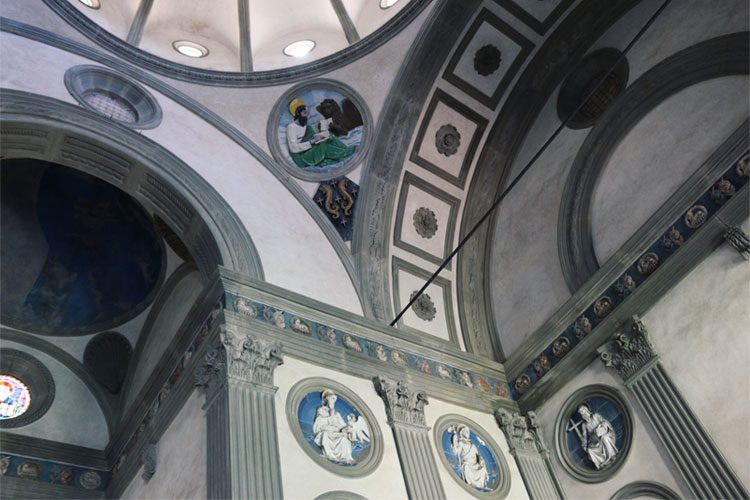
Inside the chapel, there are many beautiful works of art created by different Florentine artists. The relief, a raised sculpture representing Saint Andrew, was created by Luca della Robbia. Della Robbia also created the rounds with the apostles and decorated the central dome with sculptures and two paired dolphins. The stained glass window representing the figure of Saint Andrews was drawn by Alesso Baldovinetti.

The Pazzi Chapel is a simple yet elegant chapel. Although the interior colors are dim, the stained glass windows and colors of the paintings light up the room. Not only is the chapel full of history that dates back centuries, but it is a beautiful work of art and architecture that is worth seeing when visiting Santa Croce.

How to Visit:

Basilica di Santa Croce, Piazza S. Croce, 16, 50122 Firenze
Monday-Saturday 9:30AM to 5PM
Sunday 2PM to 5PM
Tickets: €8