Finding A Home In Florence

written by Brooke Beste for SPEL: Public Relations

Living abroad isn’t always picture-perfect. Through culture shock, homesickness, and self-discovery, I’ve learned that finding “home” in Florence takes time, patience, and an open heart. This is my journey.

I have currently been away from home for 13 weeks… not that I’m counting. While being away and immersing myself in a new culture, I’ve discovered that I value energy and the overall ambiance of my environment. I love to observe and analyze culture, food, individual attitudes, and especially fashion. Over time, I’ve found my favorite places—and a few dislikes—within Florence. I’ve explored other countries and experienced different ways of life, but I’ve come to a solid conclusion: the way Italians live is unlike anywhere else I’ve visited. 

While Florence is often portrayed through the lens of grand cathedrals and iconic artwork, I’ve learned that the real soul of the city is found in its quiet corners, local rituals, and everyday encounters. As a student living and studying here, I’ve discovered that capturing these moments through photography offers a more intimate and authentic narrative of Florence—one that goes far beyond the postcard image. 

At first, the locals gave me a hard time. From graffiti that read “Yankee Go Home” to the frustration of not understanding the Italian language, I genuinely felt like an outsider during those first few weeks. However, that all began to change once I started school. I suddenly had a

community of individuals around me who wanted to grow and learn just as much as I did. I began to understand the way of life in Italy. 

I started feeling comfortable ordering at restaurants and learning the etiquette of being in Italian society. By week eight, I finally felt like I had a grip on the reality of Florence. I realized the importance of leaving the house looking presentable and enjoying my food inside the restaurant instead of ordering it to go. These small changes made me feel more connected, intentional, and at ease in my new environment. 

Still, being homesick has been a complicated emotion to process. Sometimes it makes me feel guilty. I’m the baby of my family and incredibly close to them—they truly are my best friends. I’ve never been away from them for this long. I miss the simple things: my favorite dark blue suede couch in the living room and Chipotle just down the street. 

But when I sit with these thoughts, I can’t help but smile. How lucky am I to live in the heart of Florence, surrounded by my friends? Within just a few miles, I can be at the train station with endless possibilities. This once-in-a-lifetime opportunity has taught me so much about gratitude—how to thoroughly soak up the Italian sun and appreciate the unique beauty of my life this semester. 

Florence doesn’t offer the same activities my home city of St. Louis once did, and that’s okay. I now walk everywhere, eat pasta shamelessly every day, and leave the house feeling confident in my ability to handle whatever problems the day brings. Florence has shown me how to slow down my overthinking mind. It’s helped me discover where I find happiness and what interests me. It’s allowed me to feel more mature and make decisions supporting my well-being. 

As I approach the end of this study abroad journey, I feel deep appreciation. The excellent professors and advisors I’ve met have shown me how much kindness and intellectual curiosity matter in helping students succeed and stay on the right path. The learning experience of being a twenty-something in Florence has shown me that finding a “home” is more than a physical place to sleep and eat—it’s about the culture, the time, and the personal growth you experience along the way.

Florence has become a part of me. And in its own way, it has become home.
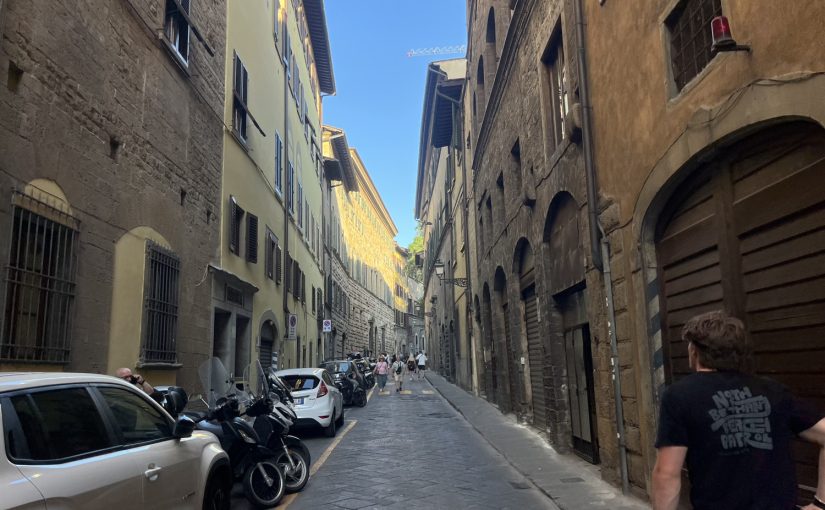
Transportation in Florence: Trading Cars for Cobblestones

written by Ashlyn Roselle

Florence, Italy, widely regarded as the heart of the Renaissance, is a city where the past is not only preserved, but woven into everyday life. The tightly packed cobblestone streets, and historic buildings are unlike the sprawling cities many American students are used to. For those studying abroad, Florence allows cultural immersion, but not without some practical adjustments, especially when it comes to transportation.

Most American cities were designed around the car, Florence however was built centuries ago for pedestrian traffic, carts, and horses. Today, the city’s historic layout remains largely intact, protected by strict preservation laws. The timeless charm that remains in Florence today is beautiful, but creates an unexpected challenge for students abroad. There is a large question mark in everyday life: how do I move through a city that was designed for another era?

Florence’s current layout is rooted in its medieval and Renaissance past. The narrow, winding streets and densely packed buildings are from a city that was never intended for modern day cars. Due to this, much of central Florence is a limited traffic zone (ZTL), where only residents and permitted vehicles are permitted to drive. Public transportation consists of buses and trams, where they travel mostly the outer zones of the city. The inner city is primarily navigated on foot or by bicycle.

For students from the US, where cars are a central part of everyday life, this can be a major shift.

Maddie Oberly, a current FUA student from Connecticut says, “In Connecticut we rely greatly on cars to get us from place to place. However here it was solely on walking and the public transportation systems like the bus.”

The transition can be jarring, but it’s also one of the most rewarding aspects of studying abroad in Florence. Students are able to truly immerse themselves in the city and soak up their surroundings of Renaissance facades and hidden piazzas while strolling to class. The lack of reliance on cars encourages deeper exploration and a more intimate connection to a place.

Another current FUA student, Trace McCament reveals his experience with transportation in Florence thus far. “The amount of walking definitely surprised me, but it’s been super nice to walk around and explore. Before dinner, it’s easy to just stroll around, read menus, and people watch, which is fun.”

Students, like Trace, soon discover that Florence’s compact design works in their favor. Most major landmarks, cafes, apartments, and restaurants are within walkable distance. What initially seems like an inconvenience becomes an unexpected part of the adventure.

Bikes and scooters are immensely popular amongst residents of Florence. There are designated parking zones for both and they are always packed. There are also rentable electric scooters and bikes for tourists, providing modern solutions for longer distances.

The pedestrian-friendly architecture of Florence doesn’t just change how students move, but changes how they live. Walking everywhere promotes physical activity, lowers stress, and encourages spontaneous interactions within the city. The benefits of walking 10,000+ steps per day are incredible, which most individuals struggle to do while in the US if they are not creating intentional time for activity. Many students report feeling healthier, more independent, and more connected to their environment after just a few weeks.

The environmental impact is real. With limited access to cars and a focus on sustainable transport, Florence experiences less traffic, lower air pollution, and an overall more pleasant atmosphere. These conditions create a safer, more accessible environment for students to thrive while abroad.

Studying abroad in Florence offers more than academic credit, it offers a new perspective on urban living. Students gain firsthand insight into how city design influences lifestyle and community. Compared to the wide streets, long commutes, and car dependency of many American cities, Florence demonstrates an older, but highly effective model of urban planning.

That contrast often sparks reflection.

Maddie Oberly admits, “I have honestly loved the exercise aspect of walking and it has been weird to get used to the bus system… but with patience it’s really easy to figure out and utilize in ways that can benefit us as students.”

Adapting to Florence’s pedestrian-focused lifestyle is easier with a few tips:

  1. Plan Ahead – Walking and biking takes time, so build buffer time into your schedule.
  2. Comfort Matters – Invest in a good pair of walking shoes, those 20,000+ step days will sneak up on you!
  3. Learn the Local Routes – Familiarize yourself with your walk to class and apartment for easy navigation.
  4. Embrace the Pace – Allow yourself to slow down and experience the city instead of rushing through it.
  5. Try the Rental Bikes – It’s okay to have a little adventure every now and then, just don’t hit anyone!

Florence’s architecture has preserved history and now shapes modern life. For students abroad, that means adapting to a new way of getting around. It requires you to learn how design and environment influence everything, from mobility to mindset.

By stepping into Florence’s streets, students also step into a bigger conversation about sustainability, community, and how cities can be built around people instead of machines. This is a lesson that reaches far beyond the classroom and one they’ll carry with them long after the semester ends.

From Coffee to Espresso & a Few Other Changes

written by Charlotte Cicero for SPEL Journalism

Ciao, my name is Charlotte Cicero. I’m a junior at the University of Missouri, and I had the privilege of studying abroad at FUA this past spring semester. For the past 15 weeks, I’ve been writing for the website you’re currently reading, and for Blending Magazine.

When I wrote my first blog post in January, I threw a corny title on what was pretty much a journal entry. For this final piece, without a corny title and with more structure and a little more wisdom, I want to reflect on some parts of that original post. So here we go.

“I’ve lived in Florence for a little over two weeks now. The adjustment has not been easy, and I think I’m still shocked that I’m finally living this dream that has just felt like some faraway plan for many, many years.”

Now I’ve lived in Florence for nearly four months. I’m not ‘shocked’ anymore, but instead in a constant state of wonder, curiosity, and awe of how much beauty I’ve witnessed in such a short time.

“This transition to Florence feels nothing like my transition to college. I’m still trying to decide if that’s a good thing, and I’m hoping it is. This transition feels almost unreal like I am still in the process of, well, processing.”

It turned out to be a great thing – change is supposed to feel like change. I’ve learned that new and different things create new and different comfort zones. At first, I felt behind my friends, like I was late to have the moment of “I’m really doing it! I’m finding myself in my twenties in Europe!” moment. But instead, I got to experience a buildup of little moments that over time made me realize that I was in my twenties, I was in Europe, and I was on the journey of finding myself. 

“I walk the same streets every day. I can get to the store, the city center, and all my classes without Google Maps. I feel lucky that these streets feel so safe and familiar, but sadly, not like home. Not yet, at least.”

I still walk most of the same streets. But now I play around with different routes, knowing that if I make it to the city center, I’ll always find my way back.

The streets feel safe, and familiar, and they finally feel like home. I walk down my street and wave to Matteo and Alessio, who work at the Virgin Rock Pub. I wave at the owners of Cucina di Ghianda, the restaurant next to our apartment. I high-fived Muhammad, who owns the convenience store next door. They all say “Ciao, Charlotte!”. I don’t know them all that well, but seeing them every day reminds me of the quiet power of human connection and community.

“There’s something special about talking to the same employee at the coffee shop on your street every morning, sipping your espresso (that you’re still getting used to) as you muster up the courage to practice the new word you learned on Duolingo the previous night.”

That person became Sergio at Santa Croce Champagneria, right across from FUA. I introduced myself to Sergio before my first day of FUA orientation, poorly attempting to speak Italian and unaware that he’d remember my name. I’d get my homework done there and spend every in-class break grabbing another espresso (which I’m very used to by now). No comment on my Duolingo streak.

“I think what we all need to remember is to stop moving for a second. Breathe. Look at the Duomo and just breathe. Look at the dark green window panes on the top floor of every street and breathe. Before going out with your friends on ‘Space Wednesday,’ breathe. Staying present is the only way to appreciate what a gift this moment is, right? Because we don’t even have any idea just how good this is all going to get.”

Note to January Charlotte: this paragraph needed workshopping, but I’ll forgive it. Deep breaths are in fact important! I paused to breathe in moments I knew were becoming memories. Like the time I was in Orvieto, having a coffee and journaling, and the man I’d shared a train row with walked by. I wrote in my journal: “A sweet elderly man in a yellow raincoat just walked by with his little dog.” I smiled at him, but he didn’t see me. Every time I think of that memory, I tear up. Not because it was emotional, but because it was ordinary. 

“I’ll see you at the end of the semester.”

Well, it’s the end of the semester. I’ve seen so many beautiful places, things, and works of art. I’ve seen life shift and stretch and swell with beauty, and met so many beautiful people. 

I can’t wait to reread this in six months, just like I’m rereading that first blog post now, knowing I had no idea how good it was all going to get.

So, here’s my last reflection: Keep walking new streets, even if you’re scared to get lost. Keep saying “Ciao” to strangers, even if you’re not sure they’ll remember you. Someday, you’ll look back and realize it was never ordinary at all.

I’ll see you. Don’t stop traveling and live your life curiously. And never stop letting the world surprise you.

Special Project: Experiential Learning in Journalism – A Writing Journey Through Study Abroad

written by Sophia Koch for Special Project: Experiential Learning in Journalism

I’ve always harbored a deep desire to explore the world. Contemplating my future as a journalist, I’ve often envisioned myself traversing diverse landscapes and culture. Some of my favorite travel experiences have thus far been confined to the United States, with standout destinations including Carmel, California; Maui, Hawaii and Key West, Florida. These travels sparked a realization within me: a profound yearning to delve into travel writing to some extent.

Studying abroad has unveiled a different facet of journalism, exposing me to the intricacies of writing about entirely new cultures, cities, and people.

Upon learning my home institution at the University of Missouri School of Journalism added the Florence study abroad program, I swiftly recognized it as the ideal opportunity. Uncertainty came over me regarding the experience awaiting me in a foreign country at a different university. I wondered whether the instructors would be stringent, what subjects they would cover, and how my Special Project Experiential Learning (SPEL) internship in Journalism would unfold. The SPEL program, offered through Florence University of the Arts – The American University of Florence, provides 3 credits along with real-world reporting and writing experience. The special project course features experiential learning hours with the Community Engagement Member Institutions (CEMI), which are dynamic learning environments created to foster learning through interaction within the community. 

During my second week in Florence, as my first class commenced and I met with Sofia Galli, my supervisor for the SPEL placement, I realized the breadth of knowledge awaiting me. The professors’ expertise and the assignments the instructor tasked me with promised to enrich my understanding of Florence thus being my first time ever in Europe.

Over the past 15 weeks, Professor Galli has assigned me various articles to be published on the institution’s websites. I’ve had the privilege of attending school-sponsored events, such as a book presentation featuring Italian author Caterina Perrone. Alongside attending, I conducted a thorough interview with the author, delving into her book and gaining insights into Florentine history. Hosted by the school’s advisors and students, the article found its place on their website. Another school-sponsored event I had the opportunity to attend was Laura Fauzzi’s art exhibition. Although I’m not a big art enthusiast, learning about the way she creates art through breathing and listening to waves was incredibly intriguing and something I had never encountered before. This experience once again reminded me why I love journalism so much – because it allows me to learn something new every day.

While some events I cover are not in English, initially posing a challenge, I’ve overcome this hurdle with assistance from my advisors and by conducting interviews in English such as the book presentation with Caterina Perrone. This journey has facilitated my growth as a journalist, reinforcing the notion that in this profession, nothing comes easy—a skill set I owe to FUA-AUF and the SPEL placement.

One of my favorite pieces I worked on was a profile of two bachelor’s degree students attending The American University of Florence. They are siblings from Brazil studying culinary arts and fine arts. I had the opportunity to speak with them about their experience living full-time abroad and learn more about their Brazilian culture. Additionally, I participated as a journalist in the Art and Community: Secret Florence Walks course, observing the dynamic interactions between the professor, students, and the urban landscape. Beyond contributing an article to the website and enhancing my portfolio, this experience exponentially deepened my understanding of Florence.

While my SPEL journalism internship is concluding, the whole experience has been transformative. From the picturesque landscapes of Carmel to the vibrant streets of Florence, each experience has shaped my understanding of journalism and ignited my passion for travel writing. Through the SPEL internship, I’ve not only honed my writing skills but also gained invaluable insights into different cultures and storytelling techniques. 

The Joys of Remaining Present

By Becca Baitel

From the smells of fresh pastries blazing through the air on a warm, sunny morning to the vibrant hubbub and personality of the city, Florence has truly grown to be a second home to me after living here for a month. However, my study abroad experience has exposed me to a myriad of different emotions, many of which have been unpleasant and difficult to handle without the comfort of my family, friends, and most importantly, the gluten-free bakery down the street from my house. As time passes and reality begins to set in, battling homesickness, FOMO, and the stresses of school, traveling, and budgeting simultaneously can feel quite stifling. Learning how to radically accept and welcome feelings of joy, excitement, anticipation, and pleasure to coexist with ones of anxiety and stress is key to making the most of your study abroad experience. 

Continue reading The Joys of Remaining Present

How “Slow” Am I? Sustainable Habits while Studying Abroad

By Beatrice Ramasauskaite

Many students studying in foreign countries often forget the main and easiest ways of sustainability. This short guide will not only help you remember the sustainable ways of life but will also lower your expenses and enrich your studying abroad experience.

Continue reading How “Slow” Am I? Sustainable Habits while Studying Abroad

Florence Through the Eyes of a Local

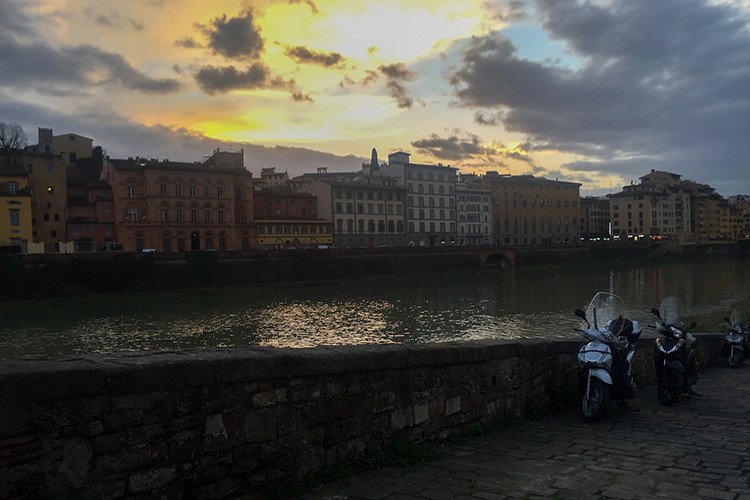
The Arno River, photo by the author

By Morgan O’Reilly

When first arriving in Florence, it’s normal to feel like a tourist. Here are some tips on how to live like a local. 

Florence, upon  first glance, can overwhelm its visitors as they crane their anxious heads above the sea of selfie sticks and open maps, search for a restaurant sans menu photos, and  squeeze through the awing crowds in the main squares of the city. Among the excited tourists, it’s important to keep in mind that a majority of people you pass by call this city home.

Firenze has so much more to offer than temporary housing for weekdays. Culture and favorite cafes and park benches with carvings live here. Children and dogs play in the streets as their parents chat with the friendly market booth owners. Familiar calls of “Buongiorno” ring through the narrow alleyways, artisans flaunt their daily food creations, and 20somethings socialize on the steps of Santo Spirito.

Learning to see Florence through the eyes of a local

Appreciating Firenze as a home can help create an authentic study abroad experience. Finding the best panini places and venturing past the piazzas will come with time, but there are some things you can do to help feel like a local in the city.

Talk to your professors

Even if not all of your instructors were born in the city, chances are they have lived here long enough to be considered a local in terms of their favorite activities. A short conversation about their ideal day will provide great insider tips while getting to know your instructors on a more personal basis.

Strike up conversations with small business owners and workers

On your next pit stop for lunch, whether in Italian or English, introduce yourself to the people behind the counter. Step out of your comfort zone and ask them how they are doing, if they have any recommendations, and what their ideal day in Florence would be. Forming relationships with local italians can immensely help authenticate your Florentine experience.

Search online for local advice

Although forming relationships with locals will prove incredibly helpful, the internet is also full of blog posts, reviews, and ‘top 10’s’ for the exact purpose to share local knowledge. Some great places to start are The Girl in Florence blog, filled with restaurant reviews and things to do off the beaten path, this Unusual Florence guide, and even Tripadvisor (Making sure to measure opinions carefully. Try the place. Do you agree with other clients’ opinions?).

Tips from a Florentine local:

Native Florentine and Marketing professor Paolo Fiorini kindly gave some insight in creating an authentic experience.

What would be your ideal day in the city?

Go out in the morning with my family to the Central market and buy typical food products. Stop at a restaurant/panino place and eat then walk in the center of the city looking at exhibition or other events

What eateries and activities would you recommend for someone visiting the city?

Well, this is a complex question. It depends on what you want to eat. If you search traditional food like lampredotto or trippa for me the best place is Il Magazzino, pasta at La casalinga, bistecca at Pandemonio, wine and cheese at Le Volpi e l’uva, and then other hundreds of eateries. Place to visit: Galleria dell’Accademia, Galleria Palatina at Palazzo Pitti, Palazzo Davanzati, exhibitions at Palazzo Strozzi, and all major churches

In closing, he shares that the best way to make your experience unforgettable is try to live as a Florentine. Buy traditional food and cook it with local people, learn basic Italian and try to speak it, relax and understand our “lifestyle.”

From personal exploring, I have stumbled across a couple great places, including  Sandwichic on Via San Gallo, which provides delicious and different sandwiches and a bottle of water for 2,50 with your FUA ID, and Da’Vinattieri, with a fennel spread that will change your life. Other recommended places I have yet to venture to include Amble, an eclectic lunch spot where you can buy the vintage furniture at the cafe and Ino, another seemingly awesome spot that uses top-notch ingredients.

Although you may only inhabit Florence for a few short weeks or months, putting in the effort and opening yourself up to new, authentic experiences can turn your perspective of this city from the eyes of a tourist to the eyes of a local.  

See more of Florence and Italy at FUA’s FB, Instagram, and Twitter.