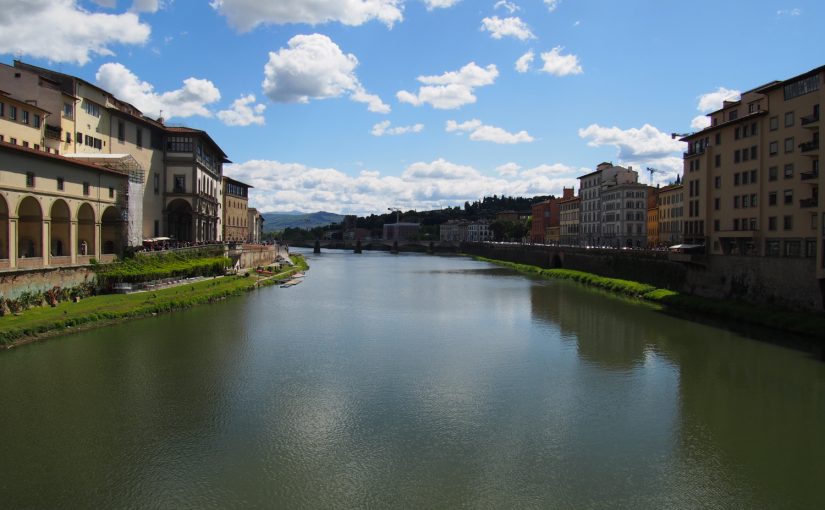
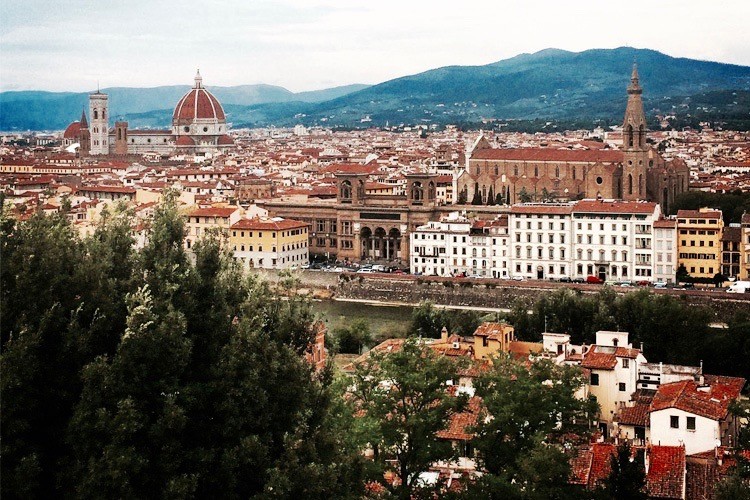
We wade across the crowded Ponte Vecchio, trying to stay out of tourists’ photographs and dodge street vendors hawking odd toys. Finally crossing, the crowd slowly fades as we venture up a steep hill toward Piazzale Michelangelo. Each step we take provides reprieve from the fast-paced Florence I spend most of my days.
As I continue climbing, nature begins to emerge quietly reasserting its dominance on the land it once controlled. Soggy leaves cover a winding cobblestone road. On each side of the street walls provide homes an additional layer of security from the city. Muffled thumps echo down the road out of my Onitsuka Tigers as I get more lost in the hills. With no end in sight I keep moving forward allowing the road to control my fate.
Eventually the soft hum of cars slowly became less and less faint, as I’m dumped out of my peaceful sanctuary onto a busy road. Following the cars deeper into the hills, I throw my headphones in, drowning out the noise.
Looking out I can see fragments of the city around tree branches and in between homes, never seeing the entire city. Each glimpse reminds me of the overwhelming beauty possessed by the city.
When I finally reach a small overlook with nothing marked, nothing out of the ordinary, I stop. Below me, Florence splinters into terracotta rooftops and thin smoke rises from chimneys, the Arno a silver ribbon threading everything together. It isn’t the grand view tourists climb for, but it feels earned, like a secret the city didn’t mind giving up today.
I stand there longer than I planned, letting the wind tug at my jacket, and the city settle into its tiny compartments below. And as I turn back toward the road, toward the descent I know is coming, I realize this is the part of Florence I’m always searching for: the quiet in-between, the spaces where the city finally lets me breathe.
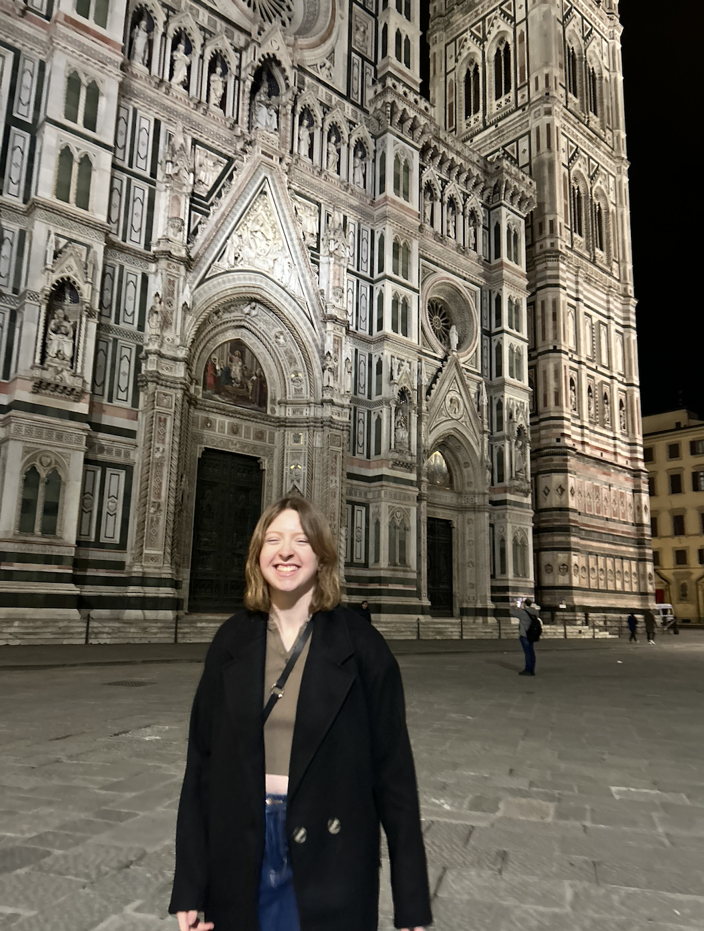
My first day in Florence back in January, 2023, as well as my first time seeing the duomo!
By Caylee Brand
After four months spent studying
abroad in Florence, I reflect on my favorite moments as well as lessons I’ve
learned, and share some of my friends stories as well.
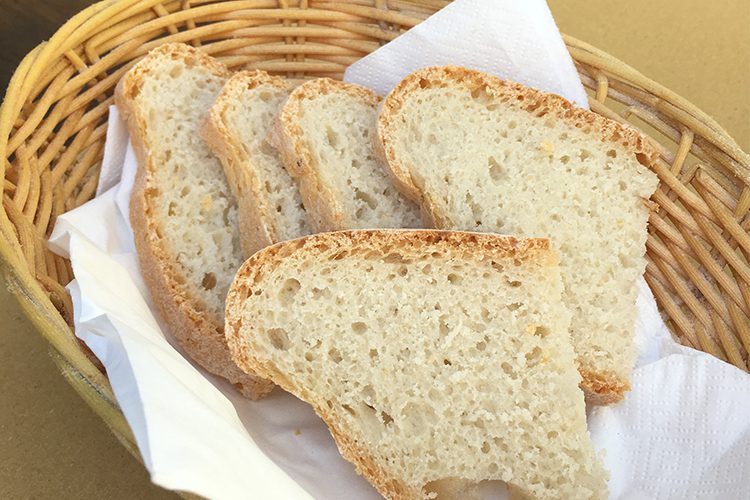
On my first day in Florence, I sat down at a restaurant in the shadow of the Duomo hungry from my flight. I had unpacked and was looking forward to food like a dog looks forward to playing fetch. So when I was brought the bread basket, I devoured each piece and noticed something strange. It was hearty but extremely bland and tasteless. I realized there was no salt! Salt, a seemingly essential ingredient, wasn’t in my first taste of Italian food whatsoever. I didn’t know at the time you should wait to mop up your meal with the bread, an Italian custom I had forgotten in my desperation to get food in my belly. So, after realizing this, I had to find out why the bread was saltless and sciapo (Italian for “bland”).
Chef Pietro Di Marco says the legends of saltless bread vary, and that if asked, every Florentine will give you a different story as to how it happened. A chef his whole life, teaching at Apicius since January, I trust his version of the salt-legend:
Throughout the centuries, the legends have been told. Nothing is on paper, but we all know about the bad blood between (the city of) Pisa and Florence. Pisa, long ago, was the only Tuscan city with access to the sea. Therefore, they were responsible for the distribution, packaging, and taxation of salt for Florence. Florence didn’t want to pay to bake their bread, plus the rivalry and battles between them didn’t help the situation. From there, the evolution of Florentine cuisine began.
The most common dishes involving Tuscan bread (pane toscano), and the most important dishes according to Chef Di Marco, are pappa al pomodoro and ribollita. Pappa al pomodoro is a bread-based tomato soup with herbs and spices, a rich and filling dish invented by Florentine farmers. Ribollita translated means “twice boiled,” and it is another soup reboiled with vegetables (like local white and black cabbage) and poured over bread. Chef Di Marco says it is easy to tell when dishes are made with old-school recipes or new-school recipes: the thickness of the soup, and the ingredients like olive oil, give it away. He says that every chef in Florence knows how to make these dishes, and that without them Florentine cuisine wouldn’t be Florentine cuisine.
Pane toscano can be made in about three hours time and takes a while to rise. This ensures its freshness for days, lasting longer than most bread you get at the supermarket. Its origin is from the province of Lucca, in the town of Altopascio, which still claims its fame to the crunchiest crust and the softest insides of all bread in Italy.
To learn about Tuscan bread, stop by Apicius, the hospitality department at FUA, and get a taste of it where it’s served daily at Ganzo, the Apicius restaurant. And while having a breakfast pastry or dessert at Fedora, the Apicius pastry shop, ask the baking experts there for tips and tidbits about it!
Italy isn’t all about the carbs; fruits and vegetables play a huge role in Italian cuisine. Here’s everything you need to know this fall about the best fruits and veggies in Florence. Check out the best markets, what produce is in-season, and vegetarian-friendly restaurants and recipes!
The high-carbohydrate diet many associate with Italian cuisine is a falsehood: Italians may eat carbs, but their lifestyle, portions, and eating habits are much healthier. That’s why when the New York Times reports on Italian eating habits, the focus is not on how to eat a low-carb diet while traveling, but rather why Italians are some of the healthiest people in the world. Fruits and vegetables, though filled with those ‘nasty’ carbs, are absolutely essential not only to a healthy diet, but also to Italian cuisine. That’s why including some apples, asparagus or zucchini in your basket while on your daily market trip is important to the Italian experience.
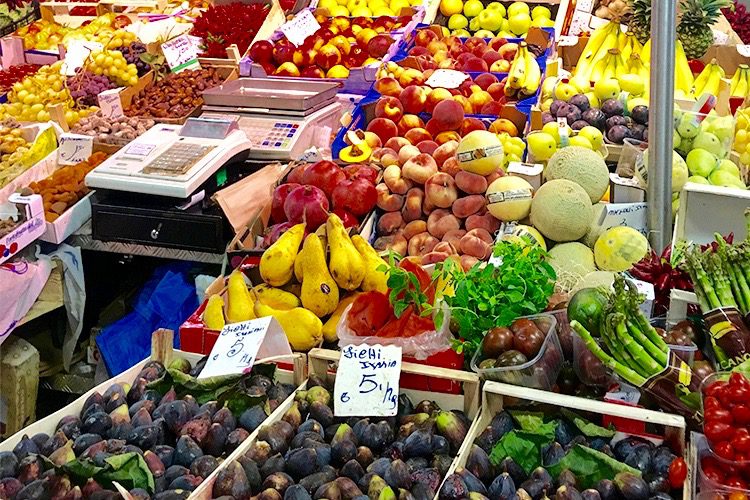
If you haven’t been to an Italian local market yet, give yourself an afternoon to go and explore one of the best parts of living in Florence. There are more than four big Florentine markets, not including the San Lorenzo Market, that you should visit to get the best, and freshest, produce (and even some clothing, music, plants and pastry too!)
However, before going to the market, know what fruits and vegetables are in season. Check out this chart to see that apples, blueberries, grapes, tomatoes, green beans, and cucumbers are just some of the fruits and vegetables that are at their best in September.
Want to visit some renowned vegetarian restaurants in Florence? Try Le Fate on Via S. Zanobi, for it’s fully vegan and vegetarian menu inspired by the signs of the zodiac and recommended by Travel + Leisure Magazine. Dolce Vegan and Il Vegetariano both have extensive vegetarian and vegan options as well, both a less than 10 minute walk from one another in the center of Florence. Still want more options? Silvana Vegan is an additional option, on Via dei Neri near the Galileo Museum.
If you don’t want to eat out, FUA Professor Cecilia Ricci, who often teaches food and culture courses, swears by this traditional Italian recipe for fruits and vegetables:
Cold Barley Salad, with Shrimp, Anchovy Fillets, and Cherry Tomatoes
Ingredients:
300 g Pearl barley
200 g Shelled shrimp
15 g Extra-Virgin olive oil
150 g Cherry tomatoes
3-4 leaves of basil, cut in julienne
Black pepper
Salt
8 Anchovies fillets, preserved under oil
Directions:
Boil the barley in a pot with 1.5lt of water with salt. Once the barley is cooked, strain it and place it to cool down in a bowl. In the meantime, wash and dice the cherry tomatoes. In a casserole pan add the extra-virgin olive oil, heat it at medium temperature, and let the anchovies fillet to melt. Once the anchovies are ready add the shrimp and sauté them in the oil for 2-3 minutes. Add the barley in the casserole, stir and mix all the ingredients together for 5 more minutes. Then, remove all the ingredients from the pan and place them in a bowl, add the diced cherry tomatoes, basil, pepper, salt, and mix. Refrigerate for at least 30-45 minutes before to serve. And enjoy!
After buying your fruits and vegetables, make sure you pay attention to how long they keep. Basically, how long the fruits veggies last is based on where they are from. If they are fresh from the market, your fruits and vegetables can last 3-4 days without rotting or refrigeration. If they are from the supermarket, the produce can go bad within a day or two because it has been refrigerated and prevented from becoming ripe. That way, as soon as they leave the supermarket your fruits and veggies can become ripe faster and ultimately rot faster. Buying fresh produce from the local market is a better way to ensure it will last (and it will taste better too!)
Click here for a guide to eating out in Florence, provided by FUA’s hospitality department.
With clamped eyelids and the flicker of a burning candle, I contemplated my wish. As my life’s dream reemerged back into my conscious thought, my eyes flicked open, I peeked at the wax “10” in front of me, and I blew. Underneath, in place of a conventional birthday cake, lay a cannoli; I looked up from the red checkerboard table and saw my cheering family under the light of the Macaroni Grill sign. My wish was to travel; little did I know that I would be enjoying an authentic Italian meal in Florence only 10 years later.
Growing up, I had always loved food. I sat at dinner tables scooping mussels from shells and openly trying international cuisine. To this day, I actively search for new flavor combinations and cooking techniques. Despite my culinary openness, my perception of Italian cooking has changed dramatically since my arrival in Florence. I grew up with the mac and cheese, breadsticks, and spaghetti of Italian restaurant chains back home; and despite trying my hand in Italian home cooking, I really didn’t know what the “real thing” entailed. For me, I was coming to the land of bread, cheese, and pasta; and I was 100% fine with that.
Upon arrival, I aimlessly wandered Florence’s winding streets as I gripped my list of recommended panino and aperitivo places. After tasting some of Italy’s fresh pasta and coming to the harsh realization that meatballs are not an actual thing here, I realized how skewed my perception on this lifestyle was. My day to day life in town surprisingly never included the bread or pasta-induced food comas of the “Italian” food that I was accustomed to, and instead, I felt physically and mentally satisfied with what I was putting into my body. In fact, although the study abroad 15 has proved an irritating reality, I have never felt as good about the food I was consuming.
After a few weeks, once the initial excitement died down, I started to eat in more. Whether at the farmer’s market or grocery store, I slowly began appreciating the seasonality and freshness of what I was consuming. Although eating in does not seem like the optimal way to seize the day while abroad, learning to utilize fresh, regional ingredients in simple recipes gave me a deeper appreciation for the food I was eating and for Italian culture. My roommates and I have made everything from roasted vegetables to pork chops to shrimp with lemon asparagus; and the simple act of learning to work with seasonal, simple ingredients has shown me more about Italian culture than I would have ever expected.
Looking back, my experience with food while abroad and my deeper appreciation for what I eat has mirrored my sense of appreciation for all aspects of culture. Like expanding my knowledge on the slow food movement, biodynamic farming, and the third wave coffee movement through conversations with locals, I have learned to step out of my comfort zone and challenge my perception of Italy, travelling, and on life in general. This experience has opened my eyes to finding value and culture in the tiniest of details; whether it be a tablespoon of olive oil, my daily walk past the Santa Croce, or a genuine conversation with friends from around the world. Above all else, studying abroad has taught me to openly seek out culture in every aspect of living, and it is something I cannot wait to apply beyond the walls of the city I now call my home.
Coffee does not limit itself to its basic ingredients and the seemingly fundamental role of stimulating its consumer. Coffee sits in cafe bars under the dull roar of thought-provoking conversation. Coffee occupies cupholders in Manhattan taxis, accompanies egg yolks and condensed milk in Vietnam, and carries ceremonial value in Ethiopia. It can exist as a supportive friend among late-night spreadsheets and early-morning meetings, and its aroma alone can wake a sleepy family on a rainy Saturday morning. Coffee has the power to support entire villages through the harvesting trade, especially with the insurance of the Fair Trade Movement. It is complex and the possibilities for innovation lie infinitely between the harvesting, the roasting, the brewing methods, and the preparation.
The drink originated in the highlands of Ethiopia, where it arrived in the Middle East before spreading to Venice in the 1570s. Coffeehouses later spawned all along its canals before spreading to other major Italian cities like Turin and Rome. Since then, coffee has transcended past its functionality of improving productivity into a rich, diverse, ever evolving culture across the world’s borders.
As a previous barista and hopeful future coffee shop owner, I had a delightful week exploring the coffee culture Florence has to offer.
Basic Coffee Etiquette in Italy
Coffee culture in Italy stands unprecedented among its neighbors; it is quick and medicinal with little to no fuss over the preparation. Because of its uniqueness, the dreaded ‘tourist’ label can come far too easily. To avoid the foxpaus, here are some observations I’ve compiled:
Any coffee drink containing dairy should only be consumed in the morning, and never after a meal.
Coffee in Italy is enjoyed its simplest and purest form. Caffé shelves leave no space for an array of flavor pumps, so savor your beverage and try to taste all the subtle hints from the brew.
In a traditional Italian bar (neighborhood coffee joint), always check if you need to pay for a receipt first to present to the barista or if you can order first and pay later.
Typically, locals order and drink coffee at the counter. It also costs much less than sit-down coffee in some of the bigger cafes in squares such as Duomo, Repubblica, and Signoria.
Typical menu items
Caffè: One shot of espresso
Cappuccino: Espresso with foamed milk
Caffè Macchiato: Espresso with a dash of milk
Latte Macchiato: Hot milk with a dash of coffee
Caffè Americano:Espresso with the addition of hot water
Other spin-offs found at most Italian cafes:
Caffè Shakerato: A frothy iced coffee drink prepared with ice cubes in a cocktail shaker. Usually served in a martini glass
Caffè d’orzo: A caffeine free beverage made from roasted barley
Caffè ginseng: Similar to white coffee: a cream, usually of the plant origin, the sugar, the instant coffee and the dry extract of ginseng
Marocchino: Popular in Milan, this drink comes in a small glass dusted with cocoa powder, when topped with milk froth and espresso, and topped with some more cocoa powder
Cappuccino Viennese: A cappuccino topped with whipped cream and cocoa powder
Pro Tip: My all-time personal favorite is the cold brew, the espresso-ground beans are steeped in cold water for 24 hours. This method results in a less acidic, slightly sweeter drink. I like to pour the black coffee over ice, but a splash of milk or cream is always a good move. You can easily make cold brew at home by steeping the beans in a french press.
The Old School, the Roasters, and the Contemporary: Without question, every coffeeshop derives from a wide variety of values, customs, and creativity; so in no way can one title sum up an entire business. This being said, these three coffee categories do point to major differences throughout Florence’s coffee scene.
Old School bar/pasticceria These shops contain classic Italian coffee and fresh pastries. They stick to the roots of Italian coffee culture to provide an authentic, timeless experience.
Example: Pasticceria Nencioni. Open for over 60 years, this family-owned Florentine coffee and pastry bar stands as a charming gem with a wide array delicious sweets and quality coffee. Whether it be a profiterole, a mini tart, a croissant, or a slice of cake, this shop will please its guests through their freshly homemade approach and unbeatable tradition.
Atmosphere: The shop gives off a timeless, charming feel with their beautiful pastries displayed before the customer.
The Roasters Some roasting companies open stores in the city, so their base value lies on their quality, specialty coffees.
Example: ChiaroScuro. This shop was opened by the roasting company Mokaflor and contains coffees and teas from around the world. The array of espresso drinks, hot chocolates, and teas proves quite impressive, so don’t be afraid to take your time deciding. Personally, I am fond of the caffè nocciolato, combining their high quality, rich espresso with hazelnut and whipped cream.
Atmosphere: This shop has a homey, old school atmosphere with plenty of seating.
The Contemporary Many New Age Coffee shops typically value the Third Wave Coffee movement, in which coffee is treated as a culinary delicacy, like wine, rather than a commodity. The movement lends itself to stronger relationships between coffee growers, traders, and roasters, as well as focusing on direct trade, single origin coffee (as opposed to blends), and high-quality beans. Along with these ideals, they may emphasize fair trade as well as focussing on the unique atmosphere of the space.
Example: Ditta Artigianale. This contemporary coffee shop prides itself in its focus on international coffee blends and brewing methods. Also directly involved in the roasting process, the shop combines the traditional values of Italian coffee culture with the Third Wave movement. The Artigianale baristas are knowledgeable of the bean’s origin and the process to which they receive them, so they gladly welcome conversation over their coffee’s “story.” In fact, the shop itself is designed to welcome this interaction through their lower-than-normal counters and complete visibility between the customer and the barista.
Atmosphere: The shop on Via Dei Neri, in my opinion, gives off a retro vibe with the script typography and industrial lighting. It’s a great place to sit and finish some homework or enjoy friendly conversation while alternative, mellow music fills the space. In contrast, the newOltrarno location gives off a more posh atmosphere through interesting patterns and lighting, a muted, sophisticated color scheme, and more mature, jazzy playlist.
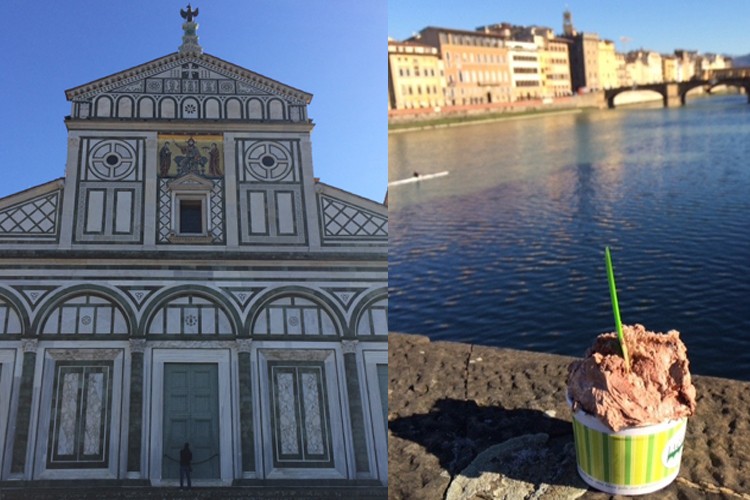
Left, San Miniato al Monte; Right, gelato from La Carraia with a beautiful view. Photos by author.
By Emma Vogel
Contrary to popular belief, not everything worth seeing in Florence is on the north side of the Arno river. Here are some of the hidden gems I’ve discovered living beyond the river, or as the locals call it, the “Oltrarno” or in an even further colloquial way, “Diladdarno.”
I was confused the first day I arrived at my apartment in Florence. Where was the Duomo? The Ponte Vecchio? The statue of David? Okay, I wasn’t quite so naive as to expect all of those Florentine staples right outside of my apartment door, but I knew I was in a different part of Florence than I had seen when searching Google Images. It took me only a few minutes of wandering to realize that I lived on the south side of the Arno river, and it took only a few days after that to fall in love with where I live. Sure, what draws most people to Florence is the bustling Piazza della Repubblica, the magnificent Duomo, and the incredibly famous Palazzo Vecchio, but there’s much more to see than what the tourist guides suggest. There’s a whole hidden part of Florence with charming artisan shops, authentic Italian cuisine, and hip cafés filled with locals that you can find by simply crossing one of the many bridges. Here are the best parts of Oltrarno that I’ve discovered so far.
Food
Oltrarno has some of the best restaurants in all of Florence. With a multitude of choices from family-owned restaurants to trendy eateries, I find a new favorite restaurant every day. So far my top picks include: GustaPizza (not surprising as it is loved by abroad students, tourists, and locals alike), Osteria Santo Spirito (great sit-down spot), Club Paradiso (owned by an Italian couple, the wife cooks the food, the husband is the waiter, and the menu changes everyday!) As for gelato, Gelateria Carraia never disappoints and has been a local favorite for years (a wide variety of flavors and generous portions.)
Pro Tip: You can compare southern Italian pizza styles in the neighborhod. After GustaPizza, check out O’ Munaciello and Da Gherardo (don’t let the plain website fool you, the place is tiny but packs a punch!).
Santo Spirito: A Place to See
Crossing the Ponte Vecchio into Oltrarno brings you to the center of the most authentic artisan shops in Florence. Walking down Via Romana, you pass stores selling handmade leather shoes, fresh pasta and olive oil, and art galleries. Past the artisan shops you can find Santo Spirito, arguably the hippest neighborhood in Florence. Piazza Santo Spirito is filled with cute cafes and trendy restaurants known for apertivo and, of course, the famous Basilica di Santo Spirito. The square has a daily market open until 2 p.m. where you can find fresh produce sold by neighborhood locals. A short hike from there brings you to the breathtaking Piazzale Michelangelo where you have a view of the entire city. A little farther up the hill you can find San Miniato al Monte, one of the most beautiful and unique churches in Florence.
Pro Tip: Santo Spirito is the iconic square of the Oltrarno area. Also try exploring the tiny Piazza della Passera for funky restaurants and great gelato. Piazza del Carmine (also home to the Brancacci Chapel) and Piazza Tasso are also interesting squares with a great local vibe.
Although Florence’s most famous monuments are undeniably amazing, it’s more than worth it to escape the crowds of tourists to explore the hidden beauty and authenticity that is Oltrarno.
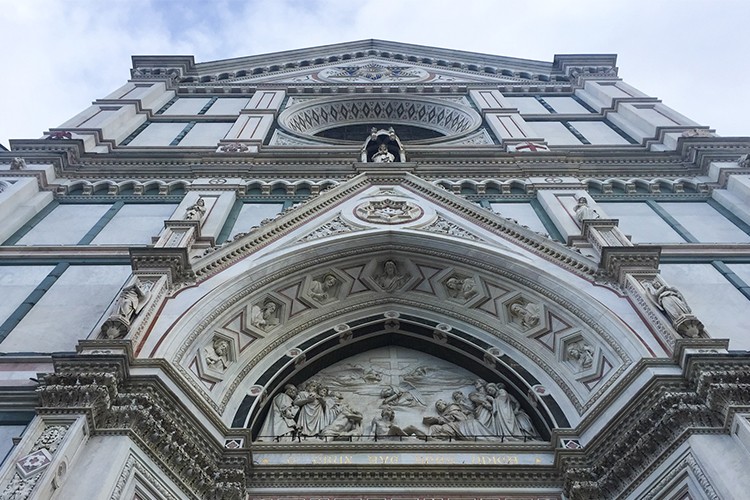
Examining the detail of the Santa Croce church, photo by Morgan O’Reilly
By Morgan O’Reilly
It’s 8:30 on a February morning as I swiftly dodge bikes and local pedestrians on my way to class. The damp chill of Florentine air jostles my bones as my tired eyes stare downwards at the passing cobblestone. The frigid gust of wind and the loom of tardiness pick up my weary feet and hurl them toward the next stone, until suddenly a crack on the sidewalk catches my foot and I trip. Only then do I look up from my monotonous routine and spot a little, hidden bakery; a woman laughing with her daughter; the incredible detail on the Santa Croce archways; and a side of Florence I had neglected to notice.
Falling into a routine comes naturally when settling in Florence: you find the quickest routes, the cheap panini places, and a couple go-to evening spots. Although finding some favorite places will help with your acclimation to the new environment, it is also important to keep exploring the city and appreciating new sights each day. Yes, many weekends will be spent crossing off travel bucket lists, but weekends should also lend themselves to new Florentine discoveries. The city cannot be fully appreciated in one, momentous layer. It opens itself up to its guest every day; tripping and confusing its inhabitants and then strategically placing a hidden gem right in their winding paths
Finding a new sight a day, or moreover, appreciating a new sight a day, can transform the city from a world renowned bustle to a personalized home. Form a realistic plan of things you want to see, do and eat, and try to knock off a few each week. Reach out to your professors and locals for their recommendations. Even on your walk back from class, pay extra attention to the detail on the Duomo; the finely cured meats at your favorite panini spot; the muffled italian chatter in the Oblate Library; veins on statues; love locks on fences; foam on your cappuccino. Explore the Uffizi over and over again, visit Oltrarno’s gardens, grottos, and local eateries, and find those special details and locations you would have overlooked if you hadn’t payed active attention.
The simple act of opening one’s senses to new discoveries can not only act as a mantra for an immensely enriching Florentine experience, it also lends itself to a life of new discovery and appreciation. Begin to notice, to see the overlooked, and to experience the little moments that make Florence so unprecedented.
Welcome to the beautiful, bustling center of the Italian Renaissance. Upon arrival, your bags will be full, your feet tired, your stomach empty, and your mind racing. To ease the initial shock, here is an essential survival guide to help you through your first few days in this incredible city.
1 – Get to know your apartment
When you first walk into your new apartment, you’ll probably feel a mix of emotions. One of these will be excitement, but another one might hit you: confusion. Apartment living may be a little different than what you’re used to at home. Italians value conserving electricity, water, and heat. Turning on too many electrical appliances at the same time can result in a power surge. Don’t expect to take long showers because the hot water will run out. Remember to space out showers between roommates to conserve the hot water and turn off lights when you leave a room. Be environmentally friendly!
Electrical outlets are also different, and it’s very important to use the correct converter/adapter to avoid damaging your devices. Ladies, don’t use your electrical hair tools unless they’re dual wattage and compatible with Italian outlets.
Appliances like ovens, stovetops, and washing machines work differently than what most study abroad students use at home. Carefully read your apartment manual to figure out how the appliances work in your individual apartment. If you find that they aren’t working, don’t panic! Simply visit your MyFUA account and fill out a Housing Troubleshooting form to have the issue resolved in a timely manner.
Pro Tip: Scope out if your sleeping area is facing an internal or external part of the building. Like in any city in the world, facing street-side can get noisy at times, consider whether you may need earplugs or not.
2 – Get to know your area
At first, living in Florence might seem overwhelming. Don’t worry. It’s normal. You’ll be surprised at how quickly it is to get around the city. Begin to walk around the area near your apartment to familiarize yourself with the markets, cafes, and restaurants. You never know, there may be an awesome panini joint right under your apartment.
Take photos of different landmarks for reference when you need help remembering how to get somewhere. Pay attention to your surroundings! Think: how far away is this place from a main square or easily recognizable landmark? Organize a walking tour with roommates or newfound friends. Find the best routes from your apartment and your classes, and it’s also a great way to get to know the city! Knowing where you can grab a quick bite or grab groceries will help Florence feel like home.
Once you become more acquainted with the city, it’s time to find your favorite study spot in addition to the quiet study areas at the FUA Main Library. Head over to the bookstore La Feltrinelli in Piazza Repubblica. You can grab a quick bite to eat from the cafe to enjoy while completing your weekly assignments. There’s also a large selection of books. It’s open all week 9:30am-11pm. If you need a quieter place to do your work, Oblate Library is located near FUA’s J School. Take a study break and head to the top floor where you can find an aperitivo buffet. Peek out the window, and you’ll see a great view of the Duomo! It’s open Monday 2-10pm and Tuesday through Thursday 9-12am. In addition, make sure to explore Florence’s wide array of coffee shops, book stores, and other nooks to find your perfect study area for the upcoming semester.
Pro Tip: Don’t forget to take a picture or carry around a physical copy of your updated registration to avoid walking into the wrong class.
3 – Get to know FUA’s Facilities
Florence’s bustling, crowded piazzas and countless street corners can make anyone feel bewildered upon stepping on this giant historical landmark. One of the most effective and easiest ways to get to know the city lies alongside many of your classes. The Student Life office in Corso Tintori offers events, tours, trips, and free campus facility services. Attending events like the Welcome Reception, walking tours, weekend trips, or free gym classes, can open up possibilities to meet the faculty and staff as well as some fellow study abroad students. After a long day, grab a pastry or some aperitivos at the campus pastry spot, Fedora, or FUA’s student restaurant, Ganzo.
Pro Tip: Exercising at FUA’s gym will not only give you the most for your money, but it can be a great stress reliever for the hectic first week. Also, attending a free class can be a fun, social way to burn off last night’s third scoop of Gelato.
4 – Get to know Italian dining/social culture
In your first few days in living in Florence, you will probably realize that there are some serious culture differences, especially around food. Italians generally sit down for dinner around 8:30 or 9. If they eat out, it is not generally for convenience, but rather as a treat not to be rushed through. A good Italian waiter will never rush a customer, so it will be your responsibility to ask for the check. Here, dining establishments can generally be categorized by three types: Osteria, Trattoria, and Ristorante. An Osteria is a less formal way of eating out with food served at shared tables. A Trattoria serves as the second “level” of Italian dining. These serve inexpensive, regional home cooking. A Ristorante tends to be a little more formal and expensive of the three. But always do a double check if possible, as the names and price ranges nowadays are interchangeable.
Other types of establishments include the Pizzeria, Bar, and places for Aperitivo. We can conclude that pizzerias serve pizza, and they might serve other food as well. The best usually have an actual wood burning oven. Pizzas in Italy are generally individual dishes rather than family style. A Bar in Italy is a cafe, a place for people to grab a quick espresso and a small sandwich or pastry. Aperitivo is usually a pre-meal beverage served with snacks and appetizers, and the popular buffet-style has become a quick, informal way to enjoy dinner and wine with friends. Keep in mind that wine with a meal is an Italian social activity, but excessive drinking is not.
One last note is that tipping in Italy is not a common practice. Waiters and retail employees earn a regular salary as opposed to working for tips, so a required service charge and possibly rounding up a euro or two will more than suffice. This being said, if your service is exceptional; for example if they make you laugh, cry of happiness, or if they pull out their best magic tricks/acrobatic techniques, then by all means tip as you see fit.
Pro Tip: If you want to find a local Italian restaurant, stray away from the main squares and keep your ears open; if the customers speak Italian, it’s a good sign that the experience will be more authentic.
5 – Get to know some Italian
Learning some Italian phrases will not only help you communicate with the locals, but it will also help you better assimilate into the Italian culture. Don’t be afraid of pronouncing things wrong. The locals will appreciate your effort! Practicing each day will improve your skills.
Hello Ciao/Salve (formal)
Good morning Buongiorno
Good afternoon Buonasera
Good night Buonanotte
Good bye Ciao/Arrivederci (formal)
Please Per favore
You’re welcome Prego
How are you? Come stai/Come sta? (formal)
I’m fine Sto bene
Excuse me Mi Scusi
I’m sorry Mi dispiace
I don’t understand Non capisco
How much is it? Quanto costa?
Pro Tip: Check out your Student Manual for other helpful phrases. Download a translation App to your phone when you need help reading a menu or communicating with someone. Or, keep a small notebook to jot down other commonly used words.
Soak up the rich history, enjoy authentic cuisine, and admire the amazing views. Living in a new place might feel scary at first, but Florence will start to feel like home sooner than you expect.
For many students arriving in Florence, adjusting to a new country can take some time. A new language and atmosphere can sometimes create moments of culture shock or homesickness. There are many tips to help with the adjustment process and embrace life in Florence, and the FUA Student Life Department is a great resource for a comprehensive and detailed approach to experiencing your term abroad. In the meantime, here are a few immediate yet easy and essential tips for all students, regardless of how long you’re staying in Florence!
Make an effort to go out of your comfort zone! There are plenty of restaurants and areas that are designed towards tourists, but push yourself to find more localized restaurants and nightlife. It can be very rewarding and help you feel like less like a tourist. This also forces you to practice Italian phrases which is the only way you will ever start to feel comfortable with a new language.
Do something new every day! Florence is a small city, but it is filled with different activities and things to do. Do not let yourself let a day go by without enjoying all that is around you! Your time here is short. (Suggestion: Try a thematic approach, like a street or a square per day of exploration, or bookshops and/or minor museums. Have the day to yourself? Florence can be beautiful when enjoyed in solitude!)
Stay off social media. Staying in touch with your friends and family back home is obviously important, but if you find yourself aimlessly browsing Facebook timelines or Instagram feeds and watching Youtube videos, it’s time to shut it off.
Life in Florence is such a great experience for students. It is important to transition as quickly as possible so you can spend your time enjoying what is around you. Hopefully these first tips provide a little insight into the transition into Italian culture. Have an open mind and have fun enjoying life in Florence!