I Wish I’d Been Here When: My Home Was a Nunnery

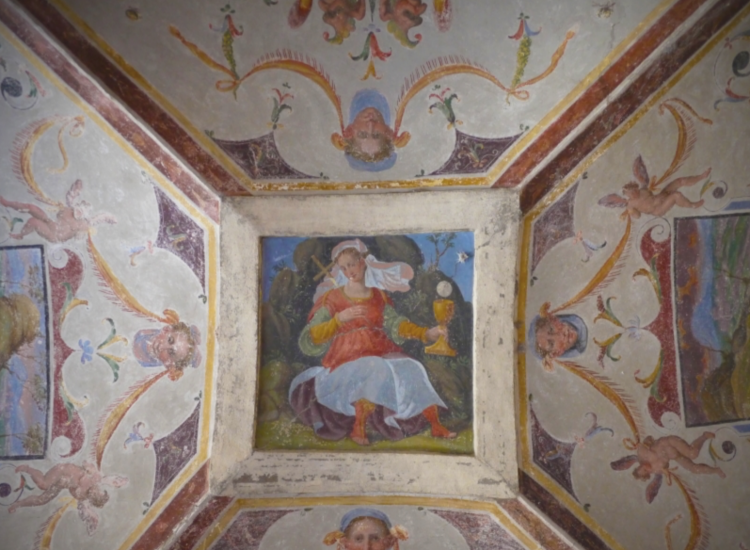
Artwork from my apartment’s walkway depicting angels and other religious imagery. Image courtesy of apartment building.

By Isabel Pellegrino

My apartment used to be a convent dating back to the 15th  century. I can’t help but wonder about the way the nuns lived here. I wish I was able to go back in time to better understand their lives and how they perceived Florence and its future.

I wish I had been in Firenze when nuns gathered in my apartment’s kitchen. In the 15th century, my apartment was a convent. It is hard to picture this space as home to a religious community. While I try to embrace the Italian culture in all of it’s beauty and class, I am not sure the way I live could ever be compared to the grace of a Renaissance nunnery. Yet, here I am. Through an old wooden door, rod iron gates and a few flights of stone stairs, you will find us cooking and practicing our Italian; sometimes we feel like it’s the best we can do to connect with those who occupied this space before us.

During the 15th century, Florentine convents were evolving from small communities to large institutions, according to historian Sharon T. Strocchia in her book “Nuns and Nunneries in Renaissance Florence.” It became common practice for highly- educated unmarried women to congregate in convents. As a result, nunneries became hubs for research, academic dialogue and political influence. As I sit at the kitchen counter of my apartment, I dream of traveling back in time to speak with these women. I can see them now gathering around tables with their noses in books and crosses around their necks. Question after question would flow from me: What is it like to be women leaders of a religion often dominated by men? What do you see your legacy as? What does Firenze mean to you and your faith? How can I honor your lives in my time?

But more than anything else, I wish I had the chance to roam the Florentine streets with them and see the city through their perspective. In the midst of the Renaissance, I wonder how they felt about the art and how it influenced their faith. I wonder if they had any idea of what the convent space would become in the centuries afterwards. While I will never have a time machine during my fleeting few months in Italy, my roommates and I have pledged to take time every day to be grateful for our apartment and our lives in Italy. When we sit around our dinner table and discuss culture, religion, politics and philosophy, it’s almost as if we have been transported back in time by the everlasting art of conversation. I like to imagine the nuns doing exactly this, just centuries ago. Our apartment bridges our times together. So maybe, we aren’t all that disconnected after all.

See more of Florence and Italy at FUA’s FB, Instagram, and Twitter.
The Pazzi Chapel: Venturing into Santa Croce

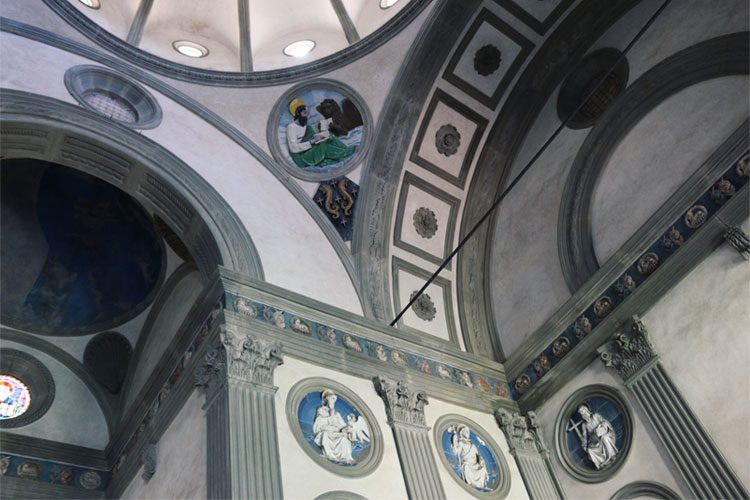
Photo by the author

By Shelby Olson

If you venture further into the Santa Croce complex, you will come across many other monuments that hold much significance to early Florentine history such as the Pazzi Chapel. 

When staying in Florence, Santa Croce is a highly recommend spot to visit because it is beautiful but also has fascinating history behind it such as the tombs of the famous. When you enter Santa Croce, the first thing you see is a large church filled with sculptures, paintings, and stained glass windows that light up the room. When you head out of the church, you are met by a large garden and a series of cloisters. If you walk across the garden, this is where you will find the Pazzi Chapel which is not something to miss out on when visiting Santa Croce.

The Pazzi Chapel was commissioned by Andrea Pazzi and built by Filippo Brunelleschi. It was built to show the legacy of the Pazzi’s power and patronage, as well as to show off their wealth and status to the Medici family. Originally, the chapel was a learning area for the monks but also a burial place for the family.

The chapel is a very important project of Filippo Brunelleschi because it was built according to a specific architectural harmony, and he was able to achieve this after studying and measuring ancient buildings in Rome such as the Pantheon. The chapel was commissioned in 1429 and it was opened in 1443, during this time Brunelleschi had passed away and was not able to finish the chapel on his own. There were also many stops in construction throughout the years due to funding as well as conspiracies the Pazzi family made on the Medici family. In 1478, Giuliano de’Medici was killed and Lorenzo de’Medici wounded while attending mass at the Florence Cathedral. Needless to say, the family’s position swiftly fell after the attempted coup to topple the Medici.

Although Filippo Brunelleschi was not able to finish the chapel, he holds much significance within it because of his perspective and ingenuity. Brunelleschi’s works are not limited to the Pazzi Chapel as he had worked on the Florence Cathedral of Santa Maria del Fiore and its famed Dome, the Basilica di San Lorenzo, the Ospedale degli Innocenti and much more. Filippo Brunelleschi is buried inside the Florence Cathedral and continues to be an important part of the city’s history.

Inside the chapel, there are many beautiful works of art created by different Florentine artists. The relief, a raised sculpture representing Saint Andrew, was created by Luca della Robbia. Della Robbia also created the rounds with the apostles and decorated the central dome with sculptures and two paired dolphins. The stained glass window representing the figure of Saint Andrews was drawn by Alesso Baldovinetti.

The Pazzi Chapel is a simple yet elegant chapel. Although the interior colors are dim, the stained glass windows and colors of the paintings light up the room. Not only is the chapel full of history that dates back centuries, but it is a beautiful work of art and architecture that is worth seeing when visiting Santa Croce.

How to Visit:

Basilica di Santa Croce, Piazza S. Croce, 16, 50122 Firenze
Monday-Saturday 9:30AM to 5PM
Sunday 2PM to 5PM
Tickets: €8