A “Carless” Chronicle: What I Learned Trading My Keys For a Passport

written by Logan Grigsby

At first, I was nervous about trading my sedentary, car-dependent life for the walkable streets of Florence. I was nervous about getting lost, accidentally walking into the “bad side of town,” or simply not being able to physically walk that far. However, walking in Florence led me on a journey of self-discovery, connection, and helped transform me physically, spiritually, and emotionally.

In my hometown of Kansas City, going just about anywhere meant getting in the car; heck, I couldn’t even take my own dog on a walk without driving somewhere! My lifestyle was very sedentary most days; I would only walk a couple of thousand steps. I felt unhealthy, and walking more than a few blocks felt foreign to me. However, I knew even before I arrived in Florence that I wanted to trade my car keys for a passport and a nice pair of shoes. I knew I wanted to explore the city, and I knew I wanted to be healthier and happier. I never could have imagined the transformation that was in store for me, physically, emotionally, and even spiritually, and the love I would gain for Florence. This is my journey on how simply walking has changed my perspective and my life.

As I mentioned before, I was in pretty rough shape. I didn’t exercise, I didn’t go to the gym, and I was considered by most to be a “couch potato” stuck in a constant loop of getting out of school, plopping on the couch, and doom scrolling TikTok or Instagram for hours, never seeing the beauty in front of me.

My journey started small. Let me tell you, the first week was a challenge. We had a heat wave, and my body was just not used to walking around. At first, my body screamed when I had to walk across town for class, and don’t even get me started on the hills… Although, as time went on, I started shedding off fat, and the steps got easier as every day went by. At first, I struggled to hit seven thousand steps. I soon found I was disappointed in myself if I got anything less than fifteen thousand.

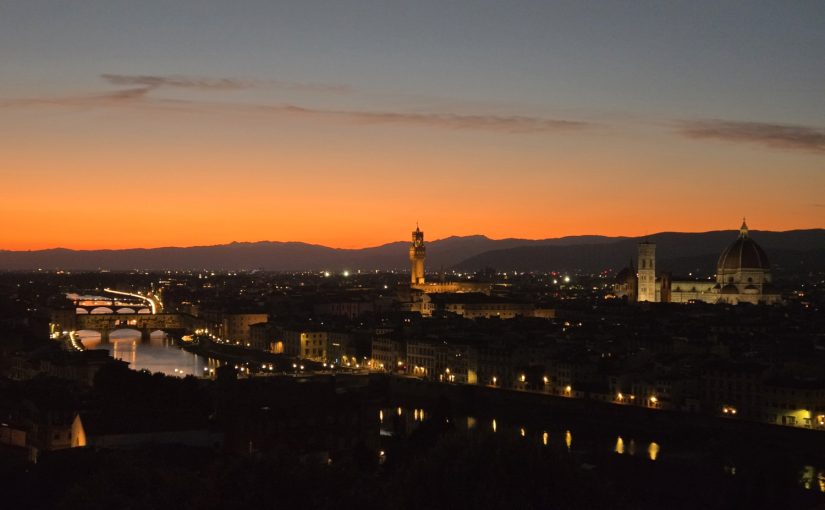
I remember my first week here attempting to make the trek up to Piazzale Michelangelo; A wonderful square with a beautiful look over the city. It was not the easiest hike. I remember having to stop and take breaks constantly. I drank nearly a gallon of water and I genuinely thought my body would give up on me. I decided to retake that journey during my final week in Florence, and not only did I not need any breaks, but I also found I was genuinely enjoying my journey up the hill!

A healthier lifestyle isn’t all that I found; the true magic of a walkable city isn’t the exercise, but it’s the hidden treasures you find along the way. Things you wouldn’t bat an eye at if you were driving in a car. Wandering aimlessly through the city quickly became a favorite pastime of mine. I didn’t know where I was going, but every day I would pick a new direction and set off. This led to some genuinely life-changing experiences.

During my first week, I found what I assumed was a small, unassuming bookstore. I honestly went in for the air conditioning; however, it turned out to be the legendary “Giunti Odeon,” a library and cinema, and what many locals have told me is one of their favorite places in the city. This quickly became one of my favorite spots to study, hang out, or just relax and watch a movie.

Then, one day while walking along the river, I stumbled upon “The Ultravox,” a truly unique outdoor event space that regularly hosts free concerts and offers a vast array of food options. I must admit, I fell in love.

One of my more memorable experiences was discovering “The Havana Club,” a small area on the river that the Cuban embassy officially recognizes for showcasing their culture in Florence. This is a place where I truly connected with the area and grew culturally. I remember walking up to the sand volleyball court quite nervous and sheepishly asking if I could join in, and before long, I had made a group of friends with local Florentines! They would eventually convince me to take to the dance floor, something I never considered, as I always thought that I had “two left feet.” I was so anxious, I thought I was going to throw up, but surrounded by people with positive attitudes and energy, I quickly found myself learning to Salsa dance. Who would have thought that I would learn to Salsa in Florence, of all places.

Of all the things I have done, if I hadn’t decided to just go on a walk, I would have never had these amazing experiences.

My walks have allowed me to truly appreciate the art and history of the city, which permeates it. My first time walking into Piazza della Signoria, I honestly was at a loss for words. Surrounded by breathtaking architecture, beyond lifelike statues, I have never experienced anything like that, and it will forever be a memory in my mind. Back home, I felt like I never took the time to “stop and smell the roses,” and appreciate the beauty surrounding me; however, in Florence, it is unavoidable.

My appreciation for Florence extends beyond the architecture, though. What truly makes Florence so special is the people who make up the city. Every day I see something new and special, from seeing artists freehand the Mona Lisa on the street with chalk, to guitars and accordions filling the streets with sound, to my first experience with Opera music on the front steps of the Duomo, the melodies of this city have filled my heart and soul.

My most spiritual moment came from walking down the street and discovering a small church on the street corner where I saw locals walking in and out of. I don’t usually consider myself a religious person, but something drew me to it, and I decided I needed to walk in and see the building for myself. It was quiet, it felt holy, but it also felt warm and welcoming. Before coming to Florence, I attended the funeral of a friend near and dear to me and was still struggling a bit with the loss, so I decided to do something I haven’t done in a very long time: I sat and I prayed. I talked to my friend who left too early, I spoke to my family who left this earth too early, and I sat and I prayed. This was a tremendously difficult moment for me, but I honestly felt a weight off my shoulders, and I felt a connection I hadn’t felt in a long time. I honestly felt like a changed person.

My time in Florence has taught me so much. At first, I thought getting more steps in would at best help me lose some weight and breathe a little deeper, but that couldn’t be further from the truth. It builds a sense of community and connection. I love running into my flatmates or classroom friends that I have made here, who may also just be aimlessly walking around, an experience that never happens back home. Trading my keys for a passport was a nerve-wrecking experience at first, but I now know it’s one of the most rewarding experiences of my life. It forced me to slow down, to pay attention, and engage in my new home. I’m not just living in Florence, I am discovering it one step at a time. This experience has changed my body, my heart, my mind, and my soul in the best way possible. I will forever be grateful for my experience here.

A Guided Journey Through the City’s Creative Underground

written by Alison Sweeney

This blog feature is an exclusive bonus installment to our Spring issue of Blending Magazine. After you finish reading, be sure to explore the rest of the magazine online—just follow this link to download the full Spring 2025 edition:
https://jschoolfua.com/images/BM/BM_151.pdf

From literary cafes to rebellious music movements, uncover the lesser-known artistic history behind some of Florence’s modern-day cultural hot spots.

Florence’s Underground Artistic and Creative Scene

Though Florence is known for its Renaissance art, grand architecture, and famous landmarks, the city has a hidden artistic scene that offers a different kind of cultural perspective and experience. While many of the venues that once hosted this creative underground scene have become more commercial over time, their roots tell hidden stories of rebellion, reinvention, and the key to discovering true Italian culture. This travel guide invites you to step into Florence’s underground, not just physically but historically, creatively, and culturally.

Caffé Giubbe Rosse: A Literary Revolution is Brewed 

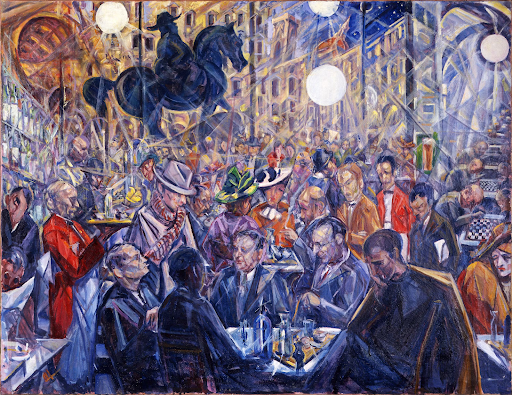
Start your journey at one of the most famous historic literary cafes in Florence, Caffé Giubbe Rosse, where famous poets and writers sat to scribe and exchange radical ideas. According to the article, “Grand Re-opening of Caffé Giubbe Rosse” by Accord Italy Smart Tours, Caffé Giubbe Rosse is located in the Piazza della Republica and was established in 1896 by two German brothers. The cafe earned its current name, meaning Red Jackets, because it was inspired by the red uniform worn by the waiters. 

Caffé Guibbe Rosse grew to become a hub for intellectuals, artists, and writers. The cafe played a pivotal role in the Futurist movement and served as a gathering place for avant-garde thinkers like Baccio Maria Bacci, who looked to challenge traditional artistic roles. 

Today, visitors can still visit the cafe and bar to experience the Italian cultural experience and legacy, where you can find some original Futurist writings still on display! 

Teatro Verdi: Reinventing the Stage

Next, step into the dimly lit Teatro Verdi of the 1980s, where the stage is filled with redefined Italian performance and shortly became a prestigious turnpoint in the uprise of the futurist avant-garde movement. Teatro Verdi transformed into a space for the most sophisticated pop and rock music and for unconventional drama. 

According to the Teatro Verdi website, the theater was inaugurated in 1854 and is the largest “Italian-style” theatre in Tuscany. Located in the historic Santa Croce district, it was built on the remnants of the 14th-century Carcere delle Stinche. In the early 20th century, the theater embraced the futurist avant-garde movement, which challenged traditional theatrical norms. These weren’t just performances but protests, celebrations of youth, and identity in a space of avant-garde reinvention.

Today, Teatro Verdi remains a diverse cultural venue, offering classical music, contemporary performances, and pop and rock concerts, reflecting the artistic landscape Florence has to offer.

Tenax: A Hub for Florence’s New Wave Movement

Last but not least, explore one of the music venues that fueled the cities’ New Wave movement in the 1980s, Tenax. Tenax quickly emerged as a hub for new artists and musicians by influential New Wave and post-punk bands and today remains a symbol of Florence’s alternative music history. Picture this: it’s September 1981, and amid Florence’s enthusiasm for new wave, dark, and punk sounds from the UK, Tenax emerges as a pioneering nightclub. According to the Tenax website, the club was founded by a group of young entrepreneurs and quickly became an innovative and alternative hub for emerging artists, fashion designers, and musicians. Tenax’s stage has hosted an impressive number of acts, including Spandau Ballet, Bauhaus, and New Order, becoming a cornerstone of Italy’s music scene. Bands like Litfibia and Neon, formed in Florence in 1979, found a platform at Tenax for their innovative sounds. 

As the music landscape evolved, Tenax adapted and began to embrace other genres like house music. The club’s ability to reinvent itself while maintaining its core identity has ensured a lasting influence on Florence’s cultural aspect. 

All of these examples of Florence’s underground cultural scene offer a rich and nuanced perspective of the city’s artistic evolution. These places, now more visible, carry with them the same legacy of those underground revolutions. So, next time you find yourself in this beautiful and magnificent city, look closer. Look beyond the espresso machines, beneath the stage lights, and in the echoes and flashing lights, and maybe you’ll find the story of a city whose past reflects a magnificent creative rebellion. 

Art as Protest

The Political Undercurrents of Florence’s Futurism Movement and Its Impact in the Modern World

written by Susana Colunga

This blog feature is an exclusive bonus installment to our Spring issue of Blending Magazine. After you finish reading, be sure to explore the rest of the magazine online—just follow this link to download the full Spring 2025 edition:
https://jschoolfua.com/images/BM/BM_151.pdf

Florence has long been known as the cradle of the Renaissance, a symbol of classical beauty and deep cultural tradition. But by the 20th century, the city; like much of Italy, was ready for a leap into modernity. This transformation came with the rise of Futurism, one of the most radical and revolutionary artistic movements of the time.

Founded by Filippo Tommaso Marinetti on February 20, 1909, Futurism challenged Italy’s cultural conservatism and aligned itself with bold political change. The movement rejected traditional ideologies like conservatism, liberalism, and socialism, instead celebrating a new vision that emphasized speed, innovation, violence, and the power of the individual.

Futurism aimed to destroy the past in order to build a new, dynamic future.

The movement began with Marinetti’s Manifesto of Futurism, a provocative call to artists around the world to embrace modernity and abandon outdated ways of thinking. It inspired creatives and politicians alike, offering a blueprint for revolution and renewal. For Futurists, artists were not just visionaries they were leaders, responsible for reshaping the political and cultural landscape.

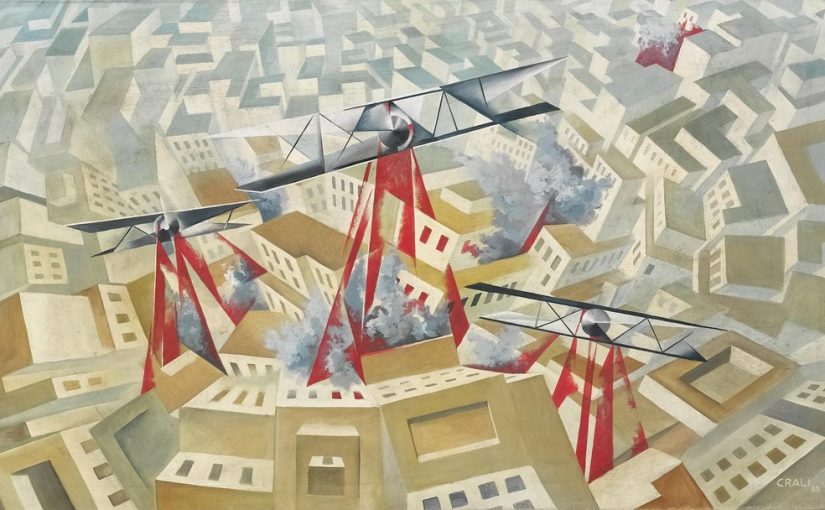
In Florence, Futurism quickly aligned with the rise of Fascism and the political career of Benito Mussolini. As Marinetti publicly supported Mussolini, many Futurist artists followed, embracing violence and destruction as necessary tools for building a new world. Their art reflected this ideology through militaristic and nationalistic themes, visible in poetry, posters, and especially painting. In his manifesto, Marinetti famously called war “the world’s only hygiene.”

The relationship between Futurism and Fascism intensified during World War I. Marinetti and his followers supported Italy’s entry into the war, and some even volunteered to fight.

However, rather than ushering in the radical transformation they envisioned, the war left Italy politically and economically devastated. This collapse only deepened the Futurists’ desire to rebuild a powerful, modern nation.

In 1919, Futurists carried out one of their most notorious acts: the burning of the socialist newspaper Avanti! in Milan. Led by Marinetti, the group set fire to the newspaper’s offices, seeing it as a symbolic act of defiance and alignment with Fascist ideals. Their commitment to political violence only grew, and by the March on Rome in 1922, which brought Mussolini to power, many Futurists believed they had finally achieved the society they had long imagined. But over time, Fascism became more institutionalized and authoritarian, drifting away from the chaotic, revolutionary energy of Futurism. Eventually, the two movements diverged, with Fascism absorbing some Futurist aesthetics but abandoning its more radical artistic ideals.

Still, Futurism’s legacy didn’t disappear. In the 1970s and 1980s, its influence reappeared in various political and artistic movements, particularly through its aesthetic and ideological emphasis on dynamism and transformation. One example is the Italian Autonomia
Movement of the 1970s, a radical leftist collective of students and workers who rejected both capitalism and communism. Their use of bold typography, manifestos, and dynamic visual styles clearly echoed Futurist strategies. Elements of Futurist design found their way into underground magazines, protest posters, and political demonstrations.

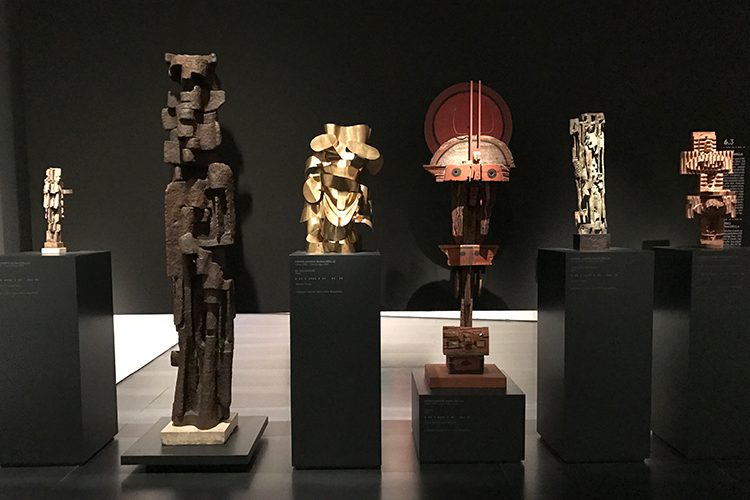
Similarly, radical architecture groups such as Superstudio and Archizoom (active from the 1960s to 1980s in Florence) embraced Futurist ideals of destruction and renewal. Their futuristic designs, filled with utopian and dystopian visions, critiqued capitalist consumer culture and proposed bold alternatives to conventional architecture. These movements emerged from Florence’s long-standing tradition of underground intellectual exchange, dating back to the literary cafes of the 19th century, where artists challenged the dominant norms of their time.

Futurism was more than an art movement, it was a cultural and political force that left a lasting imprint on Florence, Italy, and beyond. From its revolutionary beginnings to its entanglement with Fascism, and later its echoes in radical protests and design, Futurism showed how deeply political ideology can shape artistic expression. Even today, we can trace the movement’s legacy in the ways artists challenge norms and imagine new futures, often in the same underground spaces where past movements once thrived.

Unpacking Self-Discovery: How Florence Painted My Journey of Growth

written by Kylyn Maxwell for SPEL: Public Relations

Packing is always daunting for me. Whether it is an overnight stay at a friend’s house or a three month endeavor in a foreign country, both scenarios instill the same amount of panic within me. How do I temporarily abandon the things that mean so much to me? I would never wish my most prized possessions to collect a layer of dust, leaving them neglected. 

My bag can only weigh fifty pounds. Even my youngest sister weighs more than that.

I had finally come to terms with entering a new country. I prepared myself to become consumed with a deep feeling of discomfort. I was willing to let things go. After all, how do you grow if nothing is changing? I let my petals flourish and my roots grow deep into unfamiliar soil. 

My suitcase held business casual loafers and slacks instead of my cherished paint brushes and 16×20 canvases. I had been decorating canvases with the thoughts that entered my mind since I was 16. 

I could refrain from zipping my sister up in my suitcase, but I had no choice but to let go of the things that have been grounding me for so many summers. 

The plane engulfed my thoughts. The amount of rows on the aircraft put me in a trance, I had never been overseas. The flight was filled with contemplation. I decided I would welcome the unfamiliar with open arms, in hope that it would do the same to me. 

A different scene appears through the narrow gape of the plane window. Mediterranean cypresses and warm-colored buildings caught my attention. They were quite different from the oak trees and neutral-colored houses I had been surrounded with my whole life. I had no idea what I was doing, and perhaps that was the best remedy for an intense desire for personal growth and expansion. 

I wandered the uneven, cobblestone streets of Florence. Not a single step I took was steady and secure, similar to my placement in the city. I couldn’t find anything reminiscent of the things that typically brought me comfort. 

I had four keys. Two small ones, one medium sized one, and one that looked like it was out of a storybook. I put the key in the lock of the large, decadent door, struggling to enter. 

Noticing my struggle, a man next door asks if I need help. He grasps the key in his hand, easily unlocking the door. I notice his hand is covered in swatches of paint; blues, yellows, and red-orange. I noticed his shop next door, decorated in canvases with thick strokes of paint and thoughtful color choices. I feel a sense of comfort knowing that my apartment is next to someone who shares the same love for painting as me. It was in that moment, that I knew I could make home in a place that was unconnected from the rest of my life. 

As my time in Florence dwindled, the sun gleamed brighter and my connection with the painter grew stronger. I used his acrylic paint and palette knives. I showed him paintings from the previous summers that I had left behind. Our styles of painting were so different, yet we could both appreciate each other’s talent. We made an exchange. I sketched citrus fruits along the canvas he lent me. I had painted oranges, lemons, and grapefruits before, but the painter insisted I try to paint in his style; a style that was reminiscent of Post-Impressionist artworks. 

As time is fleeting, my suitcase reappears in front of me. I stare at the canvas that hangs on the wall of my bedroom that I grew to love. How do I rip my roots from the ground that I had become so familiar with? I place my canvas in my suitcase, remembering how I came here lacking canvases, paints, and brushes.

My suitcase is more full than it was in May, along with my heart and my brain. I had flourished, all because of Florence. 

Connections can be forged no matter the location and there are always exchanges to be made that leave you fulfilled. Sometimes the best fertilizer for growth can be one you’re unfamiliar with.

Pre-departure: Museum Tips

Photo by Author

By Emily Robinson

Free Museum Days: 5 tips to make the most out of free entry.

On the first Sunday of every month, as well as other special days throughout the year, Florence’s civic museums allow guests to visit for free! Here are some tips to get the most out of your visit and appreciate the Medici art.

1.  Check hours and restrictions
Some museums and churches open earlier than others, while other facilities (such as Museo del Bigallo) may only allow visitors upon reservation. Did you know that the Palazzo Vecchio museum is open from 9 a.m. to 7 p.m. but the museum’s tower is only open from 10 a.m. to 5 p.m.? Do your research ahead of time to avoid frustration later.

2.  Map out your day
If you are aimlessly walking around the city from one museum to another, you will tire out before even getting to your destination. After picking the places you want to visit and checking their hours, map the museums out and see what route makes the most sense. Your friends (and feet) will thank you later!

3.  Dress for success
Check the weather and dress accordingly. If you plan on walking a lot, make sure to wear comfortable shoes. If you plan on visiting a church, make sure your outfit adheres to their dress code (some require shoulders and knees to be covered.)

4.  Pack Light
Make sure you are prepared for a long day of adventures. If you are planning on using your phone a lot, bring a portable phone charger or wall unit and adapter. Throw a water bottle into your bag since beverages at a restaurant or café can be pricey. When it comes to traveling, less is more. Keep in mind that anything you pack you will have to carry on your back all day and that can start to weigh on you.

5.  Expect crowds
You are not the only person who decided to save a few euros and visit museums on a free entrance day! Anticipate long lines and crowded exhibits and remember that you are not the only person who has been walking from one museum to another. Be patient, kind and – most importantly – flexible when things do not go as planned.

With these tips in mind, my friends and I were able to visit Palazzo Vecchio, Museo Novecento, Santa Maria Novella and Cappella Brancacci all in one afternoon. Even with a student discount, we saved over 100 euros between the five of us on one free museum day. Hopefully these tips can help you get the most out of free museum days in Italy, too!

See more of Florence and Italy at FUA’s FB, Instagram, and Twitter.

The Column of Justice

Photo by Author

By Valerie White

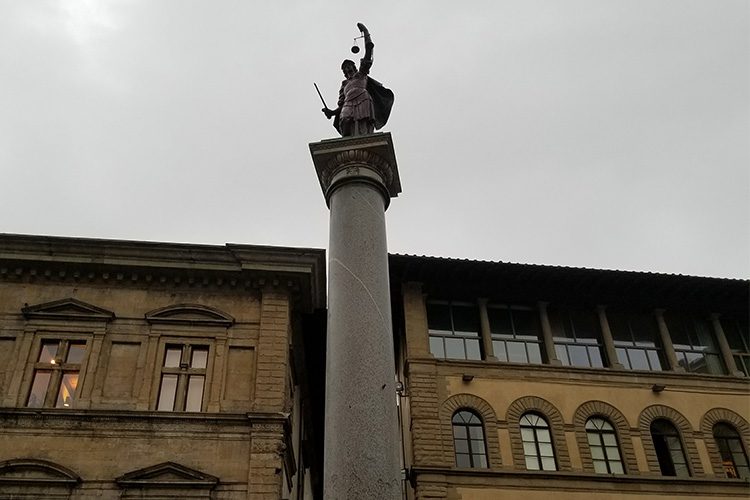
A Roman column stands surrounded by designer brands in the center of Florence.

The Column of Justice in piazza Santa Trinita is one of the many great works of art in Florence.  Unfortunately, it receives little tourist attention, despite being at end of the famous via Tornabouni. Along this road are a myriad of designer and luxury stores that attract tourists from all over; wealthy or not, everyone can window shop. In piazza Santa Trinita the luxury brand stores with their extravagant displays are contrasted with the Medieval and Renaissance architecture of several palaces from Florence’s history. Overlooking this juxtaposition of contemporary fashion and historical architecture is the statue of Lady Justice, stoically watching as the city evolves around her.

The Column of Justice is the largest Roman column in Florence. Atop it stands a statue of Lady Justice, carved out of porphyry stone. The column has two mates in the city, the Column of Peace in piazza San Marco and the Column of Religion in piazza San Felice; neither of which have statues atop them.

The Column of Justice was originally found in the Baths of Caracalla in Rome, but was moved to Florence in 1563 as a gift from Pope Pius IV to Duke Cosimo I de’ Medici.  The journey from Rome to Florence took almost an entire year. It was also attacked several times along the way by Turkish pirates.

The statue atop the column was originally a wooden replica until the current porphyry stone was created. At the time it was carved, porphyry was one of the hardest materials known.  It was an incredibly difficult material to work with for this reason and was carved by expert porphyry sculptor Francesco del Tadda and his son Romolo del Tadda. It took them eleven years to carve the statue to completion, and it is carved from six different blocks of porphyry that are held together by copper linchpins.

The Column of Justice was just made viewable again after a period of restoration.  Lady Justice had noticeable wear and even some holes in her cape before the restoration. But now she is looking impeccable as ever!

See more of Florence and Italy at FUA’s FB, Instagram, and Twitter.

Documenting Strangers

Photo by the Author

By Chrystalla Christodoulou

Have you ever pondered on how you navigate the cities you inhabit or visit? In this piece I discuss a change in mediums I made in order to find my place in Florence’s streets. 

Everything I love about art came from my introduction to photography. It made me appreciate the human body as poetry, with secrets being exchanged between subject and audience. My own camera has helped me turn moments of joy, doubt, and vulnerability into art.

However, when travelling, photography becomes a game for me; it gives me adrenaline and pushes me around. I didn’t want to remember my time in Florence as a rushed hunt.

So I bought a sketchbook.

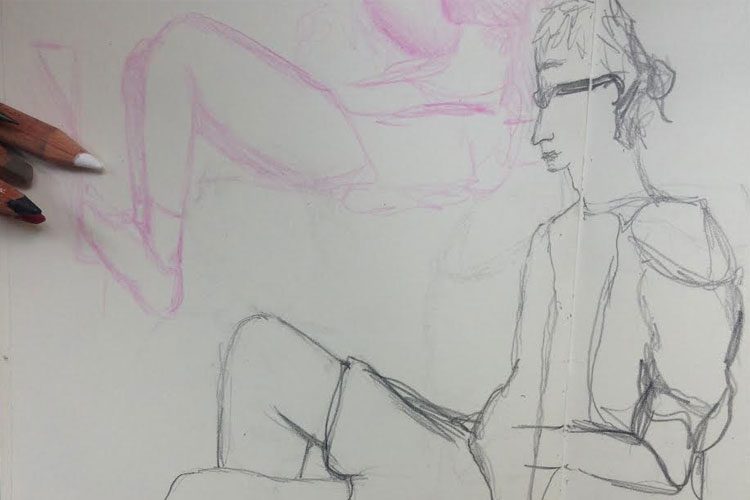
Drawing pulls me to the ground. It slows me down, and makes me choose one single atom of this vivid city to analyse.

When someone realises I’m drawing them, they are usually amused. Vastly different from the angered looks I get as a photographer; I am seen as harmless when sketching. They sometimes accentuate their pose, or even ask to see themselves.

I sit on the steps of Palazzo Vecchio and observe a couple presumably travelling together. They are discussing the David, as tourists and residents alike rush by them. In that moment, they are still unaware of me so I take my time in documenting her hat and his ponytail.

When I look back at the drawing I remember waiting for my friend, knowing she’ll be mad because of my dead phone. I remember the man trying to make his companion laugh, and her looking away. I know exactly what song I was listening to, playing from a stranger’s phone. A new favourite.

See more of Florence and Italy at FUA’s FB, Instagram, and Twitter.

Venice in a Day?

Photo by the author
Photo by the author

By Monica Humphries

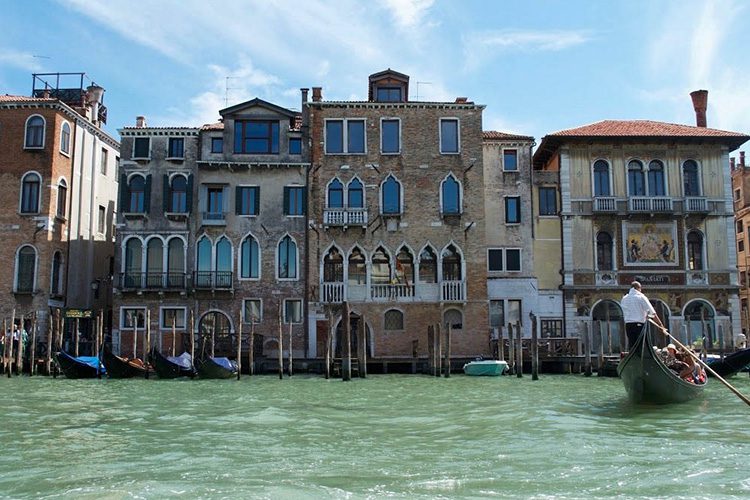
Venice is full of little nooks and crannies but often the beautiful, wider bodies of water are overlooked. This shot was taken from a gondola. The contrasting blues from the water and sky along with the architecture of the buildings and windows captured my vision of Venice. To fully understand Venice you have to be on the water, which is why it was important for me to have a photo from a lower perspective and angled up towards the sky and windows.

Travel Tips:

Known for its gondolas and seafood, Venice feels like a must-do if you’re spending your summer in Florence. But when I opened my map and my budget, I had to ask: one day or two?

Venice is a small city made up of over 100 islands, and although it may seem small from the scope of a map, there’s a lot to do in Venice. Highlights of Venice include watching glass blowing in Murano Island, taking a gondola ride, viewing the contemporary art museums and sipping a Bellini next to the water.

With Venice being so small, one of its challenges is finding a place to stay. If you’re on a student budget there aren’t a lot of options within the city. However, just outside the city there a quite a few places with differing budgets. You can find everything from a typical hostel to a campsite. So pick a place and factor the added time a train ride to the city will take.

Also consider price. Venice is known for luxury. Being a college student, it might be a little more difficult to spend €80 on a boat ride or €30 on dinner.  It’s important to consider food and activities when making a decision on how long to stay.

Finally, know what you want to do. Are you planning on getting there at the crack of dawn and staying to see the sunset? Will you venture to any of the farther islands? Are touring the churches important to you? In order to know what you want to do, you have to know a little about the city. Venice is known Biennale, a six-month art festival. Each year it switches between art and architecture (this year is architecture), and it’s held from May to November. But even if you don’t go during festival months, there’s always an open contemporary museum to discover. Another favorite form of art for Venetians is food. Being on the water, indulging in seafood is a must. Outside of seafood, Venice has wonderful Tiramisu, pasta and drinks to enjoy. Finally, Venice is home to Saint Mark’s Basilica. This and a huge piazza are in the heart of the city. You could spend weeks in Venice and still have a full list to do, so if you’re planning on going just for a day, do your research and make a list of the key things you want to get done.

In a city so beautiful you can spend as much or as little time there. I spent only the afternoon, but I felt rushed. I wish my trip could’ve been more relaxed and the commute not as long, however I was satisfied. Just know that you might not accomplish everything in a single day, but you’ll get a wonderful taste of the city.

See more of Florence and Italy at FUA’s FBInstagram, and Twitter.

From Da Vinci to Mac: Creative Connections

Untitled-2

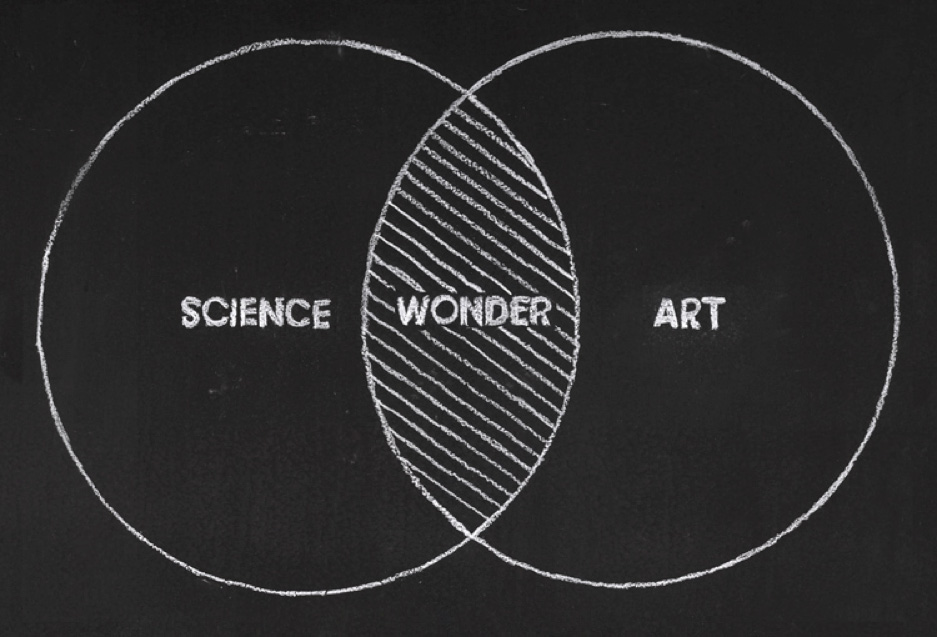
Tuscans like Leonardo da Vinci created a connection between the arts and sciences that continues to inspire global brands like Apple.

Leonardo da Vinci was one Tuscan who blurred the boundaries between the worlds of science and art. Little did he know that the world would be referencing his great work well into the 21st century.

His influence on brands such as Apple began with his use of the “golden ratio,” a ratio that dates back to the 3rd century BC. The “golden ratio” is a concept used to achieve, what is considered, perfect balance and beauty. This concept is still used today in order to create precise and relative designs. Apple is known to have used the ratio in several of its products, such as the iCloud logo. The company logo is also thought to have been designed with the ratio in mind but a Quora  discussion online seems to debunk this theory.

Leonardo Da Vinci, Dante Alighieri, Brunelleschi, Michelangelo, and Galileo, are some Tuscan names that can be identified internationally through their renowned works that have all held an impact within the modern-day use in the arts and sciences. These individuals were able to blur the boundaries of cultures by studying profusely and realizing the subtle connections between the inspiration that had been sought by artists, and the teachings that are required for educating oneself. Their ability to wonder, think, and ponder the scientific ideas they were posed with, broke barriers and created bridges between two very different disciplines.

The culture of art and science that Italy has to offer has made a strong impact for the world and its future. Maybe you too, during your term abroad, can develop such studies that will break boundaries and bridge the two worlds of arts and science. Inspiration is everywhere, even in FUA’s very own DIVA campus where Michelangelo’s Tondo Doni was originally housed before its permanent installation at the Uffizi!

See more of Florence at FUA’s FB, Instagram, and Twitter.

Image credit: Venn diagram image courtesy of the Imaginary Foundation.