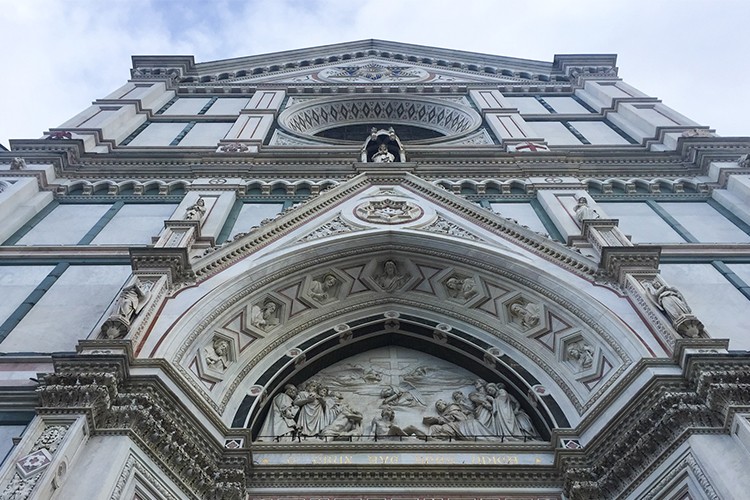
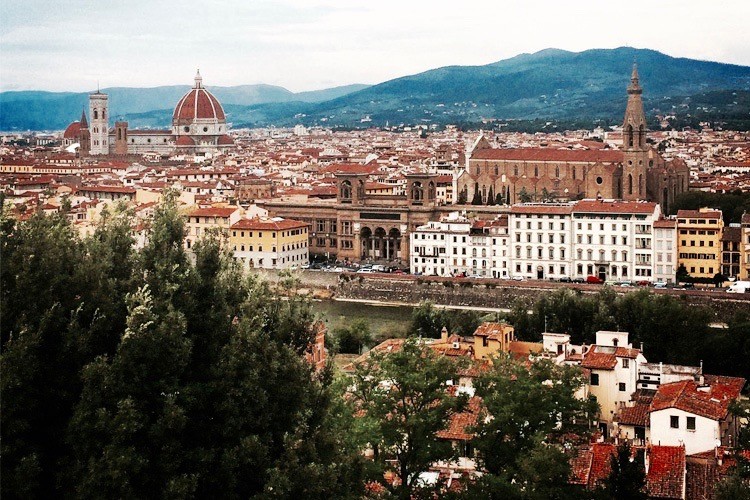
Examining the detail of the Santa Croce church, photo by Morgan O’Reilly
By Morgan O’Reilly
It’s 8:30 on a February morning as I swiftly dodge bikes and local pedestrians on my way to class. The damp chill of Florentine air jostles my bones as my tired eyes stare downwards at the passing cobblestone. The frigid gust of wind and the loom of tardiness pick up my weary feet and hurl them toward the next stone, until suddenly a crack on the sidewalk catches my foot and I trip. Only then do I look up from my monotonous routine and spot a little, hidden bakery; a woman laughing with her daughter; the incredible detail on the Santa Croce archways; and a side of Florence I had neglected to notice.
Falling into a routine comes naturally when settling in Florence: you find the quickest routes, the cheap panini places, and a couple go-to evening spots. Although finding some favorite places will help with your acclimation to the new environment, it is also important to keep exploring the city and appreciating new sights each day. Yes, many weekends will be spent crossing off travel bucket lists, but weekends should also lend themselves to new Florentine discoveries. The city cannot be fully appreciated in one, momentous layer. It opens itself up to its guest every day; tripping and confusing its inhabitants and then strategically placing a hidden gem right in their winding paths
Finding a new sight a day, or moreover, appreciating a new sight a day, can transform the city from a world renowned bustle to a personalized home. Form a realistic plan of things you want to see, do and eat, and try to knock off a few each week. Reach out to your professors and locals for their recommendations. Even on your walk back from class, pay extra attention to the detail on the Duomo; the finely cured meats at your favorite panini spot; the muffled italian chatter in the Oblate Library; veins on statues; love locks on fences; foam on your cappuccino. Explore the Uffizi over and over again, visit Oltrarno’s gardens, grottos, and local eateries, and find those special details and locations you would have overlooked if you hadn’t payed active attention.
The simple act of opening one’s senses to new discoveries can not only act as a mantra for an immensely enriching Florentine experience, it also lends itself to a life of new discovery and appreciation. Begin to notice, to see the overlooked, and to experience the little moments that make Florence so unprecedented.
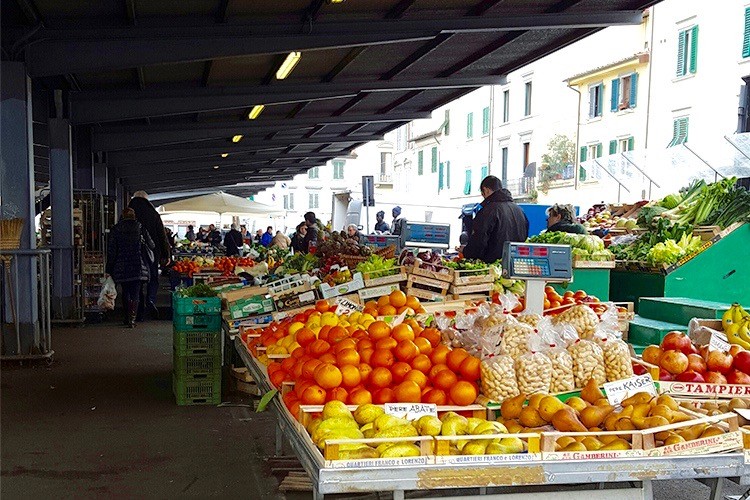
In Florence, venturing into the market isn’t simply about buying food, but it’s also about being part of an authentic experience. You’ll be surrounded by Italian speakers, vibrant colors and something new on every corner to indulge your senses. Vendors can tell you the origin of the foods whether an item comes from the northern regions of Italy or right here in Tuscany. You’ll develop a deeper appreciation and closer connection to these Italian products. Markets are also a great place to observe local life and even practice the language.
You probably heard about the popular San Lorenzo Market before even stepping off the plane to Florence, but there are many more options to purchase groceries in the in the city center.
Sant’Ambrogio Designed by Giuseppe Mengoni and built in 1873, the Mercato di Sant’Ambrogio is home to a selection of fresh fruits, vegetables, meat and fish, breads, and pasta that may offer more advantageous prices than the San Lorenzo Market. The market is both indoors and outdoors, open every day 7am-2pm except on Sunday. It’s about 15 minutes away from the Duomo.
Santo Spirito Every third Sunday of the month, the square hosts an organic food market from 9am to 7pm. You can browse through various stalls of local food purveyors.
Fruit and vegetable grocers: Fruttivendolo Around the city you’ll find fruttivendoli or ortofrutta shops specialized in fruits and vegetables. Everyone has their favorite based on their neighborhood or shopping preferences, try asking professors or new acquaintances at which shops they like to buy their frutta e verdure (fruit and vegetables)!
How to Shop – An Essential Guide
Be sustainable and bring along a reusable grocery shopper bag.
Bring cash instead of relying on a credit card as most vendors only accept cash.
Don’t touch the fruits and vegetables without asking. Tell the vendor what you want. They’ll either give you it or hand you a plastic bag to pick it up before it’s weighed.
Don’t forget to keep an eye out for seasonal fruits and vegetables. Eating seasonally is key to Italian cuisine and the market is a great place to experiment with products that vary as the weather changes.
Know how much you want and how to say it. Although some vendors will know English, this won’t be the case in all situations. I would like… Vorrei…(i.e. I would like 2 apples. Vorrei due mele) Can you give me..? Mi da…? (i.e. Can you give me 2 apple? Mi da due mele?) One Uno Two Due Three Tre Four Quattro Five Cinque 1 pound= about a half a kilogram Mezzo chilo For cured meats, the etto, or 100 grams, is a common unit of measure.
If you don’t see something on the list that you want to purchase, look up the translation and write it down. Don’t worry if you’re having trouble saying something in Italian, or indicating the item that you wish to purchase.
Shopping at local markets is a great option for making dinner at home with friends, preparing fresh packed lunches to enjoy in between classes, or to have healthy snacks on hand such as perfectly ripe fruit. In addition to shopping locally, you can also check out the Apicius CiboChat blog for student reviews of local restaurants, bakeries, gelato shops, and much more.
Welcome to the beautiful, bustling center of the Italian Renaissance. Upon arrival, your bags will be full, your feet tired, your stomach empty, and your mind racing. To ease the initial shock, here is an essential survival guide to help you through your first few days in this incredible city.
1 – Get to know your apartment
When you first walk into your new apartment, you’ll probably feel a mix of emotions. One of these will be excitement, but another one might hit you: confusion. Apartment living may be a little different than what you’re used to at home. Italians value conserving electricity, water, and heat. Turning on too many electrical appliances at the same time can result in a power surge. Don’t expect to take long showers because the hot water will run out. Remember to space out showers between roommates to conserve the hot water and turn off lights when you leave a room. Be environmentally friendly!
Electrical outlets are also different, and it’s very important to use the correct converter/adapter to avoid damaging your devices. Ladies, don’t use your electrical hair tools unless they’re dual wattage and compatible with Italian outlets.
Appliances like ovens, stovetops, and washing machines work differently than what most study abroad students use at home. Carefully read your apartment manual to figure out how the appliances work in your individual apartment. If you find that they aren’t working, don’t panic! Simply visit your MyFUA account and fill out a Housing Troubleshooting form to have the issue resolved in a timely manner.
Pro Tip: Scope out if your sleeping area is facing an internal or external part of the building. Like in any city in the world, facing street-side can get noisy at times, consider whether you may need earplugs or not.
2 – Get to know your area
At first, living in Florence might seem overwhelming. Don’t worry. It’s normal. You’ll be surprised at how quickly it is to get around the city. Begin to walk around the area near your apartment to familiarize yourself with the markets, cafes, and restaurants. You never know, there may be an awesome panini joint right under your apartment.
Take photos of different landmarks for reference when you need help remembering how to get somewhere. Pay attention to your surroundings! Think: how far away is this place from a main square or easily recognizable landmark? Organize a walking tour with roommates or newfound friends. Find the best routes from your apartment and your classes, and it’s also a great way to get to know the city! Knowing where you can grab a quick bite or grab groceries will help Florence feel like home.
Once you become more acquainted with the city, it’s time to find your favorite study spot in addition to the quiet study areas at the FUA Main Library. Head over to the bookstore La Feltrinelli in Piazza Repubblica. You can grab a quick bite to eat from the cafe to enjoy while completing your weekly assignments. There’s also a large selection of books. It’s open all week 9:30am-11pm. If you need a quieter place to do your work, Oblate Library is located near FUA’s J School. Take a study break and head to the top floor where you can find an aperitivo buffet. Peek out the window, and you’ll see a great view of the Duomo! It’s open Monday 2-10pm and Tuesday through Thursday 9-12am. In addition, make sure to explore Florence’s wide array of coffee shops, book stores, and other nooks to find your perfect study area for the upcoming semester.
Pro Tip: Don’t forget to take a picture or carry around a physical copy of your updated registration to avoid walking into the wrong class.
3 – Get to know FUA’s Facilities
Florence’s bustling, crowded piazzas and countless street corners can make anyone feel bewildered upon stepping on this giant historical landmark. One of the most effective and easiest ways to get to know the city lies alongside many of your classes. The Student Life office in Corso Tintori offers events, tours, trips, and free campus facility services. Attending events like the Welcome Reception, walking tours, weekend trips, or free gym classes, can open up possibilities to meet the faculty and staff as well as some fellow study abroad students. After a long day, grab a pastry or some aperitivos at the campus pastry spot, Fedora, or FUA’s student restaurant, Ganzo.
Pro Tip: Exercising at FUA’s gym will not only give you the most for your money, but it can be a great stress reliever for the hectic first week. Also, attending a free class can be a fun, social way to burn off last night’s third scoop of Gelato.
4 – Get to know Italian dining/social culture
In your first few days in living in Florence, you will probably realize that there are some serious culture differences, especially around food. Italians generally sit down for dinner around 8:30 or 9. If they eat out, it is not generally for convenience, but rather as a treat not to be rushed through. A good Italian waiter will never rush a customer, so it will be your responsibility to ask for the check. Here, dining establishments can generally be categorized by three types: Osteria, Trattoria, and Ristorante. An Osteria is a less formal way of eating out with food served at shared tables. A Trattoria serves as the second “level” of Italian dining. These serve inexpensive, regional home cooking. A Ristorante tends to be a little more formal and expensive of the three. But always do a double check if possible, as the names and price ranges nowadays are interchangeable.
Other types of establishments include the Pizzeria, Bar, and places for Aperitivo. We can conclude that pizzerias serve pizza, and they might serve other food as well. The best usually have an actual wood burning oven. Pizzas in Italy are generally individual dishes rather than family style. A Bar in Italy is a cafe, a place for people to grab a quick espresso and a small sandwich or pastry. Aperitivo is usually a pre-meal beverage served with snacks and appetizers, and the popular buffet-style has become a quick, informal way to enjoy dinner and wine with friends. Keep in mind that wine with a meal is an Italian social activity, but excessive drinking is not.
One last note is that tipping in Italy is not a common practice. Waiters and retail employees earn a regular salary as opposed to working for tips, so a required service charge and possibly rounding up a euro or two will more than suffice. This being said, if your service is exceptional; for example if they make you laugh, cry of happiness, or if they pull out their best magic tricks/acrobatic techniques, then by all means tip as you see fit.
Pro Tip: If you want to find a local Italian restaurant, stray away from the main squares and keep your ears open; if the customers speak Italian, it’s a good sign that the experience will be more authentic.
5 – Get to know some Italian
Learning some Italian phrases will not only help you communicate with the locals, but it will also help you better assimilate into the Italian culture. Don’t be afraid of pronouncing things wrong. The locals will appreciate your effort! Practicing each day will improve your skills.
Hello Ciao/Salve (formal)
Good morning Buongiorno
Good afternoon Buonasera
Good night Buonanotte
Good bye Ciao/Arrivederci (formal)
Please Per favore
You’re welcome Prego
How are you? Come stai/Come sta? (formal)
I’m fine Sto bene
Excuse me Mi Scusi
I’m sorry Mi dispiace
I don’t understand Non capisco
How much is it? Quanto costa?
Pro Tip: Check out your Student Manual for other helpful phrases. Download a translation App to your phone when you need help reading a menu or communicating with someone. Or, keep a small notebook to jot down other commonly used words.
Soak up the rich history, enjoy authentic cuisine, and admire the amazing views. Living in a new place might feel scary at first, but Florence will start to feel like home sooner than you expect.
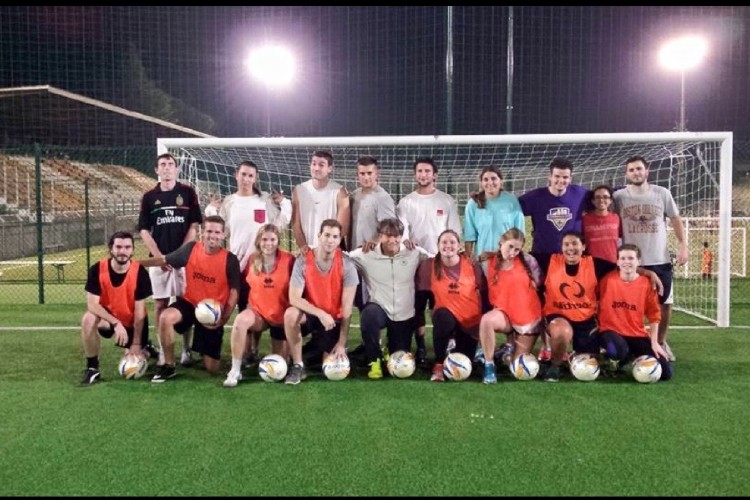
As a Florence University of the Arts student, you have multiple options to experience fitness in Italy, especially through soccer. The first, which is available to all students, is sports night. Every Tuesday night at 8:45pm, we meet at at the FUA fashion campus (FAST) to walk over to the two fields. Lead by Fabrizio Polloni, a former professional soccer player and professor at FUA, we divide into teams and play! It’s perfect for any level of player, from beginner to advanced, and such a fun way to socialize with your fellow classmates and get some exercise.
Another beneficial way to understand the importance of soccer in Italian culture is the Italian Soccer Experience course. Professor Polloni teaches you the basic skills needed in the game, while also giving you a history of soccer in Italy. We traveled to Coverciano, which is the official training area for the Italian Football Federation. There is also a museum which houses the World Cup trophy from 2006 and other historic memorabilia. Through on-field training, classroom discussion, and field trips, each student receives an unique experience on what soccer means in Italian culture.
FUA Student Life & Development tip:
For those interested in other types of fitness activities, check out the Mind & Body activities on designated Fridays or the FUA gym class schedules. And don’t forget, you can always work out at the gym during open hours if you prefer a solo session to an organized activity. Check out MyFUA for upcoming fitness activities and write to sld-studentservices@fua.it for any questions.
Contributed by the Fall ’15 Web & Social Marketing Class
Though Florence has become renowned for its rich culture in historic art, there is a wave of contemporary artists leaving their mark on the city. Taking their talents to the streets and alleyways, Florence has become a canvas for these emerging artists. You cannot walk more than a few blocks without seeing at least one piece of art plastered along the walls. A common theme amongst many pieces throughout town are historical figures in scuba gear underwater. It is known as “L’Arte Sa Nuotare,” which roughly translates to “Art Knows How to Swim.” The artist, Blub, remains anonymous to this day. Though reserved in identity, this artist is making strives in the contemporary art scene this is should prove to have lasting influence on the city of Florence.
Blub is just one of the several street artists in Florence. What examples can you found in and around the city in terms of street art, museums, cultural centers, and local galleries? The history of art has an incredibly important presence in Florence due to the innovations and inventions that happened right here. Yet at times we can get overwhelmed by the weight of Florentine history. Art is alive and ongoing, it is not bound by time periods, as Maurizio Nannucci wrote with neon lighting, “All art has been contemporary.”
When deciding to study abroad in Florence had two huge components to it for me – living in an Italian city to try to adapt to the culture, and also traveling around Europe. Many students who choose to study in Europe have the intention of traveling the continent. Some come with a “list” of must sees, and sometimes students plan each weekend down to a T before even arriving.
Upon coming to Florence, I was struck with a dilemma. I wanted to fully immerse myself for the full three and a half months, learn some Italian, even embrace culture shock in its entirety. Because “when will I ever be able to do this again,” right?
How do you find the right balance between staying in your host city and traveling the world?
First of all – you don’t need to travel every weekend! Some students really jam pack every single weekend they have here, which is fine on one hand, but some of my favorite weekends were the ones spent here in Florence.
On top of that – you don’t always have to travel outside of Italy! There are SO many amazing places easily reachable from Florence, even for a day trip. Some examples of places I went by train or bus include Parma, Milan, Rome, Venice, Lucca, the Amalfi Coast, Perugia, Tuscany, and Siena. Going to these spots was a great way for me to balance traveling/seeing new places and immersing myself in the Italian culture.
Also, it’s o.k. if you don’t make it to every single spot on your “list.” This was a huge thing for me to finally realize. In the beginning I got so caught up on all the cities I needed to see as if I was never ever going to come back to Europe. You will be back. You won’t make it to every city you heard is great – there are waaaaay too many in Europe to see in just three and a half months.
As I looked back at my experience a few weeks before departing, I was thankful to have no regrets about how I spent my weekends. I think I found a great balance traveling in and outside of Italy. So see a few different cities, prioritize the ones you want to see most, or don’t and just wing it. Either way, you’ll go back to those spots you didn’t get to see this time around. That doesn’t sound too bad right?
ps, Looking for local travel ideas? FUA’s Educational Field Trips Department are organized by the Student Life office over several weekends in the semester. The planning team includes FUA faculty who regularly teach culture courses so you’ll get to experience the best of experience and learning about Italy. Check out the current trips online or at the MyFUA portal.
pps, For food exploration starters during your time in Florence, check out the food blog of Apicius, the hospitality division of FUA!
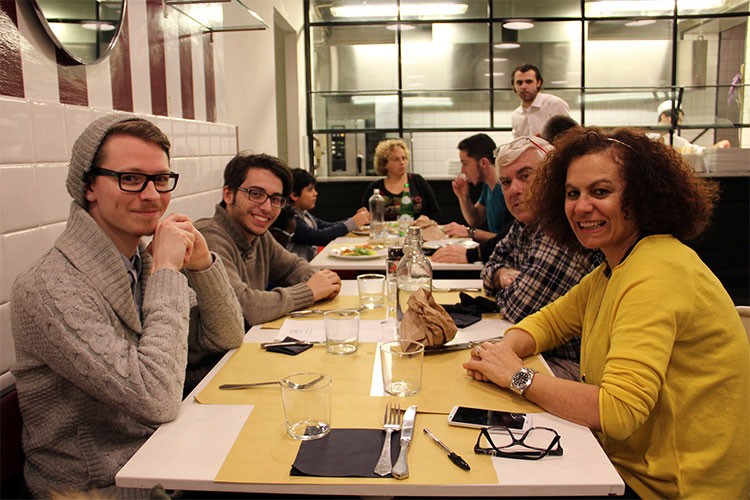
Students meeting new families at the Spring 2015 Italian Family Club welcome dinner
By Kristyn Laviola Photo by Lauren Fromin
As a study abroad student in Italy, I wanted to immerse myself into the Italian culture. Luckily enough, FUA offers an Italian Family Club (IFC) in which students get “adopted” by a Florentine family where both get a hands-on experience of each other’s cultures. Students and families are “matched” according to their common interests and shared characteristics. The application process was simple and quick. All I had to do was attend the first meeting, fill out a one-sided sheet of paper of basic information about myself, and then have a one-on-one interview. When I read the email saying that I was accepted into the program, I was ecstatic!
I was introduced to my family in the beginning of the semester at a group dinner. At first I was nervous and anxious to meet them, but once we sat down at our table, the conversation immediately sparked. My Florentine family consisted of a mother, father, and a younger sister who is seventeen years old. We asked questions about one another trying to learn as much as we could about each other. I thoroughly enjoyed my whole time spent with them that evening.
Throughout the semester, we have met up several times. I have joined them for dinner, watched movies, and we both have helped each other with learning our native languages. Their warm hospitality made me feel welcomed and joining the IFC was one of the best decisions I made here. My Italian family has become my home away from home and I feel as if I could reach out to them for anything and everything. I strongly recommend any student abroad to step out of their comfort zone and find ways to meet the locals of the city they are studying in. The Italian Family Club has enhanced my study abroad experience and I have made amazing connections that I will never forget!
Have questions about the Italian Family Club? Get in touch with the FUA Student Life team at sld-studentservices@fua.it.
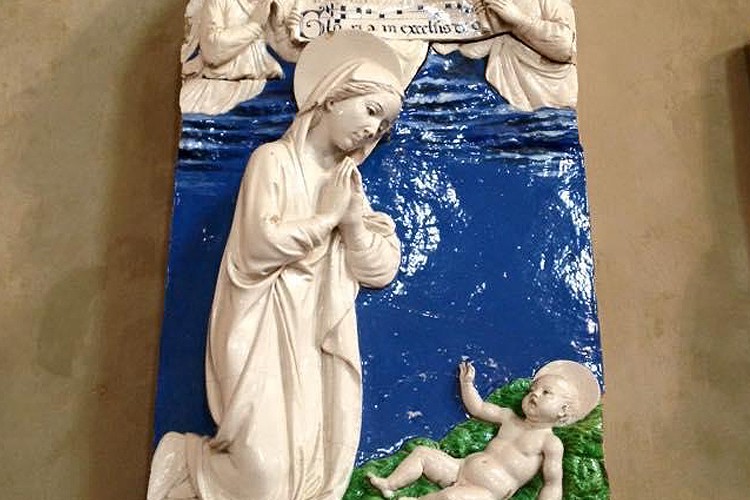
Ever run into gorgeous bursts of ceramic color in Florence or around Tuscany? Tinged with cobalt blue, intense yellow, verdant green, the glazed sculptures of the Della Robbia laboratory are entwined with the history of Florentine craftsmanship. Thanks to a class visit at the Bargello, Rachel Santos digs into the techniques of a family whose origins were documented in the 13th century and whose fortunes transformed in the 1400s when Luca Della Robbia, who trained as a sculptor alongside Donatello, discovered the glazed terracotta technique.
The distinct blue glazes used by the Della Robbia workshop instantly catch your eyes as you enter the first and second floors of the Bargello Museum. The Della Robbia family receives credit for being the first to use the glazed sculpture technique in hopes of creating more distinct and vibrant glazes. Although most known for their blue and white glazes, the Della Robbia family also used green and yellow hues to add even more color to their reliefs. The uniqueness of these glazes came from their chemical compositions; the Della Robbia altered the chemical balance of the glazes to include higher levels of tin and lead in order to increase the durability and opaqueness of the hues. Additionally, chemical studies lead artists and art historians to believe the famous blue glaze came from cobalt pigments. No one, however, can be sure, for these glaze formulas have been kept secret by the Della Robbia workshop. As a result of these special formulas, this family business flourished during the Renaissance, leading to great respectability and prosperity for the family. Be sure to visit the Bargello Museum to see their glazes, their pristine attention to detail and their masterful technique of relief work!
Bargello Museum
Via Proconsolo 4, Florence
Visit the museum website for hours and tickets.
Day trip ideas in Tuscany:
1. The Santuario della Verna is a medieval sanctuary in the countryside near Arezzo dedicated to Saint Francis that contains several important examples of the Della Robbia.
2. Pistoia is a town only a 35-minute train ride from Florence. You can check out Della Robbia works at San Giovanni Fuorcivitas (only 3d sculpture in existence) and the facade of the Duomo. Make sure to stroll around the town while you’re there.
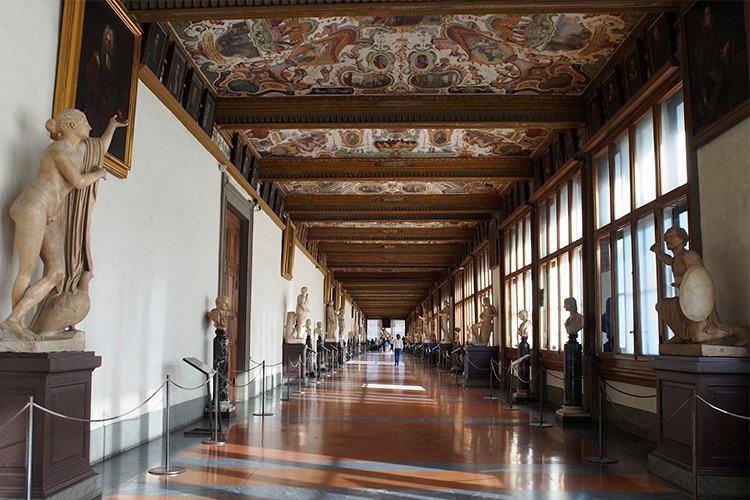
I am not an art major, nor would I call myself a lover of art, but I will say that the Uffizi represents an important historic and cultural gateway to Italy and is a must for all students. Right as you walk into the gallery you are instantly awed by the many sculptures and portraits that line the long halls. Beyond framed artwork, your eyes will also be drawn to the vast and intricate examples of ceiling art. Each of the many rooms in the Uffizi has unique works from artists from around the world. A majority of the art in the Uffizi represents the Italian artists from the Renaissance period such as Michelangelo, Leonardo da Vinci, and Botticelli.
Despite my lack of art history expertise, I still found myself browsing through the Uffizi for several hours of contemplation, and dedicating substantial amounts of time to single pieces. Always plan on several hours to slowly peruse the many exhibition halls, and any art or visual comm majors should plan on a full day. The Uffizi is one of the most popular tourist attractions in Florence and can have lines that may take hours to get through, so in order to avoid lengthy waiting times you can choose one of two options. The first is to buy a ticket online with a reserved timeslot (for an extra fee). The other is to arrive early, around 8am. After all, you don’t want to waste your precious time in Florence standing in lines right?
Visiting the Uffizi for the first time can be daunting. In addition to 1) reading up on the museum, 2) setting aside a good chunk of the day for the visit, and 3) making online reservations, it may be helpful to visit the Uffizi in “bite-sized chunks” especially if you’ll be living in Florence for a few weeks or months. Thematic visits are always fun to plan and allow you to follow a focused path throughout a museum. The following is a Madonna and child-themed itinerary courtesy of FUA faculty member Federico Cagnucci. Pressed for time? A shorter version of the itinerary can be experienced by following the items with an asterisk*.
UFFIZI ITINERARY: MADONNA AND CHILD – FROM RENAISSANCE TO BAROQUE
XIV century: The transition from the Bizantine style of Middle Ages to Renaissance realism in Tuscany (Siena and Florence)
Duccio, Madonna Rucellai
Cimabue, Madonna of Santa Trinita *
Giotto, Madonna of Ognissanti *
Simone Martini, Annunciation *
Pietro Lorenzetti, Madonna with Child in throne with angels
XV century: The International Gothic
Gentile da Fabriano, Adoration of the Magi *
XV century: Early Renaissance in Florence
Filippo Lippi, Madonna with Child and Saints *
Sandro Botticelli, Madonna of the Magnificat *
Sandro Botticelli, Adoration of the Magi
Leonardo da Vinci, Annunciation *
Leonardo da Vinci, Adoration of the Magi
Early Renaissance in Venice
Jacopo Bellini, Madonna with Child
Antonello da Messina, Madonna with Child *
XVI century: High Renaissance and Mannerism
Florence
Michelangelo, Doni Tondo (Holy Family), originally painted for Palazzo Doni which houses FUA’s DIVA/IDEAS campus! *
Rosso Fiorentino, Pala dello Spedalingo di Santa Maria Nuova *
Pontormo, Madonna with Child and Saint John *
Bronzino, Holy Family Panciatichi
Raphael, Madonna del cardellino *
Emilia Romagna and Lombardia
Correggio, Madonna in adoration of Christ
Parmigianino, Madonna with long neck *
Lorenzo Lotto, Holy Family
XVII century Baroque in Italy
Rome (followers of Caravaggio): Gherardo delle Notti, Adoration of the Christ *
Florence: Carlo Dolci, Announcement Virgin Mary
Image credit:
“Uffizi Gallery hallway” by Petar Milošević – Own work. Licensed under CC BY-SA 4.0 via Wikimedia Commons – https://commons.wikimedia.org/wiki/File:Uffizi_Gallery_hallway.JPG#/media/File:Uffizi_Gallery_hallway.JPG
For many students arriving in Florence, adjusting to a new country can take some time. A new language and atmosphere can sometimes create moments of culture shock or homesickness. There are many tips to help with the adjustment process and embrace life in Florence, and the FUA Student Life Department is a great resource for a comprehensive and detailed approach to experiencing your term abroad. In the meantime, here are a few immediate yet easy and essential tips for all students, regardless of how long you’re staying in Florence!
Make an effort to go out of your comfort zone! There are plenty of restaurants and areas that are designed towards tourists, but push yourself to find more localized restaurants and nightlife. It can be very rewarding and help you feel like less like a tourist. This also forces you to practice Italian phrases which is the only way you will ever start to feel comfortable with a new language.
Do something new every day! Florence is a small city, but it is filled with different activities and things to do. Do not let yourself let a day go by without enjoying all that is around you! Your time here is short. (Suggestion: Try a thematic approach, like a street or a square per day of exploration, or bookshops and/or minor museums. Have the day to yourself? Florence can be beautiful when enjoyed in solitude!)
Stay off social media. Staying in touch with your friends and family back home is obviously important, but if you find yourself aimlessly browsing Facebook timelines or Instagram feeds and watching Youtube videos, it’s time to shut it off.
Life in Florence is such a great experience for students. It is important to transition as quickly as possible so you can spend your time enjoying what is around you. Hopefully these first tips provide a little insight into the transition into Italian culture. Have an open mind and have fun enjoying life in Florence!