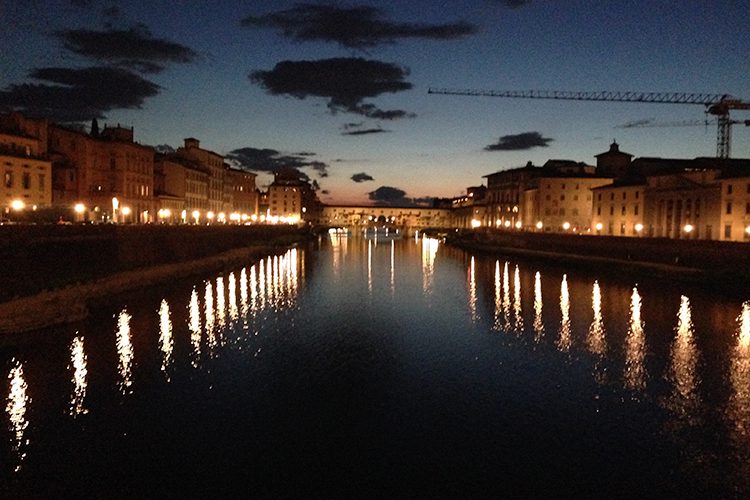
Live Music Evenings in Florence


By Madison Starkey

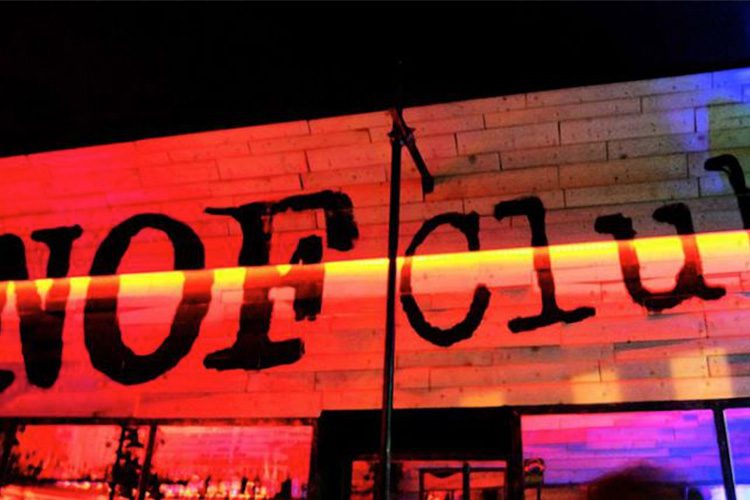
Florence is home to a rich live music scene waiting to be discovered. Madison checked out NoF, a locals’ favorite in the artsy San Frediano neighborhood in the Oltrarno, where the vocals and beat made for an unforgettable experience to be remembered. 

NoF is where good vibes are plenty and musicians from “all corners and crossroads of the globe” are hosted weekly. My friends and I have the good fortune of living just a block away from this cool and confident live jazz club in the Oltrarno neighborhood. We recently caught a performance that I know will be one of my favorite memories of Florence. A young woman with dark hair, black boots, and the strongest, most vibrant voice I’ve ever heard provided the vocals for this unforgettable evening. The night was unforgettable, due to her captivating talent and due to the fact that we stumbled across it by pure chance. We had originally intended to walk past NoF, but the voice of the singer, the rhythm the drummer was banging out, and the smooth, deep sounds emanating from the guitarist’s strings captured us before we could do so. Instead, we wandered, dreamlike, into NoF, and weaved our way through the small crowd to the front of the stage.

And that is where we stayed.

I so vividly remember that night, that music, and stealing glances at my friends faces and enjoying their facial expressions: they were as entranced as I was. The woman’s voice was deep, smooth, and seductive even with the most upbeat songs. The band played mostly jazz music and re-vamped versions of classic hits. I failed to find out what the artist or band’s name was, unfortunately, but I know I’ll be revisiting that night in years to come. In my reveries, one moment I’m taking notes at University, the next, I’m back in that dark wood-panelled room, unable to stop myself from swaying to my imagined, but once real music.

NoF
Borgo S. Frediano 17red

See more of Florence at FUA’s FBInstagram, and Twitter.

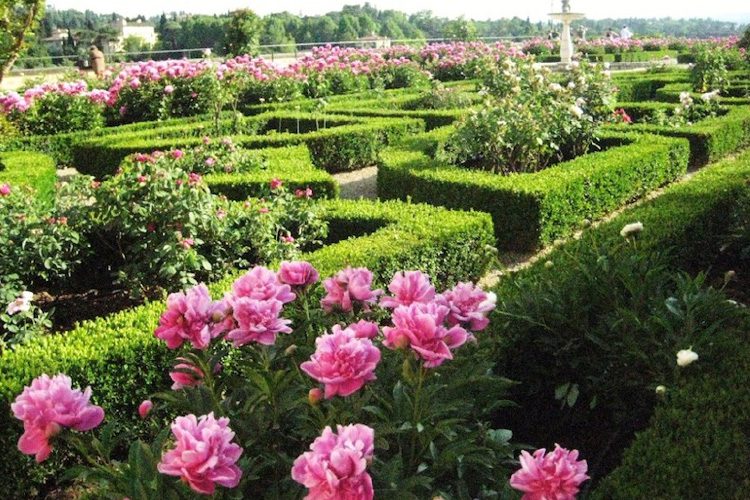
Time to “Leaf” Home for Florentine Gardens

Boboli Garden View

By Samara Rynecki 

Get away from the touristy crowds in the museums and art galleries, and get lost in the green areas of Florence.

These quiet spots can have you feeling relaxed and stress free within minutes. These places are interesting to get lost in and easy to spend hours in. If you want a place where you can feel peaceful and connect with nature, away from the busy and chaotic streets during touristy seasons, then check out these sanctuaries.

There are many options in Florence where you can appreciate the greenery and landscape, They include the Orto Botanico also known as the “Giardino dei Semplici,” the well-known Boboli gardens, the Bardini garden, and Florence Tepidarium at the Giardino di Orticoltura.

Each of these individual gardens is unique in their own, and in Florence. The Orto Botanico is a botanical garden located in Via Micheli, 3. It was originally the Medici family’s medicine garden and one of the oldest in Europe. Today it is a part of the Science of Natural History complex managed by the Italian university in Florence. Boboli is Florence’s grandest palatial garden with an early baroque drama and amazing view of the city. Bardini is not well known despite being connected to Boboli, but its terraced landscape is making a comeback from its previous restoration. The Florence Tepidarium located at the Giardino di Oritcoltura and was the largest greenhouse in Italy when it was built in the late 1800s.

These charming spots for calm walks and cooling off in the heat are going to leave you wishing you were smelling the roses instead of standing in long lines for the major monuments of Florence.

See more of Florence at FUA’s FBInstagram, and Twitter.

Marketing Class Visits Florentine Perfume Company

Photo by the author

By Amanda Guido

FUA’s Marketing Mix class visited with a local perfume-maker to discover the marketing practices of a niche industry.

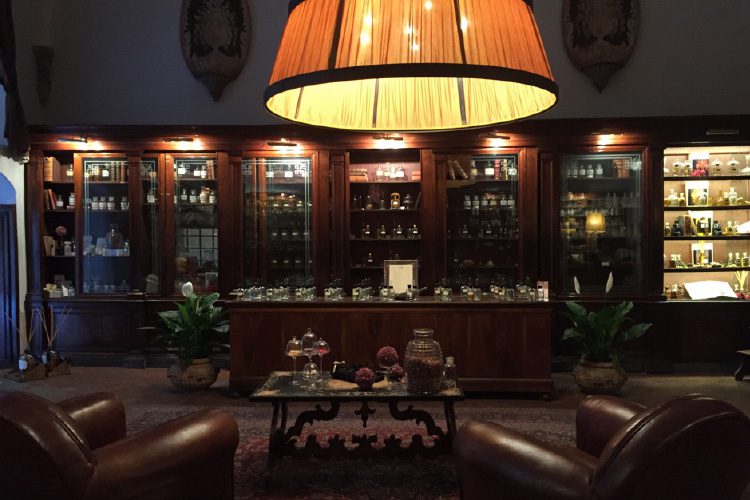
You can smell the rose-scented air even before reaching the street where AquaFlor is located. As you turn onto Borgo Santa Croce, the inviting smell only gets stronger until you find yourself in front of the 15th century Renaissance Palazzo where AquaFlor is located. In case you could not already tell from the image above, this is no ordinary perfume store. AquaFlor is a perfume showroom and laboratory outfitted with olfactory specialists. This is not just a store where you can purchase high quality perfumes, but an experience where you are educated on scents so that you can find the right one for you. Open seven days a week, AquaFlor is truly a hidden gem in the city center of Florence.

During my experience in this magical place, I was given a tour of the grounds from their communications strategies specialist. He explained to us that the perfume industry is growing rapidly, increasing 15% from 2014 to become a 39.2 billion dollar industry. He is taking advantage of this by making AquaFlor different from any other perfumery to create brand recognition and word of mouth advertising.

Clients can spend hours just browsing different scents with the help of experienced olfactory specialists, and create their own scent to take home.

The perfume showroom itself had such a unique aesthetic: classy, put together, and vintage. The first room has diffusers, used to give rooms in the home a pleasant scent. Next, our guide then took us to a room filled with pastel-colored soaps. These are very affordable and would make a great gift for loved ones back home. The third and final room on this floor was where the perfumes are kept. The price point for the perfumes is 140€, but this is a steal considering the quality of the product. Most other perfumes have a high concentration of alcohol and water whereas these have a significantly higher concentration of the actual scent for a longer lasting experience. Even testing the perfume is unique at AquaFlor. The pure scent is concentrated in beakers and a test tube is placed upside down in this scent. You simply smell the inside of the test tube which is meant to give a more accurate feel for what the perfume will smell like when it is worn. Most other retailers spray the perfume on a piece of paper, which is not effective for getting an accurate smell. I personally enjoyed how the rooms were split up by product. From a consumer perspective, this made it easier to shop.

Lastly, we visited the lower level lab. Our guide explained the scientific and chemical aspects of the production process and showed us how the perfumes were made. We also explored scent categories, and the experiential aspect of the visit is a great marketing tool. The Instagram account of AquaFlor is beautifully curated too. You can visit AquaFlor in Borgo Santa Croce 6 in Florence, as well as check out the company’s website.

 Did you know that an FUA alum is a part of the AquaFlor team? Watch this alumni video interview.

See more of Florence at FUA’s FBInstagram, and Twitter.

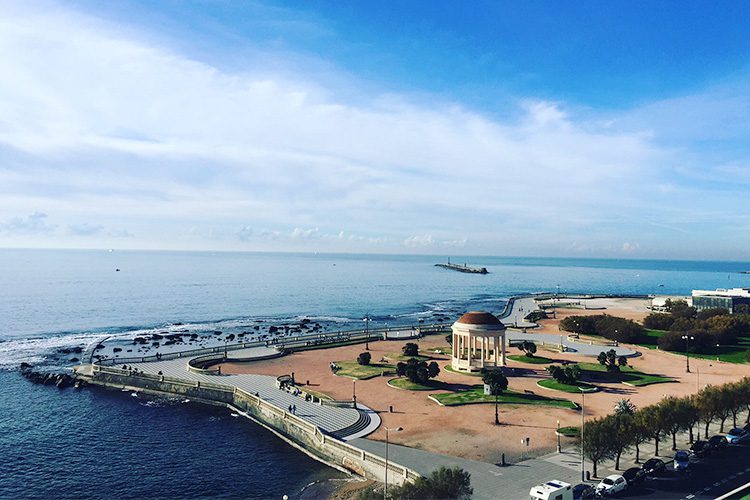
Along the Lungomare in Livorno

Photo courtesy of FUA

By Steven Scaglione

Italy is famous for its food, but did you know that each region, and even more specifically, each city, has their own specialties? When in Italy make sure to try some of these typical dishes that you won’t be able to find back home. This week’s focus is on the Tuscan port town of Livorno.

On the second day of what was planned to be a nine-day bike tour, I finally reached Tuscany’s beautiful port city of Livorno. I had been riding for about four hours, with frayed nerves from sharing the road rather unevenly with trucks of various sizes. It felt nice to pop the kickstand and sit among the trees in Parco Pertini, one of Livorno’s few green spaces just outside the city center while I reflected on my simple priorities for today: find some food, then find the sea.

After checking into a bed-and-breakfast with some difficulty (this key is for the front door?), I was ready to explore the city. With my first priority in mind, I set out to find a 5&5 (cinque e cinque) sandwich: a popular Livornese street food specialty consisting of a savory chick pea flour “cake” topped with olive oil and black pepper then placed between flat schiaccia bread.

To find the best 5&5 around, I was directed by some Livornese locals to go to “da Gagarin,” a torteria near Livorno’s own Mercato Centrale. The building was confusingly nondescript, and I’m still not sure if it has a sign on its storefront or not. But the best advertising a restaurant can have is a line of customers leading down the block, and when I saw this, I knew I was in the right spot.

Edible treasures in tow, I set my sights on the sea, looking to watch the sunset as the waves crashed on the rocks. Two enormous cruise ships sat docked in the city’s port like man-made whales with waterslides and a few freighters sailed steadily on the horizon.

Passing behind the Aquarium of Livorno, the ground under my feet seemed to morph, the familiar gravel being replaced by a seaside checkerboard of black-and-white tiles – something straight out of “Alice in Wonderland.” What was happening? Were all those hours of biking getting to me? Maybe so, but my eyes weren’t failing; these tiles were just some of the thousands composing Livorno’s stunning lungomare, or boardwalk, near Terrazza Mascagni.

The sun was going down in a ball of orange flame, setting the sky ablaze in wispy waves of pink and purple. The freighters turned on their lights to blink their presence cautiously. I unwrapped my sandwich, eating it from the paper wrapping while sitting on the concrete railing of the lungomare and thought about my trip so far. Tomorrow I would start heading south, toward Grosseto and its vineyards along the way. But tonight, just for tonight, I would sit among these black-and-white tiles until dark, watching those blinking lights and listening to the sound of the waves.

See more of Florence at FUA’s FBInstagram, and Twitter.

Il Doppio Bacio

By Christina Trupia 

It is Italian tradition for family and friends to kiss each other on each cheek as a greeting when saying hello or goodbye. If you look around the streets of Florence, you will see this salutation everywhere. Have you adopted this Italian custom or any others yet?

It is the simple gestures that hold a plethora of meanings between those who share them. You can see it between friends passing each other on the street while taking an afternoon stroll, in a restaurant amongst two friends meeting for a meal, or even those departing after a day spent with someone who was once a stranger.  Un doppio bacio, or a double kiss, customarily on the cheek, is a common gesture between those local to the region of the world that I now call home.

Mostly used among those who know each other such as family or close friends, I view this effortless, social gesture as a beautiful and welcoming practice. It is a sign of love and caring for those who have had an impact on your life at some point in time.

Imagine friends from university coming together after years of living distant lives, greeting each other with a double kiss on each cheek as a sign of the relationship they once shared. Perhaps you may see it shared within a family of grandparents, aunts, uncles, nieces, and nephews meeting for a celebration of a new life born into the family. It may even serve as a farewell gesture between a classroom of a small group of students after the completion of a course, or a guide ending their journey with the travelers they have come to know after a full day of touring and adventure in a new place.

It is an engaging tradition that means so much more than a simple handshake or an exchange of words. A small gesture with a heartfelt meaning, the double kiss symbolizes the genuine respect and sentiment we all have for one another.

See more of Florence at FUA’s FBInstagram, and Twitter.

I Wish I Was There When: Piano Invented in Florence

By Lauren Miller

We’re thrilled to introduce our new blog sound bytes featuring original podcast content produced by the FUA Broadcasting New Media course! In the “I Wish I Was There When…” series, FUAers present about landmark moments for the city of Florence told firsthand. In this inaugural radio story,  we reveal how the first piano was invented in Florence in the 18th century by Bartolomeo Cristofori.

Music credit:
Table for Four
Written and performed by CrusaderBeach

Italian Food and the Art of Waiting

Parmigiano Reggiano cheese production

By Emily Entwistle

Italian culture includes many artisan traditions, crafts, and skills. The globalized world can make it hard to preserve such traditions, which are important to maintain and practice traditions.

As part of my time in Florence I have learned about many unique, artisanal food processes. I’ve even visited production facilities in Modena and Parma for a field learning activity. The simple but lengthy processes that these artisans use to produce cheese, balsamic vinegar, and prosciutto are impressive. The extra care and time it takes to organically produce these foods seems like a challenge, but they are worth it. The rules, regulations, and standards set for these producers could seem like a bureaucratic nightmare, but they are implemented to insure that producers stay true to the craft.

There are aged balsamic vinegars that are 20, 50, and even 100 years old. The D.O.P. balsamic vinegars take an extremely long time to age, and once every year they move the balsamic from one wooden barrel to another. Consider also that there is such a huge difference between Parmigiano Reggiano and parmesan. Real Parmigiano Reggiano is aged for a minimum of 12 months, and according to most, the best is 22 to 24 months old. Making artisanal products is a waiting game. For prosciutto, producers add salt and wait. For Parmigiano, they add salt and wait. To make balsamic vinegar, they put the grape juice in a barrel and wait. The key is patience, and when the item is finally ready, it is amazing to say the least. Producing these foods is even a year-round job. Parmigiano Reggiano producers for example work every single day of the year, even on holidays, to keep their process completely natural and authentic.

While a higher cost of these products may seem too high for some people, buying quality foods is extremely important. Not only are they better for you, but they support the special skills of smaller producers. And the food is worth the extra money for the taste alone. After directly visiting production facilities, I have gained a greater appreciation for the craft of food artisans.

See more of Florence at FUA’s FBInstagram, and Twitter.