written by Sydney Kerrihard for SPEL: Public Relations
With only a few months to explore Florence, study abroad students are often swept up in the surface-level customs of the city – refraining from cappuccinos after 11 am or adjusting to the quiet afternoons of the Italian riposo. But beneath these everyday habits lies a city full of rich folklore and deep-rooted traditions, passed down from generation to generation. From haunting ghost stories whispered among children to age-old rituals, Florence’s cultural heritage is far too complex to fully unravel in just a few short months. Yet, it’s these lesser-known stories, tales, and traditions that truly capture the heart of this historic city.
The Ghost of Palazzo Vecchio
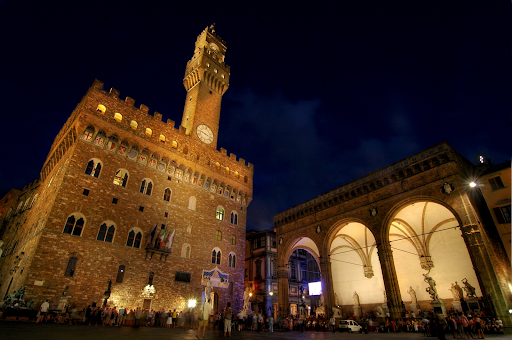
Palazzo Vecchio late at night.
While the exact number of people who were killed at Palazzo Vecchio remains unknown, one story specifically stands out. Baldaccio d’ Anghairari, a military leader notorious for his violent nature, earned his grim nickname “Baldaccio” because of his aggression.
On September 6, 1441, Baldaccio was summoned to the Palazzo Vecchio where he was ambushed – shot from behind, thrown from a window, and dragged into the Piazza della Signoria where he was beheaded. Wrongfully accused of treason, his death shocked the city of Florence, and even the Pope expressed remorse for the horrible crime committed against him.
Since that day, legend has it that Baldaccio’s ghost haunts the halls of Palazzo Vecchio, returning every September 6th. Some believe that every 50 years, Baldaccio would return on the night of his death, holding its head under its arm. In 2001, a couple claimed to have encountered Baldaccio while on a romantic stroll at Piazzale Michelangelo. Having taken some photos of the evening, they later discovered a face staring back at them in one of the pictures. When paranormal investigators confirmed the photo was unaltered, they concluded the face belonged to the restless ghost of Baldaccio, still unable to find peace.
The Legend of “Rifrullo del Diavolo” (“The Devil’s Recoil”)
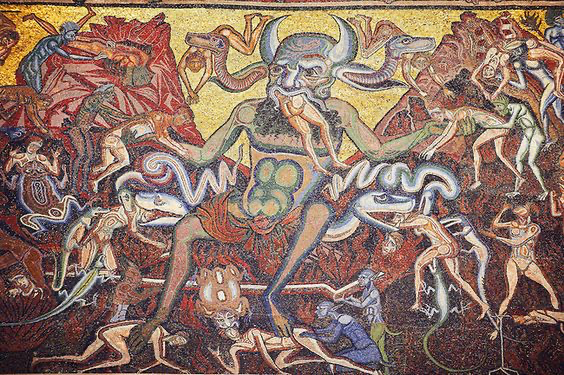
A visual representation of the “Rifrullo del Diavolo”.
Near Via Della Studio, just over the bridge, you will feel a slight breeze that in the winter turns into a powerful whirlwind. The wind is known as the “Rifrullo del Diavolo” or “The Devil’s Recoil”, a strange natural phenomenon rooted in an ancient legend.
The legend begins long ago when the devil was said to be pursuing a priest through the streets of Florence, determined to claim his soul. Once they arrived at the Cathedral of Santa Maria del Fiore, the priest pleaded with the devil, asking to pray one more time before suffering eternal damnation. The devil agreed, confident in his victory, and waited outside while the priest entered the church.
As the devil stood by the front doors, he dozed off, and his snores stirred up a gentle breeze. But when he awoke, he realized the priest had outwitted him, escaping through a back door. Furious at this deception, the devil’s anger turned his snores into a whirlwind of rage.
Since that day, the “Rifrullo of the Devil” has never stopped blowing, waiting in anger for the priest to emerge from the church.
The Rificolona Festival
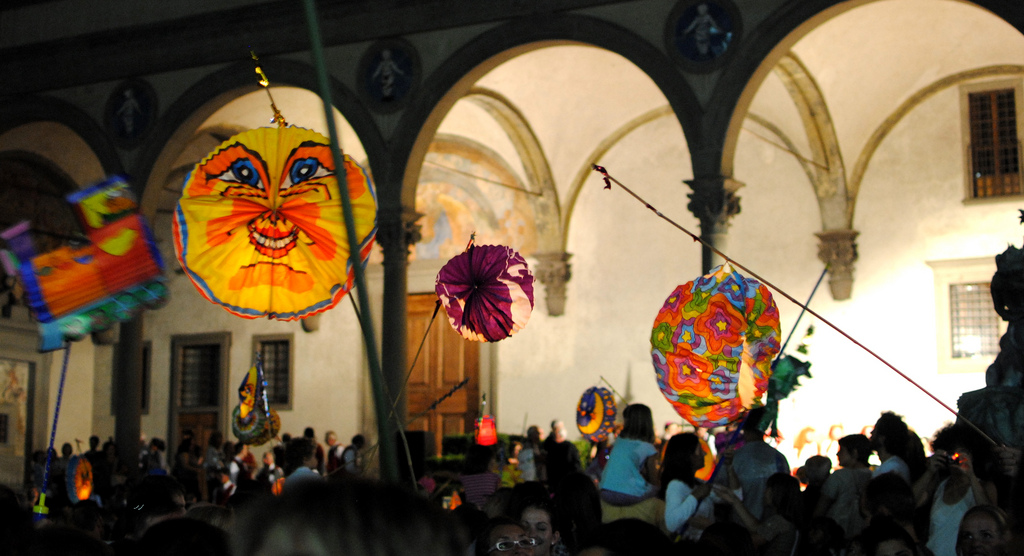
Lanterns from the Rificolona Festival lining the streets.
The Rificolona Festival is an ancient tradition that gained popularity in the mid-17th century. Held on September 7th, the night before the celebration of the Virgin Mary’s birth on September 8th, it marks a unique moment in Florence’s history.
On the evening of September 7th, farmers and merchants from the surrounding countryside would make their way into Florence, bringing goods to sell the next morning. They set out early to secure prime spots in the marketplace, lighting their way with lanterns hanging from sticks, canes, or poles, creating a beautiful collection of light through the dark streets.
Today, this tradition lives on through the children of Florence, who will craft or buy colorful lanterns to parade throughout the city. As they traverse the streets, they chant traditional songs such as the famous folk tune, “Ona, ona, ona che bella Rificolona! La mia l’è co’ fiocchi e la tua l’è co’ i pidocchi” (“Oh, oh, oh, what a beautiful lantern! Mine has ribbons, yours has lice”). The parade begins at the Basilica di Impruneta at 4 pm and concludes at Piazza Santissima Annunziata at 9:30. Sometimes, children will even throw clay balls at the lanterns to try and break them, adding an element of competition to the evening.
The following day on September 8, the terrace of Santa Maria del Fiore opens to visitors, offering a view of the lanterns from the previous night.