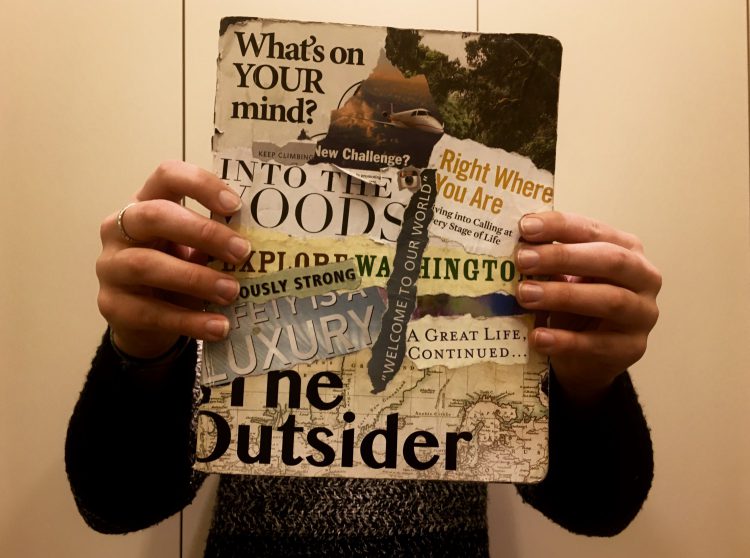
My Journal: A Priceless Souvenir

Photo courtesy of the author

By Amber Wright

“I’m a fickle girl who falls in love easily. It’s happened about a million times since I started my study abroad journey four months ago. I get off the bus/plane/train and it’s love at first sight. No matter where I am, every street, corner shop, and coffee bar seem as if they’re covered in gold. In Siena, I fell in love faster than the horses ran in the Palio di Siena, and in Cinque Terre I could feel the warmth of the sun all through my body – at least for the ten minutes it was out. I’m in love, and I can’t imagine leaving this feeling behind.” – A reflection from my personal journal.

It wasn’t until a month after arriving in Italy that I realized I hadn’t actually bought any souvenirs. At first, I was a little bummed I didn’t buy a bunch of things from the places that I had been exploring, but as I thought about it more, I was thankful I didn’t. Being abroad did not have to be something I did to acquire things. I didn’t have the budget for that, nor did I want to have to carry pointless souvenirs. Instead, I had accumulated memories, feelings, and stories. I hadn’t wasted any time in souvenir shops, instead I was just present where I was spending money on museums and experiences rather than keychains.

I’m one of those individuals who has always kept a journal in some form or fashion. I also have a problem because when I see a new one that catches my eye, I have to have it – which also means I have about a hundred half-finished notebooks. My travel writing class here at FUA requires you to keep a journal for class, which I’m very thankful for. I get so caught up in the exciting day to day, that I often don’t take a breather or moment to reflect. Being held accountable on a constant basis, to journal makes me sit every so often and really reflect on what I’m seeing, doing, and encountering. I have a running list of “things I’ve learned traveling,” “places I need to go back to,” and “favorite memories.” I also have multiple entries about things I’m missing from home, things encountered that I dislike, and general grievances from that day. It’s me and my thoughts put down onto paper, and nothing could accurately represent my time abroad more than this journal.

My journal has actually become the best souvenir I could have asked for. In it now holds the memory of when I went wine tasting for the first time in beautiful Vinci in Tuscany, and I absolutely did not like the glass I had. In addition to my memories of living and studying in Florence, it contains the story of when I went to Portugal with my best friends and walked home in the rain, lost, but somehow wound  up in front of a beautiful monastery. It holds the account of each outlandish costume I ran into in Barcelona on Halloween. My journal is also full of visuals – i.e. funny photostrips from the photobooth across from a favorite pizza slice stop in Florence – every photo features at least one friend taking an overly ambitious bite.

Other than the photostrips, I would say you can’t buy memories. Your thoughts and memories will last longer than any tee-shirt or key chain would. Invest in a journal and constantly reflect and write down what has been happening during your studies abroad. Keep a list of your favorite spots in Florence and jot down the funny moments you have with your friends on the train. Write down how the interior of Santa Croce made you feel, and what you thought about the view from the Duomo. Instead of just being able to say you’ve been to this place and purchased a trinket, a journal will reveal the true fruits of your experiences. It will safeguard your memories, thoughts, feelings, and lessons all associated with a new place, and it will be completely priceless.
See more of Florence at FUA’s FB, Instagram, and Twitter

Home is Where the Heart Is

Photo courtesy of the author

By Amber Wright

If you asked me how many places I’ve called “home,” I would say four – I grew up in California, now live in Washington, worked in Northern Ireland for a few months, and am now studying for four months in Italy. I’ve had to make a home where I am three times since I’ve left where I grew up, and each time my concept of home has changed.

When I first moved to Seattle, it was easy. My close friends in California had all moved, so it was generally painless for me to leave. I found all the things that made me feel comfortable and things that were familiar to me. I found my groove, and I made as many new friends from school as possible to surround myself with.

When I moved to Belfast, it wasn’t so easy. I was very secluded and separated from people where I lived, and the most familiar place I could go was Starbucks thirty minutes away. I hardly met anybody my age while working there and often spent days alone.

As excited as I was to be in Florence for a semester, I was nervous about moving to a new country again. With moving to Florence, I would be here longer and there was an added challenge of the language barrier in trying to make friends. How was I going to meet anybody? I was afraid that I wouldn’t be able to make a home for myself here like I wasn’t able to in Belfast.

Three months later, Italy now feels like home just as much as Seattle does. When I first arrived, I had no idea what to do. I went the first week eating out every night and using a tee-shirt to dry off because I had no idea where a supermarket was or where I could buy a shower towel. Now, after traveling to amazing places like Germany, Croatia, and Spain, I get a sense of comfort, something I never got in Belfast, arriving at Santa Maria Novella Station, walking past the Duomo, and entering my apartment.

Italy has been very different from anywhere I’ve lived before, landscape, language, and climate-wise, but it has become normal and comfortable for me. However, this sense of comfort hasn’t come from knowing where to buy food or from decorating my room, it’s come from the community I’ve been lucky enough to form here. “Home is where the heart is,” “home is where your family is,” and my mother’s personal favorite, “home is where your momma is,” are popular phrases for a reason. Feeling at home is about the people surrounding and supporting you in that place, whether that be friends or family.

My study abroad program staff and the institution have done an excellent job of bringing students together and creating a community that people feel at home in. From taking day trips to having Thanksgiving dinner together, my program has become my family who I lean on for support.

The relationships you form over study abroad are quick and wild. You form friendships immediately because you all know you’re in the same position – a new country where you don’t know anybody. You go to dinner together that first night, then to Piazzale Michelangelo the next day, and then before you know it you’re exploring Florence with these friends every weekend. These friends will be the ones you climb to the top of the Duomo with and also get lost trying to find that one osteria in the far outskirts of city center. You’ll struggle though your Italian language class, and celebrate together when you have your first successful conversation with a local. You’ll discuss the culture you’re immersing yourself in, and also reminisce about the few things you miss about home. Finally, it’s three months later in December, still with two weeks to go, and you’re already crying thinking about leaving these people and leaving what and who has been home for the past few months.

Home isn’t a thing or a place, but a feeling that you get from the people by your side. My time here in Florence is intertwined with the people I spent it with, and I won’t be able to think about Europe without thinking of them. When I’ll look back on living in Italy and how much I felt at home here, it won’t be because of my apartment on Borgo Pinti. It will be because of the amazing friends and community I had surrounding me here making it feel like home.

See more of Florence at FUA’s FB, Instagram, and Twitter

Art’s Greatest Spy: Exploring the Museo Casa Siviero

FUA digital writing students visit Casa Siviero. Photo by Beatrice Santini.

By Leeya Mengistu

A Florentine home-turned-museum houses the intriguing story of a man whose involvement in WWII and fascism in Italy made a priceless contribution to Italian art.

Lungarno Serristori 1 is nondescript in the way that every historical home in Florence blends into the Renaissance landscape of the city. The exterior is a faded shade of yellow. The front courtyard is shaded by trees and the driveway covered in gravel. The building itself is styled the typical Florentine architecture. But the former owner of the home, as well as the treasures that lie inside, are what draws visitors from around the world.

Meticulously cared for by the Amici dei Musei e dei Monumenti Fiorentini, the Museo Casa Siviero hosts the memory and history of classical art’s 007 figure: a man whose reputation as a smartly dressed, valiant ladies’ man is surprisingly much less known than James Bond’s.

Rodolfo Siviero’s two-story estate is home to an exciting legacy. The basement holds a museum of his life and achievements, while the main floor holds the personal art collection of Siviero, who wanted to be remembered for his achievements as a collector as well as his achievements as a spy. The pieces include weapons, paintings, sculptures whose cultural and historical significance attributed to their owner are priceless.

But how did a failed art historian become a national hero?

Siviero, born in 1911, began as a humble humanistic studies major at the University of Florence with dreams of working in art history. Instead, life led him to the fascist Italian secret service, where he became an agent going undercover to recover beloved pieces from the Nazi party. His largest mission in 1937 brought him to Berlin, where he collected intelligence undercover as a persona very close to himself: a student pursuing art history.

A few years later, Siviero joined the resistance in Italy and became an anti-fascist. He began to monitor the movements of artwork stolen by the Germans. This time he worked from the home at Lungarno Serristori after previous owner and dear friend, Jewish artist Giorgio Castelfranco, fled Florence in fear of the incoming Nazis.

It wasn’t long before he was captured and tortured in the Villa Triste, or the Sad House, by the Fascist military in 1944. Committed to the role, he resisted relentless interrogation and won back his freedom. Even today it is still unknown whether Siviero himself was truly with or against the National Fascist Party.

Of course, Siviero’s work was not in vain. Around 200 pieces of artwork recovered by the spy are currently hosted or archived in Florence’s world-famous Uffizi Gallery.

Although anxious to secure his status in the Italian art history world, Siviero remained an obscure figure during his time. An interesting fact, he loved women and a letter to Hollywood’s popular blonde bombshell, Jean Harlow, was reciprocated with autographed photo. Siviero eventually retired his life of espionage and returned to a traditional job in the arts: President of the Accademica delle Arti del Disegno. He maintained the position until his death in 1983, and his home was given to the Tuscan Region in order to keep the legacy alive for generations to come.

Museo Casa Rodolfo Siviero
Lungarno Serristori, 1-3
Free entry, see the below site for opening times.
www.museocasasiviero.it

See more of Florence at FUA’s FB, Instagram, and Twitter

Experiencing Eataly: Italy & the Global Market

Photo by Jess Pitocco

By Anastasia Finney

An FUA Marketing class goes inside the food retail business through a site visit at Eataly Florence.

Studying abroad at Florence University of the Arts is truly an experience like no other.  Oftentimes, this is due simply to the location of this institution in the heart of Florence, allowing effective and memorable learning outside the traditional classroom walls.

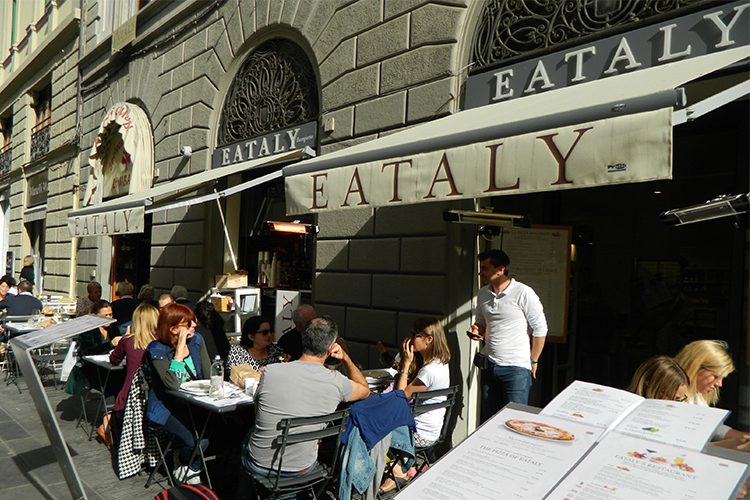
An “Introduction to Marketing” class taught by Professor Andrea Adams experienced a site visit this fall to local Eataly store.  Eataly is a food retailer, comprised of grocery markets and restaurants, that focuses on selling quality Italian goods to an international market.  According to the website, the Eataly mission is “to demonstrate that high-quality Italian food and drink are at hand.”  Eataly also highlights that they not only focus on Italian food itself, but also “living the Italian way” in terms of taking the time to enjoy this high-quality and local food.

The marketing class was able to go on a tour of the Eataly facilities, as well meet with a store manager to get an insider’s perspective.  “We got to learn about an Italian business through an international marketing perspective,” said student Nicholas Tyndall.  “I got a new view on how Italian businesses are vying to compete in an evolving global marketplace.”

Founded in 2007, Eataly has already grown exponentially and received international attention.  The most recent addition to the company is a second New York City store in downtown Manhattan, opened in August 2016, which has received excitement and positive reviews.  The students in this marketing class were able to see Eataly here in its founding country, as well as see how it has already influenced their home countries.

Besides in Italy and the United States, Eataly has locations in Brazil, Japan, South Korea, United Arab Emirates, Germany, and Turkey.  From the presentation, Tyndall said the most interesting thing he learned was “how far Eataly has already spread across the globe and how aggressive its expansion plans are for the future.”  The company plans to open additional stores across the United States, as well as expand into Canada, Mexico, France, Russia, China, Australia, and more.

The marketing class also received student cards from Eataly to experiment with the customer experience of benefits and discounts, ranging from bakery items to restaurant meals.

“I like that FUA really emphasizes this kind of experiential learning,” Tyndall concluded.  “It makes the material much more interesting and helps you to explore Florence itself.”

Interested in visiting Eataly?  The main store is on Via de’ Martelli, 22, right by the Duomo.  There is also a smaller Eataly marketplace within the Mercato Centrale – Via dell’Ariento, 50123 Firenze.

See more of Florence at FUA’s FB, Instagram, and Twitter.

A Local & Two Foreigners: Our Favorite Places in Florence

Photo by the authors

By Amber Wright, Deborah Galasso, Jess Pitocco

Our mission this week between the three of us, Amber Wright, Deborah Galasso, and Jess Pitocco, was to write down the places that best symbolize or represent Florence, Italy. It proved to be pretty difficult; there are thousands of unique bars, monuments, churches and museums to visit in the city. It could take years to explore all that Florence has to offer! Even so, from each of our own perspectives, domestic and abroad, we chose our favorite spots in Florence.

Florence from the perspective of a local, Deborah Galasso, is full of art, culture, and cappuccino. Her favorite parks, restaurants and artistics centers that, in her opinion, best describe the culture and feeling of Florence, Italy:

  1. Villa Bardini is a magical place where I go frequently. Today, it is an exhibition center that hosts temporary shows. Villa Bardini is a beautiful garden setting, and can be visited today separately with the same ticket that you would purchase at the Boboli Gardens.
  2. Opera di Firenze is another particular place I visit as a fan of art, theater, and Florence’s musical works. I like the unusual and modern structure, and the theater’s interior is spacious and gorgeously decorated.
  3. I always go to Anfiteatro Romano alle Cascine because I love art. This amphitheater located in the Cascine Park, and takes us back to past times. It’s a historic space for indoor and outdoor events in Florence, the best ones are featured in the summer.
  4. Giardino del Drago, near Via Bolognese and a part of the Giardiano dell’Orticultura, is a relaxing place that makes you admire the beauty of Florence from another point of view. The distinctive and artistic statue in the shape of a dragon is at the center, and gives the garden its name. It is a place I visited as a child and remember fondly to this day.
  5. Chiosco is a small bar/kiosk along the Arno near St. Niccolò. It’s great especially in the summer, because you can observe the river while having aperitivo. The bar is close to the Arno, is full of lights, and has a fun atmosphere.”

Florence from our perspective, Amber and Jess, two study abroad students, is a bit different. These five places represent Florence for us because they are landmarks to help us get home, great food and shopping, and places that make Florence feel like home since we’ve arrived.

  1. We pass Piazza Gaetano Salvemini every day on our way to class at FUA’s J School. Whether in the morning or at night, there are always a myriad of characters in the Piazza, from tourists to locals. The old men play chess near the bike racks everyday, and the dog owners are followed by their pooches without leashes. There are helpful places on the edges of the palazzo: an ATM, Tabacchi, and 99 cent store. It is a place where everyone gathers for errands and meals!
  2. Sant’Ambrogio Market is the most authentic market we have found in Florence, and conveniently one of us lives across the street from it. We love ordering a cappuccino at the bar inside, while listening to impromptu performances of the violinist and cellist in the center of the market. This indoor-outdoor market is cheaper than Central Market and offers everything from clothing, antiques, to any type of produce and food you could imagine – a gem for foodies!
  3. La Milkeria is a small boutique coffee shop on Borgo degli Albizi. Every so often when we’re missing home, we go in there and get a good ol’ bagel. It’s our little secret how often we go in there to get a taste of home!
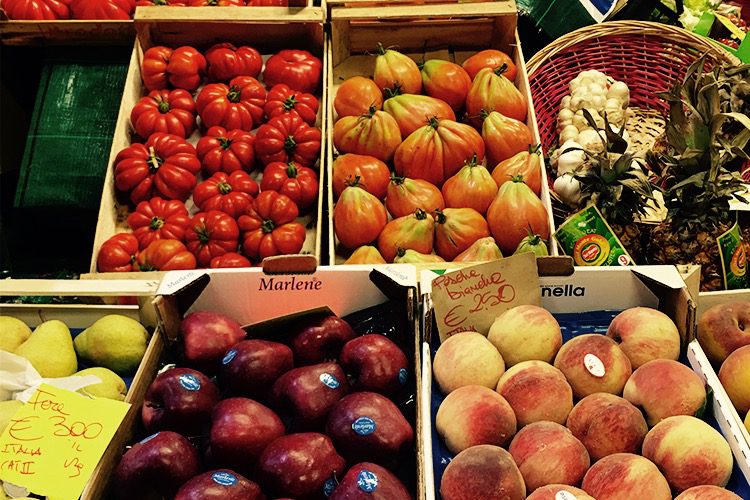
  4. Walking east on that street, you’ll come to Piazza di San Pier Maggiore. This square used to be the home of the Church of San Pier Maggiore. While it no longer stands, the reconstructed arches of the church still outline the square. There is a fresh produce stand in front of the arches that is the perfect place to grab a piece of fruit on your way to class. We love stopping in this square to imagine what it used to look like!
  5. Lastly, our favorite part of Florence are our own streets. We walk home and every time we stroll down our roads, we stumble upon a new shop or new restaurant. We continue to discover a mix of small boutiques, local restaurants, and vintage shops in our own corner of Florence. As we get closer to our homes, street art and familiar places welcome us home – our favorite places in Florence.

See more of Florence and Italy at FUA’s FBInstagram, and Twitter.

The Love Affair of Dante and Florence

Photo by Amber Wright
Photo by the author

By Amber Wright

Every time I walk down a corridor of the Uffizi, I look Dante in the eye. I bitterly and sarcastically thank him for making me work so hard in the literature class I took my senior year of high school. Oh, The Divine Comedy. I still have the poem on my shelf back in California with copious amounts of notes in the margins, yet somehow I completely forgot Dante himself was a Florentine. Now living in the city’s center, it seems I cannot walk down the road without metaphorically looking Dante in the eye.

It’s not hard to miss the admiration Florence has for the poet. According to FUA faculty member Marta Russo, there are over 100 references to Dante throughout the city. He had a love affair with Florence as you can see in his poems. However, it was not always like this. In Florence, he was involved in a political struggle between the Guelphs and Ghibellines, and these rival parties disagreed on who should hold power in Italy. The Ghibellines supported the Holy Roman Emperor and the Guelphs were in favor of the Pope. Dante himself was a Guelph and was eventually exiled for it, but you wouldn’t know by Florence’s current celebration of the poet.  

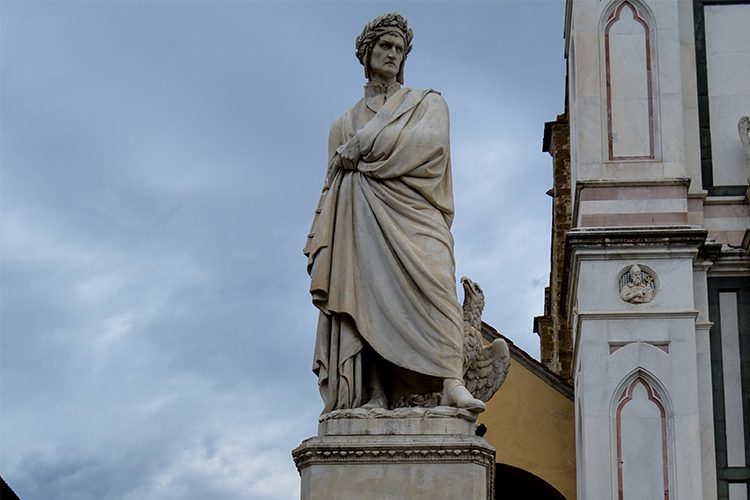
The most obvious places to see Dante in Florence are the Uffizi – in the museum’s outdoor gallery of statues – and in front of the Basilica of Santa Croce. As mentioned previously, Dante was exiled from Florence for his political stance among the Guelphs. He never returned, and was buried in Ravenna – this is something Florence is still trying to cope with. According to Prof. Russo, the cities to this day disagree over where his bones should rest. While he isn’t actually buried there, Santa Croce still houses a tomb in his honor.

This love struggle isn’t one-sided: Dante loved his city back then as much as it loves him now. The father of the Italian language references Florence in many passages in The Divine Comedy. In Canto XXVI, Dante proclaims, “Florence, rejoice, now that you have such fame, and over land and sea you spread your wings! The whole Inferno’s ringing with your name!”

He may have been exiled, but his ties to Florence were undying. In fact, if Dante had not been exiled, he may have not written The Divine Comedy at all, says Prof. Russo. It was his exile that made Dante realize and understand his great love for his city. He was able to step back and fully understand the greatness of where he was from, and essentially intertwine this passion into his poem.

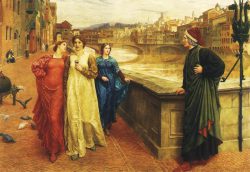
Dante and Beatrice, painting by Henry Holiday

Today, Florence honors Dante with plaques and statues around the city. They are its olive branch to the great poet, and a way to preserve his great history.  I see this preservation not only when I visit the Uffizi, but also when I walk down Via Guelfa. I see his legendary presence on the corner where he first saw his true love Beatrice and am reminded of the ultimate love story that Dante lived, with his native city.

See more of Florence and Italy at FUA’s FB, Instagram, and Twitter.