Filistrucchi: Fake Beauty, Real Tradition

Photo by Megan McCall

By Melissa Maize

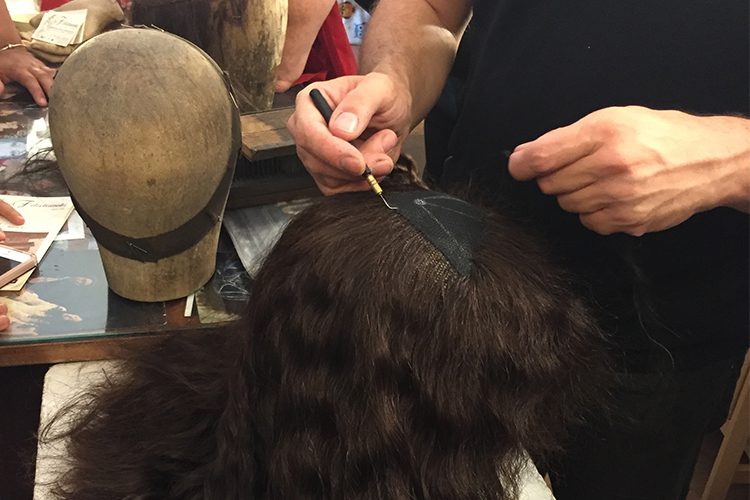
Filistrucchi is a Florentine institution that makes the ordinary, extraordinary. FUA Digital Writing students recently visited the historic theater makeup laboratory and shop. 

If you could be anyone, who would you want to be?

If you could swap faces, swap lives, even for only day, who would you choose? A Duke, a Duchess, Abraham Lincoln? Lady GaGa? At Filistrucchi, you can be anyone.

We all have little things about our appearance we’d like to change- smaller nose, thicker hair, higher cheekbones- and Filistrucchi was built on that need. Established in 1720, it catered to Florentine nobles, providing wigs and make up to suit their stylistic needs. It then developed into one of the leading make-up and hair providers to the Opera and stage, and later cinema. Gaining notoriety as masters of their trade, their clients soon spread as far as New York and Boston.

Perusing photos of their work, the shop owners recount stories of how they transformed men into women, women into men, old into young, the transformations often so complete that the clients’ families didn’t even recognize them.

It’s amazing to think that all that stands between you and complete anonymity is a few layers of make up. It seems to me that Filistrucchi has survived three hundred years and two epic floods not because beauty is timeless, but because the desire to look beautiful is.

See more of Florence and Italy at FUA’s FB, Instagram, andTwitter.
Art History: A Different Perspective

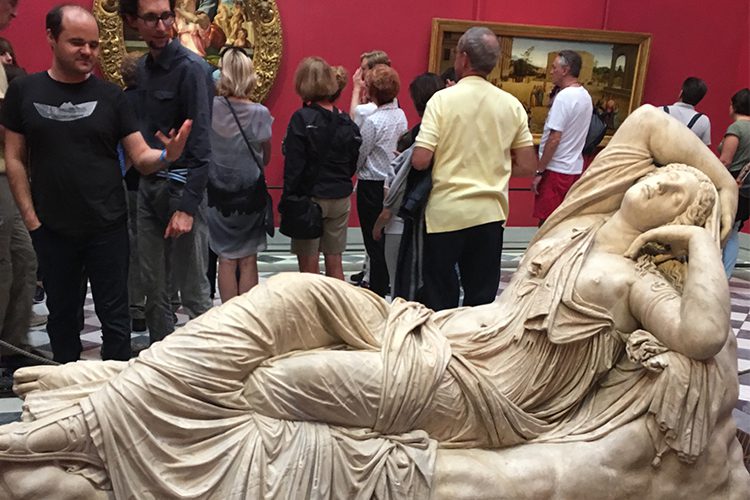
Visitors at the Uffizi. Photo by Jessica Pitocco.

By Nicole DeCosta

Alicia Deakin from London discusses how being in Florence has had a first hand impression on her perspective on Art History.

After the first half of the semester here at Florence University of the Arts, the students seem to be settling in nicely to the bustling lifestyle of classes during the week and exploring on the weekends. Sitting down with 21-year-old Alicia Deakin from Suffolk, England we discussed how she has had to adapt to this cultural change and new lifestyle.

With classes taking place Monday through Friday, Deakin said that her art history class is held twice a week.

“I’m happy that the class meets twice a week. Originally I found myself comparing my schedule to other semester students taking once a week classes, but I quickly realized just how much I enjoyed the class,” said Deakin. “I was feeling super lucky to be able explore the city of Florence and take part in the included field learning city activities offered through the class.”

Taking an art history course through FUA, Deakin said how amazing it was to experience this much raw culture within a class. When asked why this class was her favorite, she said how inspiring it was to be amongst some of the most amazing artwork she’d ever seen.

“Offering me new skills that I have not used in sometime, because I had taken a few years off from University, this class provides me an opportunity to study a new topic that both interests me and excites me,” said Deakin.

Noting the high quality education being provided to her through FUA, Deakin said, “the difference in my classes here from in London are so drastic, it is important to see how much the professors want to engage with you as students, while also wanting you to have the best possible experience in Florence.”

Since Deakin has never studied art history prior to coming to Florence, she said her favorite part is the novelty of the class, learning new topics, while also being placed within the Florentine environment. Knowing she is able to see the art firsthand, Deakin is thankful for the opportunity that FUA has provided her, and being here has allowed her to open her cultural perspective.

Offering students an opportunity to receive a strong education, while also an experience of a lifetime, including travel, cultural exchanges, and new opportunities, attending FUA, Deakin says, “is a once in a lifetime experience!”

See more of Florence and Italy at FUA’s FB, Instagram, and Twitter.

The Love Affair of Dante and Florence

Photo by Amber Wright
Photo by the author

By Amber Wright

Every time I walk down a corridor of the Uffizi, I look Dante in the eye. I bitterly and sarcastically thank him for making me work so hard in the literature class I took my senior year of high school. Oh, The Divine Comedy. I still have the poem on my shelf back in California with copious amounts of notes in the margins, yet somehow I completely forgot Dante himself was a Florentine. Now living in the city’s center, it seems I cannot walk down the road without metaphorically looking Dante in the eye.

It’s not hard to miss the admiration Florence has for the poet. According to FUA faculty member Marta Russo, there are over 100 references to Dante throughout the city. He had a love affair with Florence as you can see in his poems. However, it was not always like this. In Florence, he was involved in a political struggle between the Guelphs and Ghibellines, and these rival parties disagreed on who should hold power in Italy. The Ghibellines supported the Holy Roman Emperor and the Guelphs were in favor of the Pope. Dante himself was a Guelph and was eventually exiled for it, but you wouldn’t know by Florence’s current celebration of the poet.  

The most obvious places to see Dante in Florence are the Uffizi – in the museum’s outdoor gallery of statues – and in front of the Basilica of Santa Croce. As mentioned previously, Dante was exiled from Florence for his political stance among the Guelphs. He never returned, and was buried in Ravenna – this is something Florence is still trying to cope with. According to Prof. Russo, the cities to this day disagree over where his bones should rest. While he isn’t actually buried there, Santa Croce still houses a tomb in his honor.

This love struggle isn’t one-sided: Dante loved his city back then as much as it loves him now. The father of the Italian language references Florence in many passages in The Divine Comedy. In Canto XXVI, Dante proclaims, “Florence, rejoice, now that you have such fame, and over land and sea you spread your wings! The whole Inferno’s ringing with your name!”

He may have been exiled, but his ties to Florence were undying. In fact, if Dante had not been exiled, he may have not written The Divine Comedy at all, says Prof. Russo. It was his exile that made Dante realize and understand his great love for his city. He was able to step back and fully understand the greatness of where he was from, and essentially intertwine this passion into his poem.

Dante and Beatrice, painting by Henry Holiday

Today, Florence honors Dante with plaques and statues around the city. They are its olive branch to the great poet, and a way to preserve his great history.  I see this preservation not only when I visit the Uffizi, but also when I walk down Via Guelfa. I see his legendary presence on the corner where he first saw his true love Beatrice and am reminded of the ultimate love story that Dante lived, with his native city.

See more of Florence and Italy at FUA’s FB, Instagram, and Twitter.

When Life Gives You Fashion

Photo by Ryan McGuire via Gratisography

By Max Slepian

Most of us go through life in a comfort zone.  We like to start our day with the breakfast we like, do the job we are use to doing or go to the classes we signed up for.  But every once and a while we are put in a completely unfamiliar situation and we have to learn how to deal with it.  I was recently thrown into one when I attended my first Fashion Marketing class.  

I was one of two men in a classroom with 30 women.  In any other situation this ratio of males to females would’ve simply been laughed off as an advantage for the guys, but in this case there was much more in store.

The instructor started the lesson by reassuring us that it was not necessary to be a fashion or marketing expert but naturally it helps to know about these areas.  I didn’t know much about marketing and besides the Project Runway marathons that I had to endure with my mom when I was still in high school, I was pretty clueless about the subject of fashion.  After all, I was the guy who wore plaid shorts with a striped t-shirt just this past summer, and couldn’t decide if I should rock my “senior citizen” New Balance running shoes or Leggo socks with neon green Crocs.  It goes without saying that I was clueless about fashion and made no secret of it when we made class introductions about our backgrounds and areas of study.  In a sea of fashion and retail majors, I was the lone undeclared student.

Our first exercise was to watch the 2015 Milano Fashion Week runway and provide three adjectives that encompass the essence of the collections and a type of car you would market with each.  As the first collection came down the runway, I noticed the dresses were green, yellow and “flowy,” which seemed like somewhat sufficient adjectives.  Afterwards, we were asked to share our chosen adjectives.  Words like “feminine,”  “chic,” and “earthy” were some common adjectives while not one person said anything close to “yellow.”

I was grateful the professor didn’t call on me to share my disappointing adjectives, but my luck ran out when I was asked to share the car I would chose to market with this collection with.  My mind started racing for a good answer.  I was thinking that a general consensus for the collection was that it was earthy and before I knew it I blurted out “uhh… a Prius?”  The class burst into laughter and I quickly realized that the environmental advantages of a hybrid car doesn’t immediately qualify it as a fashionable pairing.

My fashion knowledge has yet to vastly improve, but after time my presence in the class has seemed to become less a fish out of water.  I probably don’t have the exact response to answer the question of how to deal with a situation in which we are totally unfamiliar with.  But if I have learned one thing, it’s that you should try out unfamiliar contexts even if the content seems unknown or you perceive to less knowledgeable of a subject matter compared to others. Dive in headfirst and don’t be afraid to speak, because if we are never called out on our mistakes there is no way to learn from them.

See more of Florence and Italy at FUA’s FB, Instagram, and Twitter.

Gearing Up for Exams!

Photo by the author
Photo by the author

By Leanora Karnath

Amidst the excitement of living in a new country, being in a different environment may pose some challenges in adjusting to new study habits. Participating in the classroom can be just as eye opening as sightseeing in Florence. You’ll also have the opportunity to meet students from all parts of the world to share different perspectives when discussing class material. If you’re having trouble achieving a balance when mid-terms and finals roll around, the following tips may come in handy.

  1. Keep a planner to track all your assignments and upcoming exams. With traveling plans and to-do lists filling your head, it can be easy to forget about due dates for classwork. Purchase a beautiful leather planner from a local shop or download a simple calendar app that allows you to set reminders. Because your weekends will probably fly by with traveling and exploring Florence, make sure to complete your assignments beforehand and avoid the stress of doing things in a rush!
  2. Find a space that suits your study needs. Some people are most productive in quiet, secluded areas while some don’t mind the chatter of others. Figure out what works best for you, so you’re not wasting your time in a difficult place to concentrate. Consider stepping out of your apartment to find a cafe where you can study. You’ll also avoid dealing with any roommates who may distract you. The FUA library in Corso Tintori provides a quiet zone for serious reading and reviewing. If you want to go somewhere with a view, take your notebook to Oblate Library to see a view of the Duomo or bring your study materials up to Piazzale Michelangelo (be aware of crowds though). Need to be surrounded by green to power your thinking? Try the Cascine Park, the Giardino di Orticultura, or green squares such as Piazza d’Azzeglio and Piazza Demidoff.
  3. Wake up early a few days a week. If you don’t have early classes every day of the week, consider starting some days earlier than you normally would. Although most college students may dread the idea, a couple extra hours of the day can help out with completing assignments. Wake yourself up by going to a local cafe. Sit down with a hot cappuccino and flaky croissant while you complete some work.
  4. Improve time management. Few things are worse than sitting down to read your assigned textbook only to realize you can’t remember anything you’ve just read. Remember to cut out distractions such as social media to optimize productivity and complete assignments when you’ve had enough sleep. Reviewing class material each day helps your brain retain information as opposed to procrastination which oftentimes yields stress and mediocre results.
  5. Form a study group. If you feel like time is withering away with things you want to do, consider applying your acquired knowledge from a course to your surroundings. Make some friends from class and do something around the city to enhance your learning. If you’re in an art history course, go to a museum and study the intricate details of sculptures and paintings. If you’re taking an Italian class, go to lunch with friends and practice what you’ve learned by ordering in the language. Think of creative ways to reinforce all that you’ve learned.

Hopefully, these and other tips will help you excel in your academics for a memorable and rewarding study abroad experience. Happy studying!

See more of Florence and Italy at FUA’s FB, Instagram, and Twitter.