Marketing Class Visits Florentine Perfume Company

Photo by the author

By Amanda Guido

FUA’s Marketing Mix class visited with a local perfume-maker to discover the marketing practices of a niche industry.

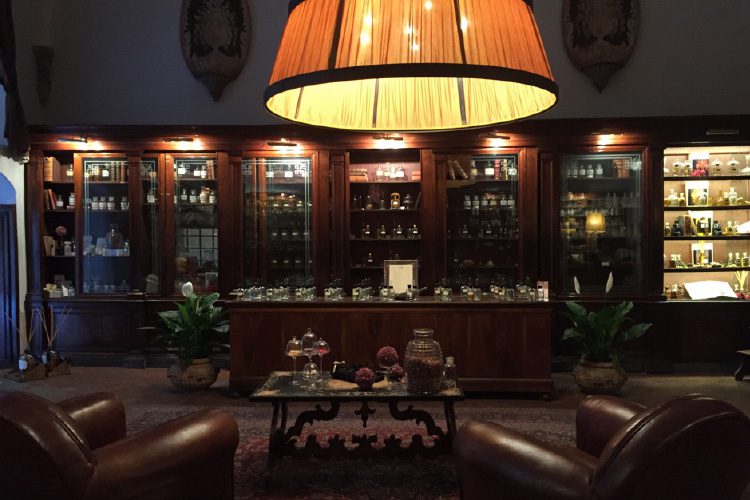
You can smell the rose-scented air even before reaching the street where AquaFlor is located. As you turn onto Borgo Santa Croce, the inviting smell only gets stronger until you find yourself in front of the 15th century Renaissance Palazzo where AquaFlor is located. In case you could not already tell from the image above, this is no ordinary perfume store. AquaFlor is a perfume showroom and laboratory outfitted with olfactory specialists. This is not just a store where you can purchase high quality perfumes, but an experience where you are educated on scents so that you can find the right one for you. Open seven days a week, AquaFlor is truly a hidden gem in the city center of Florence.

During my experience in this magical place, I was given a tour of the grounds from their communications strategies specialist. He explained to us that the perfume industry is growing rapidly, increasing 15% from 2014 to become a 39.2 billion dollar industry. He is taking advantage of this by making AquaFlor different from any other perfumery to create brand recognition and word of mouth advertising.

Clients can spend hours just browsing different scents with the help of experienced olfactory specialists, and create their own scent to take home.

The perfume showroom itself had such a unique aesthetic: classy, put together, and vintage. The first room has diffusers, used to give rooms in the home a pleasant scent. Next, our guide then took us to a room filled with pastel-colored soaps. These are very affordable and would make a great gift for loved ones back home. The third and final room on this floor was where the perfumes are kept. The price point for the perfumes is 140€, but this is a steal considering the quality of the product. Most other perfumes have a high concentration of alcohol and water whereas these have a significantly higher concentration of the actual scent for a longer lasting experience. Even testing the perfume is unique at AquaFlor. The pure scent is concentrated in beakers and a test tube is placed upside down in this scent. You simply smell the inside of the test tube which is meant to give a more accurate feel for what the perfume will smell like when it is worn. Most other retailers spray the perfume on a piece of paper, which is not effective for getting an accurate smell. I personally enjoyed how the rooms were split up by product. From a consumer perspective, this made it easier to shop.

Lastly, we visited the lower level lab. Our guide explained the scientific and chemical aspects of the production process and showed us how the perfumes were made. We also explored scent categories, and the experiential aspect of the visit is a great marketing tool. The Instagram account of AquaFlor is beautifully curated too. You can visit AquaFlor in Borgo Santa Croce 6 in Florence, as well as check out the company’s website.

 Did you know that an FUA alum is a part of the AquaFlor team? Watch this alumni video interview.
See more of Florence at FUA’s FBInstagram, and Twitter.

I Wish I Was There When: Piano Invented in Florence

By Lauren Miller

We’re thrilled to introduce our new blog sound bytes featuring original podcast content produced by the FUA Broadcasting New Media course! In the “I Wish I Was There When…” series, FUAers present about landmark moments for the city of Florence told firsthand. In this inaugural radio story,  we reveal how the first piano was invented in Florence in the 18th century by Bartolomeo Cristofori.

Music credit:
Table for Four
Written and performed by CrusaderBeach

Italian Food and the Art of Waiting

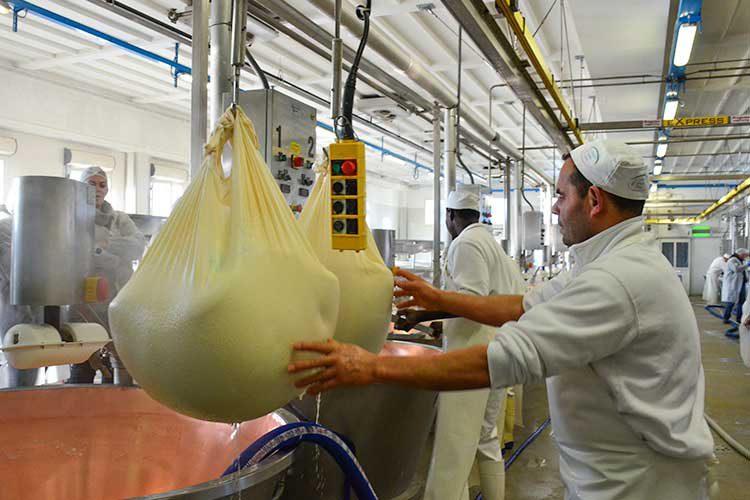
Parmigiano Reggiano cheese production

By Emily Entwistle

Italian culture includes many artisan traditions, crafts, and skills. The globalized world can make it hard to preserve such traditions, which are important to maintain and practice traditions.

As part of my time in Florence I have learned about many unique, artisanal food processes. I’ve even visited production facilities in Modena and Parma for a field learning activity. The simple but lengthy processes that these artisans use to produce cheese, balsamic vinegar, and prosciutto are impressive. The extra care and time it takes to organically produce these foods seems like a challenge, but they are worth it. The rules, regulations, and standards set for these producers could seem like a bureaucratic nightmare, but they are implemented to insure that producers stay true to the craft.

There are aged balsamic vinegars that are 20, 50, and even 100 years old. The D.O.P. balsamic vinegars take an extremely long time to age, and once every year they move the balsamic from one wooden barrel to another. Consider also that there is such a huge difference between Parmigiano Reggiano and parmesan. Real Parmigiano Reggiano is aged for a minimum of 12 months, and according to most, the best is 22 to 24 months old. Making artisanal products is a waiting game. For prosciutto, producers add salt and wait. For Parmigiano, they add salt and wait. To make balsamic vinegar, they put the grape juice in a barrel and wait. The key is patience, and when the item is finally ready, it is amazing to say the least. Producing these foods is even a year-round job. Parmigiano Reggiano producers for example work every single day of the year, even on holidays, to keep their process completely natural and authentic.

While a higher cost of these products may seem too high for some people, buying quality foods is extremely important. Not only are they better for you, but they support the special skills of smaller producers. And the food is worth the extra money for the taste alone. After directly visiting production facilities, I have gained a greater appreciation for the craft of food artisans.

See more of Florence at FUA’s FBInstagram, and Twitter.

International Women’s Day, Every Day

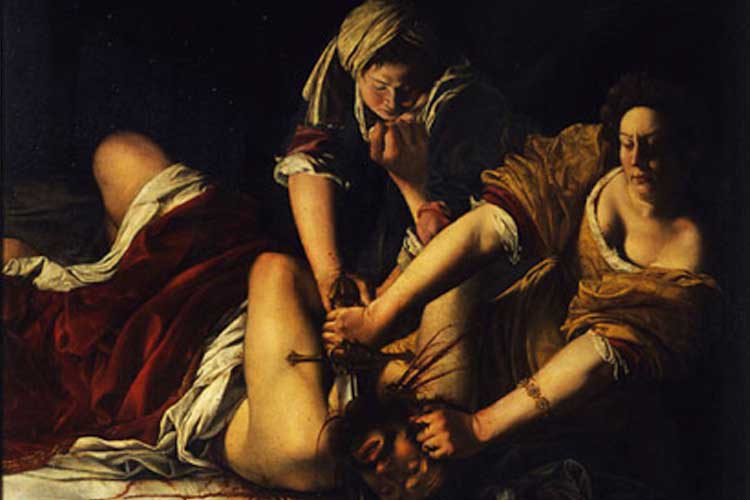
Detail from Judith Beheading Holofernes by Artemisia Gentileschi

By Madison Landau

In today’s society, there seems to be a holiday to celebrate just about anything. There’s a national holiday for Nutella, siblings, and even for French bulldogs.

Here in Italy we recently celebrated on March 8th an important holiday that won’t just be swept under the rug like the others; International Women’s Day was celebrated proudly by allowing free admission to state and municipal museums for women.

Even though Women’s Day is just once a year, you can make exploring female themes in the local culture a regular part of your daily routine. If you like exhibitions, for example, try to find special shows in your area that may focus on female artists or artists who focus on female sources of inspiration.

In Florence, the famed Uffizi Gallery Museum houses historic artists such as Artemisia Gentileschi, who is considered to be one of the most successful painters after the Caravaggio era. It’s important to not just see her artwork, but to know all that went behind it. Being an artist wasn’t easy back in the male-dominated Renaissance era, and being a female artist made recognition much more difficult.

Artemisia overcame such obstacles within her lifetime to achieve the fame she enjoys today, and for women across Italy to have the opportunity to see her artwork firsthand can prove to be a real inspiration for all. At the FUA campus, the Artemisia Room is dedicated to this important artist, and often hosts experiential learning students who collaborate on special projects related to videomaking, visual communication, and journalism.

To commemorate International Women’s Day as more than a “hallmark holiday” shows a great deal of respect to the women of not just Italy but internationally. During your studies and your daily life in Florence, seek to uncover the great as well as lesser-known women who have contributed to the artistic and civic culture of Florence and Tuscany.

See more of Florence at FUA’s 
FBInstagram, and Twitter.

Talking Stones of Florence

Photos by the author

By Aaron Klevan

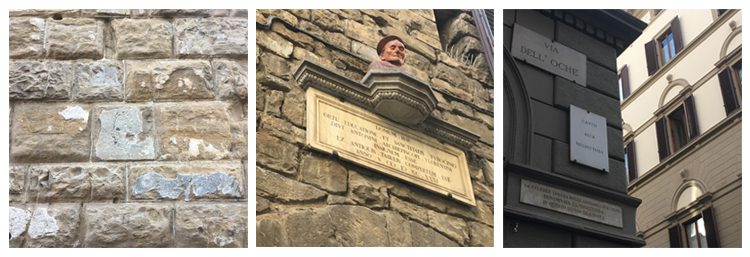
What do Florence’s “talking stones” have to do with modern-day journalism and civic awareness? FUA’s Writing for Digital Media students recently explored connected readings of the city’s political and cultural history through its talking stones. Next time you take a walk around the city center make sure to look up and see if you can spot some.

Florence is a city with a rich history that dates back centuries. One of the unique ways that the city actively communicates its vibrant past is through “talking stones.” These stones, containing inscriptions of both writing and art, are adorned on walls throughout the city and tell Florence’s most fascinating tales. The stones also portray the art of journalism in its truest form, exhibiting many principles still applied today in an authentic breath.

  • The idea of social awareness can be seen in the way the stones project the stories of Florence.
  • The principle of connected reading is presented by the way the stones link current Florentines and visitors to the city’s political past.
  • The stones also share visual information with supplementary images and drawings in addition to pure text.
  • Finally, at the time they were created, the stones were a form of enhanced technology requiring specialized knowledge and methods for chiseling messages into stone.

The first talking stone shown on the left of the photo is one of the first known forms of graffiti, located near the main entrance to Palazzo Vecchio. As the legend goes, it was a self-portrait of Michelangelo. It is a fascinating way to look at the technology artists used at the time, and also offers a glimpse into the booming art community during the Renaissance, connecting people today to those who walked Florence’s streets and drew on its walls in the past.

The second stone is perched atop a bustling intersection near the city center in Via delle Oche. It textually denotes that the building on which it is placed was once home to the prestigious Adimari family, of which Alemanno Adimari was a member. He was a famous Italian Catholic cardinal and archbishop. This stone serves the purpose of displaying the famous residents that played a fundamental role in shaping the city.

The final stone is a beautiful bust and description of Saint Antoninus in Via dello Studio. He was an Italian Dominican friar who ruled as an Archbishop of Florence. This talking stone is found on the exterior façade of the Pierozzi family home. It is a perfect example of combining visual information with written texts, much like an article, that allows viewers to see the subject and read about it.

The city continually talks to us every day through its surfaces, signs, and symbols. What unexpected discoveries have you made through Florence’s talking stones?

See more of Florence at FUA’s FBInstagram, and Twitter.

Farm to Table Focus: Vivanda

Photo courtesy of FUA

By Anastasia Finney

A typical student living in Florence has likely already seen many of the famous sights, tasted their fair share of Italian food, and interacted with a good amount of locals. However, classes at FUA often include field learning sessions around that city in order to take students off of the usual pathways and into experiences they might have otherwise missed.

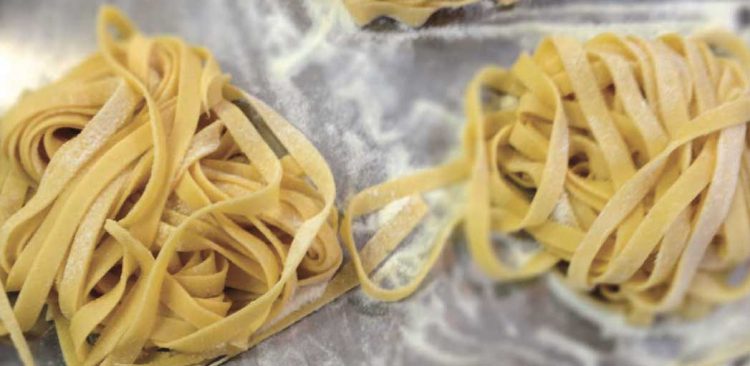
During the “An Introduction to Italian Food Traditions,” taught this past fall semester by Prof. Cecilia Ricci, students often incorporated real food experiences into their learning. Rather than simply receiving long lectures about the food and culture of Italy, the class conducted tastings, cooking projects, and visits to relevant food locations in the city. One such visit took place at a local restaurant in order to analyze fresh pasta. Before embarking to Vivanda, the students first learned about the differences between and characteristics of fresh and dry pasta through a lecture component in class.

Vivanda is a small and cozy restaurant located in Oltrarno, on the other side of the Arno River. It prides itself on organic ingredients, natural wines, fresh pasta production happening right in the restaurant, and options that can please meat-eaters, vegetarians, vegans, and gluten-free people alike. At the restaurant, the class was given three types of pasta to taste: gorgonzola gnocchi, traditional spaghetti, and ricotta and spinach ravioli. They were also served Arialdo wine with the meal.

Student Nick Tyndall shared that the tasting helped his understanding of Italian pasta traditions. “The restaurant had an authentic and inviting ambience, consistent with the best establishments I’ve visited in Florence,” said Tyndall. “We got to see how the staff made the fresh pasta and learned about the company’s food philosophy. The pasta was probably the best I’ve ever had.”

The class had time to enjoy and experience both the food and setting, while also listening to the owner talk about the restaurant. Professor Ricci also talked with the class during the visit about the food tasted and the way it paired with the wine. The students were encouraged to think critically about what they were consuming, in regard to production, presentation, and longstanding Italian traditions. Naturally, the group also got to enjoy the conviviality of delicious food too.

Experiencing a guided tasting in close contact with industry professionals gives a different perspective to daily activities that we all experience, such as trying new restaurants. “I wouldn’t have even known this restaurant existed without this class,” said Tyndall. “Now I definitely want to go back for a full meal!”

Vivanda
Via Santa Monaca 7 (between Pz. S. Spirito and Pz. del Carmine)
For further details visit the restaurant’s website.

See more of Florence at FUA’s FB, Instagram, and Twitter.

The Great Synagogue of Florence

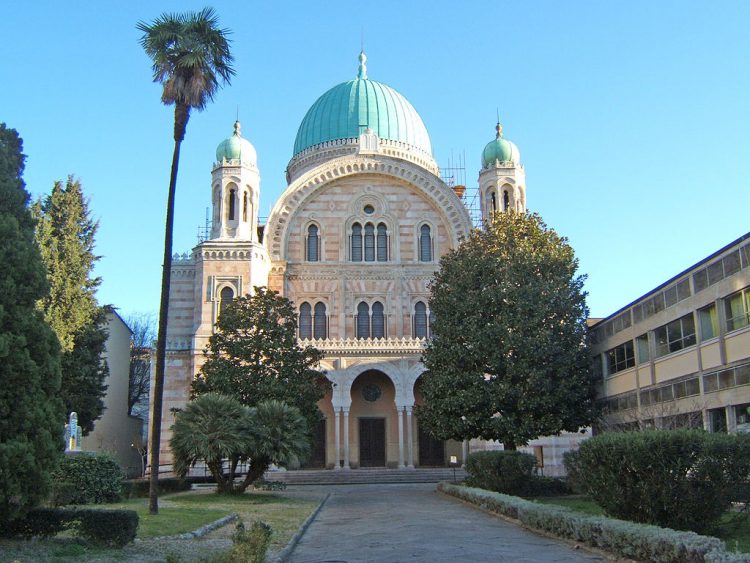
Image by Wikimedia Commons user Toksave

By Caroline Angelini

Though Italy is a predominantly Catholic country, its religious landscape represents other traditions as well. The relationship between the Jews and the city of Florence dates back hundreds of years, and this community is one of the focal points discussed during the FUA course “Shoah: The Holocaust in History.”

This course, taught in Fall 2016 by Valentina Nocentini, focuses on the history of the Jews, specifically in Italy, and how their treatment eventually led to the the Holocaust. To give her students a better grasp on exactly what happened to the Jews in Italy during the Holocaust, Prof. Nocentini brought her students to the Tempio Maggiore, or the Great Synagogue of Florence. Based on the experience and how it helped to contextualize the treatment of Jews in Italy, students wrote a reflective assignment as an outcome of the visit.

The Synagogue dating to 1882 is truly breathtaking. The intricate detail of the hand-painted walls, and the ornamentation of the women’s balcony were like nothing else that students had witnessed both in Florence and beyond. The mosaics and frescoes are reminiscent of Christian art, but have their own character that makes them unique to the Jewish culture of the Synagogue.

While the artistic ornamentation was magnificent, the mood that most students had while in the Synagogue shifted once they reached the museum. The Synagogue separates a portion of its space dedicated to the Florentine victims of the Holocaust. There are stone slabs with each victim’s name and videos depicting the lives that they carried out while being exploited during the Shoah. “It was something difficult to experience—the contrast from first seeing the beauty and grandeur of the Synagogue to then learning about how the Jews were treated during the Holocaust,” commented student Emma Dunleavy.

The visit to the Synagogue helped the students of the Shoah course gain a deeper understanding of the past lives of Jews in Florence. It also provided insight into how Florentine and Italian citizens in general aided those in need of protection especially during WWII, which gave students food for thought as they themselves experience daily the hospitality of a foreign host city with whom they must forge a new relationship, one day at a time.

To visit:
The synagogue is located in Via Farini 6, near the Sant’Ambrogio church. Details about visiting hours, synagogue history, and much more can be found on the website of the Jewish community of Florence – moked.it/jewishflorence

See more of Florence at FUA’s FB, Instagram, and Twitter.

Art’s Greatest Spy: Exploring the Museo Casa Siviero

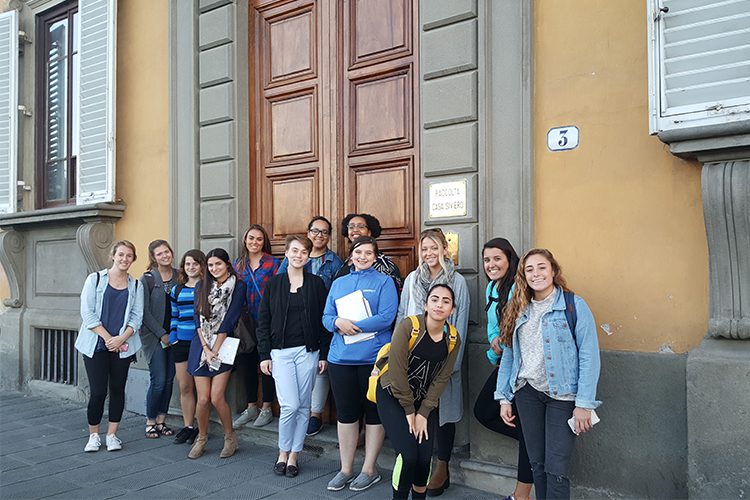
FUA digital writing students visit Casa Siviero. Photo by Beatrice Santini.

By Leeya Mengistu

A Florentine home-turned-museum houses the intriguing story of a man whose involvement in WWII and fascism in Italy made a priceless contribution to Italian art.

Lungarno Serristori 1 is nondescript in the way that every historical home in Florence blends into the Renaissance landscape of the city. The exterior is a faded shade of yellow. The front courtyard is shaded by trees and the driveway covered in gravel. The building itself is styled the typical Florentine architecture. But the former owner of the home, as well as the treasures that lie inside, are what draws visitors from around the world.

Meticulously cared for by the Amici dei Musei e dei Monumenti Fiorentini, the Museo Casa Siviero hosts the memory and history of classical art’s 007 figure: a man whose reputation as a smartly dressed, valiant ladies’ man is surprisingly much less known than James Bond’s.

Rodolfo Siviero’s two-story estate is home to an exciting legacy. The basement holds a museum of his life and achievements, while the main floor holds the personal art collection of Siviero, who wanted to be remembered for his achievements as a collector as well as his achievements as a spy. The pieces include weapons, paintings, sculptures whose cultural and historical significance attributed to their owner are priceless.

But how did a failed art historian become a national hero?

Siviero, born in 1911, began as a humble humanistic studies major at the University of Florence with dreams of working in art history. Instead, life led him to the fascist Italian secret service, where he became an agent going undercover to recover beloved pieces from the Nazi party. His largest mission in 1937 brought him to Berlin, where he collected intelligence undercover as a persona very close to himself: a student pursuing art history.

A few years later, Siviero joined the resistance in Italy and became an anti-fascist. He began to monitor the movements of artwork stolen by the Germans. This time he worked from the home at Lungarno Serristori after previous owner and dear friend, Jewish artist Giorgio Castelfranco, fled Florence in fear of the incoming Nazis.

It wasn’t long before he was captured and tortured in the Villa Triste, or the Sad House, by the Fascist military in 1944. Committed to the role, he resisted relentless interrogation and won back his freedom. Even today it is still unknown whether Siviero himself was truly with or against the National Fascist Party.

Of course, Siviero’s work was not in vain. Around 200 pieces of artwork recovered by the spy are currently hosted or archived in Florence’s world-famous Uffizi Gallery.

Although anxious to secure his status in the Italian art history world, Siviero remained an obscure figure during his time. An interesting fact, he loved women and a letter to Hollywood’s popular blonde bombshell, Jean Harlow, was reciprocated with autographed photo. Siviero eventually retired his life of espionage and returned to a traditional job in the arts: President of the Accademica delle Arti del Disegno. He maintained the position until his death in 1983, and his home was given to the Tuscan Region in order to keep the legacy alive for generations to come.

Museo Casa Rodolfo Siviero
Lungarno Serristori, 1-3
Free entry, see the below site for opening times.
www.museocasasiviero.it

See more of Florence at FUA’s FB, Instagram, and Twitter

Experiencing Eataly: Italy & the Global Market

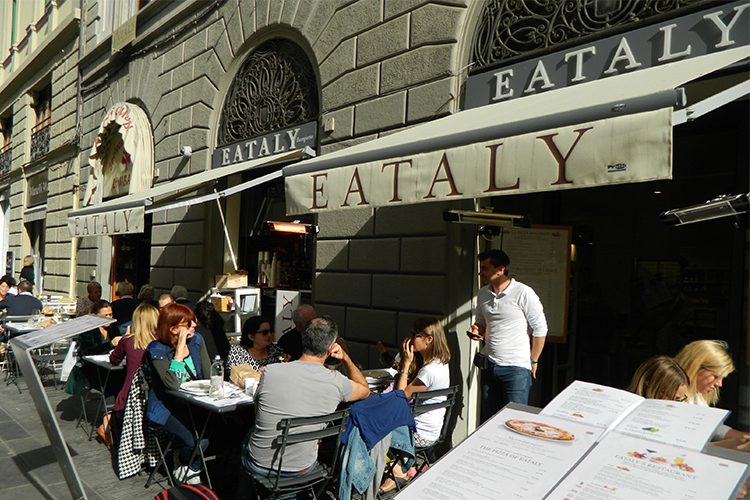
Photo by Jess Pitocco

By Anastasia Finney

An FUA Marketing class goes inside the food retail business through a site visit at Eataly Florence.

Studying abroad at Florence University of the Arts is truly an experience like no other.  Oftentimes, this is due simply to the location of this institution in the heart of Florence, allowing effective and memorable learning outside the traditional classroom walls.

An “Introduction to Marketing” class taught by Professor Andrea Adams experienced a site visit this fall to local Eataly store.  Eataly is a food retailer, comprised of grocery markets and restaurants, that focuses on selling quality Italian goods to an international market.  According to the website, the Eataly mission is “to demonstrate that high-quality Italian food and drink are at hand.”  Eataly also highlights that they not only focus on Italian food itself, but also “living the Italian way” in terms of taking the time to enjoy this high-quality and local food.

The marketing class was able to go on a tour of the Eataly facilities, as well meet with a store manager to get an insider’s perspective.  “We got to learn about an Italian business through an international marketing perspective,” said student Nicholas Tyndall.  “I got a new view on how Italian businesses are vying to compete in an evolving global marketplace.”

Founded in 2007, Eataly has already grown exponentially and received international attention.  The most recent addition to the company is a second New York City store in downtown Manhattan, opened in August 2016, which has received excitement and positive reviews.  The students in this marketing class were able to see Eataly here in its founding country, as well as see how it has already influenced their home countries.

Besides in Italy and the United States, Eataly has locations in Brazil, Japan, South Korea, United Arab Emirates, Germany, and Turkey.  From the presentation, Tyndall said the most interesting thing he learned was “how far Eataly has already spread across the globe and how aggressive its expansion plans are for the future.”  The company plans to open additional stores across the United States, as well as expand into Canada, Mexico, France, Russia, China, Australia, and more.

The marketing class also received student cards from Eataly to experiment with the customer experience of benefits and discounts, ranging from bakery items to restaurant meals.

“I like that FUA really emphasizes this kind of experiential learning,” Tyndall concluded.  “It makes the material much more interesting and helps you to explore Florence itself.”

Interested in visiting Eataly?  The main store is on Via de’ Martelli, 22, right by the Duomo.  There is also a smaller Eataly marketplace within the Mercato Centrale – Via dell’Ariento, 50123 Firenze.

See more of Florence at FUA’s FB, Instagram, and Twitter.