By Jessica Rowe
The abbeys of San Galgano and Sant’Antimo have rich histories that are worth experiencing firsthand. Located outside of Siena, these off-the-beaten-path sites will make you feel like you’ve stepped into a different time.
This summer, students and faculty took a trip to the abbeys of San Galgano and Sant’Antimo on one of FUA’s Educational Field Trips (EFT). The EFT excursions are always well-organized, planned on a student budget, and full of educational information it might be hard to find out on your own. San Galgano and Sant’Antimo were chosen as an EFT location because they are full of historical and cultural significance. Instead of being normal tourist sites students may visit on their own, they are out of the way places that still hold on to a feeling of spirituality. Students are brought to the abbeys to gain a deeper understanding of spirituality and how it can be either connected or disconnected from structured religion.
We met at the Santa Maria Novella train station at 7 a.m. to depart for San Galgano. The trip quickly became unique as instead of heading to a busy city, we were headed out into the countryside. Large fields rolled past, some green and some gold, bringing us further away from the built environment of Florence. When we got to the first stop, our tour started at the Rotunda of Saint Galgano. It holds the tomb of Saint Galgano and the famous sword in the stone. Now, you’re probably thinking, as I was, that King Arthur wasn’t from Italy. But it’s a different sword in the stone with a lesser known tale behind it. As the legend goes, Saint Galgano heard voices calling him to the place where the rotunda now sits and there he saw a vision. He wished to renounce his knighthood so he drove his sword into the stone. For years, people tried to steal the sword but it was said to be guarded by a wolf. Inside the rotunda, the bones of a man who was eaten by the wolf are displayed.
Further out sits the Abbey of San Galgano. It was started in 1218 when the hermitage became too small to contain all the monks and pilgrims. The abbey is built in classic Gothic style and has no roof. It did, at one point, have a roof but the abbey was very poor and resorted to selling the roof piece by piece for money to keep it running. Nowadays, the abbey is funded through ticket sales and event bookings.
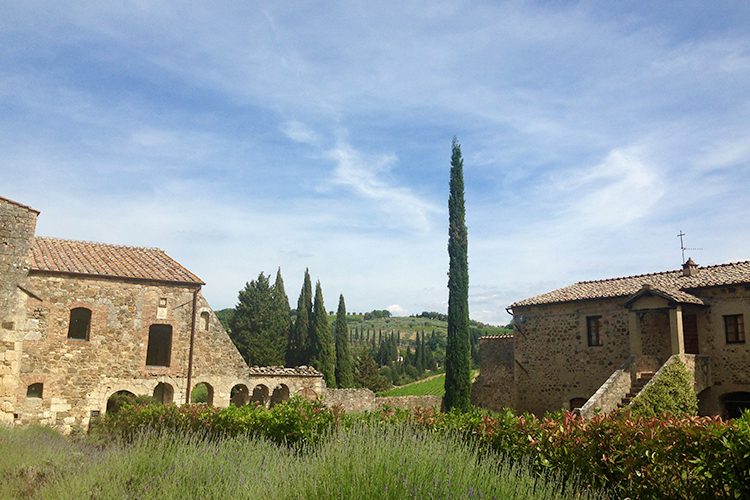
We stopped for lunch at Tenuta di Paganico, a local winery, before going on to Sant’Antimo. This abbey was under construction from 1393 until 1526, however it was in 781 that the idea for the abbey was formed. As the story goes, Charlemagne was returning from Rome when most of his court and army caught the plague. The Emperor had a dream where an angel told him to harvest a specific grass, dry it, mix it with some wine, and have his soldiers drink it. When he did so, everyone was cured. He vowed then to build an abbey.
Currently, the abbey houses a group of monks from the Benedictine monastic community of Santa Maria di Monte Oliveto Maggiore. These monks are referred to as Olivetan monks and their order was founded in 1318 by the Sienese Saint Bernardo Tolomei. They go about their days by focusing on prayer, reading and studying, and work. They are known by the white colour of their robes which symbolizes their devotion to the Virgin Mary.
Shelby, a student who attended the trip as an academic field learning activity for her Italian language class, arrived at Sant’Antimo with her group as a service was in progress. After it ended, the class saw all the nuns continue their prayers in the many different spiritual locations inside the abbey. She enjoyed the chance to get a look at what the abbey is currently used for and what it meant to the people who lived there.
After a long day, the trip came to a close and we headed back to Florence. Overall, I had a good time on the trip. I learned a lot about the two abbeys and saw some incredible architecture. I would recommend visiting these two abbeys and the EFT excursions to anyone looking for a fun day trip from Florence.
For more information on EFT trips:
EFT – FUA’s Educational Field Trip Logistics Team
Corso Tintori, 21, Firenze
Phone: 055/244664
E-mail: sld-eft@fua.it
studentlifeflorence.it/educational-field-trips-mission.html
See more of Florence and Italy at FUA’s FB, Instagram, and Twitter.
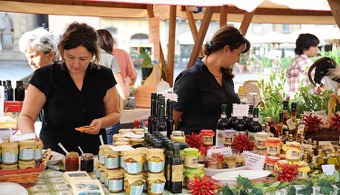 Piazza della Repubblica will host another one of its Mercatale events for the public. The market is normally held the first weekend of each month welcoming residents and tourists alike. The next market will be held on June 3rd and 4th from 8:30 to 19:30. There will be 84 producers at the event, 46 of which are from the province of Florence. Others are from the surrounding provinces such as Prato, Siena, and Arezzo. Visitors can browse long booths full of wine, oil, vegetables, fruit, truffles, and other freshly grown produce. In addition, there will be some typical products from the area including salami, cheese, and honey. The variety of vendors allows passersby to try many authentic foods such as “necci” biscuits of the Tuscan Appennino. For the rest of the spring and summer seasons, the market will rotate between Piazza Repubblica, Piazza del Carmine, and Piazza Santa Maria Novella.
 By Lauren Fulton