A Ghostly Side of Florence

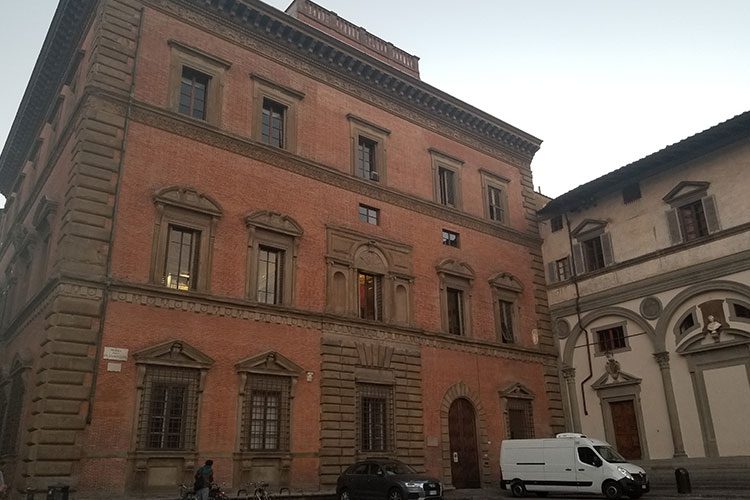
Palazzo Budini-Gattai and the open window
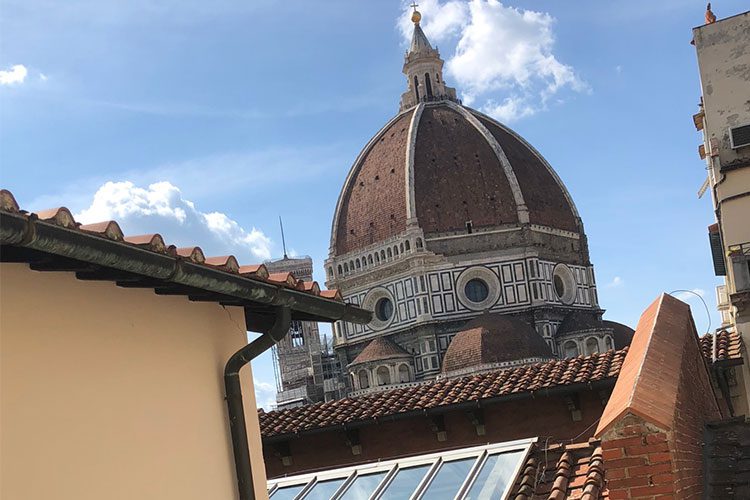
Photo by author
By Barbara Carranza

SPEL Journalism student Barbara Carranza gives us paranormal suggestions for an alternative tour of Florence.

I’ve had a life-long fascination with the paranormal; just ask my family members or friends. When I arrived in Florence, one of the first things I searched up was if the city had any reported haunted sites that I could visit. With Florence being ancient and enriched with history, of course I wasn’t let down.

The fall season has descended upon us, and with the temperatures dropping, what better way to spend your nights than reading scary stories and strolling through the streets to check out some of Florence’s darkest legends and mysteries?

  • Palazzo Budini-Gattai

If you’ve been to the Piazza Santissima Annunziata, you’ve seen the Palazzo Budini-Gattai. A red brick building with three floors, it was constructed in the 16th century by the Grifoni family and eventually came under the ownership of the Budini-Gattai family. The legend attached to this place is in the far right window on the top floor. It is always open, even when it rains. The reason for this is because the ghost of a noblewoman is still waiting for her husband to return from war. They had just married when he was called for battle, and the young lady waited by the window so she could see him return, but he never did. Heartbroken, the woman became attached to the room and the window until she died. When the shutters were finally closed, an unnatural force moved the furniture and threw books off the shelves. The chaos didn’t stop until relatives reopened the window – and so it has stayed open, never to close lest someone wants to risk angering the ghost.

Located in Piazza Santissima Annunziata, on Via dei Servi, 51.

  • Pensione Burchianti

Located less than a 10-minute walk from the Duomo, the Santa Maria Novella train station and the basilica it is named after, Pensione Burchianti is a 3-star hotel that is situated perfectly for tourists. Open since 1919, the hotel has garnered a quality reputation for housing celebrities, politicians, and poets over the years, including an alleged visit by Fascist dictator Benito Mussolini. However, guests might find themselves not the only ones residing in their suites. Among the reports of unexplained events, paranormal stories in the hotel includes hearing children skip down the hallways, the feeling of being watched, the sensation of icy cold breath being blown on people’s faces, and sensing the mattress dip as if someone was sitting on it. If that doesn’t scare you, there is also the Fresco Room where people have seen a pink, translucent figure. The owner of the hotel refuses to stay overnight, so if you’re brave enough to do it, make sure to record your stay because you might capture something!

Located on Via del Giglio, 8.

  • Palazzo Vecchio

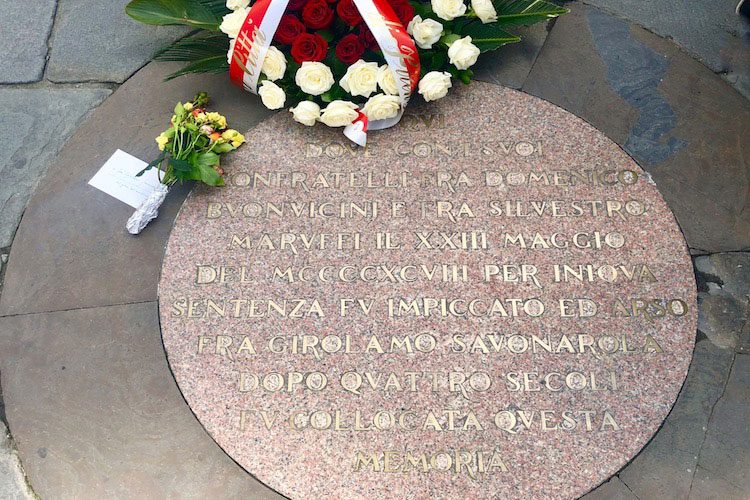
Find yourself wandering by one of the Florence’s most recognisable landmarks at night? Here are a couple words of advice: don’t yell out Baldaccio d’Anghiari’s name. Palazzo Vecchio, and the Piazza della Signoria in general, have witnessed so much blood spilled on its pavement over the last 600 years. For example, the hanging and burning of Friar Girolamo Savonarola in 1498, an event that is commemorated in a plaque positioned on the exact place where he was executed. But did you know of the mercenary Baldaccio d’Anghiari? In 1441, he was wrongly accused of treason and killed in the Palazzo Vecchio. His body was thrown out of a window and dragged across the Piazza where his severed head was put on display. It’s now said that his ghost roams the premises of the Palazzo; sounds of footsteps can be heard when it closes for the day and all the tourists have left. Do not yet his name and avoid saying it out loud for no reason. If you decide to address him, you must speak respectfully in a low voice.

Located in Piazza della Signoria,
Opening hours 9am-7pm Monday-Sunday, 9am-2 pm on Thursdays.

See more of Florence and Italy at FUA’s FBInstagram, and Twitter.

The Magic of Biblioteca delle Oblate

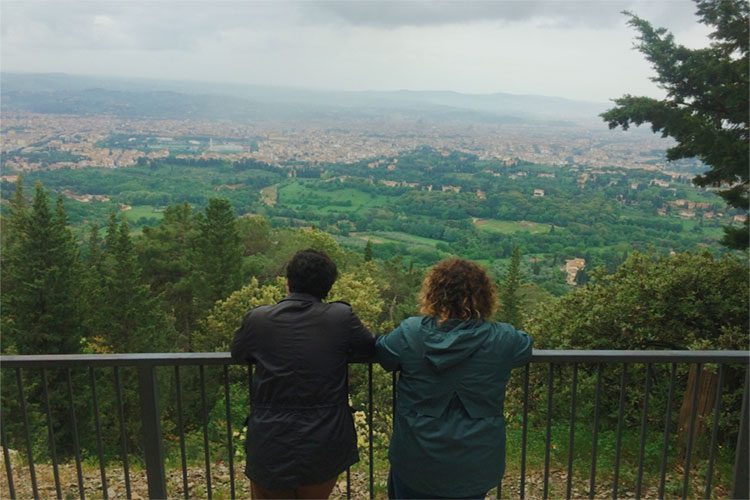
View from the terrace of Biblioteca delle Oblate
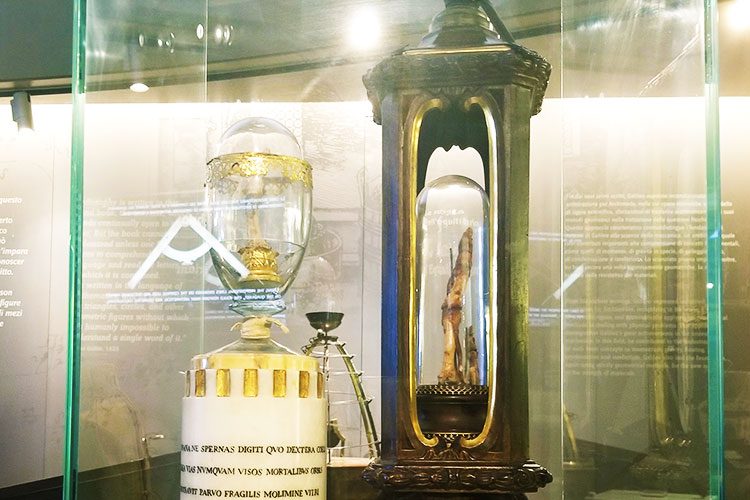
Photo by author
By Danika Clark 

FUA student Danika Clark shares her favorite study spot and culture hub within the first week of school.

Libraries. Some love them, some hate them, but we all have to use them. In Florence, the library is the center of all the action. Students from all over the world come here to study or socialize and it is the perfect place to make new friends.

This is the view of my new favorite spot in Florence. After spending the first week in awe and enchantment while exploring the city, homework and school quickly catches up to you here. Roaming the campuses of FUA, I’ve discovered some incredible study spots, but I found my favorite one right down the street from The Duomo.

If it is your first time, this public library can be quite intimidating. It is so large and under some major reconstruction. When arriving, I was a little embarrassed wandering through the narrow empty halls and trying to find out where the crowd was. So, as your new Florence tour guide, I have suffered through it and have taken notes to help guide you to my favorite spot.

To get to the rooftop terrace at Biblioteca delle Oblate, head to Via Dell’ Oriuolo and walk through the gardens in the entrance. Once you’ve reached the main building, take a left. Go through the sliding doors into where the main lobby is and find the elevator. Head to the second floor, walk out of the elevator and straight ahead you will see a gorgeous outdoor patio. This is my favorite spot, overlooking The Duomo.

It is bustling on the patio, with students from all over the world. It can be the perfect place to make friends or to reflect alone. In addition, the inside of the library tends to remain quiet, so if you’re in need of a silent study session, it is a great escape.

In conclusion, if you’re looking to make friends, explore Florence, or study, I could not recommend this library enough. The breathtaking views are worth the visit in and of itself.

See more of Florence and Italy at FUA’s FBInstagram, and Twitter.

Catching Galileo’s Middle Finger

Galileo’s middle finger

Photo by author
By Barbara Carranza

SPEL Journalism student Barbara Carranza explores the unusual at the Museo Galileo.

Though I’m not a science major, I was still interested in visiting the Museo Galileo. Not necessarily due to the scientific and technological instruments that have been collected and conserved, but that they literally have Galileo’s actual middle finger on display.

The story behind how it’s even possible to view this ancient middler finger (and it’s not alone; there’s also an index finger and a thumb, all from his hand) is one that spans almost three centuries. Galileo may now be referred to as the “father of modern science,” but the last years of his life were marred with controversy. He went against the teachings of the Catholic Church by supporting Heliocentrism, which states that the Sun, not the Earth, is at the centre of the universe. The subsequent inquisition in 1633 found him guilty of heresy. He was sentenced to house arrest that lasted until his death nine years later. The Church initially refused to honour him with a tomb, so Galileo’s family buried him in an unmarked grave outside the Basilica of Santa Croce. This decision was reversed in 1737, when he was deservingly built a tomb inside the basilica. It was during the process of reburying the cadaver when a man named Anton Francesco Gore reportedly removed three fingers, a tooth, and a vertebrae. Passed down through the generations of his family, the body parts disappeared in the early 20th century. Then in 2009, they surprisingly reemerged in an auction.  They were brought to the Florence History of Science Museum, now known as the Museo Galileo.

The museum, which sits right next to the Uffizi Gallery, dedicates its priceless collections not only to the instruments that Galileo used for his groundbreaking discoveries, but also equipment that was assembled by the Medici and Lorraine dynasties. It is in the Medici collection where the famed middle finger and the other two digits are.

When you enter the room, you are greeted with Antonio Santucci’s enormous armillary sphere, walls of other smaller spheres depicting a map of the Earth, and a regal marble bust of Galileo holding a geometric compass and a telescope. Walking past the bust, you will see the ancient fingers in egg-shaped glass shrines. It is perched up high on a pillar, the bones visible as it points up towards the sky. Looking at it at a first glance, I thought it was kind of gross that a museum would exhibit human remains, even if they belonged to a genius like Galileo. But the longer I looked at it, bringing my face as close to the glass as I could manage to examine the decaying texture of the fingers, the more I became captivated by it, just like the other visitors around me. We were, after all, seeing the real human fingers that once belonged to someone who lived 376 years ago. And not just any anyone, but someone who revolutionised science as we know it.

I think everyone should pay a visit to the Museo Galileo, even if the history of science might not sound particularly interesting. The museum provides a close personal look at thousands and thousands of artefacts that have all contributed to the evolution of science, physics, mathematics, astronomy, and technology. Despite not entirely understanding what exactly I was seeing, it was an intriguing experience overall, especially observing the fingers that Galileo used to hold his telescope as he uncovered that Jupiter has four moons.

Museo Galileo is on Piazza dei Giudici 1, open Monday, Wednesday through Sunday from 9:30am to 6pm. Open Tuesday from 9:30am to 1pm. The price for admission is 10 euros, and there is no need book a tour in advance as the wait lines are short. 

See more of Florence and Italy at FUA’s FBInstagram, and Twitter.

Espresso Yourself Through Painting


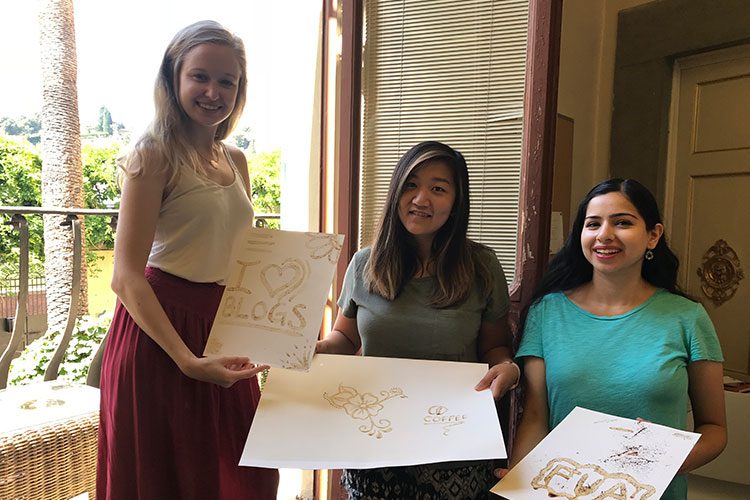
Experiential Learning students Madison Argo, Lia Butterfield, and Guneet Singh.

By Guneet Singh
All photos by author

Journalism student Guneet Singh teaches us how to paint with coffee.

If there’s one thing Florence has a lot of, it’s coffee. You’ve seen the cafes lining every street corner. You’ve noticed the restaurants and even the gelaterias with dozens of coffee options to choose from. But coffee is more than just a caffeinated drink you can use to keep yourself awake.

You can actually use it to paint and that’s what blogger and artist Maham Iftikhar does.

She combines her love for coffee with her passion for art. Her blog contains tons of reviews about different coffee places from around the world and she even teaches people how to paint with coffee. “I encourage people to overcome their fear of mistakes and paint,” Maham said.

So how exactly can you paint with your morning beverage?? Well, we tried it so you can too!

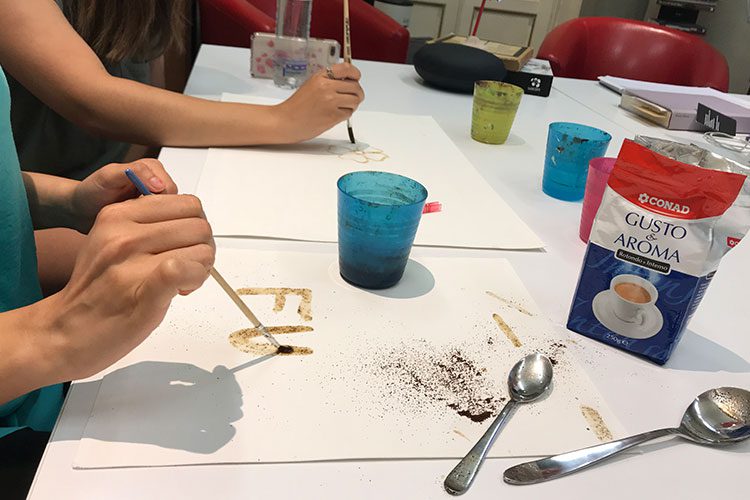
 1.Get cups of water, paintbrushes and a canvas or piece of paper ready

 2. Take some coffee powder and combine it with water. Instant coffee will get     you quicker results

3. Keep adding powder as you go. The more powder you add, the darker your   “paint” will be. Adding more water will make the color lighter

4. Be prepared to smell like coffee afterwards

So if you ever have too much coffee, don’t let it go to waste! Paint yourself a picture.

Maham also paints with wine, matcha tea and plans to use other natural materials in the future.

See more of Florence and Italy at FUA’s FBInstagram, and Twitter.

Quidditch in Florence?

By Guneet Singh
All photos by author

Journalism student Guneet Singh explores her childhood in Florence.

When I chose Florence as my study abroad location, I knew it was a city that would give me a lot of experiences. But one experience I didn’t expect was being able to attend the opening ceremony of the Quidditch World Cup.

Yes, you read that right.

Quidditch, the fictional sport J.K. Rowling created in the Harry Potter series, is a real-life sport that was invented in 2005.

A Potterhead through and through, I couldn’t believe my luck when I found out the event was happening here! I’ve read all the Harry Potter books and as a child, Quidditch was the main sport I really understood.

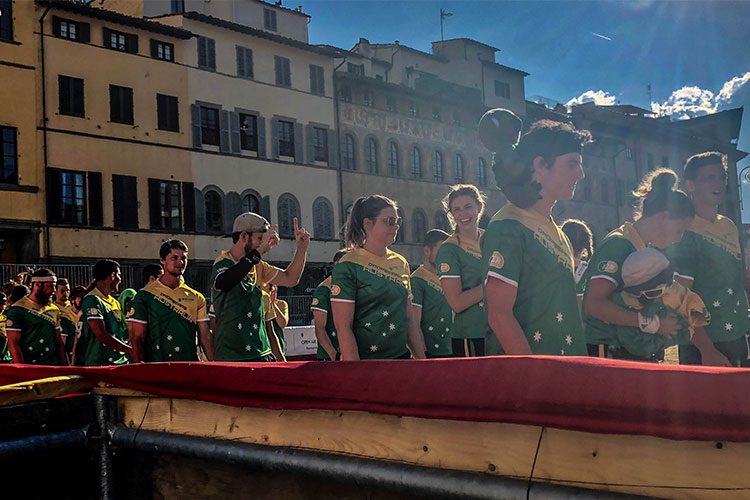
The opening parade itself was a five minute walk from Corso Tintori, one of FUA’s main buildings. I got there early and saw dozens of people in red shirts with the words “International Quidditch Association” sprawled across the back.

This is real.

A couple hundred spectators circled the stadium. I didn’t have a ticket but was standing in the right place at the right time and got in to see the ceremony! I was at the front of a crowd spread out across the sides of the dirt field. Eager fans ranged from toddlers to frantic young adults to those a little older and just curious about what the commotion was about.

Music started and teams entered the stadium slowly. I saw teams from countries all over the world, like New Zealand, Australia and the United States of America. There was a myriad of female players, which only serves as a testament to the diversity and acceptance the Harry Potter series preaches.

It was incredible to see an event like this bring so many people together and it was the best way to kick off my first week in Florence!

The Quidditch World Cup will be happening in Florence until July 2nd.

See more of Florence and Italy at FUA’s FBInstagram, and Twitter.

Pitti Uomo: Keeping Florence a Top Fashion Capital

Photo by author

By Dara Hernandez

FUA Journalism student Dara Hernandez discovers the importance of internationally acclaimed event, Pitti Uomo, and shares her experience walking through the streets of Florence during this four-day fashion extravaganza.

Florence is known around the globe for its beautiful views, structures, art and historic buildings, but some people may not know that it’s also known as a fashion capital of the world.

One of the most important events in fashion is Pitti Uomo, an event that takes place in Florence every year for four days during the months of January and June. Pitti Uomo features men’s clothing and accessories and brings in every big name in menswear whether they are a designer, buyer or creative mind.

This event was founded by Pitti Immagine, a company that organizes international fairs and promotional events in all areas of fashion. Their goal is to select as well as present the highest quality products and the most innovative styles. The reason that Pitti Uomo is so important to Florence is because the company’s origins go back to the early 1950’s where they held their first fashion show in Florence’s very own Sala Bianca in Palazzo Pitti.

The company not only has brought amazing events to the city but has added new dimension to Florence and has distinguished it as a foundation for today’s style. People from all over the globe attend in their search for the newest trends and styles or even simple details that they can take to improve their collections.


Photo by author

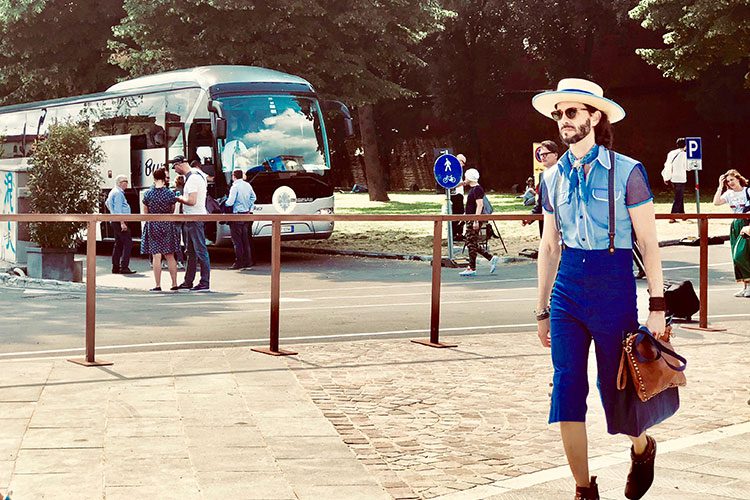
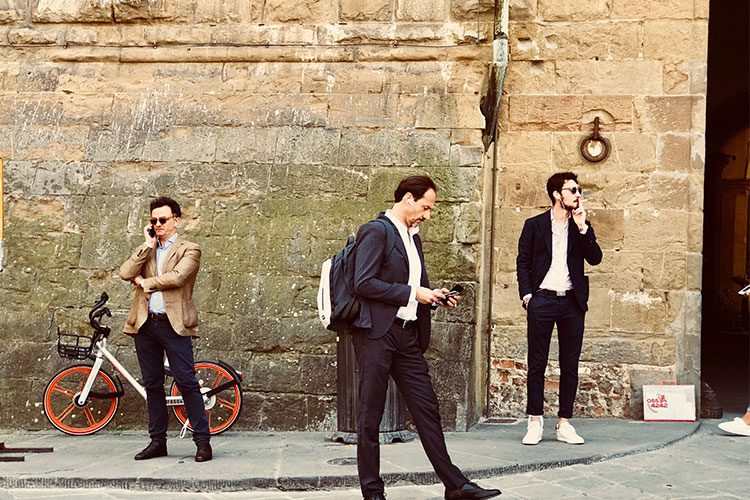
Walking around the city of Florence during Pitti Uomo makes the experience more wonderful than it already is. The city overflows with creativity and hundreds of fashionable men are seen with interesting outfits or fancy suits. The first place I walked through was Piazza della Signoria, where they held the opening ceremony. The attendees could be spotted from a mile away as they walked out of the building in their sharp suits and fancy shoes.

I, then, decided to take a stroll to the Fortezza da Basso and simply walking toward the building was quite the sight to see because it felt as if I were front row in a street fashion show. The outfits in this area were a little more spontaneous. Once I got to the Fortezza, I discovered that this is where they hold most of their main events and it was almost as if I had entered menswear heaven. Of course, many sections were closed off to the public because the event is taken very seriously in the industry but I was able to walk in and see the different stands, clothing racks and large screens showing clips of male models.

Having a fashion event as big as this one is incredible because it is an outlet for people from all over the world to not only attend and gather new ideas but also for individuals to express themselves in a creative way. Fashion is not just about clothing, it’s also about the evolution of style, piecing different garments together and the influence of the culture surrounding it.

Pitti Uomo is the real deal. This month makes it the 92nd edition of the fashion event and the 46th year since it launched in Florence in 1972. The event has grown immensely throughout the years yet remains in the city, maintaining Florence’s fashion capital status worldwide.

See more of Florence and Italy at FUA’s FBInstagram, and Twitter.

La Fiorita: A Florentine Tradition

Photo by author

By Dara Hernandez

Journalism student Dara Hernandez digs deeper into the life of Girolamo Savonarola and the meaning behind the yearly Florentine celebration of “La Fiorita.”

One of the main reasons I was drawn to Italy is for the amount of history that it possesses. Walking through the streets of Florence is like walking through a book with a chapter for every building, every piazza, and every sculpture.

Of Italy’s countless traditions, there is one in particular that has existed since 1498. It is known as Florence’s “La Fiorita” and is meaningful to the people of Florence.

The person who inspired this event was a man named Girolamo Savonarola. He was born September 21, 1452 and grew up to eventually become a Dominican friar and preacher here in Florence. He was an extremely radical preacher yet was loved by many Florentines. At the time, he became well-known for his prophecies of civic glory, destruction of secular art and calls for Christian renewal. He was also notorious for organizing “bonfires of vanities” in which artworks, books, musical instruments and other objects were burned.

Savonarola’s passion-filled beliefs led him to getting excommunicated by the Pope. He was no longer allowed to participate in services of the church. Regardless, he chose to defy the Pope. Due to issues of this sort, he ended up being hanged and burned along with two followers on May 23, 1498 in Piazza della Signoria. The next day, his followers filled the area with flowers to honor his life and thus the tradition was born.

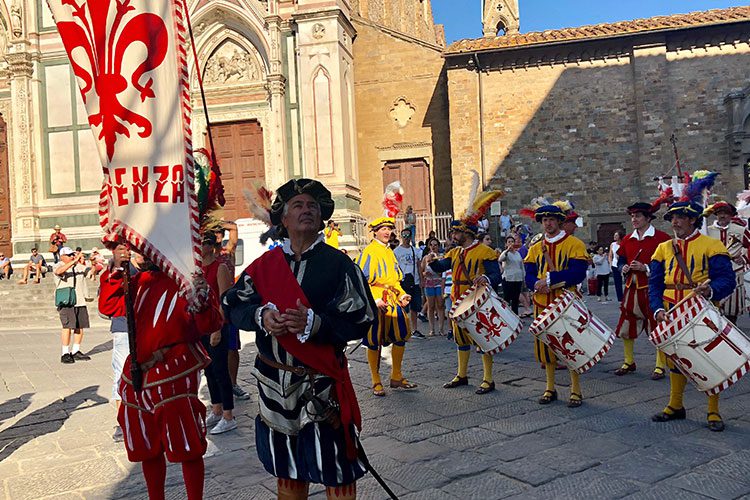
In fact, “La Fiorita” is an entire morning dedicated to the memory of Girolamo Savonarola. The people of Florence begin with a mass, proceed to spread flowers on the ground and finally, hold a costume parade to toss rose petals in the river.

As I was learning more about Savonarola, I found myself constantly wondering why people would praise someone who was famous for the destruction of, what he defined as, immoral art and someone who burned secular objects. However, seeing the roses over the plaque in memory of this man made me realize that not only are people drawn to radical, unordinary humans striving to make a difference, but also that Florentines simply accept Savonarola as part of their history. They recognize that walking through Piazza della Signoria holds stories with meaning that should be remembered.

Therefore, despite the unconventional and radical ways of his preaching, Florentines have continued celebrating his life on May 23, year after year.

See more of Florence and Italy at FUA’s FBInstagram, and Twitter.

Having Family in Florence: What I Taught and What I Learned

Photo by author

By Gregg Casazza

For two weeks my family visited me in Florence. I got to show them around the ancient city, and was eager to teach them about everything I learned. Surprisingly, throughout this experience I ended up learning quite a bit as well.

Family is everything in Italy. It is not altogether uncommon to find three generations of a family living in one house, children are in-part raised by their countless aunts and uncles, and family meals are some of the most important events in the day. Being from an Italian family myself, being away from them for so long has been quite difficult. However, the separation has taught me a lot, and has especially helped me with my own personal growth.

It wasn’t until I had the pleasure of having my family visit me, that I realized just how much I had learned throughout my Study Abroad experience “on my own.” At the beginning of the semester, time after time I was told, “You will learn your way around the city completely,” and although I am usually quite bad with directions, these people were right. I no longer needed Google Maps to navigate the city, I didn’t need Yelp to suggest restaurants, I didn’t need TripAdvisor to find things to do or see in the city. My parents remarks at how impressive it was that I knew the city so well.

I became like a tour guide for my family, on their own private tour of Florence. Showing my family around the city was in one way a test of how much I had learned about the ancient city, but also a farewell tour around my favorite spots and locales. Things like the legacy of the Medici family, hidden gardens and piazze, as well as the numerous cafes and libraries were all a bit bittersweet to visit again, but also surprised me on just how much I had learned by walking the many winding streets of the city. Even little things like the train system which at first felt impossibly foreign, now seemed almost second-nature. I taught my family about ordering meals or coffees, using different currency, picking wine, the history of Florence, and other seemingly smalls tasks that had become utterly mundane to me, but had contributed to my overall learning experience.

Learning about Florence was not the only way I grew however, I also grew personally as well. Study abroad allowed me a greater sense of independence. I learned my place in a global context, learned how to be alone, and how to be self-sufficient. Shopping for meals in and of itself can be an act of self-sufficiency, but knowing where to shop, how to get the freshest produce, and the best prices are also a huge part of personal growth in Florence, and shows a lot of maturity. Using what I had learned, I cooked for my family during their visit using the freshest vegetables and meats, I made traditional Tuscan dishes, Antipasto, Primo, Secondo, and Contorno, and I realized how much I had grown as a person, and how much being in Florence helped me to “grow-up” as well.

Being with family in Italy, just makes sense. Being away for so long was really tough, but after I made it through that hurdle, Study Abroad started to really work for me. In only one semester I became more integrated into Florentine life, learned about the country, and about myself, and it took my family being here for me to really see it for myself.

See more of Florence and Italy at FUA’s FBInstagram, and Twitter.

The Farther You Go, the Better it Gets!

Photo by the author

By Jenna Berman

Before studying abroad in Florence, I was sent nearly 10 different “guides” – each one claiming to know the “best place to eat penne with red sauce” or the “most incredible gelato spot.” Yet no one told me about San Frediano neighborhood in the Florentine “Oltrarno.” It was not until I met a local family friend for lunch that she advised me to visit the town crowned “the coolest neighborhood in the world” by Lonely Planet. Finally, three months later, as instructed by my Writing in Digital Media instructor, I set out to make my own opinion about the famous neighborhood across the river.

It is in San Frediano that the chaos of Florence fades, the streets and sidewalks get a bit narrower, the buildings appear even older, and the shiny, brand names are replaced with local artisan shops, quaint cafes, and authentic Italian restaurants. Something about the ora feels just a little more authentic, cozy, and surreal.

As I roamed the streets, stopping into a neighborhood bake shop that smelled of warm, homemade bread and chocolate-goodness, I came across Cara Jansen, 21, who is attending Syracuse University in Florence while living with a host family in San Frediano. “It’s just cooler,” Jansen said. “Everything feels more honest and authentic here.”

San Frediano is a residential district that possesses Florentine treasures such as the Basilica of Santa Maria del Carmine and the church of Santo Spirito. But don’t be fooled by its simplicity – because it is there where the beauty of the neighborhood rests. Merely minutes away from the hustle and bustle of the surrounding areas, parts of San Frediano feel so quiet, I can almost hear my own footsteps.

I sat down at a local restaurant for a quick bite where I spoke to a nice, young local couple sitting next to me. The couple married almost two years ago and reside in a “charming” home tucked away in San Frediano. Although our conservation was interrupted with a tough language barrier, I asked them both how they would describe the neighborhood. The husband, with kind eyes, looked over at his wife and smiled.

“It’s home. A beautiful town that we call home” he said.
His wife smiled back, chuckled, and turned to me and sighed.

“I grew up in Rome,” she told me. “I never thought I would love anywhere more – until I moved here.”

On my walk back from San Frediano to Santa Croce, I could not help but feel I just experienced a different world. Maybe it was the love of the married couple, the smell of the delicious baked goods, or the charm of historic streets. But I finally understand Lonely Planet – I may have just encountered “the coolest neighborhood in the world.”

See more of Florence and Italy at FUA’s FBInstagram, and Twitter.

Scenes from San Martino: Duomo of Lucca

Photo by Hannah Sanders                                      Photo by Tomie Martel

By Travel Writing Students

This post captures two intriguing figures depicted at Lucca’s main cathedral. A mysterious woman who tragically died at 24, and an artist’s attempt to capture the holy nature of Christ. Explore the peculiarity of silence and the power of the divine in the following stories, uncovered by FUA students at a recent Field Learning experience for the Travel Writing course.

Sleeping Beauty in the Silent City
By Hannah Sanders 

Even on a cold and foggy morning, the silence of Lucca is inviting. The city’s silence wraps around me like a warm robe slipped on after a shower. The stillness carries me through the streets, wet from the rain, and leads me into the Cathedral. There, a beautiful woman lies colder and more silent than the city itself.

I can tell she has lived in the quietness of Lucca for quite some time. She does not speak or move, and she too is cloaked in Lucca’s robe of silence. Her hands are delicately placed over one another and her eyes remain closed, she looks as though she is in a trance.

An English guide introduces me to the sleeping beauty: her name is Ilaria Del Carretto. She was the wife of Paolo Guinigi, the Lord of Lucca, who ruled from 1400 to 1430. Ilaria’s royalty and high rank is evident through her contemporary gothic clothing. At her feet lies a small dog, looking over his shoulder to protect his master. I look to the guide to seek what the sleeping beauty needs protection from, and learn Ilaria suffered a death following the birth of her second child. She was only 24.

The silence is loud now. The cold air shoots shivers down my spine. Thoughts flood my head. Such a beautiful queen, sculpted from white marble by the artist Jacopo della Quercia, was taken from the world much too soon. Her tomb commemorating her life appears so pure, yet her story contains a tragedy. The silence of Lucca no longer seems so inviting.

The Holy Visage
By Tomie Martel

Sitting before the Holy Visage, one can immediately feel a sense of importance and sacredness. Housed in the Cattedrale di San Martino, the carving of Jesus, that depicts him fully clothed and seemingly unharmed was created in the 11th century by an artist named Nicodemus. Nicodemus felt that he was unable to fully do justice to the true face of Jesus, so he carved the body and went to sleep, leaving the face undone. The next morning, he awoke to the visage having been created by unknown hands. From then on, the creation was seen as a miracle.

The second miracle involving this work of art came once it was transported to Italy. The carving was placed on an ox-pulled cart, and without instruction the ox took it to Lucca, where it was determined it was miraculously meant to be housed. It is due to these miracles that every year on September 13th, people from all over Tuscany come to pray to the visage for miracles, or guidance through life.

The Luminara di Santa Croce takes place the 13th of every September, whereby the Holy Visage is dressed in extremely lavish additional garments, including a larger crown, a collar, belt, and silver shoes, all of which are housed in the nearby museum of the cathedral.

With its dark wood, deep carvings, and gold detailing, The Holy Face of Lucca exemplifies the divine. Christ is portrayed as powerful, standing upright so as to emphasise his holiness. It is abundantly evident why this work of art is seen miraculous as well as beautiful.

See more of Florence and Italy at FUA’s FB, Instagram, and Twitter.