
Coffee Culture in Florence

coffee-in-florence-blog-fua
Photo by Erin McMahon

By Morgan O’Reilly

Coffee does not limit itself to its basic ingredients and the seemingly fundamental role of stimulating its consumer. Coffee sits in cafe bars under the dull roar of thought-provoking conversation. Coffee occupies cupholders in Manhattan taxis, accompanies egg yolks and condensed milk in Vietnam, and carries ceremonial value in Ethiopia. It can exist as a supportive friend among late-night spreadsheets and early-morning meetings, and its aroma alone can wake a sleepy family on a rainy Saturday morning. Coffee has the power to support entire villages through the harvesting trade, especially with the insurance of the Fair Trade Movement. It is complex and the possibilities for innovation lie infinitely between the harvesting, the roasting, the brewing methods, and the preparation.

The drink originated in the highlands of Ethiopia, where it arrived in the Middle East before spreading to Venice in the 1570s. Coffeehouses later spawned all along its canals before spreading to other major Italian cities like Turin and Rome. Since then, coffee has transcended past its functionality of improving productivity into a rich, diverse, ever evolving culture across the world’s borders.

As a previous barista and hopeful future coffee shop owner, I had a delightful week exploring the coffee culture Florence has to offer.  

Basic Coffee Etiquette in Italy

Coffee culture in Italy stands unprecedented among its neighbors; it is quick and medicinal with little to no fuss over the preparation. Because of its uniqueness, the dreaded ‘tourist’ label can come far too easily. To avoid the foxpaus, here are some observations I’ve compiled:

  1. Any coffee drink containing dairy should only be consumed in the morning, and never after a meal.
  2. Coffee in Italy is enjoyed its simplest and purest form. Caffé shelves leave no space for an array of flavor pumps, so savor your beverage and try to taste all the subtle hints from the brew.
  3. In a traditional Italian bar (neighborhood coffee joint), always check if you need to pay for a receipt first to present to the barista or if you can order first and pay later.
  4. Typically, locals order and drink coffee at the counter. It also costs much less than sit-down coffee in some of the bigger cafes in squares such as Duomo, Repubblica, and Signoria.

Typical menu items

  • Caffè: One shot of espresso
  • Cappuccino: Espresso with foamed milk
  • Caffè Macchiato: Espresso with a dash of milk
  • Latte Macchiato: Hot milk with a dash of coffee
  • Caffè Americano: Espresso with the addition of hot water

Other spin-offs found at most Italian cafes:

  • Caffè Shakerato: A frothy iced coffee drink prepared with ice cubes in a cocktail shaker. Usually served in a martini glass
  • Caffè d’orzo: A caffeine free beverage made from roasted barley
  • Caffè ginseng: Similar to white coffee: a cream, usually of the plant origin, the sugar, the instant coffee and the dry extract of ginseng
  • Marocchino: Popular in Milan, this drink comes in a small glass dusted with cocoa powder, when topped with milk froth and espresso, and topped with some more cocoa powder
  • Cappuccino Viennese: A cappuccino topped with whipped cream and cocoa powder

Pro Tip: My all-time personal favorite is the cold brew, the espresso-ground beans are steeped in cold water for 24 hours. This method results in a less acidic, slightly sweeter drink. I like to pour the black coffee over ice, but a splash of milk or cream is always a good move. You can easily make cold brew at home by steeping the beans in a french press.

The Old School, the Roasters, and the Contemporary:  Without question, every coffeeshop derives from a wide variety of values, customs, and creativity; so in no way can one title sum up an entire business. This being said, these three coffee categories do point to major differences throughout Florence’s coffee scene.

Old School bar/pasticceria
These shops contain classic Italian coffee and fresh pastries. They stick to the roots of Italian coffee culture to provide an authentic, timeless experience.

Example: Pasticceria NencioniOpen for over 60 years, this family-owned Florentine coffee and pastry bar stands as a charming gem with a wide array delicious sweets and quality coffee. Whether it be a profiterole, a mini tart, a croissant, or a slice of cake, this shop will please its guests through their freshly homemade approach and unbeatable tradition.  

Atmosphere: The shop gives off a timeless, charming feel with their beautiful pastries displayed before the customer.

The Roasters
Some roasting companies open stores in the city, so their base value lies on their quality, specialty coffees.

Example: ChiaroScuroThis shop was opened by the roasting company Mokaflor and contains coffees and teas from around the world.  The array of espresso drinks, hot chocolates, and teas proves quite impressive, so don’t be afraid to take your time deciding. Personally, I am fond of the caffè nocciolato, combining their high quality, rich espresso with hazelnut and whipped cream.

Atmosphere: This shop has a homey, old school atmosphere with plenty of seating.

The Contemporary
Many New Age Coffee shops typically value the  Third Wave Coffee movement, in which coffee is treated as a culinary delicacy, like wine, rather than a commodity. The movement lends itself to stronger relationships between coffee growers, traders, and roasters, as well as focusing on direct trade, single origin coffee (as opposed to blends), and high-quality beans. Along with these ideals, they may emphasize fair trade as well as focussing on the unique atmosphere of the space.

Example: Ditta Artigianale. This contemporary coffee shop prides itself in its focus on international coffee blends and brewing methods. Also directly involved in the roasting process, the shop combines the traditional values of Italian coffee culture with the Third Wave movement. The Artigianale baristas are knowledgeable of the bean’s origin and the process to which they receive them, so they gladly welcome conversation over their coffee’s “story.” In fact, the shop itself is designed to welcome this interaction through their lower-than-normal counters and complete visibility between the customer and the barista.

Atmosphere: The shop on Via Dei Neri, in my opinion, gives off a retro vibe with the script typography and industrial lighting. It’s a great place to sit and finish some homework or enjoy friendly conversation while alternative, mellow music fills the space. In contrast, the new Oltrarno location gives off a more posh atmosphere through interesting patterns and lighting, a muted, sophisticated color scheme, and more mature, jazzy playlist.

See more of Florence and Italy at FUA’s FB, Instagram, and Twitter.
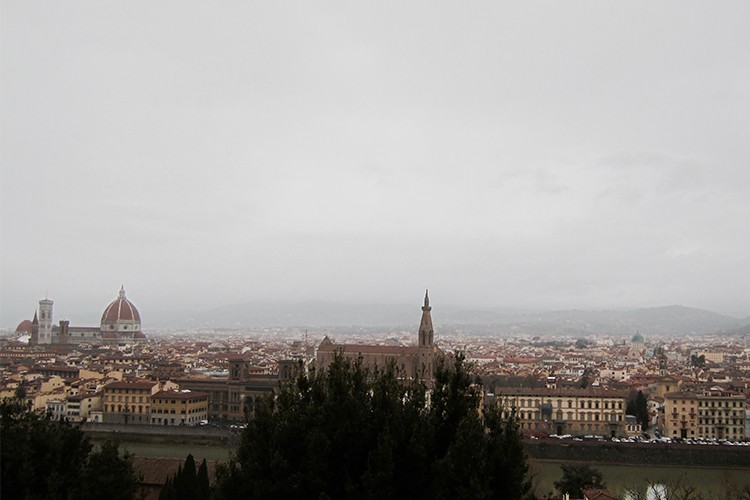
Showing Visitors Around: A Mini-Guide

finding-florence-blog-for-guests
Photo by the author

By Leanora Karnath

Looking for ideas to entertain visitors in town while keeping up with your studies? Seize the opportunity to be their own personal tour guide and show them how you’ve been spending your stay abroad. With limited time, you’ll want to make sure they have the best experience possible. The following tips offer advice on what to do before and during their visit taken from personal experience when my parents came to Florence.

Before the arrival:

  • Figure out what’s at the top of your visitor’s to-do list. Before my parents arrived, I asked them for a list of activities they were hoping to do because it’s impossible to see everything the city has to offer within a week. You might have visitors who are most interested in trying new food, seeing amazing art, engaging with the locals, or a mix of all three. It’s important to understand their top choices to ensure they have a fulfilling and personalized experience.
  • Create a flexible schedule based on what your guests would like to do. Group certain destinations for one day based on proximity. Keep in mind that your visitors may be tired from traveling, so use the first day in Florence as one to familiarize themselves with the area where they’ll spend the most time. With a tentative schedule, you can accommodate the times you’ll be in class and need to complete assignments. Planning is key to prevent stress and maximize time, so reach for a calendar and find your free time before your guests step off the plane.   
  • Plan travel outside of Florence. If possible, take a day trip or two around Italy to give your guests a better feel for Italian regional diversity. Purchase train tickets ahead of time to avoid higher costs. Keep in mind that it may be difficult to find accommodation during high tourist season, so plan accordingly. You can also sign up for free tours with licensed guides in many other Italian destinations.

While in Italy:

  • Think about what you wish you knew as a newbie to the city. Did you wish you knew some greetings? Or, how to order at a cafe or restaurant? Give them the tips that would’ve made the adjustment easier for you after your arrival! Teach them some phrases to increase their comfort level. Now that you’ve lived in Florence for some time, you’ll have the insider’s scoop on the best eats and how to blend in better with the locals. Share this knowledge with your guests.
  • Give them a map. Although this tip may seem obvious, it’s easy to slip your mind if you no longer rely on directions to find your point of interest. Remember that your visitors are seeing the city for the first time and may become lost without a map. While walking around after they arrive, point to the locations on the map to ensure your guests will be able to walk around when you’re not there to point them in the right direction. Circle and label their hotel along with other locations to provide a point of reference.
  • More than just a tourist hot spot. It might sound tortuous to venture to the top of the Duomo while maneuvering your way around a crowd of people. However, experiencing all of Florence’s beauty with visitors will give you a greater appreciation of the city you now call home. Remember, certain locations may be flooded with tourists for a good reason; they hold cultural and historical significance in Italy. Chances are you might be visiting the hotspot for a second time, so research prior those insider tidbits that you missed the first time around to create an extra-special experience for your guests as they connect to the city.

If you only had one week in Florence, what would you do? Think about this question when showing your visitors around the city to create a quality experience with a lifetime of memories.

See more of Florence and Italy at FUA’s FB, Instagram, and Twitter.
How to Combat FOMO

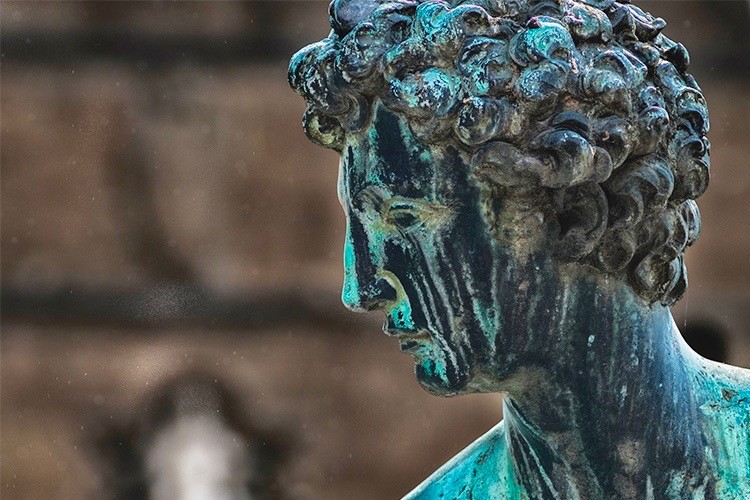
Florentine statue
Photo by David Weiss

By Leanora Karnath

When I made the choice to study abroad, the idea of FOMO or the “fear of missing out” never came close to crossing my mind. Why would I think about my small town college in Geneseo, New York when I’d be living in Florence? As someone who chose to spend the last semester of my undergraduate degree studying abroad, FOMO has happened suddenly and unexpectedly like when my friends tell me about how much fun they had on a snowday or when I hear about the upcoming spring concert I won’t be seeing.

Even if you’re not a senior, you’ve probably experienced FOMO when you think about home life. Here are a few tips to better deal with it:

  • Find a balance between spending time with friends abroad and talking to loved ones at home. It might be tempting to schedule times to talk multiple days a week, but too much can be harmful. You run the risk of missing out on all of your surroundings in Florence when you’re too busy thinking about all you’re missing out on back at home. Don’t change your plans because you want to stay in your apartment and talk to those back home. Get out and explore! Afterwards, e-mail some photos and tell your family and friends the best part of your day in Florence. It’ll help make the city feel more like home.
  • Go on the lookout for your favorite spots in Florence. How can you possibly think about what’s happening in your hometown when you’re experiencing something new and exciting? It may be an amazing view, colorful market, frothy cappuccino, flavorful dishes, or simply an eye-catching piece of street art. Strive to go out of your way and see the streets and places that rarely pop up with a Google search of Florence. You have adequate time to familiarize yourself with the culture and the areas most tourists never get to see.
  • When you have a free day, take advantage of it. Don’t just sit around and aimlessly scroll on social media sites. Seeing posts and pictures makes FOMO even worse. Instead, write a list of places you want to see, things you want to eat, and museums to visit. After you’ve written the list, go out and cross some things off! The academic session will fly by, so don’t waste time. Been to all of the big museums? Check out this group of “small but big” Florentine museums.
  • Be grateful for your opportunity to study abroad. Living in Florence is a once in a lifetime opportunity as I’m sure you already know. Don’t take it for granted by staying in when you don’t have class or clouding your mind with thoughts about what’s going on back home. Each day remind yourself that you’re living in a beautiful Italian city, one that should be appreciated and experienced to the fullest. You have the chance to go beyond the surface level of Florence during your time here. Take advantage of it!

See more of Florence and Italy at FUA’s FB, Instagram, and Twitter.

Returning Students: Firenze with Fresh Eyes

FUA student Erica Kavanagh
Blogpost author E. Kavanagh photographed by M. O’Reilly and L. Karnath

By Erica Kavanagh

After your first session in Florence, as a returning student you probably have seen all the monuments, museums, and historical sights. Those rose-colored glasses begin to fade, and you begin to experience Florence in a new light, as a local resident. Now upon your arrival back to Florence, you could face a few new issues.

For most returning students, one of the hardest adjustment can be the language especially after a holiday away in between academic seasons. Brushing up on your Italian can help for a much smoother transition back to Florence. Without practice, your language skills can and will become rusty. Seek out some fun and unconventional studying tips.

Tips to practice your language skills:

  • Talk to an Italian – For pronunciation sign up for Chat Pal through Student Life
  • Watch a T.V. show – L’italiano in Famiglia helps recap grammar
  • Download a language app – Use Duolingo for vocab exercises
  • Read a children’s book – C’era una Volta un Gatto to improve reading skills
  • Listen to a podcast – For everyday phrases use free Italian Podcasts

With a new perspective, returning students may shed a romanticized image of Florence and experience some not so beautiful aspects. It’s bound to happen, every city and country has its cultural issues that usually differ from a student’s own home country. Experiencing cultural issues can bring back the homesickness that you thought you’d gotten rid of for good, for example.

Think globally, act locally:

  • Live by being an example – Treat others how you would like to be treated
  • Keep an open mind – Have the willingness to learn, be aware of, and talk about issues that you encounter
  • Build relationships – Make a friend from a different cultural background breaks stereotypes
  • Do not let the differences of others affect daily life – Understand that some people cannot be changed, that cultural issues are deep rooted

Florence is a home away from home. For your long-term stay, it is important to have a financial plan. Running out of money can be one of the worst things that can happen while abroad. Little investments can help you save money in the end.

Budget wisely:

  • Stick to local markets – Stay away from expensive imported goods
  • Buy a stove top espresso maker (moka/caffettiera) – Avoid spending money every morning at the bar
  • Cook at home – Save money with home-cooked meals, rather than eating out

After a long holiday at home, students typically revert to their vacation mode/ lifestyle – odd sleeping/waking up habits, eating at anytime of the day, etc. It’s important to get your body and mind on a new academic schedule.

Time management:

  • Readjust your sleep schedule – You’ll get the most out of your morning classes
  • Planning enough time for proper meals – This helps you to strong off strong and avoid getting those beginning of the semester sicknesses such as colds, the flu, etc.
  • Organize – Create a system to maintain on top of school work

Most returning students are eager to catch up with their friends from the previous session. However each new start brings new students. It is just as important to connect with new students as it is with the returning ones. Approaching these encounters aren’t always immediate but are extremely beneficial.

Networking Benefits:

  • New information – New friendships open doors to new academic knowledge
  • Different experiences – Exchanging cultural backgrounds
  • Establishing similarities – Creating study groups or planning trips
  • Revisiting sites – Challenges to enrich old context with new perspective

Everyone studying here wants to make the most of their time in Florence. Sometimes it can be hard for returning students to keep that initial curiosity alive, to continue to experience different parts of the city. However I personally can testify to the importance of further exploring this city. I learn new things everyday. My new roommates introduce me to new cafes and continually teach me how to cook new cuisines. These experiences have shaped the way I view Florence and have helped me overcome potential returning student issues. Every new discovery makes my relationship with the city even more intimate. I am very happy to be in Florence and cannot wait to see what the rest of the season has to offer.

See more of Florence and Italy at FUA’s FB, Instagram, and Twitter.

When Life Gives You Fashion

Photo by Ryan McGuire via Gratisography

By Max Slepian

Most of us go through life in a comfort zone.  We like to start our day with the breakfast we like, do the job we are use to doing or go to the classes we signed up for.  But every once and a while we are put in a completely unfamiliar situation and we have to learn how to deal with it.  I was recently thrown into one when I attended my first Fashion Marketing class.  

I was one of two men in a classroom with 30 women.  In any other situation this ratio of males to females would’ve simply been laughed off as an advantage for the guys, but in this case there was much more in store.

The instructor started the lesson by reassuring us that it was not necessary to be a fashion or marketing expert but naturally it helps to know about these areas.  I didn’t know much about marketing and besides the Project Runway marathons that I had to endure with my mom when I was still in high school, I was pretty clueless about the subject of fashion.  After all, I was the guy who wore plaid shorts with a striped t-shirt just this past summer, and couldn’t decide if I should rock my “senior citizen” New Balance running shoes or Leggo socks with neon green Crocs.  It goes without saying that I was clueless about fashion and made no secret of it when we made class introductions about our backgrounds and areas of study.  In a sea of fashion and retail majors, I was the lone undeclared student.

Our first exercise was to watch the 2015 Milano Fashion Week runway and provide three adjectives that encompass the essence of the collections and a type of car you would market with each.  As the first collection came down the runway, I noticed the dresses were green, yellow and “flowy,” which seemed like somewhat sufficient adjectives.  Afterwards, we were asked to share our chosen adjectives.  Words like “feminine,”  “chic,” and “earthy” were some common adjectives while not one person said anything close to “yellow.”

I was grateful the professor didn’t call on me to share my disappointing adjectives, but my luck ran out when I was asked to share the car I would chose to market with this collection with.  My mind started racing for a good answer.  I was thinking that a general consensus for the collection was that it was earthy and before I knew it I blurted out “uhh… a Prius?”  The class burst into laughter and I quickly realized that the environmental advantages of a hybrid car doesn’t immediately qualify it as a fashionable pairing.

My fashion knowledge has yet to vastly improve, but after time my presence in the class has seemed to become less a fish out of water.  I probably don’t have the exact response to answer the question of how to deal with a situation in which we are totally unfamiliar with.  But if I have learned one thing, it’s that you should try out unfamiliar contexts even if the content seems unknown or you perceive to less knowledgeable of a subject matter compared to others. Dive in headfirst and don’t be afraid to speak, because if we are never called out on our mistakes there is no way to learn from them.

See more of Florence and Italy at FUA’s FB, Instagram, and Twitter.
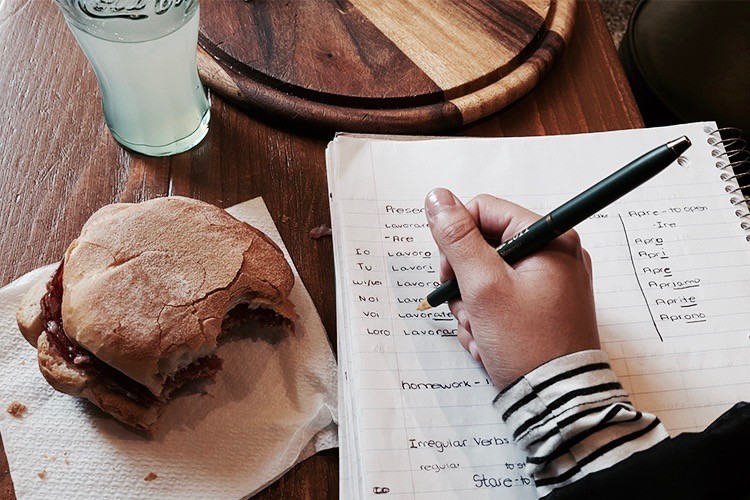
Gearing Up for Exams!

Photo by the author
Photo by the author

By Leanora Karnath

Amidst the excitement of living in a new country, being in a different environment may pose some challenges in adjusting to new study habits. Participating in the classroom can be just as eye opening as sightseeing in Florence. You’ll also have the opportunity to meet students from all parts of the world to share different perspectives when discussing class material. If you’re having trouble achieving a balance when mid-terms and finals roll around, the following tips may come in handy.

  1. Keep a planner to track all your assignments and upcoming exams. With traveling plans and to-do lists filling your head, it can be easy to forget about due dates for classwork. Purchase a beautiful leather planner from a local shop or download a simple calendar app that allows you to set reminders. Because your weekends will probably fly by with traveling and exploring Florence, make sure to complete your assignments beforehand and avoid the stress of doing things in a rush!
  2. Find a space that suits your study needs. Some people are most productive in quiet, secluded areas while some don’t mind the chatter of others. Figure out what works best for you, so you’re not wasting your time in a difficult place to concentrate. Consider stepping out of your apartment to find a cafe where you can study. You’ll also avoid dealing with any roommates who may distract you. The FUA library in Corso Tintori provides a quiet zone for serious reading and reviewing. If you want to go somewhere with a view, take your notebook to Oblate Library to see a view of the Duomo or bring your study materials up to Piazzale Michelangelo (be aware of crowds though). Need to be surrounded by green to power your thinking? Try the Cascine Park, the Giardino di Orticultura, or green squares such as Piazza d’Azzeglio and Piazza Demidoff.
  3. Wake up early a few days a week. If you don’t have early classes every day of the week, consider starting some days earlier than you normally would. Although most college students may dread the idea, a couple extra hours of the day can help out with completing assignments. Wake yourself up by going to a local cafe. Sit down with a hot cappuccino and flaky croissant while you complete some work.
  4. Improve time management. Few things are worse than sitting down to read your assigned textbook only to realize you can’t remember anything you’ve just read. Remember to cut out distractions such as social media to optimize productivity and complete assignments when you’ve had enough sleep. Reviewing class material each day helps your brain retain information as opposed to procrastination which oftentimes yields stress and mediocre results.
  5. Form a study group. If you feel like time is withering away with things you want to do, consider applying your acquired knowledge from a course to your surroundings. Make some friends from class and do something around the city to enhance your learning. If you’re in an art history course, go to a museum and study the intricate details of sculptures and paintings. If you’re taking an Italian class, go to lunch with friends and practice what you’ve learned by ordering in the language. Think of creative ways to reinforce all that you’ve learned.

Hopefully, these and other tips will help you excel in your academics for a memorable and rewarding study abroad experience. Happy studying!

See more of Florence and Italy at FUA’s FB, Instagram, and Twitter.
Hello From the Other Side (of the Arno)

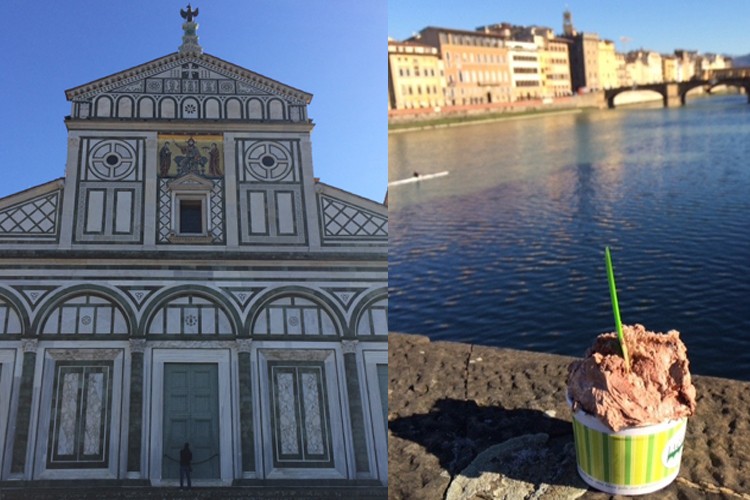
Visiting San Miniato al Monte, Enjoying gelato from Gelateria Carraia
Left, San Miniato al Monte; Right, gelato from La Carraia with a beautiful view. Photos by author.

By Emma Vogel

Contrary to popular belief, not everything worth seeing in Florence is on the north side of the Arno river. Here are some of the hidden gems I’ve discovered living beyond the river, or as the locals call it, the “Oltrarno” or in an even further colloquial way, “Diladdarno.”

I was confused the first day I arrived at my apartment in Florence. Where was the Duomo? The Ponte Vecchio? The statue of David? Okay, I wasn’t quite so naive as to expect all of those Florentine staples right outside of my apartment door, but I knew I was in a different part of Florence than I had seen when searching Google Images. It took me only a few minutes of wandering to realize that I lived on the south side of the Arno river, and it took only a few days after that to fall in love with where I live. Sure, what draws most people to Florence is the bustling Piazza della Repubblica, the magnificent Duomo, and the incredibly famous Palazzo Vecchio, but there’s much more to see than what the tourist guides suggest. There’s a whole hidden part of Florence with charming artisan shops, authentic Italian cuisine, and hip cafés filled with locals that you can find by simply crossing one of the many bridges. Here are the best parts of Oltrarno that I’ve discovered so far.

Food

Oltrarno has some of the best restaurants in all of Florence. With a multitude of choices from family-owned restaurants to trendy eateries, I find a new favorite restaurant every day. So far my top picks include: GustaPizza (not surprising as it is loved by abroad students, tourists, and locals alike), Osteria Santo Spirito (great sit-down spot), Club Paradiso (owned by an Italian couple, the wife cooks the food, the husband is the waiter, and the menu changes everyday!) As for gelato, Gelateria Carraia never disappoints and has been a local favorite for years (a wide variety of flavors and generous portions.)

Pro Tip: You can compare southern Italian pizza styles in the neighborhod. After GustaPizza, check out O’ Munaciello and Da Gherardo (don’t let the plain website fool you, the place is tiny but packs a punch!).

Santo Spirito: A Place to See

Crossing the Ponte Vecchio into Oltrarno brings you to the center of the most authentic artisan shops in Florence. Walking down Via Romana, you pass stores selling handmade leather shoes, fresh pasta and olive oil, and art galleries. Past the artisan shops you can find Santo Spirito, arguably the hippest neighborhood in Florence. Piazza Santo Spirito is filled with cute cafes and trendy restaurants known for apertivo and, of course, the famous Basilica di Santo Spirito. The square has a daily market open until 2 p.m. where you can find fresh produce sold by neighborhood locals. A short hike from there brings you to the breathtaking Piazzale Michelangelo where you have a view of the entire city. A little farther up the hill you can find San Miniato al Monte, one of the most beautiful and unique churches in Florence.

Pro Tip: Santo Spirito is the iconic square of the Oltrarno area. Also try exploring the tiny Piazza della Passera for funky restaurants and great gelato. Piazza del Carmine (also home to the Brancacci Chapel) and Piazza Tasso are also interesting squares with a great local vibe.

Although Florence’s most famous monuments are undeniably amazing, it’s more than worth it to escape the crowds of tourists to explore the hidden beauty and authenticity that is Oltrarno.

See more of Florence and Italy at FUA’s FB, Instagram, and Twitter.
Florence Through the Eyes of a Local

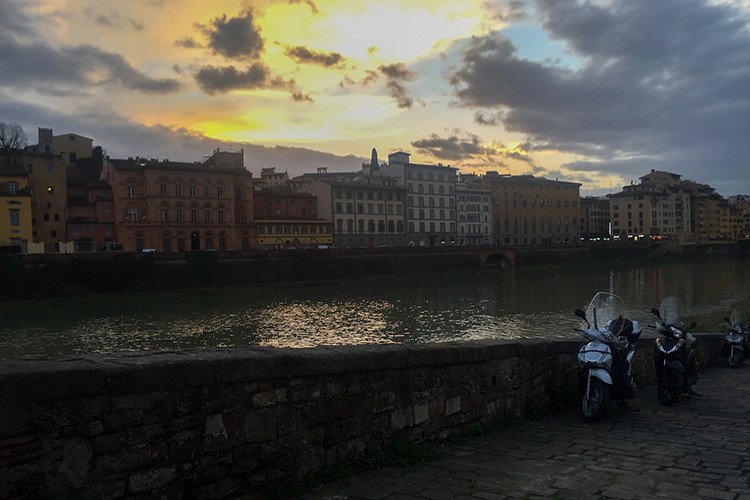
The Arno River, photo by the author

By Morgan O’Reilly

When first arriving in Florence, it’s normal to feel like a tourist. Here are some tips on how to live like a local. 

Florence, upon  first glance, can overwhelm its visitors as they crane their anxious heads above the sea of selfie sticks and open maps, search for a restaurant sans menu photos, and  squeeze through the awing crowds in the main squares of the city. Among the excited tourists, it’s important to keep in mind that a majority of people you pass by call this city home.

Firenze has so much more to offer than temporary housing for weekdays. Culture and favorite cafes and park benches with carvings live here. Children and dogs play in the streets as their parents chat with the friendly market booth owners. Familiar calls of “Buongiorno” ring through the narrow alleyways, artisans flaunt their daily food creations, and 20somethings socialize on the steps of Santo Spirito.

Learning to see Florence through the eyes of a local

Appreciating Firenze as a home can help create an authentic study abroad experience. Finding the best panini places and venturing past the piazzas will come with time, but there are some things you can do to help feel like a local in the city.

Talk to your professors

Even if not all of your instructors were born in the city, chances are they have lived here long enough to be considered a local in terms of their favorite activities. A short conversation about their ideal day will provide great insider tips while getting to know your instructors on a more personal basis.

Strike up conversations with small business owners and workers

On your next pit stop for lunch, whether in Italian or English, introduce yourself to the people behind the counter. Step out of your comfort zone and ask them how they are doing, if they have any recommendations, and what their ideal day in Florence would be. Forming relationships with local italians can immensely help authenticate your Florentine experience.

Search online for local advice

Although forming relationships with locals will prove incredibly helpful, the internet is also full of blog posts, reviews, and ‘top 10’s’ for the exact purpose to share local knowledge. Some great places to start are The Girl in Florence blog, filled with restaurant reviews and things to do off the beaten path, this Unusual Florence guide, and even Tripadvisor (Making sure to measure opinions carefully. Try the place. Do you agree with other clients’ opinions?).

Tips from a Florentine local:

Native Florentine and Marketing professor Paolo Fiorini kindly gave some insight in creating an authentic experience.

What would be your ideal day in the city?

Go out in the morning with my family to the Central market and buy typical food products. Stop at a restaurant/panino place and eat then walk in the center of the city looking at exhibition or other events

What eateries and activities would you recommend for someone visiting the city?

Well, this is a complex question. It depends on what you want to eat. If you search traditional food like lampredotto or trippa for me the best place is Il Magazzino, pasta at La casalinga, bistecca at Pandemonio, wine and cheese at Le Volpi e l’uva, and then other hundreds of eateries. Place to visit: Galleria dell’Accademia, Galleria Palatina at Palazzo Pitti, Palazzo Davanzati, exhibitions at Palazzo Strozzi, and all major churches

In closing, he shares that the best way to make your experience unforgettable is try to live as a Florentine. Buy traditional food and cook it with local people, learn basic Italian and try to speak it, relax and understand our “lifestyle.”

From personal exploring, I have stumbled across a couple great places, including  Sandwichic on Via San Gallo, which provides delicious and different sandwiches and a bottle of water for 2,50 with your FUA ID, and Da’Vinattieri, with a fennel spread that will change your life. Other recommended places I have yet to venture to include Amble, an eclectic lunch spot where you can buy the vintage furniture at the cafe and Ino, another seemingly awesome spot that uses top-notch ingredients.

Although you may only inhabit Florence for a few short weeks or months, putting in the effort and opening yourself up to new, authentic experiences can turn your perspective of this city from the eyes of a tourist to the eyes of a local.  

See more of Florence and Italy at FUA’s FB, Instagram, and Twitter.
Seizing the Florentine Moment

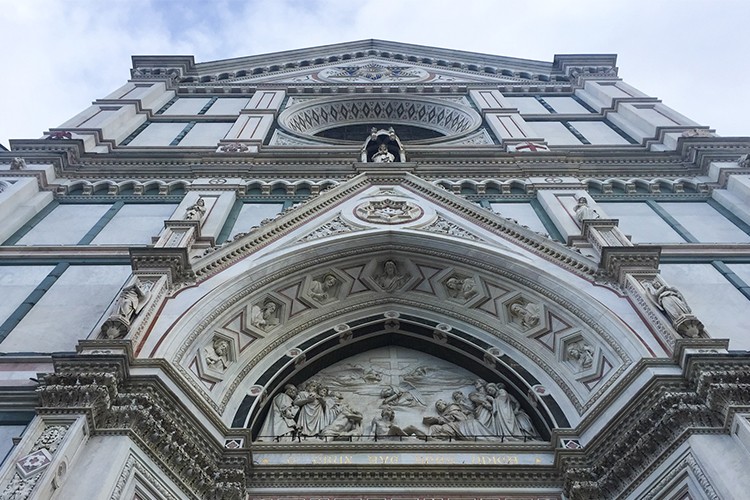
Facade of the Basilicata di Santa Croce
Examining the detail of the Santa Croce church, photo by Morgan O’Reilly

By Morgan O’Reilly

It’s 8:30 on a February morning as I swiftly dodge bikes and local pedestrians on my way to class. The damp chill of Florentine air jostles my bones as my tired eyes stare downwards at the passing cobblestone. The frigid gust of wind and the loom of tardiness pick up my weary feet and hurl them toward the next stone, until suddenly a crack on the sidewalk catches my foot and I trip. Only then do I look up from my monotonous routine and spot a little, hidden bakery; a woman laughing with her daughter; the incredible detail on the Santa Croce archways; and a side of Florence I had neglected to notice.

Falling into a routine comes naturally when settling in Florence: you find the quickest routes, the cheap panini places, and a couple go-to evening spots. Although finding some favorite places will help with your acclimation to the new environment, it is also  important to keep exploring the city and appreciating new sights each day. Yes, many weekends will be spent crossing off travel bucket lists, but weekends should also lend themselves to new Florentine discoveries. The city cannot be fully appreciated in one, momentous layer. It opens itself up to its guest every day; tripping and confusing its inhabitants and then strategically placing a hidden gem right in their winding paths

Finding a new sight a day, or moreover, appreciating a new sight a day, can transform the city from a world renowned bustle to a personalized home. Form a realistic plan of things you want to see, do and eat, and try to knock off a few each week.  Reach out to your professors and locals for their recommendations. Even on your walk back from class, pay extra attention to the detail on the Duomo; the finely cured meats at your favorite panini spot; the muffled italian chatter in the Oblate Library; veins on statues; love locks on fences; foam on your cappuccino. Explore the Uffizi over and over again, visit Oltrarno’s gardens, grottos, and local eateries, and find those special details and locations you would have overlooked if you hadn’t payed active attention.

The simple act of opening one’s senses to new discoveries can not only act as a mantra for an immensely enriching Florentine experience, it also lends itself to a life of new discovery and appreciation. Begin to notice, to see the overlooked, and to experience the little moments that make Florence so unprecedented.  

See more of Florence and Italy at FUA’s FB, Instagram, and Twitter.
A Taste of Florentine Markets

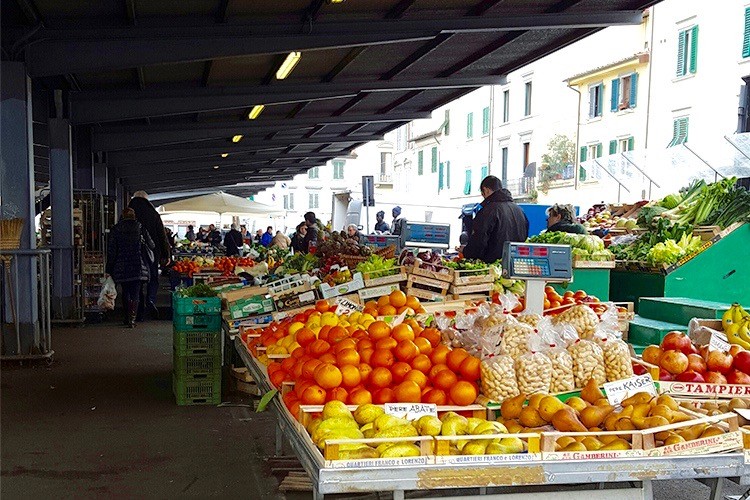
Sant'Ambrogio market, photo by Leanora Karnath
Sant’Ambrogio market, photo by the author

By Leanora Karnath

In Florence, venturing into the market isn’t simply about buying food, but it’s also about being part of an authentic experience. You’ll be surrounded by Italian speakers, vibrant colors and something new on every corner to indulge your senses. Vendors can tell you the origin of the foods whether an item comes from the northern regions of Italy or right here in Tuscany. You’ll develop a deeper appreciation and closer connection to these Italian products. Markets are also a great place to observe local life and even practice the language.

You probably heard about the popular San Lorenzo Market before even stepping off the plane to Florence, but there are many more options to purchase groceries in the in the city center.

Sant’Ambrogio
Designed by Giuseppe Mengoni and built in 1873, the Mercato di Sant’Ambrogio is home to a selection of fresh fruits, vegetables, meat and fish, breads, and pasta that may offer more advantageous prices than the San Lorenzo Market. The market is both indoors and outdoors, open every day 7am-2pm except on Sunday. It’s about 15 minutes away from the Duomo.

Santo Spirito
Every third Sunday of the month, the square hosts an organic food market from 9am to 7pm. You can browse through various stalls of local food purveyors.

Fruit and vegetable grocers: Fruttivendolo
Around the city you’ll find fruttivendoli or ortofrutta shops specialized in fruits and vegetables. Everyone has their favorite based on their neighborhood or shopping preferences, try asking professors or new acquaintances at which shops they like to buy their frutta e verdure (fruit and vegetables)!

How to Shop – An Essential Guide

  • Be sustainable and bring along a reusable grocery shopper bag.
  • Bring cash instead of relying on a credit card as most vendors only accept cash.
  • Don’t touch the fruits and vegetables without asking. Tell the vendor what you want. They’ll either give you it or hand you a plastic bag to pick it up before it’s weighed.
  • Don’t forget to keep an eye out for seasonal fruits and vegetables. Eating seasonally is key to Italian cuisine and the market is a great place to experiment with products that vary as the weather changes.
  • Know how much you want and how to say it. Although some vendors will know English, this won’t be the case in all situations.
    I would like… Vorrei…(i.e. I would like 2 apples. Vorrei due mele)
    Can you give me..? Mi da…? (i.e. Can you give me 2 apple? Mi da due mele?)
    One Uno
    Two Due
    Three Tre
    Four Quattro
    Five Cinque
    1 pound= about a half a kilogram Mezzo chilo
    For cured meats, the etto, or 100 grams, is a common unit of measure.

Common Food Items, Translated
Grapes Uva
Lemons Limoni
Limes Limes
Oranges Arance
Strawberries Fragole
Raspberries Lamponi
Apples Mele
Tomatoes Pomodori
Lettuce Lattuga
Spinach Spinachi
Mushrooms Funghi
Onions Cipolle
Potatoes Patate
Peppers Peperoni
Asparagus Asparago
Carrots Carote
Cheese Formaggio
Ham Prosciutto
Chicken Pollo
Turkey Tacchino
Beef Manzo
Pork Maiale
Garlic Aglio
Bread Pane

If you don’t see something on the list that you want to purchase, look up the translation and write it down. Don’t worry if you’re having trouble saying something in Italian, or indicating the item that you wish to purchase.

Shopping at local markets is a great option for making dinner at home with friends, preparing fresh packed lunches to enjoy in between classes, or to have healthy snacks on hand such as perfectly ripe fruit. In addition to shopping locally, you can also check out the Apicius CiboChat blog for student reviews of local restaurants, bakeries, gelato shops, and much more.

See more of Florence and Italy at FUA’s FB, Instagram, and Twitter.