By Alma Limon
This week’s “I Wish I Was There” podcast features a major Fiorentina professional soccer trophy victory in 1940 that changed the game for Florence’s home team.
By Alma Limon
This week’s “I Wish I Was There” podcast features a major Fiorentina professional soccer trophy victory in 1940 that changed the game for Florence’s home team.
By Lauren Miller
We’re thrilled to introduce our new blog sound bytes featuring original podcast content produced by the FUA Broadcasting New Media course! In the “I Wish I Was There When…” series, FUAers present about landmark moments for the city of Florence told firsthand. In this inaugural radio story, we reveal how the first piano was invented in Florence in the 18th century by Bartolomeo Cristofori.
Music credit:
Table for Four
Written and performed by CrusaderBeach
By Emily Entwistle
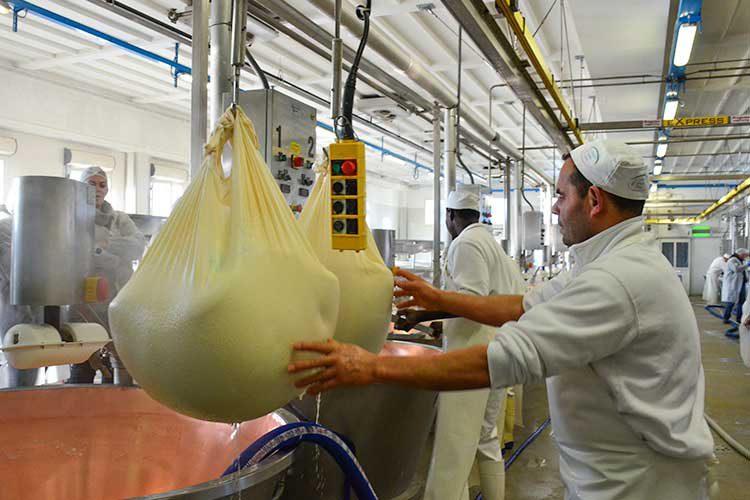
Italian culture includes many artisan traditions, crafts, and skills. The globalized world can make it hard to preserve such traditions, which are important to maintain and practice traditions.
As part of my time in Florence I have learned about many unique, artisanal food processes. I’ve even visited production facilities in Modena and Parma for a field learning activity. The simple but lengthy processes that these artisans use to produce cheese, balsamic vinegar, and prosciutto are impressive. The extra care and time it takes to organically produce these foods seems like a challenge, but they are worth it. The rules, regulations, and standards set for these producers could seem like a bureaucratic nightmare, but they are implemented to insure that producers stay true to the craft.
There are aged balsamic vinegars that are 20, 50, and even 100 years old. The D.O.P. balsamic vinegars take an extremely long time to age, and once every year they move the balsamic from one wooden barrel to another. Consider also that there is such a huge difference between Parmigiano Reggiano and parmesan. Real Parmigiano Reggiano is aged for a minimum of 12 months, and according to most, the best is 22 to 24 months old. Making artisanal products is a waiting game. For prosciutto, producers add salt and wait. For Parmigiano, they add salt and wait. To make balsamic vinegar, they put the grape juice in a barrel and wait. The key is patience, and when the item is finally ready, it is amazing to say the least. Producing these foods is even a year-round job. Parmigiano Reggiano producers for example work every single day of the year, even on holidays, to keep their process completely natural and authentic.
While a higher cost of these products may seem too high for some people, buying quality foods is extremely important. Not only are they better for you, but they support the special skills of smaller producers. And the food is worth the extra money for the taste alone. After directly visiting production facilities, I have gained a greater appreciation for the craft of food artisans.
By Madison Landau
In today’s society, there seems to be a holiday to celebrate just about anything. There’s a national holiday for Nutella, siblings, and even for French bulldogs.
Here in Italy we recently celebrated on March 8th an important holiday that won’t just be swept under the rug like the others; International Women’s Day was celebrated proudly by allowing free admission to state and municipal museums for women.
Even though Women’s Day is just once a year, you can make exploring female themes in the local culture a regular part of your daily routine. If you like exhibitions, for example, try to find special shows in your area that may focus on female artists or artists who focus on female sources of inspiration.
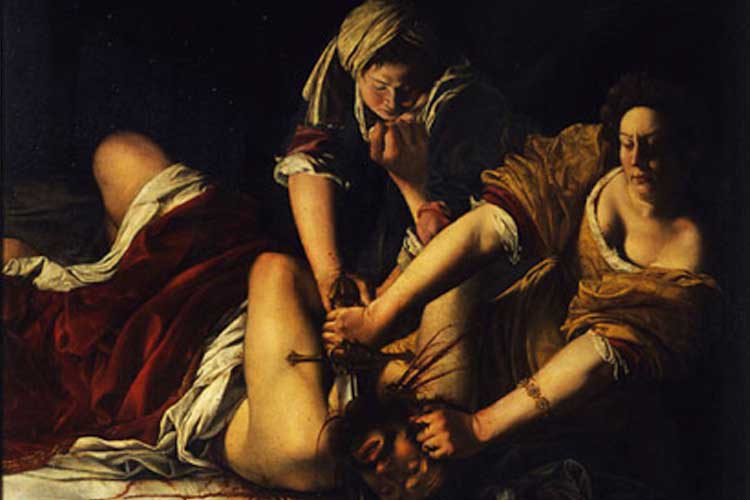
In Florence, the famed Uffizi Gallery Museum houses historic artists such as Artemisia Gentileschi, who is considered to be one of the most successful painters after the Caravaggio era. It’s important to not just see her artwork, but to know all that went behind it. Being an artist wasn’t easy back in the male-dominated Renaissance era, and being a female artist made recognition much more difficult.
Artemisia overcame such obstacles within her lifetime to achieve the fame she enjoys today, and for women across Italy to have the opportunity to see her artwork firsthand can prove to be a real inspiration for all. At the FUA campus, the Artemisia Room is dedicated to this important artist, and often hosts experiential learning students who collaborate on special projects related to videomaking, visual communication, and journalism.
To commemorate International Women’s Day as more than a “hallmark holiday” shows a great deal of respect to the women of not just Italy but internationally. During your studies and your daily life in Florence, seek to uncover the great as well as lesser-known women who have contributed to the artistic and civic culture of Florence and Tuscany.
See more of Florence at FUA’s FB, Instagram, and Twitter.
By Aaron Klevan
What do Florence’s “talking stones” have to do with modern-day journalism and civic awareness? FUA’s Writing for Digital Media students recently explored connected readings of the city’s political and cultural history through its talking stones. Next time you take a walk around the city center make sure to look up and see if you can spot some.
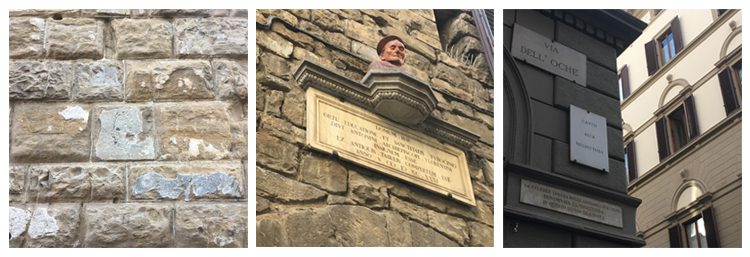
Florence is a city with a rich history that dates back centuries. One of the unique ways that the city actively communicates its vibrant past is through “talking stones.” These stones, containing inscriptions of both writing and art, are adorned on walls throughout the city and tell Florence’s most fascinating tales. The stones also portray the art of journalism in its truest form, exhibiting many principles still applied today in an authentic breath.
The first talking stone shown on the left of the photo is one of the first known forms of graffiti, located near the main entrance to Palazzo Vecchio. As the legend goes, it was a self-portrait of Michelangelo. It is a fascinating way to look at the technology artists used at the time, and also offers a glimpse into the booming art community during the Renaissance, connecting people today to those who walked Florence’s streets and drew on its walls in the past.
The second stone is perched atop a bustling intersection near the city center in Via delle Oche. It textually denotes that the building on which it is placed was once home to the prestigious Adimari family, of which Alemanno Adimari was a member. He was a famous Italian Catholic cardinal and archbishop. This stone serves the purpose of displaying the famous residents that played a fundamental role in shaping the city.
The final stone is a beautiful bust and description of Saint Antoninus in Via dello Studio. He was an Italian Dominican friar who ruled as an Archbishop of Florence. This talking stone is found on the exterior façade of the Pierozzi family home. It is a perfect example of combining visual information with written texts, much like an article, that allows viewers to see the subject and read about it.
The city continually talks to us every day through its surfaces, signs, and symbols. What unexpected discoveries have you made through Florence’s talking stones?
By Madison Landau
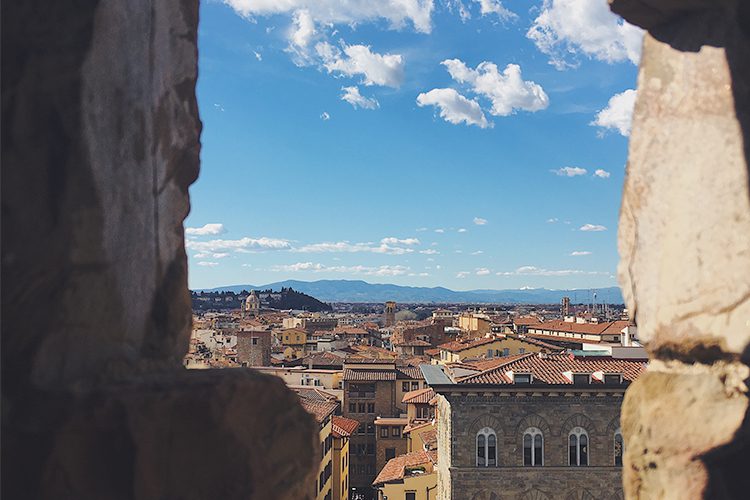
Walking down the streets in an unknown city in a foreign country can seem very overwhelming, especially in Florence’s winding neighborhoods. A great rule of thumb is to let yourself get lost and put your phone away…in trying to find your way back home you might just discover something new.
When arriving in a new country, my first instinct is to take my phone out to see if I have cell service or Wi-Fi. Arriving in Florence for my study abroad semester at FUA was no different, and I held my phone in a death like grip for the first week of living here.
Even though I was provided with great maps of the city by FUA, I still felt as if my phone was my lifeline here in Florence and that without it I would get lost forever among the streets of the city center. Little did I know how much nicer and productive my first week being here would have been if I had just allowed myself to actually get lost.
I had my face buried in my phone, looking at my maps instead of actually taking in my surroundings and understanding the streets of Florence. I didn’t want to feel uncomfortable in this city, yet I was so new to my surroundings that I refused to listen to everyone around me encouraging me to get lost.
My presence here in Florence was artificial in a sense that I really didn’t focus and appreciate where I was until I put my phone away and learned the streets of Florence.
Don’t get me wrong, I was still capturing and recording my moments here in Florence as much as I could. But instead of having my maps app constantly open, I had my camera open, or the TripAdvisor app open.
The difference between being too consumed within your electronics and being just consumed enough is a very delicate and thin line. While you want to photograph and remember every moment you can while you’re here in Florence, it’s so important to make sure you’re actually appreciating where you are and not just focusing on surviving.
Trust me, put the phone away when possible. Don’t just survive day to day while you’re abroad; thrive as much as you can here. Grow as much as you can. Put yourself in a world that you’re not familiar with, and learn to be okay with it.

By Aidan Loughran
Whether you’re packing for a semester, quarter, or single short session, these suitcase-slimming tips come in handy for everyone and may even provide a head start to making new discoveries at your destination.
As I was preparing to depart for Florence to study abroad for a semester, my main concern through the pre-departure process was how and what I was going to pack. A semester is a long time to be away from home and it is hard to know what will be needed in a new country that you’ve never been to. I know myself fairly well and I knew I would over pack, but I also don’t want to leave anything behind that I may potentially want to wear. Once I started filling up my suitcase, I realized that there were many things I wouldn’t wear and by limiting myself, I ended up packing much lighter than I originally would have. Here are three main tips you may find useful while packing.
1. Slim Down: Buy Vacuum-Sealed Ziploc Bags
These bags saved my life! While I had a decently large suitcase, being a girl, I still packed more than I needed (of course!). I was able to fit about ten, thick sweaters in one of these bags and it shrunk them down a crazy amount. It took up very little space and made ten sweaters look like two.
2. Remove When in Doubt: Toss Any “Maybe” Items
When packing, I have always had the problem of packing “maybes” or “options.” By this I mean packing clothing items that I think I may want to wear, but usually never end up doing so. DO NOT bring these items. You will not end up wearing them. If you don’t wear them at home, you won’t while abroad. Limit yourself.
3. Buy There and Make New Discoveries
Unless you are going to a country that has little access to grocery stores, pharmacies, salons, etc., do not buy your toiletries in advance. It is a waste of space and you can get anything abroad that you will need. Sure, bring along that face or hand cream from your favorite niche brand but otherwise wait to buy items such as mascara, eyeliner, and hair products until you get to your country. Florence for example has Sephora, salons, beauty stores, and interesting local brands. For the guys, there are bespoke barbershops and well-stocked men’s sections at stores. Checking out what’s available can also lead to local discoveries, such as the antiche farmacie, the historic pharmacy shops that produce their own collections, or contemporary perfume makers that you’ll only find in Florence.
I hope these tips will provide you with a simple, easy and slimmed down packing process. Enjoy!
By Steven Scaglione
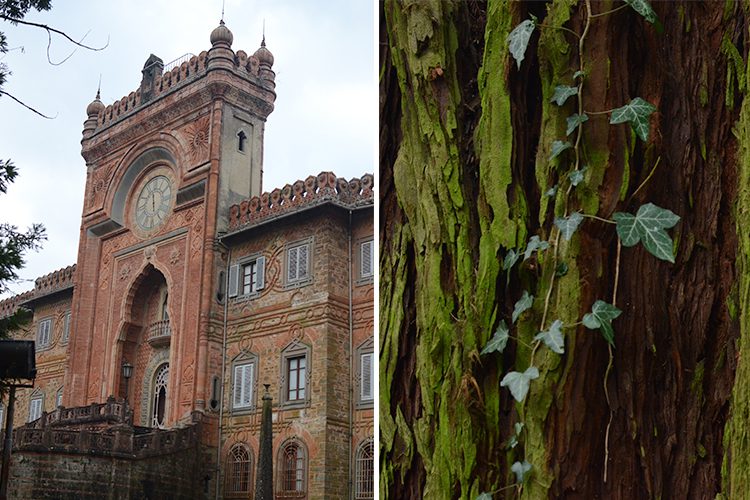
Sometimes the well-traveled roads lead to unexpected finds, such as the Sammezzano Castle that is at the center of a movement to save a now-abandoned architectural gem.
After stepping out of a two-story charter bus in little Leccio, Italy, I took a breath and surveyed my surroundings. I was at The Mall, which is not a luxury shopping mall but a luxury shopping “destination,” specializing in high fashion brands like Salvatore Ferragamo, Burberry and – maybe more fittingly named – Billionaire started by Italian entrepreneur Flavio Briatore. Though the stores would not open for another 20 minutes, already a line of eager shoppers had neatly queued in front of the Gucci and Prada outlets, talking among themselves with an electric excitement. Soon they would be pulling green suits and bright dresses from the racks, but I would not be among them. I was headed for a different kind of treasure: Sammezzano Castle, only a short hike away.
The castle lies at the top of Sammezzano Park’s central hill, overlooking the town below like a silent, stoic patriarch. The park is home to many exotic species of plants, including the species of giant sequoias native to California. One of them, known as “Sequoia Gemella,” or the “Twin Sequoia” in English, is more than 8.4 meters (27 feet) in diameter and 50 meters (164 feet) tall.
From the outside, the castle’s Moorish-style architecture is a mix of Spanish, Arabic, and Oriental influences. Inside “La Sala dei Pavoni,” or “The Room of the Peacocks” in English, is arguably its most beautiful feature, with mosaics of every color stretching from floor to ceiling.
Unfortunately, the castle is currently closed to the public, falling victim to littering and vandalism. One organization, Save Sammezzano, has been fighting to preserve and protect the now abandoned castle and surrounding park. A petition by the group ended with over 30,000 signatures, but the castle is now privately owned, making it difficult for the municipal government institutions to safeguard it. The future for any restoration is uncertain, but the cause has found great support on social media. For now, the castle remains as it has been for many years, the hands on its clock stopped at 11:28, waiting for the day they might turn again.
By Abby Moran
Embrace the uncomfortable, enjoy the bewilderment of studying abroad.
Studying abroad may have been the most difficult thing i have ever done. 21 years of figuring life out, myself out and now a new culture is an incredible adventure. To step away from all that is familiar, to acknowledge that you will get lost mentally, emotionally, and physically but all of this will make you grow in ways you could never imagine is daunting. After a couple weeks in Florence, I am less afraid and regaining pieces of myself I thought would be lost back home forever.
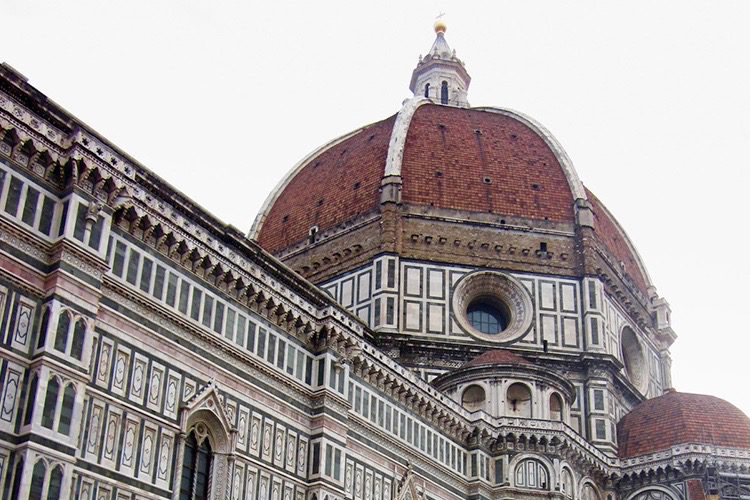
Being in a situation where in order to save time, effort, and my roommate’s energy involves being outgoing, assertive, and confident in new situations has turned out to be the absolute best scenario. I love it. I love walking in the rain here. I love the puzzle of streets that could lead anywhere but often times lead me to the Duomo, that I’ve come to see as a safe haven. I love the different languages filling my ears. The uncertainty of who and what can be encountered around the next corner. Gucci, Prada, Valentino, your shop windows bring a spark of life to my longest walks. Even in the most unfamiliar places we find objects to cling to, people to relate to, and places to become accustomed to.
Home is truly where the heart is and when we open our hearts to the culture and lifestyle of others we are given a priceless gift. Be scared, intimidated, and get completely lost because it is there, in this state of initial uncertainty where we find our strength. Find your home away from home is what study abroad offers, despite the voice in your head that says “but it will be hard.” It’s often said that nothing good comes to those who wait, so let’s proactively reach for that which seems the most intimidating. Find your landmark, in my case the Duomo, and learn something about it instead of just passing through the piazza.
Don’t shoot for the stars, shoot for the Duomo.
By Anastasia Finney
A typical student living in Florence has likely already seen many of the famous sights, tasted their fair share of Italian food, and interacted with a good amount of locals. However, classes at FUA often include field learning sessions around that city in order to take students off of the usual pathways and into experiences they might have otherwise missed.
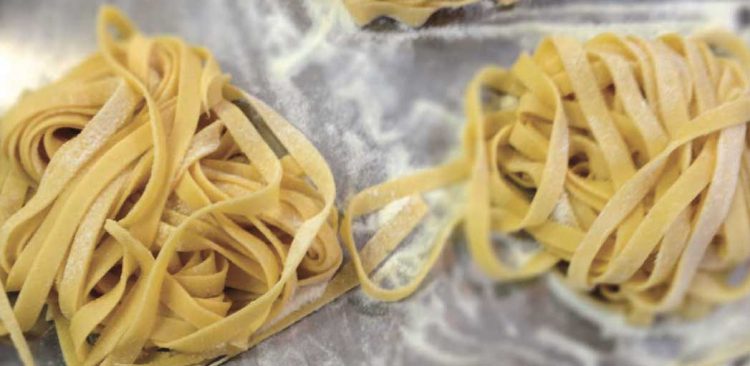
During the “An Introduction to Italian Food Traditions,” taught this past fall semester by Prof. Cecilia Ricci, students often incorporated real food experiences into their learning. Rather than simply receiving long lectures about the food and culture of Italy, the class conducted tastings, cooking projects, and visits to relevant food locations in the city. One such visit took place at a local restaurant in order to analyze fresh pasta. Before embarking to Vivanda, the students first learned about the differences between and characteristics of fresh and dry pasta through a lecture component in class.
Vivanda is a small and cozy restaurant located in Oltrarno, on the other side of the Arno River. It prides itself on organic ingredients, natural wines, fresh pasta production happening right in the restaurant, and options that can please meat-eaters, vegetarians, vegans, and gluten-free people alike. At the restaurant, the class was given three types of pasta to taste: gorgonzola gnocchi, traditional spaghetti, and ricotta and spinach ravioli. They were also served Arialdo wine with the meal.
Student Nick Tyndall shared that the tasting helped his understanding of Italian pasta traditions. “The restaurant had an authentic and inviting ambience, consistent with the best establishments I’ve visited in Florence,” said Tyndall. “We got to see how the staff made the fresh pasta and learned about the company’s food philosophy. The pasta was probably the best I’ve ever had.”
The class had time to enjoy and experience both the food and setting, while also listening to the owner talk about the restaurant. Professor Ricci also talked with the class during the visit about the food tasted and the way it paired with the wine. The students were encouraged to think critically about what they were consuming, in regard to production, presentation, and longstanding Italian traditions. Naturally, the group also got to enjoy the conviviality of delicious food too.
Experiencing a guided tasting in close contact with industry professionals gives a different perspective to daily activities that we all experience, such as trying new restaurants. “I wouldn’t have even known this restaurant existed without this class,” said Tyndall. “Now I definitely want to go back for a full meal!”
Vivanda
Via Santa Monaca 7 (between Pz. S. Spirito and Pz. del Carmine)
For further details visit the restaurant’s website.