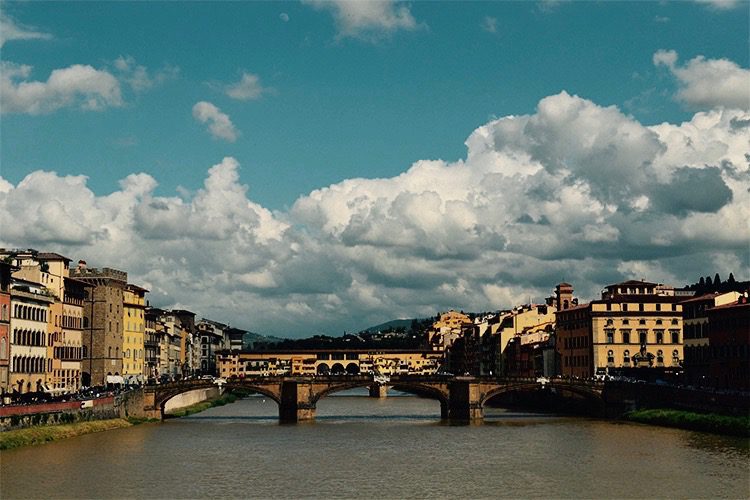
My Transition Place: Arno River & Carraia Bridge

Photo of Ponte alla Carraia by the author

By Monica Humphries

When you step out of your apartment for the very first time, it’s a whirlwind of emotions. You feel enthralled to be in a new place. You feel excited for what the semester has to offer. You feel anxious, confused and eager.

I felt nervous.

Yes there were positive emotions, but buried not-so-deep were my nerves. I was in a foreign country, and the car ride to my apartment left me feeling like I was on the other side of the world.

I can vividly remember our driver taking all 7 students to their apartments. The first one was dropped off right past the Duomo, the second two near the San Lorenzo, a few more in the city center. Then there was me. I could remember crossing a river, going up and down the one-way streets, and finally pulling into a narrow, bike-filled lane right up to apartment number nine. After what must have been a half hour, I was home, but I wasn’t happy.

Although I was just on the other side of the river, I felt like there was a wall dividing me from all of my classmates. I stepped out onto the cobblestone street and immediately was lost. I stumbled my way through the streets until I found the Arno.

Since that first afternoon, the Arno, more specifically the Ponte alla Carraia, which is the bridge that leads to my street, has become my favorite place in Florence.

No matter where I was coming from – class, dinner or a cappuccino, all I had to do was find the river, and I knew exactly where I was. Since moving to Florence, the river is not only beautiful, but it has also become my safety net. A safety net that encourages me to explore and challenge my surroundings.

Curious about the Arno’s history and bridges, I talked to Giulio Vinci, a professor at FUA.

Vinci started at the very beginning. Florence was founded and controlled by the Romans. Romans generally build their cities in the valleys, so Florence followed this tradition and was built in a valley close to the river.

The city was structured in a rectangular shape with two central roads crossing through the city. The city was close to the water, but Florence wasn’t directly on the water, so there wasn’t travel between the sides of the river. Florence began expanding, and the Ponte Vecchio was the first bridge across the Arno. The first occurrence of the bridge was in a painting in 996.

The Ponte alla Carraia bridge is the second oldest bridge in Florence and known for its history of collapsing. Built in 1218 by architect Lapo, it collapsed for the first time in 1274 because of a flood. The bridge was originally built in wood, but it was rebuilt in stone. However, the stone was strong enough to support a crowd and collapsed again. In 1333 another flood struck Florence, and the bridge was once again destroyed. The most recent collapse was during WWII when it was bombed to prevent passage of allied troops from the Nazis in retreat.

Vinci said that tourism has exponentially grown in the past 20 years, and now Florence is a key location for visitors. He made a point to express that the river and its bridges always attract tourists.  Florence is known for its concentration of art, and the bridges are a part of that art. But not everyone, unfortunately, is interested in the art and history behind the bridges, and many prefer to simply use the bridges are picture spots. We’ve lost the meaning of tourism, and traveling today is vastly different from the young aristocrats of the 18th century who often went on year-long Grand Tour to discover the culture of European cities.

Thinking about what Vinci shared helped me appreciate my time here. Sometimes three months seems like forever, but with a city that has enough history for a lifetime, I’m thankful that I will have a chance to immerse myself and retain the details I learn about this city.

Walking home from the interview gave me a chance to reflect on my time here. Although it’s only been a month, I can now continue to expand my safety net to the entire city of Florence.

The bridge is a place of comfort but it’s now a place of curiosity. Each time I walk across the bridge I notice a new detail. I question the statue at the entrance, the crack along the pavement and the windows in the Ponte Vecchio. The comfort I have now encourages me to explore. It’s important that every student finds their Ponte alla Carraia. Whether it’s the San Lorenzo church or carousel in Piazza della Repubblica, we need a monument or location where we feel at home. But part of home is knowing its history and why it’s there. Yes, the pictures we take are important, but the history behind those photographs enrich our experience so much more. Take a second, learn about the area you call home, because you might end up loving the city just a little bit more.

I find comfort in the bridge because that’s where I find confidence. Confidence with directions, confidence in knowing there’s the best gelato place right around the corner, confidence that there will be a beautiful sunrise in the morning and an even prettier sunset at night. Learn about the landmark you call home, and you might end up finding a little confidence in a city full of new experiences.

See more of Florence and Italy at FUA’s FB, Instagram, and Twitter.
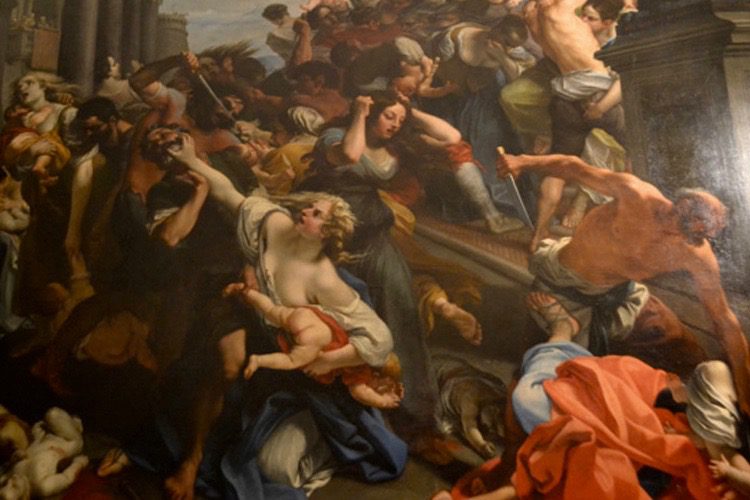
Uffizi: Innocent Bystanders

Marco Benefial’s “Massacre of the Innocents,” Uffizi Gallery. Photo by the author.

By Kaly Nasiff

The Uffizi is known for its popular paintings, but the museum is also filled with hidden treasures. This is my reaction to a lesser known painting called “Massacre of the Innocents” by Marco Benefial.

Not much is known about Marco Benefial’s “Massacre of the Innocents,” except that it was painted in the 1700s. When I saw it at the Uffizi Gallery I knew nothing about it. I had spent the afternoon being overwhelmed by the artworks that line nearly every inch of the Uffizi. The bright colors of this painting initially caught my attention, but upon further inspection, I realized that fiery women were fighting off savage men in order to save their children. I immediately fell in love with the determined faces of these women. They did not care that the men were larger and stronger than they were; they fought back with a passion that I found invigorating.

Looking around me, no one seemed to be as captivated with the painting as I was. I knew it was not one of the more famous paintings in the gallery, but I did not understand how anyone could ignore these women. Sure, they did not look like “Birth of Venus,” but to me they were more interesting. I was struck by the huge difference when I saw Sandro Botticelli’s Venus just minutes later. There was a crowd of people around the painting trying to get pictures of and with Venus. While it is a beautiful and famous painting, nothing about “Birth of Venus” made me feel what “Massacre of the Innocents” did. Venus is stunning but almost standoffish, and seems to be there to have others look at her. Meanwhile the women in Benefial’s painting were not placed in the painting for anyone’s benefit. They were meant to be appreciated for their determination rather than their beauty. I can only imagine and guess what Benefial was thinking when he painted these women, but I hope that he was trying to represent them as I saw them.

See more of Florence and Italy at FUA’s FB, Instagram, and Twitter.
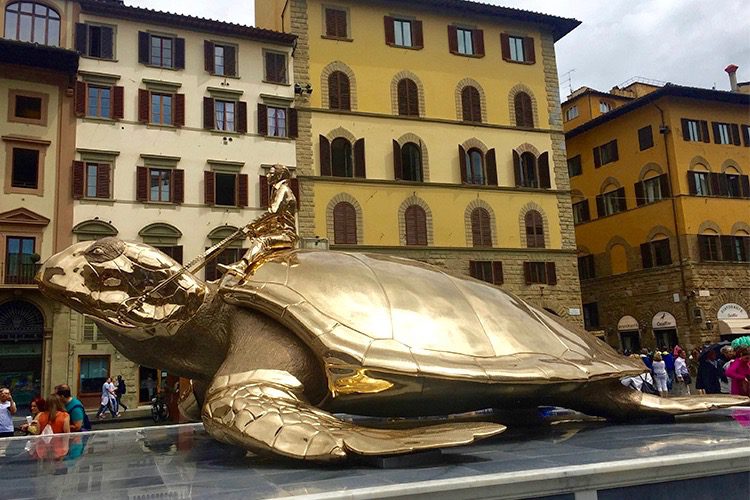


Art: Spiritual Guards in Florence

Photo by Monica Humphries

By Camila Ibarra Gallego

On a sunny day in Firenze it’s hard to miss the bright, bronze sculptures sitting in Piazza della Signoria. But what might be even more shocking is how modern they look contrasted to the sculptures from centuries ago. Pieces from Jan Fabre’s exhibition can be found all over Florence. Find out why they’re here.

Many of you have probably been wondering what the heck a giant sea turtle is doing in the middle of Piazza della Signoria. That’s exactly what passed through my mind the morning I took my usual route to class and saw this big, shiny sculpture I had never seen before. So I decided to do some research to find out what this whole thing was about and share it with everyone who may be as flabbergasted as I was.

Jan Fabre (born in 1958) is a Belgian artist, playwright, stage director, choreographer, and designer. He is having an art exhibition here in Florence called Spiritual Guards. The exhibition is sponsored by the City of Florence, and it is be located between Forte Belvedere, Palazzo Vecchio, and Piazza della Signoria. It is said to be one of the most complex and complicated exhibitions in public spaces created by Jan Fabre. The exhibition will also host hundreds of works done by Fabre between 1978 to 2016 such as bronze sculptures, like the man riding the turtle, installations of beetle shells, wax sculptures, and documentary films of his performances.

The sculpture standing in the middle of the piazza is called Searching for Utopia. On top of the turtle sits a man holding on to reins. This man is the representation of the equestrian statue that was given to Grand Duke Cosimo I, a member of the Medici family and the Grand Duke of Tuscany, which was created by Giambologna.

As I stood there looking at the big turtle, I thought about how the artist paid attention to every detail on the turtle’s shell and on the man riding it. This sculpture is a cross between classical art and contemporary art.

I watched as people gathered around and took selfies with their selfie sticks. Many who just arrived in the city probably don’t realize that this statue has not been there for a while, and think that it is a piece of art that is part of the piazza. I see how they just stand in awe and admire the shiny gold piece of bronze, which looks a lot like Crush, the turtle from Finding Nemo. Children run around the installation and inspect it from every angle, probably wishing they could slide down the turtle’s shell or act as the captain of the ship.

Now every time you walk pass by this shiny, big sculpture and find a person who is just as confused as you were, you will be able to explain to some extent what it is about. If you are interested, Palazzo Vecchio is hosting a series of sculptures interacting with the frescoes and artifacts housed in some rooms to the public. Then check out the entire Fabre exhibition at Fort Belvedere. Fabre will be displayed in Florence until Oct 2. Spiritual Guards is a great art exhibition for those who love imagination and beauty. 

See more of Florence and Italy at FUA’s FB, Instagram, and Twitter.
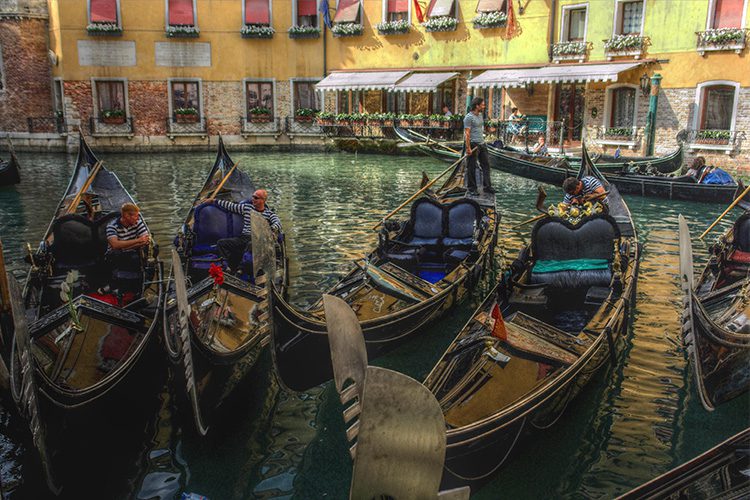
Lorenzo the Gondolier

Photo by GaborfromHungary via Morguefile.com

By Mikayla Rendall

Certain things and places become the cultural icons of a city. It’s enough to mention the David, Duomo, and Boboli Gardens for most travelers to immediately associate them to Florence; they’ve become by now not only icons of culture but also mass tourism. Venice, another highly visited Italian city, immediately conjures up Piazza San Marco, canals, gondolas, and lavish Carnevale celebrations. FUA student Mikayla Rendall took tourism a step further by not only going on a gondola ride but interviewing the gondoliere for his perspective as a Venetian local.

When did you become a gondolier?
I was born and raised in Venice and started giving gondola rides about eight years ago. I‘m now living on the other side of Venice because of the high expenses of living on the canal.

What made you decide to become a gondolier?
I love being on the water. Venice is beautiful and after living here for 33 years I knew this was something I want to do for a long time.

How did you learn this craft?
I learned as young man since my father had his own gondola but I got my own license to become a professional gondolier later on.

What year did the gondolas originate?
They are extremely old and go back to the 11th century, but there have been many changes over time time to make them stronger and larger.

What are the gondolas made of?
Gondolas are a flat-bottomed boat made of many pieces and eight different types of wood. The oar of the gondola is made from beech and are made for the narrow canals in Venice and quick maneuvers.

How deep are the canals?
The grand canal is around 18-20 feet and most other canals are about 8 feet. When high tide comes sometimes we cannot provide rides because the water is too high and the boats don’t fit under the bridges. The water levels keep getting higher so now no one can live on the first floor of the apartments that are on the canal.

What does this mean for the future?
Gondola rides may not be available on city canals if water levels keep rising. We will not fit under the bridges because they are not high enough and the boat is tall in the front and back.

What is the busiest season for gondola rides?
Carnival in February is a busy time for tourists and in the spring. Gondola rides are requested solely by tourists, most locals don’t get on.

How often do you work and for how long?
During busy days I will work up to six times every week. I usually work ten-hour days. On the slower months, I work less so my schedule is always changing.

What is your favorite part about being a gondolier?
Getting to know people from all around the world and showing them the beauty of Venice.

See more of Florence and Italy at FUA’s FB, Instagram, and Twitter.
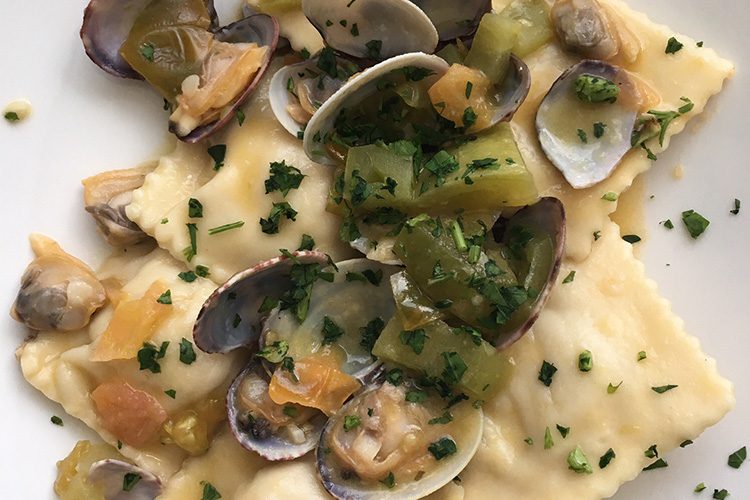
 

Exploring Culture Through Italian Cuisine

Photo by the author
Photo by the author

By Morgan O’Reilly

With clamped eyelids and the flicker of a burning candle, I contemplated my wish. As my life’s dream reemerged back into my conscious thought, my eyes flicked open, I peeked at the wax “10” in front of me, and I blew. Underneath, in place of a conventional birthday cake, lay a cannoli; I looked up from the red checkerboard table and saw my cheering family under the light of the Macaroni Grill sign. My wish was to travel;  little did I know that I would be enjoying an authentic Italian meal in Florence only 10 years later.

Growing up, I had always loved food. I sat at dinner tables scooping mussels from shells and openly trying international cuisine. To this day, I actively search for new flavor combinations and cooking techniques. Despite my culinary openness,  my perception of Italian cooking has changed dramatically since my arrival in Florence. I grew up with the mac and cheese, breadsticks, and spaghetti of Italian restaurant chains back home; and despite trying my hand in Italian home cooking, I really didn’t know what the “real thing” entailed. For me, I was coming to the land of bread, cheese, and pasta; and I was 100% fine with that.

Upon arrival, I aimlessly wandered Florence’s winding streets as I gripped my list of recommended panino and aperitivo places. After tasting some of Italy’s fresh pasta and coming to the harsh realization that meatballs are not an actual thing here, I realized how skewed my perception on this lifestyle was. My day to day life in town surprisingly never included the bread or pasta-induced food comas of the “Italian” food that I was accustomed to, and instead, I felt physically and mentally satisfied with what I was putting into my body. In fact, although the study abroad 15 has proved an irritating reality, I have never felt as good about the food I was consuming.  

After a few weeks, once the initial excitement died down, I started to eat in more. Whether at the farmer’s market or grocery store, I slowly began appreciating the seasonality and freshness of what I was consuming. Although eating in does not seem like the optimal way to seize the day while abroad, learning to utilize fresh, regional ingredients in simple recipes gave me a deeper appreciation for the food I was eating and for Italian culture. My roommates and I have made everything from roasted vegetables to pork chops to shrimp with lemon asparagus; and the simple act of learning to work with seasonal, simple ingredients has shown me more about Italian culture than I would have ever expected.

Looking back, my experience with food while abroad and my deeper appreciation for what I eat has mirrored my sense of appreciation for all aspects of culture. Like expanding my knowledge on the slow food movement, biodynamic farming, and the third wave coffee movement through conversations with locals, I have learned to step out of my comfort zone and challenge my perception of Italy, travelling, and on life in general. This experience has opened my eyes to finding value and culture in the tiniest of details; whether it be a tablespoon of olive oil, my daily walk past the Santa Croce, or a genuine conversation with friends from around the world. Above all else, studying abroad has taught me to openly seek out culture in every aspect of living, and it is something I cannot wait to apply beyond the walls of the city I now call my home.

See more of Florence and Italy at FUA’s FB, Instagram, and Twitter.
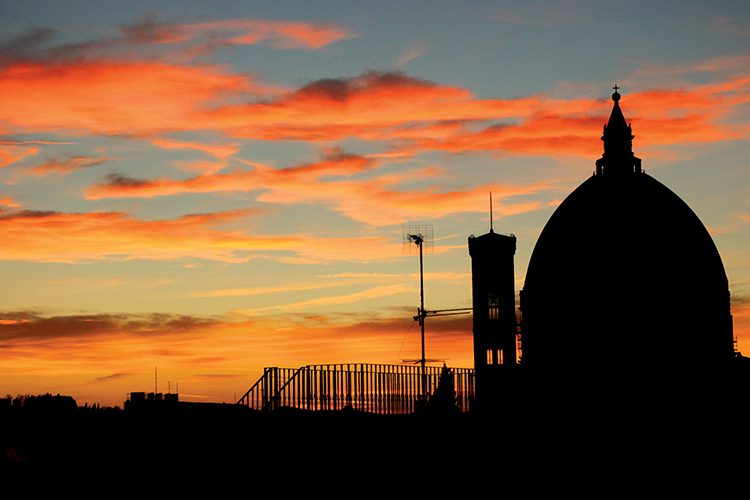
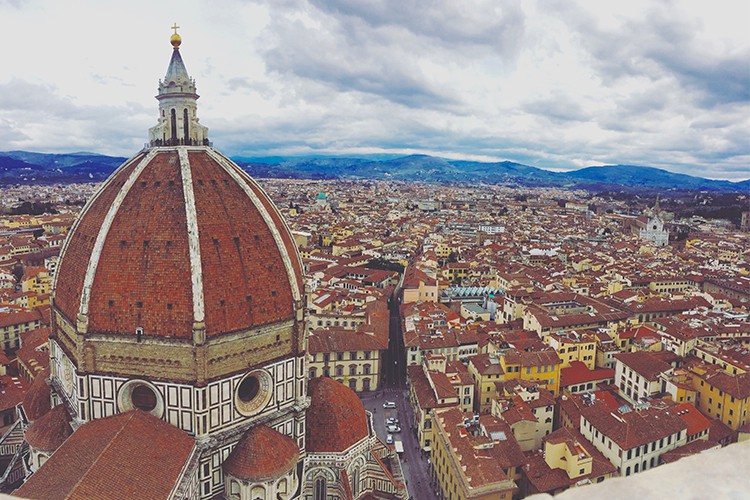
The Intricacies of Life in a Renaissance City

duomo-finding-florence-blog-fua

By Leanora Karnath

White marble, red and green lines of color, ornate details covering every inch of its facade, copper ball protruding into the sky. Before arriving for the semester, I knew of Santa Maria del Fiore Cathedral, better known as the Duomo of Florence, but little about its historical or cultural significance within Italy as a European country. My feelings towards one of Florence’s most popular landmarks have evolved throughout my time abroad.

When I first saw the church, I was astounded by its massive size. I strained my neck, scanning the entire length of the front side with hungry eyes. I saw the Duomo in its entirety– the lines of color, the white marble, and the large wooden doors.

After the thrill of the first sighting, I learned that people use the church as a meeting point which frustrated me. Whenever someone said to meet by the Duomo, my body grew tense. Where? I thought. This thing is too big.

I soon became accustomed to walking past the Duomo each day. I hadn’t thought much about the church after my first month abroad other than wishing it wasn’t my usual route to class when flocks of tourists visited, making my route longer than usual.

As I stepped away from the Duomo, I realized its functional purpose. When I would become lost around Florence, I simply walked down a few streets and waited to see the Duomo’s copper ball and spherical top. Though I was aware of the Duomo’s presence, I solely viewed it for its practical use.

My indifference began to shift right before my parents’ visit halfway through the semester. Because of my dad’s interest in architecture and history, he read a book about the Duomo before his arrival entitled Brunelleschi’s Dome: How a Renaissance Genius Reinvented Architecture. He asked me, “Did you know they didn’t even use buttresses to support the weight of the Duomo? And that the copper ball fell off in the 1500’s?” I didn’t. I felt ashamed that I had failed to learn much about a monument that stands only five minutes away from my apartment.

As the lines became longer for everything in April, I knew it was time I climbed the Duomo. I purchased my ticket, woke up early on a Wednesday morning, and waited in line. As I began walking up the steep steps, a rush of energy overwhelmed my body. I thought of all the people who did the same hundreds of years ago, the ones who dedicated their lives to create such a beautiful combination of art and architecture to create a place for worship. And, now I was climbing to the top.

Later that same day, I entered the Museo dell’Opera del Duomo and marveled at the displays and the information that accompanied them. It was fascinating to learn about the comprehensive history behind such an influential monument that I was lucky to see on a daily basis. I stepped out of the museum and the Duomo greeted me; my mouth immediately curled into a smile. Wow, I thought.

As I reflect on the semester, I have realized that the Duomo isn’t simply one singular piece of architecture that can be absorbed and processed from one sighting. It’s comprised of many pieces and the tiniest of details: the distinct expressions on the face of numerous statues, the marbled spirals in the windows, the gold streaks of the paintings. I neglected to see all of these intricacies when I first arrived.

These intricacies have not only been present in the Duomo’s structure but also my daily life in Florence: the scent of finocchiona floating in the air as I pass a panino shop, the familiar faces of street musicians, a small piece of colorful street art poking out from the ground.

The church that was once a nuisance to walk around has become a reassuring point of reference, a sign that I had returned home after a long day or weekend of traveling, and a sense of stability in a semester that presented new experiences and challenges each week. During my last few weeks in Florence, I take a little extra time to find a small detail that had previously gone unnoticed. It never fails.

See more of Florence and Italy at FUA’s FB, Instagram, and Twitter.
What You Really Need to Know About Gelato

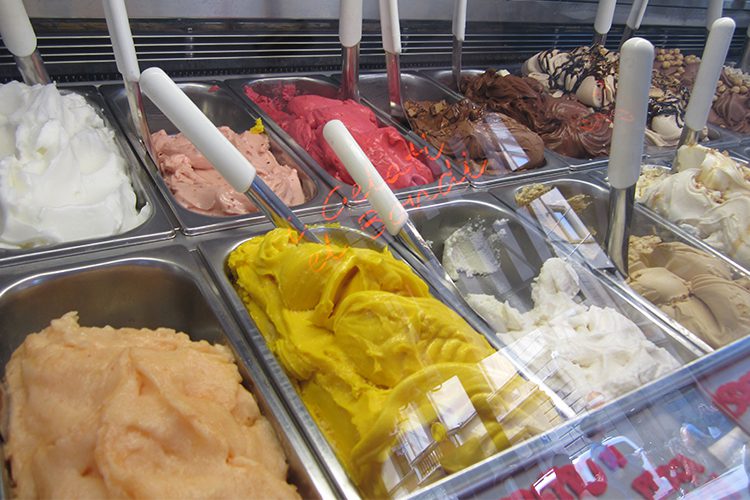
Photo by the authors

By Leanora Karnath and Morgan O’Reilly

Gelato can be found in virtually every street corner in Florence. As a Florentine delicacy, locals and visitors stroll the streets with a cone in hand no matter the season. Over the years, because of its touristic popularity, traditional, quality gelato has become more and more of a rarity. We sat down with Vetulio Bondi, owner of I Gelati del Bondi and president of the Florence Gelato Association, to gain insight into recognizing quality, authentic gelato in Florence. Bondi has also taught a gelato making course at Apicius. We’ve narrowed down our interview with him into 3 simple steps to keep handy when trying out new gelaterie.

1. Read the Ingredients

Fresh, authentic gelato should not need any preservatives or extra fat. The main ingredient should be fresh milk and the sugar used should lead to a smooth, “warm” gelato, as opposed to a sweeter, colder treat that was popular in the 80s.

Bondi also attributes his high quality gelato to his strong relationships with the hazelnut, pistachio, and produce farmers that he works with.

2. Order In-Season Flavors

It is easy to overlook the environmental difference of ordering mango sorbet in the winter as opposed to pear. Bondi prefers serving in-season, local flavors to cut down on food miles.  “In Europe, we try to follow the seasons, so in the summer, it is much better to eat the peach sorbet than the mango sorbet because the mangos will be coming from Brazil, so it can cause pollution and peach sorbet, melon sorbet, watermelon sorbet, and plum sorbet is amazing.” If you want to know what is in season when, here is a list.

3. “When You See a Mountain, Turn Around”

Like any tourist destination, flashy fakes are everywhere. When looking for authentic gelato shops, steer clear of the mountain-high, neon window displays. These are often made with artificial flavors, colors, oil, and fat. You want to spend your time seeking out neutral colored, simpler displays. Some places will cover the gelato with lids, which usually means they made it that morning.

If you have time, stop by I Gelati del Bondi. Our personal favorites are his peach, salted caramel, pistachio, hazelnut chocolate, or cherry.

See more of Florence and Italy at FUA’s FB, Instagram, and Twitter.
Schiacciata Throwdown!

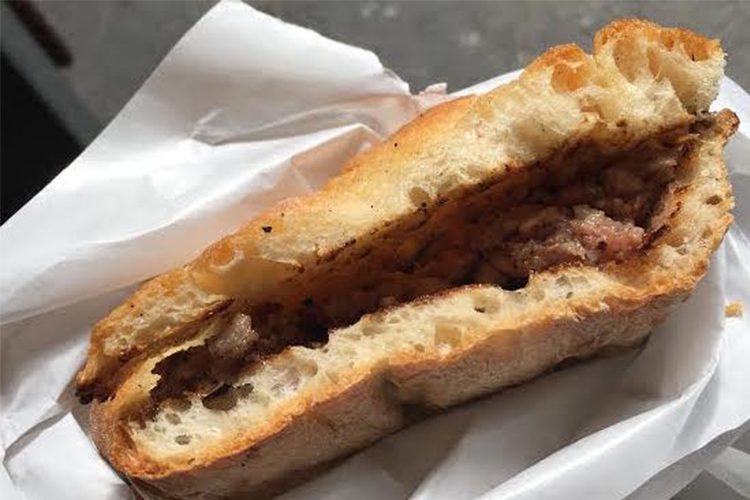
Schiacciata sandwich in Florence. Photo by the authors.

By Deborah Glasso, Leanora Karnath, Morgan O’Reilly

Schiacciata is a typical flatbread of the Tuscany region used to prepare panini. In English, the word translates to “crushed” or “flattened.” If you’ve lived in the Tuscany region, unsalted bread is probably what first comes to mind when thinking of bread products. In contrast, schiacciata is sprinkled with coarse salt grains, giving consumers a burst of flavor coupled with other ingredients in a panino. Made with flour, yeast, water, salt, and olive oil, traditional schiacciata should be crispy, but not hard. Also, the olive oil should not produce a greasy feeling but be enough to complement the mix of ingredients.

After learning about schiacciata in Florence, we decided to extend our research one step further with some tastings and then compare our findings.

Morgan – soft or crispy?

After living in Florence for three months, I have fallen in love with Schiacciata. From trying too many places than I would like to admit, I realized I prefer a crispier crust with a fluffy center as opposed to a thinner, chewier flatbread I usually get at All’Antico Vinaio. My personal favorite spot is Sandwichic because they use just enough olive oil and salt to make the flatbread crispy and flavorful. The Oil Shoppe also deserves a mention for their softer, circular schiacciata that I also enjoy.

SandwiChic: Via San Gallo, 3
Al’Antico Vinaio: Via dei Neri, 74/R

Lea – olive oil in each bite

After trying many different panino shops, I found Due Sorsi e un Boccone (“two sips and a bite”) which has become my favorite place for a quick bite. I was happy to discover the consumers were mostly Italian which has always been helpful to seek out local spots.  I love how the schiacciata is crispy but not too hard as I’ve tried some places where the schiacciata can scrape the roof of my mouth, leaving an unpleasant sensation. I also view the schiacciata as characteristic of the traditional staple because of its olive oil you can taste with each bite. The taste does not distract from any of the other ingredients but enhances the overall experience of eating a panino and indulging your taste buds.

Due Sorsi e un Boccone: Via degli Alfani, 105

Deborah – great ingredients, great sandwiches

Being a Florentine, I believe that All’Antico Vinaio is one of the few places that offers good street food. The schiacciata is crushed with sbriciolona, a cured meat with fennel seeds, so we can say it is a must-try in Florence.

The Prosciutteria is another great place to try this traditional Tuscan favorite, just a few doors down from All’Antico Vinaio. Vinaino Di Parte Guelfa also offers tasty sandwiches with typical Tuscan and Florentine ingredients.

Vinaino Di Parte Guelfa: Via Val di Lamona, 6
La Prosciutteria: Via dei Neri, 54r

Our Findings  

From recommendations of professors and other locals, our tastings led us to the discovery that despite schiacciata’s status as a Tuscan staple, various places prepare the bread in different ways. While some may be very crispy on the outside, others are softer which results in a more chewy bite. The “best” panino shop is subjective because people enjoy their breads in different ways. The staple has evolved and each panino shop has their own take on how to prepare it.

What’s your favorite place?

See more of Florence and Italy at FUA’s FB, Instagram, and Twitter.
A Day at FUA (Semester)

Photo by the
Photo by the authors

By Leanora Karnath and Morgan O’Reilly

Sometimes, envisioning your life in a new country can be a bit difficult to imagine until after you’ve arrived. Whether you are getting ready to come abroad or already in Florence and in need of inspiration, below are some itineraries of a typical day of FUA semester students.  Semester classes are usually held once a week and students typically take anywhere from 4-6 courses. If you’ve signed up for any 3-week short session courses within the 15-week semester, remember that classes will be held daily from Monday to Friday.

Day 1
Leanora shares an example of her typical day that coincides with when she has one class and has some extra time to explore locally while balancing coursework.

9:30am – Wake up.

10am – Grab a cappuccino and chocolate croissant at Fedora, the pastry shop operated by FUA hospitality students and faculty.

10:30am-12:30pm – Check out a new museum. Already seen the major ones? Then try these smaller gems.

1-2pm – Browse through the Sant’Ambrogio fresh food market and purchase some groceries for the week.

2:30pm – Grab lunch from my favorite panino place. Grabbing a panino is something quick and easy to eat before class. There are many options in the area, so try a few before deciding which one you like best.

3-5:30pm – Travel Writing class at the FUA journalism building near the Duomo.

6-8pm – Cross the street from the J School towards the Oblate Library to do homework. Pack up my backpack. Enjoy the great view of the Duomo with a pastry from the cafe.

8:30 – Dinner out with friends. Meet by the Duomo and head over to the Santo Spirito area. Walk by the Arno River along the way.

Day 2
Morgan shares her typical day when she has two classes scheduled.

9am – Wake up.

10am – Grab a cappuccino and a pastry at specialized coffee bar such as Ditta Artigianale. There are many spots around Florence for a coffee and a quick bite to eat, both traditional and from newer generations. Being a barista myself, love checking out new coffee places on my way to class  and discovering different coffee drinks.

10:30am – Read a book or paint in the Rose Garden.

12pm-2:30pm – Intermediate Drawing class at the FUA main building near Piazza Santa Croce. If you want to take an art class at FUA, this class focuses on human anatomy through Florentine sculpture. You learn how to improve your technical drawing skills while applying them to your own drawing style.

3pm – Grab a fennel salami panino with pecorino and pear jam at Sandwichic and sit on the steps of the San Lorenzo church.

3:30pm-5:30pm – Do some homework in the top floor, open-air courtyard of the Oblate Library.

6pm-8:30pm – International Marketing class at the main building. Learn marketing techniques on a global scale through lecture and real world application to a multinational company.

9pm – Grab dinner with friends at Osteria Santo Spirito.

Other Activities?
FUA offers a series of extracurricular activities so students can become more involved in the community and fellow peers. Here’s a selection of some of our favorites.

Taste Italy Culinary Workshops – The classes are fun and interactive, held at FUA’s hospitality school, Apicius, and you can meet FUA students over some delectable food.

FUA’s Gym Classes These are a fun and social way to stay motivated and healthy as you explore your way through Italian/Tuscan food culture:). The gym also has regular hours for workouts. 

Ganzo Themed Dinner These are delicious and so much fun. They also happened to be prepared by FUA culinary classes so you can check out what your hospitality peers are up to. Check out the calendar for upcoming Thursday themes, put your reservation in early, and enjoy interesting, delicious courses with wonderful wine pairings.

Visit the Student Life department’s website to learn other ways to become involved in your new home. Curious about what fellow students suggest? This blog regularly offers ideas, suggestions, and explorations so keep checking back for updates!

See more of Florence and Italy at FUA’s FB, Instagram, and Twitter.
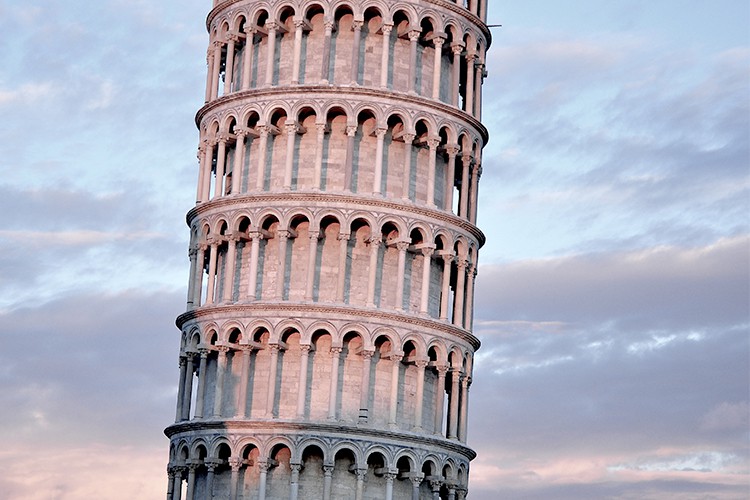
 

Tuscan Day Trips: Going West

leaning tower of pisa
Photo by Davide Raguda via unsplash.com – Leaning Tower of Pisa

By Morgan O’Reilly

When studying abroad in as beautiful an area as Tuscany, the opportunities for rich history and scenic views lie just outside Florence’s city walls. Students can find three unique towns within the area between Florence and the coast.

Pisa

Students from Florence can easily catch a 50 minute train ride into this small city for a full or half day or history, art, and great food. Marta Russo, an FUA faculty member who lived in Pisa for 19 years, has kindly provided a local perspective on this famous little town. Aside from the infamous Leaning Tower, some other beautiful sites include the Piazza dei Cavalieri and Piazza Martiri della Libertà. She recommends a nice stroll along the Lungarni (sidewalks along the river), where one can see the Chiesa della Spina, originally built on the river bank of the Arno and later rebuilt on a higher level. Two other churches visitors can visit are Chiesa Santa Caterina and Chiesa di San Francesco.

All of the good restaurants in Pisa are located near the market squares Piazza delle Vettovaglie and Piazza Sant’Omobono, according to Russo. These include La Mescita and Il Campano, among others. For a good panini, Il Crudo in Piazza della Berlina (aka Piazza Cairoli) of Il Montino in Via Monte; where the local specialty is focaccia con la cecina, a traditional dish made with chickpea flour, water, and olive oil, which is baked and stuffed into a flour focaccia bread.

For those interested in art, Russo recommends checking out the current exhibition at Palazzo Blue, the venue exhibiting the major art shows of great painters of the past (like Picasso or Modigliani.) One thing visitors don’t know is that there is a Keith Haring mural painting on the side of the Chiesa di Sant’Antonio, so there is even some modern art in this culturally rich city.

Lucca

A small town to the west of Florence, Lucca radiates rich history, art, scenic views, beautiful churches, and plenty of greenery. High walls surround the city, eluding military history dating back to 200 A.C, now provide visitors with a beautiful walking path, picnic spots, and playgrounds for a relaxed afternoon under the shade of their chestnut trees.

The beautiful churches of Lucca include the San Michele in Foro Church, the San Martino Cathedral, and the Church and Baptistery of San Giovanni and Reparata. All originally built before the 14th century, these Romanesque monuments are not to be missed.

The Piazza dell’ Anfiteatro, a former Roman amphitheatre, now holds restaurants, cafe’s, and shops along its oval-shaped frame. In July, the piazza makes a perfect venue for open-air music performances.

To end a day of sightseeing and strolling around the city’s walls, visitors can climb the Guinigi Tower’s 130 steps for spectacular views of the historic city.

Livorno

An understated small port city on the western coast of Tuscany, Livorno holds great seafood, majestic panoramic views, a Venetian-style neighborhood, and a short train ride from Santa Maria Novella.

Piccola Venezia, or little Venice, is a fun pocket of Livorno crossed with small canals built during the 17th century using Venetian methods of reclaiming land from the sea. Whether via foot path or by boat, the canals provide picturesque scenes of the city with nice waterside cafes interspersed.

The Terrazza Mascagni is a popular spot in the city where guests can discover panoramic views of the beautiful city. Built in the 1920s, this dazzling terrace captivates its visitors with the seafront as well as the cityscape, perfect for sunset after a long day of exploration.

See more of Florence and Italy at FUA’s FB, Instagram, and Twitter.