written by Kaylin Martinez, Elena Beenblossom & Rachel Ward
This blog feature is an exclusive bonus installment to our Fall 2025 issue of Blending Magazine. After you finish reading, be sure to explore the rest of the magazine online—just follow this link to download the full Fall 2025 edition:
https://jschoolfua.com/images/BM/BM_151.pdf
In the heart of Renaissance Florence, history is not just confined to museum walls; instead, it floods the streets, where the art can truly come alive. Florentine street artist, Moradi il Sedicente, creates art through his surrounding resources, intentionally interacting with the environment around him. As an artist, Moradi believes that art “shouldn’t be trapped in galleries — it should grow from the ground, from the city itself.”
Born in Florence in 1980, Moradi creates art organically, made from branches, leaves, axes, and memory. Looking further into his pieces, it is visible that his works have a deeper meaning; his installations are mostly found in places that he knows well, spaces that he can connect with and understand. Originally having a passion for painting, Moradi found inspiration through nature and what it evokes. He began to adopt the theory behind street art, aiming to connect his art with his viewers. Pieces that have been seen around Florence have revolved mainly around animals made out of wood, but the meaning goes beyond that. Seen through his social media, he further explains the depth behind his pieces. For instance, “I’ve always believed that Nature should take back her space” (27 April 2020). That is supporting the sculpture of a deer standing by the River Arno.
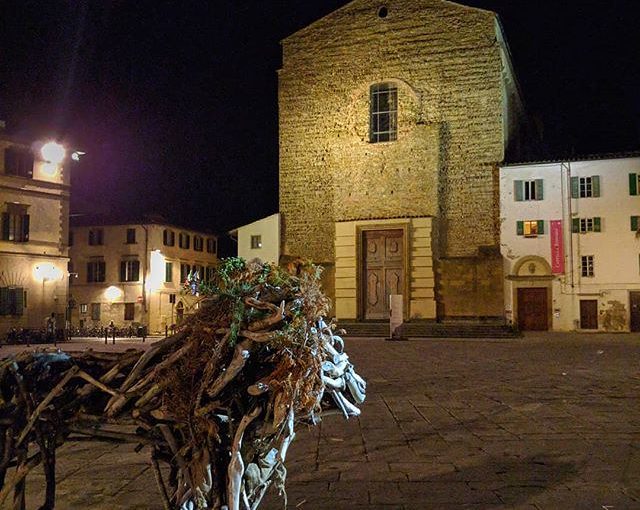
When walking through Florence, it is not uncommon to come across one of Moradi’s creations emerging from an unexpected corner of the city. A realistic crocodile covered in bark sits on Lungarno Torrigiani, while a statue of a unicorn stands tall in Anoncella Park, serving as a symbol of rebirth after a destructive storm that destroyed the park in 2015.
Each sculpture seamlessly blends into the surroundings of the city due to the natural materials used to build it. Viewers of the artwork are typically drawn in by the details used in creating these pieces, unsure at first whether they are seeing an artwork or something that has simply taken shape on its own. This quiet merging of art and environment captures the essence of Moradi’s work, inviting viewers to rediscover the connection between nature and urban life.
Moradi’s creations often emerge from what others might overlook, materials such as discarded branches, fragments of wood, and remnants of nature. By reconstructing these materials into expressive, often animalistic forms, he gives new life to the remnants of the natural world. Florence’s environment seems to bring each piece to life with its artistic history, architecture, and heritage. This relationship between Moradi’s work and Florence’s identity is central to his practice. The city of Florence has long been defined by its appreciation for the Renaissance era, and Moradi’s work is an extension of that natural beauty that was once so prevalent. His materials are fragile, temporary, and deeply tied to the cycles of life and death in nature. Instead of striving for timelessness, he allows his works to weather, to rot, to be reclaimed by their environment. Viewers of his work comment, “his pieces don’t stand out at a first glance, and then suddenly it’s there, like the city is breathing.”
After a quick scroll through Moradi il Sedicente’s Instagram page, his devotion to his art becomes very apparent. As he describes, his work is “a profound journey of listening, creation, and connection, where nature, landscape, and community intertwine in a single, vibrant breath” (23 July 2025). This statement reflects his belief that each piece is more than a sculpture, and is a direct act of participation with Florence’s surroundings and those who inhabit it. Moradi’s art is not meant to be admired as a singular work of art but as part of the street art culture of Florence. His “installations that blend with the territory, inviting passers-by to pause, observe, and feel” (8 August 2025) embody the idea that art should emerge from life itself. In this way, his social media presence extends his practice beyond the physicalities, becoming another form of connection, and sharing the evolving relationship between art and nature.
Through his blending of tradition and modern technique, Moradi has the means to reshape the understanding of what it is like to be a contemporary Florentine artist today. His sculptures, crafted from reclaimed materials and natural elements, serve as quiet reminders that beauty in Florence is not only in its past but also in a constant transformation. Moradi’s work invites both tourists and locals to reflect on the placement and purpose of the art, suggesting that creativity in Florence is not confined to its museums or monuments. Instead, it lives and evolves within the everyday landscape, continuing the city’s long tradition of reinvention through artistic expression.