The Beating Heart Above Florence

A place where sunsets, cameras and people meet to be present

This blog feature is an exclusive bonus installment to our Fall 2025 issue of Blending Magazine. After you finish reading, be sure to explore the rest of the magazine online—just follow this link to download the full Fall 2025 edition:
https://jschoolfua.com/images/BM/BM_151.pdf

written by Maëlys Brunet

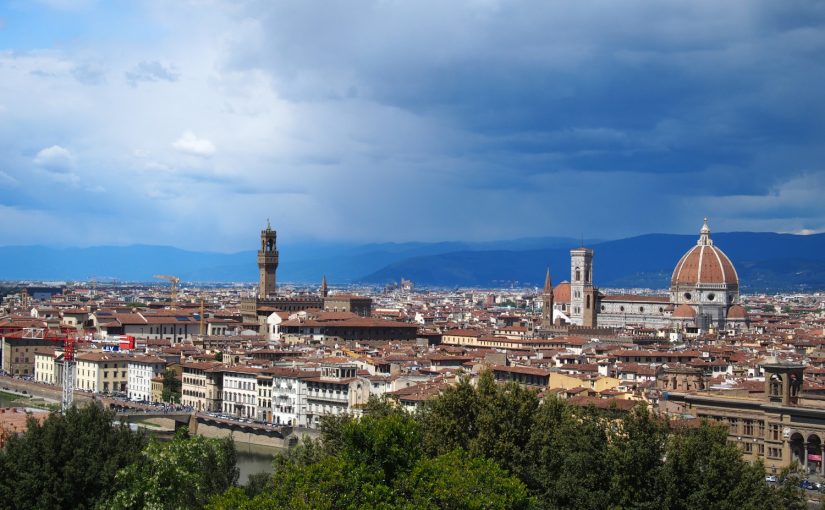
As the city slowly changes from season to season, we are constantly reminded of Piazzale Michelangelo as the beating heart of Florence. Especially during the summer months. The Piazzale remains alive through both tourists and locals, particularly at sunset, as wanderers gather on the steps with a simple glass of wine to listen to a band’s music or take pictures as a souvenir of the moment, as time pauses, just for a moment. This Florence phenomenon stirs curiosity about the aura the city holds in people’s hearts, a current that pulses through and unites communities. 

Piazzale Michelangelo seems nowadays as a rite of passage, a go-to place when visiting Florence to admire the city’s iconic skyline. But what about its history? Built in 1869 by Giuseppe Poggi, it was originally meant to just be a terrace, celebrating Michelangelo’s art. A representation of progress, but also modernity and the future, as Florence was the capital of Italy during that time. Nowadays, we see Piazzale Michelangelo as a place to slow down, reconnect to the beauty of the city, with a crowd to accompany us into this poetic journey. 

The typical route to Piazzale Michelangelo is just as memorable as the view itself. Beginning from the tower of San Niccolò, take the ascending stairs and path between the large trees. The climb begins as we slowly rise above the city of Florence, in anticipation of the view that awaits, as if leading towards something sacred. Then, the main terrace appears, the crowd gets denser, and the city spreads below. In the golden hour of the evening, music plays in the background and people dance to its infectious beat. Monuments wear orange and yellow as the sun begins to set, offering the perfect moment for multiple photoshoots to spontaneously appear. Phones and digital cameras alike click with the same rhythm as conversation or laughs. 

Piazzale Michelangelo is the place where multiple generations meet to capture the essence of Florence. As a guitarist tunes his strings, he shares that although the people there always change, the sunset and view remain a constant. There is poetry when we stare at the landscape, thinking it was approximately the same view as the one our ancestors looked out at centuries ago. People at first come for a simple view, then leave with memories, connections and hearts filled with emotion. Here the sunset isn’t edited, it is put on display, shown in its raw form to its audience.

Looking away from the view and back towards the crowd, students share a bottle of wine, while pizzas are eaten by a family visiting from abroad. All the while, social media enthusiasts are trying to capture the perfect shot. A couple stairs down, people listen to music, dance to the rhythm of guitars and saxophones, and cheers can be heard for a couple that just got engaged. This place holds authentic moments of life and connection that will never be forgotten. 

As night approaches, some remain while others venture further, all the way to San Miniato al Monte – a hidden place above Piazzale Michelangelo – to admire the city from a similar perspective. Apart from the overwhelming crowd and movement, you find peace and quietness, almost like coming out of a dream. Two different atmospheres but only a single feeling remains unchanged: reassurance and interaction. 

In those small interactions, it is where Piazzale Michelangelo holds its core, being something rare and precious to keep hold of. A moment apart from digital, inviting those that gather to be there mentally, with your own thoughts, to live in the moment rather than posting it. The space gathers both past and present. Life and art coexist around a skyline view, with a community to share the same moment with, just for a couple of minutes… or even a couple of hours. 

In an age of constant digital scrolling, Piazzale Michelangelo remains a symbol of the contrary. Not every view needs to be shared or posted on social media, as it must be experienced and lived through the senses and presence of people around us. The difference lies in the fact that the beauty of the square can be shared through both photos and memory, however those emotions we feel when in its presence, cannot be replicated on the digital screen.

When we look at Piazzale Michelangelo, we can see its beauty in the different communities it brings together. Some live in the moment, as a break, an aside, a moment apart from the fast pace of life. We take this moment to slow down, take a step back, and enjoy the present moment with friends, family, or alone. Others may take advantage of the moment by capturing a memory, particularly through digital means, engaging in an online community.

Piazzale Michelangelo explores the possibilities and redefines the opportunity to come together as a community, whether in-person or virtually. This place in Florence demonstrates a new perception of what a community can be, beyond what we are used to seeing, while continuing on the same path of harmony and the search for unforgettable moments. 

Jazz Revival Amongst the Youth

With the recent closure of Florence’s Jazz Club, allow this to be read as an ode to a staple in past study abroad students’ daily lives, with hopes of bringing back fond memories. In addition, this blog feature is an exclusive bonus installment to our Fall 2025 issue of Blending Magazine. After you finish reading, be sure to explore the rest of the magazine online—just follow this link to download the full Fall 2025 edition:
https://jschoolfua.com/images/BM/BM_151.pdf

written by Clara Koster, Hailey Kookaby, Tess Letendre & Peri Raczynski

“Going to Jazz Club felt like being at home in New York,” said Colleen, a student at Florence University of the Arts (FUA). For many students, the Jazz Club offers a familiar, intimate vibe — a break from the usual bars and techno nights of Florence. The dimly lit venue, tucked into a side street, draws students in with the promise of soulful music and a warm, relaxed atmosphere. 

Despite being an older style of music, jazz is finding new resonance among the city’s youth. A sign of its relevance is when a place appeals to students, who have consistently driven cultural trends. The sound of jazz now drifts through the streets of Florence, played by street performers and live musicians, sparking curiosity and excitement for a nightlife experience that emphasizes listening rather than dancing. 

The Jazz Club opened in 1979 and has consistently offered live performances. While jazz is the primary style, rock, R&B, and blues are also commonly heard. The club is small, and lines begin to form about a half hour before doors open, mostly made up of students eager to see what the venue has to offer. Guests are greeted at the desk, pay cover, and receive a membership card — their first drink included, with future visits covered by the card. 

Reactions to the club vary. “I thought it was kind of boring,” stated Harleigh, another student. “It’s not like the other bars I usually go to.” Devon, a classmate, described her experience as “amazing,” citing her deep love and appreciation for jazz. Maria, another student, elaborated on how she prefers Thursday nights for blues sets, saying, “It’s slower, moodier and fits the atmosphere better than Wednesday nights, which are more crowded.” Despite the differing opinions, one thing is clear: the Jazz Club leaves a lasting impression on those who seek it out. 

For our own visit, the ambiance was immediately striking. The room was filled with resonant bass tones, the wail of the saxophone, and a sense of focus on the music. Students swayed gently to the rhythm, some closing their eyes to fully immerse themselves, while others held quiet conversations without shouting over the music. The atmosphere was comforting and welcoming, creating a space where anyone interested in music could feel at home. 

The Jazz Club’s blend of historical charm and contemporary appeal illustrates Florence’s ongoing artistic legacy. Students like Tatum Park appreciate the club as a break from conventional “college” music, feeling connected to the city’s long-standing appreciation for music and art. Similarly, Colleen finds nostalgia and familiarity in the experience, while Devon finds inspiration and awe. The club demonstrates that even older musical forms, when presented thoughtfully, can engage and excite a younger generation. 

While most students gravitate toward techno-heavy clubs and crowded bars, the Jazz Club offers something different: a revival of old-fashioned musical reception. It’s a space where students can experience live jazz, blues, and other genres in a way that emphasizes presence and connection. In Florence, a city steeped in artistic and musical heritage, the Jazz Club has become a bridge between past and present, giving students a new way to engage with the timeless power of music.

The Rebirthed Art of “La Vita Lenta”

Journaling: The Personal and Authentic Form of Memory

This blog feature is an exclusive bonus installment to our Fall 2025 issue of Blending Magazine. After you finish reading, be sure to explore the rest of the magazine online—just follow this link to download the full Fall 2025 edition:
https://jschoolfua.com/images/BM/BM_151.pdf

written by Liana Torres, Heather Collins & Lydia Turner

In an age where our thumbs type faster than our thoughts, the digital world feels impossible to escape. Our devices allow us to easily type reminders, organize assignments, jot down school notes, or record fleeting thoughts within seconds. Walking into a library, classroom, or café in Florence, you will often see people with iPhones in their hands, computers on their laps, and the rhythmic tapping of keyboards as they urgently take notes and revise them in record time. It’s a convenience that may seem luxurious, but people are craving originality due to the loss of creative media. It’s efficient, but detached. 

A new wave of creatives, travelers, and locals in Florence is embracing a slower, more tactile ritual: taking pen to paper. Here in Italy, where beauty can be found in imperfection and time is slowed down, journaling has taken on a deeper meaning. Writing by hand anchors you in the moment, making it a physical craft that demands presence and meaningful thought. 

Journaling is an extremely personal experience; a leather-bound notebook isn’t just stationery it’s an accessory, an extension of personal style. The marbled paper, the smooth pen, the color of ink chosen, every detail becomes a reflection of self. In a city renowned for its craftsmanship, from leather bags to jewelry, the journal joins the wardrobe of self-expression. To open it is to reveal not curated perfection, but raw honest thought. The choice of the journal’s cover is unique and tailored to the user’s taste, often serving as a fashion accessory. Residents and visitors alike are slowing down, mirroring the ancient streets and buildings around them, translating their experiences through ink rather than a screen. 

Florence itself feels designed for reflection. The view from the rose garden at sunset, views of the Duomo, the echo of footsteps on cobblestones, and the scent of paper and ink from small workshops all invite slowness. To sit with a notebook in a Florentine café isn’t merely to write, it’s to participate in a centuries-old dialogue between beauty, and thought. The act of journaling becomes a quiet rebellion against the speed of modern life, reconnection with presence. 

Psychological studies have shown that handwriting engages more areas of the brain than typing does. When the hand forms letters on paper, neural pathways responsible for memory, comprehension, and creativity become activated. Writing slows down the mind and creates deeper reflection, forming strong connections between thought, language, and page. One must think before they write, as each sentence becomes more meaningful when it cannot be easily erased. There’s something deeply human about seeing one’s thoughts take shape, imperfect and unfiltered. Typing on a computer removes the permanence, thoughtfulness, and focus that handwriting naturally gives. It is nostalgic, but also a neurological discipline. Our engagement with what we are learning, feeling, and experiencing is deepened.

Journaling is an art form in Florence. In local markets and small boutiques, hand-stitched leather notebooks and marbled papers are commonly found authentic, high-quality stationery. They signify Italy’s value for craftsmanship, and in Florence, the art of leatherwork. These boutiques also draw consumers into the old, analog world by offering products such as wax seals, personalized notecards, and fountain pens. Each item tells a story, not only of Italian craftsmanship, but of the person who chooses it. 

Tourists, visitors, and students of Italy often feel compelled to document their experiences here in an honest and authentic way. Instead of simply snapping photos on their phones, many sketch their surroundings or write about their emotions in the moment, carrying their journals as if they were passports. 

The Italian way of life, la vita lenta, is a philosophy of taking it easy and living in the moment. It embraces the rhythm of slowness and authenticity, valuing conversation, artistry, and the transformation of life’s seemingly mundane moments into something meaningful: a shot of espresso made by a local barista, a handwritten letter or postcard, or a leather journal carefully crafted by an Italian artisan. People can truly reflect rather than quickly react on their phones. 

Journaling allows for the documentation of lived experiences; it’s a way to highlight valuable memories and live through physical paper instead of a screen. Imperfection is welcomed, and the texture of the paper carries the rawness and realness of each written experience. It is more sacred. In Florence, handwriting isn’t about rejecting technology, it’s about reclaiming something real. Paper invites you to be unfiltered, unedited, and utterly yourself.