Football in Football Country

written by Jack Wardynski for SPEL: Journalism

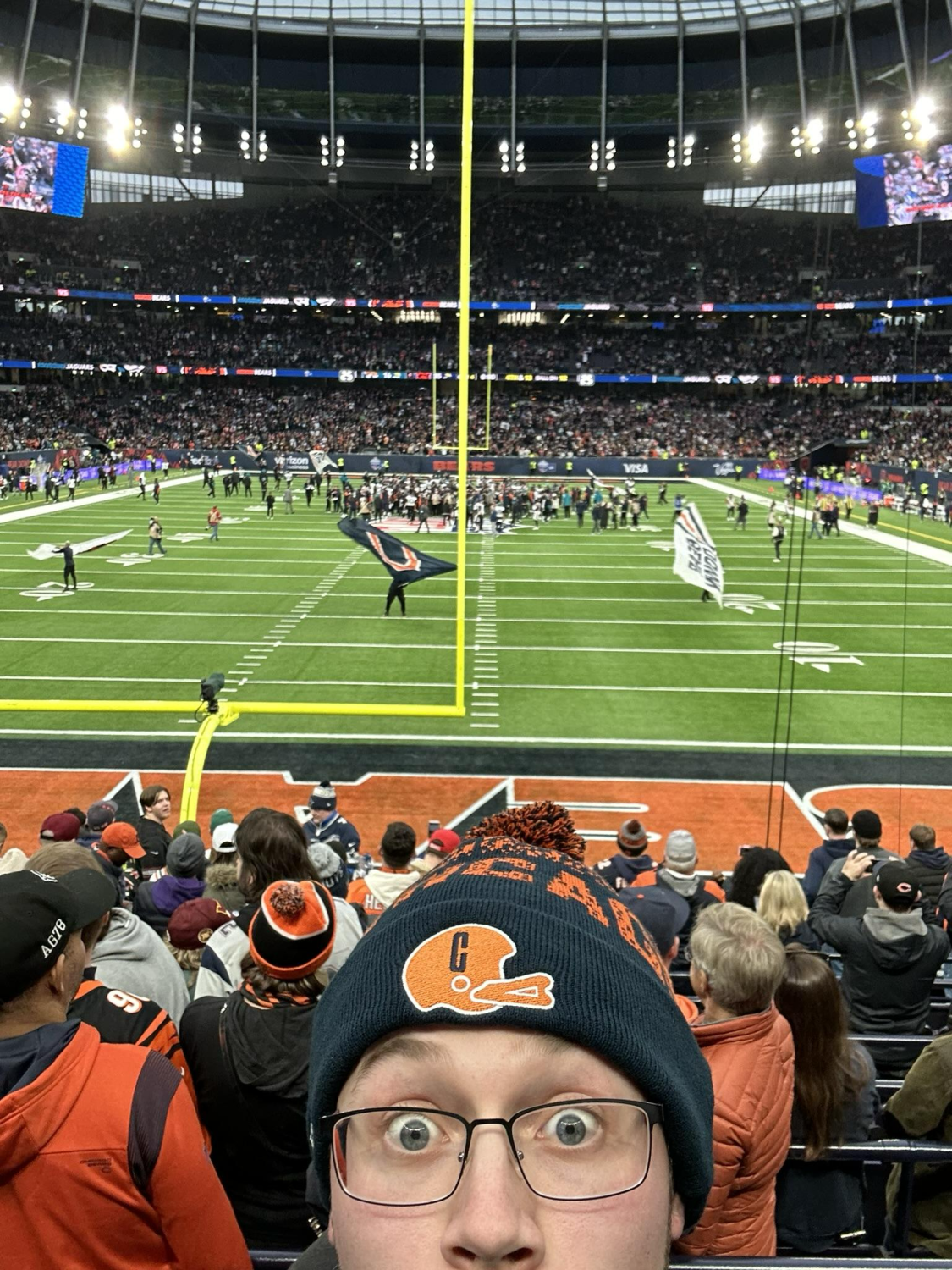
While I may be spending four months abroad to immerse myself in new, foreign cultures, I find it difficult to keep myself from indulging in my home country’s most popular pastime. American football is an exciting, dramatic, slightly barbaric–definitely dangerous–sport, but it’s ours, darn it. My hometown Chicago Bears are 4-2 this season, a feat that on the surface may not seem wildly impressive, but for the Bears it feels like a small miracle. Lucky for me, their Week 6 game in London was just a short plane ride away.

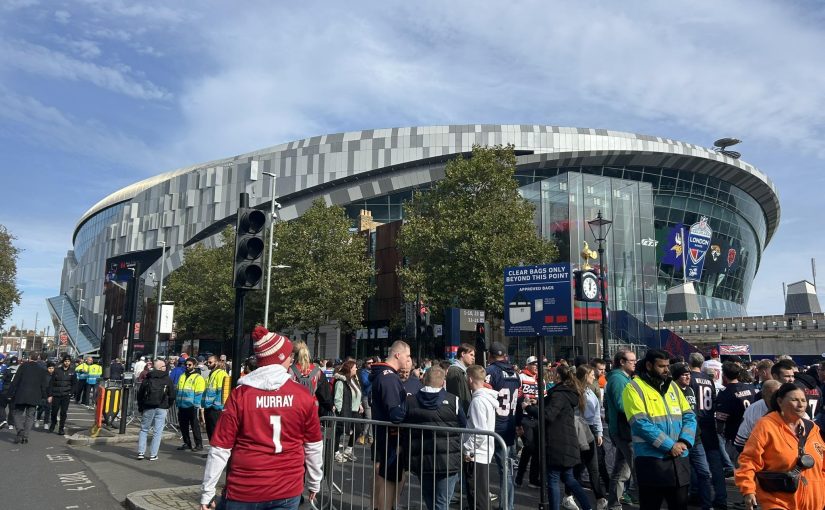
As most fans back in the States were still fast asleep, I was riding the London Tube to Tottenham Hotspur Stadium. This arena is typically used for the classic English sport, but today it would house a bunch of Americans tossing the pigskin around. A funny thing about the NFL in London is how many expats attend who are not actually fans of either team playing. I made it my mission to find a jersey for each of the 32 teams before I entered the stadium. Bears jerseys were rampant across the city the whole weekend, and I noted Eagles, 49ers, Jets, and Seahawks before I stepped off the train.

There is a certain maximalist quality to American football that permeates into all aspects of the sport. Teams employ a roster of 53 players each, and those players are divided into three different teams within. Unlike most sports, where points are scored one at a time, football awards points in chunks of two, three, six, seven, or eight. Players wear bulky pads and helmets that make them appear more like post-apocalyptic gladiators than athletes. Every Sunday, fans in the stands don ridiculous costumes while cheering the entire game, many of them legends in their respective fanbase, then return to their normal lives the next day as if nothing happened.

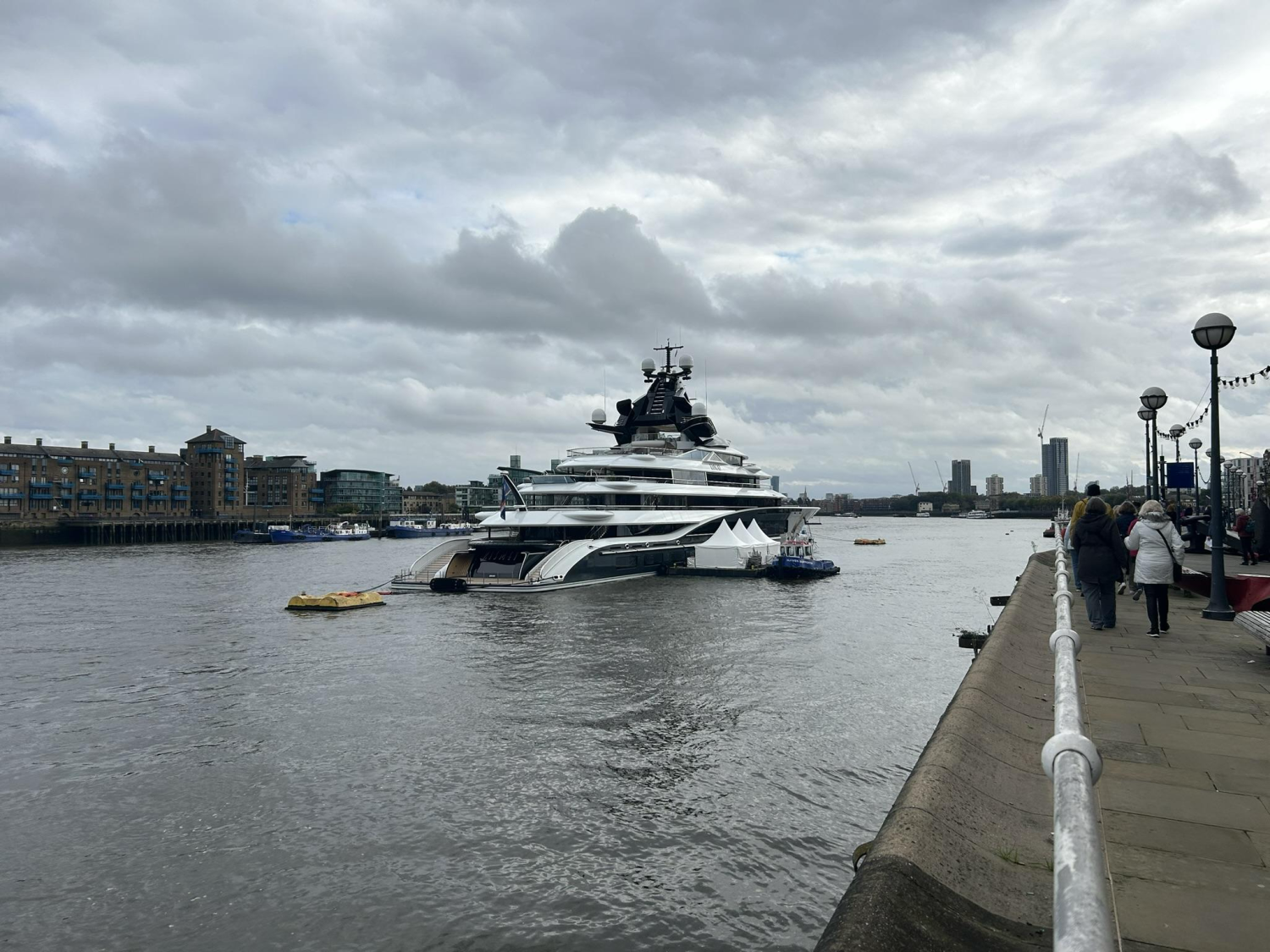
Shad Khan’s superyacht, Kismet, parked in the River Thames struck me as an extension of the sport’s megalomaniacal streak. If you were the owner of the Jacksonville Jaguars and worth somewhere in the tens of billions, wouldn’t you also take your 400-foot pleasure barge across an entire ocean and park it in the heart of a metropolis to watch your 1-5 football team play?
Of course, English football (soccer as we “Yanks” would call it) has its own mania around it which surpasses that of its western counterpart. The Tottenham residents were largely unfazed as the seemingly endless procession of fans traveled north on High Road to the arena. For them, this must have been no different than any other Spurs game day, just with different jerseys. For me, the 30 minute walk was a brand new experience. I’m used to being stuck in cars, jamming up the highway into the city, then spending the better part of an hour hunting for a parking spot that won’t cost an arm and a leg. The chance to walk about and explore the area offered exciting new opportunities. I bought an overpriced sandwich from a street vendor, an even more overpriced commemorative Chicago Bears beanie, and listened to the tranquil tones of religious extremists on every corner warning about the rapture that would surely come if we don’t repent soon (this had something to do with football I suppose).

I joined in with a group of older English fellows who, like me, had taken on the challenge of spotting merchandise for each franchise. I soon narrowed it down to just two teams that I had yet to see: the Tennessee Titans and the Houston Texans. A #8 Will Levis jersey spotted off in the distance made Houston the big losers of my exercise. The Texans are only as old as I am, so I can’t blame them for having subpar international appeal.

At 12:30, the gates opened and the fans started pouring inside. I found my seat behind the south end zone and took in the sights. Despite the Jaguars having games in London every season, Bears fans handily outnumbered them, with the stands blanketed in navy and orange. Playing on the screens in the arena was a PSA-style video explaining the rules of football, and I chuckled to myself realizing how silly the particulars of the game really are when summarized in this manner. After settling in, I watched the players warm up and waited for the opening kickoff.

After a slow start, the Bears found their stride and bested Jacksonville 35-16. After a full week of anticipation, seeing your team score five touchdowns in person makes you believe you are untouchable, unassailable. I felt like I could walk right up to Buckingham Palace and claim it as my own. Luckily, I instead settled for a corner table at a pub down the road and a chicken sandwich. I struck up a conversation with an Englishman, his wife, and a couple of American tourists. The Englishman was recounting his origins with the team, how the famous Super Bowl-winning 1985 Bears captured his imagination as a kid and converted him into a diehard fan, despite never stepping foot in Chicago. I heard stories of other local fans who, pre-Internet, would make international calls to Chicago numbers on game days to ask what the score was.

There are many aspects of football that can do nothing but draw an individual’s ire. The sport itself is violent, with the potential to cause serious physical and mental harm. The draft system is fairly archaic and arguably exploitative of young players entering the league. The whole endeavour, ultimately, is a thinly-veiled cash grab, with major American universities functioning more like professional football franchises with education as a side gig. But on a baseline level, it is truly remarkable how much football, and sporting as a whole, can bring disparate individuals together. There are consistent trends across the world of crime rates dropping in cities when the local sports team is performing well. For me, I doubt I would have found my way to London were it not for my team coming to town. I certainly wouldn’t have ended up in a dingy bar at the end of the night, surrounded by locals from a country brand new to me. At that time, sitting next to a sleeping cat on a stack of speakers, and watching a broadcast of teams playing halfway across the world, I felt the most at-home as I’ve been during my study abroad journey.
In Florenzia: A Day In The Life

written by Makayla Sims

When I wake, the black-out curtains of my apartment that are cracked only let in a sliver of light to let me know a new day has come. I’ll lay in bed for a couple (see: 30) more minutes and then decide it’s time to go face what has come to greet me. Today is Tuesday, so it’s my slow morning. Normally, I will make myself breakfast, but Conad was busy last night with locals, tourists, and students alike shopping, so I figured I’ll go out for breakfast before my anatomy class later in the evening. 

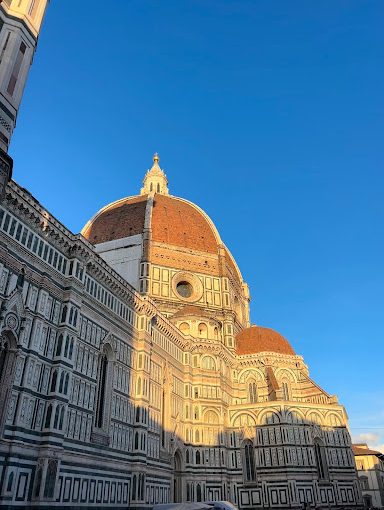
I make my way to Le Vespe Cafe, a little American breakfast spot off of Via Ghibellina and where I find myself if I ever miss a taste of home. Currently, I’m studying abroad until mid-December, and I’ve been here since mid-September. Slight homesickness is a part of the gig, I fear. When I step outside of my apartment, I catch a glimpse of the Duomo, not even five minutes away from my front door. Despite my sentimentality, I will miss it greatly when I am gone. My ten minute walk to Le Vespe is accompanied by October rain, and the pumpkin latte I end up getting reminds me of how beautiful it is to have rain during the fall.

I still have a couple of hours before my next class, and there are a couple of things I want to do today before my three and a half hour lecture. 

The first place I want to go to is the Boboli Gardens. For my 8 am class, Grow, Cook, Heal, Therapy for Wellbeing, that I have on Wednesdays, we have an assignment where my group must tour four different gardens from different neighborhoods. Then, we must take and upload photos as well as a brief history and description of the grounds (as you can see, nothing too bad).

My twenty minute walk to the gardens features a major staple in Florence, as we (me and my friends) cross the Golden Bridge. It’s hectic and loud and crowded, and by far has one of the most beautiful views of the Arno River I have seen. Still, hold onto your phone and your friends- with these conditions losing one of these is not unlikely.

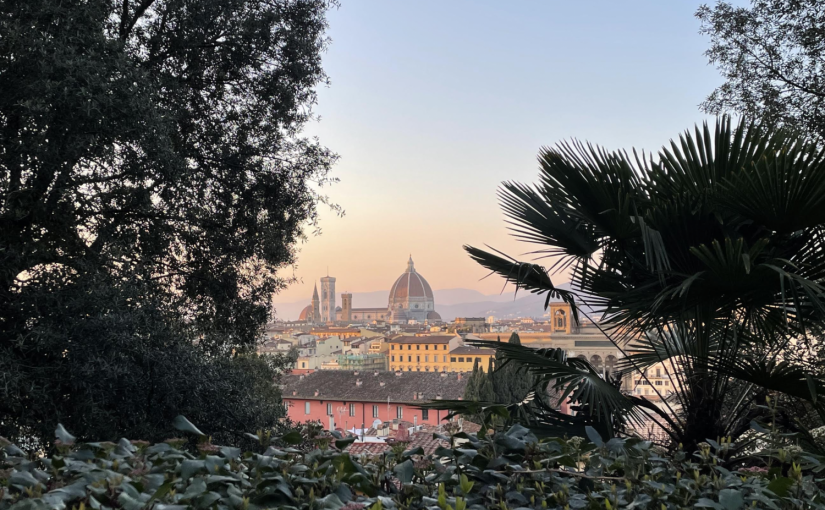
Boboli Gardens comes attached with a ten dollar entrance fee for the day. We enter through the Pitti Palace, but skip that tour because that isn’t what I’m here for. Instead, we climb the slanted, small, long stairs to the beginning of the garden’s grounds. It’s beautiful here, undeniably so, with a beautiful clearing for the main statues and ponds. To the left and right, the grounds spread out behind a wall of shrubs, with a maze to get into and out of those sections of the garden. If you continue straight all the way to the top, however, you see one of the best views in Florence (apart from the top of the Duomo). 

This picture does not do this view justice.

For a moment, I forget about the assignment and just stare. I’m in Italy, I’m in Florence. And the bustling cityscape, the rolling countryside behind it, that’s been my home. For the rest of my life I can know for myself that I, at one point in the distant past, lived there. The beauty of the art, the people (most of them), the food, my friends. It’s just-

Beautiful. 

I finish up taking notes of the different architecture and landscapes, then I make my way to my second destination before my anatomy class.

There’s this little record store called Contempo Records that I pass everyday on my way to FUA’s lecture halls. Everyday I pass it, I want to go inside. I don’t have a record player, but my sister does. I know she will appreciate a little memento. I walk inside and am greeted with spiraling ceilings and records stacked to the nines. I don’t end up getting anything, but it makes me feel at home.

After enduring my three hour lecture, I know that it’s time for me to get some homework done. FUA has a library in the same building, but it closes at 6pm and my class is done at 6:55. So I go to, quite genuinely, my favorite place in the city. 

The Giunti Odeon Libreria e Cinema is a bookstore/movie theater. Up in the rafters, there are old theater seats for visitors to read or work on homework while a movie plays in the background. Almost always it’s really, really warm inside and almost never can you hear the movie. I love it.

I sit there and work till about 8:30 pm, which is when I make my way back to my apartment. My friends and I have decided to cook ourselves dinner, with some gnocchi pasta, green beans, and focaccia. Before I head inside, I take one last look at the Duomo. How can anyone not be romantic about Florenzia? I wonder.

La última parada

Florence & the moment that changed everything

written by Paula Simon Borja for SPEL: Journalism

En el verano de 2022, tuve el privilegio de viajar 45 días por Europa. Comencé en Madrid, luego recorrí Barcelona, Viena, Budapest, Praga, Berlín, Ámsterdam, París, Roma, Venecia y, finalmente, Florencia. Aunque en ese momento no era plenamente consciente de ello, esa última parada marcaría el cierre perfecto para un viaje que terminó superando todas mis expectativas. Al final de aquel mes, me encontraba exhausta: había subido y bajado de cientos de trenes, me había alojado en hoteles baratos, arrastrado maletas de 20 kilos y me había alimentado principalmente de comida rápida de puestos callejeros. Ya no sentía el impulso de seguir explorando, aunque era absurdo quejarse. Durante esas semanas, tuve la fortuna de admirar algunos de los lugares más hermosos del mundo, de escuchar las canciones más alegres, de reír hasta sentir dolor de estómago y, a su vez, sentir una necesidad profunda de llorar. Florencia, de todos los lugares que visité, fue el que más me conmovió.

In the summer of 2022, I had the privilege of spending 45 days traveling around Europe. I landed in Madrid, then made my way to Barcelona, Vienna, Budapest, Prague, Berlin, Amsterdam, Paris, Rome, Venice, and finally, Florence. What I didn’t know at the time was that I would end the trip with a truly unforgettable experience. By the end of that month, I was utterly exhausted: hopping on and off trains, staying in budget hotels, hauling 44-pound suitcases, and surviving mostly on street food. Honestly, I was running out of steam. It felt almost ridiculous to complain, given how fortunate I was. I had seen some of the world’s most beautiful places, heard the happiest music, laughed until my stomach hurt, and, at times, cried from overwhelming emotions. It was Florence that moved me the most.

Llegué a Florencia sin demasiadas expectativas. Después de haber estado en lugares como París o Roma, pensaba que la ciudad no podía competir con la magnitud histórica y cultural de esos destinos. Mi hermano, un apasionado de la historia, siempre me había hablado de Italia con una devoción casi reverencial. Su fascinación por el Imperio Romano, por los mapas antiguos y por las ciudades históricas es casi obsesiva. Vivió un año en Turín, y su lugar favorito en el mundo es la Plaza de San Marcos, en Venecia. Ese verano, tuve el privilegio de recorrer Italia a través de su ojos, de sus relatos, de sus sentimientos.

I arrived in Florence with little to no expectation. After seeing amazing places like Paris and Rome, I thought, perhaps wrongly, that Florence couldn’t compare in terms of history, culture, or beauty. My brother, however, has an almost obsessive passion for history. He spends hours watching documentaries, drawing ancient cities from old photos, and knows everything there is to know about the Roman Empire. He is utterly obsessed with old maps, especially of ancient cities. He lived in Turin for a year, and his favorite place in the world is Piazza San Marco in Venice. That summer, I had the privilege of seeing Italy through his eyes.

Fuimos al Coliseo en dos ocasiones, exploramos el Vaticano, pasamos casi tres horas bajo el sol abrasante del Foro Romano y contemplamos el atardecer desde el Castillo Sant’Angelo. Fueron experiencias inolvidables. Al día siguiente, llegamos a Florencia. Visitamos el Duomo, recorrimos el museo Uffizi, comimos pizzas y focaccias, nos impresionamos ante el David y volvimos a caminar bajo el sol abrasante ahora en Santo Spirito. En nuestro último día de recorrido, y de viaje en general, mi hermano nos llevó a la Plaza Michelangelo.

We visited the Colosseum twice, explored the Vatican, spent nearly three hours under the scorching sun at the Roman Forum, and watched the sunset from Castel Sant’Angelo. Those were unforgettable experiences. The next day, we arrived in Florence. We toured the Duomo, walked through the Uffizi Gallery, ate pizza and focaccia, were awestruck by the statue of David, and then walked under the hot sun again, this time in Santo Spirito. On our last day in the city, and the last day of the trip, my brother took us to Piazzale Michelangelo.

La subida no fue fácil, pero cada paso valió la pena. Opté por lo que hoy sé que es “el lado correcto”: el que ofrece una vista completa de la ciudad, mientras que el otro, más corto, evita el espectáculo que se despliega frente a ti. Ese día, me encontré en primera fila. La plaza no estaba no estaba demasiado, estaba en su punto justo: un ambiente vibrante, festivo, pero con espacio para sentarse en las famosas escaleras y dejarse envolver por la magia del lugar. En la cima, una banda comenzó a tocar música, canciones populares, algunas de ellas de épocas pasadas. Una de esas canciones, en particular, me dejó sin aliento. No era de mi gusto ni pertenecía a mi estilo musical habitual, pero en ese instante, en ese preciso contexto, la sentí profundamente, hasta lo más íntimo. No pude evitarlo: lloré con una intensidad inesperada, como si ese momento estuviera sanando algo dentro de mí, como si fuera la pieza que me faltaba para sentirme completamente realizada y feliz.

The climb wasn’t easy, but every step was worth it. I took what I now know is “the right path”, the one that offers a full view of the city, while the other, shorter route, turns its back on the spectacle ahead. That day, I was front and center. The square wasn’t too crowded; it was just the right amount of people: lively, festive, but still with space to sit on the famous stairs and let yourself be wrapped up in the magic of the place. At the top, a band started playing music—popular songs, some from past eras. One of those songs, in particular, took my breath away. It wasn’t my usual taste, nor the kind of music I’d typically choose, but in that moment, in that exact place, it moved me deeply. I couldn’t help it: I cried, unexpectedly and intensely, as if that moment was healing something inside me, like it was the missing piece I needed to feel completely whole and happy.

Estaba acompañada de mis hermanos y dos mujeres rumanas que habíamos conocido unos destinos atrás y que decidieron acompañarnos en la última parte del viaje. Compartí esa experiencia con personas que, aunque tal vez por razones distintas, estaban viviendo algo igualmente significativo. En ese momento, todos compartimos una misma emoción, un mismo sentimiento. Es una acción tan común entre los seres humanos que parece casi involuntaria, pero es un privilegio sentir. Es un privilegio llorar, reír, admirar, asombrarse. 

I was with my siblings and two Romanian women we had met a few stops earlier, who decided to join us for the last part of the trip. I shared that experience with people who, although for different reasons, were feeling something just as meaningful. In that moment, we all shared the same emotion, the same feeling. It’s such a common thing among humans that it almost feels automatic, but it’s a privilege to feel. It’s a privilege to cry, to laugh, to appreciate, to be amazed.

Esa escena, esa canción, ese atardecer en la Plaza Michelangelo, fue el cierre perfecto para un viaje que ya había sido extraordinario. Ese momento encapsuló todo lo que había vivido en los 45 días anteriores: los lugares, las personas, los sentimientos, los recuerdos. Fue como si la vida hubiese tomado todo eso y lo hubiera condensado en ese instante, en ese lugar, con esas personas. Ese día comprendí, de manera profunda, que Florencia poseía una magia única. Fue entonces cuando supe que debía regresar, que había vivido algo irrepetible. En diciembre de 2024, cuando decidí buscar la oportunidad de hacer un intercambio académico, no hubo duda de que Florencia sería mi destino. Ahora, todos los días, voy a esa plaza a ver el atardecer, a escuchar música y a compartir un sentimiento de libertad. Abrazo con fuerza el privilegio de revivirlo a diario.

That moment, that song, that sunset in Piazzale Michelangelo, was the perfect ending to a trip that had already been extraordinary. It captured everything I had experienced in the past 45 days: the places, the people, the emotions, the memories. It felt like life had taken all of that and condensed it into one instant, in one place, with those specific people. That day, I deeply understood that Florence had a unique magic. It was then that I knew I had to return, that I had experienced something unforgettable. In December 2024, when I decided to look for a chance to study abroad, there was no question: Florence would be my destination. Now, every day, I go to that place to watch the sunset, listen to music, and share a sense of freedom. It’s a gift I cherish, being able to relive it each day.

Tuscan Leather

written by Pedro Calderon for SPEL: Public Relations

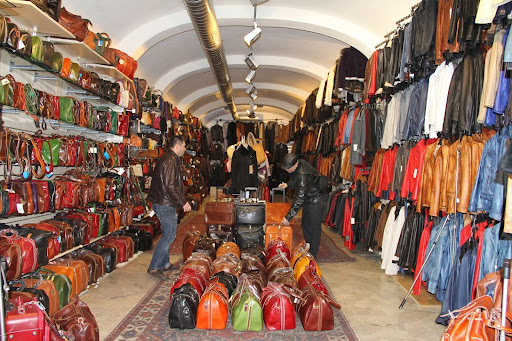
If you take just a 10-minute walk through the center of Florence, you will immediately notice a wide variety of storefronts: trattorias, gelaterias, and souvenir shops. Among these, leather goods shops are particularly prominent, and for good reason. Many of these shops offer a range of products such as leather jackets, accessories, bags, wallets, shoes, belts, and countless other items in practically every color you can imagine. Italy, especially the region of Tuscany, is known for its high-quality leather and craftsmanship, thanks to a long tradition of being a central market for trade.

One of the best places to find leather goods is the Mercato di San Lorenzo, located next to the Mercato Centrale, just a 7-minute walk from the Piazza del Duomo. Inside the Mercato Centrale, you will find vendors selling fresh produce and meat, as well as restaurants upstairs offering delicious local cuisine and an excellent selection of wines. Outside, the Mercato di San Lorenzo is lined with vendors selling souvenirs like key chains, miniature statues, postcards, shirts, sweaters, scarves, and an impressive selection of leather goods. While these shops are plentiful with colors and designs, real leather lovers may want to wander outside of the Mercato Centrale area to find family-run boutiques. Some of the highest rated, and local favorites include Casini (Piazza de Pitti, 30, Firenze), Bemporad (Via Calzaiuoli 11/15/17/B Firenze), Giorgio 1966 Leather Store (Via del Canto dei Nelli 34, Florence), Pierotucci (via Lungo L’Ema 17, Ponte a Ema, Florence), and Benheart. 

Tuscan leather is sourced from local cattle, and the region’s pastures are ideal for raising them. The same cattle that contribute to Florence’s famous Bistecca alla Fiorentina also provide the high-quality hides used in artisanal leather products. This connection between the livestock and leather industries reinforces a sustainable tradition where nothing goes to waste, blending the region’s culinary and artisanal excellence into one cultural experience.

The area’s tradition of leather working dates back to the 13th century. Leather working was already popular in the 1200s in the Republic of Pisa, and after Florence conquered Pisa in the 1400s, many wealthy business owners decided to establish leather production operations in and around Florence; this practice has remained stable despite economic cycles. Professional leather workers can have successful careers as pattern makers, prototype makers, product developers, accessories designers, and fashion entrepreneurs. Modern luxury brands based in Florence, such as Gucci, Ferragamo, Pucci and Cavalli, specialize in high-quality leather goods. Today, local artisans are often hired to collaborate with high-end fashion houses on specialty accessory designs.

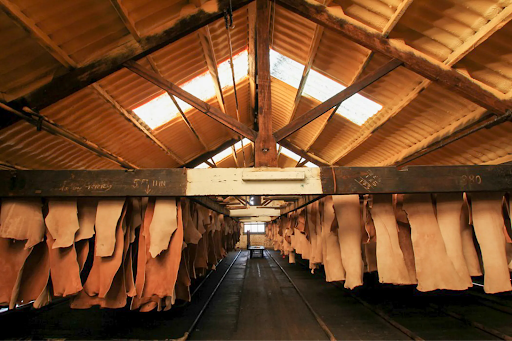
The leather making process begins in a tannery, where the hide is processed using vegetable tannins to get its color. The tanning agent, called liquor, is made from a mixture of ground tree bark, twigs, leaves, and water, and other ingredients to form the desired color. But before this step, the raw hides must be prepared by tanning or drying them with salt to preserve their properties. The hides are then rehydrated to make it easier to remove the hair on the surface, exposing the leather’s natural grain, texture, and softness. They are then pre-tanned with natural tannins and then fully vegetable-tanned using the liquor. Finally, the hides are dried and classified based on their appearance and quality, determining how and for what they will be used. The entire process can take 20 to 40 days to complete. Although centuries old, the process has been made more efficient by technological advancements. In the Arno Valley near Pisa alone, there are hundreds of leather factories and workshops.

Leather is prized for its many qualities, including flexibility, strength, elasticity, malleability, and breathability. There are generally four types of leather that consumers encounter. The highest quality is full-grain leather, which is the top layer of leather and shows off the natural properties of the leather, sometimes even imperfections. Top-grain leather, which is smoother and cheaper than full-grain leather, is still considered high quality. Genuine leather, the most common and affordable type, is what is usually found in everyday designs and souvenirs, although it is considered the lowest quality. Finally, suede is a soft, velvety type of leather often used for footwear and upholstery.

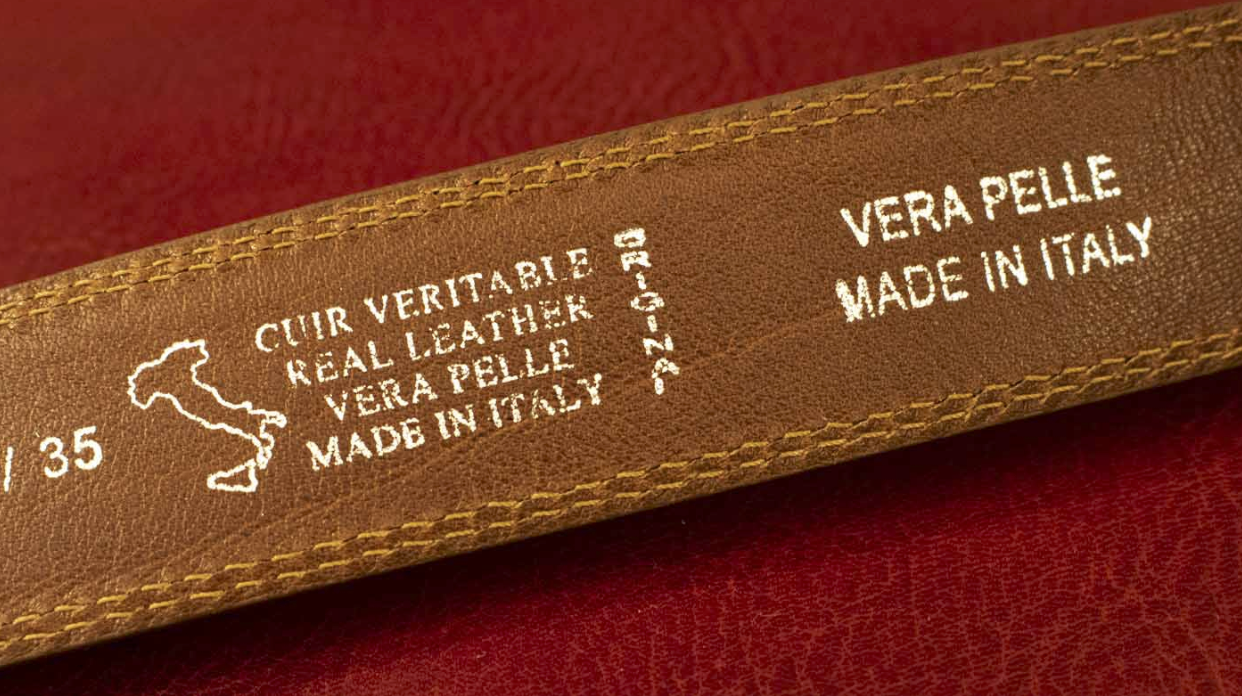
I always recommend purchasing leather products with the “Made in Italy” label to support local artisans and the economy. Although cash is often preferred, most vendors accept cards. Leather is a perfect and useful souvenir or gift for anyone visiting Florence and wanting to take home a piece of Tuscany. It is a product that lasts almost a lifetime.

Florence on Two Wheels: The Subtle Joys of Cycling in Italy

Throughout the United States, car-based infrastructure reigns supreme. But here in Florence, all I need for a quick commute, a trip to the market, or just a leisurely day exploring the city, is a bicycle.

written by Savvy Sleevar for SPEL: Journalism

Shifting Gears

Back home in Illinois, it takes me 30 minutes to get from my house to work on a bike. 25 if I’m really booking it. That’s 5 miles, 4 busy, multi-lane streets, 3 bridges, 2 zip codes, and 1 water bottle’s worth of riding. The trail system in my town provides me with a safe path for most of my trip, and the canopy of trees overhead grants me a much-needed respite from the boiling Midwestern sun as I ride. But even the most bike-friendly route to work includes a sprawl of asphalt parking lots and the off chance of being hit by a car on College Avenue or Jumer Drive. Without the security of the trail (unless you’re a professional, Tour de France-level cyclist), it’s eat or be eaten out on the road. 

An ocean away from my hometown, in Florence it takes me less than 15 minutes to get almost anywhere I need to go. Granted, that’s partially because I’m in a city. It’s also because skinny, one-way streets dominate the urban landscape here. If a car finds itself behind me on the street and doesn’t have the room to pass me for a few blocks, there are no funny looks from the drivers. I’m rarely honked at and never relegated to the sidewalks — I can’t be, they’re microscopic anyhow. I have the right of way. I can ride in the street without fear of a car hitting me, and I can park in more places than a car ever could. When you’re on a bike in Italy, how can it feel like it’s eat or be eaten when you’re at the top of the food chain? 

In Florence, riding a bike isn’t just a way to get exercise, it’s a key to the city. For a cash-poor college student whose time management is a little worse for wear and whose legs are still getting used to the sheer amount of walking that’s almost synonymous with European living, a bicycle for me might as well be a shiny new Vespa, ready to ferry me to new places, new people, and new experiences that I’d never encounter back home. 

No More Training Wheels

The first time I tried to rent a bike in Florence, I was in rough shape. I didn’t know my class would be taking a 30-plus-minute walk at the end of the lecture that day, and while my grandma’s vintage brown sandals looked super cute with my outfit, they were threatening to cover the soles of my feet with blisters. Long story short, I adopted something of a nonchalant hobble by the time class was dismissed. I was way out of my way, it was blazing hot, and there was absolutely no way I was walking home, not like this.

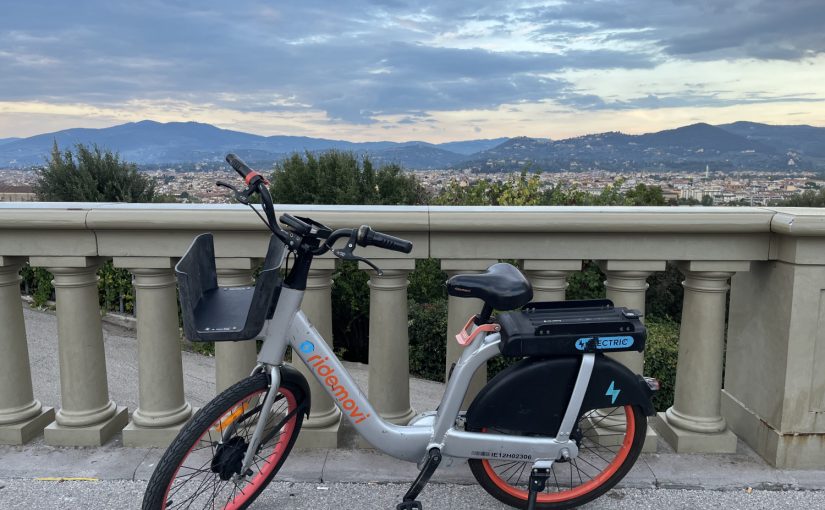
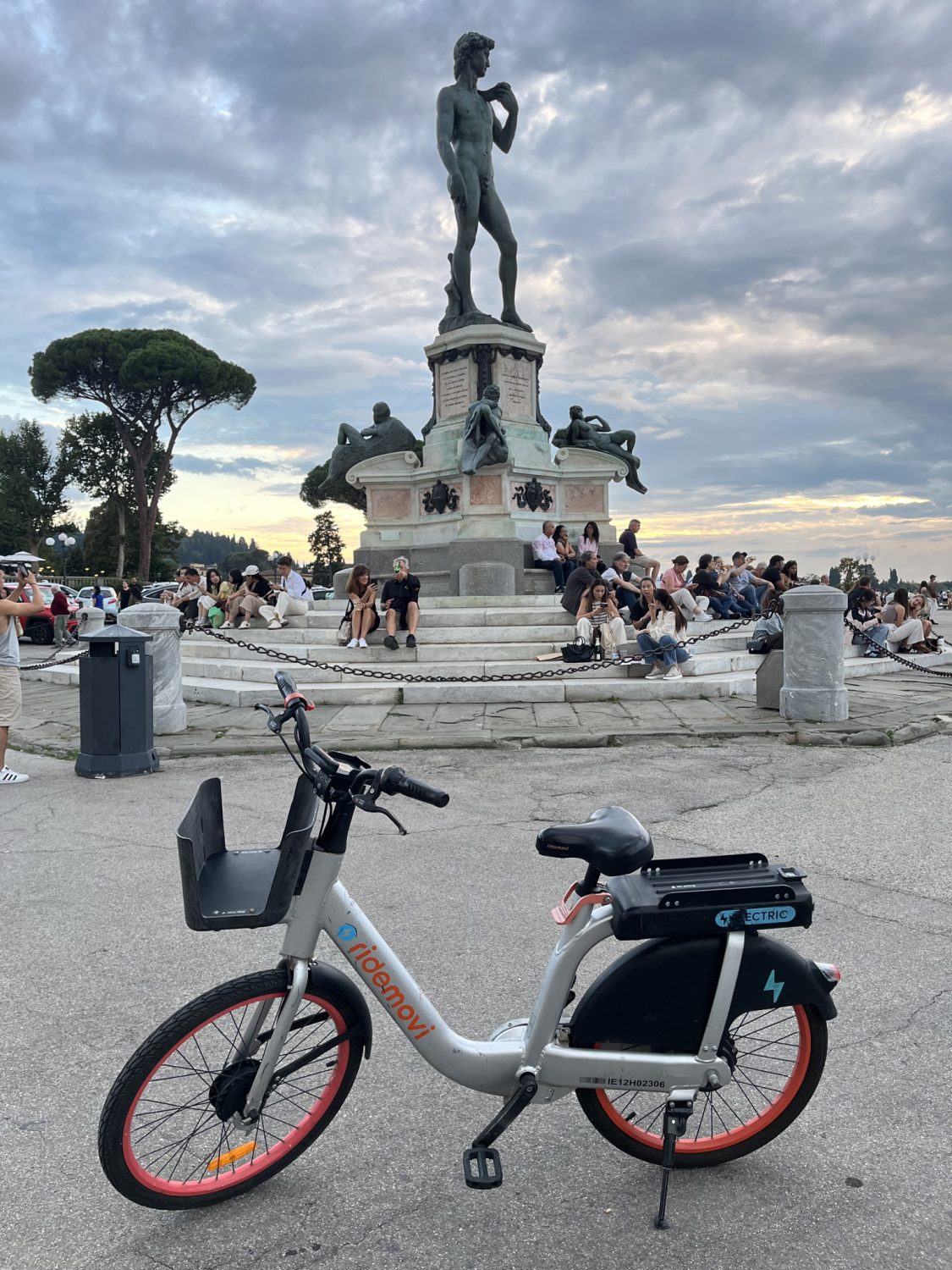
When I saw the orange and silver frame of a rentable bike, casually parked on the curb, I made a beeline for it. I hadn’t spent the summer riding around on my swanky blue Huffy for nothing. I intended to do some cycling in Italy, and there was no better time to start. 

Well, my time to start ended up feeling more like a time to start, then stop, then start, then stop again. 

What I didn’t realize when I unlocked the bike was that a.) it would talk to me and b.) it was electric. While manual bikes are no problem for me, I had never used an electric one before. So as I’m trying to mount this talking Italian bicycle, I get spooked by the momentum boost it gives me as soon as my feet hit the pedals. I quickly lose my balance, making an ungraceful dismount. All of a sudden, I’m a 5-year-old girl again, learning to ride without training wheels in my driveway. But this time, Mom and Dad aren’t here with me to give me a push. Just the occasional passersby on the sidewalk, all of whom minded their own business, but definitely watched me try and fail to get myself situated on the bike seat an embarrassing number of times. 

After a few more attempts, I finally get on the bike and stay there, gingerly pedaling as it propels me down the cobbled street. Thousands of miles from home and 16 years after my training wheels first came off, I was learning to ride a bike again.

Picking Up Speed

Soon, I began riding everywhere. I’ll fill the front basket with groceries, my purse, or a tote bag, and then I’ll set off for class, a quick lunch, a leisurely dinner, an outing to the market — any reason to get on a bike is reason enough for me. 

By no means am I the perfect European cyclist. So far, I have accidentally hit one tourist in a crowded piazza, lost my balance and hopped off the bike mid-ride at least twice, and I just recently figured out how to ring my bell. Even so, riding a bike here has felt miraculous. My first week or so in Florence was dominated by the unforgiving September heat, culture shock, and the overall sense that I was stuck in survival mode until further notice. But that very first time I cycled here, I decided to take a long route home. The road I was on spit me out onto a paved street by the river; I felt my first cool breeze in days rushing through my hair, and as I whizzed down the street, I saw the Duomo peek out from behind the buildings on the north side of the Arno. 

For the first time, I didn’t feel like I was in survival mode. I wasn’t just visiting Florence, I was living here. I was riding down the street in my host city, soaking up the view, the sunshine, the essence of this new home away from home.