Arcetri’s Ambiguity: A Hidden Escape

written by Amber Roldan for SPEL: Journalism

A 27-minute walk.

0.9 miles away from my apartment in the heart of the city center. 

Where would it lead?

Would the noise fade? Would tourists disappear?

I typed “Chiesa di San Leonardo in Arcetri” into my phone as I descended four flights of stairs.

I love living in Santa Croce, but existing in such excitement can become overstimulating.

The walk started similarly enough to routes I have taken dozens of times before. 

Past the basilica, over the river.

Usually, once I cross the river I turn left or right.

Left towards Piazzalle Michelangelo, or right towards Santo Spirito.

Today I went straight. Straight up a road I never noticed before. 

A road I have passed and neglected countless times.

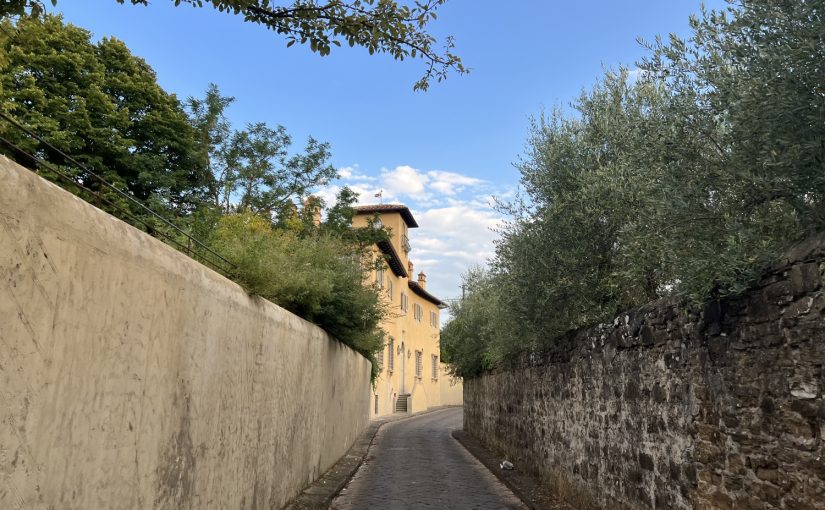
As I climbed up Via Di San Leonardo, the curved roads invited me to discover what they were hiding.

The further I climbed, the quieter it got.

Street noise was replaced by the sweet song of birds.

Do the birds not sing in the city center, or is it just too loud to hear?

As I continued my climb, my calves felt the impact of the increased elevation.

I passed a few locals: a couple holding hands. A woman walking her dog.

Should I be concerned that the further I get the more alone I am?

Why do I feel safer in the empty streets of a foreign country instead of crowded streets at home?

My lack of fear was both frightening and invigorating. 

I stopped to take in what was in front of and behind me. 

Unable to see the beginning or end of the street. 

Like my study abroad experience, I knew what was at the beginning but not what lay ahead.

An orange tree sat perched in front of Chiesa di San Leonardo in Arcetri.

Full of bright promising fruit, the tree appeared untouched.

Oranges littered the sidewalk after falling from above.

No one to taste, but animals living close.

How can such a scenic street remain so untouched?

Walking the empty streets felt like a privilege.

A privilege that came with a promise.

A promise to not exploit.

Arcetri’s ambiguity allowed me to reflect on the last 12 weeks I spent living in Florence.

I think I’ll always remember the streets and serenity of Arcetri. 

As I began my descent, I stopped in an alley with a gate overlooking the city. 

Viewing such a vibrant city in this intimate way, filled me with immense gratitude.

Arcetri. A 27-minute walk.

0.9 miles from my apartment in the heart of the city center. 

Over the river, past the basilica.

Where the noise fades and the tourists disappear.

Traveling Alone to Study Abroad: SAY YES!

Studying Abroad Alone: My Fears, Making Friends, and Why You Should Do It

written by Margaret Hann for SPEL: Public Relations

I’ll admit, I was scared. Studying abroad in Florence would be my first time leaving the United States, and I would be traveling completely alone. However, studying abroad has always been a dream of mine since I was young. My mom studied abroad in London for a semester during her college years, and ever since she shared her experiences, I have dreamed of doing the same. I knew I wanted to make my dream a reality, but the prospect of doing it without any of my friends joining me, on the other side of the world, was daunting.

Regardless, I signed up for the six week summer program at Florence University of the Arts – The American University of Florence. I wanted to experience the world and fulfill my dreams. Although I was nervous, I knew it was something I had to do. To make the most of my experience abroad, and to meet new people before settling in Florence, I also enrolled in the pre-week travel course, Cultural Introduction to Italy. I scheduled my flight – Detroit to Philadelphia to Rome – and began my preparations. Despite my best efforts, I never felt fully ready; it was simply a leap of faith. 

Airport Trouble

I hit my first challenge at the airport. Navigating an airport can be daunting, especially when you’re alone and it’s your first time out of the country. Even before I arrived, my flight had been delayed, and my connecting flight had to be rescheduled. Once I went inside, I checked in my large suitcase and asked the attendant about my new flight information. I was now rescheduled to go from Detroit to Philadelphia to London and would end in Rome. I inquired further about my options in case of additional delays. The woman mentioned there were flights with more transfers, but in the worst case, I might have to stay overnight in a hotel and wait for flights the next day if international flights were unavailable. I waited at the gate for departure and made sure to keep an eye on all of my stuff. When traveling alone, it’s scary. It’s nerve wracking. I tried to remind myself that I know more than I think I do, to trust my instincts, but still not be afraid to ask for help. 

When I arrived in Philadelphia after my first flight, I had already missed my new connection due to continued delays of my flight. Myself and two others I had met on the plane were in the same predicament – we were all supposed to be on the London flight that we had now missed because of maintenance. We stuck together to talk to guest services to try and get our flights rescheduled. When we talked to them however, they said there were no more international flights that night for them to put us on, meaning that the worst case scenario had happened. Thankfully, the airport supplied me with a hotel and money for food until my flight the next day at 6:40 pm. 

I arrived at the airport early since the hotel checkout was at 2:00 pm. I made sure to keep in contact with the FUA-AUF support team in order to update them on my flight and when I would be arriving so I could meet up with the class. Finally, it was time for my flight and the beginning of my study abroad journey.

The Beginning: Travel Week

After landing in Rome at Fiumicino Airport, I collected my checked luggage. Thankfully, my professor for the Travel Week class had sent me all the necessary information regarding which train to take, the hotel address, and the restaurant I could meet the rest of the class at for group lunch. Navigating the train system was difficult, being from a place without public transportation, but the airport had workers throughout that I could ask for directions or assistance. The machines which sell the tickets are able to be translated to English in order for easier navigation. 

Luckily, our hotel was a few minutes walk from the Roma Centrale train station. I was able to check in, drop off my luggage, and change before going to meet the rest of the group for lunch. When I arrived, the group was already seated at the restaurant. I was filled with nervous energy from all the chaos from the flight, navigating the train, and walking to find the group all on my own. Despite this, I pushed myself to introduce myself to my professor, his assistant, and the rest of the students at the table I had joined. Everyone was very friendly and open to meeting new people. This theme was carried throughout the rest of the week, as the group of people I met in the class had become increasingly close and bonded over our adventure together. We all exchanged numbers and shared where we were from, what university we attend back home, and compared what classes we were taking in Florence. After our meal, we continued on to the Colosseum, Palatine Hill, and the Imperial Forum. Our class had a guided tour through the three landmarks, and we were able to listen to our guide with headphones. The history behind the sites was extremely interesting; we learned the myths behind some of the architecture, and were able to discuss as a group and ask the guide questions.

During the week-long course, we visited many Italian cities throughout the central region of Italy. We were given the opportunity to travel to different landmarks and unique Italian sites. We traveled north from Rome to explore multiple Italian Renaissance gardens such as Villa Farnese, Villa Lante, and Sacro Bosco. We learned of the historical meanings behind the structure of the gardens and the different statues. As a group, we continued north along the coast to visit Viareggio: the city of Carnevale, and two of the cities in Cinque Terre, Vernazza and Monterosso. Each day, we were allotted free time to explore on our own or with others in the group. All of us grew extremely close and would often eat dinner together, even if it wasn’t an official group meal. Throughout the entire week-long trip, we had visited 15 different cities in total and had arrived in Florence with long-lasting friendships.

My Classes at FUA-AUF 

When selecting my classes for study abroad, I knew I wanted to immerse myself in the Italian culture and community in Florence. Luckily, FUA-AUF offers a range of classes that enable their students to connect to the culture, the food, and the local community. For FUA-AUF, it is extremely important for students in all of their classes to be interconnected with the Florentine community. One of the classes offered is the Food, Wine, and Culture in Italy course. Through this course, we learn about the history of Italy, regional differences, and of course, the food and wines of Italy. 

The class takes on a very interactive approach, as it is considered an experiential learning course. This means we learn in a hands-on learning environment, allowing us to cook historical dishes, taste local wines, visit restaurants in Florence, as well as work a shift at FUA-AUF’s student-run restaurant, Ganzo. 

The class typically consisted of a lecture followed with an interactive experience. The class encourages the students to explore and interact with the city. We visited local restaurants, markets, and were able to sample classic Italian foods such as arancini and cannoli. Another part of the class we enjoyed were the cooking labs: we were able to both cook and taste dishes from different Italian eras. Two of the Renaissance Era dishes we made were Pollo alle Prugne and Schiacciata Bianca Cappello. 

I also decided to sign up for the Special Project: Experiential Learning in Public Relations (SPEL PR) course which resembles an internship. For this course, I was put on a team with other students in the PR course where we would work together to manage the image of FUA-AUF. We would attend events hosted by FUA-AUF in collaboration with the local Palazzi Community Center. As a group or individually, we would write press releases advertising the events to the public as well as write articles about the topic. Some of these included a story from a woman who had survived WWII, and a discussion on society and artificial intelligence. As a team, we also managed FUA-AUF’s alumni Instagram account. We planned the posts, researched our audience, and determined a posting schedule. 

Making Friends While Abroad 

I have to admit that my biggest fear about coming alone to study abroad was that I would remain that way. I was nervous that everyone else in attendance would have come with their friends from their universities and would not be interested in meeting new people. However, once landing in Rome for my pre-week travel course I was delightfully surprised. Many others that I met had also had the courage to travel across the world alone to study abroad. Regardless if others came alone or with others that they knew previously, everyone was very open to meeting new people and making new friends. The travel week prior to the beginning of the session was where I personally made most of my friends as that week helped us to form bonds and friendships. I also made friends with people in my classes and friends of friends I made while studying abroad. 

Exploring Europe

Everyone knows that one of the main reasons people come to study abroad is to travel on the weekends. With the different friends I made while in class, during the pre-week, or through other people, we would get together to schedule weekend trips. Throughout my time abroad, I traveled to Amsterdam, Lake Como, Milan, Switzerland, the Amalfi Coast, and Barcelona. Each of these trips I went on was with the friends I made at FUA-AUF. I found that I liked best to travel with other people, however other people that I met had no issue traveling alone. It all depends on your personal preferences. 

Regardless, one of the main things to do before traveling is set your expectations, budget, and boundaries. If you aren’t comfortable with leaving Italy, then don’t feel pressured to. Due to Florence’s centralized location, there are many popular Italian cities nearby where students will often participate in day trips and weekend trips to. Using the high-speed trains makes it easy to travel to landmarks such as Pisa, Venice, Milan, Lake Como, and Cinque Terre. You can often find people that you may not be close with who are traveling to places that you want to go, even if your friends are going somewhere else. Part of the experience is that traveling with someone you may not know as well is that it can bring you closer. Before setting your expectations, it is important to research the different countries and cultures of the places you plan

to visit: the currency, the food, the landmarks, and the cost. Cost is very important, and it’s necessary to understand that everyone has different financial situations. Do what works best for you and consider others’ needs as well. An important few things to note is that plans often can change, and it is smart to have a backup plan and be willing to be flexible and schedule loosely. You may not get the chance to travel to every place on your bucket list, and that’s okay!

Studying Abroad Alone: It’s okay

Despite all of my personal fears and the different obstacles I faced, I would not change my experience abroad for the world. The challenges and opportunities are what made it my own. During my time abroad, I experienced personal growth, cultural immersion, life skills, and above all, empowerment. I learned so much more from studying abroad than just what was in my class lectures – living in Florence provided me with so many opportunities to immerse myself in both the city itself and the culture while still having the safety net of the help from FUA-AUF and their staff. They provided me with so many resources and were beyond helpful with navigating the city, traveling, and day-to-day life. In summary, in my time of studying abroad alone, I learned that it is not only okay, but is an experience that I would not change. It has offered me so many unique opportunities for personal, academic, and professional growth which have helped me to become more confident, adaptable, and independent as an individual.
From a Smile to Friendship: Florence’s Small Moments

written by Gia Woodfolk for SPEL: Public Relations

My time in Florence has been full of newness: new people, new streets, new food, and everything in between. However, the element I have most enjoyed is the new smiles. Throughout my time living in the heart of the city center, and taking the daily walks to coffee shops, classes, and my internships, I have realized what I most look forward to is not the incredible grandeur of the city, but rather, a simple interaction. 

Living in a smaller town in Virginia, I have to drive everywhere. I do not have the opportunity to build relationships with shopkeepers and restaurant owners through the act of walking by them as I begin or end my day. However, Florence has provided me with the natural occurrence of relationships fostered through the mere existence of a small, walkable city. 

One of these relationships happens to be with a local leather shopkeeper whose store stands next door to my apartment. Every time I leave my apartment, exiting the sprawling wooden doors, I greet my neighbor.

Since the first “ciao!” was exchanged, there have seldom been days without this meaningful interaction. It became a part of my day I looked forward to. And, eventually, the “ciao!” turned into a “how are you?” As time has passed, on good days and bad days, a consistency I can count on is this exchange of words. I soon began stopping by for conversation for a few moments to learn a bit more about the man downstairs.

I eventually learned he hails from Bangladesh, and, through each interaction, he has told me bits and pieces of his life story. Although I may have expected us to be very different individuals, I came to learn we are more similar than I originally thought. 

Each moment I strolled by his shop, the conversations brightened my day. I cherished each hello and goodbye and felt more integrated with the community through getting to know such a unique Florentine individual. And, most importantly, these interactions helped me understand that what matters is not what is on my phone or computer screen. Rather, it is the people in front of me in this present moment. 

The lack of presence is something that transcends global populations; with the rise of technology and the capitalist drive that permeates our world, billions of humans are preoccupied with the future or materialistic aspirations.

Living in Florence, however, has made me realize that taking a moment to put down your phone, look around you, and say hello to a stranger is incredibly important. Because of a singular moment I was present, a stranger became a friend. And now, every small interaction provides more internal happiness than anything a screen could provide. 

Ultimately, Florence is known for its large attractions, from the Duomo to the Uffizi and Piazzale Michelangelo. But, it is the little moments that make the city so special. Florence is filled with people from diverse places who have many stories to tell; I am eternally grateful to have been able to meet and get to know one of these individuals.

Home Away From Home

written by anonymous

To be an immigrant’s daughter, there is a certain weight that sits with you. From the day you are born, you’re split in two. To be taught two languages, two cultures, two homelands. In the United States, to be an immigrant is to be lower. To be a Mexican immigrant is to be scum. As I grew up, I was taught to hide my identity. I spoke in English in public and Spanish in private, to favor American pop culture over Mexican. My golden skin was something to be ashamed of, to stay inside more. My locks of curls to be burned and tamed into straightened hair. My heart has always been torn into two.

At home, my family was proud of the life they worked so hard to make for my brothers and I. Now, it is our job to show that we are educated, organized, and hard working; that university is the goal to change the narrative for my family. My mom attended high school in the U.S. and graduated, but it wasn’t until 18 years later when she was 32 years old that she got her bachelor’s degree. She was the first in my family to ever receive a degree in higher education. My mom set the example that anything was possible, that my brothers and I had our futures handed to us; we were supposed to be nothing more than exceptional. In my parent’s eyes, that meant to hide our culture that America saw as less-than.

My brothers and I knew how to play the part; after all, we experienced the everlasting backlashes of America. Our whole lives, we have been told we didn’t belong where generations of my family worked for us to be. I was told to go back where I came from, and countless times I was picked on. Kids would throw my pencil case to the floor, leaving my things scattered, and tell me to pick it up “cleaning lady.” My brother was told to “mow the grass gardener” by a player of the opposite team on the soccer field. My little brother is a clean slate, doesn’t know any Spanish, and has yet to come to understand his culture.

The aggressions are something I’ve realized is my price to pay for living in the United States. Something I’m not sure I’m equipped to take anymore. Since going to university, I’ve been faced with micro aggressions, and it’s now supposed to be my job as the minority to educate my classmates. It’s aggravating, and parts of me wished I had never stepped foot in Missouri. Countless phone calls to my mom asking if I am overreacting or if they are being racist. It’s hard to be in a place that I have worked to be, and yet, in many ways said or unsaid, that I shouldn’t be in. Despite this, I continue my academic career in hopes of raising the percentage of 19% of Latino that have a bachelor’s degree, joining my mom and my older brother and showing my dad that his countless days of sacrifice have amounted to something.

Now, I stand here, not in the U.S. or Mexico, but in Italy, a country that my grandparents would have never imagined one of their grandkids would be in. I’m here interning for a food publication, where I had the opportunity to cover an event dedicated to Latino food. For once, I saw my culture being celebrated on a bigger stage instead of being shamed or transformed into something others could easily grasp. For once, speaking Spanish isn’t alien-like, but a bridge for me to communicate with others. Being Mexican doesn’t mean I’m associated with drugs, gangs, or the lower class. I was told by one of the chefs that, “It’s so wonderful that you’re Mexican. Your culture, your people are so bright, giving, and happy. Thank you for everything you have brought here.”

For once, I was seen for who I am, who my family is, and for how my people are. Parts of me never want to leave Italy with my little time spent here. The problem is, if I stay here, what was all that my family struggled for? To be an immigrant’s daughter is to be split in two.

Unpacking Self-Discovery: How Florence Painted My Journey of Growth

written by Kylyn Maxwell for SPEL: Public Relations

Packing is always daunting for me. Whether it is an overnight stay at a friend’s house or a three month endeavor in a foreign country, both scenarios instill the same amount of panic within me. How do I temporarily abandon the things that mean so much to me? I would never wish my most prized possessions to collect a layer of dust, leaving them neglected. 

My bag can only weigh fifty pounds. Even my youngest sister weighs more than that.

I had finally come to terms with entering a new country. I prepared myself to become consumed with a deep feeling of discomfort. I was willing to let things go. After all, how do you grow if nothing is changing? I let my petals flourish and my roots grow deep into unfamiliar soil. 

My suitcase held business casual loafers and slacks instead of my cherished paint brushes and 16×20 canvases. I had been decorating canvases with the thoughts that entered my mind since I was 16. 

I could refrain from zipping my sister up in my suitcase, but I had no choice but to let go of the things that have been grounding me for so many summers. 

The plane engulfed my thoughts. The amount of rows on the aircraft put me in a trance, I had never been overseas. The flight was filled with contemplation. I decided I would welcome the unfamiliar with open arms, in hope that it would do the same to me. 

A different scene appears through the narrow gape of the plane window. Mediterranean cypresses and warm-colored buildings caught my attention. They were quite different from the oak trees and neutral-colored houses I had been surrounded with my whole life. I had no idea what I was doing, and perhaps that was the best remedy for an intense desire for personal growth and expansion. 

I wandered the uneven, cobblestone streets of Florence. Not a single step I took was steady and secure, similar to my placement in the city. I couldn’t find anything reminiscent of the things that typically brought me comfort. 

I had four keys. Two small ones, one medium sized one, and one that looked like it was out of a storybook. I put the key in the lock of the large, decadent door, struggling to enter. 

Noticing my struggle, a man next door asks if I need help. He grasps the key in his hand, easily unlocking the door. I notice his hand is covered in swatches of paint; blues, yellows, and red-orange. I noticed his shop next door, decorated in canvases with thick strokes of paint and thoughtful color choices. I feel a sense of comfort knowing that my apartment is next to someone who shares the same love for painting as me. It was in that moment, that I knew I could make home in a place that was unconnected from the rest of my life. 

As my time in Florence dwindled, the sun gleamed brighter and my connection with the painter grew stronger. I used his acrylic paint and palette knives. I showed him paintings from the previous summers that I had left behind. Our styles of painting were so different, yet we could both appreciate each other’s talent. We made an exchange. I sketched citrus fruits along the canvas he lent me. I had painted oranges, lemons, and grapefruits before, but the painter insisted I try to paint in his style; a style that was reminiscent of Post-Impressionist artworks. 

As time is fleeting, my suitcase reappears in front of me. I stare at the canvas that hangs on the wall of my bedroom that I grew to love. How do I rip my roots from the ground that I had become so familiar with? I place my canvas in my suitcase, remembering how I came here lacking canvases, paints, and brushes.

My suitcase is more full than it was in May, along with my heart and my brain. I had flourished, all because of Florence. 

Connections can be forged no matter the location and there are always exchanges to be made that leave you fulfilled. Sometimes the best fertilizer for growth can be one you’re unfamiliar with.

Bio Fashion Lab: The Thoughtful Retail Experience

written by Lily Carroll for Special Project: Experiential Learning in Journalism

Through experiential learning at FUA-AUF, I’ve gotten the opportunity to interact with Bio Fashion Lab, an independent boutique dedicated to responsible, ethical shopping. The store’s owner, Debora Florio, has spent over nine years in the fashion industry, seven of which were in fast fashion, an industry worth approximately 103 billion U.S. dollars in 2022, projected to reach 291 billion U.S. dollars in 2032, according to PR Newswire. This experience has driven Florio to conduct extensive research, educating herself about consumer behavior, the fashion industry as a whole, and ethical solutions to the extensive problems it creates. With her findings, Florio started Bio Fashion Lab, a space designed to invite others to join in this mission for change. 

Upon receiving a degree in Economics, Florio realized that she wasn’t dissatisfied in this line of work. She says that at the time, unfortunately, shopping for clothes was what brought her the most joy, so she decided to find a job in the fashion industry. Unaware of the many unethical practices implemented in the industry, Florio slowly uncovered the ways we harm people around the world and the environment when we support fast fashion. She learned that these stores use minimal human resources, producing thousands of the same products at low prices, 30% of which wind up in landfills. Just one of the many ways this industry is creating crises everywhere. 

“I realized what was behind the scenes of production in terms of social injustice, and the negative impact that this industry has on the planet, I decided to take action,” Florio said. “I started studying consumer behavior, marketing and whatever lies behind the mechanism that triggers our mind to go and shop for ourselves.”

Florio continued to work in the fashion industry, this time with a seemingly ethical brand. It was there that she met a woman with a crippling shopping addiction, spending thousands of euros a week with no satisfaction, and an insatiable desire that could not be fulfilled. This woman inspired her to create a solution for people to shop responsibly.

So, Bio Fashion Lab was born, to promote emerging, ethical designers using natural materials and equitable production. Offering a healthy way for customers to shop in a manner that does not promote overconsumption, and respects the environment and all who inhabit it.

“Whenever you start to go really deep in the research, you see the truth with your eyes. I’ve never been to Pakistan, Bangladesh, places where these issues are most prevalent, so we do a lot of calls with different unions and government workers on the other side of the world,” Florio proudly states. “We can hear their testimonies and see that it’s quite real. It’s there. When you really understand what’s going on, you can never go back.”

Florio says that the clothes are just a small part of the ways she educates others on the fashion industry, and how we can improve it. Through documentary screenings, workshops, and panels. Bio Fashion Lab strives to educate this generation of consumers to make the right choices. An environment that encourages shoppers to ask themselves, “Do I really need this?” especially when faced with a cheap, overproduced option. Bio Fashion Lab teaches us how to say no, and explore another option.

To learn more about Bio Fashion Lab, visit https://biofashionlab.com/, where you can read about the movement and upcoming events. On Thursday, 13 June, Bio Fashion Lab will host its first fashion show entitled, “Fashion Under Construction,” making light of the construction that currently surrounds the store, highlighting the store’s call for unconventional ways to shop.