La Fiorita: A Florentine Tradition

Photo by author

By Dara Hernandez

Journalism student Dara Hernandez digs deeper into the life of Girolamo Savonarola and the meaning behind the yearly Florentine celebration of “La Fiorita.”

One of the main reasons I was drawn to Italy is for the amount of history that it possesses. Walking through the streets of Florence is like walking through a book with a chapter for every building, every piazza, and every sculpture.

Of Italy’s countless traditions, there is one in particular that has existed since 1498. It is known as Florence’s “La Fiorita” and is meaningful to the people of Florence.

The person who inspired this event was a man named Girolamo Savonarola. He was born September 21, 1452 and grew up to eventually become a Dominican friar and preacher here in Florence. He was an extremely radical preacher yet was loved by many Florentines. At the time, he became well-known for his prophecies of civic glory, destruction of secular art and calls for Christian renewal. He was also notorious for organizing “bonfires of vanities” in which artworks, books, musical instruments and other objects were burned.

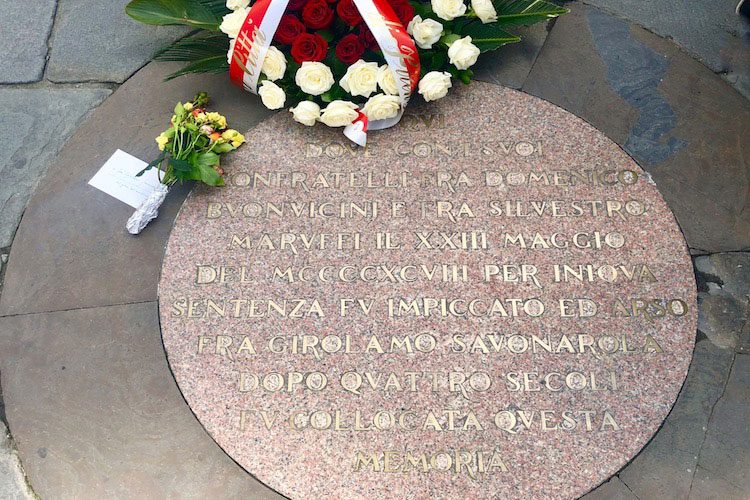
Savonarola’s passion-filled beliefs led him to getting excommunicated by the Pope. He was no longer allowed to participate in services of the church. Regardless, he chose to defy the Pope. Due to issues of this sort, he ended up being hanged and burned along with two followers on May 23, 1498 in Piazza della Signoria. The next day, his followers filled the area with flowers to honor his life and thus the tradition was born.

In fact, “La Fiorita” is an entire morning dedicated to the memory of Girolamo Savonarola. The people of Florence begin with a mass, proceed to spread flowers on the ground and finally, hold a costume parade to toss rose petals in the river.

As I was learning more about Savonarola, I found myself constantly wondering why people would praise someone who was famous for the destruction of, what he defined as, immoral art and someone who burned secular objects. However, seeing the roses over the plaque in memory of this man made me realize that not only are people drawn to radical, unordinary humans striving to make a difference, but also that Florentines simply accept Savonarola as part of their history. They recognize that walking through Piazza della Signoria holds stories with meaning that should be remembered.

Therefore, despite the unconventional and radical ways of his preaching, Florentines have continued celebrating his life on May 23, year after year.

See more of Florence and Italy at FUA’s FBInstagram, and Twitter.

Having Family in Florence: What I Taught and What I Learned

Photo by author

By Gregg Casazza

For two weeks my family visited me in Florence. I got to show them around the ancient city, and was eager to teach them about everything I learned. Surprisingly, throughout this experience I ended up learning quite a bit as well.

Family is everything in Italy. It is not altogether uncommon to find three generations of a family living in one house, children are in-part raised by their countless aunts and uncles, and family meals are some of the most important events in the day. Being from an Italian family myself, being away from them for so long has been quite difficult. However, the separation has taught me a lot, and has especially helped me with my own personal growth.

It wasn’t until I had the pleasure of having my family visit me, that I realized just how much I had learned throughout my Study Abroad experience “on my own.” At the beginning of the semester, time after time I was told, “You will learn your way around the city completely,” and although I am usually quite bad with directions, these people were right. I no longer needed Google Maps to navigate the city, I didn’t need Yelp to suggest restaurants, I didn’t need TripAdvisor to find things to do or see in the city. My parents remarks at how impressive it was that I knew the city so well.

I became like a tour guide for my family, on their own private tour of Florence. Showing my family around the city was in one way a test of how much I had learned about the ancient city, but also a farewell tour around my favorite spots and locales. Things like the legacy of the Medici family, hidden gardens and piazze, as well as the numerous cafes and libraries were all a bit bittersweet to visit again, but also surprised me on just how much I had learned by walking the many winding streets of the city. Even little things like the train system which at first felt impossibly foreign, now seemed almost second-nature. I taught my family about ordering meals or coffees, using different currency, picking wine, the history of Florence, and other seemingly smalls tasks that had become utterly mundane to me, but had contributed to my overall learning experience.

Learning about Florence was not the only way I grew however, I also grew personally as well. Study abroad allowed me a greater sense of independence. I learned my place in a global context, learned how to be alone, and how to be self-sufficient. Shopping for meals in and of itself can be an act of self-sufficiency, but knowing where to shop, how to get the freshest produce, and the best prices are also a huge part of personal growth in Florence, and shows a lot of maturity. Using what I had learned, I cooked for my family during their visit using the freshest vegetables and meats, I made traditional Tuscan dishes, Antipasto, Primo, Secondo, and Contorno, and I realized how much I had grown as a person, and how much being in Florence helped me to “grow-up” as well.

Being with family in Italy, just makes sense. Being away for so long was really tough, but after I made it through that hurdle, Study Abroad started to really work for me. In only one semester I became more integrated into Florentine life, learned about the country, and about myself, and it took my family being here for me to really see it for myself.

See more of Florence and Italy at FUA’s FBInstagram, and Twitter.