Van Gogh’s Colors

Photo by Author

By Chrystalla Christodoulou

“Loving Vincent”, and what Vincent van Gogh can teach us about color and life.

“Loving Vincent” is the first movie to ever be produced using only oil paintings. In order to make this dream a reality, the movie’s production team hired 500 artists from around the world who not only were amazing in their own right, but could paint in Van Gogh’s different styles with painstaking accuracy.

I watched the movie in the cinema, and I am convinced it is the only way to really appreciate it’s magic. It does not miss a beat and from the first scene we are introduced to its interesting nature. The paint strokes are always moving, crawling across the screen in a spiral or straight line. Every slight change in facial expression is captured, every scrunch of the eyebrow, every shoulder shrug. I remember sitting up when the young protagonist is smoking and talking to someone. After taking a drag, he looks away in order to not blow the smoke in the face of his companion. Little details like this could have theoretically been omitted, and the five year long project maybe wouldn’t have taken as long. Yet, the honesty the movie exudes would not have been present.

The movie is filled with “Easter eggs” as most of, if not all, scenes are inspired or adapted from one of Van Gogh’s paintings, including every single speaking character! While the story that is played out isn’t necessarily true, it is interesting to see how the death of one of the world’s most beloved artists might have affected the people around him.

During my Fall Break I visited London for the first time and after seeing “Loving Vincent” I made sure to not miss Van Gogh’s corner in the National Gallery. Exhibited in a room with Pissarro, Seurat, Toulouse-Lautrec and others, his pieces take up an entire wall. This was the first time I had seen his work in real life. Upon seeing “Farms near Auvers”, which was included in one of the most visually engaging scenes in the movie, I understood why the idea for “Loving Vincent” came up. Even in a still painting, Van Gogh’s brush strokes seem to be dancing.

Florence illuminates with color throughout the day, shifting through tones of a similar palette. On my walk to school I play a game. I try to see how many colors I can find in new places. Electric blue on this lady’s eyelids, yellow socks on that toddler, a rainbow caught in a puddle on the street. It is said we dream in black and white. All the more reason to live in pursuit of full, brilliant color.

See more of Florence and Italy at FUA’s FB, Instagram, and Twitter.

An Intimate Portrait of Pietra Serena

Photo by the Author

By Oceana Minthorne

Anyone who has visited Tuscany will appreciate pietra serena, a gray stone found in architectural and sculptural details as well as street pavement throughout cities such as Florence, Siena, and Arezzo. It has been used by the ancient Etruscans and cited since Renaissance times by the likes of Vasari. Oceana Minthorne shares an intimate and personified portrait of pietra serena.

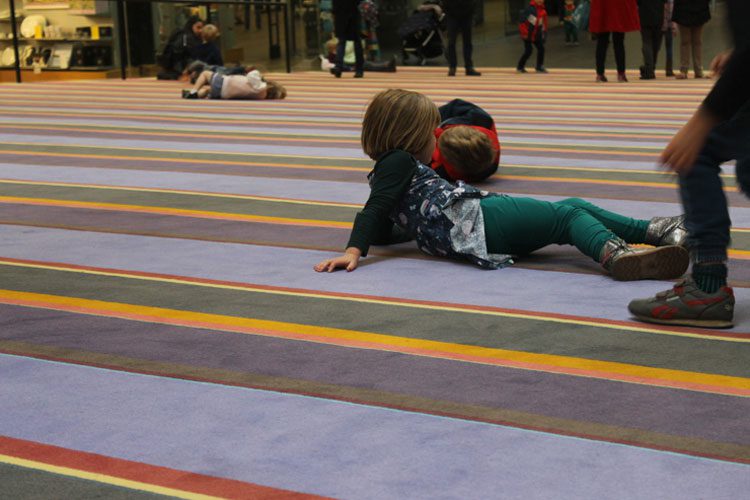
I wish I could lay down on the floor and stare for hours.  The stone is so smooth. Opposite from me, I want to be it. Perfect. Elegant. Clean. It envelopes this entire ceiling, cascades onto the walls, and delicately embraces the floors. The stone is cool but inviting, like the girl you envied in high school and wanted to be friends with but didn’t know how to talk to.  Serena.  Calm.  She is just that.

The dome is circular.  It goes round and round and does not stop.  Gets back to its starting position and begins again.  Never tiring.  Effortlessly elegant.

I wish I could lay down on the floor and stare for hours.  Melt into the ground, become the stone.  I would have a view of the dome forever.  I could watch visitors “oooh” and “aaah” over my aesthetic. They could step on me and it wouldn’t hurt. I’d be quarried from Fiesole. The best. They’d talk about how strong and sleek I am. I would inspire Steve Jobs and bits of me would be placed all over the world.

I am the stone.  Perfect. Elegant. Clean.  I fill the room, the ceiling, the walls, the floor. I am cool, inviting, Serena.

See more of Florence and Italy at FUA’s FB, Instagram, and Twitter.
A Glance into Florentine Tabernacles

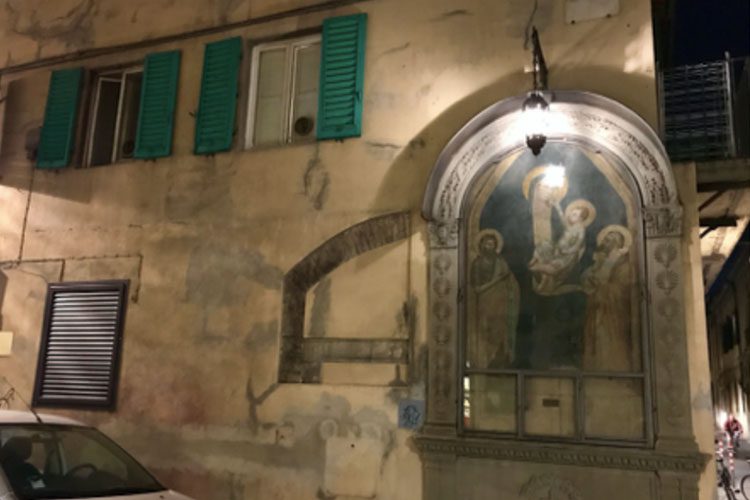
The Florentine Tabernacle Canto di Monteloro on Via degli Alfani.

By Emelia Imperati

Tabernacles cover the streets of Florence, adding further religious, historical and aesthetic appeal and meaning to the city. Canto di Monteloro is one example of these beautiful and purposeful creations, dedicated to their patron saints.

Although it is customary to be swept away by the grandiose markers of Florence, such as the Duomo or the Santa Croce, many tourists overlook the hidden treasures that flood the city. The Florentine tabernacles cover many streets and offer additional historic and artistic significance that is often overlooked by travelers. Depictions of Pagan gods were originally displayed around the city but were later replaced by images of saints after Constantine’s conversion to Christianity. During the 14th century, Italian towns dedicated themselves to patron saints, and Florence reflected their vowed devotion to the Virgin Mary and John the Baptist through the approximate 1,200 tabernacles. These religious testaments were built to offer support for the Christian doctrine during the war against heresy, during which groups challenged Catholicism. They also were used as a source of protection during the plague in 1348, the year of the “Black Death” Residents utilized them through candle lightings, written prayers, and placed offerings to seek out defense from the patron saints against disease and death. They were commonly commissioned by middle class families, as those of greater wealth focused on assisting cathedrals, chapels, sculptures and more elegant decorations and structures.

One of these tabernacles placed on Via degli Alfani, on the corner of Borgo Pinti, was a common site for these behaviors, customs and beliefs of the past. It was named Canto di Monteloro, meaning Corner of Monteloro. It reflects an illustration of the Virgin Mary holding the child, surrounded by Saint John and Saint Peter. It was built by Compagnia della’Assunta, one of the companies of the Festive Powers, an association of regional companies that created exhibits, parties and banquets. They played an essential role in the construction of antiquities of late Renaissance Florence. The Canto di Monteloro was made with a popular and traditional stone of this era known as pietra serena, which was used for many other structural and artistic creations throughout the city. Below the image of the three saints is a portrayal of a cross on a 3-pointed mountain, which became the crest that gave name to the song the tabernacle was named after, and also to the powerful festive power, Montiloro, who gathered at this location. A wide shed resembling a small chapel originally protected the ornament, but was destroyed by traffic in the street. The fresco underwent several reconstructions overtime and was removed in 1953 for an extended period of time by the Superintendent for Artisitic and Historical Property. It was later replaced in this original location in 1991, and still remains as a beautiful additive to the street.

See more of Florence and Italy at FUA’s FB, Instagram, and Twitter.
I Wish I’d Been Here When: My Home Was a Nunnery

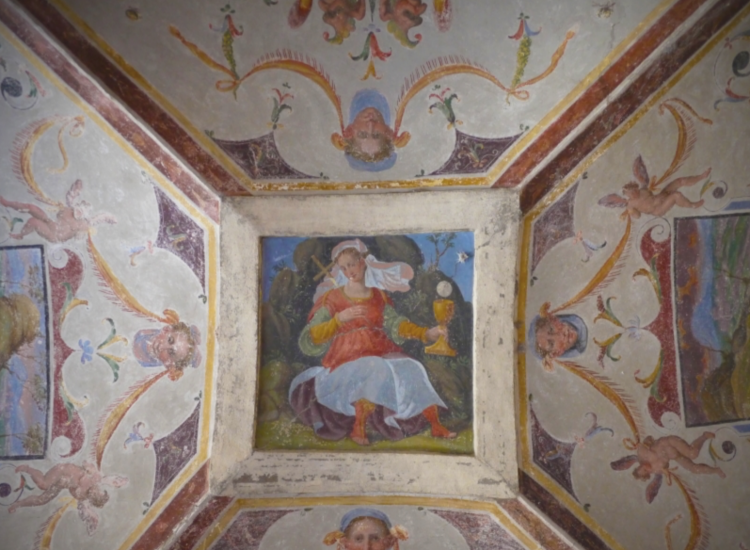
Artwork from my apartment’s walkway depicting angels and other religious imagery. Image courtesy of apartment building.

By Isabel Pellegrino

My apartment used to be a convent dating back to the 15th  century. I can’t help but wonder about the way the nuns lived here. I wish I was able to go back in time to better understand their lives and how they perceived Florence and its future.

I wish I had been in Firenze when nuns gathered in my apartment’s kitchen. In the 15th century, my apartment was a convent. It is hard to picture this space as home to a religious community. While I try to embrace the Italian culture in all of it’s beauty and class, I am not sure the way I live could ever be compared to the grace of a Renaissance nunnery. Yet, here I am. Through an old wooden door, rod iron gates and a few flights of stone stairs, you will find us cooking and practicing our Italian; sometimes we feel like it’s the best we can do to connect with those who occupied this space before us.

During the 15th century, Florentine convents were evolving from small communities to large institutions, according to historian Sharon T. Strocchia in her book “Nuns and Nunneries in Renaissance Florence.” It became common practice for highly- educated unmarried women to congregate in convents. As a result, nunneries became hubs for research, academic dialogue and political influence. As I sit at the kitchen counter of my apartment, I dream of traveling back in time to speak with these women. I can see them now gathering around tables with their noses in books and crosses around their necks. Question after question would flow from me: What is it like to be women leaders of a religion often dominated by men? What do you see your legacy as? What does Firenze mean to you and your faith? How can I honor your lives in my time?

But more than anything else, I wish I had the chance to roam the Florentine streets with them and see the city through their perspective. In the midst of the Renaissance, I wonder how they felt about the art and how it influenced their faith. I wonder if they had any idea of what the convent space would become in the centuries afterwards. While I will never have a time machine during my fleeting few months in Italy, my roommates and I have pledged to take time every day to be grateful for our apartment and our lives in Italy. When we sit around our dinner table and discuss culture, religion, politics and philosophy, it’s almost as if we have been transported back in time by the everlasting art of conversation. I like to imagine the nuns doing exactly this, just centuries ago. Our apartment bridges our times together. So maybe, we aren’t all that disconnected after all.

See more of Florence and Italy at FUA’s FB, Instagram, and Twitter.
Documenting Strangers

Photo by the Author

By Chrystalla Christodoulou

Have you ever pondered on how you navigate the cities you inhabit or visit? In this piece I discuss a change in mediums I made in order to find my place in Florence’s streets. 

Everything I love about art came from my introduction to photography. It made me appreciate the human body as poetry, with secrets being exchanged between subject and audience. My own camera has helped me turn moments of joy, doubt, and vulnerability into art.

However, when travelling, photography becomes a game for me; it gives me adrenaline and pushes me around. I didn’t want to remember my time in Florence as a rushed hunt.

So I bought a sketchbook.

Drawing pulls me to the ground. It slows me down, and makes me choose one single atom of this vivid city to analyse.

When someone realises I’m drawing them, they are usually amused. Vastly different from the angered looks I get as a photographer; I am seen as harmless when sketching. They sometimes accentuate their pose, or even ask to see themselves.

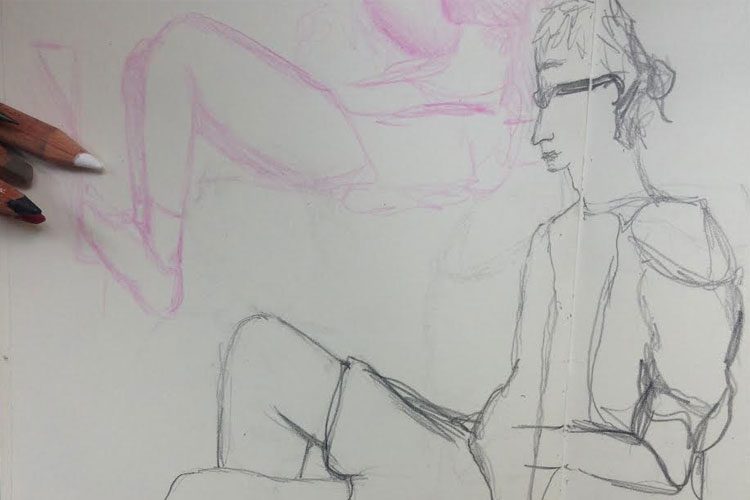
I sit on the steps of Palazzo Vecchio and observe a couple presumably travelling together. They are discussing the David, as tourists and residents alike rush by them. In that moment, they are still unaware of me so I take my time in documenting her hat and his ponytail.

When I look back at the drawing I remember waiting for my friend, knowing she’ll be mad because of my dead phone. I remember the man trying to make his companion laugh, and her looking away. I know exactly what song I was listening to, playing from a stranger’s phone. A new favourite.

See more of Florence and Italy at FUA’s FB, Instagram, and Twitter.