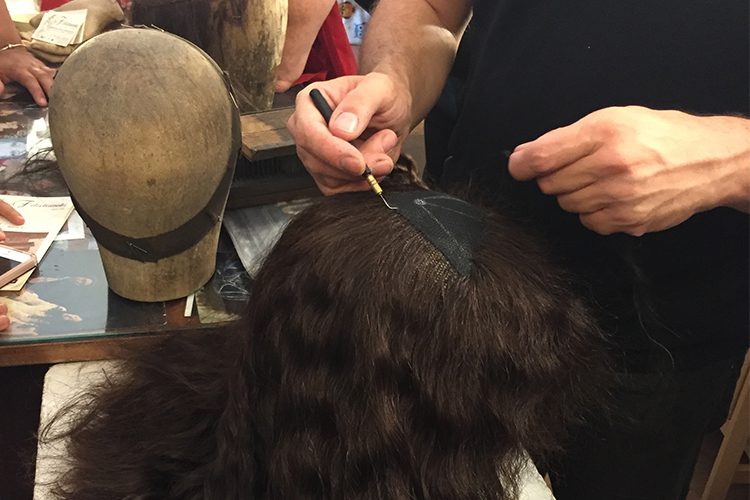
Filistrucchi: Fake Beauty, Real Tradition

Photo by Megan McCall

By Melissa Maize

Filistrucchi is a Florentine institution that makes the ordinary, extraordinary. FUA Digital Writing students recently visited the historic theater makeup laboratory and shop. 

If you could be anyone, who would you want to be?

If you could swap faces, swap lives, even for only day, who would you choose? A Duke, a Duchess, Abraham Lincoln? Lady GaGa? At Filistrucchi, you can be anyone.

We all have little things about our appearance we’d like to change- smaller nose, thicker hair, higher cheekbones- and Filistrucchi was built on that need. Established in 1720, it catered to Florentine nobles, providing wigs and make up to suit their stylistic needs. It then developed into one of the leading make-up and hair providers to the Opera and stage, and later cinema. Gaining notoriety as masters of their trade, their clients soon spread as far as New York and Boston.

Perusing photos of their work, the shop owners recount stories of how they transformed men into women, women into men, old into young, the transformations often so complete that the clients’ families didn’t even recognize them.

It’s amazing to think that all that stands between you and complete anonymity is a few layers of make up. It seems to me that Filistrucchi has survived three hundred years and two epic floods not because beauty is timeless, but because the desire to look beautiful is.

See more of Florence and Italy at FUA’s FB, Instagram, andTwitter.
Art History: A Different Perspective

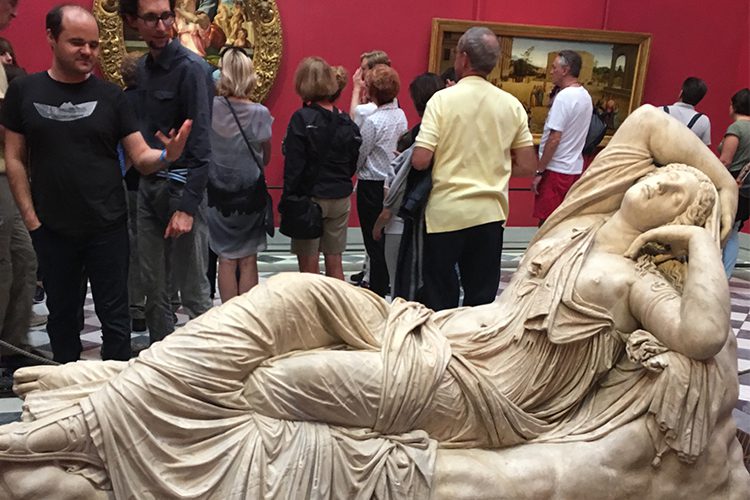
Visitors at the Uffizi. Photo by Jessica Pitocco.

By Nicole DeCosta

Alicia Deakin from London discusses how being in Florence has had a first hand impression on her perspective on Art History.

After the first half of the semester here at Florence University of the Arts, the students seem to be settling in nicely to the bustling lifestyle of classes during the week and exploring on the weekends. Sitting down with 21-year-old Alicia Deakin from Suffolk, England we discussed how she has had to adapt to this cultural change and new lifestyle.

With classes taking place Monday through Friday, Deakin said that her art history class is held twice a week.

“I’m happy that the class meets twice a week. Originally I found myself comparing my schedule to other semester students taking once a week classes, but I quickly realized just how much I enjoyed the class,” said Deakin. “I was feeling super lucky to be able explore the city of Florence and take part in the included field learning city activities offered through the class.”

Taking an art history course through FUA, Deakin said how amazing it was to experience this much raw culture within a class. When asked why this class was her favorite, she said how inspiring it was to be amongst some of the most amazing artwork she’d ever seen.

“Offering me new skills that I have not used in sometime, because I had taken a few years off from University, this class provides me an opportunity to study a new topic that both interests me and excites me,” said Deakin.

Noting the high quality education being provided to her through FUA, Deakin said, “the difference in my classes here from in London are so drastic, it is important to see how much the professors want to engage with you as students, while also wanting you to have the best possible experience in Florence.”

Since Deakin has never studied art history prior to coming to Florence, she said her favorite part is the novelty of the class, learning new topics, while also being placed within the Florentine environment. Knowing she is able to see the art firsthand, Deakin is thankful for the opportunity that FUA has provided her, and being here has allowed her to open her cultural perspective.

Offering students an opportunity to receive a strong education, while also an experience of a lifetime, including travel, cultural exchanges, and new opportunities, attending FUA, Deakin says, “is a once in a lifetime experience!”

See more of Florence and Italy at FUA’s FB, Instagram, and Twitter.

The Pressure to Travel

Photo by the author
Photo by the author

By Jess Pitocco

There is a pressure all study abroad students feel to travel, and travel often. In the months leading up to your departure, you get seemingly hundreds of Facebook invites and messages from travel companies urging you to book trips. Your friends tell you they are jealous of all the countries you will visit, and your older sister will say that traveling during study abroad was the best experience of her entire life.

How do you compete with that? How can you balance classes, getting to know your home city and still travel every weekend? Can you afford the big price tag of traveling from country-to-country seeing the sights?

Studying abroad isn’t about getting the perfect Snapchat story, Instagram post, or foreign fashion. It’s not about impressing your friends back home with how sophisticated and worldly you have become in such a short period of time. It’s about giving yourself the opportunity to explore the world, find yourself, and have a little fun while doing it. The pressure, anxiety, and apprehensiveness that goes along with that are normal. That’s what everyone experiences every day back home. What you have to remember is that this is your experience and your four months to get outside your comfort zone and really enjoy your time here.

So stay home one weekend and try that restaurant you always pass by and smell the goodies in the air. Try that cooking class instead of Skyping home and relaying every moment of your day, instead of actually living in that moment. Give yourself a weekend to be a tourist in your own city, and try to find a favorite spot to write in your journal. And if you do want to travel, do so not because everyone else is doing it. Do it for you.

Personally, I plan on taking advantage of FUA’s optional excursions because of their convenience and quality guides. I will be going on, but not limited to, at least two different trips within Italy: Venice & its Islands, Napoli, Capri and Pompeii, and more. However, I’ve had a lot of fun staying here in Florence for some weekends as well. I love visiting the museums on the first Sunday of every month because all admission is free! I also enjoy bringing a picnic to the Piazzale Michaelangelo to enjoy with the view. Figure out your favorite spot in Florence, and tag #MyFUA to let us know how much you love just being here in the city!

See more of Florence and Italy at FUA’s FB, Instagram, and Twitter.

Pane Sciapo: The Bread Conundrum

Photo by the author
Photo by the author

By Jess Pitocco

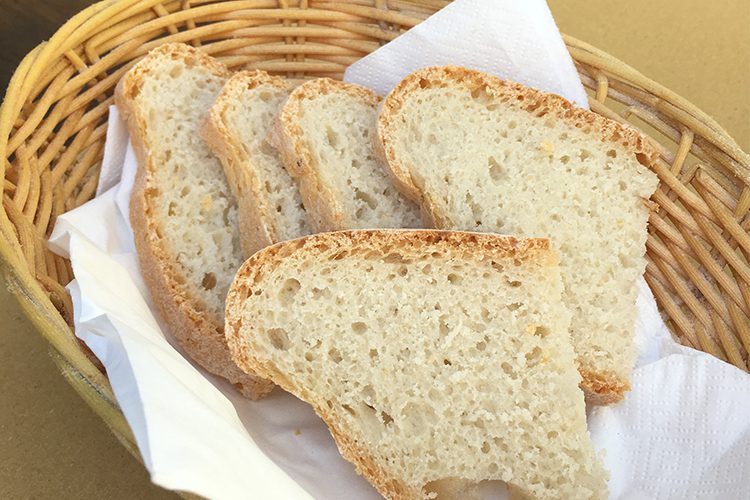
On my first day in Florence, I sat down at a restaurant in the shadow of the Duomo hungry from my flight. I had unpacked and was looking forward to food like a dog looks forward to playing fetch. So when I was brought the bread basket, I devoured each piece and noticed something strange. It was hearty but extremely bland and tasteless. I realized there was no salt! Salt, a seemingly essential ingredient, wasn’t in my first taste of Italian food whatsoever. I didn’t know at the time you should wait to mop up your meal with the bread, an Italian custom I had forgotten in my desperation to get food in my belly. So, after realizing this, I had to find out why the bread was saltless and sciapo (Italian for “bland”).

Chef Pietro Di Marco says the legends of saltless bread vary, and that if asked, every Florentine will give you a different story as to how it happened. A chef his whole life, teaching at Apicius since January, I trust his version of the salt-legend:

Throughout the centuries, the legends have been told. Nothing is on paper, but we all know about the bad blood between (the city of) Pisa and Florence. Pisa, long ago, was the only Tuscan city with access to the sea. Therefore, they were responsible for the distribution, packaging, and taxation of salt for Florence. Florence didn’t want to pay to bake their bread, plus the rivalry and battles between them didn’t help the situation. From there, the evolution of Florentine cuisine began.

The most common dishes involving Tuscan bread (pane toscano), and the most important dishes according to Chef Di Marco, are pappa al pomodoro and ribollita. Pappa al pomodoro is a bread-based tomato soup with herbs and spices, a rich and filling dish invented by Florentine farmers. Ribollita translated means “twice boiled,” and it is another soup reboiled with vegetables (like local white and black cabbage) and poured over bread. Chef Di Marco says it is easy to tell when dishes are made with old-school recipes or new-school recipes: the thickness of the soup, and the ingredients like olive oil, give it away. He says that every chef in Florence knows how to make these dishes, and that without them Florentine cuisine wouldn’t be Florentine cuisine.

Pane toscano can be made in about three hours time and takes a while to rise. This ensures its freshness for days, lasting longer than most bread you get at the supermarket. Its origin is from the province of Lucca, in the town of Altopascio, which still claims its fame to the crunchiest crust and the softest insides of all bread in Italy.

To learn about Tuscan bread, stop by Apicius, the hospitality department at FUA, and get a taste of it where it’s served daily at Ganzo, the Apicius restaurant. And while having a breakfast pastry or dessert at Fedora, the Apicius pastry shop, ask the baking experts there for tips and tidbits about it!

See more of Florence and Italy at FUA’s FB, Instagram, and Twitter.

The Love Affair of Dante and Florence

Photo by Amber Wright
Photo by the author

By Amber Wright

Every time I walk down a corridor of the Uffizi, I look Dante in the eye. I bitterly and sarcastically thank him for making me work so hard in the literature class I took my senior year of high school. Oh, The Divine Comedy. I still have the poem on my shelf back in California with copious amounts of notes in the margins, yet somehow I completely forgot Dante himself was a Florentine. Now living in the city’s center, it seems I cannot walk down the road without metaphorically looking Dante in the eye.

It’s not hard to miss the admiration Florence has for the poet. According to FUA faculty member Marta Russo, there are over 100 references to Dante throughout the city. He had a love affair with Florence as you can see in his poems. However, it was not always like this. In Florence, he was involved in a political struggle between the Guelphs and Ghibellines, and these rival parties disagreed on who should hold power in Italy. The Ghibellines supported the Holy Roman Emperor and the Guelphs were in favor of the Pope. Dante himself was a Guelph and was eventually exiled for it, but you wouldn’t know by Florence’s current celebration of the poet.  

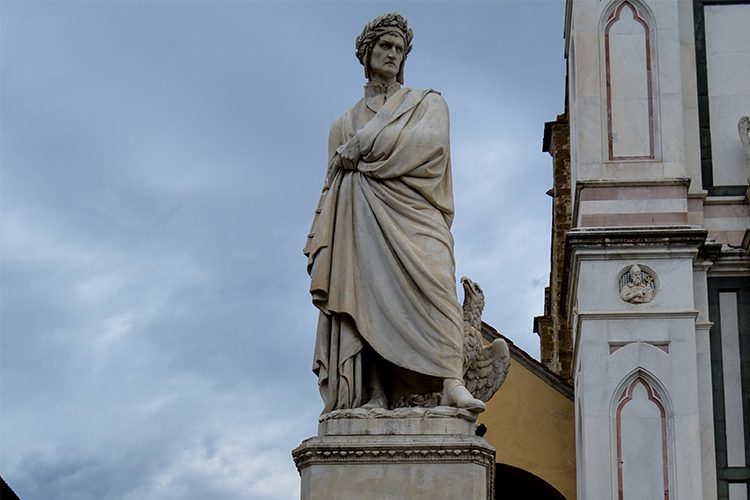
The most obvious places to see Dante in Florence are the Uffizi – in the museum’s outdoor gallery of statues – and in front of the Basilica of Santa Croce. As mentioned previously, Dante was exiled from Florence for his political stance among the Guelphs. He never returned, and was buried in Ravenna – this is something Florence is still trying to cope with. According to Prof. Russo, the cities to this day disagree over where his bones should rest. While he isn’t actually buried there, Santa Croce still houses a tomb in his honor.

This love struggle isn’t one-sided: Dante loved his city back then as much as it loves him now. The father of the Italian language references Florence in many passages in The Divine Comedy. In Canto XXVI, Dante proclaims, “Florence, rejoice, now that you have such fame, and over land and sea you spread your wings! The whole Inferno’s ringing with your name!”

He may have been exiled, but his ties to Florence were undying. In fact, if Dante had not been exiled, he may have not written The Divine Comedy at all, says Prof. Russo. It was his exile that made Dante realize and understand his great love for his city. He was able to step back and fully understand the greatness of where he was from, and essentially intertwine this passion into his poem.

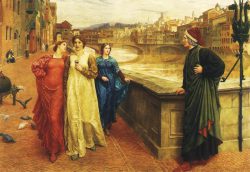
Dante and Beatrice, painting by Henry Holiday

Today, Florence honors Dante with plaques and statues around the city. They are its olive branch to the great poet, and a way to preserve his great history.  I see this preservation not only when I visit the Uffizi, but also when I walk down Via Guelfa. I see his legendary presence on the corner where he first saw his true love Beatrice and am reminded of the ultimate love story that Dante lived, with his native city.

See more of Florence and Italy at FUA’s FB, Instagram, and Twitter.