Your Fall Guide to Fruits and Vegetables in Florence

Central Market
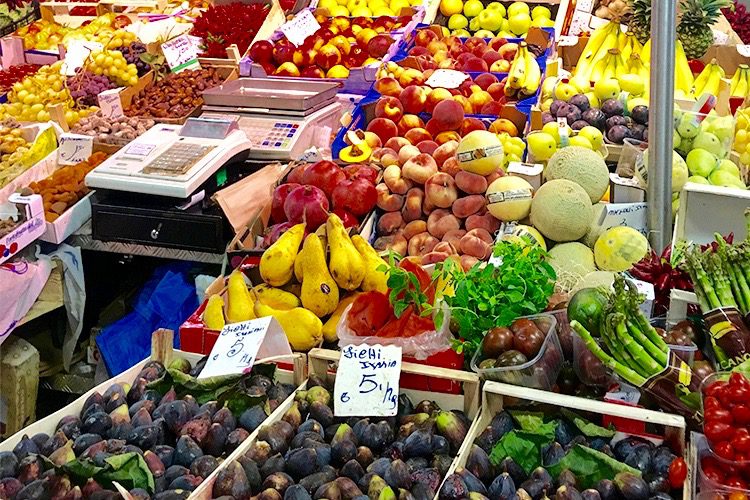
The Central Market, photographed by the author.

By Jess Pitocco

Italy isn’t all about the carbs; fruits and vegetables play a huge role in Italian cuisine. Here’s everything you need to know this fall about the best fruits and veggies in Florence. Check out the best markets, what produce is in-season, and vegetarian-friendly restaurants and recipes!

The high-carbohydrate diet many associate with Italian cuisine is a falsehood: Italians may eat carbs, but their lifestyle, portions, and eating habits are much healthier. That’s why when the New York Times reports on Italian eating habits, the focus is not on how to eat a low-carb diet while traveling, but rather why Italians are some of the healthiest people in the world. Fruits and vegetables, though filled with those ‘nasty’ carbs, are absolutely essential not only to a healthy diet, but also to Italian cuisine. That’s why including some apples, asparagus or zucchini in your basket while on your daily market trip is important to the Italian experience.

If you haven’t been to an Italian local market yet, give yourself an afternoon to go and explore one of the best parts of living in Florence. There are more than four big Florentine markets, not including the San Lorenzo Market, that you should visit to get the best, and freshest, produce (and even some clothing, music, plants and pastry too!)

However, before going to the market, know what fruits and vegetables are in season. Check out this chart to see that apples, blueberries, grapes, tomatoes, green beans, and cucumbers are just some of the fruits and vegetables that are at their best in September.

Want to visit some renowned vegetarian restaurants in Florence? Try Le Fate on Via S. Zanobi, for it’s fully vegan and vegetarian menu inspired by the signs of the zodiac and recommended by Travel + Leisure Magazine. Dolce Vegan and Il Vegetariano both have extensive vegetarian and vegan options as well, both a less than 10 minute walk from one another in the center of Florence. Still want more options? Silvana Vegan is an additional option, on Via dei Neri near the Galileo Museum.

If you don’t want to eat out, FUA Professor Cecilia Ricci, who often teaches food and culture courses, swears by this traditional Italian recipe for fruits and vegetables:

Cold Barley Salad, with Shrimp, Anchovy Fillets, and Cherry Tomatoes

Ingredients:

  • 300 g Pearl barley
  • 200 g Shelled shrimp
  • 15 g Extra-Virgin olive oil
  • 150 g Cherry tomatoes
  • 3-4 leaves of basil, cut in julienne
  • Black pepper
  • Salt
  • 8 Anchovies fillets, preserved under oil

Directions:

Boil the barley in a pot with 1.5lt of water with salt. Once the barley is cooked, strain it and place it to cool down in a bowl. In the meantime, wash and dice the cherry tomatoes. In a casserole pan add the extra-virgin olive oil, heat it at medium temperature, and let the anchovies fillet to melt. Once the anchovies are ready add the shrimp and sauté them in the oil for 2-3 minutes. Add the barley in the casserole, stir and mix all the ingredients together for 5 more minutes. Then, remove all the ingredients from the pan and place them in a bowl, add the diced cherry tomatoes, basil, pepper, salt, and mix. Refrigerate for at least 30-45 minutes before to serve. And enjoy!

After buying your fruits and vegetables, make sure you pay attention to how long they keep. Basically, how long the fruits veggies last is based on where they are from. If they are fresh from the market, your fruits and vegetables can last 3-4 days without rotting or refrigeration. If they are from the supermarket, the produce can go bad within a day or two because it has been refrigerated and prevented from becoming ripe. That way, as soon as they leave the supermarket your fruits and veggies can become ripe faster and ultimately rot faster. Buying fresh produce from the local market is a better way to ensure it will last (and it will taste better too!)

Click here for a guide to eating out in Florence, provided by FUA’s hospitality department.

See more of Florence and Italy at FUA’s FB, Instagram, and Twitter.
Cinque Terre-ible Weather

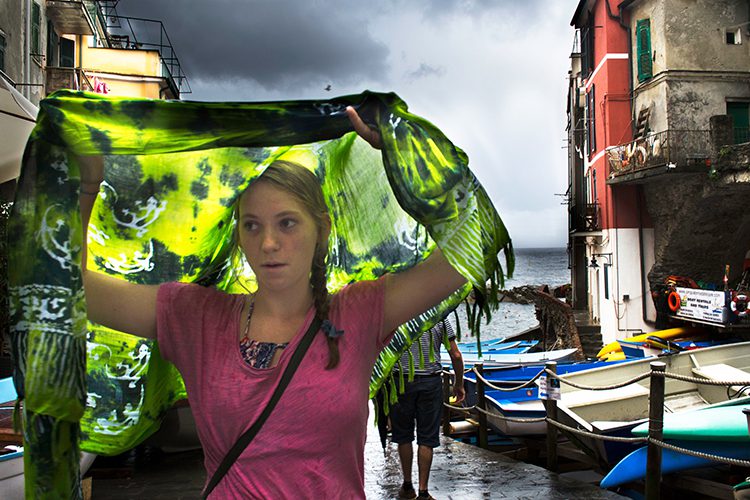
Rain in Cinque Terre, photo by the author.

By Amber Wright

Every photograph, video, and snap chat I have ever seen of Cinque Terre has been stunning. The colors of the buildings, the waves breaking on the rocks, and the sun shining down on the tourists makes it the perfect destination, and I finally had the opportunity to experience it for myself.

However, the sun wasn’t shining, and the water seemed to be more of a sea monster than just the Mediterranean sea. This area is constantly in danger of mudslides and the hiking trails were closed off for the rain that seemed to never stop falling. My weekend that was supposed to be picturesque and dream-like, now had the potential of being ruined by the Cinque Terre-ible weather.

Thankfully, I was sitting at a covered cafe as the rain came down and was able to just take it all in. I surprisingly loved the rain. I felt that the weather was a nice change from the sweltering heat, and my friends and I were not about to let a few raindrops keep us from the sea. It was surreal swimming in the mediterranean for the first time, during a storm no less, and the view of Monterosso from the water was magnificent. I now understood the raving reviews and why this coastal town deserved to be a protected site.

Sanctioned by the United Nations, a World Heritage Site like Cinque Terre is deemed so for its cultural, scientific, or historical significance. Therefore, it’s unsurprising that Italy, being the beautiful and rich country it is, has the largest number of these UNESCO protected sites.

The symbiotic relationship between man and nature is captured in the complex structure and architecture of each village. The steep hills and cliffs are dotted with buildings and agriculture that have been perfectly constructed to withstand the treacherous coastal area.

Monterosso and Vernazza were the first of the five villages built in the eleventh century. The following three villages were soon developed, and later reinforced with barricades and defence towers to combat the attacks from pirates. By the 15th century, Cinque Terre, or “five villages,” was the local term for the villages, and it was known for it’s excellent vino, produced to this day by incredibly determined farmers whose vines seem to grow vertically from the precipitous inclines. Progress halted in the area when mudslides destroyed the local agriculture, but recovered in the mid-18th century. Fast forward to 1997 when it became a protected area and to 1999 when it was officially named a national park. Today, accessibility is limited in Cinque Terre, and other than a train between the five villages, modern infrastructure has had only a hidden presence in this area.

It’s one of the most photographic areas in Italy, but there is so much more to experience than what you’ll see through the lense of your camera or behind your iPhone. Take a look around and understand why this area is deeply cherished. Look up and see the local old ladies people-watching from above, or take the hike to see the sweeping views from above. Take a dip to feel the warmth of the sea and try your hardest not to swallow the brackish water. Climb the stairs to the top of a watch tower and imagine being under attack by pirates.

Lastly, if the weather is bad, embrace it. Not only did the rain not ruin my trip, but it added to the excitement and memories that I’ll have forever. The history and beauty easily shines through, and I cannot wait to go back.

See more of Florence and Italy at FUA’s FBInstagram, and Twitter.

Stepping Back from the Lens: Florence Through My Eyes

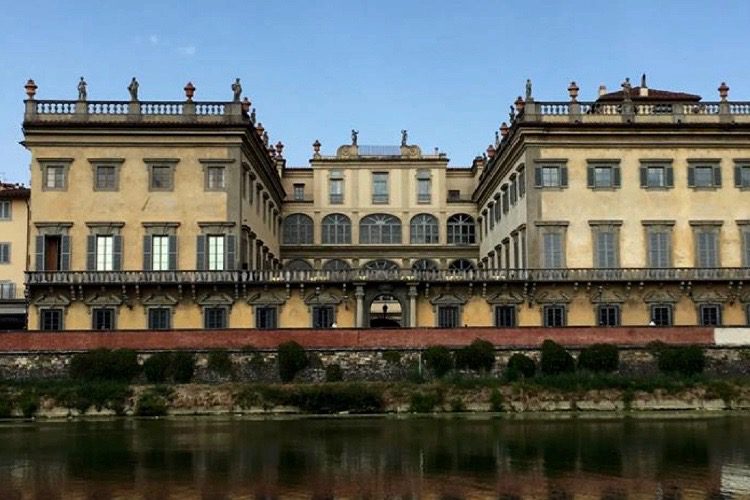
Palazzo Corsini from the Arno River, photo by the author.

By Ryanne Doherty

We all take photos. It’s a part of living in the digital age; everyone keeps a camera right in his or her pocket, and we can capture and share memories in an instant. As convenient as this is, there is a drawback.

Seeing the world through a camera lens can take away from fully experiencing a moment. It causes a person to merely see an image inside a cropped area. By focusing only on the visual, the sounds of a city, the smells of bakeries, and the feel of the air on one’s face are often overlooked.

I am just as guilty of this practice as anyone else. I will walk around Florence’s city center and take a picture of the Duomo or Santa Croce and ignore all other surroundings. For a Writing for Digital Media class assignment, I was actually required to get lost in the city and look only for the visual aspects of Florence. Through this, I was able to see in more detail but unable to fully feel the atmosphere around me.

For an hour, I explored new parts of Florence, but it’s hard to describe where I was. Taking pictures on my old Canon was my only focus and goal. This goal, I believe, caused me to miss out on a full Florentine experience as a new resident of the city.

The following day, however, my focus changed. With my class, I had the opportunity to experience the Arno River with the I Renaioli association. I took a few photos, but for the most part I tried to concentrate on more than just what I could see.

It was a sweltering day in September, and I had already broken out into a sweat on the walk to the riverbank. After a couple minutes on the water, however, a cool breeze shielded the hot sun, and I cooled down significantly. This was a breeze as I had never felt in the city center. Here, I realized the one of the coolest places in Florence at any time may in fact be the surface of the Arno, and I regretted not having taken this excursion earlier.

Paolo, the association representative who rowed the small wooden boat named the Ghibellino, recounted the Florentine history that surrounds the Arno. Some of the history was familiar to me, like the path of the Vasari Corridor through the Ponte Vecchio. Some information was new, like the history and utility of Palazzo Corsini, which is best seen from the Arno. Paolo’s voice was punctuated by the trickle of water as the oar cut through the river or his occasional whistles to rowers ahead of us as we made our way under bridges.

We docked again after an hour or so on the boat, and it was then that I decided I should step away from the camera from time to time. In the week that has passed since then, I have found myself trying to focus on the entire atmosphere of where I am – while it’s nice to have the photos, it is the desire for a new experience that drives us to have an adventure.

See more of Florence and Italy at FUA’s FBInstagram, and Twitter.