written by Ansley Peterson
This blog feature is an exclusive bonus installment to our Spring issue of Blending Magazine. After you finish reading, be sure to explore the rest of the magazine online—just follow this link to download the full Spring 2025 edition:
https://jschoolfua.com/images/BM/BM_151.pdf
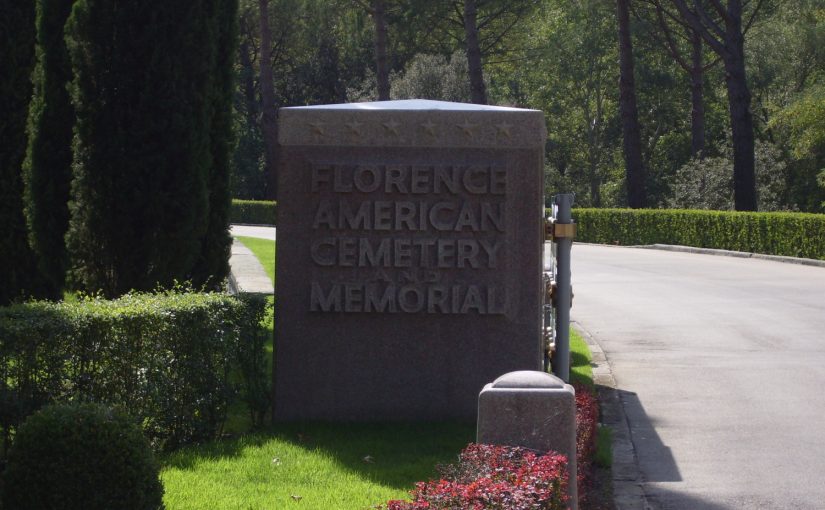
A determined young man in a black puffer jacket nervously clutches a map, tapping his fingers on its cover. An American teenager crouches by a headstone and slowly traces his fingers over the letters of its inscription as his dad watches from afar. An elderly couple stands at the entrance, shoulder to shoulder in awed silence as they look upon rows and rows of graves. They walk slowly, hand in hand, steeling themselves for the journey up the sloping path ahead of them. No matter the reason, it’s 10 a.m. on a Thursday in March and the lives of these strangers all intersect here at the Florence American Cemetery.
Situated on the Greve River just outside of Florence’s city center, Americans and locals alike make the trip to the cemetery to gain familial closure and to learn more about the historical ties between Italy and the United States. The location of Florence was chosen for a multitude of reasons, starting with its ease of accessibility because of the nearby Santa Maria Novella train station and the bus routes that run with stops at the cemetery throughout the day. Since this is a World War II cemetery, there is a higher likelihood of visitors being descendants of those who have fallen and having memories to share and preserve about those buried here.
Florence American Cemetery is managed by the American Battle Commission, whose overall mission is to ensure that “time will not dim the glory of their deeds.” Current superintendent Eryth Zecher has been working at the Commission for five years and has been maintaining the Florence American Cemetery for the past year and a half. She explains that the process for choosing the location dates to just after World War II when temporary cemeteries were set up in areas where major battles had just occurred. It was a time of transition when some of the fallen service members were being shipped back to America to their families and the temporary cemeteries were being compared to see which would be best fit for building a permanent cemetery. The Florence location allows a good proximity for visitors, and its rolling Tuscan hills made it a beautiful environment that was deemed fit for the sacrifices of the men killed while liberating nearby cities in the Northern Italian Campaign.
It seems surreal that their bodies eternally rest below the freshly manicured grass, with nothing but a shiny marble cross to signify their life’s worth. Lead gardener, Leonardo has been working with the nature of the cemetery for the past 10 years to keep it as close to the condition as the year that it was founded, in 1960. He polishes the headstones with a sponge and blows off all leaves and debris from each plot. He is passionate about his work and pays close attention to detail because of the gratitude he has for its historical significance.
“My grandparents were freed by the American soldiers in 1944,” explains Leonardo, “For me, it’s an honor to work here.”
Small, perfectly shaped Tuscan Cypress trees line the perimeter of the grounds, standing like soldiers at attention over the headstones. Leonardo shares that adult trees don’t grow very well in the cemetery’s environment, so he and his team raise the trees from saplings and keep them looking uniform. They don’t use chemicals on the trees, and everything is done by hand, including removing all weeds from the property. On this blustery, Thursday morning, I watch as two men take turns anchoring down wooden support stakes for smaller trees and chopping off uneven branches.
The maintenance team and superintendent Zecher work diligently to make sure all the upkeep efforts reflect the promise to the fallen soldier’s families that their loved one’s resting place would be taken care of. The groundskeepers clean the memorial and headstones on a set schedule and work meticulously to keep them in perfect condition.
“It’s just the ultimate mission to be able to commemorate and honor these service members every day and also work in such a beautiful place,” says Zecher, “I couldn’t find a better way to spend my life than doing this mission.”