By Aaron Klevan
What do Florence’s “talking stones” have to do with modern-day journalism and civic awareness? FUA’s Writing for Digital Media students recently explored connected readings of the city’s political and cultural history through its talking stones. Next time you take a walk around the city center make sure to look up and see if you can spot some.
Florence is a city with a rich history that dates back centuries. One of the unique ways that the city actively communicates its vibrant past is through “talking stones.” These stones, containing inscriptions of both writing and art, are adorned on walls throughout the city and tell Florence’s most fascinating tales. The stones also portray the art of journalism in its truest form, exhibiting many principles still applied today in an authentic breath.
- The idea of social awareness can be seen in the way the stones project the stories of Florence.
- The principle of connected reading is presented by the way the stones link current Florentines and visitors to the city’s political past.
- The stones also share visual information with supplementary images and drawings in addition to pure text.
- Finally, at the time they were created, the stones were a form of enhanced technology requiring specialized knowledge and methods for chiseling messages into stone.
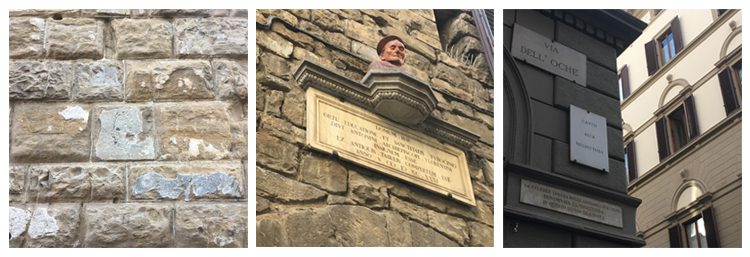
The first talking stone shown on the left of the photo is one of the first known forms of graffiti, located near the main entrance to Palazzo Vecchio. As the legend goes, it was a self-portrait of Michelangelo. It is a fascinating way to look at the technology artists used at the time, and also offers a glimpse into the booming art community during the Renaissance, connecting people today to those who walked Florence’s streets and drew on its walls in the past.
The second stone is perched atop a bustling intersection near the city center in Via delle Oche. It textually denotes that the building on which it is placed was once home to the prestigious Adimari family, of which Alemanno Adimari was a member. He was a famous Italian Catholic cardinal and archbishop. This stone serves the purpose of displaying the famous residents that played a fundamental role in shaping the city.
The final stone is a beautiful bust and description of Saint Antoninus in Via dello Studio. He was an Italian Dominican friar who ruled as an Archbishop of Florence. This talking stone is found on the exterior façade of the Pierozzi family home. It is a perfect example of combining visual information with written texts, much like an article, that allows viewers to see the subject and read about it.
The city continually talks to us every day through its surfaces, signs, and symbols. What unexpected discoveries have you made through Florence’s talking stones?