By Zack Shattuck
Photo by Petar Milošević
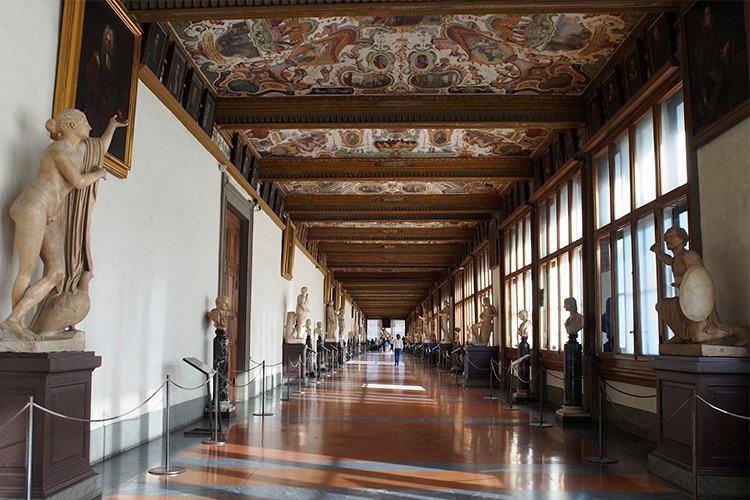
I am not an art major, nor would I call myself a lover of art, but I will say that the Uffizi represents an important historic and cultural gateway to Italy and is a must for all students. Right as you walk into the gallery you are instantly awed by the many sculptures and portraits that line the long halls. Beyond framed artwork, your eyes will also be drawn to the vast and intricate examples of ceiling art. Each of the many rooms in the Uffizi has unique works from artists from around the world. A majority of the art in the Uffizi represents the Italian artists from the Renaissance period such as Michelangelo, Leonardo da Vinci, and Botticelli.
Despite my lack of art history expertise, I still found myself browsing through the Uffizi for several hours of contemplation, and dedicating substantial amounts of time to single pieces. Always plan on several hours to slowly peruse the many exhibition halls, and any art or visual comm majors should plan on a full day. The Uffizi is one of the most popular tourist attractions in Florence and can have lines that may take hours to get through, so in order to avoid lengthy waiting times you can choose one of two options. The first is to buy a ticket online with a reserved timeslot (for an extra fee). The other is to arrive early, around 8am. After all, you don’t want to waste your precious time in Florence standing in lines right?
Visiting the Uffizi for the first time can be daunting. In addition to 1) reading up on the museum, 2) setting aside a good chunk of the day for the visit, and 3) making online reservations, it may be helpful to visit the Uffizi in “bite-sized chunks” especially if you’ll be living in Florence for a few weeks or months. Thematic visits are always fun to plan and allow you to follow a focused path throughout a museum. The following is a Madonna and child-themed itinerary courtesy of FUA faculty member Federico Cagnucci. Pressed for time? A shorter version of the itinerary can be experienced by following the items with an asterisk*.
UFFIZI ITINERARY: MADONNA AND CHILD – FROM RENAISSANCE TO BAROQUE
XIV century: The transition from the Bizantine style of Middle Ages to Renaissance realism in Tuscany (Siena and Florence)
- Duccio, Madonna Rucellai
- Cimabue, Madonna of Santa Trinita *
- Giotto, Madonna of Ognissanti *
- Simone Martini, Annunciation *
- Pietro Lorenzetti, Madonna with Child in throne with angels
XV century: The International Gothic
- Gentile da Fabriano, Adoration of the Magi *
XV century: Early Renaissance in Florence
- Filippo Lippi, Madonna with Child and Saints *
- Sandro Botticelli, Madonna of the Magnificat *
- Sandro Botticelli, Adoration of the Magi
- Leonardo da Vinci, Annunciation *
- Leonardo da Vinci, Adoration of the Magi
Early Renaissance in Venice
- Jacopo Bellini, Madonna with Child
- Antonello da Messina, Madonna with Child *
XVI century: High Renaissance and Mannerism
- Florence
- Michelangelo, Doni Tondo (Holy Family), originally painted for Palazzo Doni which houses FUA’s DIVA/IDEAS campus! *
- Rosso Fiorentino, Pala dello Spedalingo di Santa Maria Nuova *
- Pontormo, Madonna with Child and Saint John *
- Bronzino, Holy Family Panciatichi
- Raphael, Madonna del cardellino *
- Emilia Romagna and Lombardia
- Correggio, Madonna in adoration of Christ
- Parmigianino, Madonna with long neck *
- Lorenzo Lotto, Holy Family
XVII century Baroque in Italy
- Rome (followers of Caravaggio): Gherardo delle Notti, Adoration of the Christ *
- Florence: Carlo Dolci, Announcement Virgin Mary
Image credit:
“Uffizi Gallery hallway” by Petar Milošević – Own work. Licensed under CC BY-SA 4.0 via Wikimedia Commons – https://commons.wikimedia.org/wiki/File:Uffizi_Gallery_hallway.JPG#/media/File:Uffizi_Gallery_hallway.JPG