written by Ashlyn Roselle
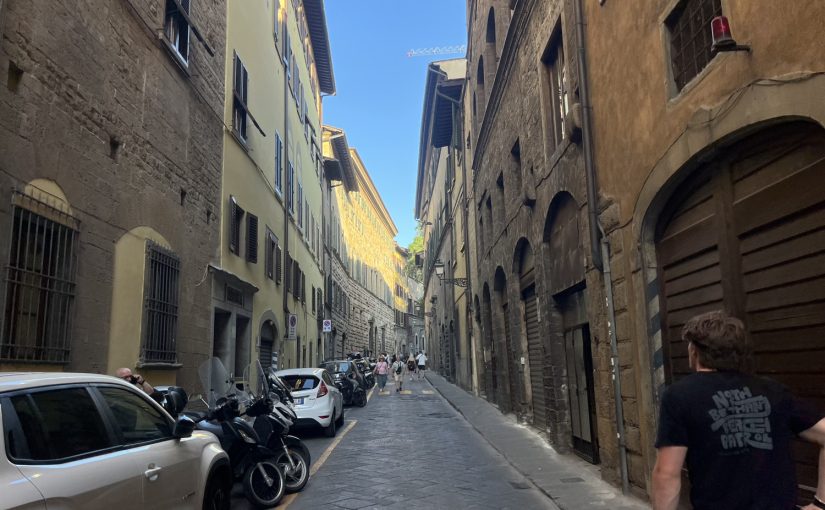
Florence, Italy, widely regarded as the heart of the Renaissance, is a city where the past is not only preserved, but woven into everyday life. The tightly packed cobblestone streets, and historic buildings are unlike the sprawling cities many American students are used to. For those studying abroad, Florence allows cultural immersion, but not without some practical adjustments, especially when it comes to transportation.
Most American cities were designed around the car, Florence however was built centuries ago for pedestrian traffic, carts, and horses. Today, the city’s historic layout remains largely intact, protected by strict preservation laws. The timeless charm that remains in Florence today is beautiful, but creates an unexpected challenge for students abroad. There is a large question mark in everyday life: how do I move through a city that was designed for another era?
Florence’s current layout is rooted in its medieval and Renaissance past. The narrow, winding streets and densely packed buildings are from a city that was never intended for modern day cars. Due to this, much of central Florence is a limited traffic zone (ZTL), where only residents and permitted vehicles are permitted to drive. Public transportation consists of buses and trams, where they travel mostly the outer zones of the city. The inner city is primarily navigated on foot or by bicycle.
For students from the US, where cars are a central part of everyday life, this can be a major shift.
Maddie Oberly, a current FUA student from Connecticut says, “In Connecticut we rely greatly on cars to get us from place to place. However here it was solely on walking and the public transportation systems like the bus.”
The transition can be jarring, but it’s also one of the most rewarding aspects of studying abroad in Florence. Students are able to truly immerse themselves in the city and soak up their surroundings of Renaissance facades and hidden piazzas while strolling to class. The lack of reliance on cars encourages deeper exploration and a more intimate connection to a place.
Another current FUA student, Trace McCament reveals his experience with transportation in Florence thus far. “The amount of walking definitely surprised me, but it’s been super nice to walk around and explore. Before dinner, it’s easy to just stroll around, read menus, and people watch, which is fun.”
Students, like Trace, soon discover that Florence’s compact design works in their favor. Most major landmarks, cafes, apartments, and restaurants are within walkable distance. What initially seems like an inconvenience becomes an unexpected part of the adventure.
Bikes and scooters are immensely popular amongst residents of Florence. There are designated parking zones for both and they are always packed. There are also rentable electric scooters and bikes for tourists, providing modern solutions for longer distances.
The pedestrian-friendly architecture of Florence doesn’t just change how students move, but changes how they live. Walking everywhere promotes physical activity, lowers stress, and encourages spontaneous interactions within the city. The benefits of walking 10,000+ steps per day are incredible, which most individuals struggle to do while in the US if they are not creating intentional time for activity. Many students report feeling healthier, more independent, and more connected to their environment after just a few weeks.
The environmental impact is real. With limited access to cars and a focus on sustainable transport, Florence experiences less traffic, lower air pollution, and an overall more pleasant atmosphere. These conditions create a safer, more accessible environment for students to thrive while abroad.
Studying abroad in Florence offers more than academic credit, it offers a new perspective on urban living. Students gain firsthand insight into how city design influences lifestyle and community. Compared to the wide streets, long commutes, and car dependency of many American cities, Florence demonstrates an older, but highly effective model of urban planning.
That contrast often sparks reflection.
Maddie Oberly admits, “I have honestly loved the exercise aspect of walking and it has been weird to get used to the bus system… but with patience it’s really easy to figure out and utilize in ways that can benefit us as students.”
Adapting to Florence’s pedestrian-focused lifestyle is easier with a few tips:
- Plan Ahead – Walking and biking takes time, so build buffer time into your schedule.
- Comfort Matters – Invest in a good pair of walking shoes, those 20,000+ step days will sneak up on you!
- Learn the Local Routes – Familiarize yourself with your walk to class and apartment for easy navigation.
- Embrace the Pace – Allow yourself to slow down and experience the city instead of rushing through it.
- Try the Rental Bikes – It’s okay to have a little adventure every now and then, just don’t hit anyone!
Florence’s architecture has preserved history and now shapes modern life. For students abroad, that means adapting to a new way of getting around. It requires you to learn how design and environment influence everything, from mobility to mindset.
By stepping into Florence’s streets, students also step into a bigger conversation about sustainability, community, and how cities can be built around people instead of machines. This is a lesson that reaches far beyond the classroom and one they’ll carry with them long after the semester ends.