by Jessica Rowe
As you walk through Florence, you’ll see that street names usually start with via or borgo. What do these words means? What are the differences between the streets? It’s quite simple, really.
If you’ve been walking around the streets of Florence, you might have realized that different street names have different words in front of them – usually via or borgo. If you don’t know Italian, then telling the difference between these two types of streets is nearly impossible.
To start, we can define the words “via” and “borgo.” Via (pl. vie) typically means “street.” Borgo (pl. borghi), on the other hand, translates to “village.” From this we would assume that borghi would be bigger streets, perhaps with more apartment buildings or houses, and that they would more closely resemble little towns of their own rather than streets. However, these assumptions would be wrong.
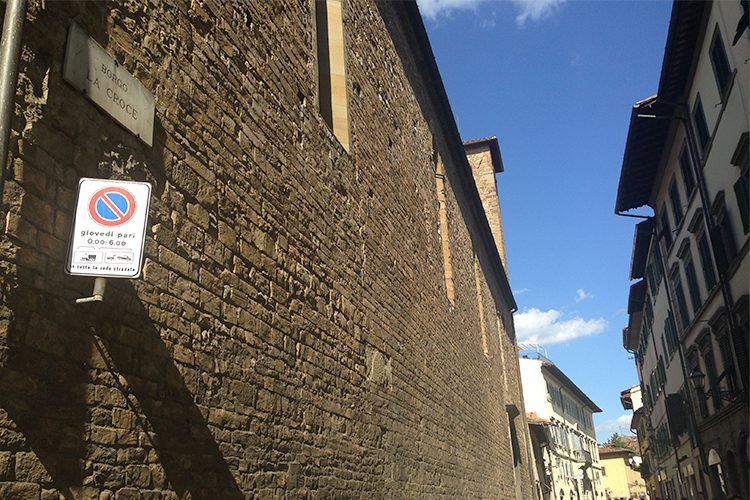
While trying to figure this out, I walked down Via Pietrapiana which later turns into Borgo la Croce. I thought that the difference between these two types of streets would hit me when I crossed from one to the other. In truth, I didn’t even notice the street had switched names until I was a full block down Borgo la Croce. I then started to pay more attention. The contents of the streets were similar – shops, apartments, restaurants, etc. – and the number of each was nearly the same. However, Borgo la Croce is a narrower street with much less traffic. People walk right down the street and barely ever have to move out of the way for cars or motorcycles. Via Pietrapiana, on the other hand, had much more traffic on it.
From this, I concluded that borghi were streets with less traffic that were more accommodating for pedestrians. This, unfortunately, did not hold true for every borgo I passed. Some of them had heavy traffic and even parking on the street. The only difference that seemed fairly uniform was that borghi were almost always narrower than vie.
To figure this out, I contacted Catia Ballerini who works at FUA’s Squola. She said that in normal usage the two words are just different ways to say “street,” like avenue or road in English. However, she also found out that borgo was used to name medieval streets of varying size. The use of borgo indicated that the neighbourhood was located outside of the city’s defensive walls but as the city expanded, these streets became included in the historic centre. Via, on the other hand, was used to name any city space used for traffic.
In conclusion, we see that nowadays via and borgo can be used interchangeably but, in the past, these two words indicated the locations of roads in reference to the city walls.