By Gregg Casazza
Walls are built to keep people apart, but in the small borgo of San Frediano it seems that this wall actually brings the community together.
Between 1332 and 1334 the Porta San Frediano was constructed. This gate acted as an important route between Pisa and Florence, allowing travellers to access the city through the gate in the sixth city wall, and enter the Oltrarno quarter. Nearly 500 years later, this gate is still a functioning access point to the city, however, unlike many of the standing gates, much of the connected wall remains. More remarkable than this is the veneration the community around the wall has for the historic culture of this gate.
In a city like Florence, the birthplace of the Renaissance, it should come as no surprise that those who walk its cobblestoned streets appreciate and respect the history of the city. Perhaps nowhere in the city is this as true as in the hidden treasure of Florence, the Oltrarno quarter.
The “other side of the river” (the Arno) as it is sometimes called, is home to many artisan shops, and is too often overlooked by the casual tourist. The borgo (borough) of San Frediano is especially connected to its historical roots, and to the roots of the Porta San Frediano. It seems in many ways that the gate which watched over the borgo for centuries now acts like a friend or a family member within the close knit community.
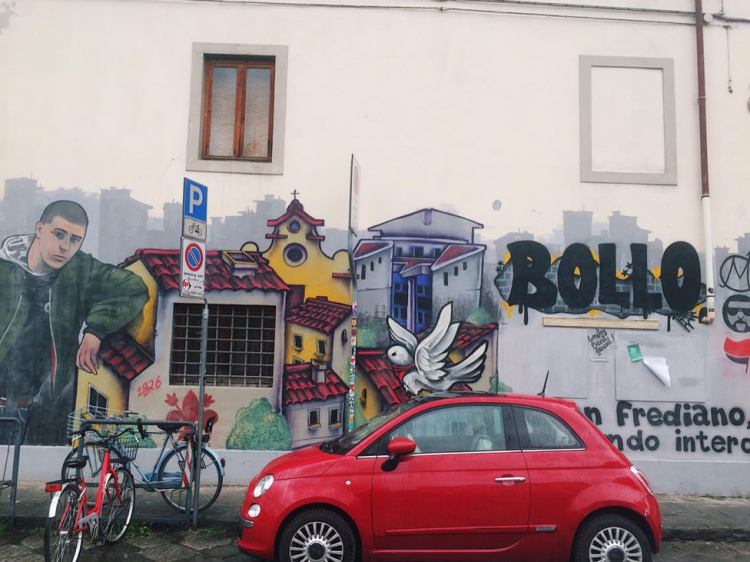
Locals can be seen hanging out by the wall. They leave flowers at its base, and in the alcoves of its stone exterior. Bright orange carnations pepper the ground, and stand out on even the dreariest of February days. A likeness of the gate is painted in stylistic purple on the outside walls of Da Simone la buticche del lampredotto, and a massive multicolored mural depicts the wall, the borgo, and states “San Frediano, il mondo intero” (San Frediano, the whole world) to all who enter the small borgo.
The wall acts as a sort of keystone for the community, holding the community together. Whether you sit in any of the small cafes nearby, or try some traditional cuisine at Trattoria Sabatino, the Porta San Frediano can be seen, watching over and protecting the community all these years later. During Notte Bianca, one of the famous festivals held in June in San Frediano, the community gathers for a long night of fun and music. During which, the focal point for many is the Porta San Frediano, which has lights and designs projected on it while locals partake in festivities from 9pm to 2am.
When something is part of a culture for so long it is easy to forget its importance. This is how history is lost, and how stories are forgotten. Thankfully, the people of San Frediano are keeping this part of their history in the forefronts of their minds, and still see an importance in this ancient wall.
See more of Florence and Italy at FUA’s FB, Instagram, and Twitter.