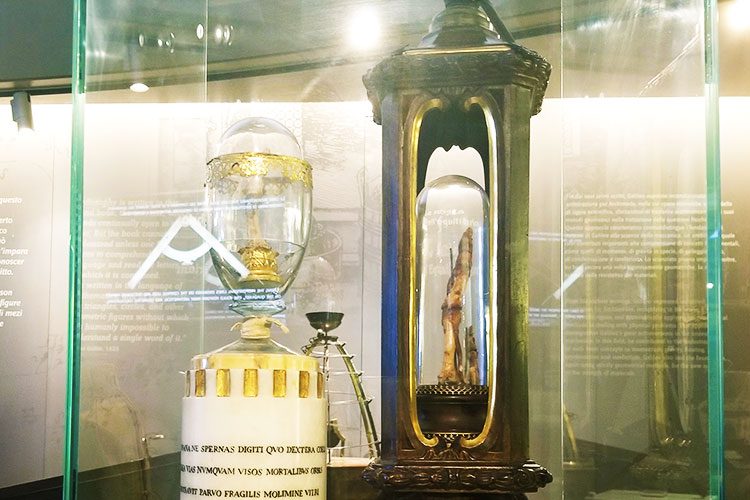
 Galileo’s middle finger
Photo by author
By Barbara Carranza
SPEL Journalism student Barbara Carranza explores the unusual at the Museo Galileo.
Though I’m not a science major, I was still interested in visiting the Museo Galileo. Not necessarily due to the scientific and technological instruments that have been collected and conserved, but that they literally have Galileo’s actual middle finger on display.
The story behind how it’s even possible to view this ancient middler finger (and it’s not alone; there’s also an index finger and a thumb, all from his hand) is one that spans almost three centuries. Galileo may now be referred to as the “father of modern science,” but the last years of his life were marred with controversy. He went against the teachings of the Catholic Church by supporting Heliocentrism, which states that the Sun, not the Earth, is at the centre of the universe. The subsequent inquisition in 1633 found him guilty of heresy. He was sentenced to house arrest that lasted until his death nine years later. The Church initially refused to honour him with a tomb, so Galileo’s family buried him in an unmarked grave outside the Basilica of Santa Croce. This decision was reversed in 1737, when he was deservingly built a tomb inside the basilica. It was during the process of reburying the cadaver when a man named Anton Francesco Gore reportedly removed three fingers, a tooth, and a vertebrae. Passed down through the generations of his family, the body parts disappeared in the early 20th century. Then in 2009, they surprisingly reemerged in an auction. They were brought to the Florence History of Science Museum, now known as the Museo Galileo.
The museum, which sits right next to the Uffizi Gallery, dedicates its priceless collections not only to the instruments that Galileo used for his groundbreaking discoveries, but also equipment that was assembled by the Medici and Lorraine dynasties. It is in the Medici collection where the famed middle finger and the other two digits are.
When you enter the room, you are greeted with Antonio Santucci’s enormous armillary sphere, walls of other smaller spheres depicting a map of the Earth, and a regal marble bust of Galileo holding a geometric compass and a telescope. Walking past the bust, you will see the ancient fingers in egg-shaped glass shrines. It is perched up high on a pillar, the bones visible as it points up towards the sky. Looking at it at a first glance, I thought it was kind of gross that a museum would exhibit human remains, even if they belonged to a genius like Galileo. But the longer I looked at it, bringing my face as close to the glass as I could manage to examine the decaying texture of the fingers, the more I became captivated by it, just like the other visitors around me. We were, after all, seeing the real human fingers that once belonged to someone who lived 376 years ago. And not just any anyone, but someone who revolutionised science as we know it.
I think everyone should pay a visit to the Museo Galileo, even if the history of science might not sound particularly interesting. The museum provides a close personal look at thousands and thousands of artefacts that have all contributed to the evolution of science, physics, mathematics, astronomy, and technology. Despite not entirely understanding what exactly I was seeing, it was an intriguing experience overall, especially observing the fingers that Galileo used to hold his telescope as he uncovered that Jupiter has four moons.
Museo Galileo is on Piazza dei Giudici 1, open Monday, Wednesday through Sunday from 9:30am to 6pm. Open Tuesday from 9:30am to 1pm. The price for admission is 10 euros, and there is no need book a tour in advance as the wait lines are short.
See more of Florence and Italy at FUA’s FB, Instagram, and Twitter.