by Jessica Rowe
The Laurentian Library is one of Michelangelo’s lesser-known constructions. With its imposing entrance and beautiful stain glass windows, the space houses its treasures in perfect architectural harmony.
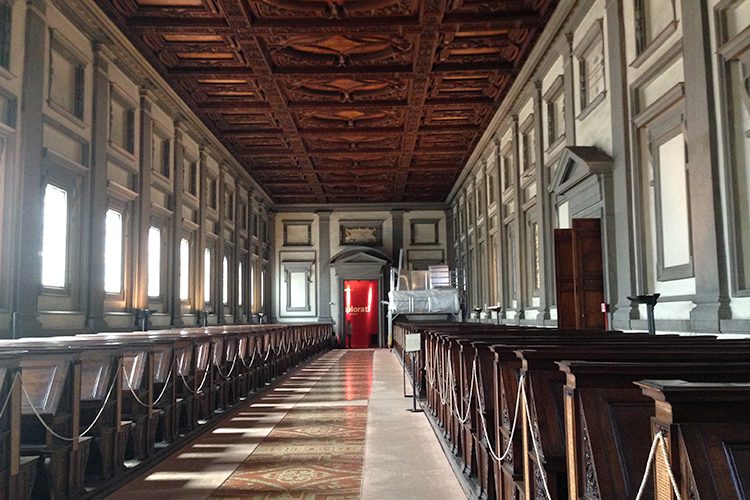
The Laurentian Library is part of the San Lorenzo Medicean Complex. Most people visit to see the Medici Chapel, the Basilica’s cellar of treasures, and the Chapel of Princes, where the Medici are buried. They miss the library entirely. But entering the Laurentian Library feels like walking into a work of art. Designed by and constructed under the watchful eye of Michelangelo, the library is considered one of the most unified works of Mannerism in Florence because the decorations were created during the building’s assembly. The grand staircase leads into a reading room filled with pews and stained glass windows.
The library is a cultural inheritance from the Medici family. The collection was started by Cosimo the Elder and his friend Niccolò Niccoli. The two of them shared a desire to collect ancient manuscripts and, when Niccoli died, he left his collection to Cosimo.
In 1494, the Medici family was banished from Florence and Cosimo’s collection was confiscated by the republican government to be added to the San Marco monastery’s library. The collection was later moved to Rome before returning to Florence once again in 1523. It was then that Michelangelo was commissioned to build a library to house the collection. The library was meant to signal that the Medici were no longer merchants but now members of the church and intelligent society. In 1571, still incomplete, the library was opened to scholars.
There are many architectural aspects of the building that break the rules of ancient architectural theory. For one, it is impossible to tell if the walls or the columns hold up the ceiling as the columns are imbedded in the walls themselves. Also, the staircase leading into the library is often said to seem too big for the space. Since proportions were very important to Renaissance architecture, historians believe that these stairs are the first sign that Michelangelo had intentionally turned away from tradition. The space allocated for the library was also limited before construction started as the monastic complex was already built. Still, the entrance vestibule, or ricetto, appears to mimic the human body, resembling skin pulled tight between vertical supports, which was believed to be the ideal form during the Renaissance.
Today, the Laurentian Library is considered the most important and prestigious collection of antique books in Italy. It contains more than 11 000 manuscripts and 4 500 early printed books, including the Codex Amiatinus which contains the earliest surviving manuscript of the Latin Vulgate Bible and fragments of the Erinna papyrus which contains poems of Sappho’s friend.
Laurentian Medici Library
Piazza San Lorenzo n° 9 – 50123 Firenze
Tesori inesplorati Exhibit
Open 15 February – 23 June 2017
Monday – Friday | 9.30 a.m. – 1.30 p.m.
www.bmlonline.it/en