By Travel Writing Students
This post captures two intriguing figures depicted at Lucca’s main cathedral. A mysterious woman who tragically died at 24, and an artist’s attempt to capture the holy nature of Christ. Explore the peculiarity of silence and the power of the divine in the following stories, uncovered by FUA students at a recent Field Learning experience for the Travel Writing course.
Sleeping Beauty in the Silent City
By Hannah Sanders
Even on a cold and foggy morning, the silence of Lucca is inviting. The city’s silence wraps around me like a warm robe slipped on after a shower. The stillness carries me through the streets, wet from the rain, and leads me into the Cathedral. There, a beautiful woman lies colder and more silent than the city itself.
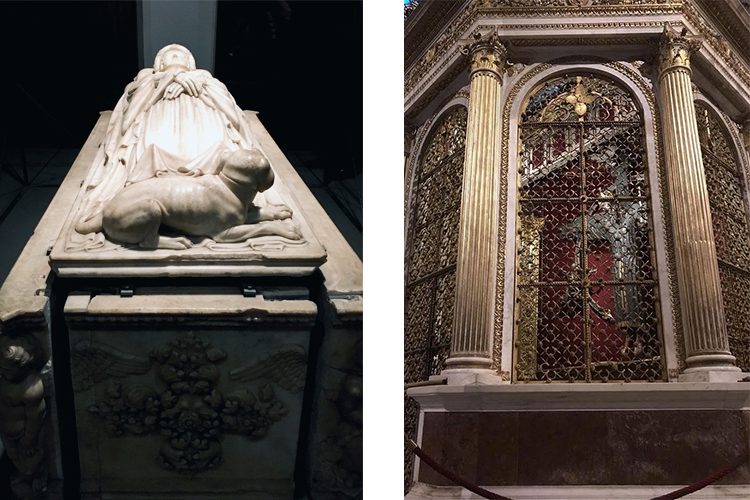
I can tell she has lived in the quietness of Lucca for quite some time. She does not speak or move, and she too is cloaked in Lucca’s robe of silence. Her hands are delicately placed over one another and her eyes remain closed, she looks as though she is in a trance.
An English guide introduces me to the sleeping beauty: her name is Ilaria Del Carretto. She was the wife of Paolo Guinigi, the Lord of Lucca, who ruled from 1400 to 1430. Ilaria’s royalty and high rank is evident through her contemporary gothic clothing. At her feet lies a small dog, looking over his shoulder to protect his master. I look to the guide to seek what the sleeping beauty needs protection from, and learn Ilaria suffered a death following the birth of her second child. She was only 24.
The silence is loud now. The cold air shoots shivers down my spine. Thoughts flood my head. Such a beautiful queen, sculpted from white marble by the artist Jacopo della Quercia, was taken from the world much too soon. Her tomb commemorating her life appears so pure, yet her story contains a tragedy. The silence of Lucca no longer seems so inviting.
The Holy Visage
By Tomie Martel
Sitting before the Holy Visage, one can immediately feel a sense of importance and sacredness. Housed in the Cattedrale di San Martino, the carving of Jesus, that depicts him fully clothed and seemingly unharmed was created in the 11th century by an artist named Nicodemus. Nicodemus felt that he was unable to fully do justice to the true face of Jesus, so he carved the body and went to sleep, leaving the face undone. The next morning, he awoke to the visage having been created by unknown hands. From then on, the creation was seen as a miracle.
The second miracle involving this work of art came once it was transported to Italy. The carving was placed on an ox-pulled cart, and without instruction the ox took it to Lucca, where it was determined it was miraculously meant to be housed. It is due to these miracles that every year on September 13th, people from all over Tuscany come to pray to the visage for miracles, or guidance through life.
The Luminara di Santa Croce takes place the 13th of every September, whereby the Holy Visage is dressed in extremely lavish additional garments, including a larger crown, a collar, belt, and silver shoes, all of which are housed in the nearby museum of the cathedral.
With its dark wood, deep carvings, and gold detailing, The Holy Face of Lucca exemplifies the divine. Christ is portrayed as powerful, standing upright so as to emphasise his holiness. It is abundantly evident why this work of art is seen miraculous as well as beautiful.
See more of Florence and Italy at FUA’s FB, Instagram, and Twitter.