By Lauren Fromin
Photo courtesy of Erica Kavanagh
We all visit the Duomo in Florence but did you know that the museum dedicated to the cathedral has bene recently renovated? The new museum is a breath of fresh air that recounts Florentine history in a beautiful contemporary setting. Flowing through the halls of The Museo dell’Opera del Duomo are stories unseen by most visitors.
As you enter the main hallway to pass through the Museo’s winding exhibitions, you come face-to-face with a smooth, marbled wall with famous Italian names listed gracefully from floor to ceiling. As is familiar in other flagship museums internationally, a similar wall can be found listing the names of that country’s or time period’s greatest artists. Generally, these walls contain 50-100 names. Behold, the wall of greats in this Florence museum. After having a list of over 1,000 names to engrave, due to space constraints…and financial considerations…(engraving is manual labor) a couple hundred of Florence and Italy’s best were etched into the modern design. This depicts the importance and magnitude of Florence’s talents at the height of some of history’s most important art periods.
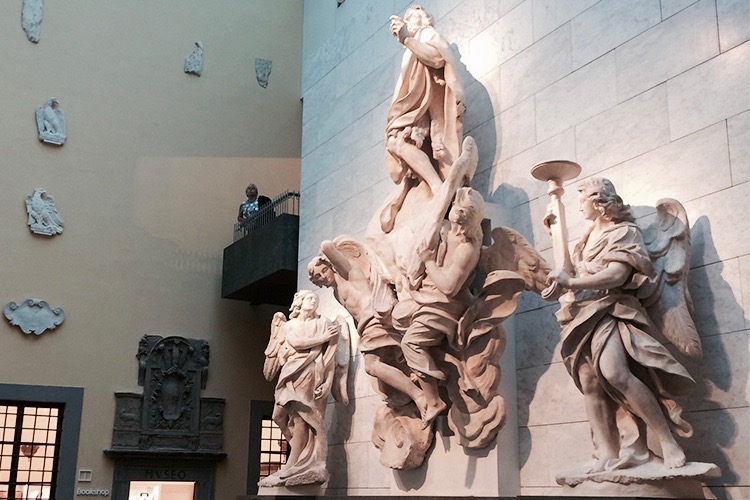
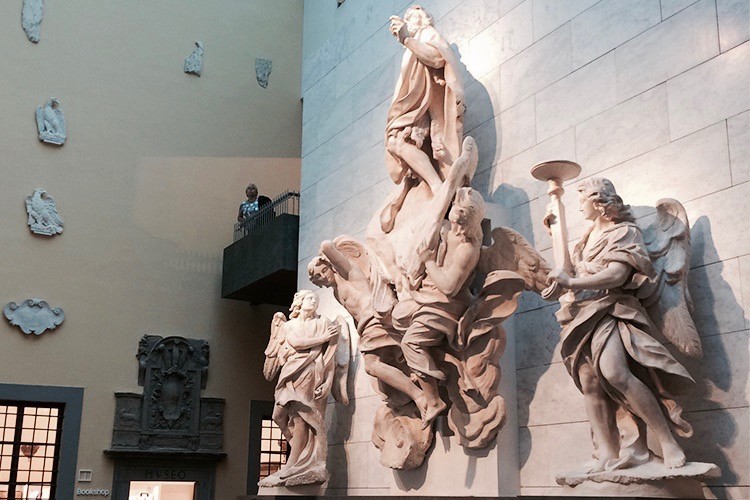
A surely breathtaking instance is entering the room housing the original facade design of Santa Maria del Fiore. Having to cut four meters from either side to fit into the exhibit, the rendition holds in place replicated statues in their original positions. However, the original statues are placed at ground level directly underneath the replicated version. This placing is intended to offer the viewer an up close perspective of the body of work in its natural, original form – while respecting the perspective of placement high-up on the facade. The Museo hopes to give off two different observations to understand the artists’ creations.
You will definitely have to take a few steps back to admire the facade’s structure completely, but if you step back too many times, you might run into Ghiberti’s bronze Gates to Paradise. The first set of doors engineered by the young artist at the time, in his early 20s, are displayed in glass protectors, adding an even more ‘heavenly’ appeal. The story goes, Ghiberti beat out Brunelleschi in a competition to sculpt the doors for the Battistero (Baptistry). Supposedly Brunelleschi gave up sculpting due to this and went into architecture. Why are they called the Gates to Paradise, you ask? This other story goes that later on in time Michelangelo walked up to them and at first site declared them the doors to heaven. The doors in turn inspired the young Michelangelo to become a sculptor.
Finally, you enter the Pietà room. On display, isolated on one side of this room, though in its full glory, you come across an original Michelangelo masterpiece. Not to be confused with La Pietà, the statue situated in St. Peter’s in Rome, but Pietà Bandini. An equally remarkable piece of work, with an interesting analysis. Michelangelo wanted this sculpture to dress his tomb, in Rome, where he planned to be buried. As you may know, Michelangelo is buried in Florence instead. An old Michelangelo was so keen to perfect this piece, that in the end he forgot one major component to most human forms. One of the legs of Christ is missing entirely in the sculpture. The extremely informed and witty director of the Museo dell’Opera del Duomo, Monsignor Verdon, synthesized in one of his own papers on the subject, that Michelangelo had spent all of his life being the best and creating the most amazing, perfect works of art. But by the time he reached an old age, he had began to question his entire life’s work and wondered if he had lived a life of any real worth. Indirectly, his art suffered under this mindset and this statue now famously represents Michelangelo’s own tribute to his death.
These are just a few of the stories waiting to be heard while visiting Museo dell’Opera del Duomo. Never settle for the work of art itself, but alway seek to understand where is came from and how exactly it came to be what it is. The stories will not only humor you, but surely inspiration will find its way to you as well.
Find out how, when, and what to visit at the Opera del Duomo website (in English).
Tip: A special joint ticket for the current Palazzi Strozzi exhibition also includes entrance to the Opera del Duomo until January 24th!
See more of Florence at FUA’s FB, Instagram, and Twitter.