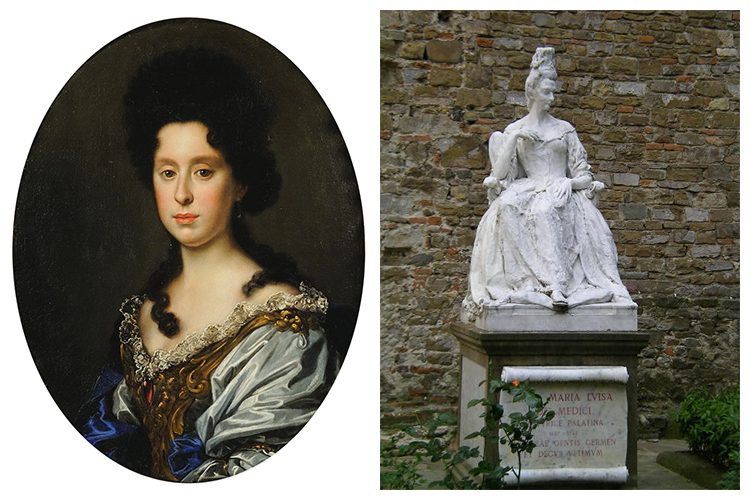
The Legacy of the “Wise Princess”


Photograph on right: by Sailko, distributed under a CC BY-SA 3.0 license

By Gregg Casazza

On the first Sunday of each month Florence opens up its museums free of charge, so why then were you able to stumble into the Uffizi on Feb. 18th without paying? You consult with your calendar, count back the weeks of the month, and are utterly stumped. Perhaps there was some mistake at the ticket counter, have you just snuck into one of the most famous museums in Italy? You hurry into the museum hoping no one will notice that you did not pay, completely unaware of this momentous anniversary.

Each year on this historic date, Feb. 18, the city of Florence remembers one of the most instrumental people in its history, Anna Maria Luisa de’Medici, by opening the Medici museums and tombs free for visitors. The last of the Medici’s, Anna Maria Luisa was a woman made of fire, steel, and an intense love for her country.

Sometimes referred to as “Principessa Saggia,” the wise princess, Anna Maria Luisa is the reason all of the art in Florence remains the property of the city. She was so wise that her own father thought that she would have made an excellent eldest son of the family, and tried to make arrangements for the Medici rule to be passed to Anna Maria Luisa in the case of her brother’s death. This was ultimately unsuccessful, and so after both her and her brother failed to produce heirs, and her brother passed away, Anna Maria Luisa was faced with a difficult decision. She realized something had to be done to ensure that the next family in line, the Lorraines, did not sell the many works of art for which Florence was and is famous for. She saw how this happened to another family which fell from power, the Gonzaga family in Mantua, and so she was determined to make sure this did not happen to Florence.

Anna Maria Luisa spearheaded this cause, and eventually created the Family Pact (Patto di Famiglia.) This formal legislature declared that the patrimony of the art must remain “ornaments of the state for the use of the public,” that would “attract the curiosity of foreigners.” This pact made it so that the art of Florence would forever remain in Florence. This single action ensured the longevity of the city, and has made Florence the destination that it is today. Anna Maria Luisa can be thanked for many things: tourism in Florence, the many museums and their works, music and theatre, and of course study-abroad. As a student, Florence is one of the greatest cities to study in, the universities and the culture offer an experience unlike anywhere else in the world, all because of Anna Maria Luisa.

Anna Maria Luisa is a figure unlike any other in history. Her sacrifices and dedication have made Florence what it is today; the birthplace of the Renaissance, as well as a destination for art enthusiasts and students all over the world. The legacy she left behind is the legacy of Florence as a whole, and although she is only remembered on Feb. 18, her impact can be seen every day in each street and each painting.

See more of Florence and Italy at FUA’s FB, Instagram, and Twitter.
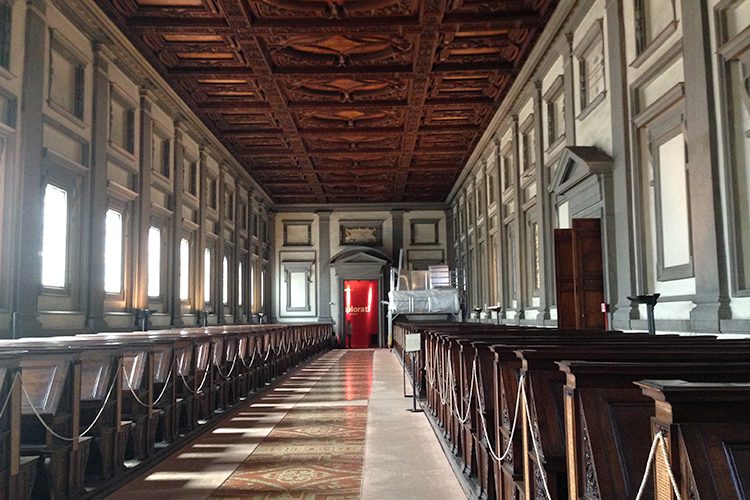
The Library of the Medici

Photo by the author

by Jessica Rowe

The Laurentian Library is one of Michelangelo’s lesser-known constructions. With its imposing entrance and beautiful stain glass windows, the space houses its treasures in perfect architectural harmony.

The Laurentian Library is part of the San Lorenzo Medicean Complex. Most people visit to see the Medici Chapel, the Basilica’s cellar of treasures, and the Chapel of Princes, where the Medici are buried. They miss the library entirely. But entering the Laurentian Library feels like walking into a work of art. Designed by and constructed under the watchful eye of Michelangelo, the library is considered one of the most unified works of Mannerism in Florence because the decorations were created during the building’s assembly. The grand staircase leads into a reading room filled with pews and stained glass windows.

The library is a cultural inheritance from the Medici family. The collection was started by Cosimo the Elder and his friend Niccolò Niccoli. The two of them shared a desire to collect ancient manuscripts and, when Niccoli died, he left his collection to Cosimo.

In 1494, the Medici family was banished from Florence and Cosimo’s collection was confiscated by the republican government to be added to the San Marco monastery’s library. The collection was later moved to Rome before returning to Florence once again in 1523. It was then that Michelangelo was commissioned to build a library to house the collection. The library was meant to signal that the Medici were no longer merchants but now members of the church and intelligent society. In 1571, still incomplete, the library was opened to scholars.

There are many architectural aspects of the building that break the rules of ancient architectural theory. For one, it is impossible to tell if the walls or the columns hold up the ceiling as the columns are imbedded in the walls themselves. Also, the staircase leading into the library is often said to seem too big for the space. Since proportions were very important to Renaissance architecture, historians believe that these stairs are the first sign that Michelangelo had intentionally turned away from tradition. The space allocated for the library was also limited before construction started as the monastic complex was already built. Still, the entrance vestibule, or ricetto, appears to mimic the human body, resembling skin pulled tight between vertical supports, which was believed to be the ideal form during the Renaissance.

Today, the Laurentian Library is considered the most important and prestigious collection of antique books in Italy. It contains more than 11 000 manuscripts and 4 500 early printed books, including the Codex Amiatinus which contains the earliest surviving manuscript of the Latin Vulgate Bible and fragments of the Erinna papyrus which contains poems of Sappho’s friend.

Laurentian Medici Library
Piazza San Lorenzo n° 9 – 50123 Firenze
Tesori inesplorati Exhibit
Open 15 February – 23 June 2017
Monday – Friday | 9.30 a.m. – 1.30 p.m.
www.bmlonline.it/en

See more of Florence at FUA’s FB, Instagram, and Twitter.