written by Kathleen Morris
This blog feature is an exclusive bonus installment to our Spring issue of Blending Magazine, honoring the never-ending legacy of Giancarlo Cauteruccio. After you finish reading, be sure to explore the rest of the magazine online—just follow this link to download the full Spring 2025 edition:
https://jschoolfua.com/images/BM/BM_151.pdf
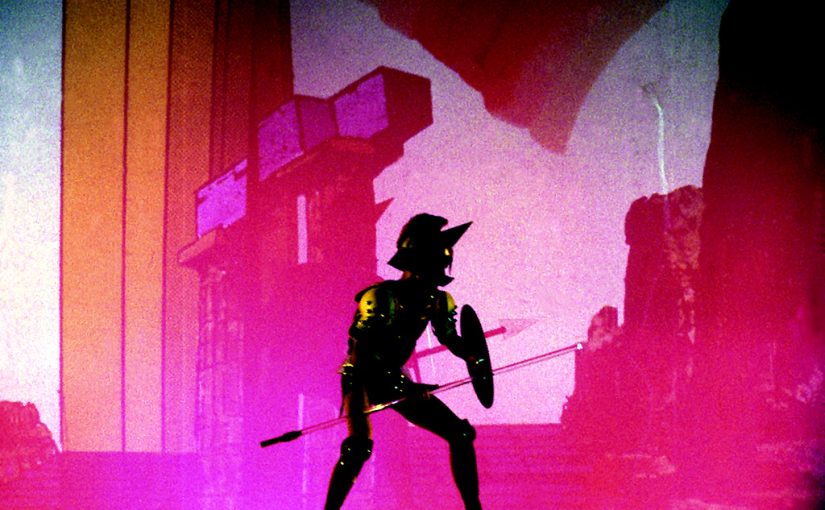
A video of a massive explosion serves as the opening backdrop for the latest production directed by Giancarlo Cauteruccio, capturing the audience’s attention as vibrant flames engulf a building.
The projector screen transitions to display a montage of troops entering battle, introducing visual motifs that reappear throughout “Il ritorno del soldato,” “The Return of the Soldier.”
The application of technology is a trademark of Cauteruccio’s theatrical style, harkening back to his roots as the founder and artistic director of Teatro Studio Krypton, located in Florence, Italy. The essence of Cauterrucio’s work can be summarized in a single word: innovation.
His show, which debuted this February at Teatro Aurora, located in Scandicci – a suburb of Florence, relies heavily on technical elements to underscore war’s toll on soldiers’ families. In his introductory speech, Cauteruccio warns audiences that it is “not going to be a fun night.” Still, he emphasizes the necessity of telling a story shrouded by darkness.
The tragedy portrayed within the script is echoed by the tragic origins of the playwright himself, Saverio Strati.
Strati, a writer from the Calabria Region, lived a life of poverty and did not receive recognition for the thousands of manuscripts he had written until after his death. To revive his legacy, the show was commissioned to celebrate the centenary of the writer’s birth.
Cauteruccio acknowledged his connection to Strati, explaining, “We found ourselves in the same peripheral city of Florence, a suburb without any identity. Today it has changed, thanks to the work done by artists who experienced it.”
Upon entering Teatro Aurora, Cauteruccio’s impact on the community is evident.
The lobby overflows with fans prepared to support his latest project. Following the show, a line forms once more. This time, patrons swarm Cauteruccio to personally offer praise for “Il ritorno del soldato.”
The love that Cauteruccio holds for the region, as evidenced by his willingness to recover Strati’s lost work, is matched by the enthusiasm of his audience in Scandicci.
For decades, Cauteruccio has demonstrated a fierce commitment to Florence’s art scene. He has distinguished himself as a changemaker, tirelessly pushing boundaries and actively defying artistic precedent to modernize the industry.
“At the end of the ‘70s, I began to understand that technological evolution would lead to a transformation,” he adds.
Since the ‘80s, he has played an influential role in redefining art practices in Florence. The establishment of Teatro Studio Krypton, founded by Cauterruccio and Pina Izzi in 1982, aligned with the awakening of the city’s avant-garde movement.
“We found ourselves amid the phenomenon of postmodernity,” Cauteruccio observes.
In collaboration with other artists, he created a new language built on the notion that the theatre is “a place of synthesis” where all art forms intersect.
“I set up a job there which looked predominantly at contemporaneity,” he shares. “It was a theater of research, experimentation, and innovation… that featured poets, musicians, philosophers and architects.”
As Florence’s underground scene blossomed in the 20th century, Cauteruccio’s embrace of radical creativity fueled a movement that created instrumental progress within and beyond the theatrical realm. Undeterred by the unknown, Cauteruccio launched a revolution driven by postmodernity and new spectacularity.
“I was led to strategic approaches in a contemporary way and an aesthetic that allowed the new generations to come into contact with a language that was previously taken for granted,” he describes.
Cauteruccio refined this approach at Krypton, replacing classical music with electronic sounds and introducing the laser beam to Europe’s theatrical sphere. By rejecting tradition while honoring the elegance of past practices, his work has garnered an “explosion of interest” for half a century.
His career transcends the stage, as he has authored several books and taught at universities across Italy and the United States. In every setting, Cauteruccio considers the influence of his emergence in “The Cradle of Renaissance.”
With a hint of reverence, he declared, “Florence was my true laboratory.”
Cauteruccio concludes with a thought about the synergistic relationship between artists and their audience – one is not complete without the other. Likewise, Florence’s underground art scene would not be complete without him. As a figurehead of progress and ingenuity, Cauteruccio’s efforts will endure and ignite a spark within the next generation of trailblazers.