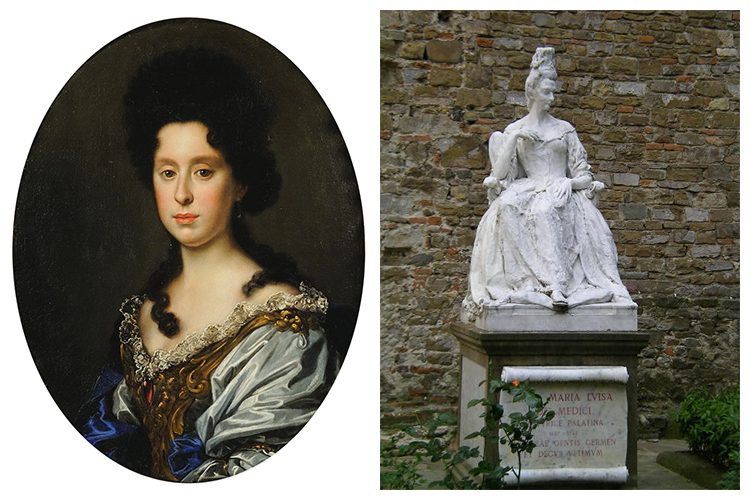
The Legacy of the “Wise Princess”


Photograph on right: by Sailko, distributed under a CC BY-SA 3.0 license

By Gregg Casazza

On the first Sunday of each month Florence opens up its museums free of charge, so why then were you able to stumble into the Uffizi on Feb. 18th without paying? You consult with your calendar, count back the weeks of the month, and are utterly stumped. Perhaps there was some mistake at the ticket counter, have you just snuck into one of the most famous museums in Italy? You hurry into the museum hoping no one will notice that you did not pay, completely unaware of this momentous anniversary.

Each year on this historic date, Feb. 18, the city of Florence remembers one of the most instrumental people in its history, Anna Maria Luisa de’Medici, by opening the Medici museums and tombs free for visitors. The last of the Medici’s, Anna Maria Luisa was a woman made of fire, steel, and an intense love for her country.

Sometimes referred to as “Principessa Saggia,” the wise princess, Anna Maria Luisa is the reason all of the art in Florence remains the property of the city. She was so wise that her own father thought that she would have made an excellent eldest son of the family, and tried to make arrangements for the Medici rule to be passed to Anna Maria Luisa in the case of her brother’s death. This was ultimately unsuccessful, and so after both her and her brother failed to produce heirs, and her brother passed away, Anna Maria Luisa was faced with a difficult decision. She realized something had to be done to ensure that the next family in line, the Lorraines, did not sell the many works of art for which Florence was and is famous for. She saw how this happened to another family which fell from power, the Gonzaga family in Mantua, and so she was determined to make sure this did not happen to Florence.

Anna Maria Luisa spearheaded this cause, and eventually created the Family Pact (Patto di Famiglia.) This formal legislature declared that the patrimony of the art must remain “ornaments of the state for the use of the public,” that would “attract the curiosity of foreigners.” This pact made it so that the art of Florence would forever remain in Florence. This single action ensured the longevity of the city, and has made Florence the destination that it is today. Anna Maria Luisa can be thanked for many things: tourism in Florence, the many museums and their works, music and theatre, and of course study-abroad. As a student, Florence is one of the greatest cities to study in, the universities and the culture offer an experience unlike anywhere else in the world, all because of Anna Maria Luisa.

Anna Maria Luisa is a figure unlike any other in history. Her sacrifices and dedication have made Florence what it is today; the birthplace of the Renaissance, as well as a destination for art enthusiasts and students all over the world. The legacy she left behind is the legacy of Florence as a whole, and although she is only remembered on Feb. 18, her impact can be seen every day in each street and each painting.

See more of Florence and Italy at FUA’s FB, Instagram, and Twitter.
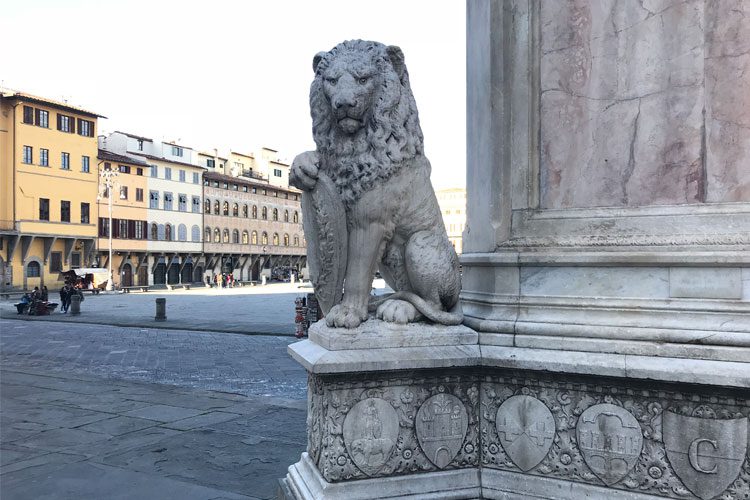
Florence’s Marzocco Lion

Photo by Author

By Kellie Bessette

Florence is covered with many versions of the Marzocco lion that date back to the Middle Ages. The Marzocco lion is the animal symbol of the free Republic of Florence.

While there are no real lions hunting the streets of Florence, statues of lions have been seen around the historic city center since the Middle Ages. The Marzocco lion, also known as the heraldic lion, is a symbol representing the free Republic of Florence. The Republic chose a lion not only because lions are a universal symbol for strength, but because they are able to tear apart eagles, which is the symbol of imperial power.

During the Middle Ages, it was not uncommon for nobles to present each other with exotic gifts. By the fifteenth century, as many as 24 lions were kept in cages behind Palazza Vecchio, or what is now Via dei Leoni. According to legend, one of the lions escaped and snatched a child during the reign of the Primo Popolo. The lion gave the child back to it’s mother unharmed and was dubbed a symbol of good luck for the people of Florence.

The most famous Marzocco was sculpted by Donatello in 1418 and was originally installed at Santa Maria Novella for Pope Martin V. The piece was later moved to Piazza Della Signoria in 1812. The lion is seated protecting the red fleur de lis, the coat-of-arms of Florence. The lion’s eyes are wise and the body is lifelike. Within the same piazza, two large lions guard the entrance to the Loggia dei Lanzi.

Another spotting of the Marzocco lion is located at Piazza Santa Croce at the Statue of Dante. The Statue of Dante was created in 1865 to celebrate the poet’s 600th birthday. Four heraldic lions stand at each corner of the pedestal holding shields with the names of Dante’s works. With many more statues of the Marzocco lion, it is clear that this animal has such an important historic connection.

See more of Florence and Italy at FUA’s FB, Instagram, and Twitter.
Orto Botanico & La Specola: Venturing Away From Main Monuments

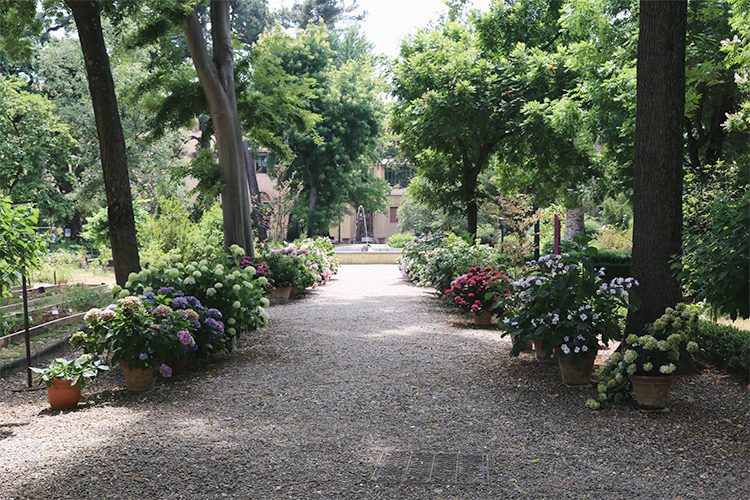
Orto Botanico, photo by the author

By Shelby Olson

As an intern, I had the opportunity to sneak away from the crowded monuments of Florence while still getting a taste of the history and culture. I visited the Giardino dei Semplici and Museo Zoologico La Specola and gained wonderful insight on what early Florence was like.

If you venture away from the main monuments in Florence, you will soon realize that Florence has much more to offer. Outside of the architecture and art, Florence presents its people and tourists alike, with beautiful gardens and museums. Being a visitor from a small town in the United States, this city has already shown its beautiful crafted and cultivated atmosphere in the span of three weeks. This past weekend, I had the opportunity to visit the Giardino dei Semplici and the Museo Zoologico La Specola. Not only are both of these places beautiful, interesting, and free of crowds, but they cost much less than the main points of interest in Florence.

First, I visited the Giardino dei Semplici which was founded in 1545 by the Medici family for medicinal research. The garden is 23,000 square metres but it is divided into smaller and larger avenues and is home to medicinal plants, flowers, spices, trees, etc. The garden contains both a greenhouse and hothouse used to cultivate special plants and the hothouse is one of the largest in Italy. The hothouse takes special care of tropical plants that have been used in both food and medicinal products.

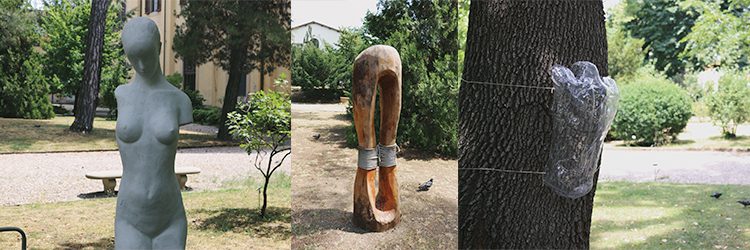
Art at the garden, photos by the author

Plants and flowers are not the only thing the garden has to offer. When I first walked in, my attention was directed towards the large fountain placed in the middle of the garden. The farther I ventured into the garden, the more art pieces I came across such as a statue of a woman, female figures placed on trees, and a wooden sculpture. Although the garden is famous for its medicinal plants, the art within the garden is not something to brush aside.

Next, I ventured to the Museo Zoologico La Specola which immediately caught my eye when I was looking up things to do in Florence, pre-arrival. The Museo Zoologico La Specola was started by the Medici family and is now the oldest public museum in Europe. The museum is made up of 34 rooms; 24 rooms are dedicated to zoology, consisting of taxidermy specimens and the other 10 rooms are dedicated to wax modeling, consisting of anatomical waxworks started by Ludovico Cigoli.

The zoology rooms are best known for the hippopotamus, which used to live in the Boboli gardens and was later donated to the museum. The waxwork rooms are known for displaying old-fashioned women with their ribcages and stomachs open for the public to see. Some of the most important pieces in the wax modeling rooms were created by Clemente Susini, one of the best Florentine wax modelers. His works are not limited to the Specola museum and can be seen in many other museums throughout the world.

I would highly recommend venturing out of the centre of Florence by visiting these two locations and getting a new taste of Florence’s history.

How to Visit:

Giardino dei Simplici: Via Pier Antonio Micheli, 3, 50121 Firenze
The Giardino dei Semplici ticket costs €3 and is open everyday except Wednesday, from 10AM-7PM.

Museo Zoologico La Specola: Via Romana, 17, 50125 Firenze
The Museo Zoologico La Specola ticket costs €5.50 for ages 6-18 and €9 for full price, along with discounts for families and groups. It is open Tuesday-Sunday from 10:30AM-5:30PM.

See more of Florence and Italy at FUA’s FB, Instagram, and Twitter.