The Political Undercurrents of Florence’s Futurism Movement and Its Impact in the Modern World
written by Susana Colunga
This blog feature is an exclusive bonus installment to our Spring issue of Blending Magazine. After you finish reading, be sure to explore the rest of the magazine online—just follow this link to download the full Spring 2025 edition:
https://jschoolfua.com/images/BM/BM_151.pdf
Florence has long been known as the cradle of the Renaissance, a symbol of classical beauty and deep cultural tradition. But by the 20th century, the city; like much of Italy, was ready for a leap into modernity. This transformation came with the rise of Futurism, one of the most radical and revolutionary artistic movements of the time.
Founded by Filippo Tommaso Marinetti on February 20, 1909, Futurism challenged Italy’s cultural conservatism and aligned itself with bold political change. The movement rejected traditional ideologies like conservatism, liberalism, and socialism, instead celebrating a new vision that emphasized speed, innovation, violence, and the power of the individual.
Futurism aimed to destroy the past in order to build a new, dynamic future.
The movement began with Marinetti’s Manifesto of Futurism, a provocative call to artists around the world to embrace modernity and abandon outdated ways of thinking. It inspired creatives and politicians alike, offering a blueprint for revolution and renewal. For Futurists, artists were not just visionaries they were leaders, responsible for reshaping the political and cultural landscape.
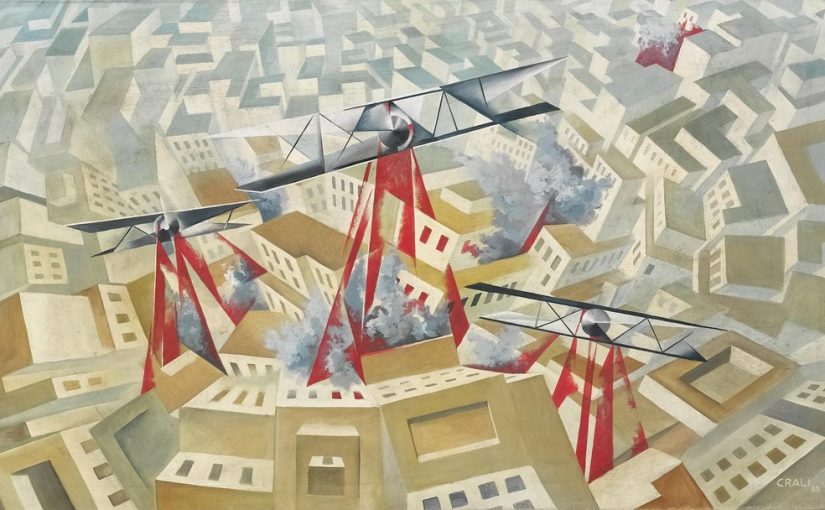
In Florence, Futurism quickly aligned with the rise of Fascism and the political career of Benito Mussolini. As Marinetti publicly supported Mussolini, many Futurist artists followed, embracing violence and destruction as necessary tools for building a new world. Their art reflected this ideology through militaristic and nationalistic themes, visible in poetry, posters, and especially painting. In his manifesto, Marinetti famously called war “the world’s only hygiene.”
The relationship between Futurism and Fascism intensified during World War I. Marinetti and his followers supported Italy’s entry into the war, and some even volunteered to fight.
However, rather than ushering in the radical transformation they envisioned, the war left Italy politically and economically devastated. This collapse only deepened the Futurists’ desire to rebuild a powerful, modern nation.
In 1919, Futurists carried out one of their most notorious acts: the burning of the socialist newspaper Avanti! in Milan. Led by Marinetti, the group set fire to the newspaper’s offices, seeing it as a symbolic act of defiance and alignment with Fascist ideals. Their commitment to political violence only grew, and by the March on Rome in 1922, which brought Mussolini to power, many Futurists believed they had finally achieved the society they had long imagined. But over time, Fascism became more institutionalized and authoritarian, drifting away from the chaotic, revolutionary energy of Futurism. Eventually, the two movements diverged, with Fascism absorbing some Futurist aesthetics but abandoning its more radical artistic ideals.
Still, Futurism’s legacy didn’t disappear. In the 1970s and 1980s, its influence reappeared in various political and artistic movements, particularly through its aesthetic and ideological emphasis on dynamism and transformation. One example is the Italian Autonomia
Movement of the 1970s, a radical leftist collective of students and workers who rejected both capitalism and communism. Their use of bold typography, manifestos, and dynamic visual styles clearly echoed Futurist strategies. Elements of Futurist design found their way into underground magazines, protest posters, and political demonstrations.
Similarly, radical architecture groups such as Superstudio and Archizoom (active from the 1960s to 1980s in Florence) embraced Futurist ideals of destruction and renewal. Their futuristic designs, filled with utopian and dystopian visions, critiqued capitalist consumer culture and proposed bold alternatives to conventional architecture. These movements emerged from Florence’s long-standing tradition of underground intellectual exchange, dating back to the literary cafes of the 19th century, where artists challenged the dominant norms of their time.
Futurism was more than an art movement, it was a cultural and political force that left a lasting imprint on Florence, Italy, and beyond. From its revolutionary beginnings to its entanglement with Fascism, and later its echoes in radical protests and design, Futurism showed how deeply political ideology can shape artistic expression. Even today, we can trace the movement’s legacy in the ways artists challenge norms and imagine new futures, often in the same underground spaces where past movements once thrived.